
An Introduction to Graph Theory BY DR DALVINDER
An Introduction to Graph Theory BY DR. DALVINDER SINGH GOVT. COLLEGE ROPAR
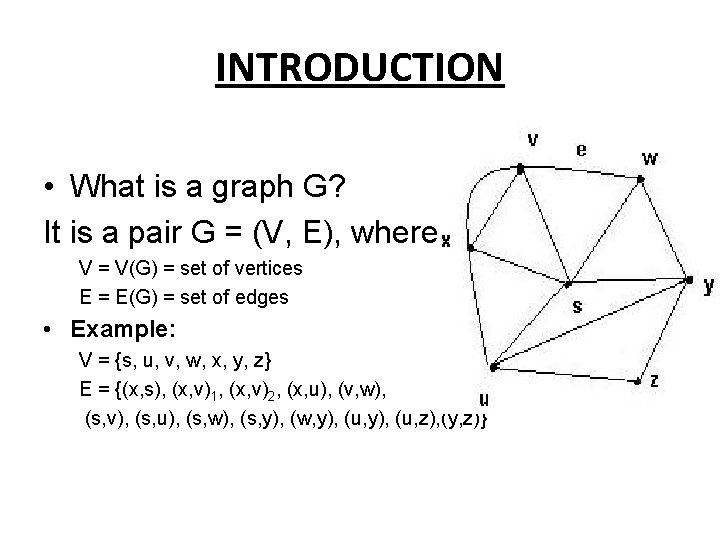
INTRODUCTION • What is a graph G? It is a pair G = (V, E), where V = V(G) = set of vertices E = E(G) = set of edges • Example: V = {s, u, v, w, x, y, z} E = {(x, s), (x, v)1, (x, v)2, (x, u), (v, w), (s, v), (s, u), (s, w), (s, y), (w, y), (u, z), (y, z)}
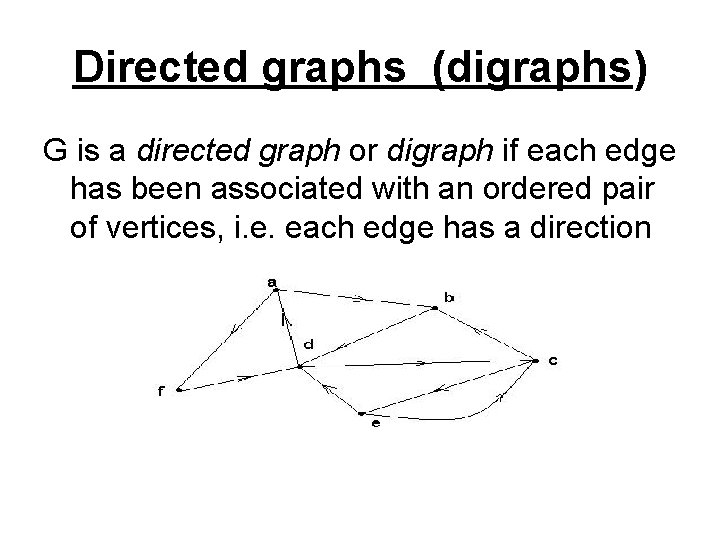
Directed graphs (digraphs) G is a directed graph or digraph if each edge has been associated with an ordered pair of vertices, i. e. each edge has a direction
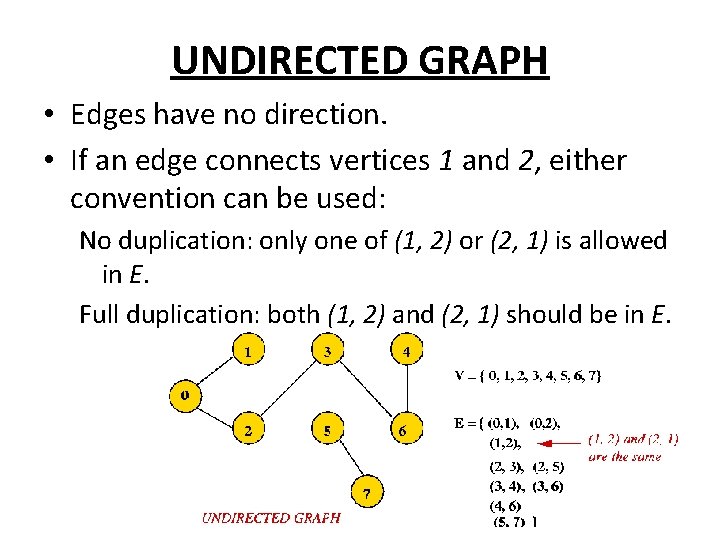
UNDIRECTED GRAPH • Edges have no direction. • If an edge connects vertices 1 and 2, either convention can be used: No duplication: only one of (1, 2) or (2, 1) is allowed in E. Full duplication: both (1, 2) and (2, 1) should be in E.
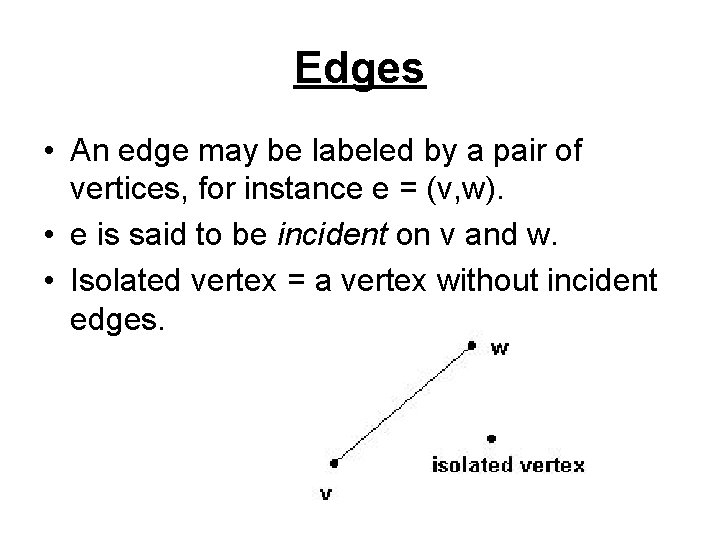
Edges • An edge may be labeled by a pair of vertices, for instance e = (v, w). • e is said to be incident on v and w. • Isolated vertex = a vertex without incident edges.
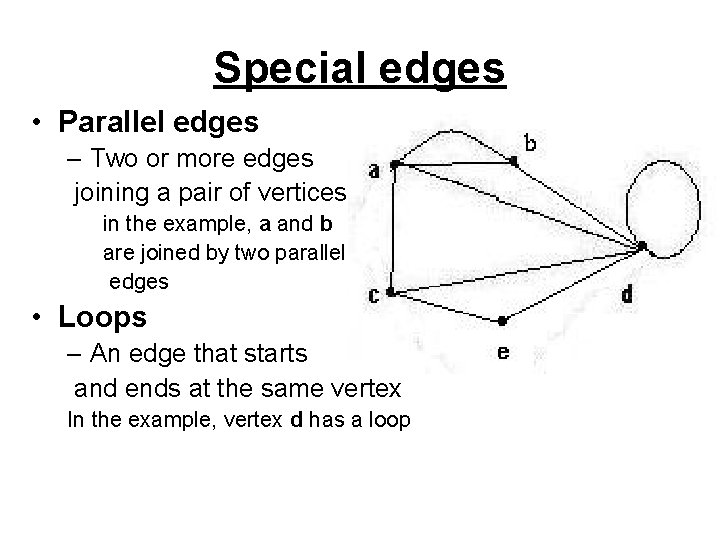
Special edges • Parallel edges – Two or more edges joining a pair of vertices in the example, a and b are joined by two parallel edges • Loops – An edge that starts and ends at the same vertex In the example, vertex d has a loop
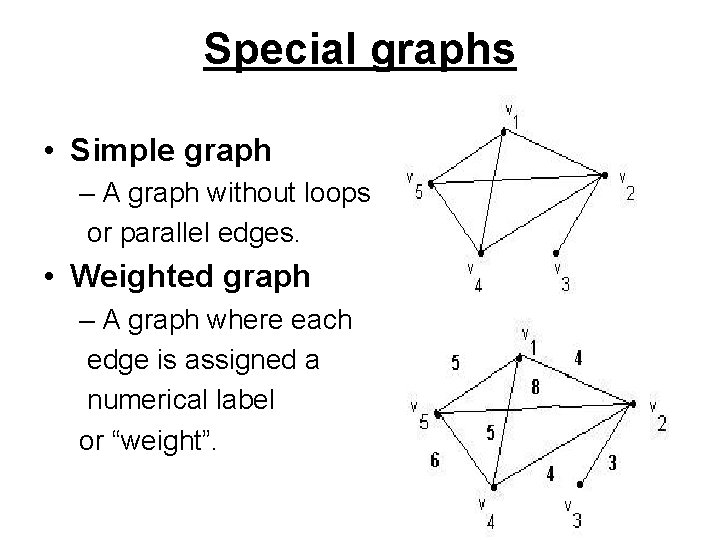
Special graphs • Simple graph – A graph without loops or parallel edges. • Weighted graph – A graph where each edge is assigned a numerical label or “weight”.
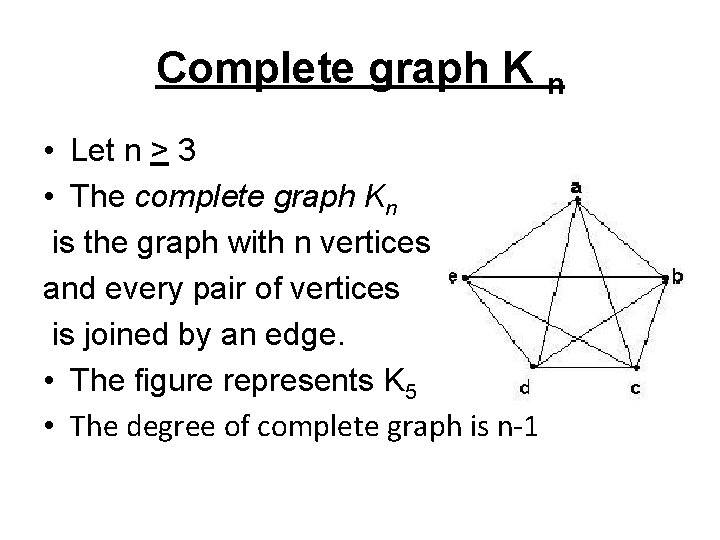
Complete graph K n • Let n > 3 • The complete graph Kn is the graph with n vertices and every pair of vertices is joined by an edge. • The figure represents K 5 • The degree of complete graph is n-1
FINITE AND INFINITE GRAPH • A graph G = ( V, E ) is called a finite graph if the vertex Set V is finite set. • A graph G = ( V, E ) is called an infinite graph if the vertex Set V is an infinite set.
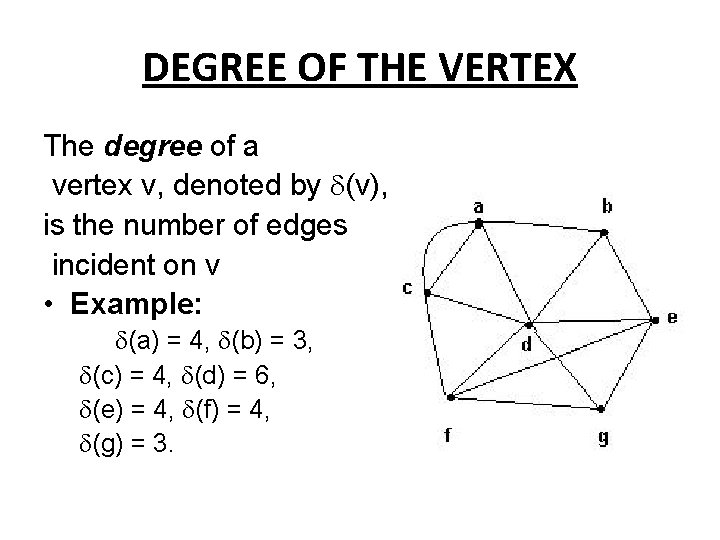
DEGREE OF THE VERTEX The degree of a vertex v, denoted by (v), is the number of edges incident on v • Example: (a) = 4, (b) = 3, (c) = 4, (d) = 6, (e) = 4, (f) = 4, (g) = 3.
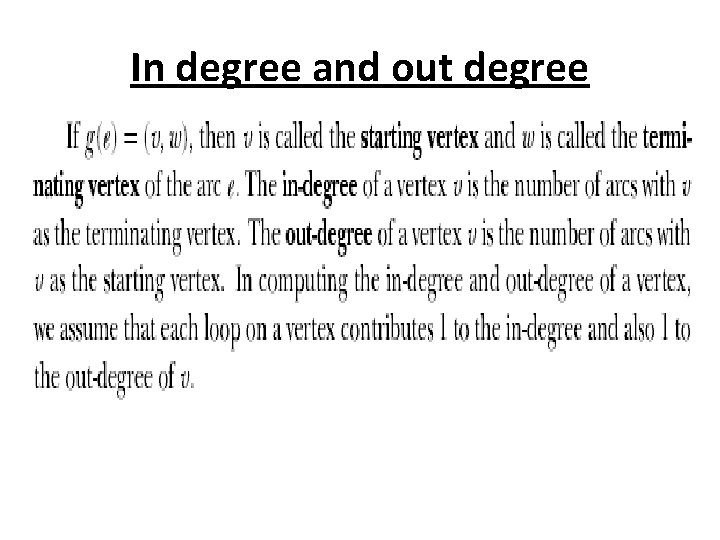
In degree and out degree
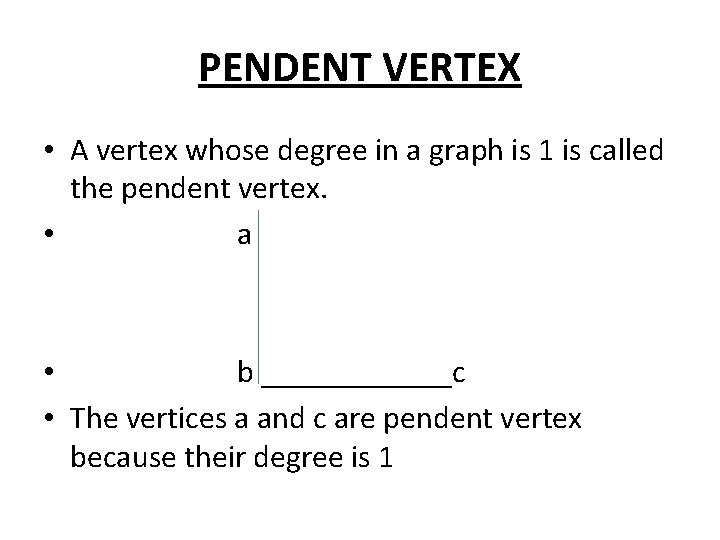
PENDENT VERTEX • A vertex whose degree in a graph is 1 is called the pendent vertex. • a • b ______c • The vertices a and c are pendent vertex because their degree is 1
DEFINATION • A Regular graph is a graph in which each vertex has the same degree • K- Regular graph is a graph in which each vertex has the same degree equal to k

for example
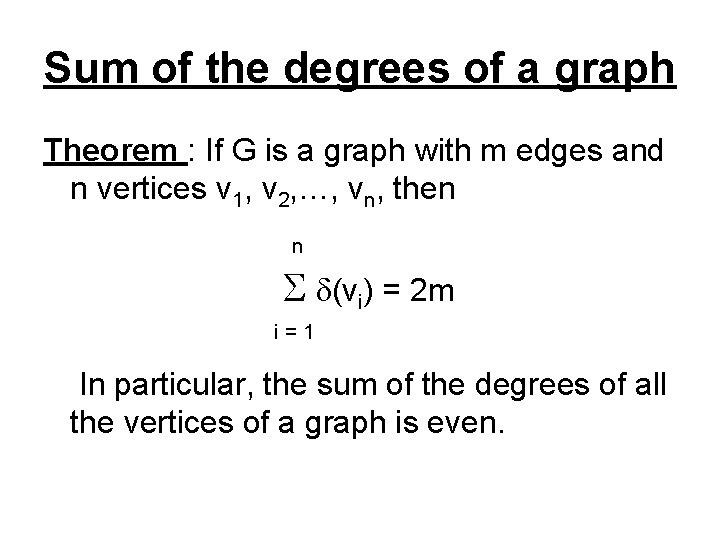
Sum of the degrees of a graph Theorem : If G is a graph with m edges and n vertices v 1, v 2, …, vn, then n (vi) = 2 m i=1 In particular, the sum of the degrees of all the vertices of a graph is even.
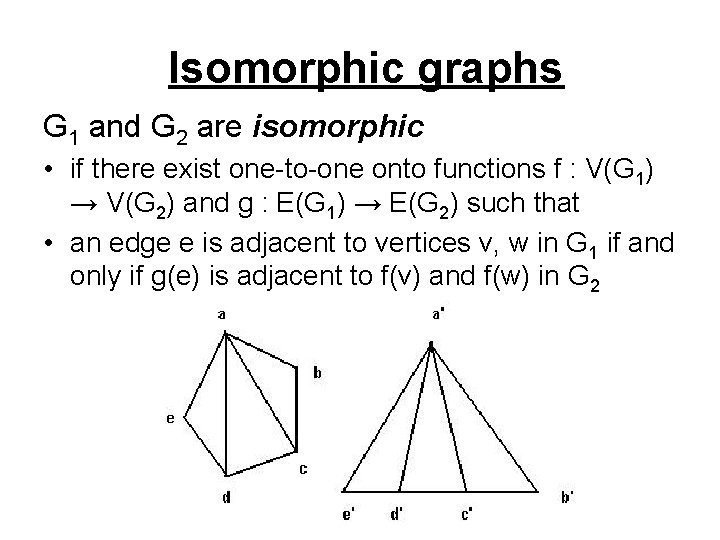
Isomorphic graphs G 1 and G 2 are isomorphic • if there exist one-to-one onto functions f : V(G 1) → V(G 2) and g : E(G 1) → E(G 2) such that • an edge e is adjacent to vertices v, w in G 1 if and only if g(e) is adjacent to f(v) and f(w) in G 2
Isomorphic Graphs • In other words , two graphs which are isomorphic will have • Same number of vertices • Same number of edges • An equal number of vertices with given degrees
Homeomorphic graphs • Two graphs G and G’ are said to be homeomorphic if G’ is obtained from G by a sequence of series reductions. – By convention, G is said to be obtainable from itself by a series reduction, i. e. G is homeomorphic to itself. • Define a relation R on graphs: GRG’ if G and G’ are homeomorphic. • R is an equivalence relation on the set of all graphs.
SUB GRAPH • Let G and H be two graphs with vertex sets V(H), V(G) and edge sets E(H) and E(G) respectively such that V(H) is contained in V(G) and E(H) is contained in E(G) , then we call H as a Subgraph of G ( or G as a supergraph of H )
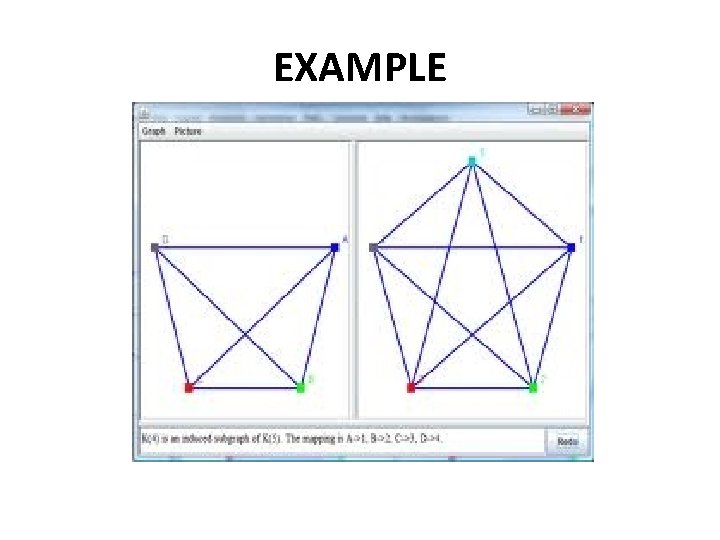
EXAMPLE
G-V GRAPH • G-V is a subgraph of G obtained by deleting the vertex V from the vertex set V(G) and deleting all the edges in E(G)which are incident on V • REMARK: • Every graph is its own subgraph • The null graph obtained from G by deleting all the edges of G is a subgraph of G

Walks, Paths, and Cycles
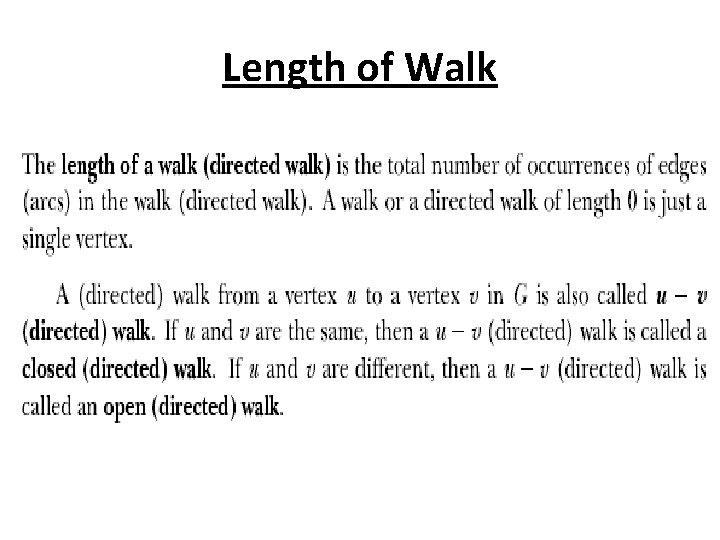
Length of Walk
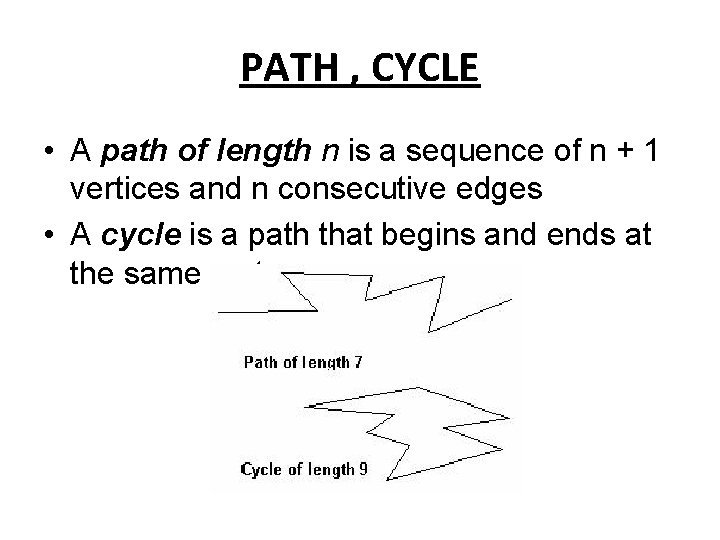
PATH , CYCLE • A path of length n is a sequence of n + 1 vertices and n consecutive edges • A cycle is a path that begins and ends at the same vertex
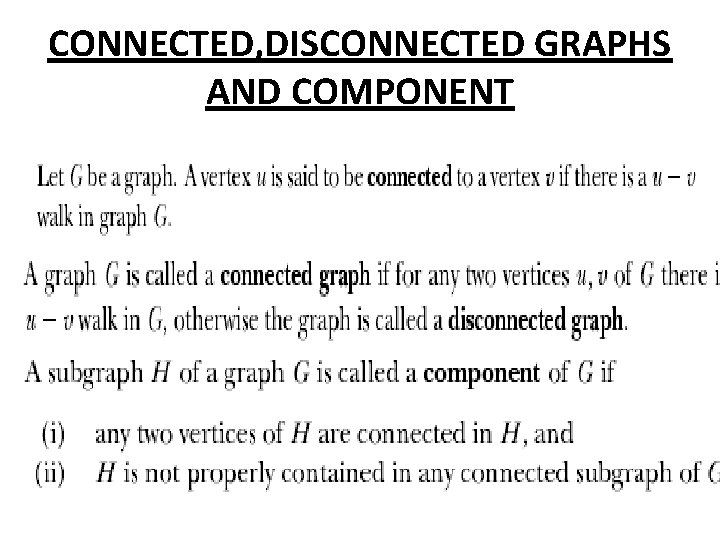
CONNECTED, DISCONNECTED GRAPHS AND COMPONENT
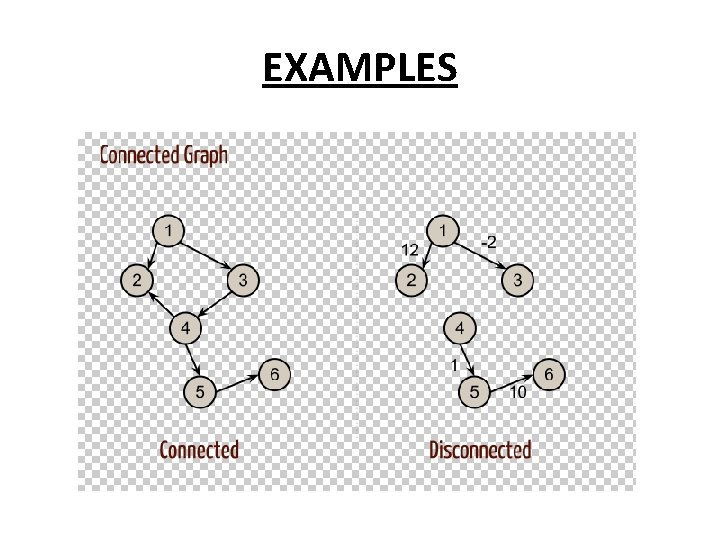
EXAMPLES
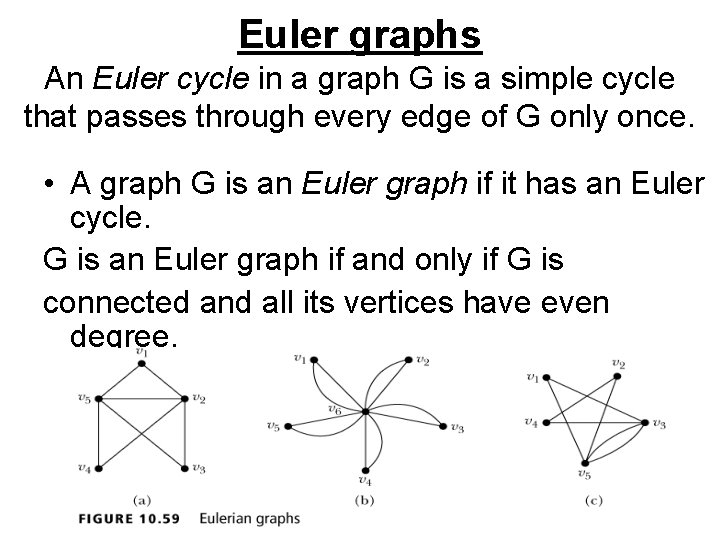
Euler graphs An Euler cycle in a graph G is a simple cycle that passes through every edge of G only once. • A graph G is an Euler graph if it has an Euler cycle. G is an Euler graph if and only if G is connected and all its vertices have even degree.
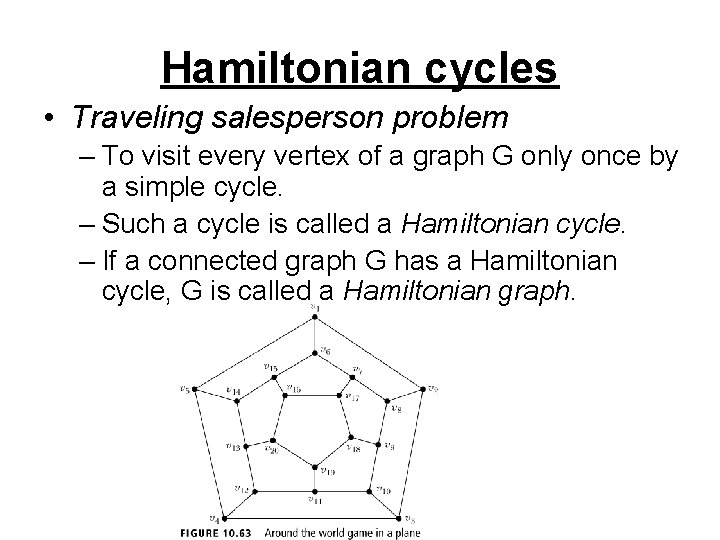
Hamiltonian cycles • Traveling salesperson problem – To visit every vertex of a graph G only once by a simple cycle. – Such a cycle is called a Hamiltonian cycle. – If a connected graph G has a Hamiltonian cycle, G is called a Hamiltonian graph.
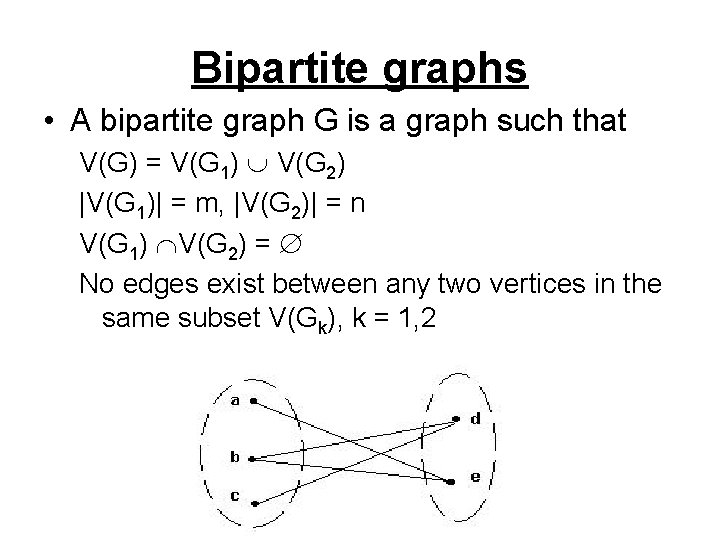
Bipartite graphs • A bipartite graph G is a graph such that V(G) = V(G 1) V(G 2) |V(G 1)| = m, |V(G 2)| = n V(G 1) V(G 2) = No edges exist between any two vertices in the same subset V(Gk), k = 1, 2
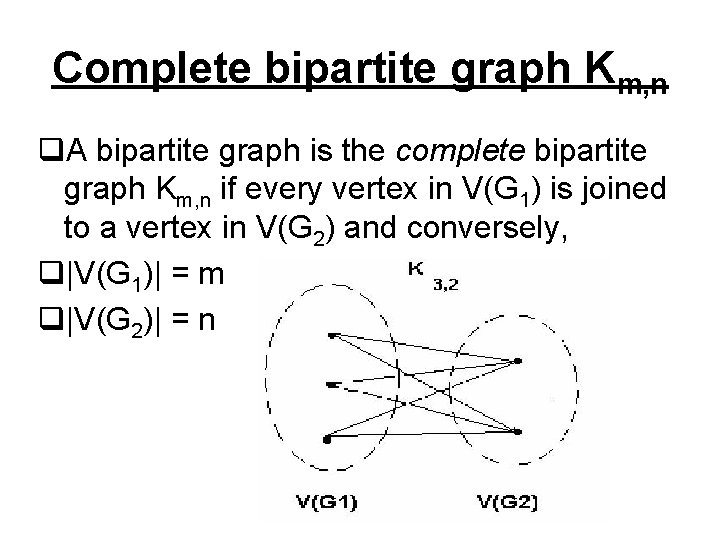
Complete bipartite graph Km, n q. A bipartite graph is the complete bipartite graph Km, n if every vertex in V(G 1) is joined to a vertex in V(G 2) and conversely, q|V(G 1)| = m q|V(G 2)| = n
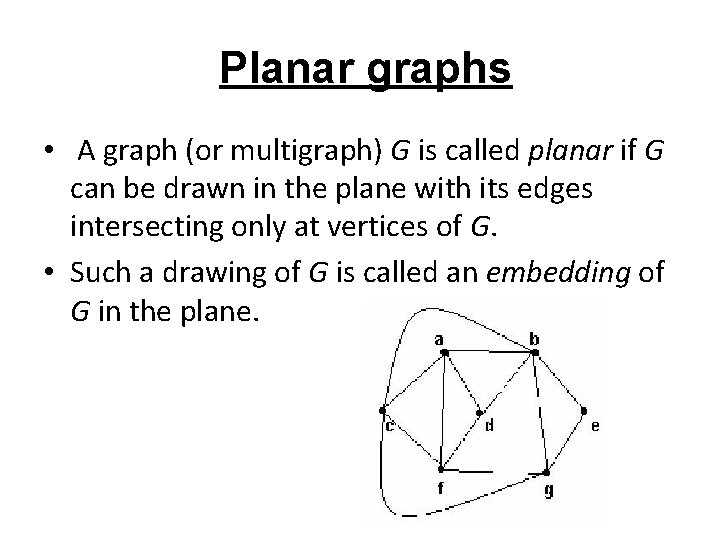
Planar graphs • A graph (or multigraph) G is called planar if G can be drawn in the plane with its edges intersecting only at vertices of G. • Such a drawing of G is called an embedding of G in the plane.
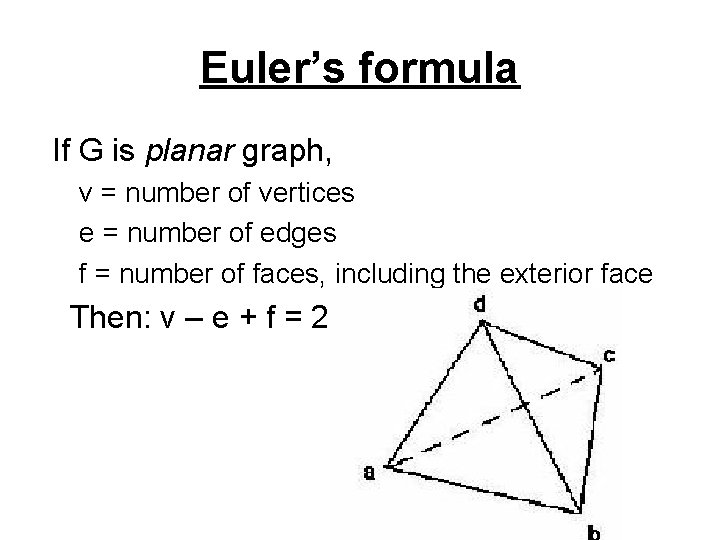
Euler’s formula If G is planar graph, v = number of vertices e = number of edges f = number of faces, including the exterior face Then: v – e + f = 2
Representations of graphs • Adjacency matrix Rows and columns are labeled with ordered vertices write a 1 if there is an edge between the row vertex and the column vertex and 0 if no edge exists between them
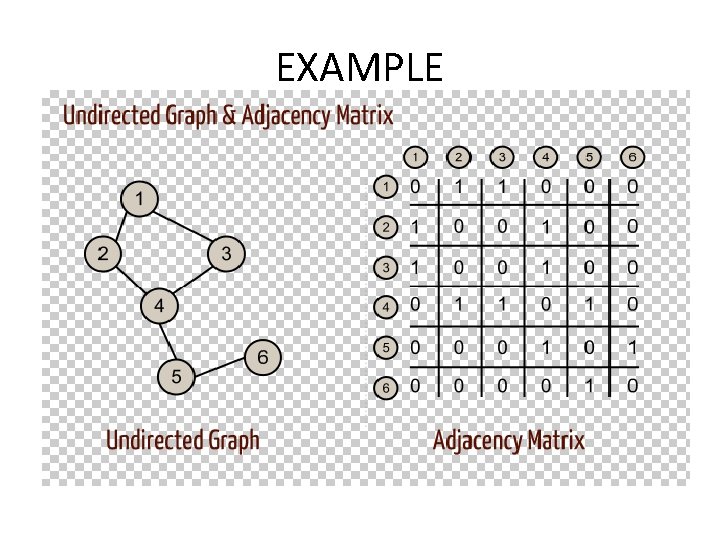
EXAMPLE
Incidence matrix • Incidence matrix – Label rows with vertices – Label columns with edges – 1 if an edge is incident to a vertex, 0 otherwise
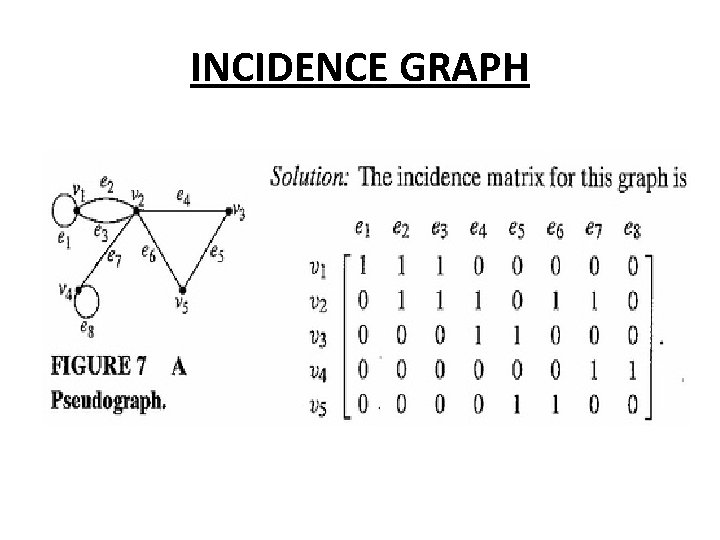
INCIDENCE GRAPH
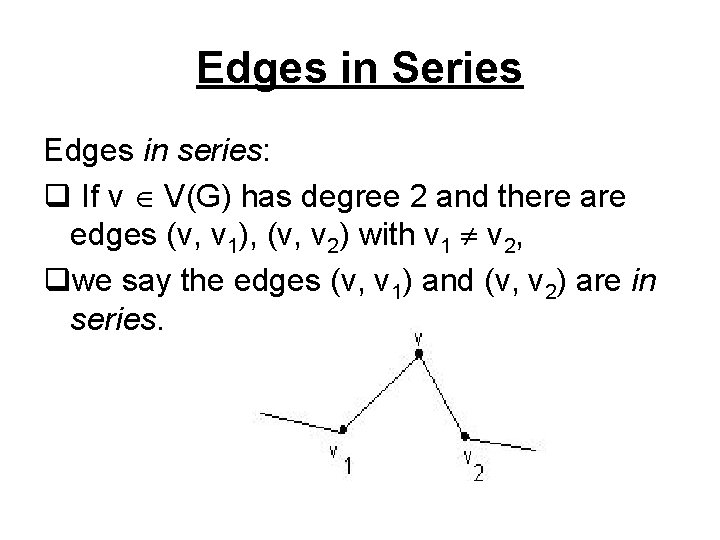
Edges in Series Edges in series: q If v V(G) has degree 2 and there are edges (v, v 1), (v, v 2) with v 1 v 2, qwe say the edges (v, v 1) and (v, v 2) are in series.
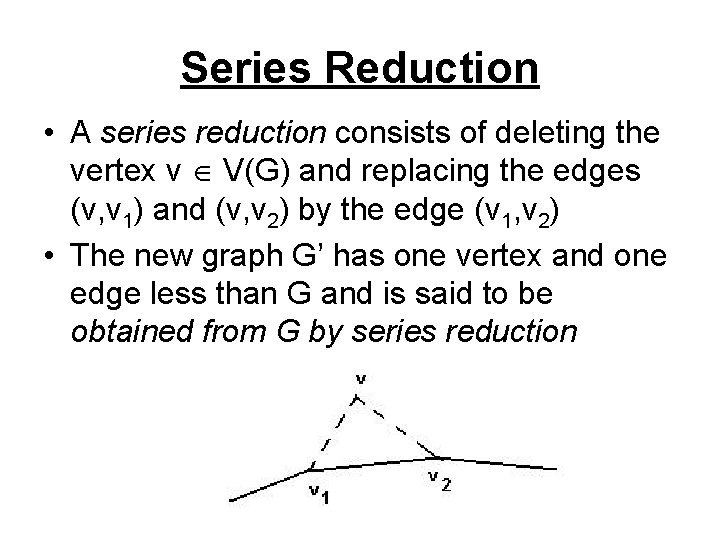
Series Reduction • A series reduction consists of deleting the vertex v V(G) and replacing the edges (v, v 1) and (v, v 2) by the edge (v 1, v 2) • The new graph G’ has one vertex and one edge less than G and is said to be obtained from G by series reduction
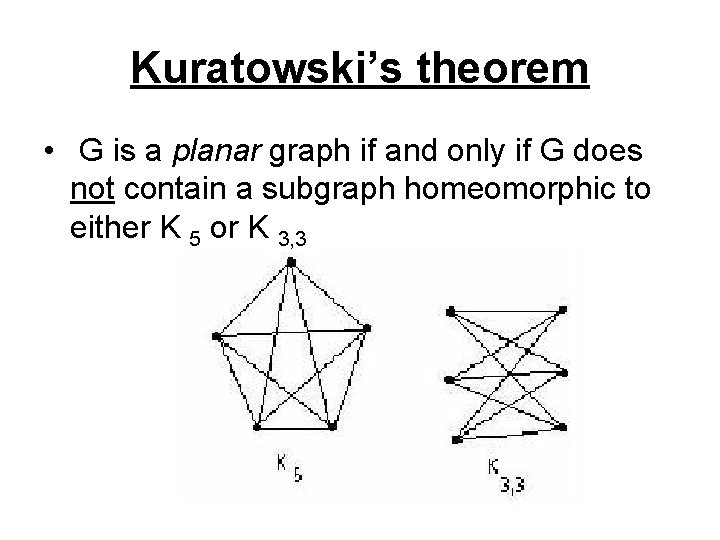
Kuratowski’s theorem • G is a planar graph if and only if G does not contain a subgraph homeomorphic to either K 5 or K 3, 3
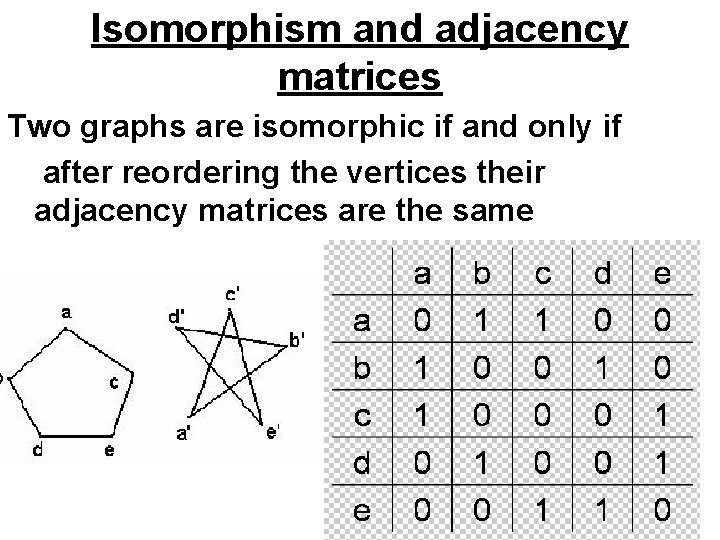
Isomorphism and adjacency matrices Two graphs are isomorphic if and only if after reordering the vertices their adjacency matrices are the same

THE END THANKS
- Slides: 41