
AN INTRODUCTION TO GENE EXPRESSION ANALYSIS BY MICROARRAY
AN INTRODUCTION TO GENE EXPRESSION ANALYSIS BY MICROARRAY TECHNIQUE (PART I) DR. AYAT B. AL-GHAFARI MONDAY 3 RD MUHARAM 1436
VOCABULARY • Gene: hereditary DNA sequence at a specific location on chromosome • Genetics: study of heredity & variation in organisms • Genome: an organism’s total genetic content (full DNA sequence) • Genomics: study of organisms in terms of their genome
VOCABULARY • Bioinformatics: the collection, organization, & analysis of large scale, complex biological data • Statistical bioinformatics: the application of statistical approaches to bioinformatics, especially in identifying significant changes (in sequences, expression patterns, etc. ) that are biologically relevant
THE BIOLOGY BACKGROUND OF MICROARRAY Ø The central dogma of molecular biology Ø DNA Ø RNA Ø Monitoring the expression of genes
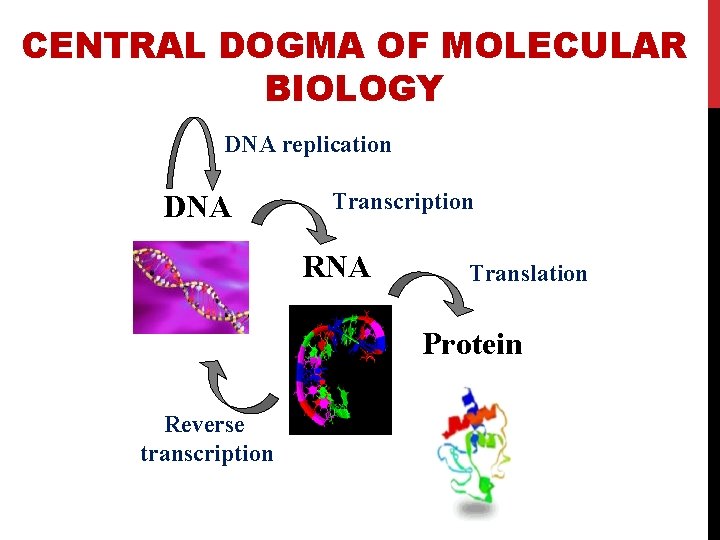
CENTRAL DOGMA OF MOLECULAR BIOLOGY DNA replication DNA Transcription RNA Translation Protein Reverse transcription
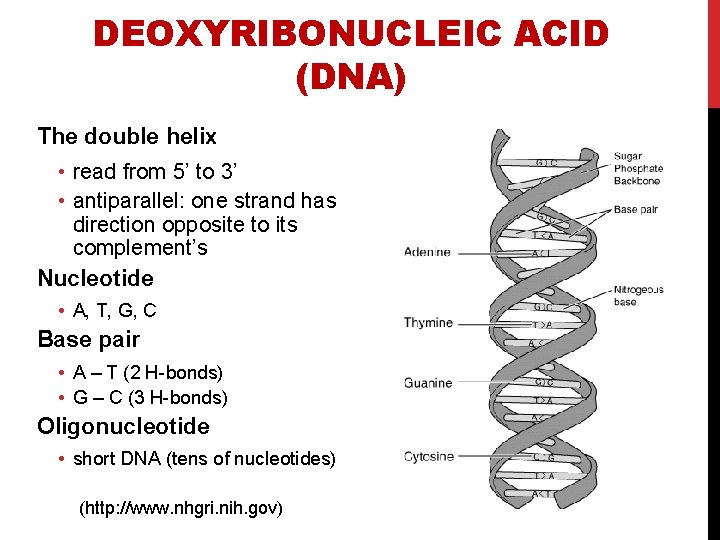
DEOXYRIBONUCLEIC ACID (DNA) The double helix • read from 5’ to 3’ • antiparallel: one strand has direction opposite to its complement’s Nucleotide • A, T, G, C Base pair • A – T (2 H-bonds) • G – C (3 H-bonds) Oligonucleotide • short DNA (tens of nucleotides) (http: //www. nhgri. nih. gov)
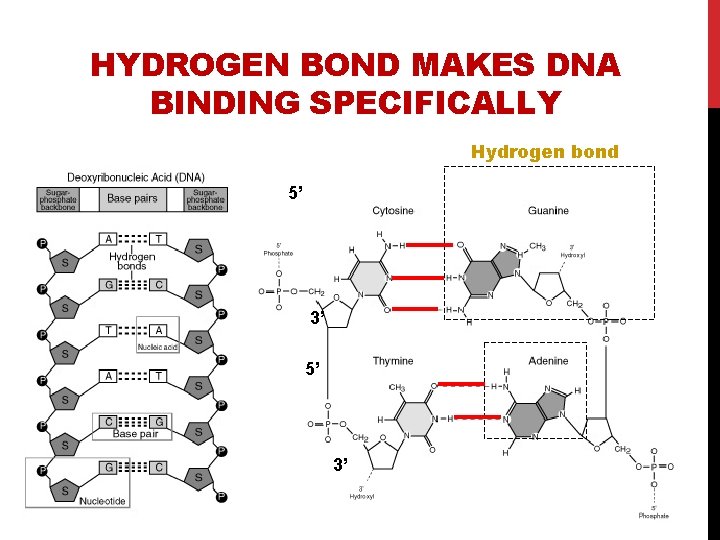
HYDROGEN BOND MAKES DNA BINDING SPECIFICALLY Hydrogen bond 5’ 3’
RIBONUCLEIC ACID (RNA) • RNA is much more abundant than DNA • There are several important differences between RNA and DNA: 1. The pentose sugar in RNA is ribose, in DNA it’s deoxyribose. 2. In RNA, uracil replaces the base thymine (U pairs with A). 3. RNA is single stranded while DNA is double stranded. 4. RNA molecules are much smaller than DNA molecules.
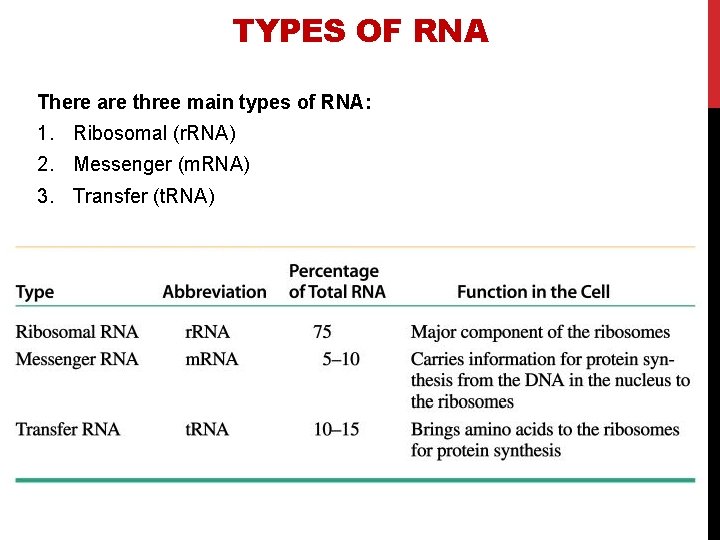
TYPES OF RNA There are three main types of RNA: 1. Ribosomal (r. RNA) 2. Messenger (m. RNA) 3. Transfer (t. RNA)
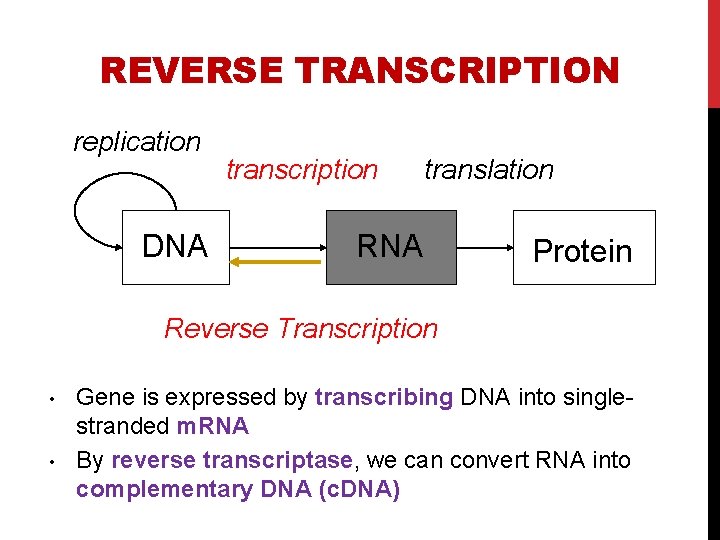
REVERSE TRANSCRIPTION replication DNA transcription translation RNA Protein Reverse Transcription • • Gene is expressed by transcribing DNA into singlestranded m. RNA By reverse transcriptase, we can convert RNA into complementary DNA (c. DNA)
MESSENGER RNA REPRESENT GENE FUNCTION • When measure the level of a m. RNA, we are monitoring the activity of a gene • Thus, if we can understand all the level of m. RNAs, we can study the expression of whole genome • Microarray takes the advantage of getting over 10000 of blotting data in a single experiment, which makes monitoring the genome activity possible
MICROARRAY • Microarray refers to types of massively parallel biological assays where many tests are done simultaneously • The word “Microarray” has become a general term, there are many types now • • • DNA microarrays Oligonucleotide microarrays Protein microarrays Transfection microarrays Tissue microarray
OLIGONUCLEOTIDE MICROARRAY (A) AN OVERVIEW • The abundance and constancy of proteins in a cell determine the functions of it. Thus, the function or activity of a gene is reflected by the synthesis of m. RNA (transcription) or protein (translation) • Microarrays represent a major technology in the field of molecular biology and medicine • Oligonucleotide microarray is also known as Affymetrix Gene. Chip Array or one color array • It has become a powerful technique in measuring gene expression levels (at a transcriptional level) in order to improve diseases diagnosis as well as to create new effective treatment regimens
OLIGONUCLEOTIDE MICROARRAY (B) THE IMPORTANCE §Understand the transcription level of gene(s) under different conditions such as: üCell types (brain vs. liver) üDevelopmental (fetal vs. adult) üResponse to stimulus (rich vs. poor media) üGene activity (wild type vs. mutant) üDisease states (healthy vs. diseased)
WHAT CAN WE LEARN BY ANALYZING COMPLEX PATTERNS OF GENE EXPRESSION? 1. Classifications: for diagnosis, prediction… • Cell-type • Stage-specific • Disease-related • Treatment-related patterns of gene expression 2. Gene Networks/Pathways: • Functional roles of genes in cellular processes? • Gene regulation and gene interactions
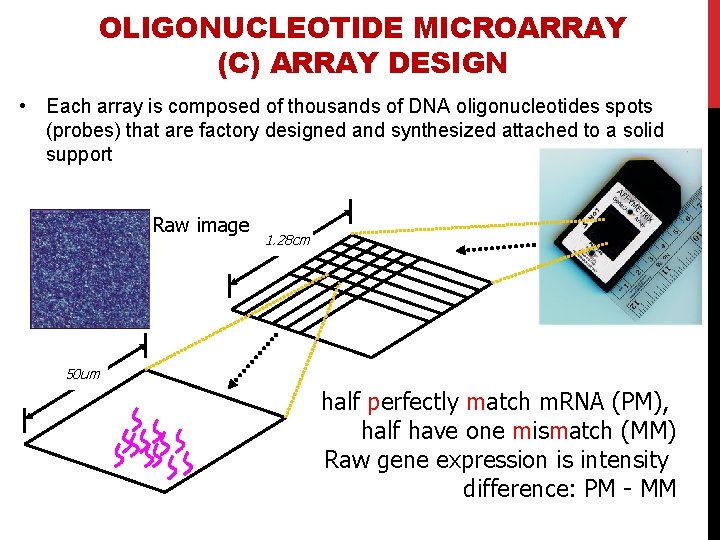
OLIGONUCLEOTIDE MICROARRAY (C) ARRAY DESIGN • Each array is composed of thousands of DNA oligonucleotides spots (probes) that are factory designed and synthesized attached to a solid support Raw image 1. 28 cm 50 um half perfectly match m. RNA (PM), half have one mismatch (MM) Raw gene expression is intensity difference: PM - MM
OLIGONUCLEOTIDE MICROARRAY (C) ARRAY DESIGN • Usually for each gene, (11 -25) pairs of probes are synthesized on the chip from the 3’ end of each transcript • Each pair of probes have two oligonucleotides: 1. Perfect match probe (PM) which has complete complementary sequence to the sequence of the reference 2. Mismatch probe (MM) has a single mismatch to the target sequence, centred in the middle of the nucleotide, usually nucleotide number 13 has been changed • The number of PM and MM probes used varied from array to another depending on specific performance criteria for each assay • In general, (MM) probes are used to minimize unspecific binding during hybridization (cross-hybridization)
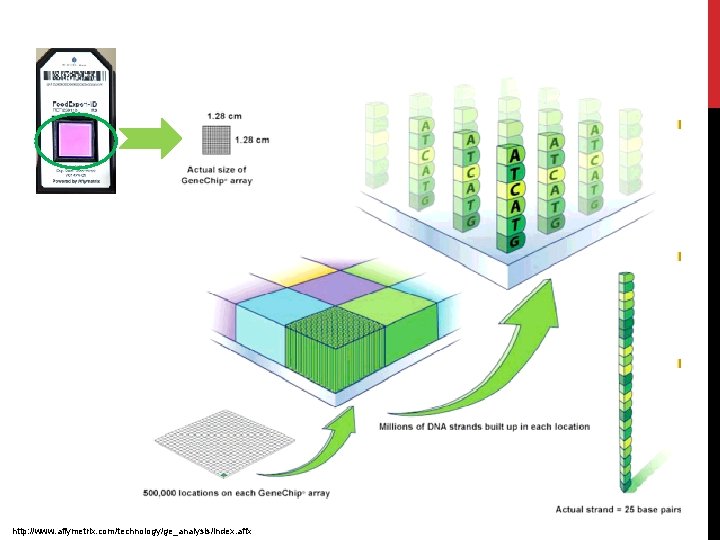
http: //www. affymetrix. com/technology/ge_analysis/index. affx

OLIGONUCLEOTIDE MICROARRAY (D) ADVANTAGES VS. DISADVANTAGES • Highly hygienic chips since these chips are synthesized by a photolithography process • Probes design is based entirely on sequencing information, there is no need for the physical intermediates such as bacterial plasmids or PCR products, which results in a minimum chance to create probes mix-up DISADVANTAGES • Highly cost to design certain chip • The need to access to expensive specialised equipment to run the analysis • Short sequence nucleotide probes may decrease the sensitivity of binding in comparing with DNA Microarray
OLIGONUCLEOTIDE MICROARRAY (E) QUALITY CONTROLS • Many factors or criteria should be involved in each array to ensure the ideal quality control and accuracy of the array such as: 1. The number of sample replicates 2. RNA isolation 3. RNA integrity number (RIN) 4. Microarray hybridization controls
OLIGONUCLEOTIDE MICROARRAY (E) QUALITY CONTROLS 1. The number of sample replicates v It varies from one species to another depending on the source of biological variability in the sample to be examined such as stage of disease 2. RNA isolation (quality and the quantity of RNA sample) v Many methods can be used to assess RNA quantity & quality: UV ratio of 260/280 (should be around 1. 8 -2. 1), Agarose gel electrophoresis or on Agilent Bioanalyzer to visualize the 18 s/28 s ribosomal subunits bands v RNA quantity should be ranged from 5 -10 µg to yield biotinylated complementary RNA (c. RNA) between 4 -10 fold greater than the total RNA sample used otherwise the sample could not be run on Affymetrix Gene. Chip Microarray
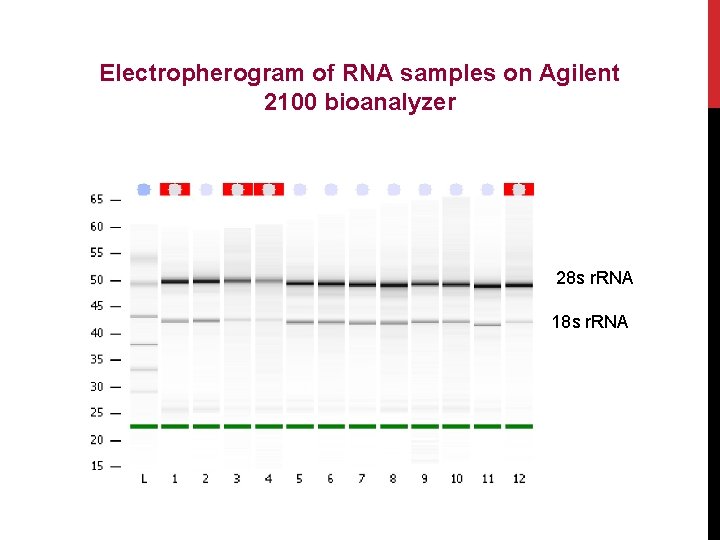
Electropherogram of RNA samples on Agilent 2100 bioanalyzer 28 s r. RNA 18 s r. RNA
OLIGONUCLEOTIDE MICROARRAY (E) QUALITY CONTROLS 3. RNA integrity number (RIN) v It is a measurement of RNA integrity and degradation ranges from 1 to 10, where 1 is the most degraded RNA and 10 is the most intact RNA v For Affymetrix Gene. Chip Microarray, RIN should be (≥ 6) 4. Microarray hybridization controls v Several hybridization controls including the visualization of the image are included to check any abnormalities in the hybridization patterns
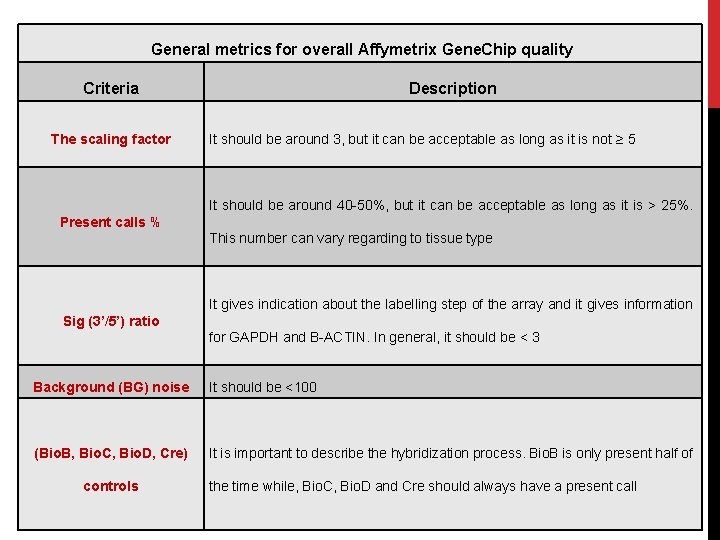
General metrics for overall Affymetrix Gene. Chip quality Criteria The scaling factor Description It should be around 3, but it can be acceptable as long as it is not ≥ 5 It should be around 40 -50%, but it can be acceptable as long as it is > 25%. Present calls % This number can vary regarding to tissue type It gives indication about the labelling step of the array and it gives information Sig (3’/5’) ratio for GAPDH and B-ACTIN. In general, it should be < 3 Background (BG) noise It should be <100 (Bio. B, Bio. C, Bio. D, Cre) It is important to describe the hybridization process. Bio. B is only present half of controls the time while, Bio. C, Bio. D and Cre should always have a present call
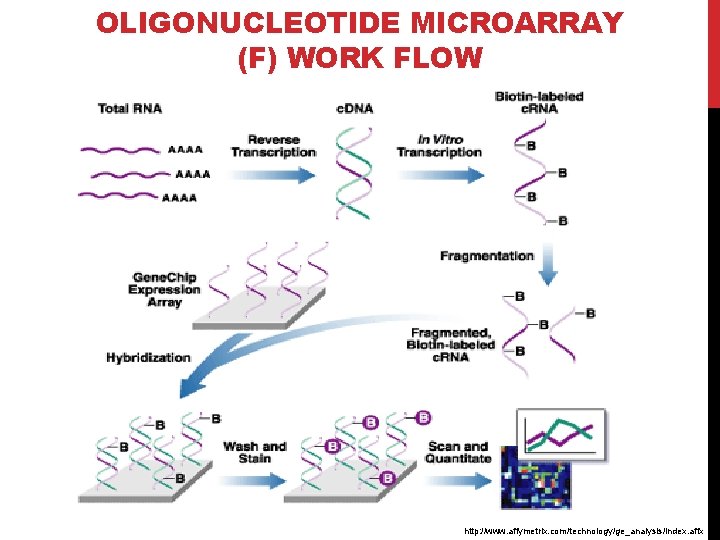
OLIGONUCLEOTIDE MICROARRAY (F) WORK FLOW http: //www. affymetrix. com/technology/ge_analysis/index. affx
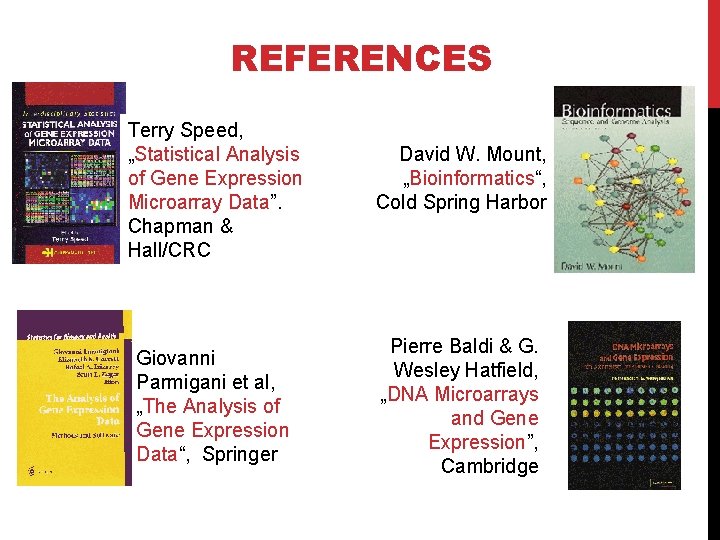
REFERENCES Terry Speed, „Statistical Analysis of Gene Expression Microarray Data”. Chapman & Hall/CRC Giovanni Parmigani et al, „The Analysis of Gene Expression Data“, Springer David W. Mount, „Bioinformatics“, Cold Spring Harbor Pierre Baldi & G. Wesley Hatfield, „DNA Microarrays and Gene Expression”, Cambridge

THANKS FOR YOUR ATTENTION ………
- Slides: 27