
An Introduction to Forensic Science Week 1 June
- Slides: 19
An Introduction to Forensic Science Week 1 June 23, 2020
Class Agenda □ What is Forensic Science? □ □ □ □ Organization of a Crime Laboratory Services of the Crime Laboratory Functions of the Forensic Scientist Other Forensic Science Services Deductive and Inductive Reasoning In Class Activity: Deductive Reasoning game Assignment: Deductive Reasoning worksheet
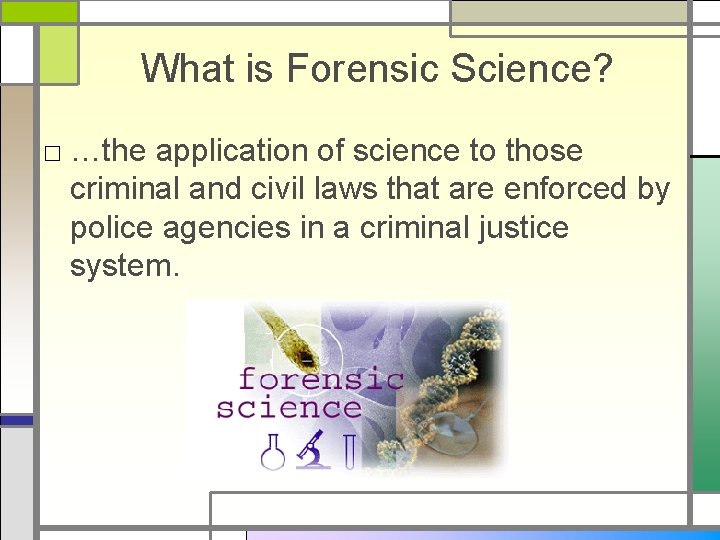
What is Forensic Science? □ …the application of science to those criminal and civil laws that are enforced by police agencies in a criminal justice system.
Forensic Science is… □ Applied Science □ Often called “criminalistics”
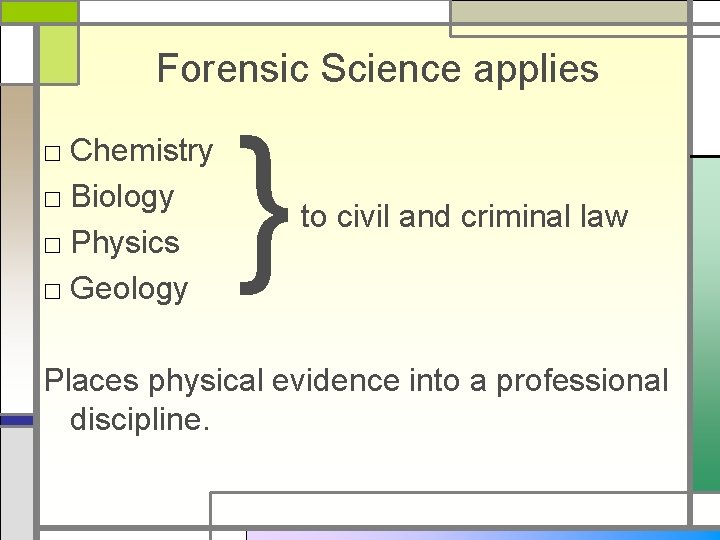
Forensic Science applies □ Chemistry □ Biology □ Physics □ Geology } to civil and criminal law Places physical evidence into a professional discipline.
Organization of a Crime Laboratory
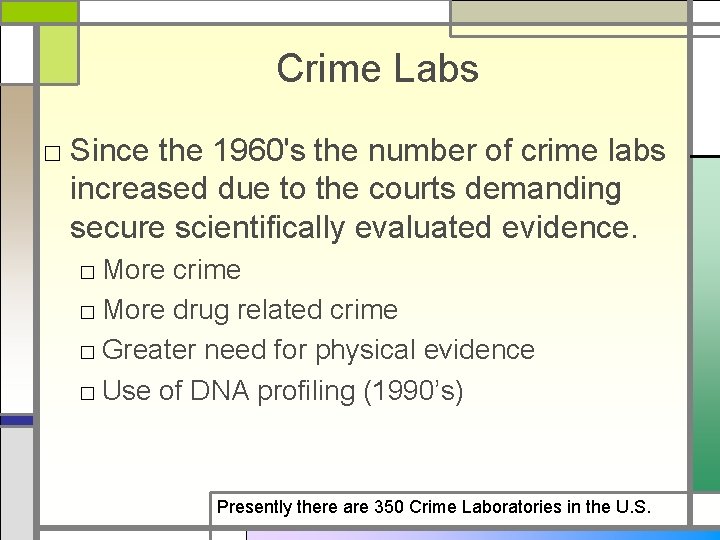
Crime Labs □ Since the 1960's the number of crime labs increased due to the courts demanding secure scientifically evaluated evidence. □ More crime □ More drug related crime □ Greater need for physical evidence □ Use of DNA profiling (1990’s) Presently there are 350 Crime Laboratories in the U. S.
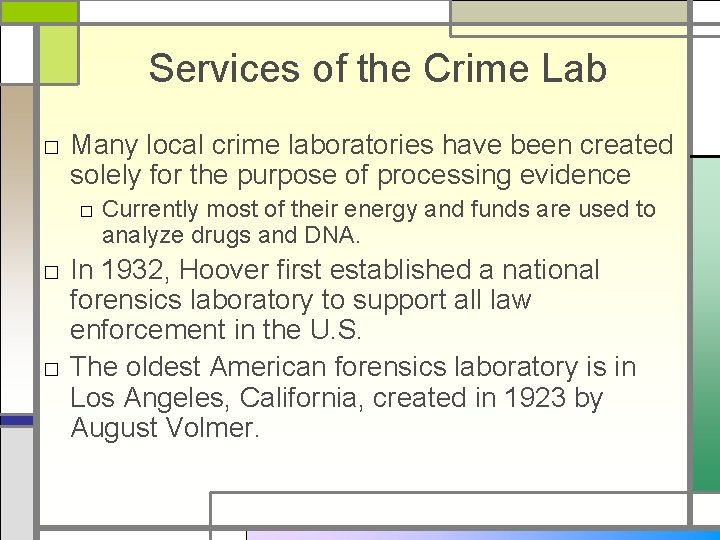
Services of the Crime Lab □ Many local crime laboratories have been created solely for the purpose of processing evidence □ Currently most of their energy and funds are used to analyze drugs and DNA. □ In 1932, Hoover first established a national forensics laboratory to support all law enforcement in the U. S. □ The oldest American forensics laboratory is in Los Angeles, California, created in 1923 by August Volmer.
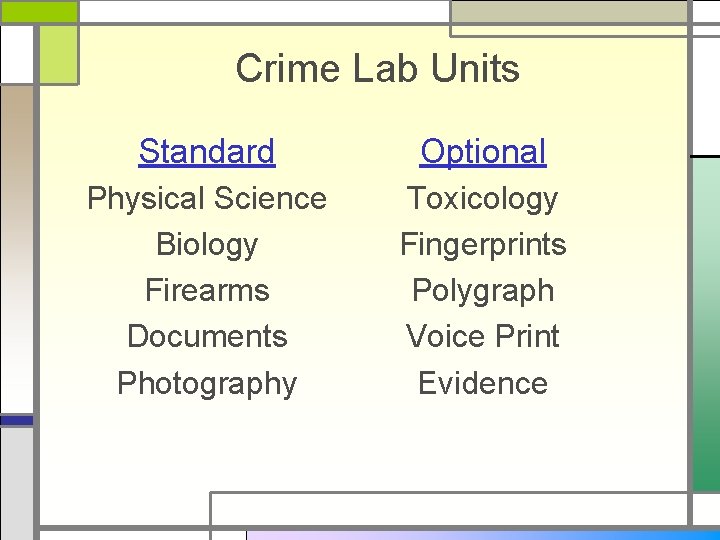
Crime Lab Units Standard Optional Physical Science Biology Firearms Documents Photography Toxicology Fingerprints Polygraph Voice Print Evidence
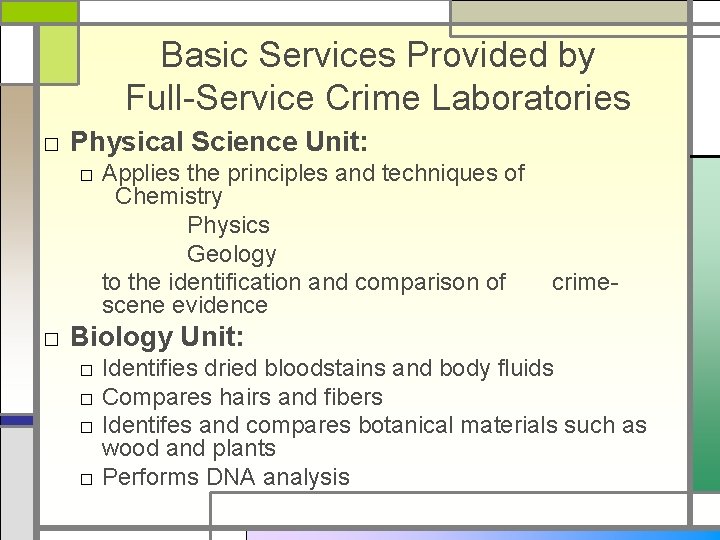
Basic Services Provided by Full-Service Crime Laboratories □ Physical Science Unit: □ Applies the principles and techniques of Chemistry Physics Geology to the identification and comparison of scene evidence crime- □ Biology Unit: □ Identifies dried bloodstains and body fluids □ Compares hairs and fibers □ Identifes and compares botanical materials such as wood and plants □ Performs DNA analysis
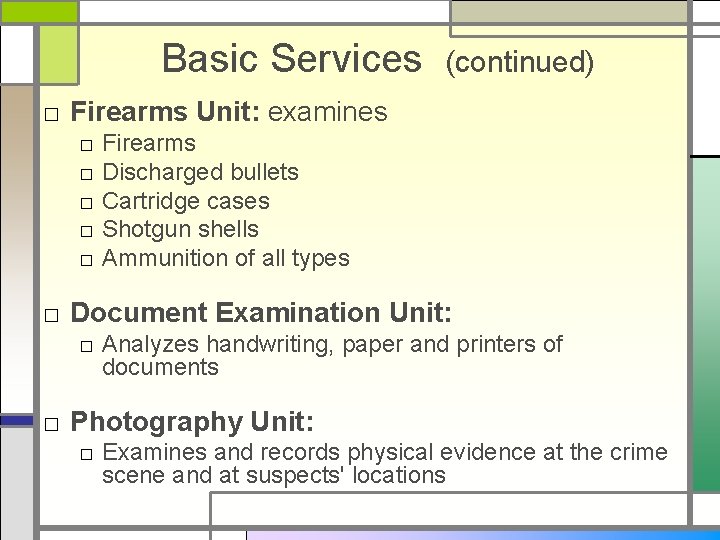
Basic Services (continued) □ Firearms Unit: examines □ □ □ Firearms Discharged bullets Cartridge cases Shotgun shells Ammunition of all types □ Document Examination Unit: □ Analyzes handwriting, paper and printers of documents □ Photography Unit: □ Examines and records physical evidence at the crime scene and at suspects' locations
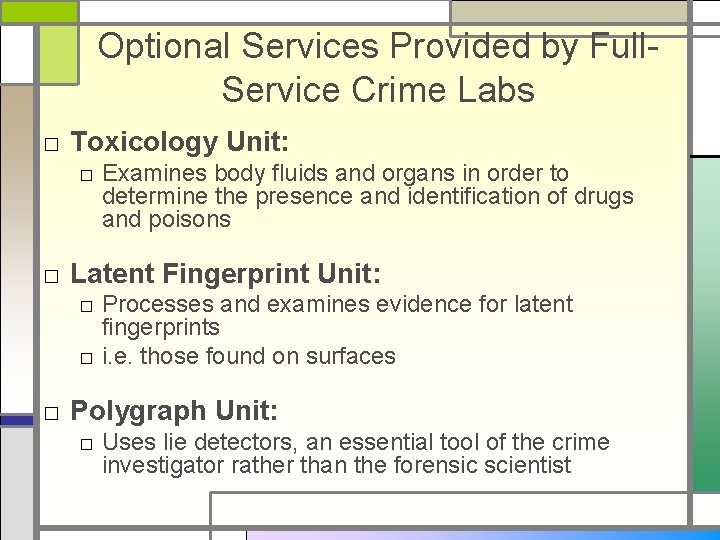
Optional Services Provided by Full. Service Crime Labs □ Toxicology Unit: □ Examines body fluids and organs in order to determine the presence and identification of drugs and poisons □ Latent Fingerprint Unit: □ Processes and examines evidence for latent fingerprints □ i. e. those found on surfaces □ Polygraph Unit: □ Uses lie detectors, an essential tool of the crime investigator rather than the forensic scientist
Optional Services (continued) □ Voiceprint Analysis Unit: □ Involved in cases of telephone threats or taperecorded messages □ Investigators may be able to connect a voice to a particular suspect □ Evidence-Collection Unit: □ Incorporates evidence collection into a total forensic science service
The Functions of the Forensic Scientist □ Analysis of Physical Evidence □ The forensic scientist must be skilled in applying the principles and techniques of the physical and natural sciences in order to identify the many types of evidence that may be recovered during crime investigations. □ Expert witness □ An expert witness possesses a particular skill or has knowledge in a trade or profession that will aid the court in determining the truth.
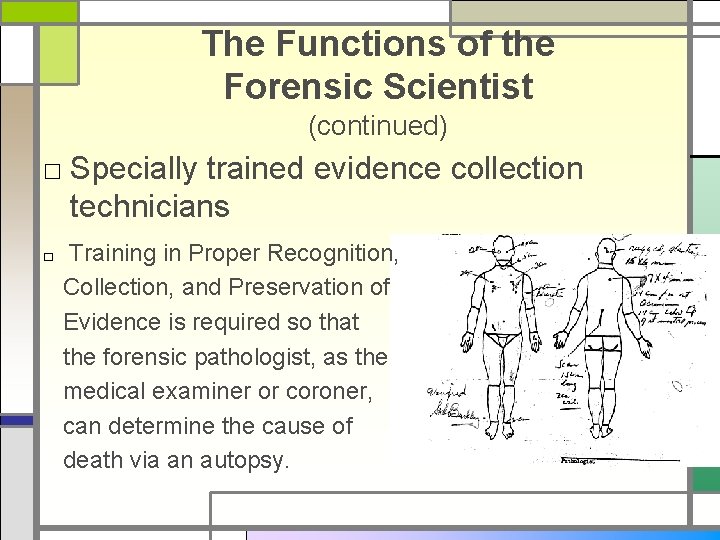
The Functions of the Forensic Scientist (continued) □ Specially trained evidence collection technicians □ Training in Proper Recognition, Collection, and Preservation of Evidence is required so that the forensic pathologist, as the medical examiner or coroner, can determine the cause of death via an autopsy.
The development of Forensic Science
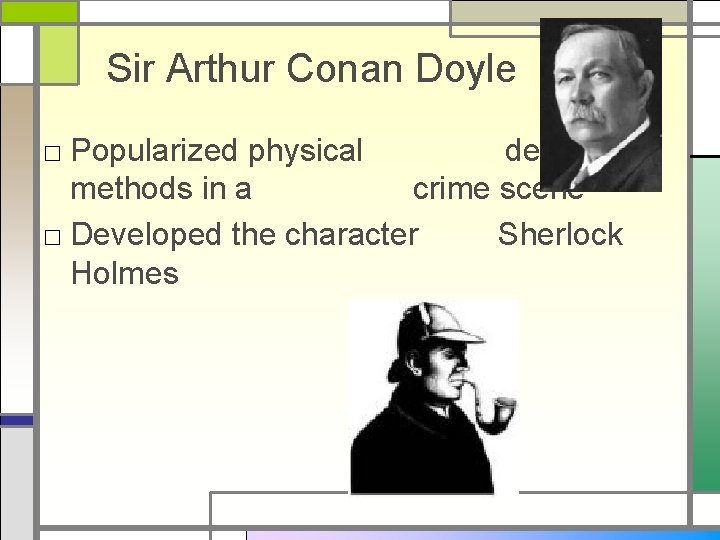
Sir Arthur Conan Doyle □ Popularized physical detection methods in a crime scene □ Developed the character Sherlock Holmes
Sir Arthur Conan Doyle □ 1887 published first novel, A Study in Scarlet □ "I've found it! I've found it, " he shouted to my companion, running towards us with a test-tube in his hand. "I have found a re-agent which is precipitated by haemoglobin, and by nothing else. . Why, man, it is the most practical medico-legal discovery for years. Don't you see that it gives us an infallible test for blood stains? . . The old guaiacum test was very clumsy and uncertain. So is the microscopic examination for blood corpuscles. The latter is valueless if the stains are a few hours old. Now, this appears to act as well whether the blood is old or new. Had this test been invented, there are hundreds of men now walking the earth who would long ago have paid the penalty of their crimes. . Criminal cases are continually hinging upon that one point. A man is suspected of a crime months perhaps after it has been committed. His linen or clothes are examined and brownish stains discovered upon them. Are they blood stains, or mud stains, or rust stains, or fruit stains, or what are they? That is a question which has puzzled many an expert, and why? Because there was no reliable test. Now we have the Sherlock Holmes's test, and there will no longer be any difficulty. " → had a considerable influence on popularizing scientific crime-detection methods
Deductive Reasoning □ Game