
An Introduction to English Change Bell Ringing With
An Introduction to English Change Bell Ringing With thanks to and acknowledgment of the Association of Ringing Teachers
What is English change bell ringing? • • • Largest and loudest instrument in the world English change ringing unique Different from other cultures’ bell ringing Soundtrack to our historic moments Call us to wake, pray, work, to arms, to feast, to celebrate 2
When? • • • Weekly for practices, and on Sundays Ring for weddings, funerals, festivals, anniversaries Personal, local and national Reflect emotions of the community, in celebration or sadness Announce the end of a war, or the passing of a monarch Roots in an ‘English’ tradition, although carried out around the world, eg Australia. ‘’Ringing a bell by the English method of rope & wheel enables each bell to give forth her fullest and her noblest note’’ - Dorothy L Sayers (writer of the bell ringing detective novel The Nine Tailors) 3
Who can ring? Requires coordination and mental agility But people from all walks of life can learn, and at all ages Learner guided through steps required to ‘handle’ a bell Then learn how to ring call changes (bells ‘swap’ places) and methods (‘tunes’) • Become part of a team or ‘band’ as part of a much larger ringing fraternity • More than 6000 ringing towers with three or more bells in the UK • Also in Ireland, Canada, USA, New Zealand, Australia, Africa and the Netherlands • • 4
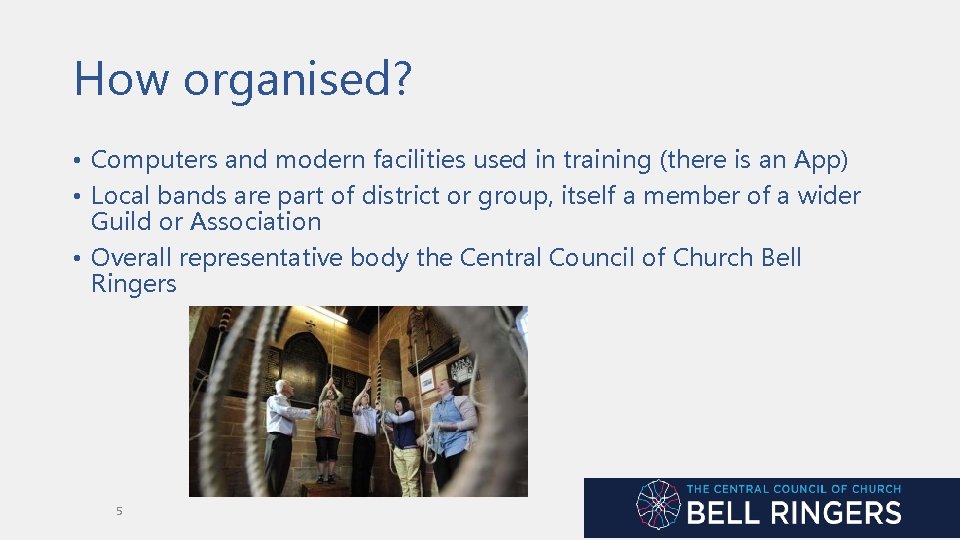
How organised? • Computers and modern facilities used in training (there is an App) • Local bands are part of district or group, itself a member of a wider Guild or Association • Overall representative body the Central Council of Church Bell Ringers 5
How does it work? • Made from an alloy of copper and tin • Arranged down the musical scale from the smallest ('treble') to the largest ('tenor') • Average tenor weight 510 kg, though can weigh up to 4, 200 kg the weight of a car • Hung within a frame and attached to a wheel • Rotate through 360 degrees, with 'clapper' striking inside of bell to sound a note • Special feature of English bells is the 'stay' • Rope wraps around wheel whereby ringer below controls bell's swing 6
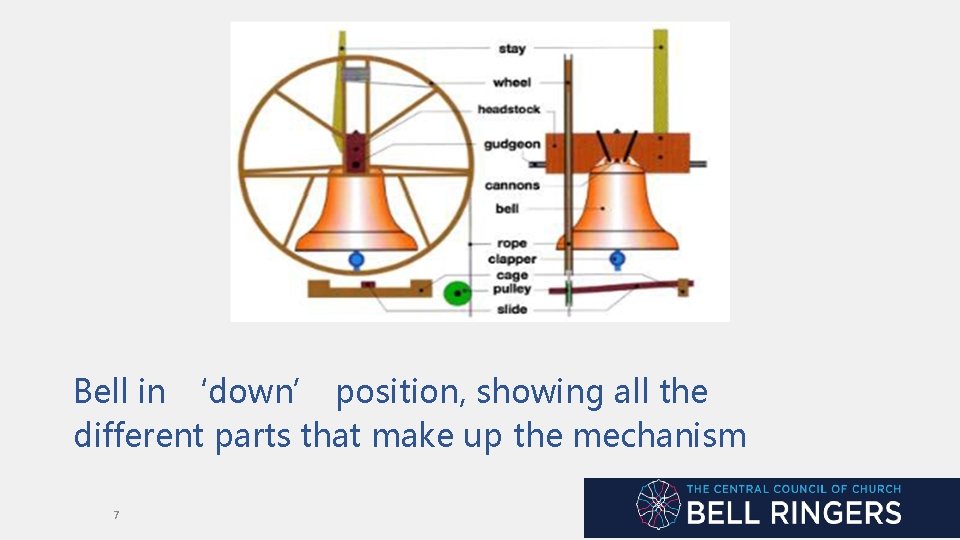
Bell in ‘down’ position, showing all the different parts that make up the mechanism 7
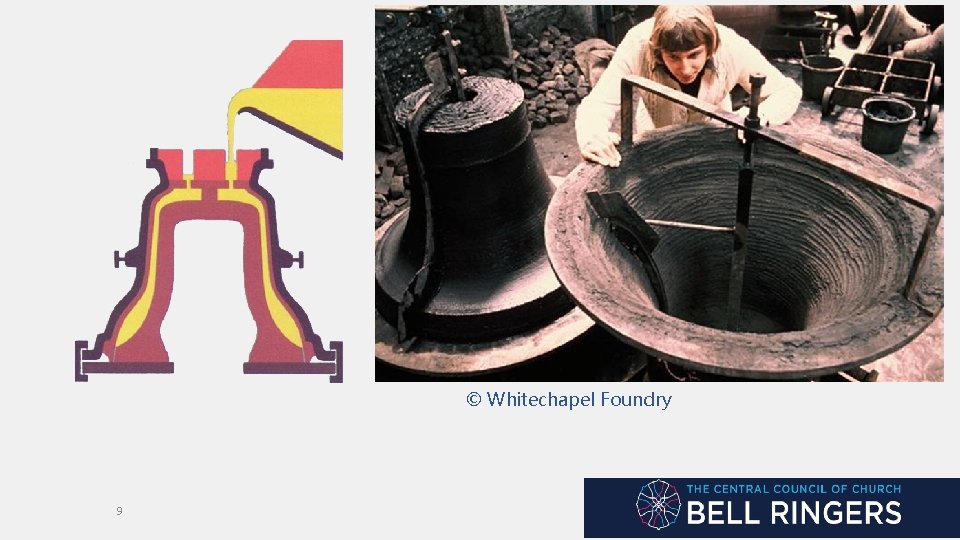
How are they made? • • • Tuned to one particular note Tuned by carving metal from the inside of the bell Made, or 'cast', in Britain for hundreds of years Moulds made and molten metal poured in Left to cool in pits Two bell foundries remaining in the UK and it is possible to visit them and have tours of their premises – sometimes even see a casting. John Taylor & Co, Loughborough www. taylorbells. co. uk Whitechapel Bell Foundry, London www. whitechapelbellfoundry. co. uk 8
© Whitechapel Foundry 9
Inscriptions on bells: “I to the Church the living Call And to the Grave do summon all” Original bell: “When we ring I sweetly sing” Replacement bell: “All ye of Bath that hear me sound Thank lady Hopton’s hundred pound” “I mean to make it understood That tho I’m little yet I’m good” 10 “NOW when we ring I sweetly sing
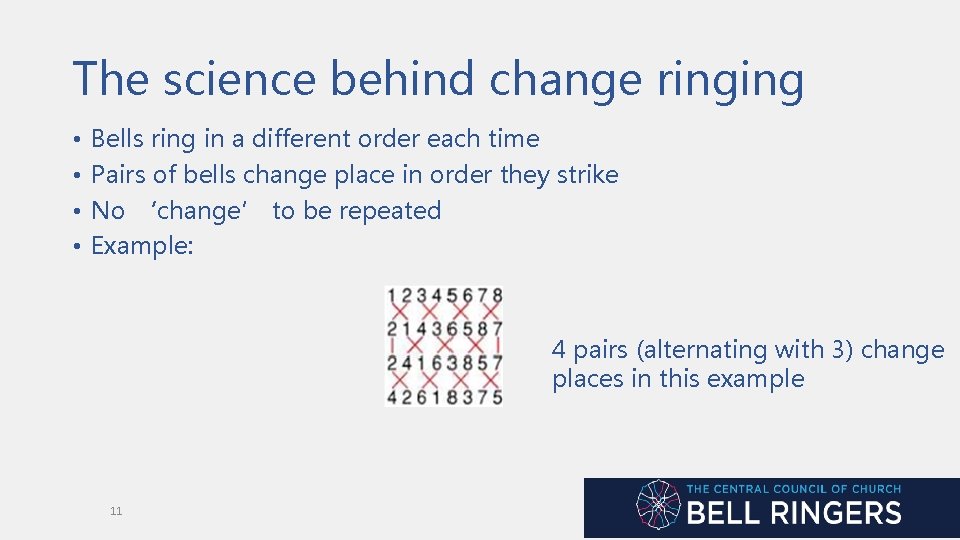
The science behind change ringing • • Bells ring in a different order each time Pairs of bells change place in order they strike No ‘change’ to be repeated Example: 4 pairs (alternating with 3) change places in this example 11
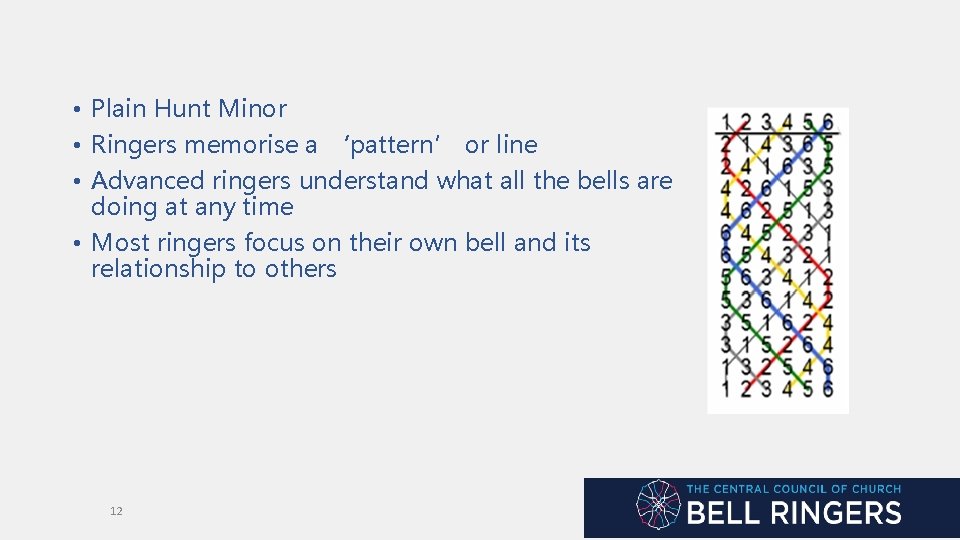
• Plain Hunt Minor • Ringers memorise a ‘pattern’ or line • Advanced ringers understand what all the bells are doing at any time • Most ringers focus on their own bell and its relationship to others 12
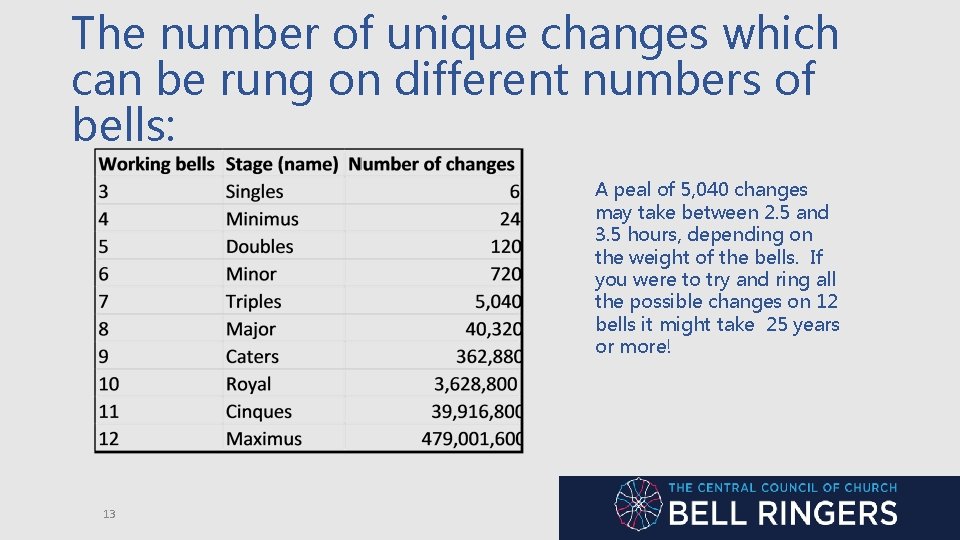
The number of unique changes which can be rung on different numbers of bells: A peal of 5, 040 changes may take between 2. 5 and 3. 5 hours, depending on the weight of the bells. If you were to try and ring all the possible changes on 12 bells it might take 25 years or more! 13

What type of people ring? • Wide cross section of the community • Ringers of over 90 have rung full, 3 -hour peals • Usually young people start to ring at about age 11 • Groups such as the ‘Zipper Society’ • Ringers meet and ring ‘Quarter Peals’ (c 45 minutes of non-stop ringing, ie a quarter of a full peal) or ‘Peals’ (c 3 hours of ringing) • Day/weekend/week outings to other regions are popular 14
How do you start? • • • Almost anyone can ring a bell Find a local tower (let us know if you need help with this) Visit a practice to see what goes on Commit some time for one-to-one lessons Small, separate steps to learn the basics For further detail of this process see next slide, and ‘Come and Learn to Ring!’ presentation. 15
“Once gained, bell ringing is a skill for life that you'll never forget and can open up a lifetime of experiences and enjoyment. ” Stages of Learning (ART) Learning can be broken down into 5 stages; learners can follow the 'Learning the Ropes' programme taught by accredited instructors of the Association of Ringing Teachers (ART) Progression • All learners make progress at their own pace and have a different learning journey. It is very common for learners to plateau, or consolidate their learning before they move on again
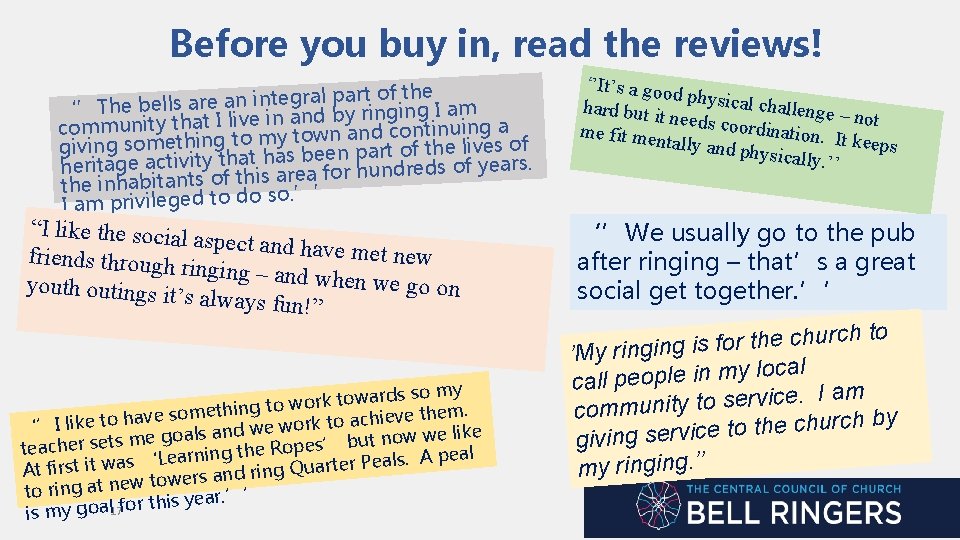
Before you buy in, read the reviews! part of the l ra g te in n a re a s ll e b ‘’The ing I am g n ri y b d n a in e v li I t community tha continuing a d n a n w to y m to g in lives of giving someth e th f o rt a p n e e b s a h heritage activity thatis area for hundreds of years. the inhabitants of tho so. ’’ I am privileged to d “I like the social aspect and have met new friends through r inging – and whe n we go on youth outings it’ s always fun!” so my s d r a w o t k r ing to wo h t e m o s e ve them. v a ie h h c o a t o e t k li k r I o ‘’ and we w ls a we like o g w e o n m t s u t b e s r ’ s e teach g the Rope in n peal r a A e. L ls ‘ a s e a P w r e it t r At first d ring Qua n a s r e w o t w to ring at ne is year. ’’ h t r o f l a o 17 g is my ‘’It’s a goo d physical challenge hard but it – not needs coo r d ination. It me fit men k tally and p hysically. ’ eeps ’ ‘’We usually go to the pub after ringing – that’s a great social get together. ’’ to h c r u h c e th r fo ’My ringing is cal lo y m in le p o e p call am I. e ic v r e s to y communit h by c r u h c e th to e ic giving serv my ringing. ’’
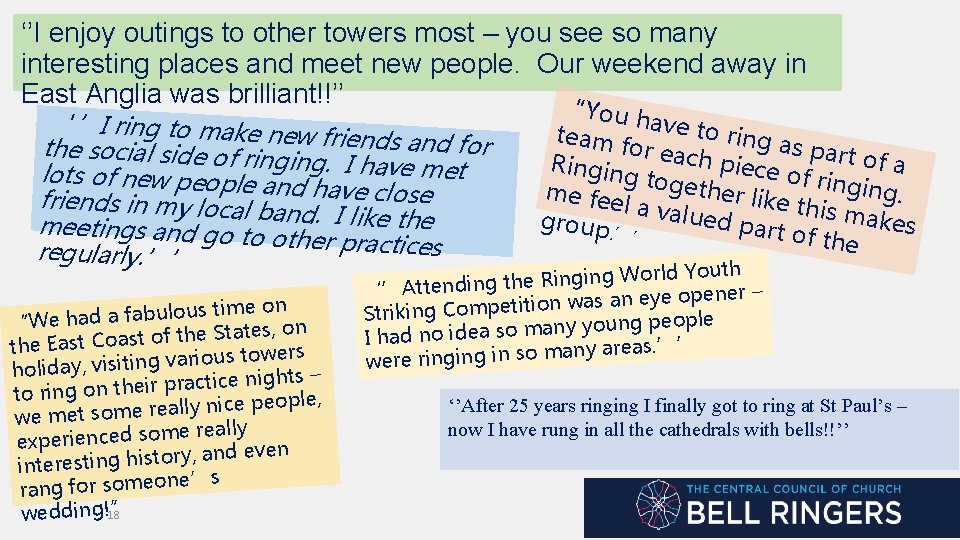
‘’I enjoy outings to other towers most – you see so many interesting places and meet new people. Our weekend away in East Anglia was brilliant!!’’ “ ‘’I ring to make new friends and for the social side of rin g lots of new people a ing. I have met nd have close friends in my local b a meetings and go to nd. I like the other practices regularly. ’’ e on m ti s u lo u b fa a “We had tes, on ta S e th f o t s a o the East C wers to s u io r a v g in it is holiday, v nights – e c ti c a r p ir e th n to ring o people, e ic n y ll a e r e m o we met s e really m o s d e c n ie r e p ex ven e d n a , y r to is h g interestin e’s rang for someon 18 wedding!” You ha team f ve to ring a s part or eac of a h Ringin piece o g toge ther lik f ringing. me fee e this m l a valu a ed par group t of th kes. ’’ e World Youth g in R e th g in d ‘’Atten pener – o e y e n a s a w n o ti Striking Competi g people n u o y y n a m o s a e I had no id as. ’’ re a y n a m o s in g in were ring ‘’After 25 years ringing I finally got to ring at St Paul’s – now I have rung in all the cathedrals with bells!!’’
Other simple powerpoint resources available from the Central Council: The following go into more detail than this general overview: Come and Learn to Ring! (for the new or potential learner ringer) The History of English Bells and Bell Ringing (for those interested in the historical aspects) The Science of English bell ringing (for those with a scientific or mathematical interest) Restoration Appeal (a template/guide for use when starting an appeal) 19
Online addresses Discover Bell Ringing - www. bellringing. org Association of Ringing Teachers - www. ringingteachers. org Learning the Ropes - www. learningtheropes. org Change Ringing Resources - www. ringing. info Central Council of Church Bell Ringers - www. cccbr. org. uk The Ringing World - www. ringingworld. co. uk Doves Guide for Church Bell Ringers - dove. cccbr. org. uk Ringing at University - www. universityringing. org 20
Other media Facebook: Association of Ringing Teachers Bellringers CCCBR Learning the Ropes …and many other local groups (just search bell ringing) Twitter: Association of Ringing Teachers - @ringingteachers Learning the Ropes - @Lt. Rringers Central Council of Church Bell Ringers - @ccringing 21
- Slides: 21