
An Introduction to Engineering Design Problem Requirements Verifications
An Introduction to Engineering Design
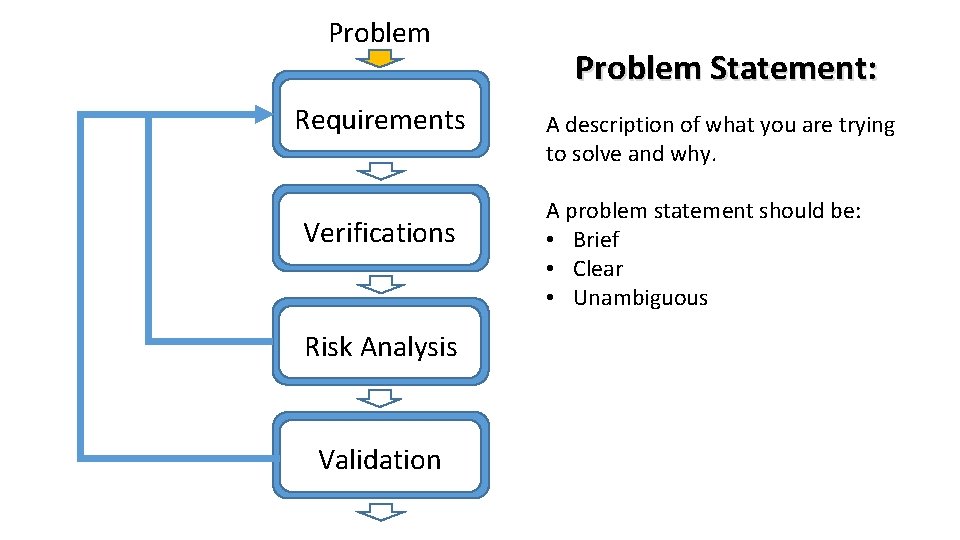
Problem Requirements Verifications Risk Analysis Validation Problem Statement: A description of what you are trying to solve and why. A problem statement should be: • Brief • Clear • Unambiguous
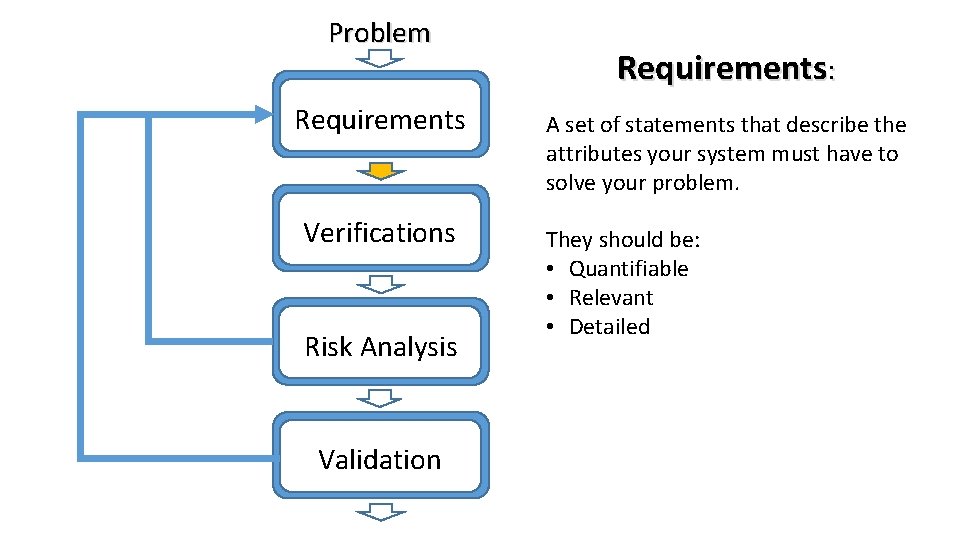
Problem Requirements Verifications Risk Analysis Validation Requirements: A set of statements that describe the attributes your system must have to solve your problem. They should be: • Quantifiable • Relevant • Detailed
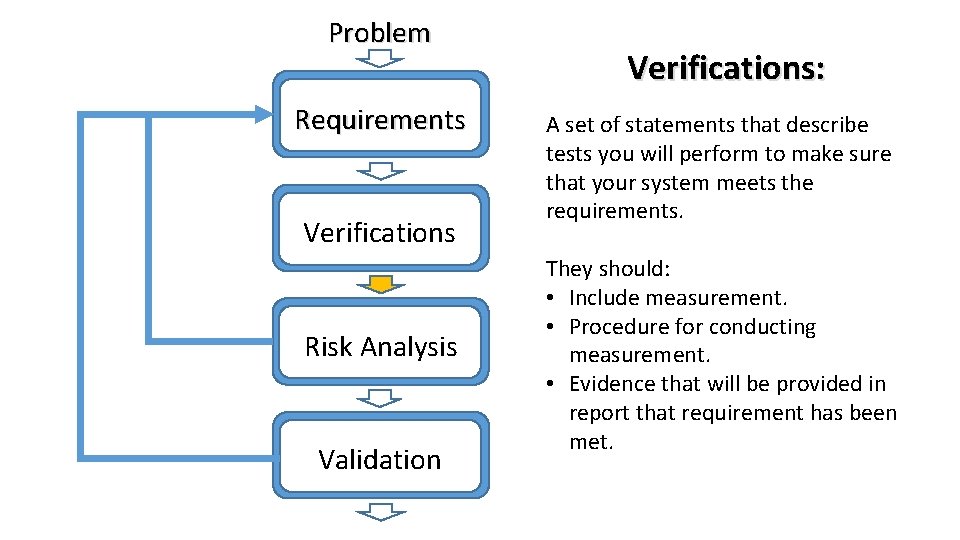
Problem Requirements Verifications Risk Analysis Validation Verifications: A set of statements that describe tests you will perform to make sure that your system meets the requirements. They should: • Include measurement. • Procedure for conducting measurement. • Evidence that will be provided in report that requirement has been met.
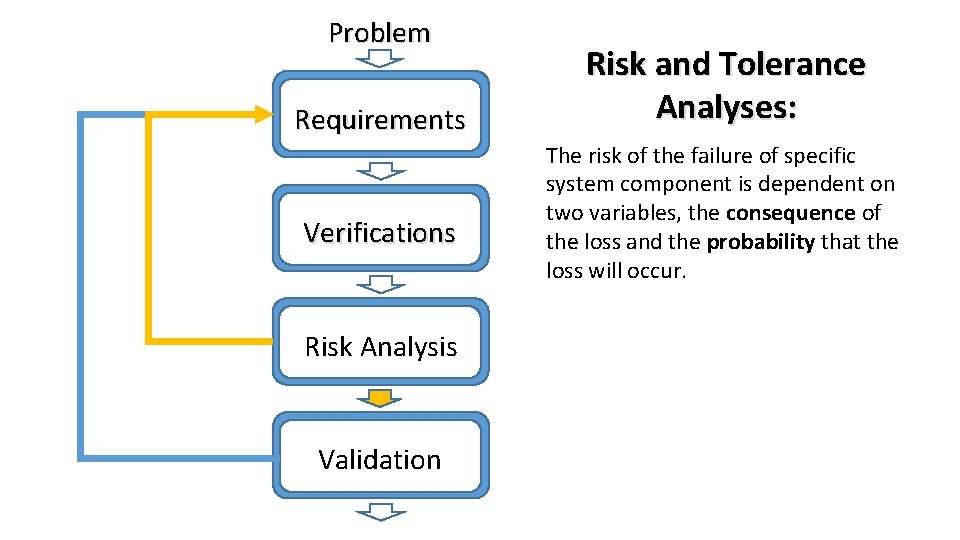
Problem Requirements Verifications Risk Analysis Validation Risk and Tolerance Analyses: The risk of the failure of specific system component is dependent on two variables, the consequence of the loss and the probability that the loss will occur.
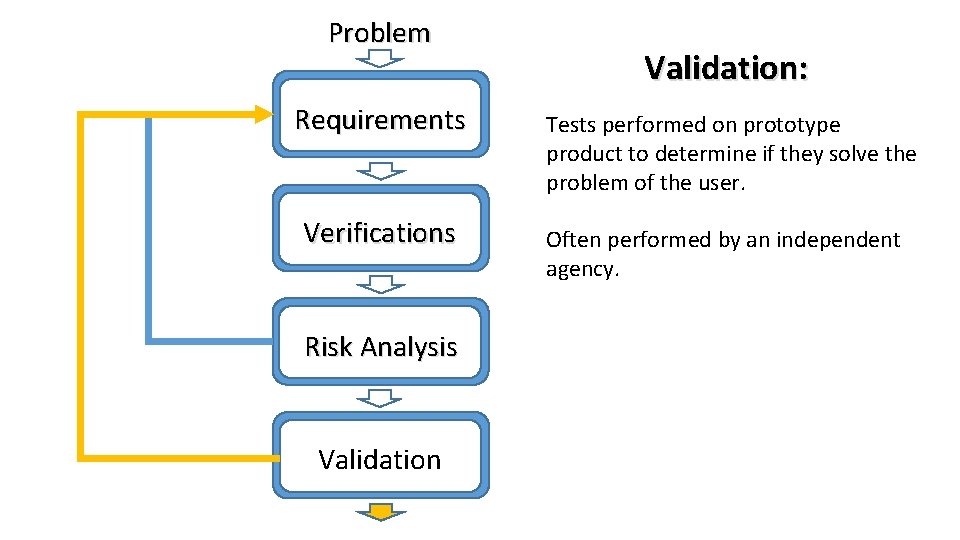
Problem Requirements Verifications Risk Analysis Validation: Tests performed on prototype product to determine if they solve the problem of the user. Often performed by an independent agency.
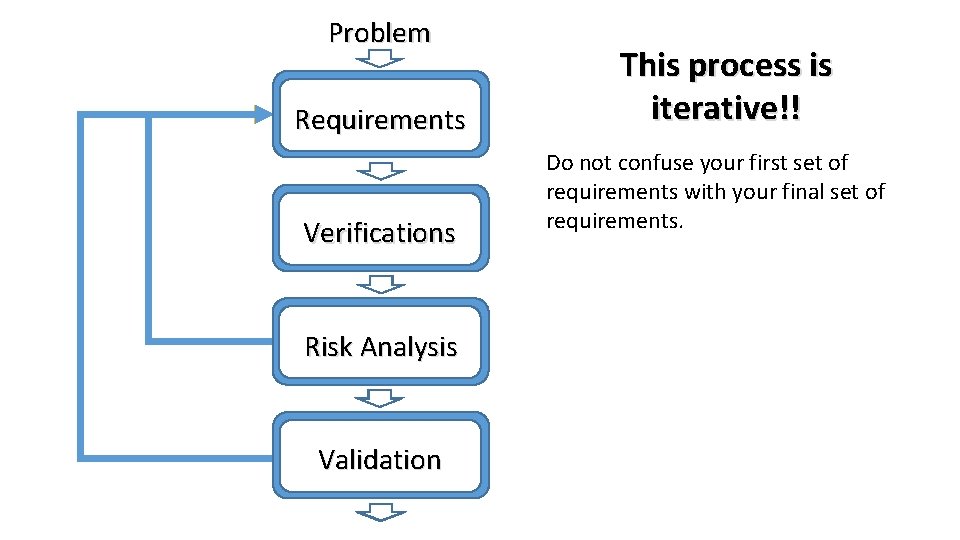
Problem Requirements Verifications Risk Analysis Validation This process is iterative!! Do not confuse your first set of requirements with your final set of requirements.
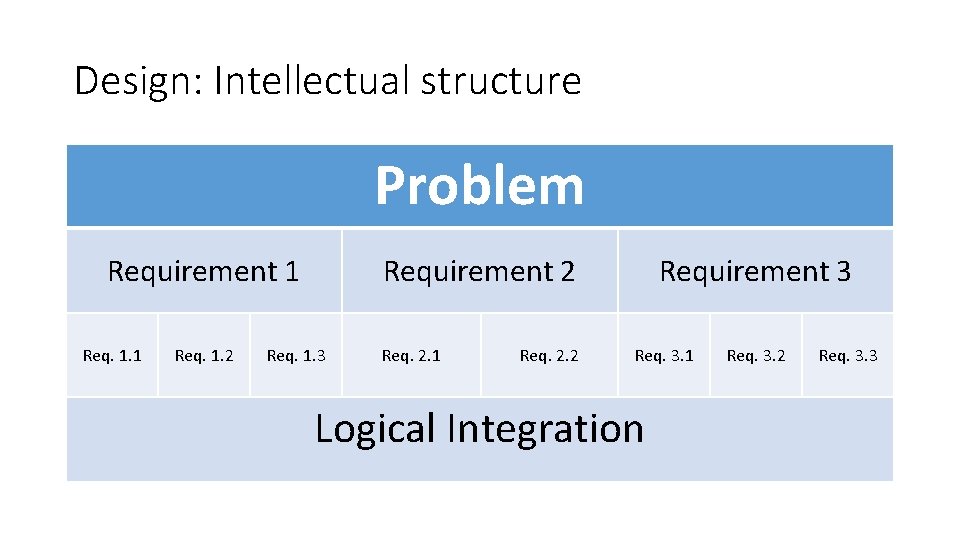
Design: Intellectual structure Problem Requirement 1 Req. 1. 2 Requirement 2 Req. 1. 3 Req. 2. 1 Req. 2. 2 Requirement 3 Req. 3. 1 Logical Integration Req. 3. 2 Req. 3. 3
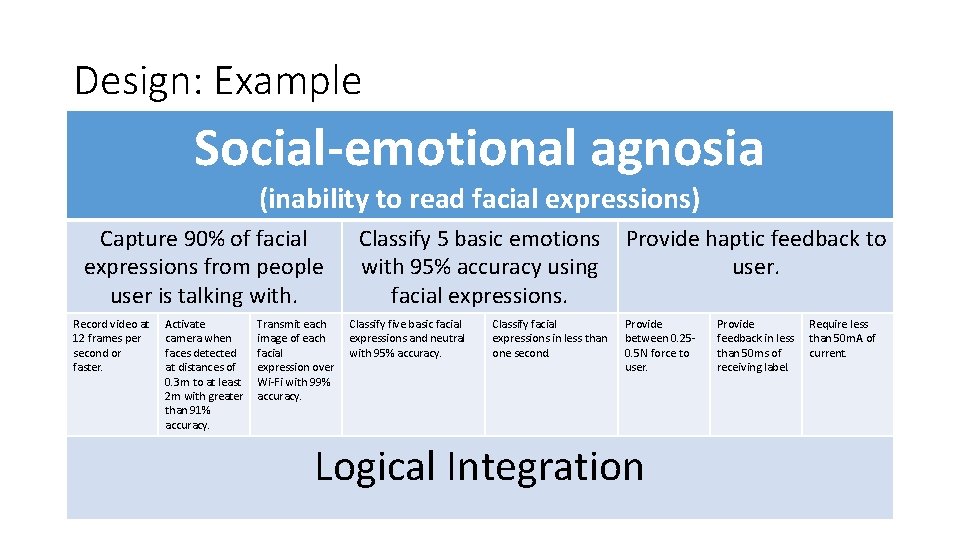
Design: Example Social-emotional agnosia (inability to read facial expressions) Capture 90% of facial expressions from people user is talking with. Record video at 12 frames per second or faster. Activate camera when faces detected at distances of 0. 3 m to at least 2 m with greater than 91% accuracy. Transmit each image of each facial expression over Wi-Fi with 99% accuracy. Classify 5 basic emotions with 95% accuracy using facial expressions. Classify five basic facial expressions and neutral with 95% accuracy. Classify facial expressions in less than one second. Provide haptic feedback to user. Provide between 0. 250. 5 N force to user. Logical Integration Provide feedback in less than 50 ms of receiving label. Require less than 50 m. A of current.
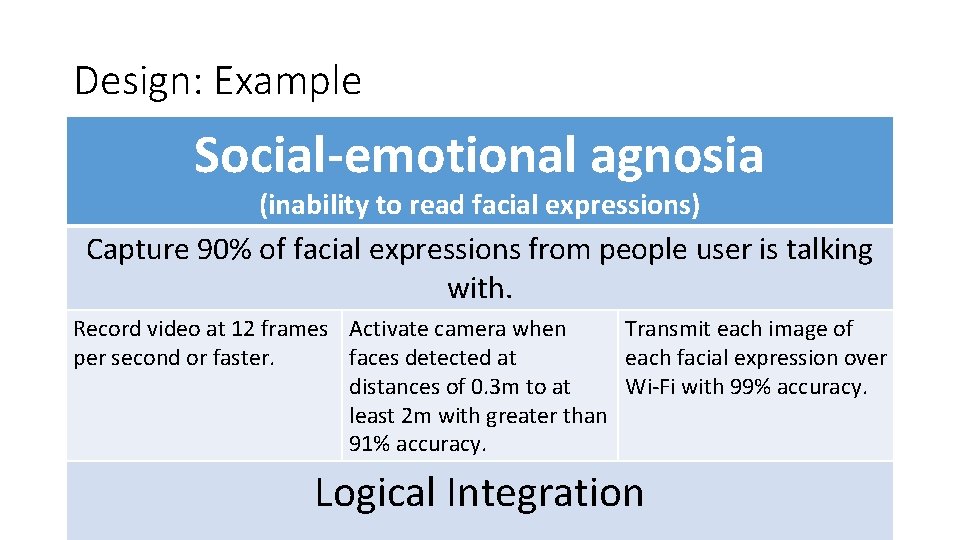
Design: Example Social-emotional agnosia (inability to read facial expressions) Capture 90% of facial expressions from people user is talking with. Record video at 12 frames Activate camera when Transmit each image of per second or faster. faces detected at each facial expression over distances of 0. 3 m to at Wi-Fi with 99% accuracy. least 2 m with greater than 91% accuracy. Logical Integration
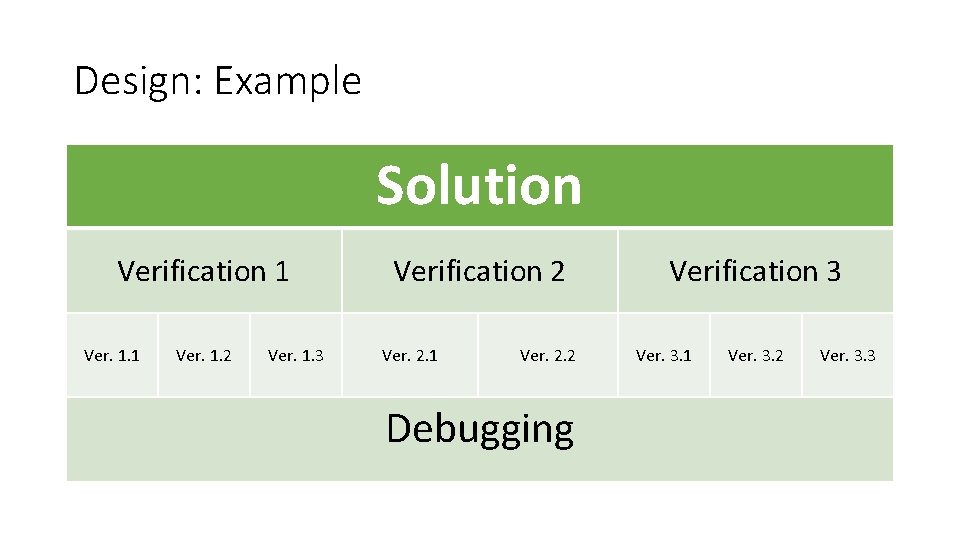
Design: Example Solution Verification 1 Ver. 1. 2 Ver. 1. 3 Verification 2 Ver. 2. 1 Ver. 2. 2 Debugging Verification 3 Ver. 3. 1 Ver. 3. 2 Ver. 3. 3
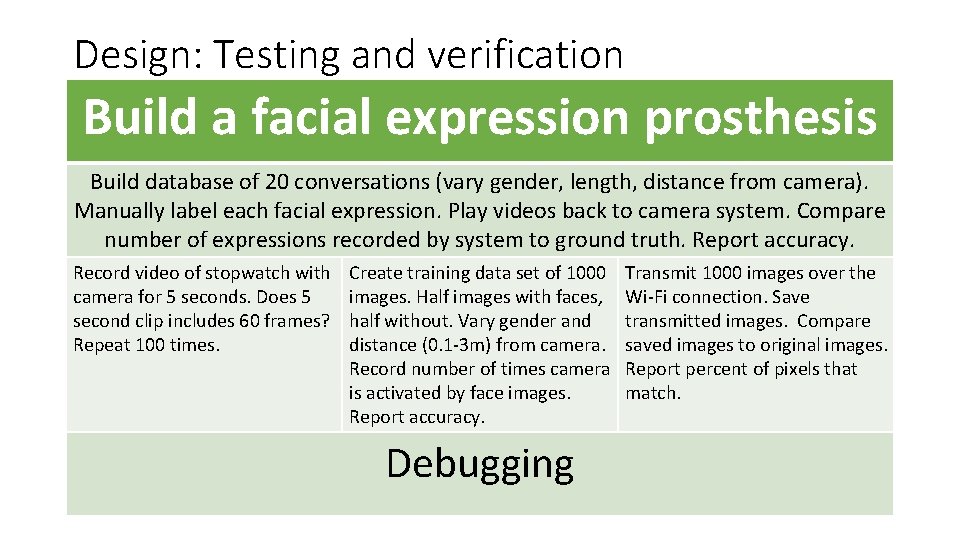
Design: Testing and verification Build a facial expression prosthesis Build database of 20 conversations (vary gender, length, distance from camera). Manually label each facial expression. Play videos back to camera system. Compare number of expressions recorded by system to ground truth. Report accuracy. Record video of stopwatch with camera for 5 seconds. Does 5 second clip includes 60 frames? Repeat 100 times. Create training data set of 1000 images. Half images with faces, half without. Vary gender and distance (0. 1 -3 m) from camera. Record number of times camera is activated by face images. Report accuracy. Debugging Transmit 1000 images over the Wi-Fi connection. Save transmitted images. Compare saved images to original images. Report percent of pixels that match.
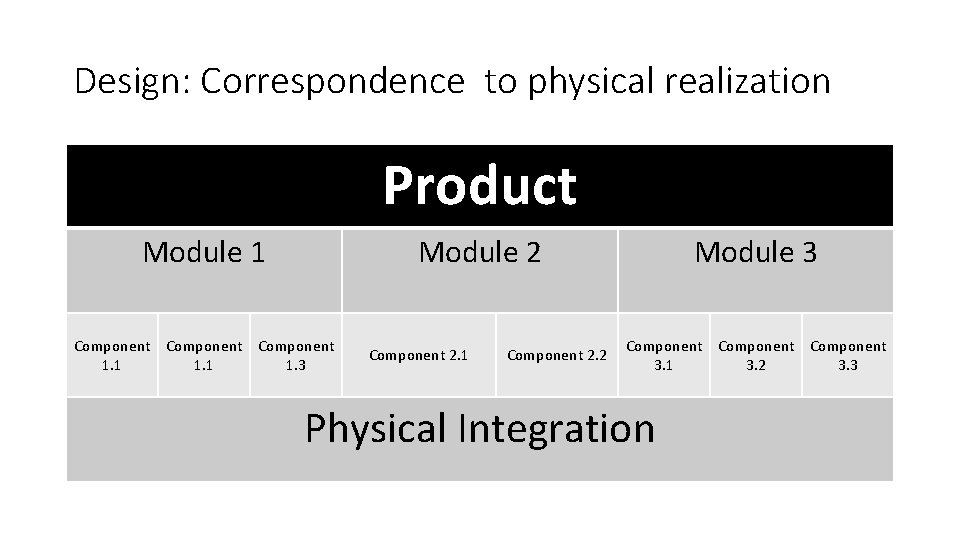
Design: Correspondence to physical realization Product Module 1 Module 2 Component 1. 1 1. 3 Component 2. 1 Component 2. 2 Module 3 Component 3. 1 3. 2 3. 3 Physical Integration
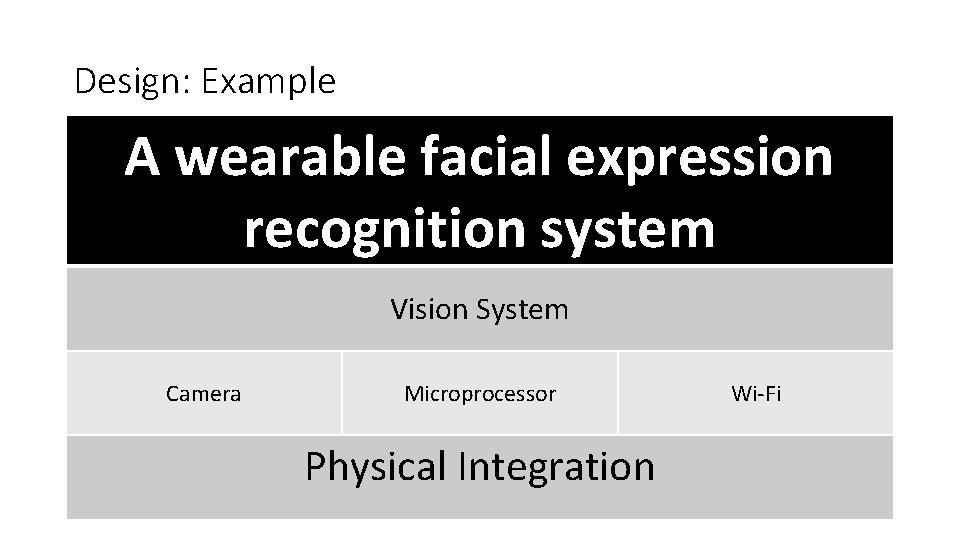
Design: Example A wearable facial expression recognition system Vision System Camera Microprocessor Physical Integration Wi-Fi
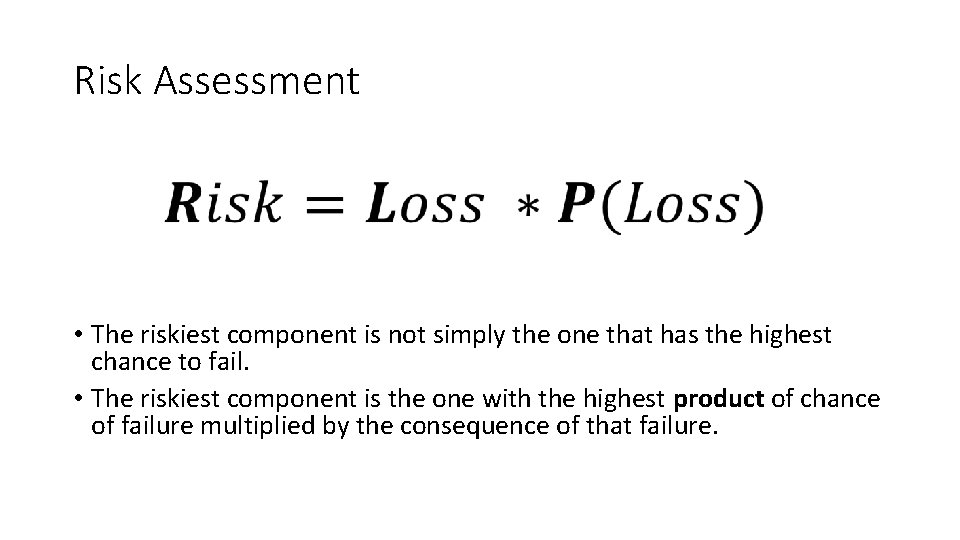
Risk Assessment • The riskiest component is not simply the one that has the highest chance to fail. • The riskiest component is the one with the highest product of chance of failure multiplied by the consequence of that failure.
Tolerance Analysis In this class, perform tolerance analysis on the component with the highest risk. Empirical verification of component as critical parameter is changed. Example: https: //courses. engr. illinois. edu/ece 445/documents/tolerance-analysis-guide. pdf • Large construction projects frequently generate ground vibrations, which result from moving heavy equipment and driving piles. • Our project is a tool for construction companies to monitor the level of vibrations which propagate off the construction site. • We decide that the highest risk component is the anti-aliasing filter before A/D conversion. If aliased frequencies are allowed to pass, sensor may give inaccurate information (high Loss).
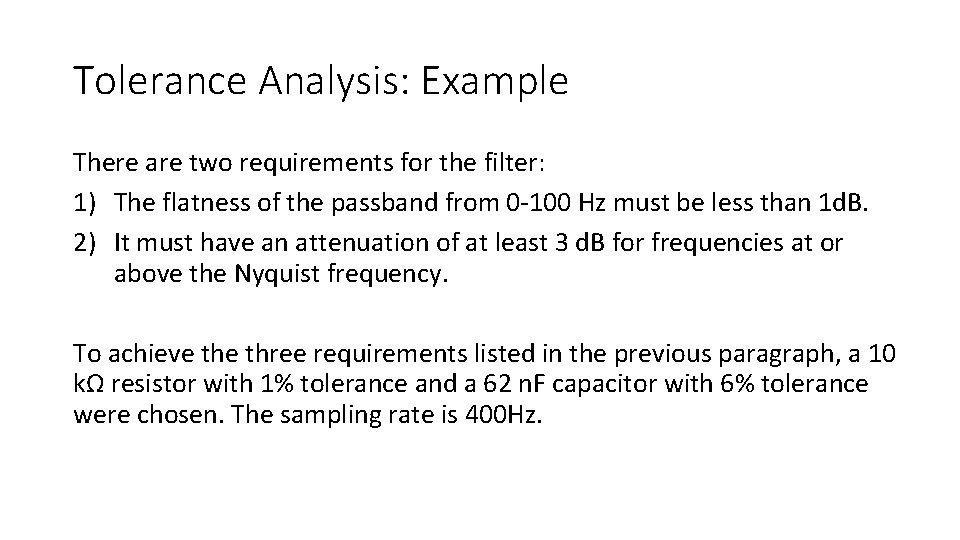
Tolerance Analysis: Example There are two requirements for the filter: 1) The flatness of the passband from 0 -100 Hz must be less than 1 d. B. 2) It must have an attenuation of at least 3 d. B for frequencies at or above the Nyquist frequency. To achieve three requirements listed in the previous paragraph, a 10 kΩ resistor with 1% tolerance and a 62 n. F capacitor with 6% tolerance were chosen. The sampling rate is 400 Hz.
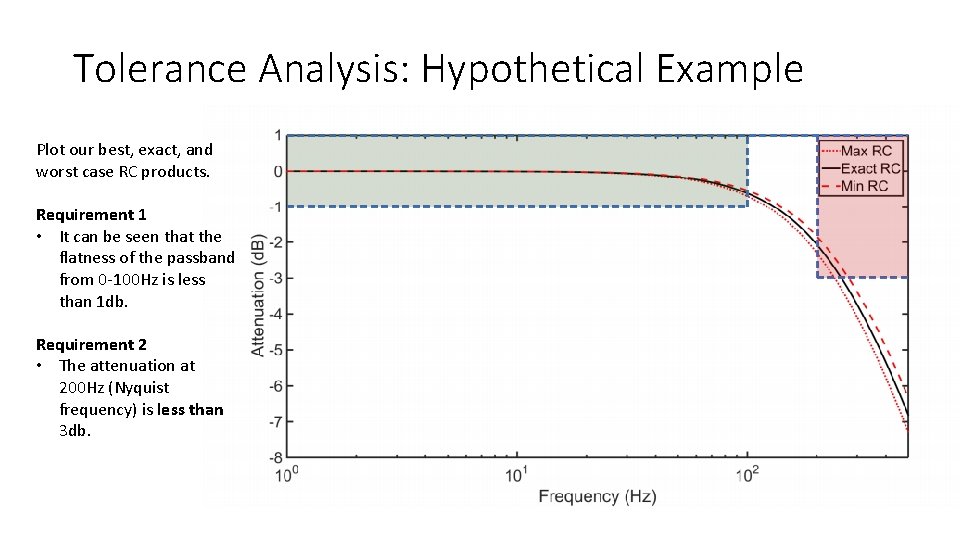
Tolerance Analysis: Hypothetical Example Plot our best, exact, and worst case RC products. Requirement 1 • It can be seen that the flatness of the passband from 0 -100 Hz is less than 1 db. Requirement 2 • The attenuation at 200 Hz (Nyquist frequency) is less than 3 db.
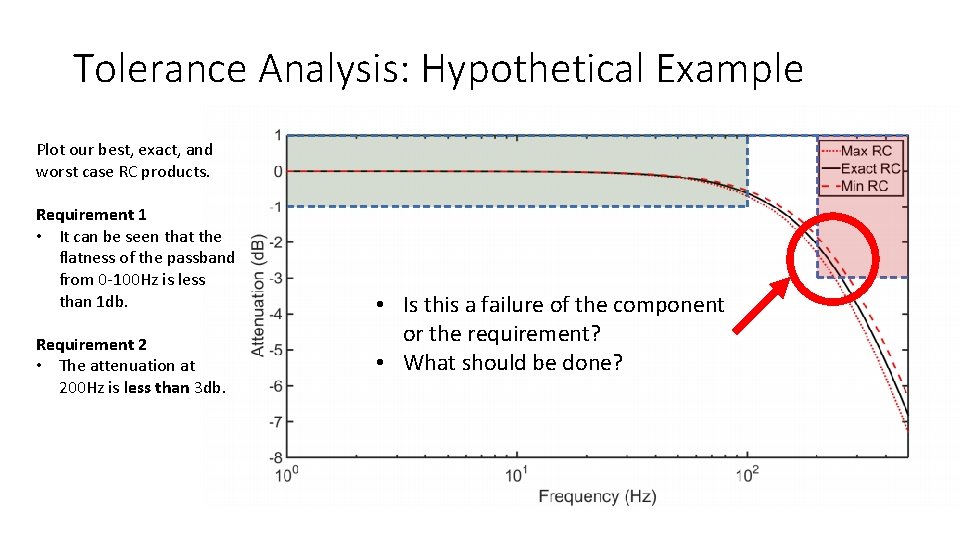
Tolerance Analysis: Hypothetical Example Plot our best, exact, and worst case RC products. Requirement 1 • It can be seen that the flatness of the passband from 0 -100 Hz is less than 1 db. Requirement 2 • The attenuation at 200 Hz is less than 3 db. • Is this a failure of the component or the requirement? • What should be done?
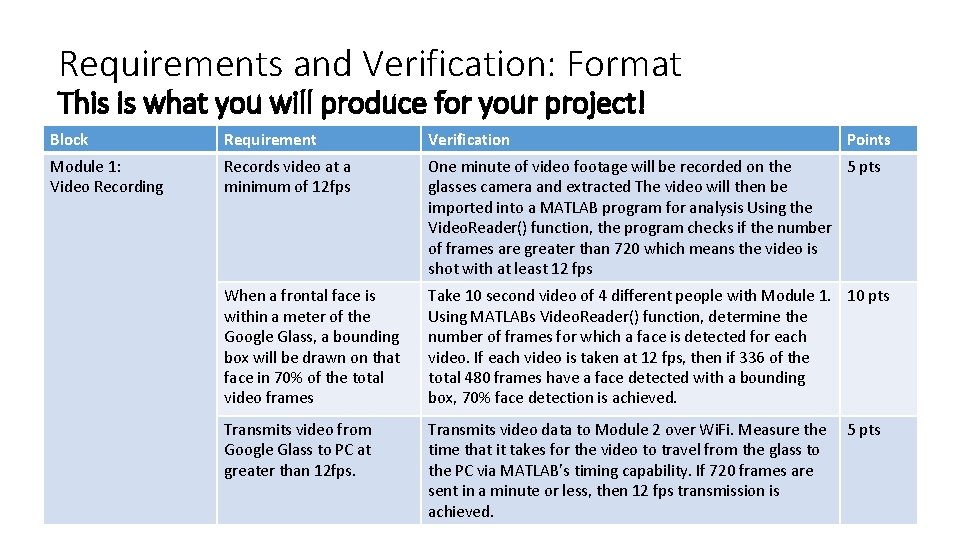
Requirements and Verification: Format This is what you will produce for your project! Block Requirement Verification Points Module 1: Video Recording Records video at a minimum of 12 fps One minute of video footage will be recorded on the 5 pts glasses camera and extracted The video will then be imported into a MATLAB program for analysis Using the Video. Reader() function, the program checks if the number of frames are greater than 720 which means the video is shot with at least 12 fps When a frontal face is within a meter of the Google Glass, a bounding box will be drawn on that face in 70% of the total video frames Take 10 second video of 4 different people with Module 1. 10 pts Using MATLABs Video. Reader() function, determine the number of frames for which a face is detected for each video. If each video is taken at 12 fps, then if 336 of the total 480 frames have a face detected with a bounding box, 70% face detection is achieved. Transmits video from Google Glass to PC at greater than 12 fps. Transmits video data to Module 2 over Wi. Fi. Measure the time that it takes for the video to travel from the glass to the PC via MATLAB’s timing capability. If 720 frames are sent in a minute or less, then 12 fps transmission is achieved. 5 pts
R&V Exercise (25 minutes) • Form groups of 3 with different people from lecture 1. Avoid friends, and say hi to someone new! • Briefly pitch your quad chart ideas, and select 1 idea per group. 2 minutes
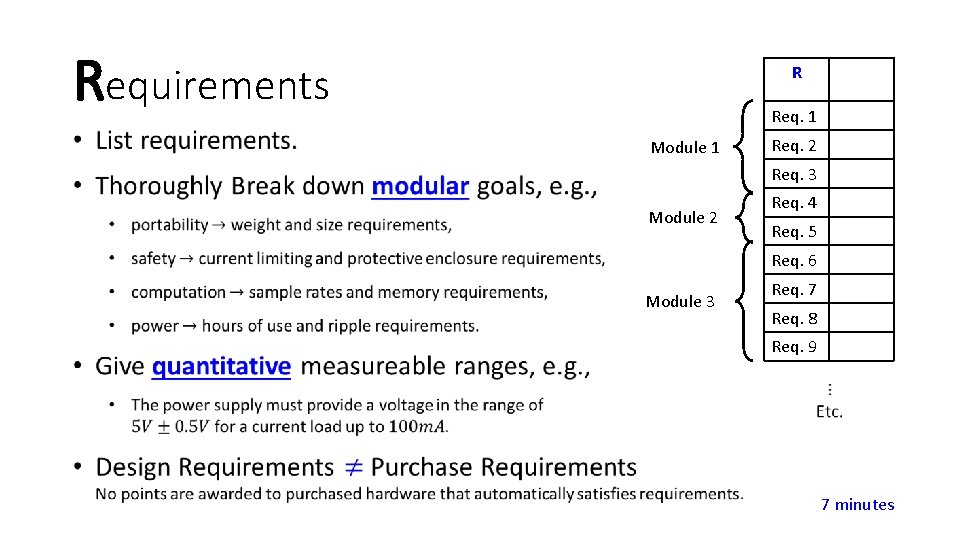
Requirements R Req. 1 Module 1 Req. 2 Req. 3 Module 2 Req. 4 Req. 5 Req. 6 Module 3 Req. 7 Req. 8 Req. 9 7 minutes
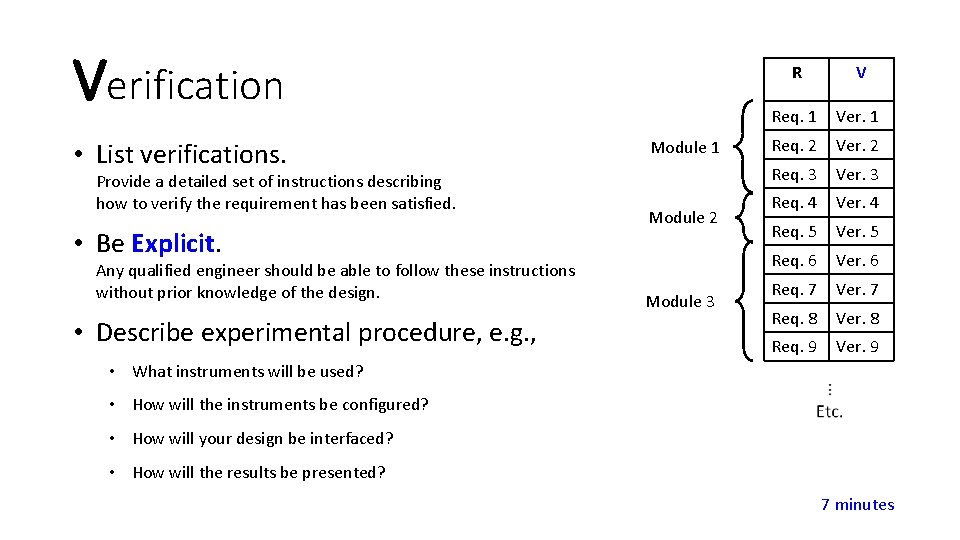
Verification • List verifications. Provide a detailed set of instructions describing how to verify the requirement has been satisfied. • Be Explicit. Any qualified engineer should be able to follow these instructions without prior knowledge of the design. • Describe experimental procedure, e. g. , Module 1 Module 2 Module 3 R V Req. 1 Ver. 1 Req. 2 Ver. 2 Req. 3 Ver. 3 Req. 4 Ver. 4 Req. 5 Ver. 5 Req. 6 Ver. 6 Req. 7 Ver. 7 Req. 8 Ver. 8 Req. 9 Ver. 9 • What instruments will be used? • How will the instruments be configured? • How will your design be interfaced? • How will the results be presented? 7 minutes
R&V Evaluation • Find 2 other groups and form a circle of 9 people. • Each group will present 1 module at a time. • Provide constructive feedback: • Are the requirements too vague? • Are the instructions unclear? • Are the requirements satisfied by purchase or design? • Are the requirements relevant to the modular goals? • Could you determine if a designed system satisfies the R&V table? 9 minutes
- Slides: 24