
An Introduction to Electron Spin Resonance ESR Part
- Slides: 61
An Introduction to Electron Spin Resonance (ESR). Part 2. Pulse methods and distance measurements. Boris Dzikovski, ACERT, Cornell University • An introduction to pulsed ESR: technical considerations. • Important instrumentation differences between pulsed and cw ESR. • Introduction to typical pulse ESR experiments: COSY, SECSY, ELDOR, DQC • Examples of pulsed ESR experiments on biological systems. • Peaceful coexistence/symbiotic relations between pulse and CW ESR. • ENDOR – ESR detected NMR. • Summary An introduction to Electron Spin Resonance (ESR), Nov 1 st 2006
What is special about ESR, in particular spin-label ESR? (e. g. compared to NMR) ESR is much more sensitive per spin (than NMR). In time domain experiments ESR’s time-scale is nanoseconds (NMR’s is milliseconds). The spin-label spectrum is simple, and can focus on a limited number of spins. ESR spectra change dramatically as the tumbling motion of the probe slows, thereby providing great sensitivity to local “fluidity”. In NMR nearly complete averaging occurs, so only residual rotational effects are observed by T 1 and T 2. Multi-frequency ESR permits one to take “fast-snapshots” using very high-frequencies and “slow-snapshots” using lower frequencies to help unravel the complex dynamics of bio-systems. Pulsed ESR methods enable one to distinguish homogeneous broadening reporting on dynamics vs. inhomogeneous broadening reporting on local structure. An introduction to Electron Spin Resonance (ESR), Nov 1 st 2006
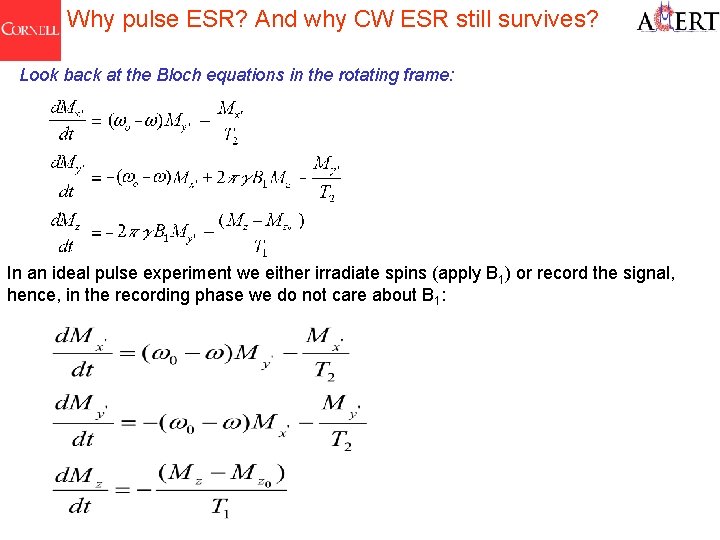
Why pulse ESR? And why CW ESR still survives? Look back at the Bloch equations in the rotating frame: In an ideal pulse experiment we either irradiate spins (apply B 1) or record the signal, hence, in the recording phase we do not care about B 1:
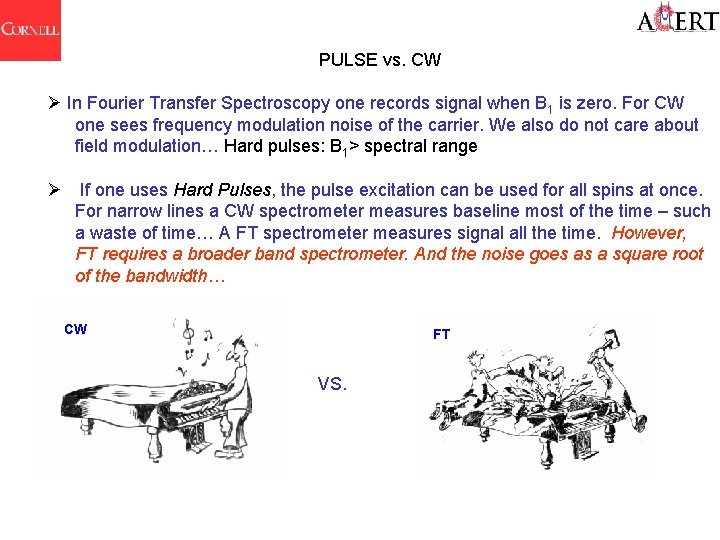
PULSE vs. CW In Fourier Transfer Spectroscopy one records signal when B 1 is zero. For CW one sees frequency modulation noise of the carrier. We also do not care about field modulation… Hard pulses: B 1> spectral range If one uses Hard Pulses, the pulse excitation can be used for all spins at once. For narrow lines a CW spectrometer measures baseline most of the time – such a waste of time… A FT spectrometer measures signal all the time. However, FT requires a broader band spectrometer. And the noise goes as a square root of the bandwidth… CW FT VS.
Sensitivity issue: one rotates all spins into the X-Y plane and detects total magnetization. In CW one usually rotates only a small fraction of the possible magnetization into X-Y plane, to avoid saturation effects. However: the dead-time problem in pulsed ESR. Dead time is finite time when the spectrometer relaxes to zero-power levels. It is not an issue in solution NMR, but a problem in solid state NMR and EPR. Pulse ESR can isolate interactions and detect correlations that are not observable by CW methods. The additional information about weakly coupled spins and relaxation properties of the spin system that can be obtained by manipulating the spins with sequences of MW pulses explains the efforts put into the development of new pulse methods. Time resolution (response time) of ~ 10 ns is much better than in CW ESR
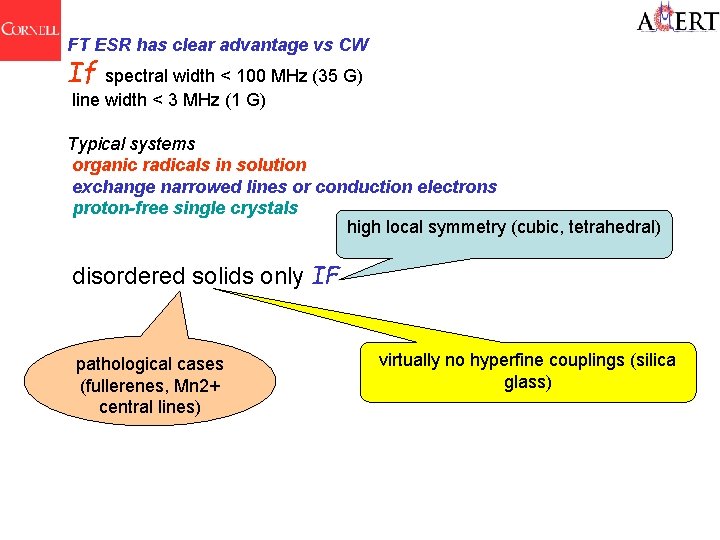
FT ESR has clear advantage vs CW If spectral width < 100 MHz (35 G) line width < 3 MHz (1 G) Typical systems organic radicals in solution exchange narrowed lines or conduction electrons proton-free single crystals high local symmetry (cubic, tetrahedral) disordered solids only IF pathological cases (fullerenes, Mn 2+ central lines) virtually no hyperfine couplings (silica glass)
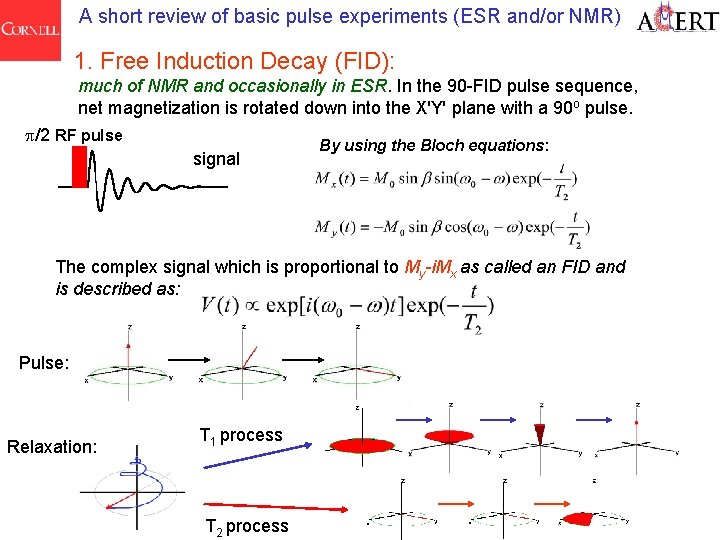
A short review of basic pulse experiments (ESR and/or NMR) 1. Free Induction Decay (FID): much of NMR and occasionally in ESR. In the 90 -FID pulse sequence, net magnetization is rotated down into the X'Y' plane with a 90 o pulse. /2 RF pulse signal By using the Bloch equations: The complex signal which is proportional to My-i. Mx as called an FID and is described as: Pulse: Relaxation: T 1 process T 2 process
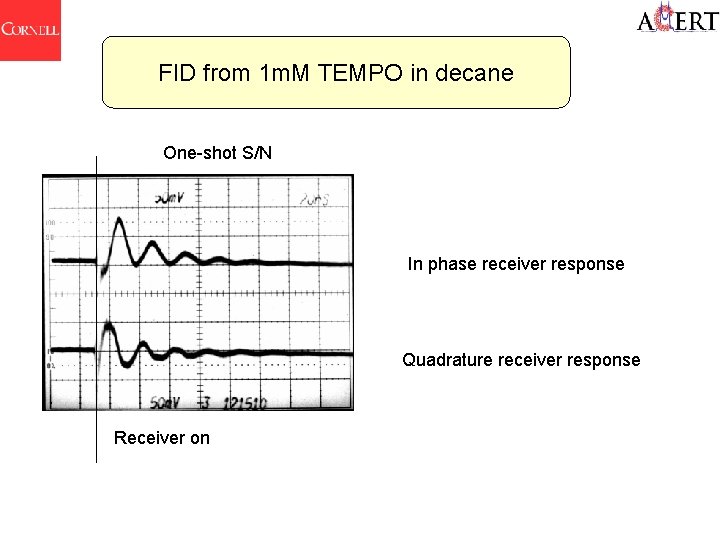
FID from 1 m. M TEMPO in decane One-shot S/N In phase receiver response Quadrature receiver response Receiver on
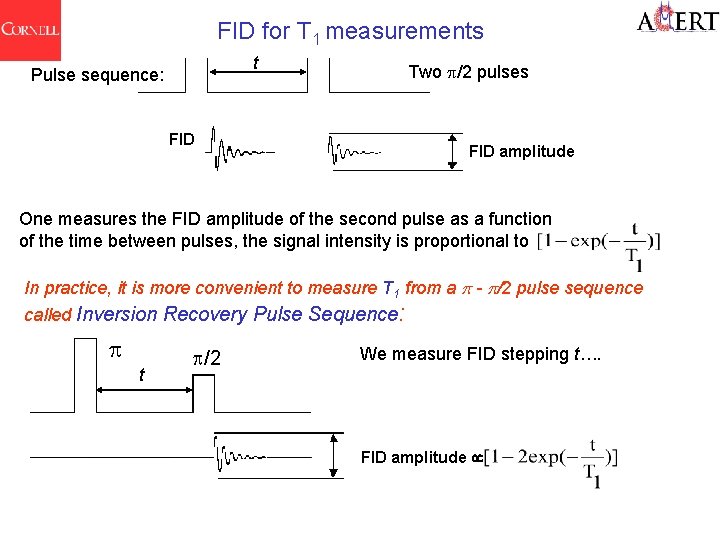
FID for T 1 measurements t Pulse sequence: Two /2 pulses FID amplitude One measures the FID amplitude of the second pulse as a function of the time between pulses, the signal intensity is proportional to In practice, it is more convenient to measure T 1 from a - /2 pulse sequence called Inversion Recovery Pulse Sequence: t /2 We measure FID stepping t…. FID amplitude
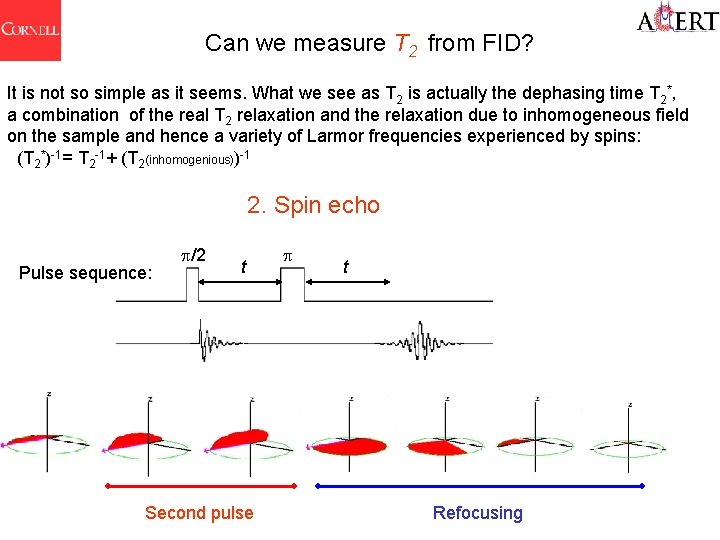
Can we measure T 2 from FID? It is not so simple as it seems. What we see as T 2 is actually the dephasing time T 2*, a combination of the real T 2 relaxation and the relaxation due to inhomogeneous field on the sample and hence a variety of Larmor frequencies experienced by spins: (T 2*)-1= T 2 -1+ (T 2(inhomogenious))-1 2. Spin echo Pulse sequence: /2 t Second pulse t Refocusing
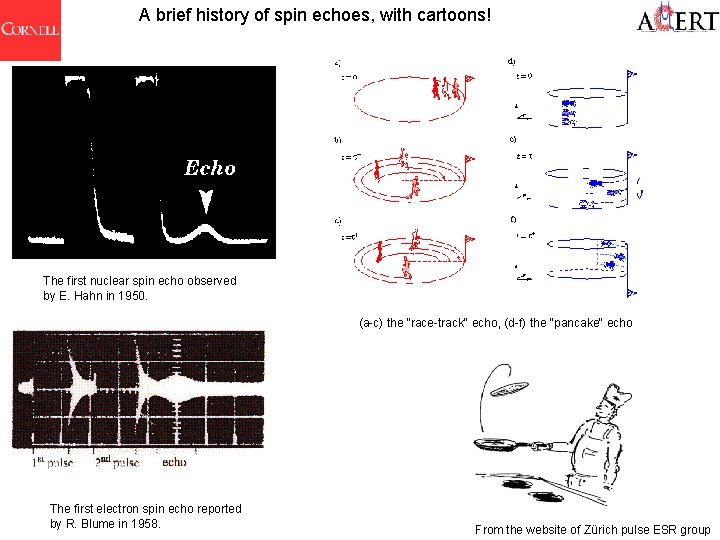
A brief history of spin echoes, with cartoons! The first nuclear spin echo observed by E. Hahn in 1950. (a-c) the "race-track" echo, (d-f) the "pancake" echo The first electron spin echo reported by R. Blume in 1958. From the website of Zürich pulse ESR group
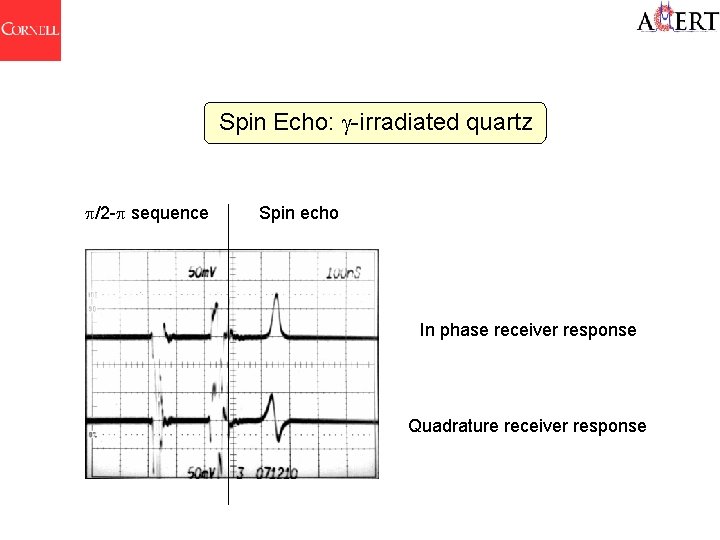
Spin Echo: -irradiated quartz /2 - sequence Spin echo In phase receiver response Quadrature receiver response
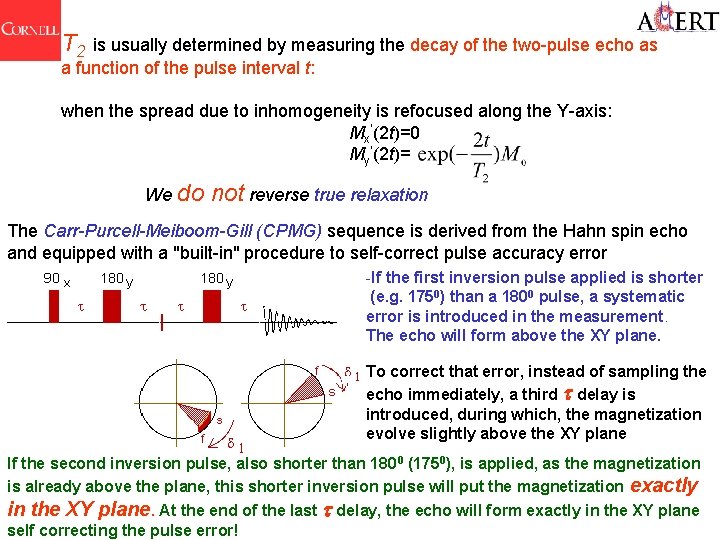
T 2 is usually determined by measuring the decay of the two-pulse echo as a function of the pulse interval t: when the spread due to inhomogeneity is refocused along the Y-axis: Mx’(2 t)=0 My’(2 t)= We do not reverse true relaxation The Carr-Purcell-Meiboom-Gill (CPMG) sequence is derived from the Hahn spin echo and equipped with a "built-in" procedure to self-correct pulse accuracy error -If the first inversion pulse applied is shorter (e. g. 1750) than a 1800 pulse, a systematic error is introduced in the measurement. The echo will form above the XY plane. To correct that error, instead of sampling the echo immediately, a third delay is introduced, during which, the magnetization evolve slightly above the XY plane If the second inversion pulse, also shorter than 1800 (1750), is applied, as the magnetization is already above the plane, this shorter inversion pulse will put the magnetization exactly in the XY plane. At the end of the last delay, the echo will form exactly in the XY plane self correcting the pulse error!
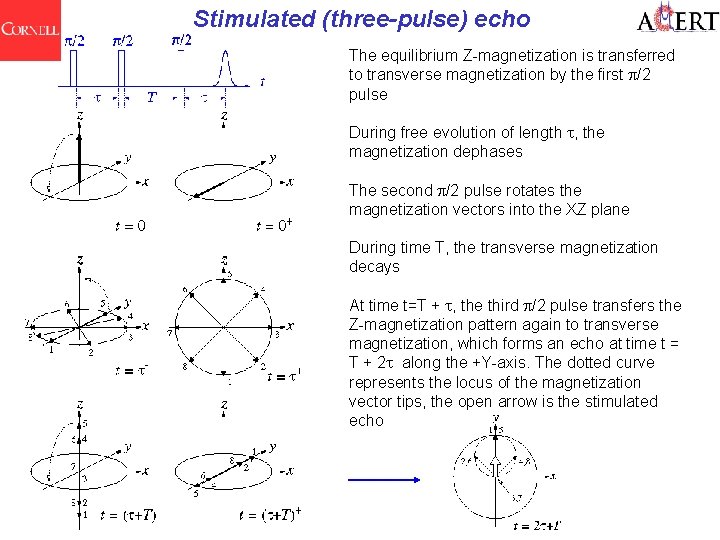
Stimulated (three-pulse) echo The equilibrium Z-magnetization is transferred to transverse magnetization by the first /2 pulse During free evolution of length , the magnetization dephases The second /2 pulse rotates the magnetization vectors into the XZ plane During time T, the transverse magnetization decays At time t=T + , the third /2 pulse transfers the Z-magnetization pattern again to transverse magnetization, which forms an echo at time t = T + 2 along the +Y-axis. The dotted curve represents the locus of the magnetization vector tips, the open arrow is the stimulated echo
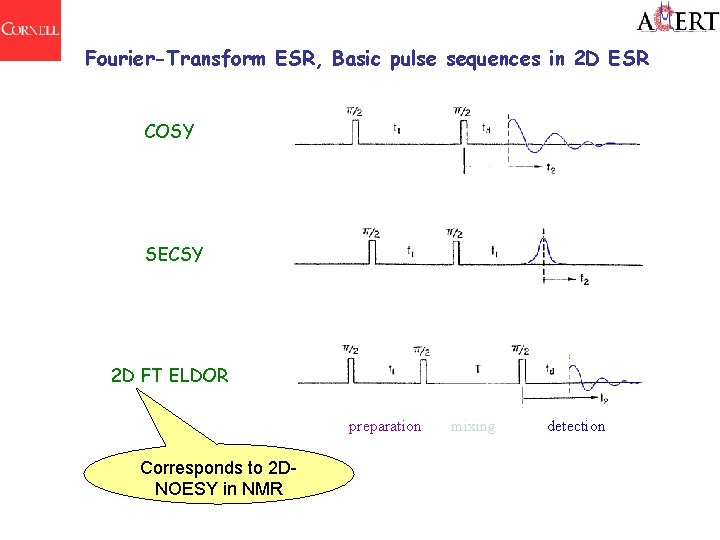
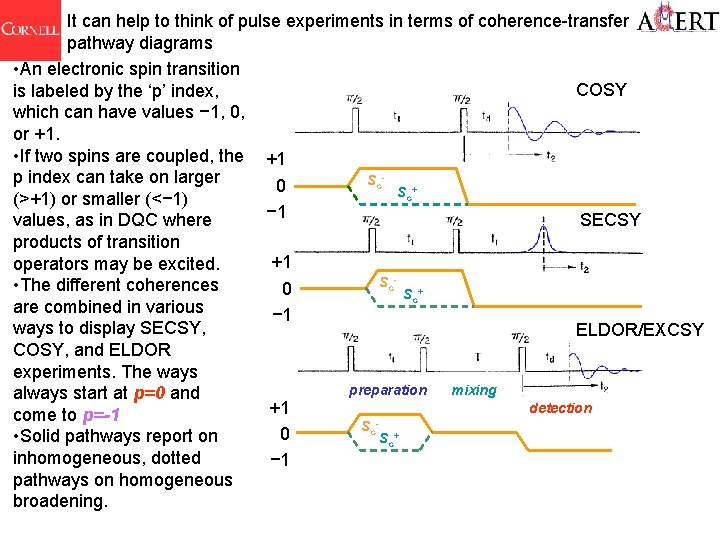
Fourier-Transform ESR, Basic pulse sequences in 2 D ESR COSY SECSY 2 D FT ELDOR preparation Corresponds to 2 DNOESY in NMR mixing detection
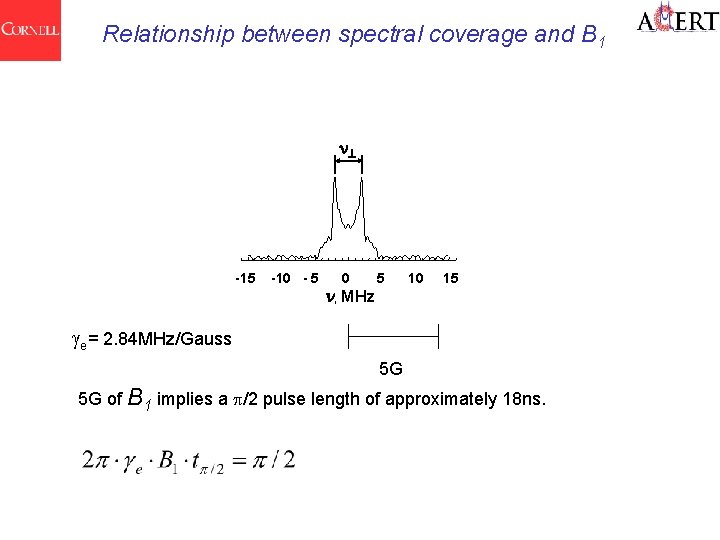
Relationship between spectral coverage and B 1 n -15 -10 - 5 0 n, MHz 5 10 15 e= 2. 84 MHz/Gauss 5 G 5 G of B 1 implies a /2 pulse length of approximately 18 ns.
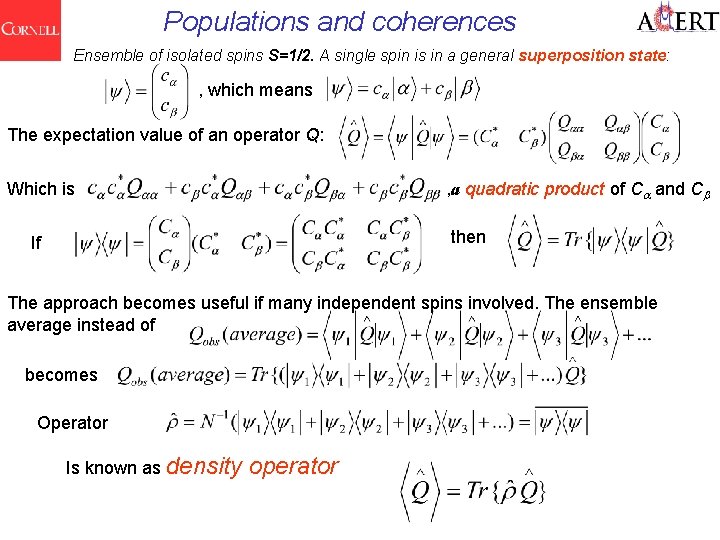
Populations and coherences Ensemble of isolated spins S=1/2. A single spin is in a general superposition state: , which means The expectation value of an operator Q: , a quadratic product of C and C Which is then If The approach becomes useful if many independent spins involved. The ensemble average instead of becomes Operator Is known as density operator
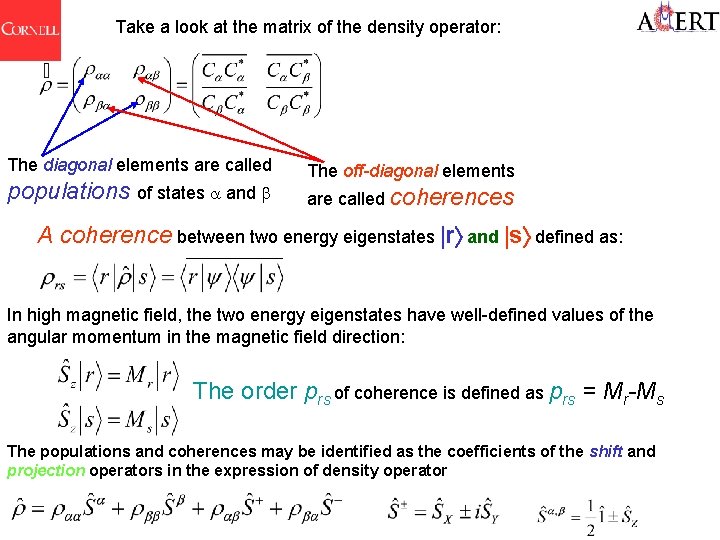
Take a look at the matrix of the density operator: The diagonal elements are called populations of states and The off-diagonal elements are called coherences A coherence between two energy eigenstates r and s defined as: In high magnetic field, the two energy eigenstates have well-defined values of the angular momentum in the magnetic field direction: The order prs of coherence is defined as prs = Mr-Ms The populations and coherences may be identified as the coefficients of the shift and projection operators in the expression of density operator
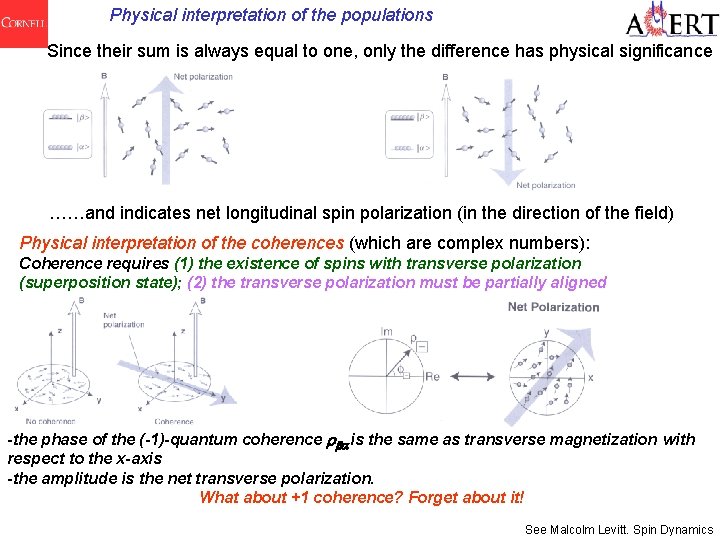
Physical interpretation of the populations Since their sum is always equal to one, only the difference has physical significance ……and indicates net longitudinal spin polarization (in the direction of the field) Physical interpretation of the coherences (which are complex numbers): Coherence requires (1) the existence of spins with transverse polarization (superposition state); (2) the transverse polarization must be partially aligned -the phase of the (-1)-quantum coherence is the same as transverse magnetization with respect to the x-axis -the amplitude is the net transverse polarization. What about +1 coherence? Forget about it! See Malcolm Levitt. Spin Dynamics
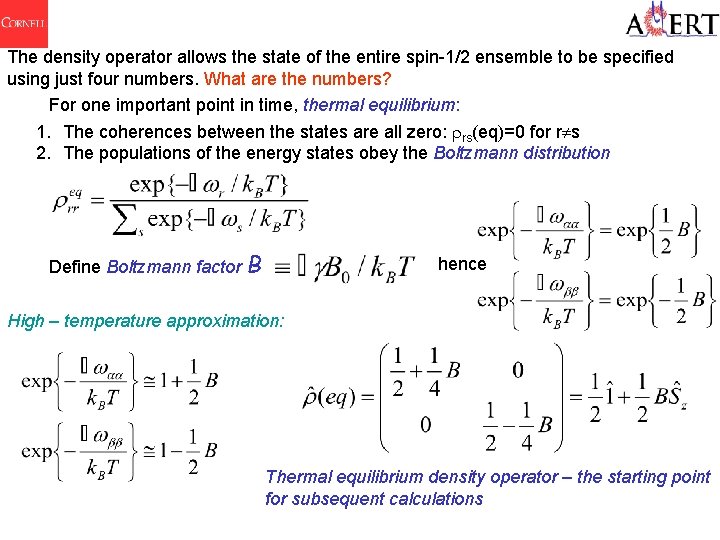
The density operator allows the state of the entire spin-1/2 ensemble to be specified using just four numbers. What are the numbers? For one important point in time, thermal equilibrium: 1. The coherences between the states are all zero: rs(eq)=0 for r s 2. The populations of the energy states obey the Boltzmann distribution Define Boltzmann factor B hence High – temperature approximation: Thermal equilibrium density operator – the starting point for subsequent calculations
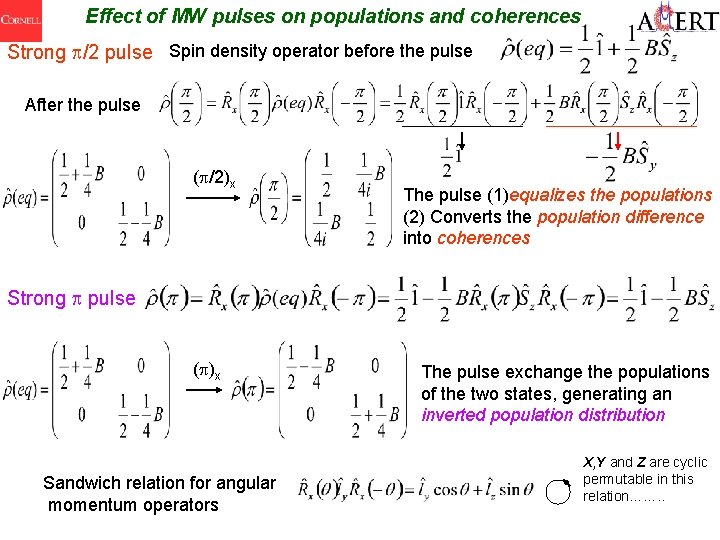
Effect of MW pulses on populations and coherences Strong /2 pulse Spin density operator before the pulse After the pulse ( /2)x The pulse (1)equalizes the populations (2) Converts the population difference into coherences Strong pulse ( )x Sandwich relation for angular momentum operators The pulse exchange the populations of the two states, generating an inverted population distribution X, Y and Z are cyclic permutable in this relation……. .
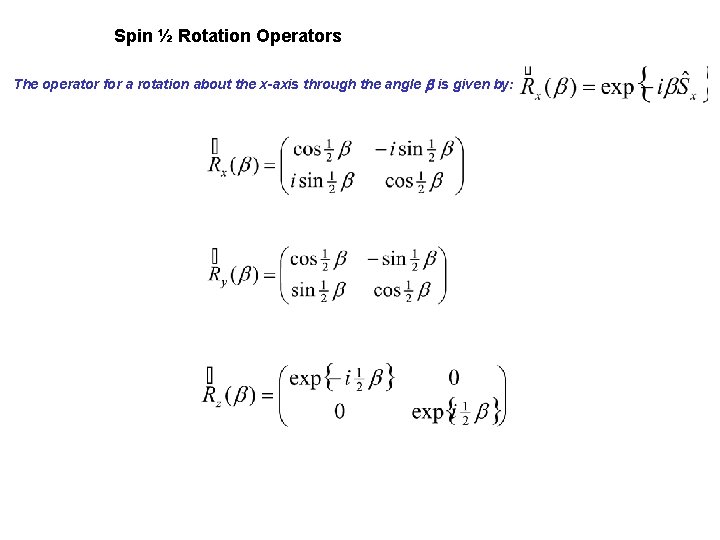
Spin ½ Rotation Operators The operator for a rotation about the x-axis through the angle is given by:
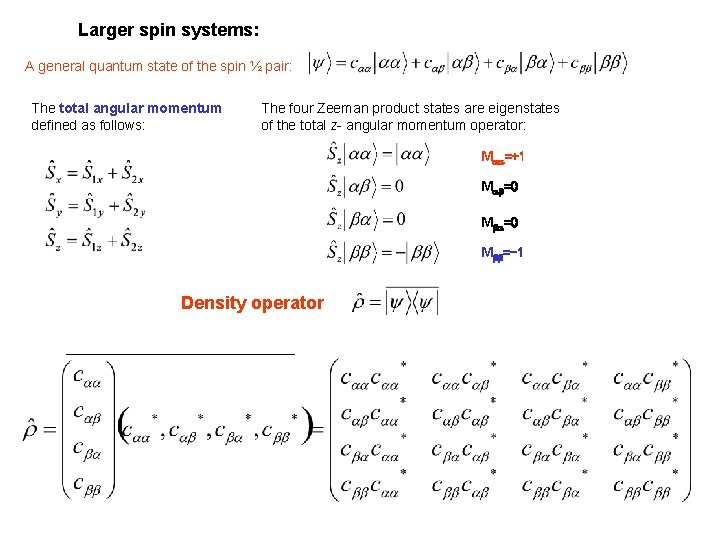
Larger spin systems: A general quantum state of the spin ½ pair: The total angular momentum defined as follows: The four Zeeman product states are eigenstates of the total z- angular momentum operator: Maa=+1 Mab=0 Mba=0 Mbb=-1 Density operator
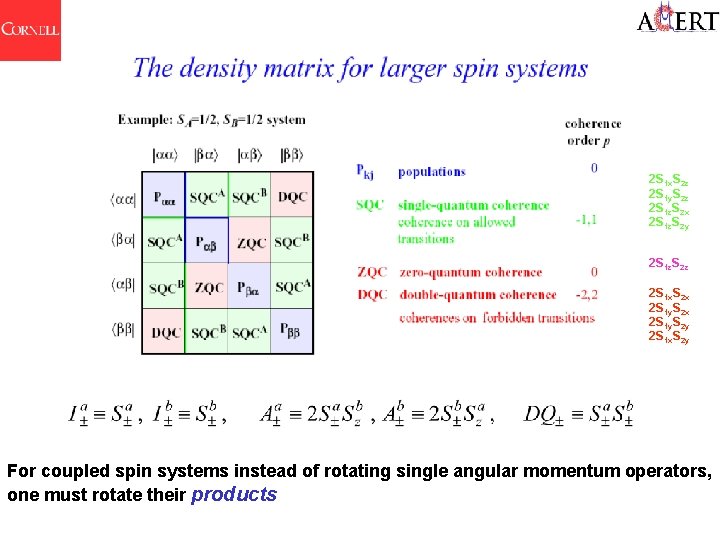
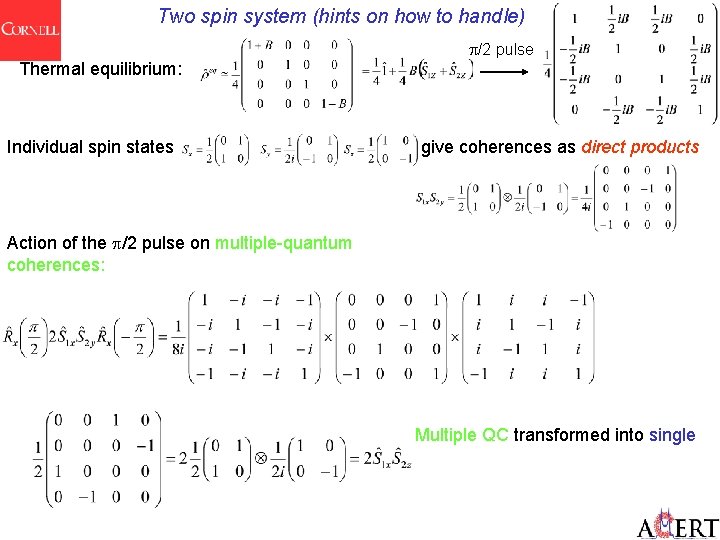
2 S 1 x. S 2 z 2 S 1 y. S 2 z 2 S 1 z. S 2 x 2 S 1 z. S 2 y 2 S 1 z. S 2 z 2 S 1 x. S 2 x 2 S 1 y. S 2 y 2 S 1 x. S 2 y For coupled spin systems instead of rotating single angular momentum operators, one must rotate their products
Two spin system (hints on how to handle) /2 pulse Thermal equilibrium: Individual spin states give coherences as direct products Action of the /2 pulse on multiple-quantum coherences: Multiple QC transformed into single
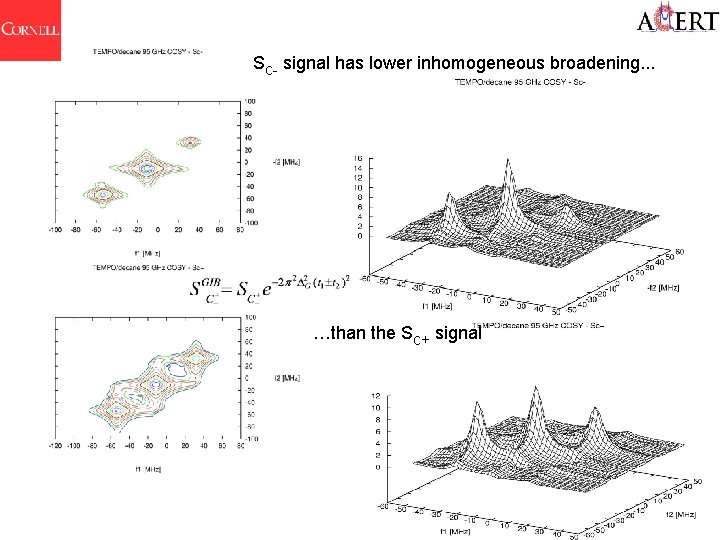
It can help to think of pulse experiments in terms of coherence-transfer pathway diagrams • An electronic spin transition COSY is labeled by the ‘p’ index, which can have values − 1, 0, or +1. • If two spins are coupled, the +1 p index can take on larger Sc 0 Sc+ (>+1) or smaller (<− 1) − 1 SECSY values, as in DQC where products of transition operators may be excited. • The different coherences are combined in various ways to display SECSY, COSY, and ELDOR experiments. The ways always start at p=0 and come to p=-1 • Solid pathways report on inhomogeneous, dotted pathways on homogeneous broadening. +1 0 − 1 Sc- Sc+ ELDOR/EXCSY preparation mixing detection Sc- Sc+
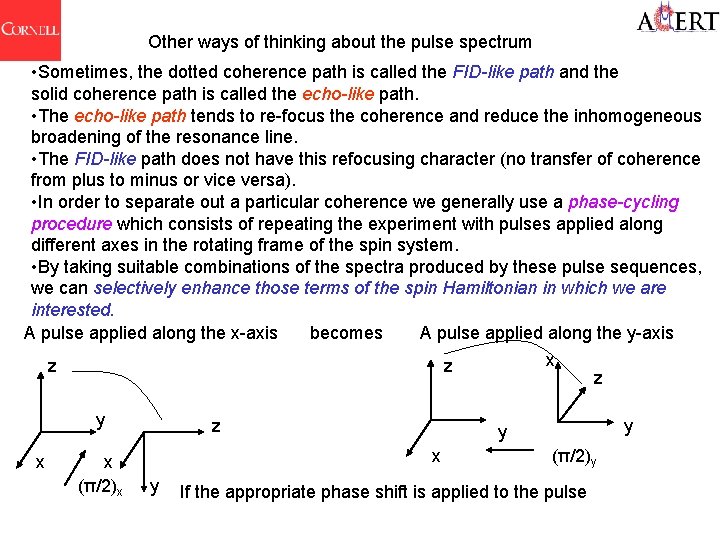
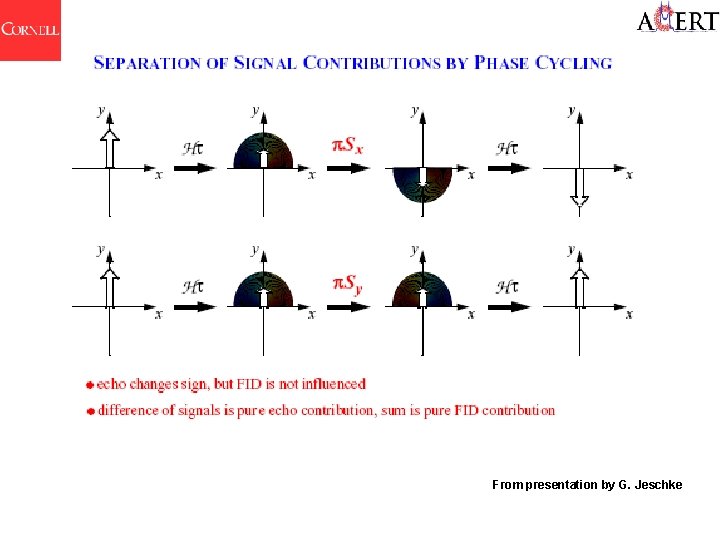
Other ways of thinking about the pulse spectrum • Sometimes, the dotted coherence path is called the FID-like path and the solid coherence path is called the echo-like path. • The echo-like path tends to re-focus the coherence and reduce the inhomogeneous broadening of the resonance line. • The FID-like path does not have this refocusing character (no transfer of coherence from plus to minus or vice versa). • In order to separate out a particular coherence we generally use a phase-cycling procedure which consists of repeating the experiment with pulses applied along different axes in the rotating frame of the spin system. • By taking suitable combinations of the spectra produced by these pulse sequences, we can selectively enhance those terms of the spin Hamiltonian in which we are interested. A pulse applied along the x-axis becomes A pulse applied along the y-axis x z z z y x x (π/2)x z x y y y (π/2)y If the appropriate phase shift is applied to the pulse
From presentation by G. Jeschke
Sc- signal has lower inhomogeneous broadening. . . …than the Sc+ signal
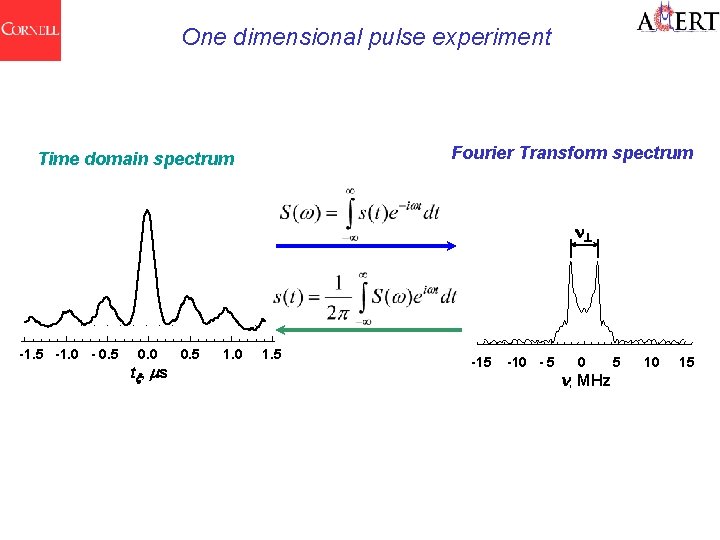
One dimensional pulse experiment Fourier Transform spectrum Time domain spectrum n -1. 5 -1. 0 - 0. 5 0. 0 t , m s 0. 5 1. 0 1. 5 -10 - 5 0 n, MHz 5 10 15
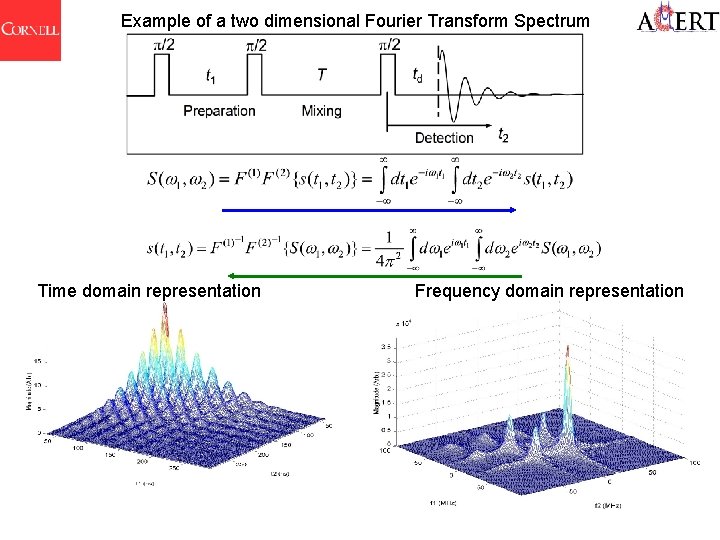
Example of a two dimensional Fourier Transform Spectrum Easy answer (specific goal): simulate and fit 2 D-FT-ESR spectra 16 -PC in pure DPPC vescicles Time domain representation Frequency domain representation General goal: 2 D methods capabilities to study biological systems
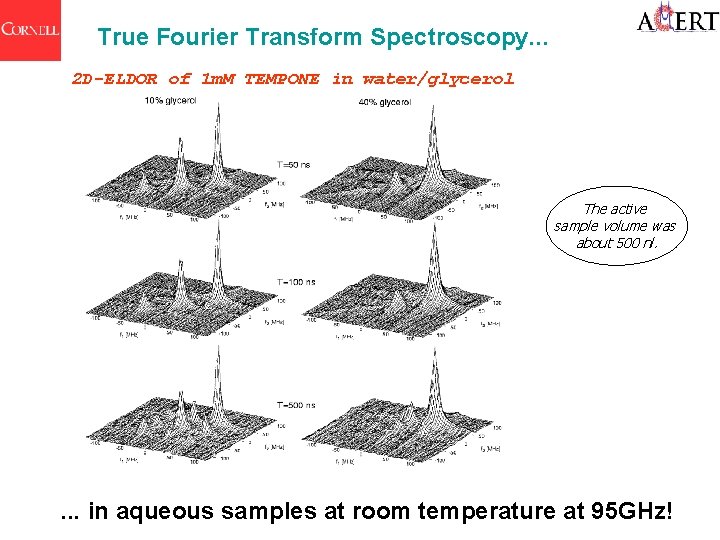
True Fourier Transform Spectroscopy. . . 2 D-ELDOR of 1 m. M TEMPONE in water/glycerol The active sample volume was about 500 nl. . in aqueous samples at room temperature at 95 GHz!
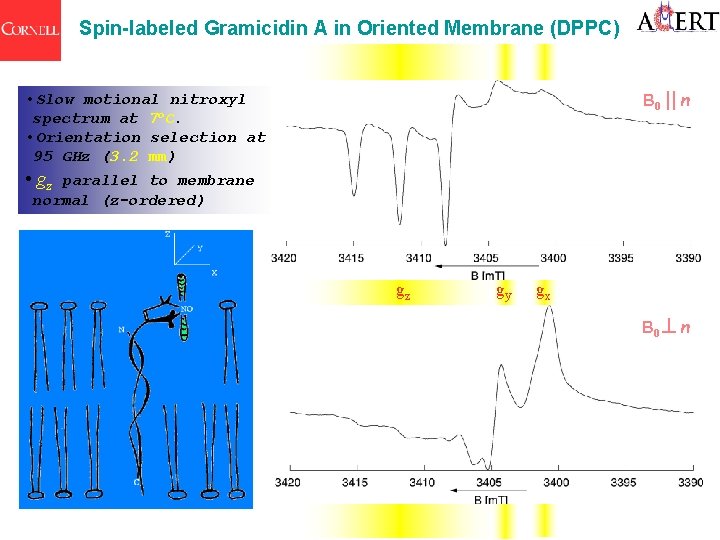
Spin-labeled Gramicidin A in Oriented Membrane (DPPC) B 0 || n • Slow motional nitroxyl spectrum at 7 o. C. • Orientation selection at 95 GHz (3. 2 mm) • gz parallel to membrane normal (z-ordered) gz gy gx B 0 n
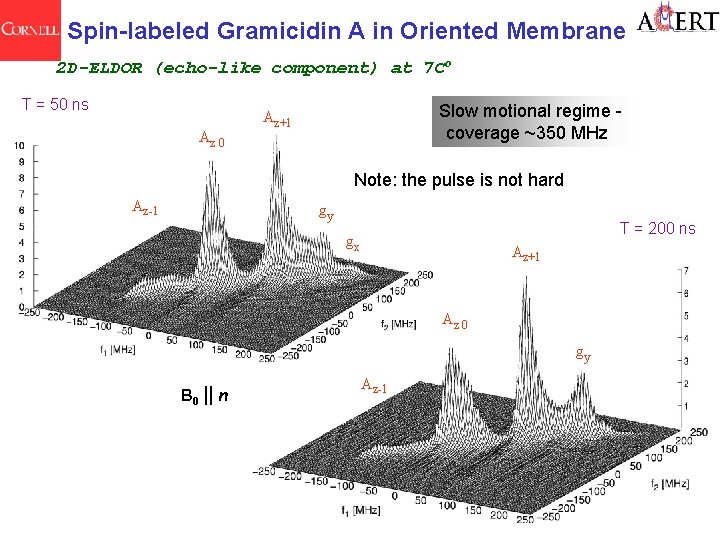
Spin-labeled Gramicidin A in Oriented Membrane 2 D-ELDOR (echo-like component) at 7 Co T = 50 ns Az 0 Slow motional regime coverage ~350 MHz Az+1 Note: the pulse is not hard Az-1 gy T = 200 ns gx Az+1 Az 0 gy B 0 || n Az-1
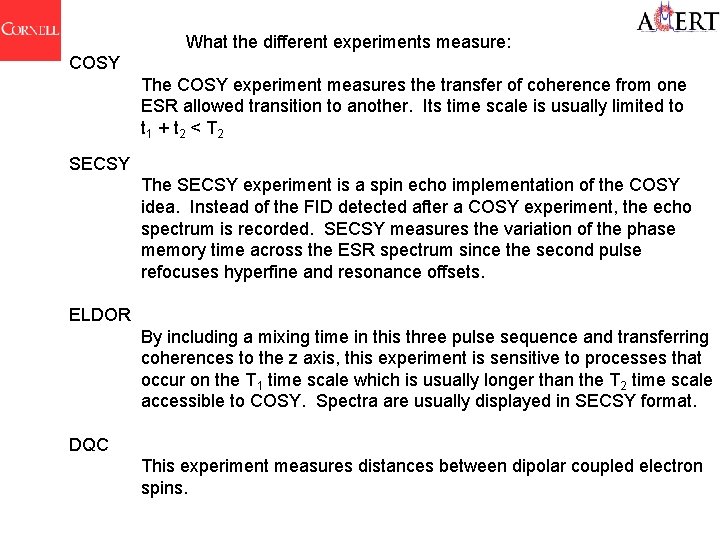
What the different experiments measure: COSY The COSY experiment measures the transfer of coherence from one ESR allowed transition to another. Its time scale is usually limited to t 1 + t 2 < T 2 SECSY The SECSY experiment is a spin echo implementation of the COSY idea. Instead of the FID detected after a COSY experiment, the echo spectrum is recorded. SECSY measures the variation of the phase memory time across the ESR spectrum since the second pulse refocuses hyperfine and resonance offsets. ELDOR By including a mixing time in this three pulse sequence and transferring coherences to the z axis, this experiment is sensitive to processes that occur on the T 1 time scale which is usually longer than the T 2 time scale accessible to COSY. Spectra are usually displayed in SECSY format. DQC This experiment measures distances between dipolar coupled electron spins.
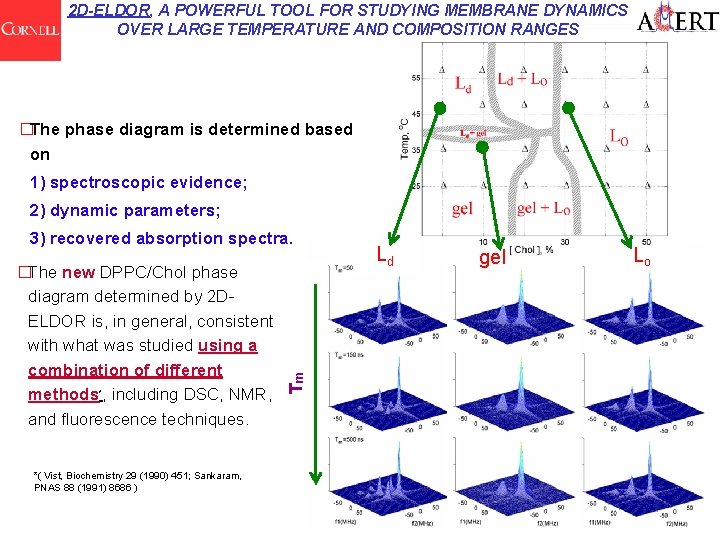
2 D-ELDOR, A POWERFUL TOOL FOR STUDYING MEMBRANE DYNAMICS OVER LARGE TEMPERATURE AND COMPOSITION RANGES �The phase diagram is determined based on 1) spectroscopic evidence; 2) dynamic parameters; �The new DPPC/Chol phase diagram determined by 2 DELDOR is, in general, consistent with what was studied using a combination of different methods*, including DSC, NMR, and fluorescence techniques. *( Vist, Biochemistry 29 (1990) 451; Sankaram, PNAS 88 (1991) 8686 ) Tm 3) recovered absorption spectra. Ld gel Lo
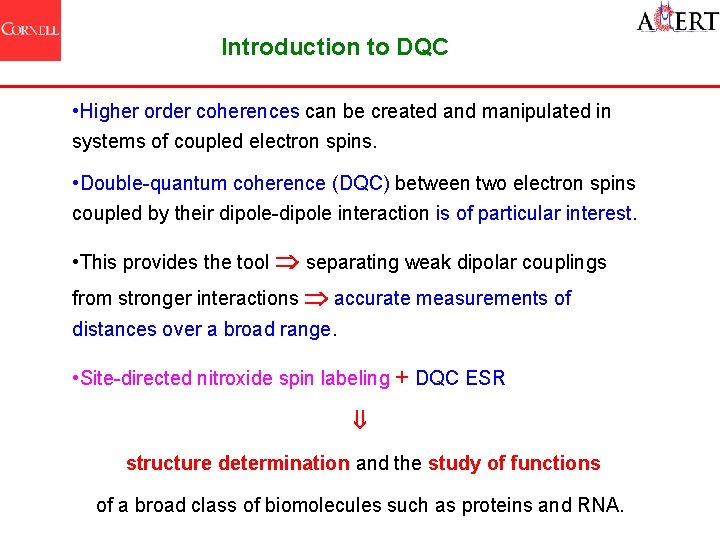
Introduction to DQC • Higher order coherences can be created and manipulated in systems of coupled electron spins. • Double-quantum coherence (DQC) between two electron spins coupled by their dipole-dipole interaction is of particular interest. • This provides the tool separating weak dipolar couplings from stronger interactions accurate measurements of distances over a broad range. • Site-directed nitroxide spin labeling + DQC ESR structure determination and the study of functions of a broad class of biomolecules such as proteins and RNA.
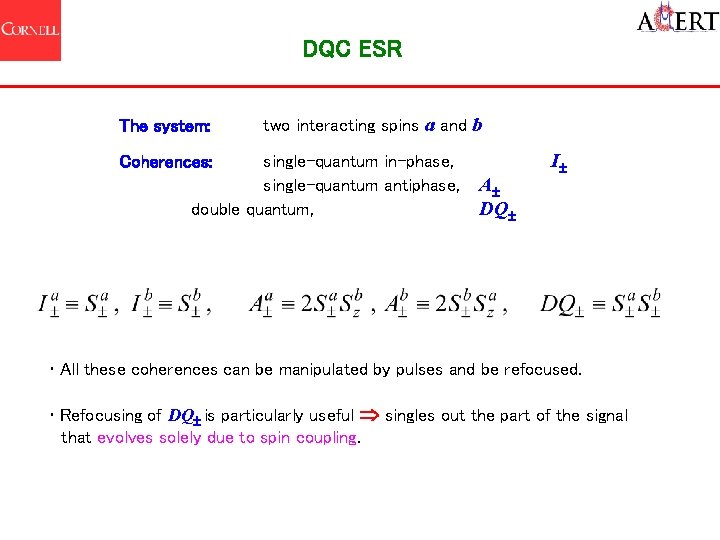
DQC ESR The system: two interacting spins a and b Coherences: single-quantum in-phase, single-quantum antiphase, double quantum, A DQ I • All these coherences can be manipulated by pulses and be refocused. • Refocusing of DQ is particularly useful singles out the part of the signal that evolves solely due to spin coupling.
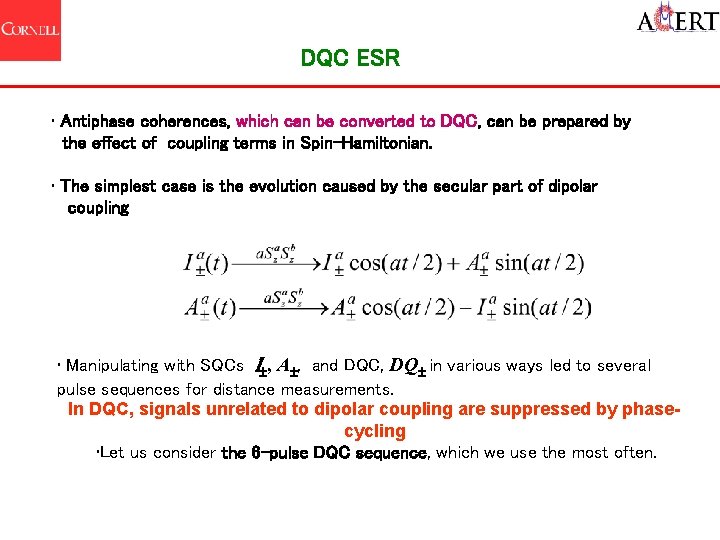
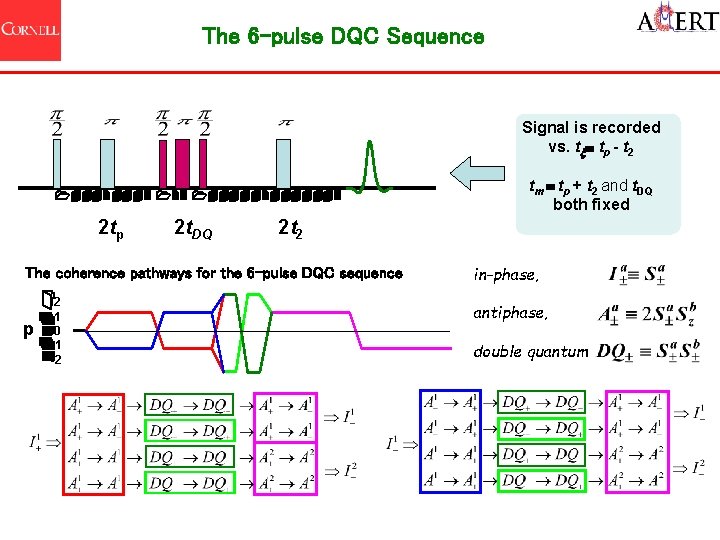
DQC ESR • Antiphase coherences, which can be converted to DQC, can be prepared by the effect of coupling terms in Spin-Hamiltonian. • The simplest case is the evolution caused by the secular part of dipolar coupling • Manipulating with SQCs I , A , and DQC, DQ in various ways led to several pulse sequences for distance measurements. In DQC, signals unrelated to dipolar coupling are suppressed by phasecycling • Let us consider the 6 -pulse DQC sequence, which we use the most often.
The 6 -pulse DQC Sequence Signal is recorded vs. t tp - t 2 2 tp 2 t. DQ 2 t 2 The coherence pathways for the 6 -pulse DQC sequence p 2 1 0 -1 -2 tm tp + t 2 and t. DQ both fixed in-phase, antiphase, double quantum
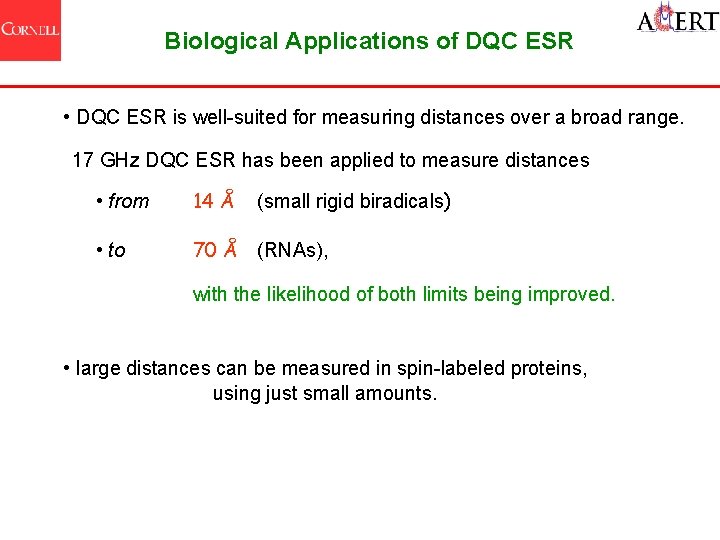
Biological Applications of DQC ESR • DQC ESR is well-suited for measuring distances over a broad range. 17 GHz DQC ESR has been applied to measure distances • from 14 Å • to 70 Å (RNAs), (small rigid biradicals) with the likelihood of both limits being improved. • large distances can be measured in spin-labeled proteins, using just small amounts.
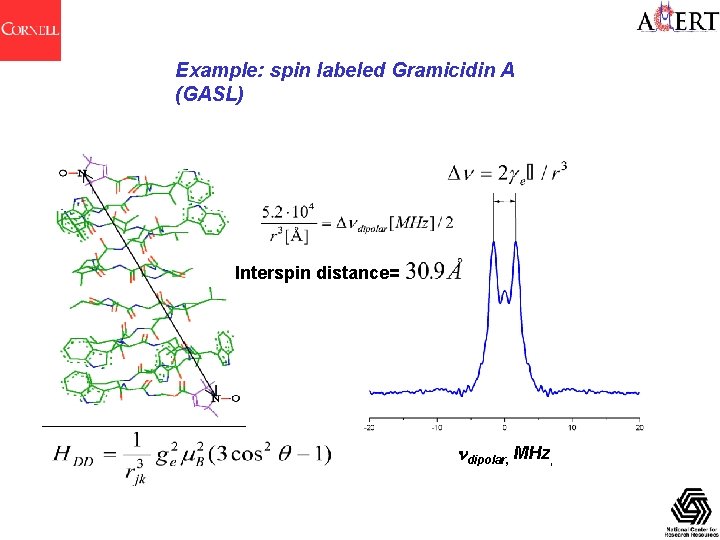
Example: spin labeled Gramicidin A (GASL) Interspin distance= ndipolar, MHz,
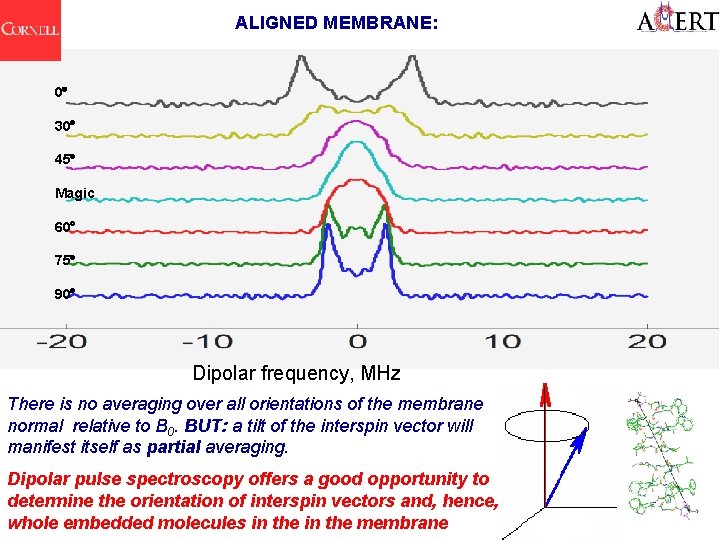
ALIGNED MEMBRANE: 0 30 45 Magic 60 75 90 Dipolar frequency, MHz There is no averaging over all orientations of the membrane normal relative to B 0. BUT: a tilt of the interspin vector will manifest itself as partial averaging. Dipolar pulse spectroscopy offers a good opportunity to determine the orientation of interspin vectors and, hence, whole embedded molecules in the membrane n
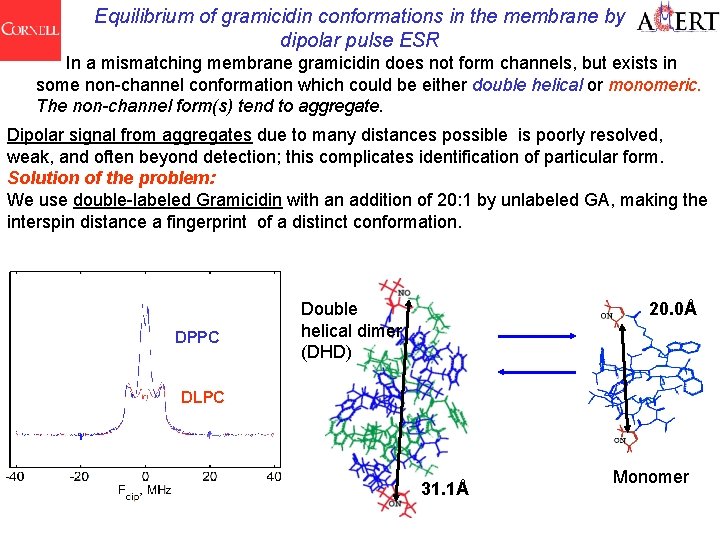
Equilibrium of gramicidin conformations in the membrane by dipolar pulse ESR In a mismatching membrane gramicidin does not form channels, but exists in some non-channel conformation which could be either double helical or monomeric. The non-channel form(s) tend to aggregate. Dipolar signal from aggregates due to many distances possible is poorly resolved, weak, and often beyond detection; this complicates identification of particular form. Solution of the problem: We use double-labeled Gramicidin with an addition of 20: 1 by unlabeled GA, making the interspin distance a fingerprint of a distinct conformation. DPPC Double helical dimer (DHD) 20. 0Å DLPC 31. 1Å Monomer
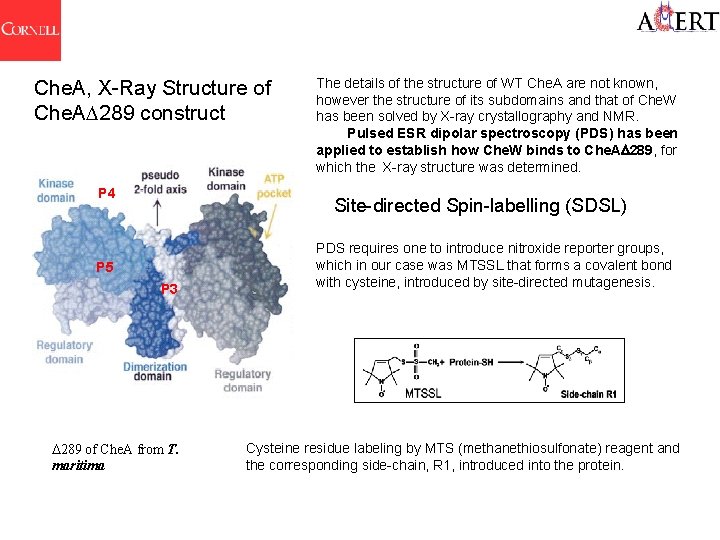
Che. A, X-Ray Structure of Che. A 289 construct P 4 The details of the structure of WT Che. A are not known, however the structure of its subdomains and that of Che. W has been solved by X-ray crystallography and NMR. Pulsed ESR dipolar spectroscopy (PDS) has been applied to establish how Che. W binds to Che. A 289, for which the X-ray structure was determined. Site-directed Spin-labelling (SDSL) P 5 P 3 289 of Che. A from T. maritima PDS requires one to introduce nitroxide reporter groups, which in our case was MTSSL that forms a covalent bond with cysteine, introduced by site-directed mutagenesis. Cysteine residue labeling by MTS (methanethiosulfonate) reagent and the corresponding side-chain, R 1, introduced into the protein.
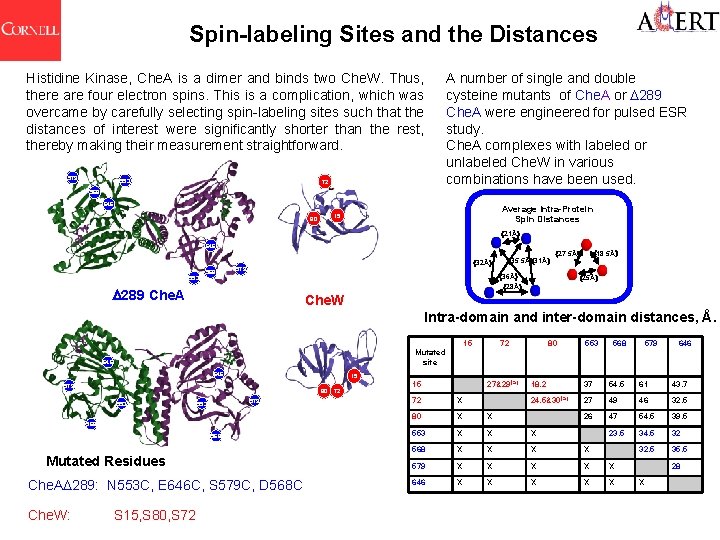
Spin-labeling Sites and the Distances Histidine Kinase, Che. A is a dimer and binds two Che. W. Thus, there are four electron spins. This is a complication, which was overcame by carefully selecting spin-labeling sites such that the distances of interest were significantly shorter than the rest, thereby making their measurement straightforward. 579 553 A number of single and double cysteine mutants of Che. A or 289 Che. A were engineered for pulsed ESR study. Che. A complexes with labeled or unlabeled Che. W in various combinations have been used. 72 568 646 Average Intra-Protein Spin Distances 15 80 21Å 646 553 568 32Å 579 35. 5Å 31Å 18. 5Å 27. 5Å 36Å 25Å 289 Che. A Che. W Intra-domain and inter-domain distances, Å. 15 646 15 579 80 553 579 553 568 Mutated Residues Che. A 289: N 553 C, E 646 C, S 579 C, D 568 C Che. W: 72 80 553 568 579 646 Mutated site S 15, S 80, S 72 72 15 27&29(a) 18. 2 37 54. 5 61 43. 7 24. 5&30 (a) 27 49 46 32. 5 26 47 54. 5 39. 5 23. 5 34. 5 32 32. 5 35. 5 72 X 80 X X 553 X X X 568 X X 579 X X X 646 X X X 28 X
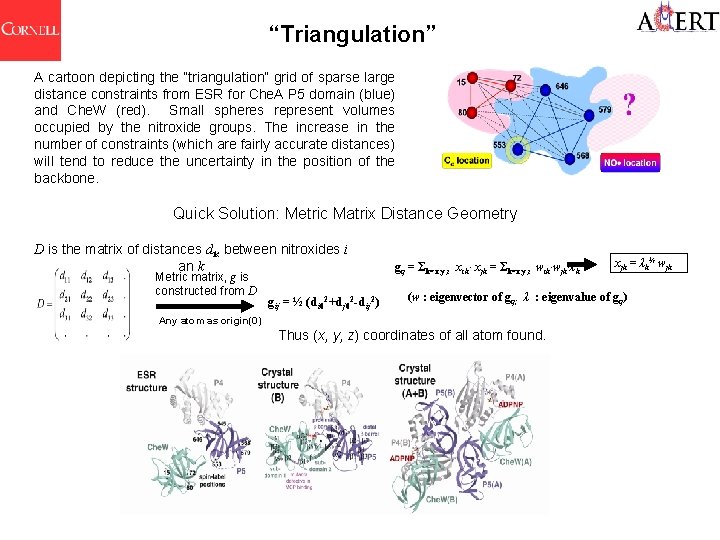
“Triangulation” A cartoon depicting the “triangulation” grid of sparse large distance constraints from ESR for Che. A P 5 domain (blue) and Che. W (red). Small spheres represent volumes occupied by the nitroxide groups. The increase in the number of constraints (which are fairly accurate distances) will tend to reduce the uncertainty in the position of the backbone. Quick Solution: Metric Matrix Distance Geometry D is the matrix of distances dik between nitroxides i an k Metric matrix, g is constructed from D gij = ½ (di 02+dj 02 -dij 2) gij = Σk=x, y, z xik· xjk = Σk=x, y, z wik·wjk·λk xjk = λk½ wjk (w : eigenvector of gij; λ : eigenvalue of gij) Any atom as origin(0) Thus (x, y, z) coordinates of all atom found.
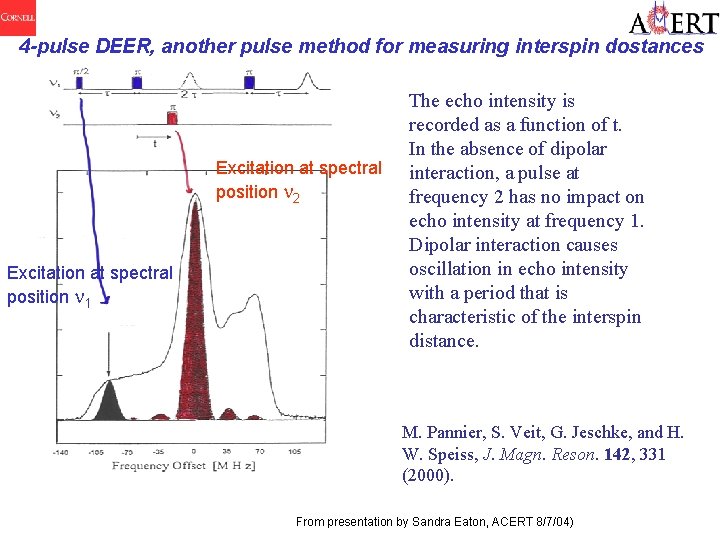
4 -pulse DEER, another pulse method for measuring interspin dostances Excitation at spectral position 2 Excitation at spectral position 1 The echo intensity is recorded as a function of t. In the absence of dipolar interaction, a pulse at frequency 2 has no impact on echo intensity at frequency 1. Dipolar interaction causes oscillation in echo intensity with a period that is characteristic of the interspin distance. M. Pannier, S. Veit, G. Jeschke, and H. W. Speiss, J. Magn. Reson. 142, 331 (2000). From presentation by Sandra Eaton, ACERT 8/7/04)
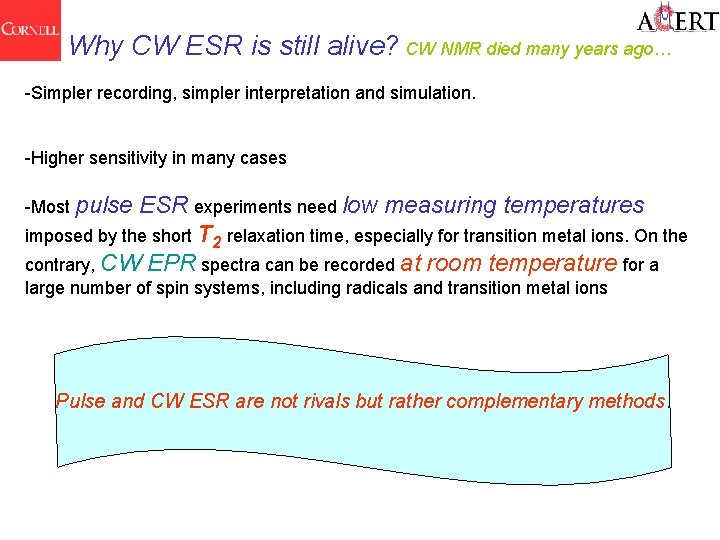
Why CW ESR is still alive? CW NMR died many years ago… -Simpler recording, simpler interpretation and simulation. -Higher sensitivity in many cases -Most pulse ESR experiments need low measuring temperatures imposed by the short T 2 relaxation time, especially for transition metal ions. On the contrary, CW EPR spectra can be recorded at room temperature for a large number of spin systems, including radicals and transition metal ions Pulse and CW ESR are not rivals but rather complementary methods.
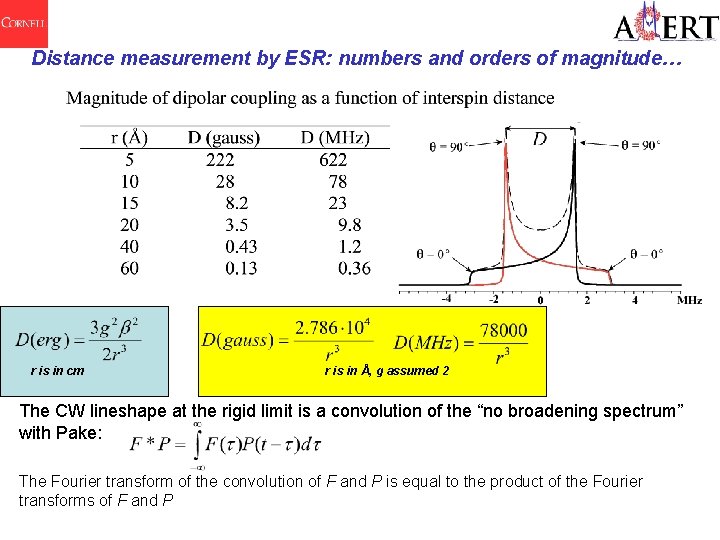
Distance measurement by ESR: numbers and orders of magnitude… r is in cm r is in Å, g assumed 2 The CW lineshape at the rigid limit is a convolution of the “no broadening spectrum” with Pake: The Fourier transform of the convolution of F and P is equal to the product of the Fourier transforms of F and P
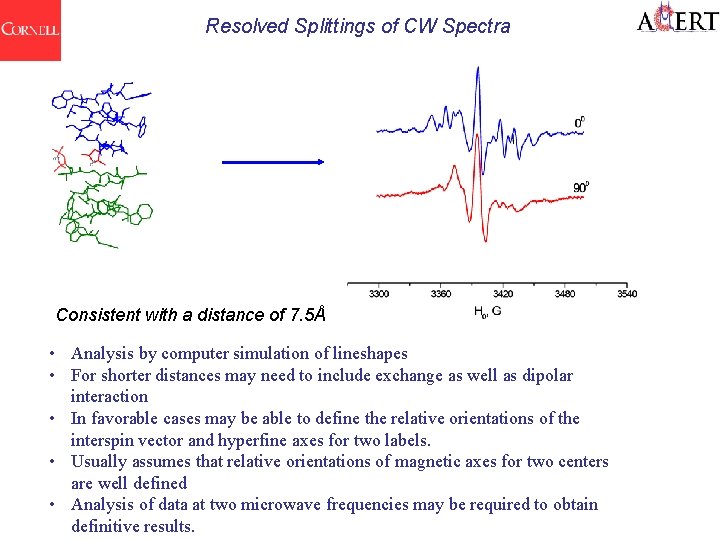
Resolved Splittings of CW Spectra Consistent with a distance of 7. 5Å • Analysis by computer simulation of lineshapes • For shorter distances may need to include exchange as well as dipolar interaction • In favorable cases may be able to define the relative orientations of the interspin vector and hyperfine axes for two labels. • Usually assumes that relative orientations of magnetic axes for two centers are well defined • Analysis of data at two microwave frequencies may be required to obtain definitive results.
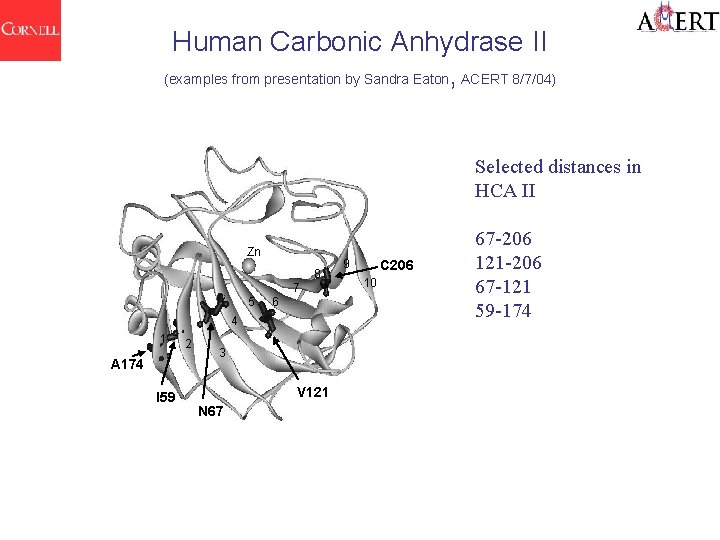
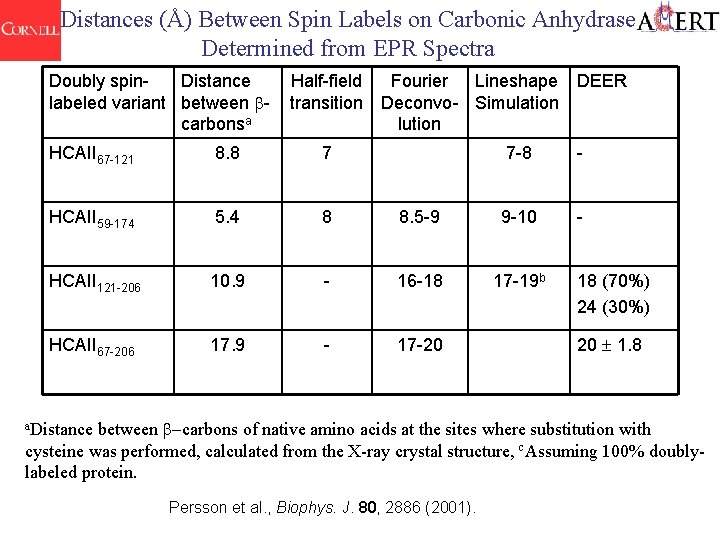
Human Carbonic Anhydrase II (examples from presentation by Sandra Eaton, ACERT 8/7/04) Selected distances in HCA II Zn 8 7 5 6 4 1 A 174 I 59 2 3 V 121 N 67 9 C 206 10 67 -206 121 -206 67 -121 59 -174
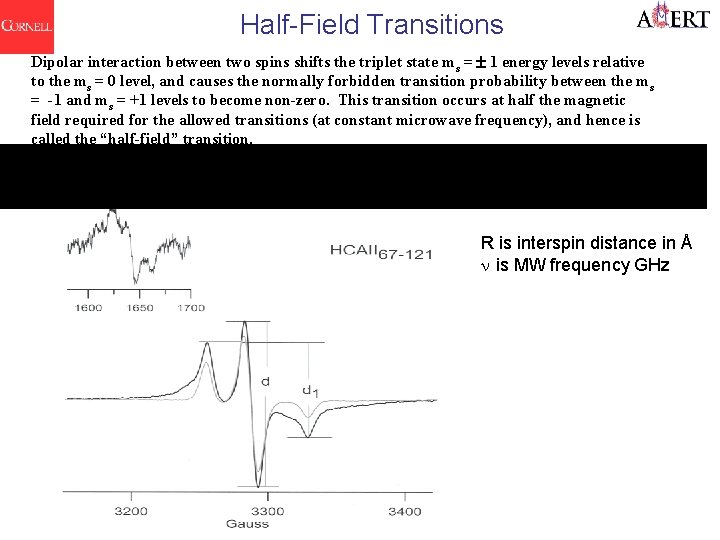
Half-Field Transitions Dipolar interaction between two spins shifts the triplet state ms = 1 energy levels relative to the ms = 0 level, and causes the normally forbidden transition probability between the ms = -1 and ms = +1 levels to become non-zero. This transition occurs at half the magnetic field required for the allowed transitions (at constant microwave frequency), and hence is called the “half-field” transition. R is interspin distance in Å is MW frequency GHz
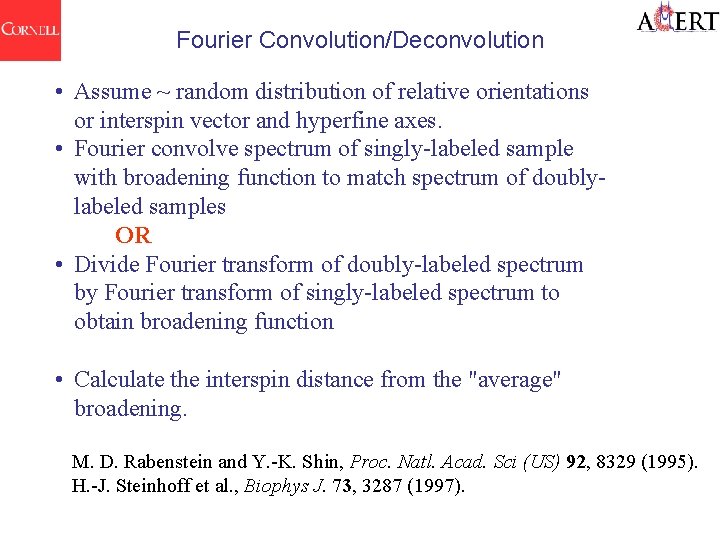
Fourier Convolution/Deconvolution • Assume ~ random distribution of relative orientations or interspin vector and hyperfine axes. • Fourier convolve spectrum of singly-labeled sample with broadening function to match spectrum of doublylabeled samples OR • Divide Fourier transform of doubly-labeled spectrum by Fourier transform of singly-labeled spectrum to obtain broadening function • Calculate the interspin distance from the "average" broadening. M. D. Rabenstein and Y. -K. Shin, Proc. Natl. Acad. Sci (US) 92, 8329 (1995). H. -J. Steinhoff et al. , Biophys J. 73, 3287 (1997).
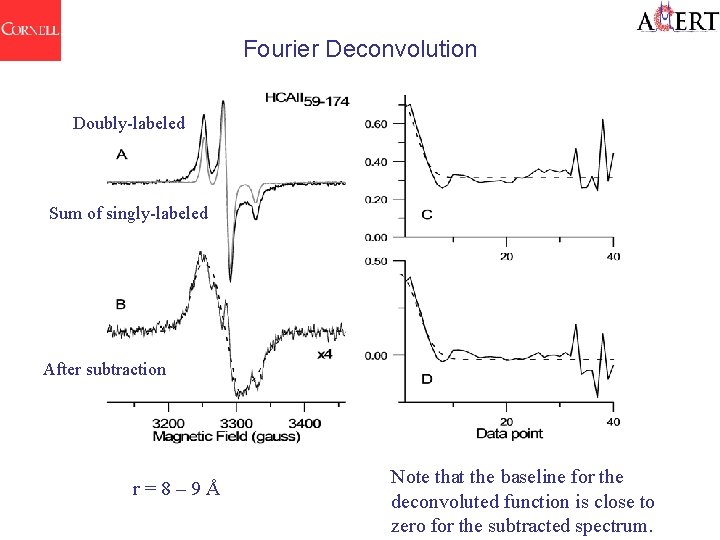
Fourier Deconvolution Doubly-labeled Sum of singly-labeled After subtraction r=8– 9Å Note that the baseline for the deconvoluted function is close to zero for the subtracted spectrum.
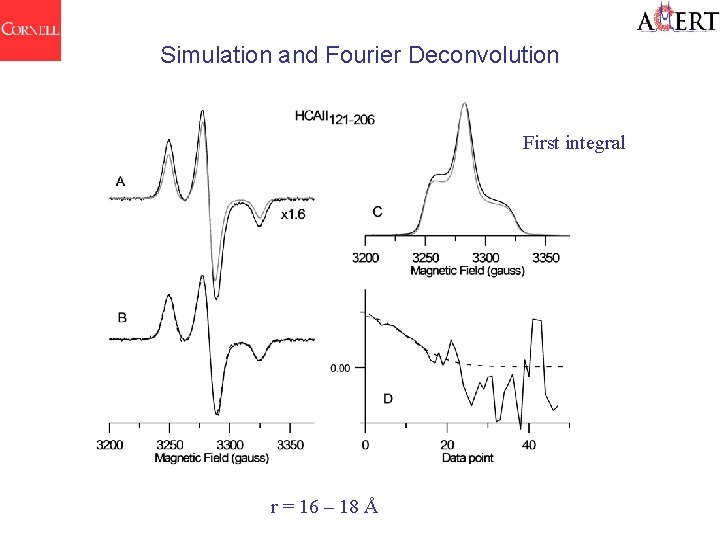
Simulation and Fourier Deconvolution First integral r = 16 – 18 Å
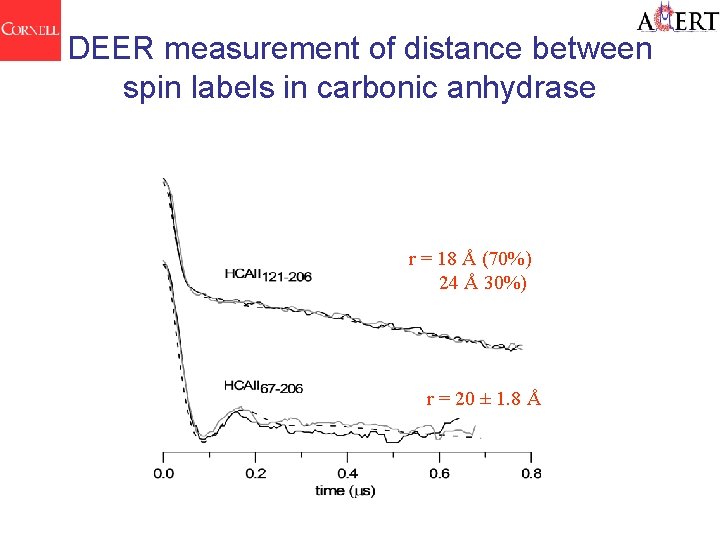
DEER measurement of distance between spin labels in carbonic anhydrase r = 18 Å (70%) 24 Å 30%) r = 20 ± 1. 8 Å
Distances (Å) Between Spin Labels on Carbonic Anhydrase Determined from EPR Spectra Doubly spin. Distance labeled variant between carbonsa Half-field transition HCAII 67 -121 8. 8 7 HCAII 59 -174 5. 4 8 HCAII 121 -206 10. 9 HCAII 67 -206 17. 9 Fourier Lineshape Deconvo- Simulation lution DEER 7 -8 - 8. 5 -9 9 -10 - - 16 -18 17 -19 b - 17 -20 18 (70%) 24 (30%) 20 1. 8 between -carbons of native amino acids at the sites where substitution with cysteine was performed, calculated from the X-ray crystal structure, c. Assuming 100% doublylabeled protein. a. Distance Persson et al. , Biophys. J. 80, 2886 (2001).
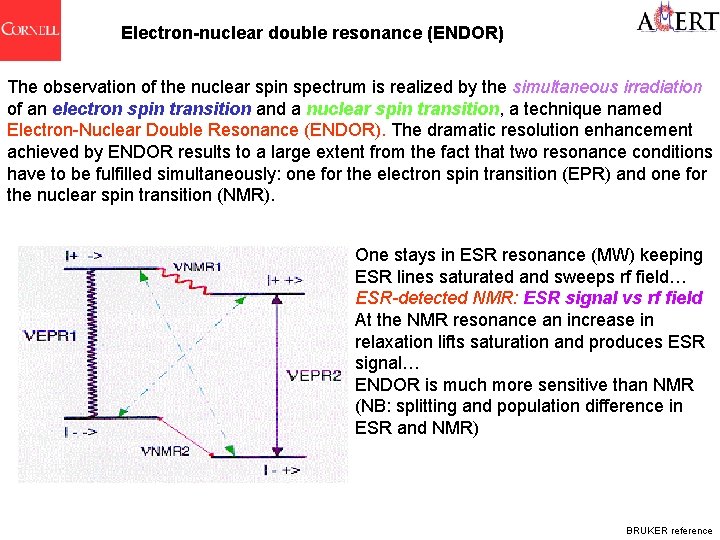
Electron-nuclear double resonance (ENDOR) The observation of the nuclear spin spectrum is realized by the simultaneous irradiation of an electron spin transition and a nuclear spin transition, a technique named Electron-Nuclear Double Resonance (ENDOR). The dramatic resolution enhancement achieved by ENDOR results to a large extent from the fact that two resonance conditions have to be fulfilled simultaneously: one for the electron spin transition (EPR) and one for the nuclear spin transition (NMR). One stays in ESR resonance (MW) keeping ESR lines saturated and sweeps rf field… ESR-detected NMR: ESR signal vs rf field At the NMR resonance an increase in relaxation lifts saturation and produces ESR signal… ENDOR is much more sensitive than NMR (NB: splitting and population difference in ESR and NMR) BRUKER reference
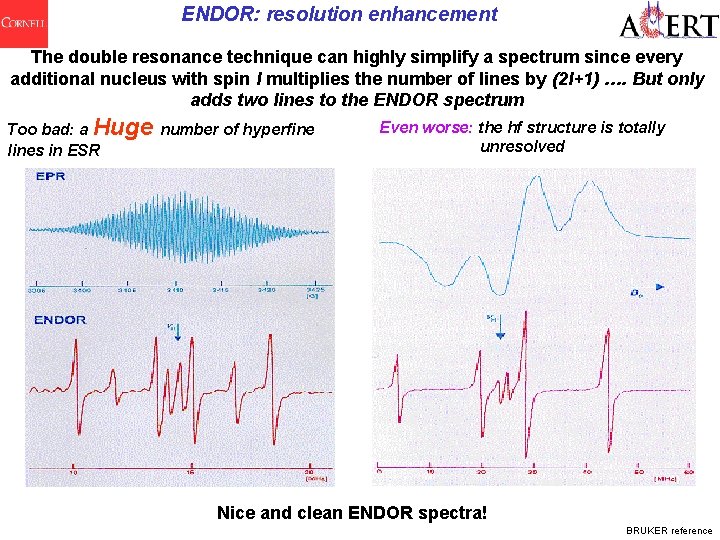
ENDOR: resolution enhancement The double resonance technique can highly simplify a spectrum since every additional nucleus with spin I multiplies the number of lines by (2 I+1) …. But only adds two lines to the ENDOR spectrum Too bad: a Huge number of hyperfine lines in ESR Even worse: the hf structure is totally unresolved Nice and clean ENDOR spectra! BRUKER reference
Useful references for cw and pulse ESR Wertz and Bolton. Electron paramagnetic resonance. Carrington and Mac. Lachlan. Magnetic resonance in chemistry. Slichter (Good general background on NMR and ESR) Principles of magnetic resonance, 3 rd Ed. Schweiger and Jeschke (pulse ESR/EPR) Principles of pulse electron paramagnetic resonance Berliner (Ed. ) (Biological applications of resonance techniques >20 vv. ) Biological Magnetic Resonance, Spin Labeling (vv. 1, 2, 8), Distance measurements (v. 19) Poole (Experimental methods, mostly cw) Electron spin resonance: A comprehensive treatise on experimental techniques