
An Introduction to Dynamic Symbolic Execution and the
An Introduction to Dynamic Symbolic Execution and the KLEE Infrastructure Cristian Cadar Department of Computing Imperial College London 14 th TAROT Summer School UCL, London, 3 July 2018
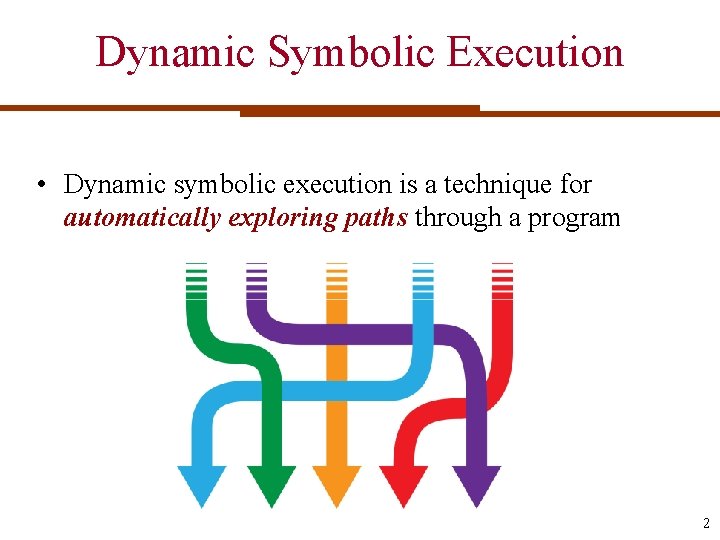
Dynamic Symbolic Execution • Dynamic symbolic execution is a technique for automatically exploring paths through a program 2
Dynamic Symbolic Execution • Received significant interest in the last few years • Many dynamic symbolic execution/concolic tools available as open-source: – CREST, KLEE, SYMBOLIC JPF, etc. • Started to be adopted by industry: – – – Microsoft (SAGE, PEX) NASA (SYMBOLIC JPF, KLEE ) Fujitsu (SYMBOLIC JPF, KLEE/KLOVER) IBM (APOLLO) etc. 3
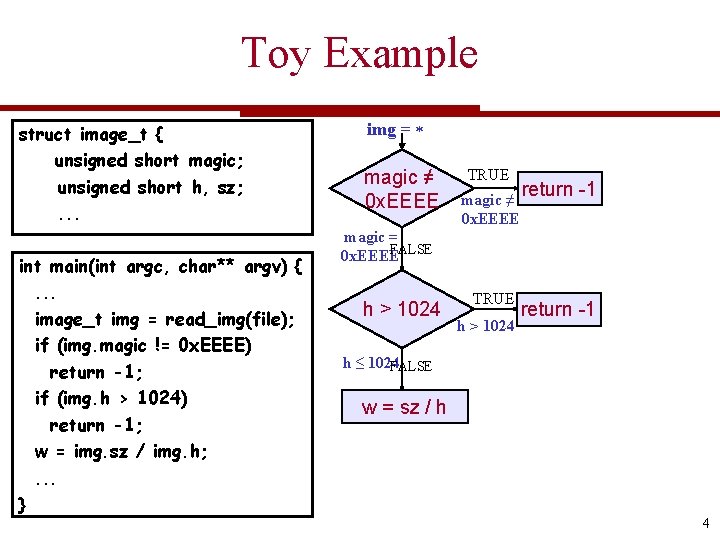
Toy Example struct image_t { unsigned short magic; unsigned short h, sz; . . . int main(int argc, char** argv) {. . . image_t img = read_img(file); if (img. magic != 0 x. EEEE) return -1; if (img. h > 1024) return -1; w = img. sz / img. h; . . . } img = magic ≠ 0 x. EEEE TRUE magic ≠ 0 x. EEEE return -1 magic = FALSE 0 x. EEEE h > 1024 TRUE h > 1024 return -1 h ≤ 1024 FALSE w = sz / h 4
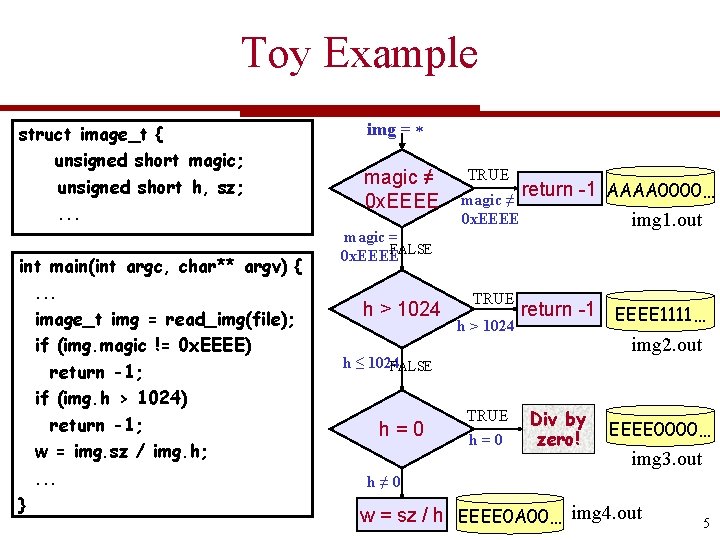
Toy Example struct image_t { unsigned short magic; unsigned short h, sz; . . . int main(int argc, char** argv) {. . . image_t img = read_img(file); if (img. magic != 0 x. EEEE) return -1; if (img. h > 1024) return -1; w = img. sz / img. h; . . . } img = magic ≠ 0 x. EEEE TRUE magic ≠ 0 x. EEEE magic = FALSE 0 x. EEEE h > 1024 TRUE h > 1024 h ≤ 1024 FALSE h=0 TRUE h=0 return -1 AAAA 0000… img 1. out return -1 EEEE 1111… img 2. out Div by zero! EEEE 0000… img 3. out h≠ 0 w = sz / h EEEE 0 A 00… img 4. out 5
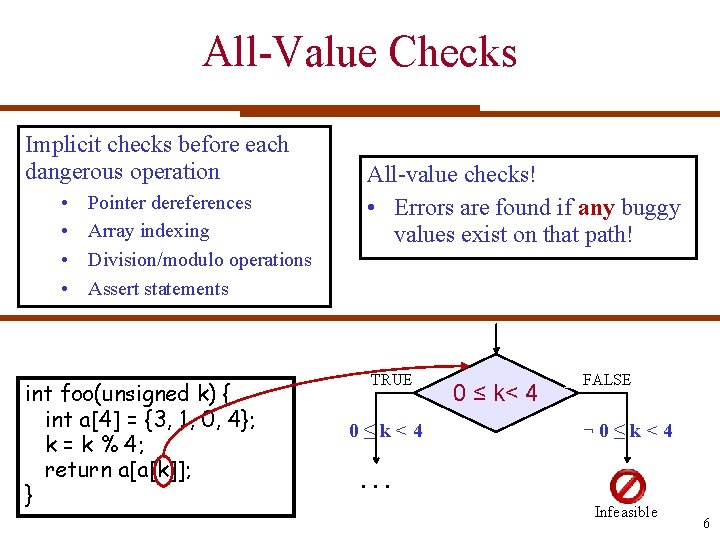
All-Value Checks Implicit checks before each dangerous operation • • Pointer dereferences Array indexing Division/modulo operations Assert statements int foo(unsigned k) { int a[4] = {3, 1, 0, 4}; k = k % 4; return a[a[k]]; } All-value checks! • Errors are found if any buggy values exist on that path! { k = * }. . . TRUE 0≤k<4 . . . 0 ≤ k< 4 FALSE ¬ 0≤k<4 . . . Infeasible 6
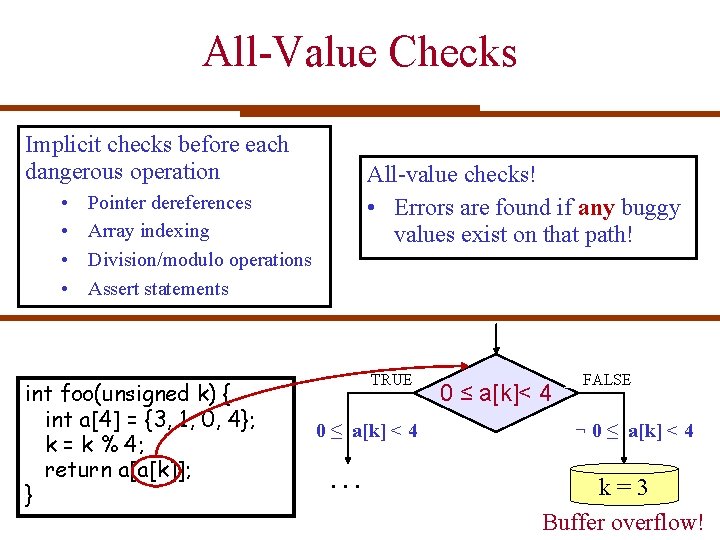
All-Value Checks Implicit checks before each dangerous operation • • All-value checks! • Errors are found if any buggy values exist on that path! { k = * } Pointer dereferences Array indexing Division/modulo operations Assert statements int foo(unsigned k) { int a[4] = {3, 1, 0, 4}; k = k % 4; return a[a[k]]; } . . . TRUE 0 ≤ a[k] < 4 . . . 0 ≤ a[k]< 4 FALSE ¬ 0 ≤ a[k] < 4 . k = 3. . Buffer overflow!
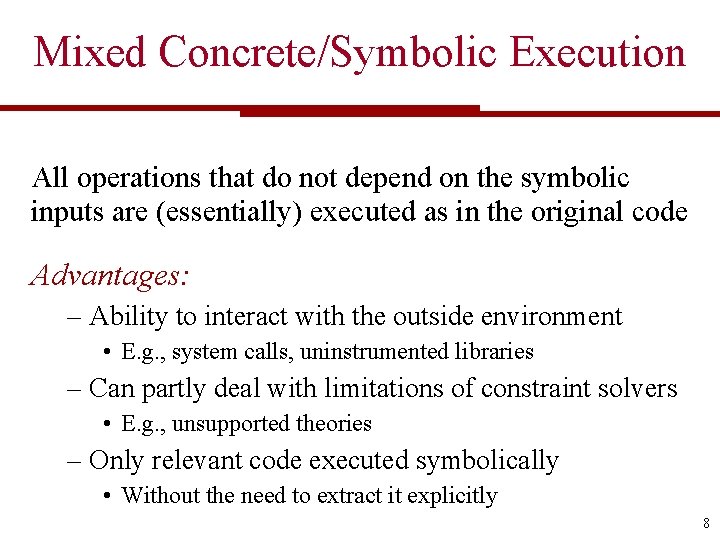
Mixed Concrete/Symbolic Execution All operations that do not depend on the symbolic inputs are (essentially) executed as in the original code Advantages: – Ability to interact with the outside environment • E. g. , system calls, uninstrumented libraries – Can partly deal with limitations of constraint solvers • E. g. , unsupported theories – Only relevant code executed symbolically • Without the need to extract it explicitly 8
KLEE • Symbolic execution tool started as a successor to EXE • Based on the LLVM compiler, primarily targeting C code • Open-sourced in June 2009, now available on Git. Hub • Active user base with over 300 subscribers on the mailing list and over 50 contributors listed on Git. Hub • KLEE workshop this April had >80 people from academia, industry and government, w/ registration closed early Webpage: http: //klee. github. io/ Code: https: //github. com/klee/ Web version: http: //klee. doc. ic. ac. uk/ 9
KLEE • Extensible platform, used and extended by many groups in academia and industry, in the areas such as: • bug finding • high-coverage test input generation • exploit generation • automated debugging • wireless sensor networks/distributed systems • schedule memoization in multithreaded code • client-behavior verification in online gaming • GPU testing and verification, etc. An incomplete list of publications and extensions available at: klee. github. io/Publications. html 10
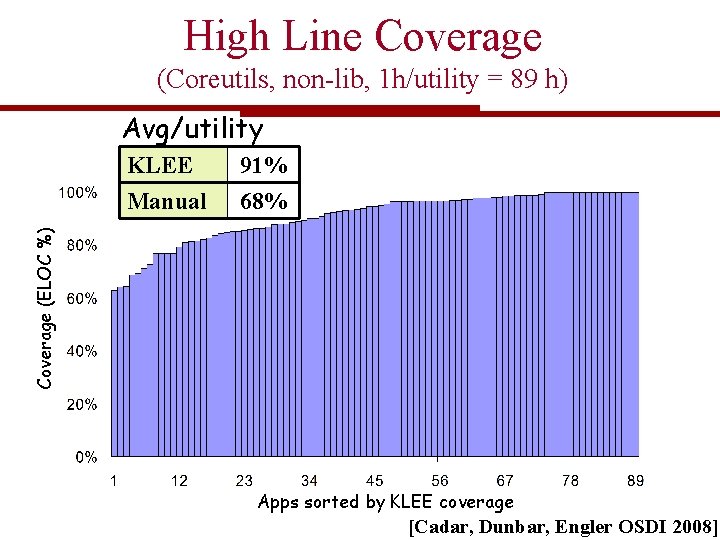
High Line Coverage (Coreutils, non-lib, 1 h/utility = 89 h) Avg/utility 91% 68% Coverage (ELOC %) KLEE Manual Apps sorted by KLEE coverage [Cadar, Dunbar, Engler OSDI 2008]
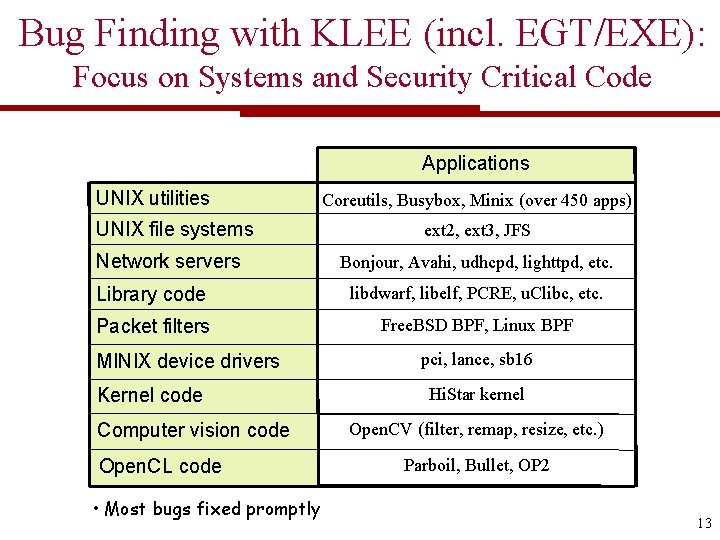
Bug Finding with KLEE (incl. EGT/EXE): Focus on Systems and Security Critical Code Applications UNIX utilities UNIX file systems Network servers Coreutils, Busybox, Minix (over 450 apps) ext 2, ext 3, JFS Bonjour, Avahi, udhcpd, lighttpd, etc. Library code libdwarf, libelf, PCRE, u. Clibc, etc. Packet filters Free. BSD BPF, Linux BPF MINIX device drivers Kernel code Computer vision code Open. CL code • Most bugs fixed promptly pci, lance, sb 16 Hi. Star kernel Open. CV (filter, remap, resize, etc. ) Parboil, Bullet, OP 2 13
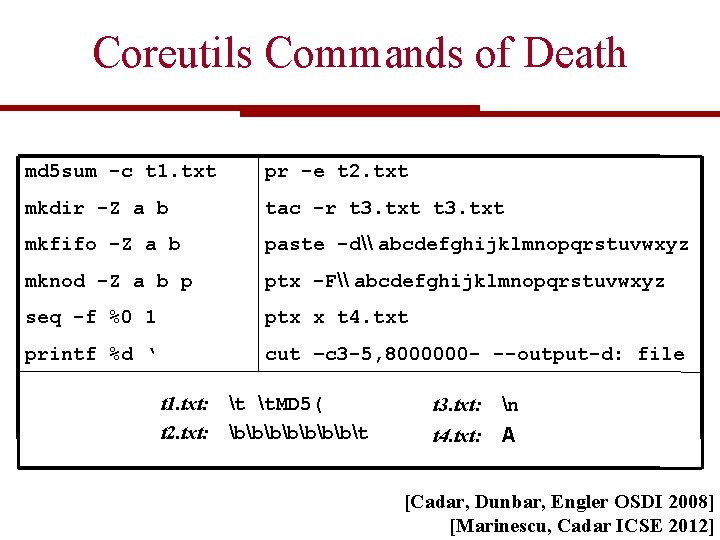
Coreutils Commands of Death md 5 sum -c t 1. txt pr -e t 2. txt mkdir -Z a b tac -r t 3. txt mkfifo -Z a b paste -d\ abcdefghijklmnopqrstuvwxyz mknod -Z a b p ptx -F\ abcdefghijklmnopqrstuvwxyz seq -f %0 1 ptx x t 4. txt printf %d ‘ cut –c 3 -5, 8000000 - --output-d: file t 1. txt: t 2. txt: t t. MD 5( bbbbt t 3. txt: n t 4. txt: A [Cadar, Dunbar, Engler OSDI 2008] [Marinescu, Cadar ICSE 2012]
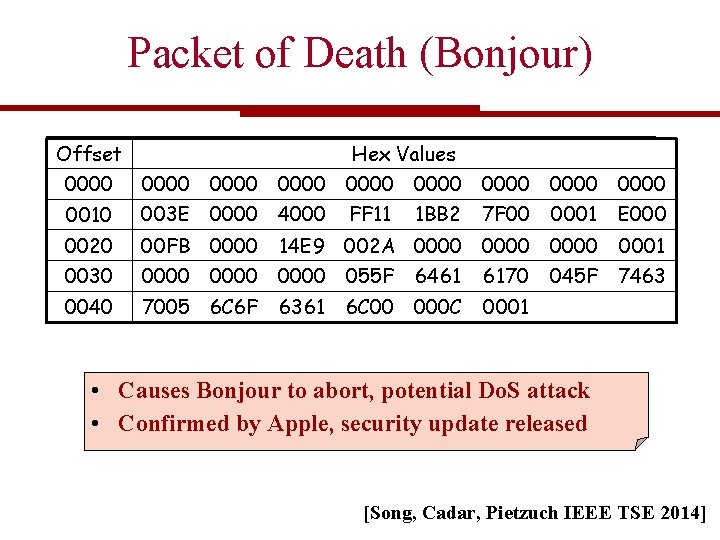
Packet of Death (Bonjour) Offset Hex Values 0000 0010 0000 0000 003 E 0000 4000 FF 11 1 BB 2 7 F 00 0001 E 000 0020 00 FB 0000 0030 0000 055 F 0040 7005 6 C 6 F 14 E 9 002 A 0000 6361 6461 6170 6 C 00 000 C 0001 045 F 7463 • Causes Bonjour to abort, potential Do. S attack • Confirmed by Apple, security update released [Song, Cadar, Pietzuch IEEE TSE 2014]
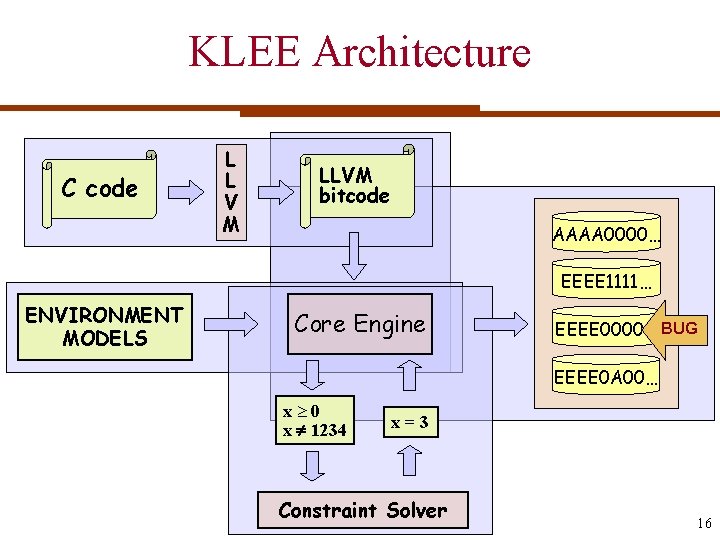
KLEE Architecture C code L L V M LLVM bitcode AAAA 0000… EEEE 1111… ENVIRONMENT MODELS Core Engine EEEE 0000… BUG EEEE 0 A 00… x 0 x 1234 x=3 Constraint Solver 16
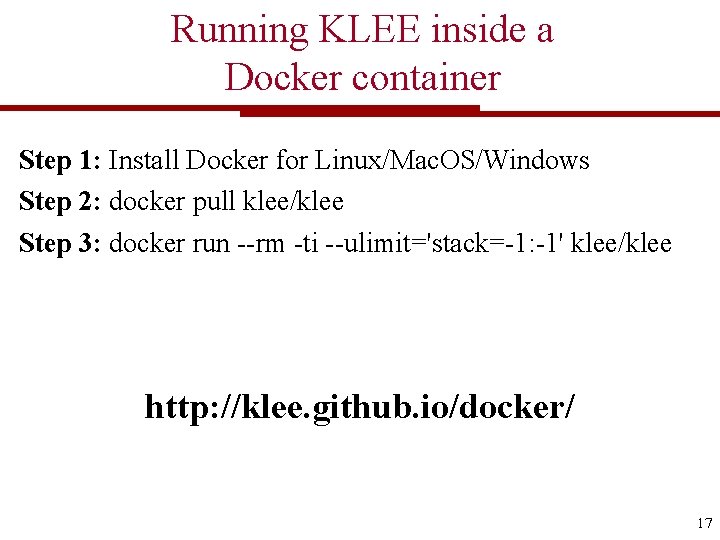
Running KLEE inside a Docker container Step 1: Install Docker for Linux/Mac. OS/Windows Step 2: docker pull klee/klee Step 3: docker run --rm -ti --ulimit='stack=-1: -1' klee/klee http: //klee. github. io/docker/ 17
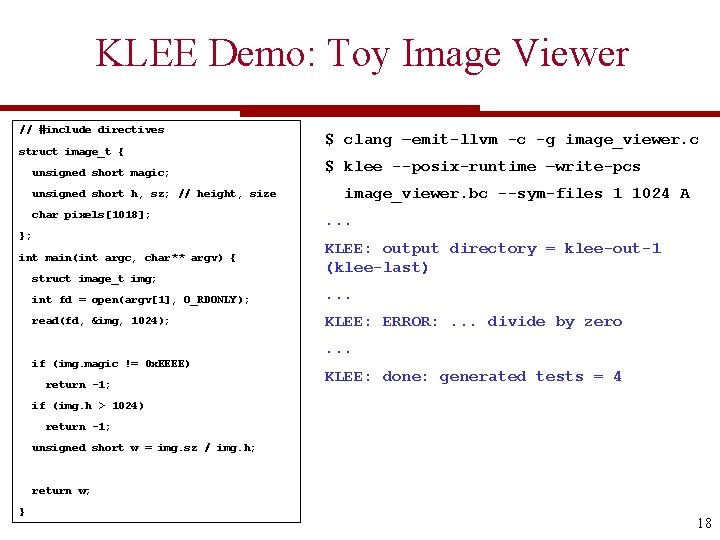
KLEE Demo: Toy Image Viewer // #include directives struct image_t { unsigned short magic; unsigned short h, sz; // height, size char pixels[1018]; }; int main(int argc, char** argv) { struct image_t img; $ clang –emit-llvm -c -g image_viewer. c $ klee --posix-runtime –write-pcs image_viewer. bc --sym-files 1 1024 A. . . KLEE: output directory = klee-out-1 (klee-last) int fd = open(argv[1], O_RDONLY); . . . read(fd, &img, 1024); KLEE: ERROR: . . . divide by zero if (img. magic != 0 x. EEEE) return -1; . . . KLEE: done: generated tests = 4 if (img. h > 1024) return -1; unsigned short w = img. sz / img. h; return w; } 18
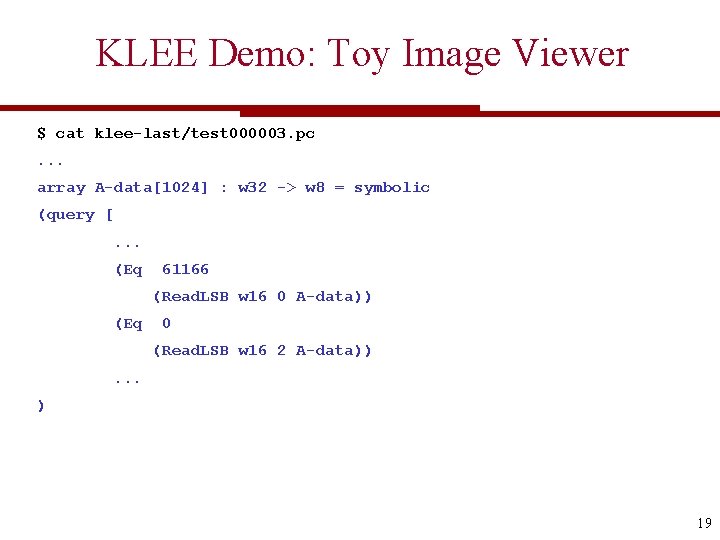
KLEE Demo: Toy Image Viewer $ cat klee-last/test 000003. pc. . . array A-data[1024] : w 32 -> w 8 = symbolic (query [. . . (Eq 61166 (Read. LSB w 16 0 A-data)) (Eq 0 (Read. LSB w 16 2 A-data)) . . . ) 19
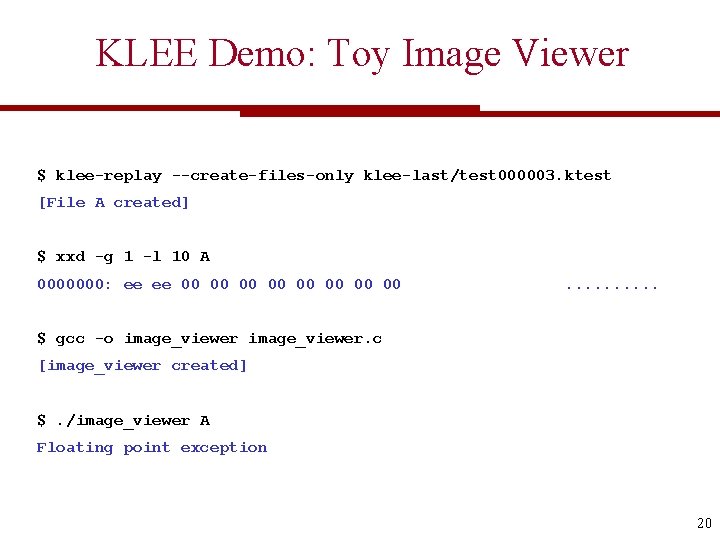
KLEE Demo: Toy Image Viewer $ klee-replay --create-files-only klee-last/test 000003. ktest [File A created] $ xxd -g 1 -l 10 A 0000000: ee ee 00 00 . . $ gcc -o image_viewer. c [image_viewer created] $. /image_viewer A Floating point exception 20
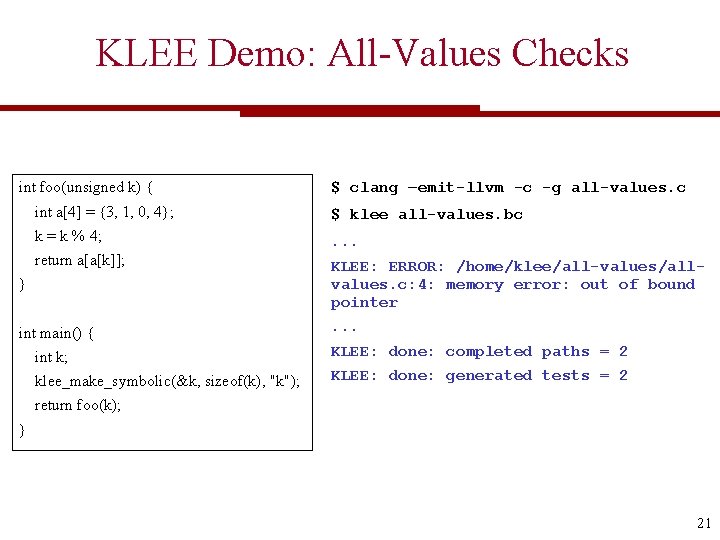
KLEE Demo: All-Values Checks int foo(unsigned k) { $ clang –emit-llvm -c -g all-values. c int a[4] = {3, 1, 0, 4}; $ klee all-values. bc k = k % 4; . . . return a[a[k]]; } KLEE: ERROR: /home/klee/all-values/allvalues. c: 4: memory error: out of bound pointer int main() { . . . int k; KLEE: done: completed paths = 2 klee_make_symbolic(&k, sizeof(k), "k"); KLEE: done: generated tests = 2 return foo(k); } 21
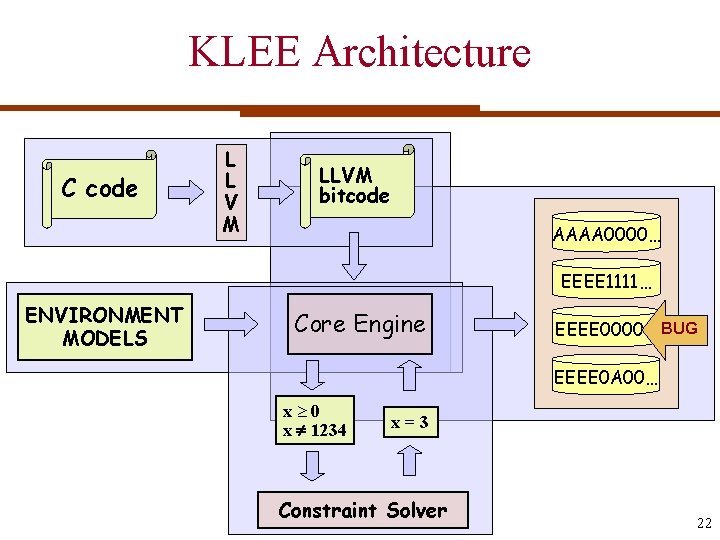
KLEE Architecture C code L L V M LLVM bitcode AAAA 0000… EEEE 1111… ENVIRONMENT MODELS Core Engine EEEE 0000… BUG EEEE 0 A 00… x 0 x 1234 x=3 Constraint Solver 22
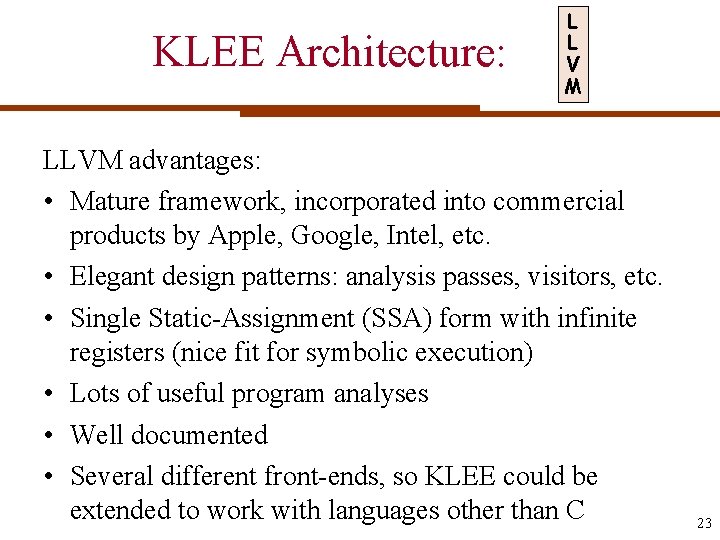
KLEE Architecture: L L V M LLVM advantages: • Mature framework, incorporated into commercial products by Apple, Google, Intel, etc. • Elegant design patterns: analysis passes, visitors, etc. • Single Static-Assignment (SSA) form with infinite registers (nice fit for symbolic execution) • Lots of useful program analyses • Well documented • Several different front-ends, so KLEE could be extended to work with languages other than C 23
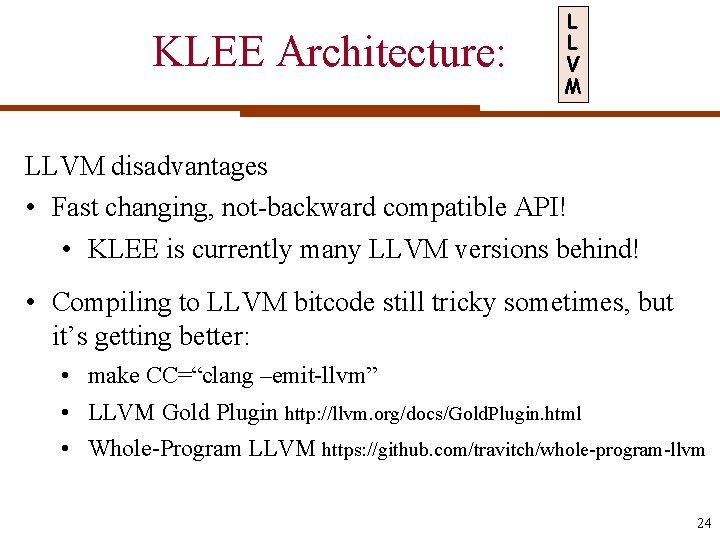
KLEE Architecture: L L V M LLVM disadvantages • Fast changing, not-backward compatible API! • KLEE is currently many LLVM versions behind! • Compiling to LLVM bitcode still tricky sometimes, but it’s getting better: • make CC=“clang –emit-llvm” • LLVM Gold Plugin http: //llvm. org/docs/Gold. Plugin. html • Whole-Program LLVM https: //github. com/travitch/whole-program-llvm 24
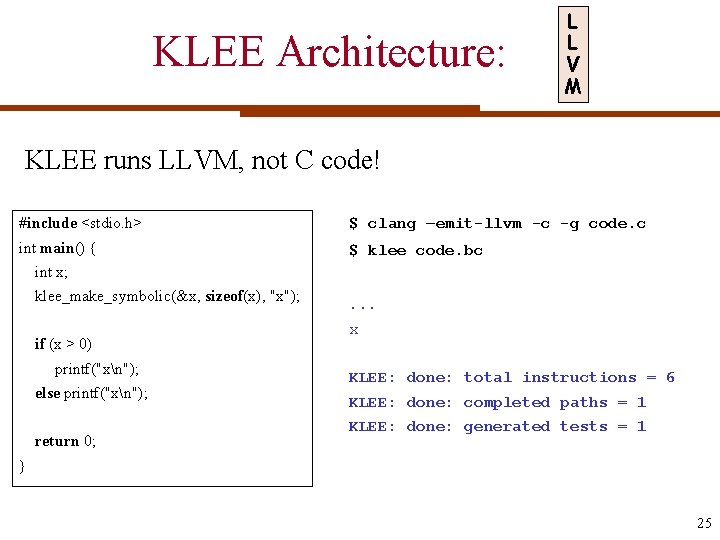
KLEE Architecture: L L V M KLEE runs LLVM, not C code! #include <stdio. h> $ clang –emit-llvm -c -g code. c int main() { $ klee code. bc int x; klee_make_symbolic(&x, sizeof(x), "x"); if (x > 0) printf("xn"); else printf("xn"); return 0; . . . x KLEE: done: total instructions = 6 KLEE: done: completed paths = 1 KLEE: done: generated tests = 1 } 25
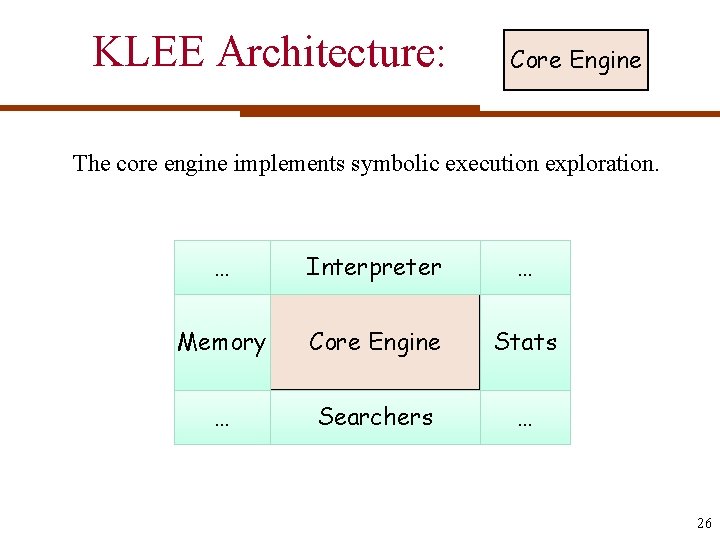
KLEE Architecture: Core Engine The core engine implements symbolic execution exploration. … Interpreter … Memory Core Engine Stats … Searchers … 26
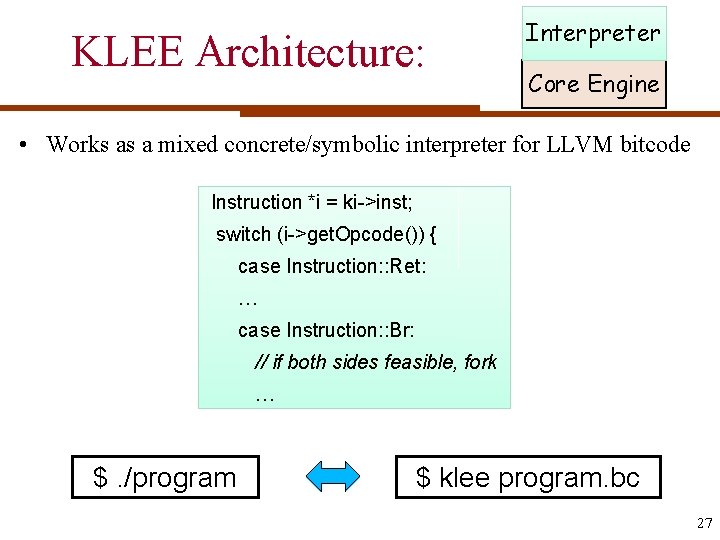
KLEE Architecture: Interpreter Core Engine • Works as a mixed concrete/symbolic interpreter for LLVM bitcode Instruction *i = ki->inst; switch (i->get. Opcode()) { case Instruction: : Ret: … case Instruction: : Br: // if both sides feasible, fork … $. /program $ klee program. bc 27
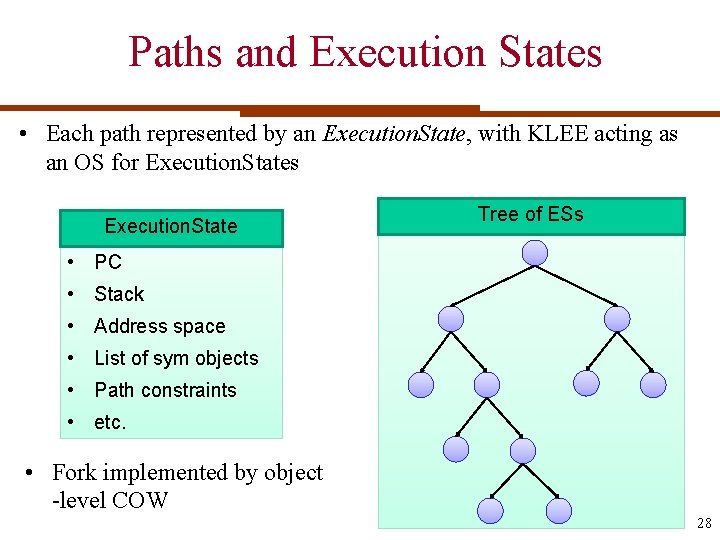
Paths and Execution States • Each path represented by an Execution. State, with KLEE acting as an OS for Execution. States Execution. State Tree of ESs • PC • Stack • Address space • List of sym objects • Path constraints • etc. • Fork implemented by object -level COW 28
KLEE Architecture: Core Engine The core engine implements symbolic execution exploration. Two main scalability challenges: Path exploration challenges Constraint solving challenges 29
Path Exploration Challenges Naïve exploration can easily get “stuck” • Employing search heuristics • Dynamically eliminating redundant paths • Statically merging paths • Using existing regression test suites to prioritize execution • Skipping irrelevant code • etc. 30
Search Heuristics in KLEE Core Engine Searchers • Basic search heuristics such as BFS and DFS klee --search=bfs program. bc • Coverage-optimized search (--search=nurs: md 2 u) – Select path closest to an uncovered instruction • Random-state search (--search=random-state) – Randomly select a pending state/path • Random-path search (--search=random-path) – Described next • etc. [Cadar, Ganesh, Pawlowski, Dill, Engler CCS’ 06] [Cadar, Dunbar, Engler OSDI’ 08] [Marinescu, Cadar ICSE’ 12], etc. 31
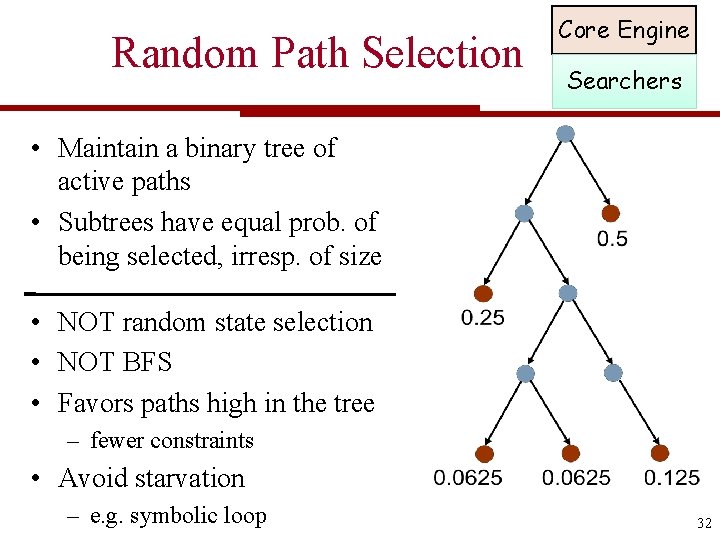
Random Path Selection Core Engine Searchers • Maintain a binary tree of active paths • Subtrees have equal prob. of being selected, irresp. of size • NOT random state selection • NOT BFS • Favors paths high in the tree – fewer constraints • Avoid starvation – e. g. symbolic loop 32
Combining Search Heuristics Core Engine Searchers KLEE can also use multiple heuristics in a roundrobin fashion, to protect against individual heuristics getting stuck in a local maximum. klee --search=nurs: md 2 u -–search=dfs –-search=random-path. . . 33
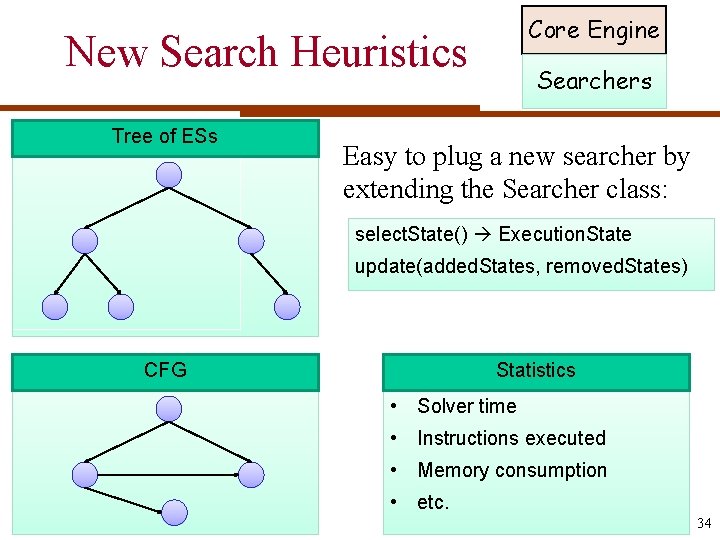
Core Engine New Search Heuristics Tree of ESs Searchers Easy to plug a new searcher by extending the Searcher class: select. State() Execution. State update(added. States, removed. States) CFG Statistics • Solver time • Instructions executed • Memory consumption • etc. 34
Memory Modelling Core Engine Memory Accuracy: need bit-level modeling of memory: • Systems code often observes the same bytes in different ways: e. g. , using pointer casting to treat an array of chars as a network packet, inode, etc. • Bugs (in systems code) are often triggered by corner cases related to pointer/integer casting and arithmetic overflows 35
Memory Modelling Core Engine Memory • One data type: arrays of bitvectors (BVs) • Mirror the (lack of) type system in C – Model each memory block as an array of 8 -bit BVs – Bind types to expressions, not bits • We can translate all C expressions into constraints in theory of quantifier-free BV with arrays (QF_ABV) with bit-level accuracy – Main exception: floating-point, but two extensions (Aachen + Imperial) to KLEE for FP are now available, see [ASE 2018] 36
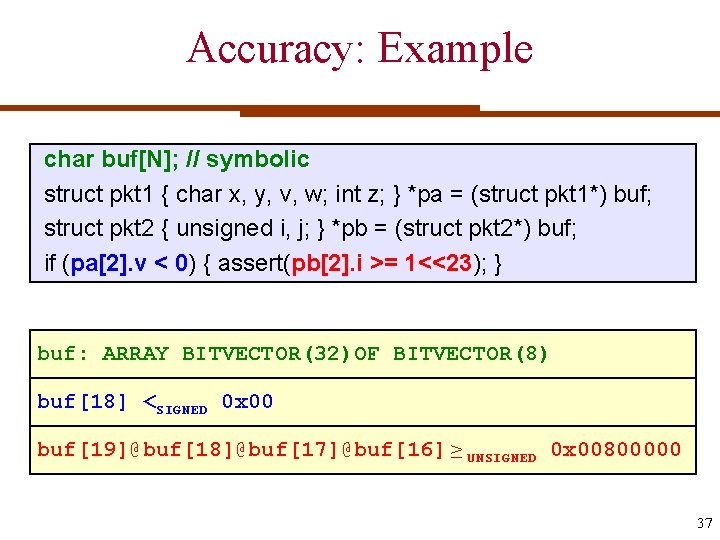
Accuracy: Example char buf[N]; // symbolic struct pkt 1 { char x, y, v, w; int z; } *pa = (struct pkt 1*) buf; struct pkt 2 { unsigned i, j; } *pb = (struct pkt 2*) buf; if (pa[2]. v < 0) { assert(pb[2]. i >= 1<<23); } buf: ARRAY BITVECTOR(32)OF BITVECTOR(8) buf[18] <SIGNED 0 x 00 buf[19]@buf[18]@buf[17]@buf[16] ≥ UNSIGNED 0 x 00800000 37
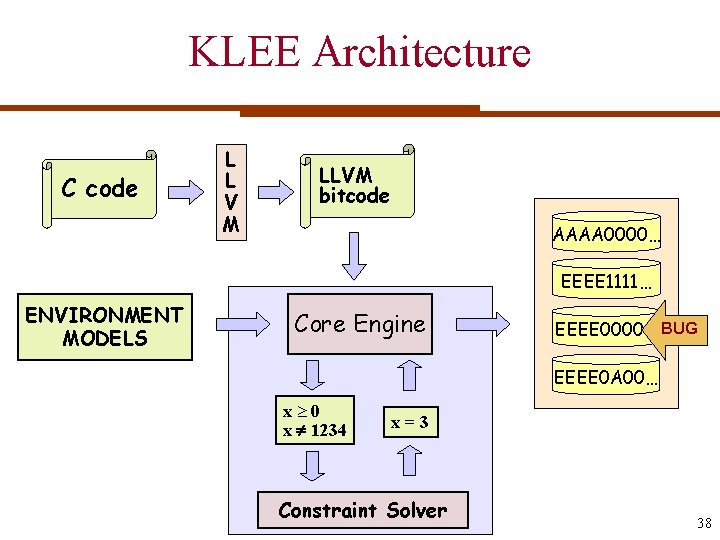
KLEE Architecture C code L L V M LLVM bitcode AAAA 0000… EEEE 1111… ENVIRONMENT MODELS Core Engine EEEE 0000… BUG EEEE 0 A 00… x 0 x 1234 x=3 Constraint Solver 38
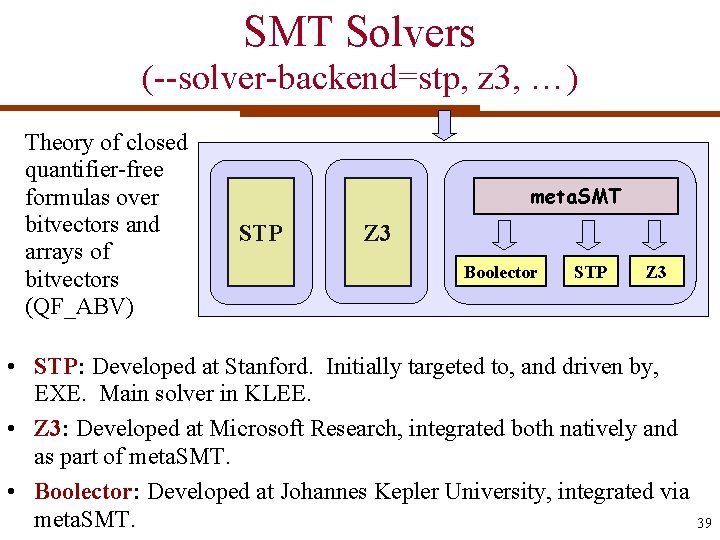
SMT Solvers (--solver-backend=stp, z 3, …) Theory of closed quantifier-free formulas over bitvectors and arrays of bitvectors (QF_ABV) meta. SMT STP Z 3 Boolector STP Z 3 • STP: Developed at Stanford. Initially targeted to, and driven by, EXE. Main solver in KLEE. • Z 3: Developed at Microsoft Research, integrated both natively and as part of meta. SMT. • Boolector: Developed at Johannes Kepler University, integrated via meta. SMT. 39
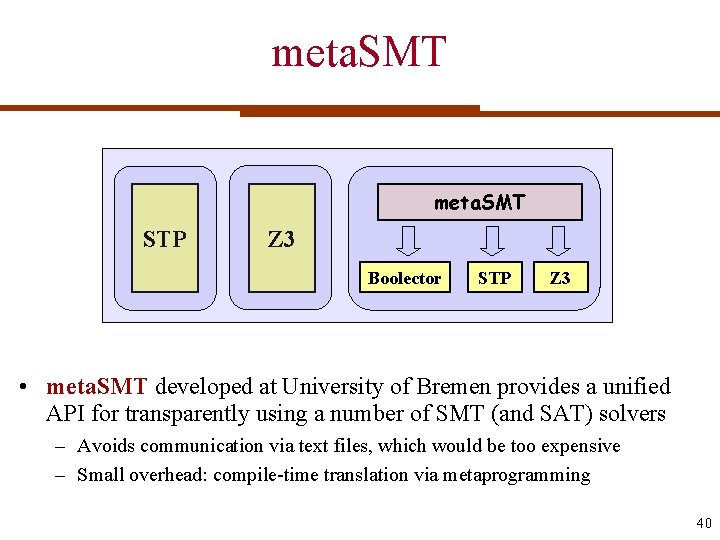
meta. SMT STP Z 3 Boolector STP Z 3 • meta. SMT developed at University of Bremen provides a unified API for transparently using a number of SMT (and SAT) solvers – Avoids communication via text files, which would be too expensive – Small overhead: compile-time translation via metaprogramming 40
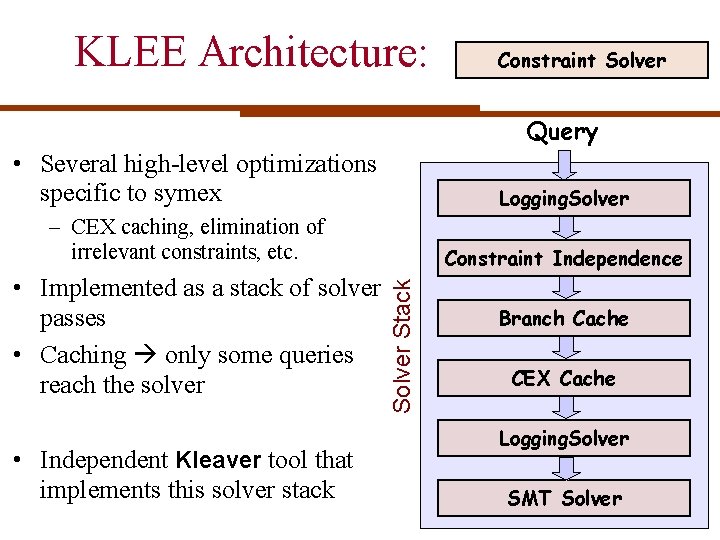
KLEE Architecture: Constraint Solver Query • Several high-level optimizations specific to symex Logging. Solver – CEX caching, elimination of irrelevant constraints, etc. • Independent Kleaver tool that implements this solver stack Solver Stack • Implemented as a stack of solver passes • Caching only some queries reach the solver Constraint Independence Branch Cache CEX Cache Logging. Solver SMT Solver
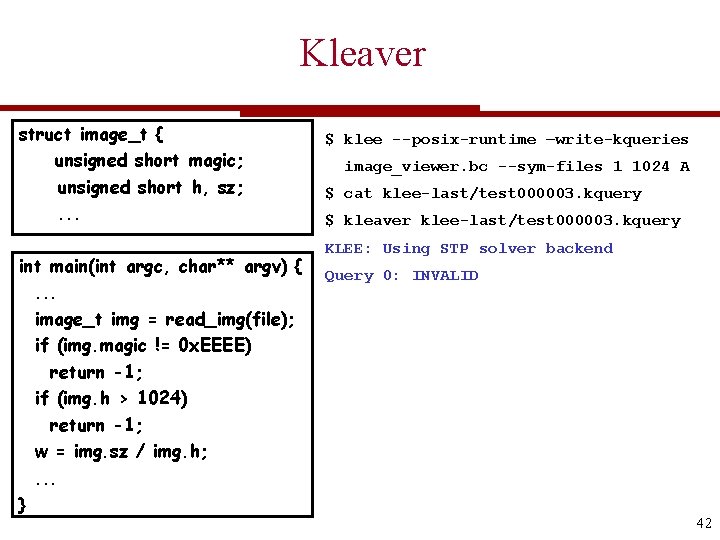
Kleaver struct image_t { unsigned short magic; unsigned short h, sz; . . . int main(int argc, char** argv) {. . . image_t img = read_img(file); if (img. magic != 0 x. EEEE) return -1; if (img. h > 1024) return -1; w = img. sz / img. h; . . . } $ klee --posix-runtime –write-kqueries image_viewer. bc --sym-files 1 1024 A $ cat klee-last/test 000003. kquery $ kleaver klee-last/test 000003. kquery KLEE: Using STP solver backend Query 0: INVALID 42
Constraint Solving: Performance • Inherently expensive • Invoked at every branch • Key insight: exploit the characteristics of constraints generated by symex 43
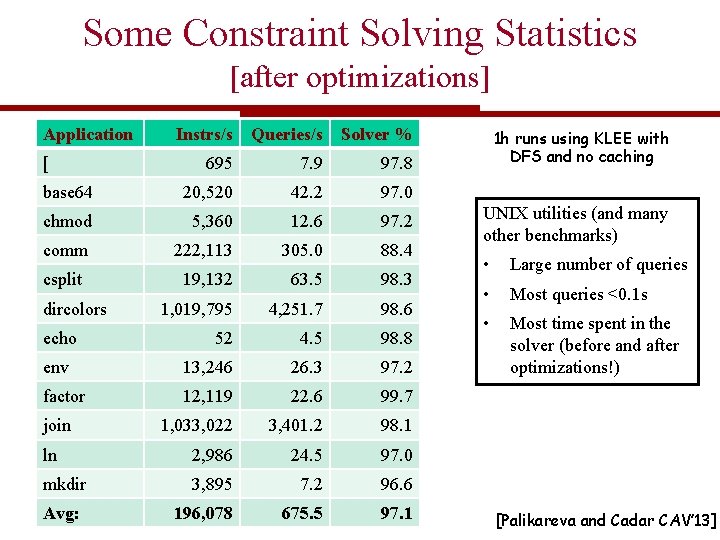
Some Constraint Solving Statistics [after optimizations] Application Instrs/s Queries/s Solver % 695 7. 9 97. 8 base 64 20, 520 42. 2 97. 0 chmod 5, 360 12. 6 97. 2 comm 222, 113 305. 0 88. 4 csplit 19, 132 63. 5 98. 3 1, 019, 795 4, 251. 7 98. 6 52 4. 5 98. 8 env 13, 246 26. 3 97. 2 factor 12, 119 22. 6 99. 7 1, 033, 022 3, 401. 2 98. 1 ln 2, 986 24. 5 97. 0 mkdir 3, 895 7. 2 96. 6 196, 078 675. 5 97. 1 [ dircolors echo join Avg: 1 h runs using KLEE with DFS and no caching UNIX utilities (and many other benchmarks) • Large number of queries • Most queries <0. 1 s • Most time spent in the solver (before and after optimizations!) [Palikareva and Cadar CAV’ 13]
Higher-Level Constraint Solving Optimizations • Two simple and effective optimizations – Eliminating irrelevant constraints – Caching solutions 46
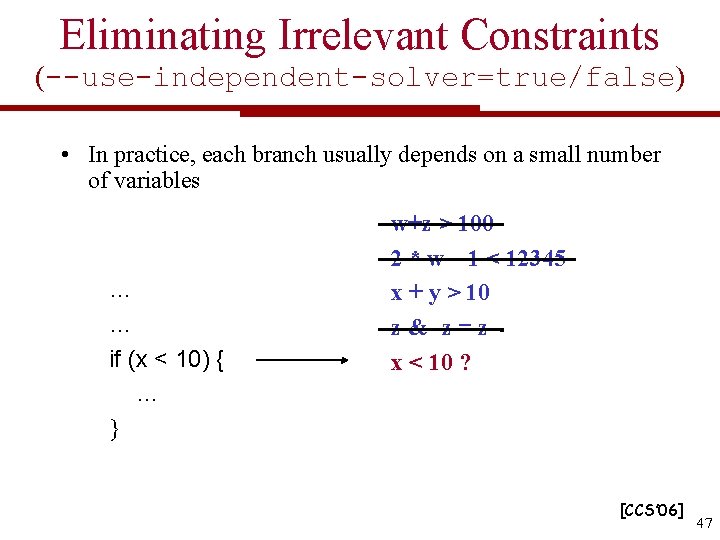
Eliminating Irrelevant Constraints (--use-independent-solver=true/false) • In practice, each branch usually depends on a small number of variables … … if (x < 10) { … } w+z > 100 2 * w – 1 < 12345 x + y > 10 z & -z = z x < 10 ? [CCS’ 06] 47
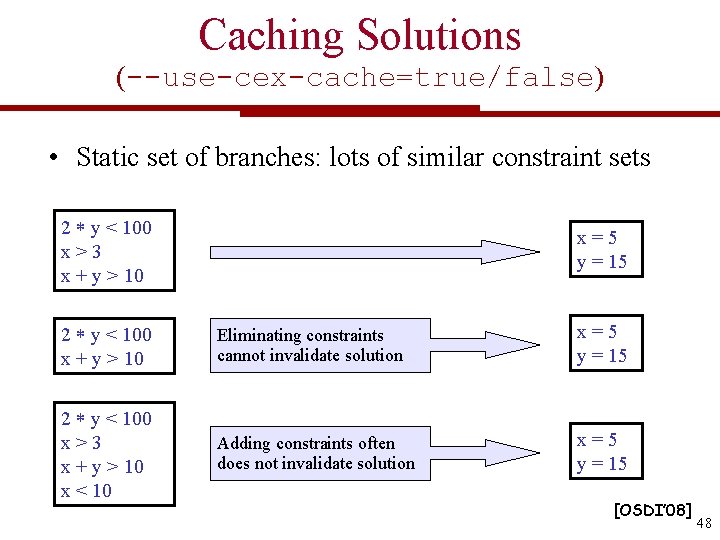
Caching Solutions (--use-cex-cache=true/false) • Static set of branches: lots of similar constraint sets 2 y < 100 x > 3 x + y > 10 x = 5 y = 15 2 y < 100 x + y > 10 Eliminating constraints cannot invalidate solution x = 5 y = 15 2 y < 100 x > 3 x + y > 10 x < 10 Adding constraints often does not invalidate solution x = 5 y = 15 [OSDI’ 08] 48
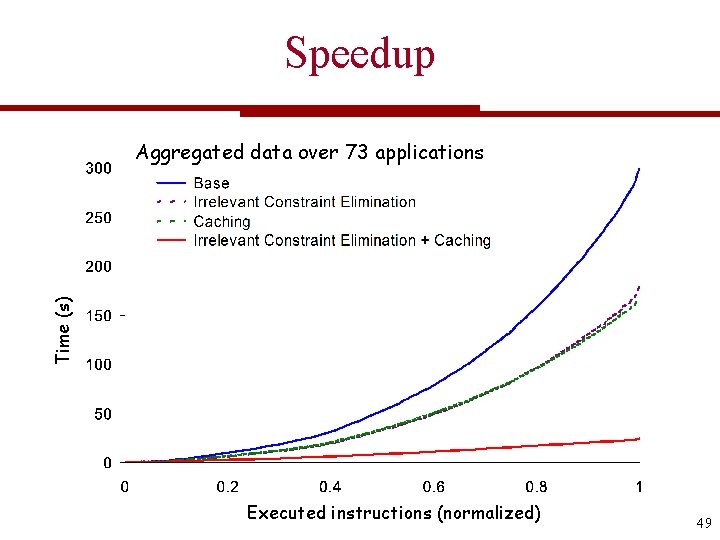
Speedup Time (s) Aggregated data over 73 applications Executed instructions (normalized) 49
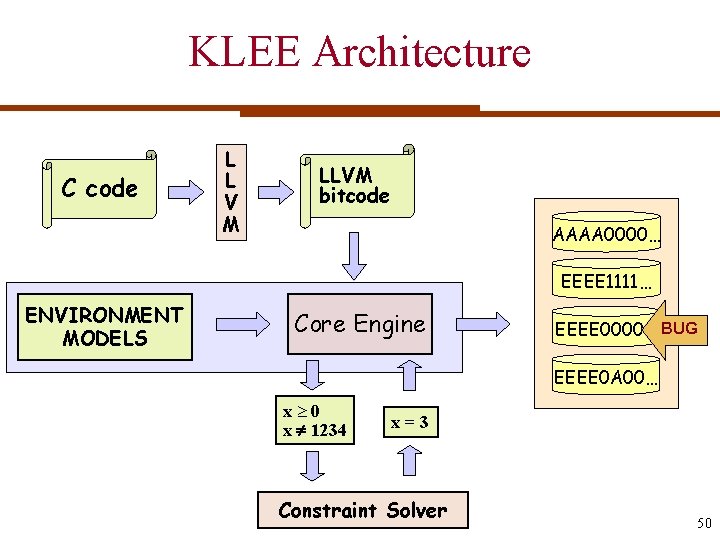
KLEE Architecture C code L L V M LLVM bitcode AAAA 0000… EEEE 1111… ENVIRONMENT MODELS Core Engine EEEE 0000… BUG EEEE 0 A 00… x 0 x 1234 x=3 Constraint Solver 50
KLEE Architecture: Environment Models • Environment model: model for a piece of code for which source is not available • In KLEE, the environment is mainly the OS system call API 51
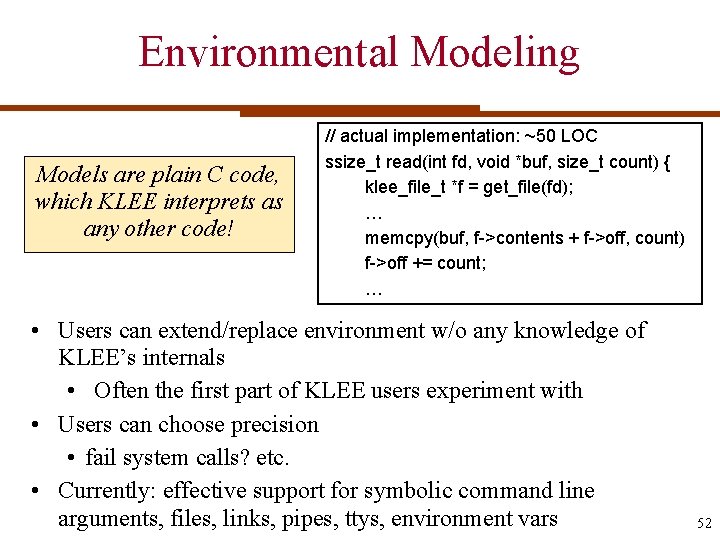
Environmental Modeling Models are plain C code, which KLEE interprets as any other code! // actual implementation: ~50 LOC ssize_t read(int fd, void *buf, size_t count) { klee_file_t *f = get_file(fd); … memcpy(buf, f->contents + f->off, count) f->off += count; … • Users can extend/replace environment w/o any knowledge of KLEE’s internals • Often the first part of KLEE users experiment with • Users can choose precision • fail system calls? etc. • Currently: effective support for symbolic command line arguments, files, links, pipes, ttys, environment vars 52
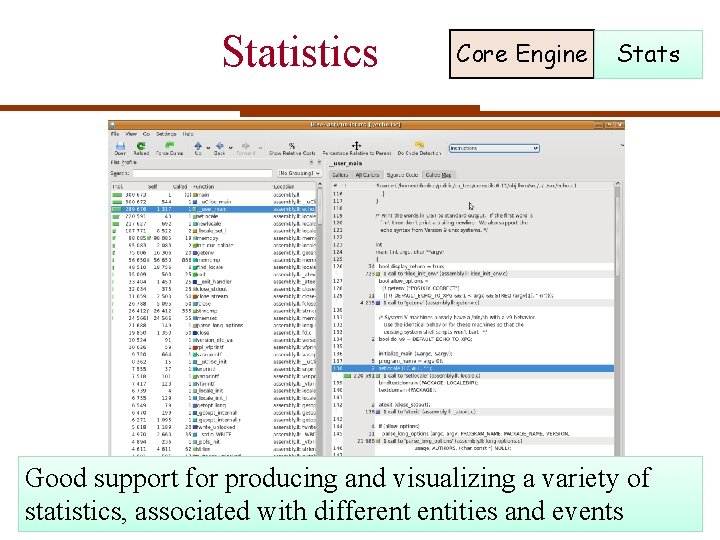
Statistics Core Engine Stats Good support for producing and visualizing a variety of statistics, associated with different entities and events
Non-determinism in Sym. Ex and KLEE • Any good experiment needs to take nondeterminism into account • Sources of non-determinism include constraint solving, search heuristics, LLVM versions, memory allocation – We have already fixed most implementationlevel non-determinism, such as hash tables indexed by memory addresses, which can differ across runs 54
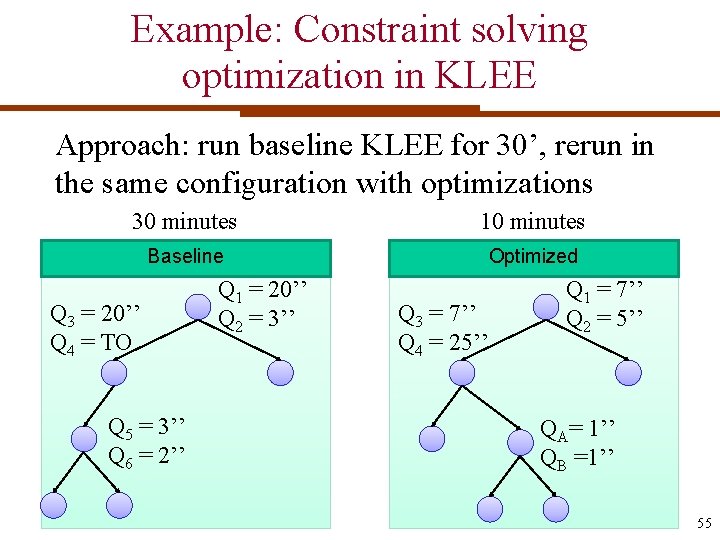
Example: Constraint solving optimization in KLEE Approach: run baseline KLEE for 30’, rerun in the same configuration with optimizations 30 minutes 10 minutes Baseline Optimized Q 3 = 20’’ Q 4 = TO Q 5 = 3’’ Q 6 = 2’’ Q 1 = 20’’ Q 2 = 3’’ Q 3 = 7’’ Q 4 = 25’’ Q 1 = 7’’ Q 2 = 5’’ QA= 1’’ QB =1’’ 55
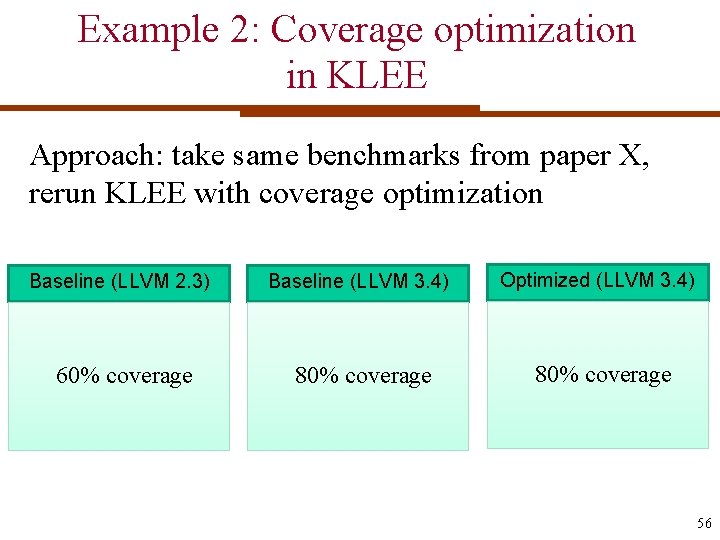
Example 2: Coverage optimization in KLEE Approach: take same benchmarks from paper X, rerun KLEE with coverage optimization Baseline (LLVM 2. 3) Baseline (LLVM 3. 4) Optimized (LLVM 3. 4) 60% coverage 80% coverage 56
Dynamic Symbolic Execution • Program analysis technique that can be use to automatically explore paths through a program • Can generate inputs achieving high-coverage and exposing bugs in complex software 57
KLEE: Freely Available as Open. Source http: //klee. github. io/ • Popular symbolic execution tool with an active user and developer base • Extended in many interesting ways by several groups from academia and industry, in areas such as: • exploit generation • wireless sensor networks/distributed systems • automated debugging • client-behavior verification in online gaming • GPU testing and verification • etc. 58
- Slides: 56