
An Introduction to DipPen Nanolithography What is DPN
- Slides: 12
An Introduction to Dip-Pen Nanolithography
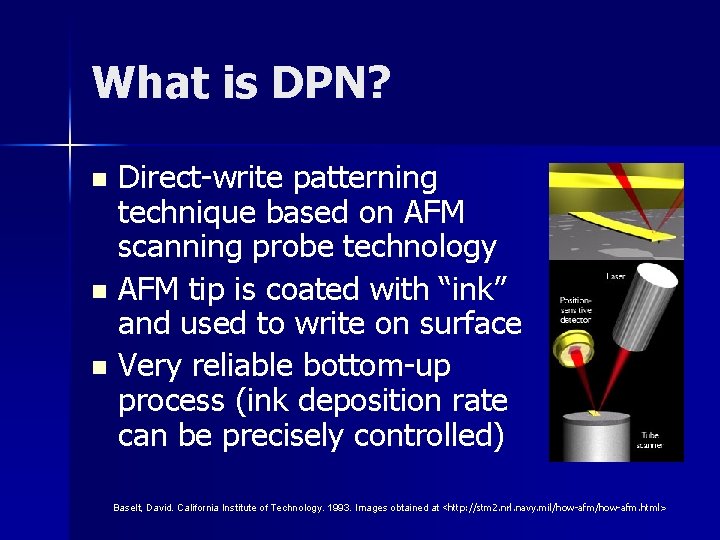
What is DPN? Direct-write patterning technique based on AFM scanning probe technology n AFM tip is coated with “ink” and used to write on surface n Very reliable bottom-up process (ink deposition rate can be precisely controlled) n Baselt, David. California Institute of Technology. 1993. Images obtained at <http: //stm 2. nrl. navy. mil/how-afm. html>
What is DPN? (continued) n n n Compatible with both hard and soft matter on lengthscales below 100 nm Capable of depositing arrays of biomolecules on various materials (metals, semiconductors, functionalized surfaces) Biomolecules can be directly deposited on the surface in ambient temperature, no exposure to etchants, electron beams, or radiation
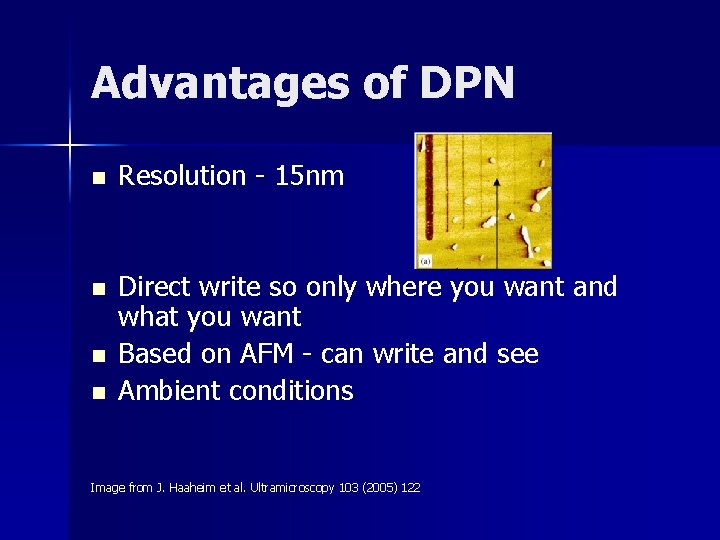
Advantages of DPN n Resolution - 15 nm n Direct write so only where you want and what you want Based on AFM - can write and see Ambient conditions n n Image from J. Haaheim et al. Ultramicroscopy 103 (2005) 122
Advantages continued More than one layer n Can work with multiple “inks” at once n Organic and inorganic inks n Bottom-up and top-down n
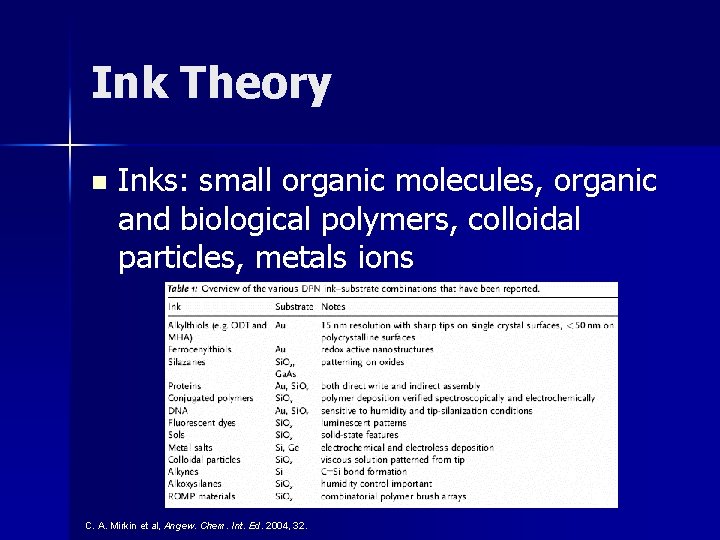
Ink Theory n Inks: small organic molecules, organic and biological polymers, colloidal particles, metals ions C. A. Mirkin et al, Angew. Chem. Int. Ed. 2004, 32.
Ink Theory (continued) n n Ink-substrate combinations Tip-substrate molecular transport – – – Chemical makeup and purity (ink and surface) Shape of tip Distribution of ink on tip Temperature Humidity of surroundings Solubility of ink
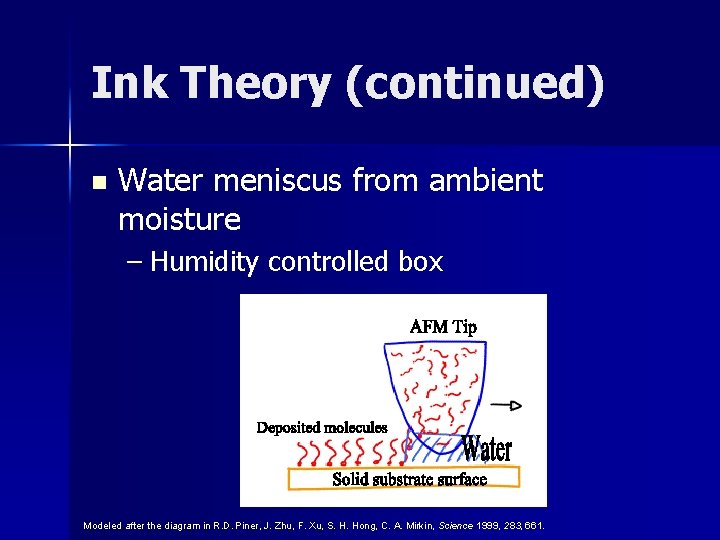
Ink Theory (continued) n Water meniscus from ambient moisture – Humidity controlled box Modeled after the diagram in R. D. Piner, J. Zhu, F. Xu, S. H. Hong, C. A. Mirkin, Science 1999, 283, 661.
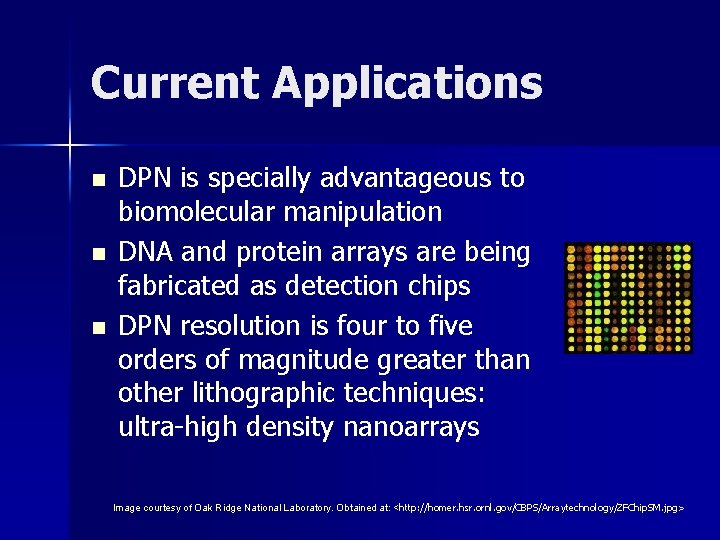
Current Applications n n n DPN is specially advantageous to biomolecular manipulation DNA and protein arrays are being fabricated as detection chips DPN resolution is four to five orders of magnitude greater than other lithographic techniques: ultra-high density nanoarrays Image courtesy of Oak Ridge National Laboratory. Obtained at: <http: //homer. hsr. ornl. gov/CBPS/Arraytechnology/ZFChip. SM. jpg>
Obstacles n Most are currently being addressed – Speed – Matching inks to substrates, correct conditions – Smooth surfaces to work on – Turning the write head on/off at will
Future Applications n Parallel arrays – Passive probe array n Duplicate a pattern multiple times – Independent control of each probe tip n Create complex arrays at high speeds – Automated tip coating and ink delivery n Microfluidic technology – possible ink wells for dipping of probe tip
Sources n n n C. A. Mirkin et al, Angew. Chem. Int. Ed. 2004, 43, 30 -45. Baselt, David. California Institute of Technology. 1993. Images obtained at http: //stm 2. nrl. navy. mil/how -afm/how-afm. html J. Haaheim et al. Ultramicroscopy 103 (2005) 122 Gerding, J. D. et al. Journal of American Chemical Soc. 2005 127. 1106 -1107. R. D. Piner, J. Zhu, F. Xu, S. H. Hong, C. A. Mirkin, Science 1999, 283, 661. Oak Ridge National Laboratory. http: //homer. hsr. ornl. gov/CBPS/Arraytechnology/