
An Introduction to DDI CDI Background for Public
An Introduction to DDI - CDI Background for Public Reviewers Webinar, 18 June 2020 DDI Modeling, Representation and Testing Working Group (with thanks to the CODATA Decadal Programme)
DDI-CDI and the DDI Alliance • The Data Documentation Initiative (DDI) is a membership-based alliance of data archives, data producers, research institutions, and government agencies • They have produced a series of technical specifications for data, metadata, and data management purposes • DDI – Codebook • DDI - Lifecycle • DDI – Cross-Domain Integration is an additional specification, designed to support new features • As a stand-alone specification • In combination with other technical specifications/models

TO REVIEW DDI-CDI!
Outline • • Background: MRT and DDI 4 Core Group and Events DDI-CDI within the DDI Product Suite DDI-CDI Features DDI-CDI Alignment with Other Standards Implementations of DDI-CDI Current Status: The Public Review
History: MRT and DDI Developments • In the margins of the 2018 European DDI User’s Group meeting (Berlin) it was agreed that a “core” of the next-generation/model based DDI work should be brought to market • A 1 -year timeframe was proposed • The Modelling, Representation and Testing (MRT) group was formed in early 2019 • The working process was to base models on implementations, tested against real-world use cases • ALPHA Network • DDI R Libraries • Others (BLS for time series, etc. )
Group and Events • Small group (9 members) meeting weekly (and more) for over a year • No turn-over – members have been extremely focused and disciplined • Ottawa Sprint in margins of NADDI 2019 • Dagstuhl Sprint in October 2019 • Public Review Release April 2020 • Communications with management, technical committee work, marketing, and training groups within the DDI Alliance have been emphasized
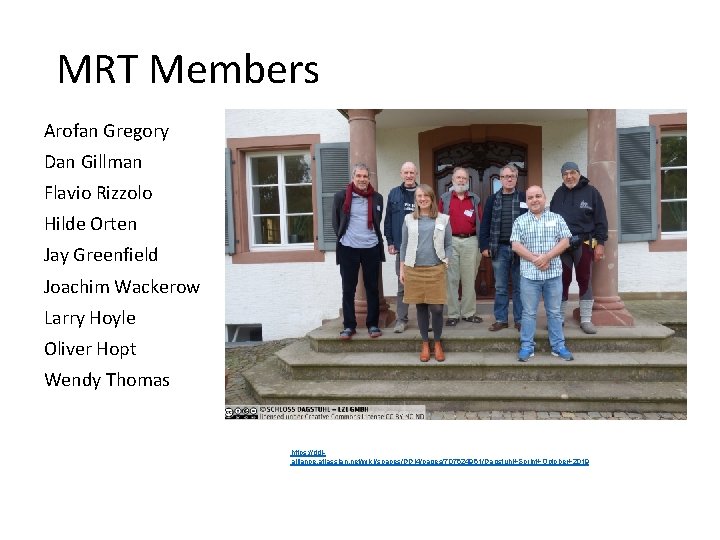
MRT Members Arofan Gregory Dan Gillman Flavio Rizzolo Hilde Orten Jay Greenfield Joachim Wackerow Larry Hoyle Oliver Hopt Wendy Thomas https: //ddialliance. atlassian. net/wiki/spaces/DDI 4/pages/707624961/Dagstuhl+Sprint+October+2019
Evolution in Purpose • DDI-CDI was expected to be the “core” of a modeldriven DDI • A “next generation” after DDI-Lifecycle • Implementation cases showed that something else was needed: a focus on data provenance and data integration • DDI-CDI has emerged as a companion to DDICodebook and DDI-Lifecycle, not a replacement for them • The Social, Behavioral, and Economic (SBE) community needs better data integration tools • So do other domains!
Real-World Trends and Requirements • Several changes have taken place in recent years which impact the requirements for DDI-CDI • Larger research projects using data sometimes coming from external domains • More data, coming from a wider range of sources • Increased ability to compute with data (Machine Learning, etc. ) • These changes result in requirements for data/metadata management • More complete, machine-actionable metadata is needed • Improved “context” for data is needed (provenance, semantics) • New data formats/structures must be described and integrated • A broader range of technology platforms require support

DDI-CDI within the Product Suite • DDI-CDI does not replace DDI-C or DDI-L • It can and will be used in combination with other DDI specifications • It adds support for describing new types of data • It expands the ability to describe process/provenance • It provides a detailed description of integration between disparate types of data • Extends the applicability of the DDI to new domains/disciplines • As an integration tool • As a data management tool
DDI-CDI Features: Data Description and Provenance • Provides an exact understanding of data in a variety of formats from many different sources. • Flexible means of describing data that can reveal the connection between the same data existing in different formats. • Means of describing the provenance of data at a detailed level.
DDI-CDI Goals and Purpose • Design goal: Create a useful, implementable product based on real use cases • Developed with modern systems in mind • That employs a variety of models • That complies with a range of specifications, related to data description and provenance • Fills in information that other standards do not capture (align rather than replace) • For data: Description of a single data point – a Datum – that can play different roles in different data structures and formats • For process/provenance: Packaging of machine level processes into a structure that relates to business processes described at a level understood by users.
DDI-CDI Domain-Independence • Designed to be used by any domain • Focus on structure and generic aspects of the things it • • describes Generic elements like variables and classifications Do not cover domain specific aspects like semantics or lifecycles (provided by domains) Complementary to domain specific models, for example DDI-Lifecycle Well suited to combining data from more than one domain or system (cross domain)
DDI-CDI Datum-Oriented Data Description • Based on atomic components – individual Datums • Datums can play different roles in different formatting of the same (or different) dataset(s), depending on how it has been transformed or processed (Identifier, Descriptor, Measure, etc. ) • Each Datum’s use can be described across a series of processes as it plays different roles in different structures
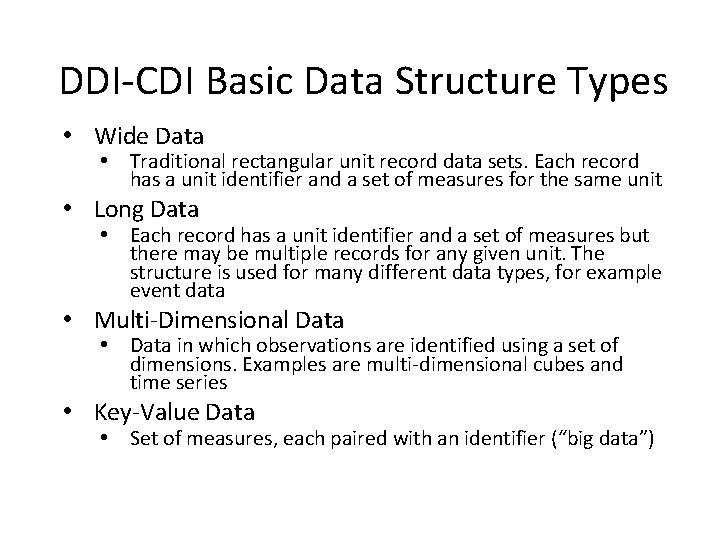
DDI-CDI Basic Data Structure Types • Wide Data • Traditional rectangular unit record data sets. Each record has a unit identifier and a set of measures for the same unit • Long Data • Each record has a unit identifier and a set of measures but there may be multiple records for any given unit. The structure is used for many different data types, for example event data • Multi-Dimensional Data • Data in which observations are identified using a set of dimensions. Examples are multi-dimensional cubes and time series • Key-Value Data • Set of measures, each paired with an identifier (“big data”)
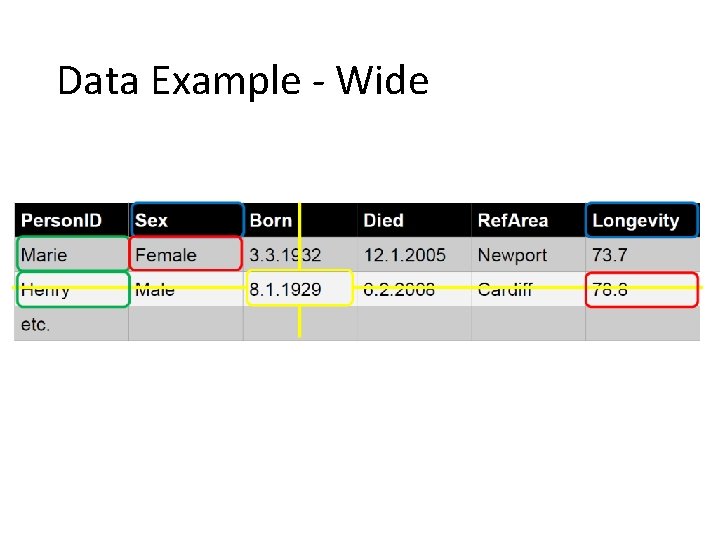
Data Example - Wide
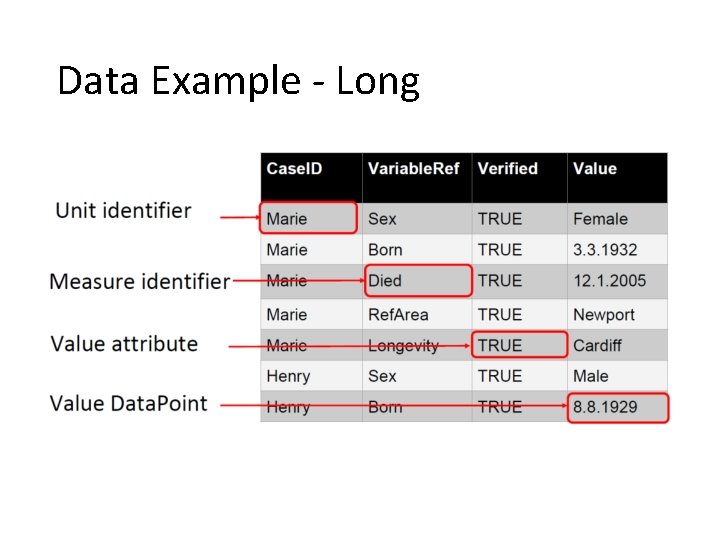
Data Example - Long
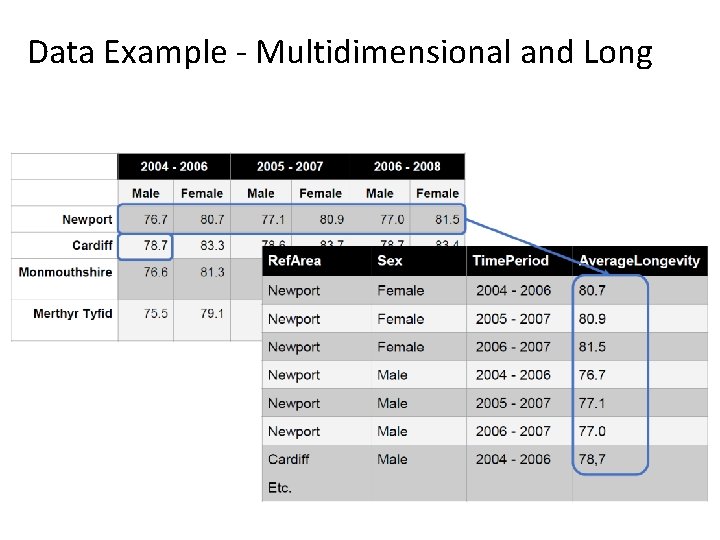
Data Example - Multidimensional and Long
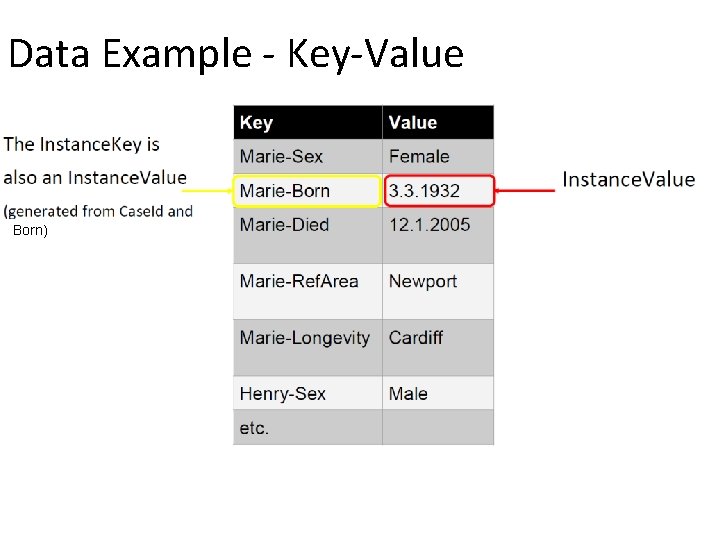
Data Example - Key-Value Born)
DDI-CDI Provenance and Process • • • To understand data we need to understand how it was processed and transformed Popular models to describe this e. g. : BPMN (Business Process Modelling and Notation), PROV Ontology (W 3 C) Syntaxes for deriving transformations, cleaning, analyses etc. , e. g. : R, SAS, Stata, Python, SPSS. Standard transformation models e. g. : Structured Data Transform Language (SDTL), Validation and Transformation Language (VTL) DDI-CDI tries to do something that compliments such models: • Connecting specific machine interpretable processes (syntax specific) with higher-level human readable business process documentation Supports both linear (flow specified in advance) and declarative processing (the system rather than the developer controls when computations are processed)
DDI-CDI Foundational Metadata • Core elements to be modelled – based on DDI 4 work • Statistical concepts and their various usages • Includes categories and variables and much more • DDI-CDI tries to adapt common terms – incorporate domain semantics • Important feature: The variable cascade • How different types of variables relate to each other • How they describe data creation, processing and use
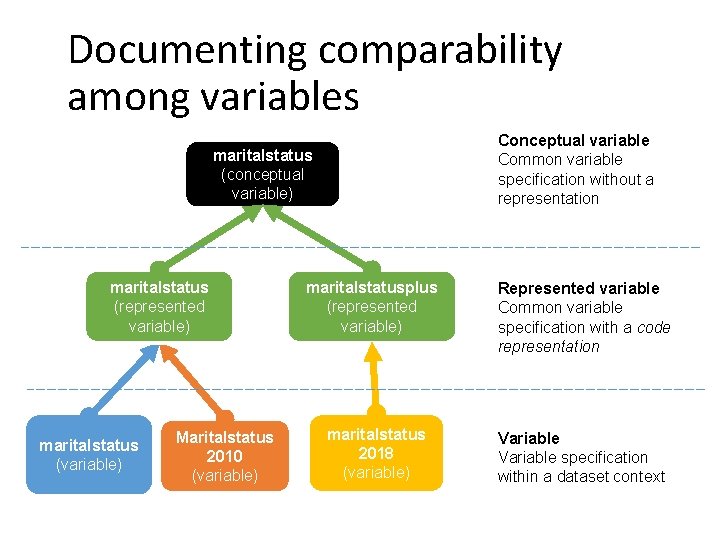
Documenting comparability among variables Conceptual variable Common variable specification without a representation maritalstatus (conceptual variable) maritalstatus (represented variable) maritalstatus (variable) Maritalstatus 2010 (variable) maritalstatusplus (represented variable) Represented variable Common variable specification with a code representation maritalstatus 2018 (variable) Variable specification within a dataset context
DDI-CDI Interoperability, Sustainability, and Standards Alignment • DDI-CDI is a model intended to be implemented across a • • • wide variety of technology platforms In combination with other models and standards, models and specifications Formalized in UML (Unified Modelling Language) – designed to be “future-proof” Provided in the form of Canonical XMI – interchange format of UML supported by many different UML tools Platform independent model, makes it more easily applicable across a broad range of applications XML Schema syntax representation is provided – RDF syntax representation now being investigated Builds on and aligns with other (defined) standards where appropriate (refined, extended, or used)
DDI-CDI Implementations • To describe new kinds of data (sensors, registers, clinical records, social media, etc. ) and their provenance • To integrate new data with existing data • For analysis • For management • Support search and harmonization across collections of different data types • Variable cascade • Integrate data across domain boundaries at a detailed level (SSHOC)
Current Status/Timeline • Public review period ongoing through July 2020 • Series of webinars to recruit meaningful review from other domains • CODATA is supporting this activity • Revised review version released in September 2020 • Focused review at intensive Dagstuhl workshop or virtual equivalent • CODATA has offered to convene a working group of reviewers from external domains to feed requirements into MRT • First production release early 2021
Review by “External” Domains We will be conducting webinars among several domains to recruit reviewers from outside the traditional DDI community: • Health/Infectious Disease • Earth sciences • Life Sciences • Engineering • Physical sciences • Sustainable Development Goals (SDGs) and other policy monitoring indicators
Further Discussions Groups will be convened to discuss the following topics in follow-up meetings: • Data Description related content • Transformation between data structures • The Variable Cascade for comparison and harmonization purposes • Process/provenance • Model related topics – UML/XMI • Relationship between DDI-CDI and other standards Please get back to us if you would be interested to discuss these topics with us, or if you have further ideas.
Welcome to the DDI-CDI review page at https: //ddi-alliance. atlassian. net/wiki/x/IQBPMw
First Things First… The Intro document (for a brief summary): https: //ddialliance. atlassian. net/wiki/download/attachments/8 60815393/Part_1_DDI-CDI_Intro_PR_1. pdf
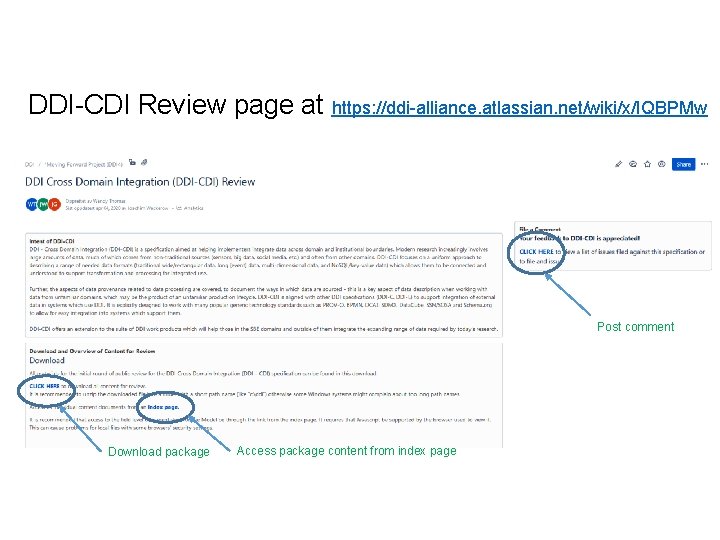
DDI-CDI Review page at https: //ddi-alliance. atlassian. net/wiki/x/IQBPMw Post comment Download package Access package content from index page
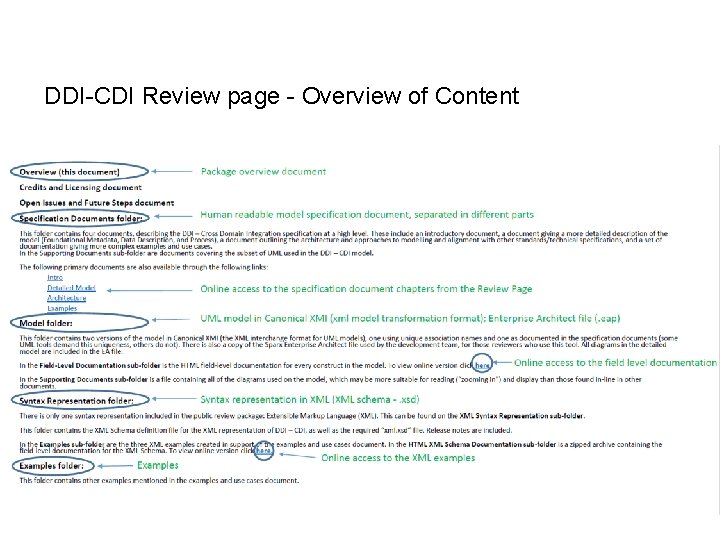
DDI-CDI Review page - Overview of Content
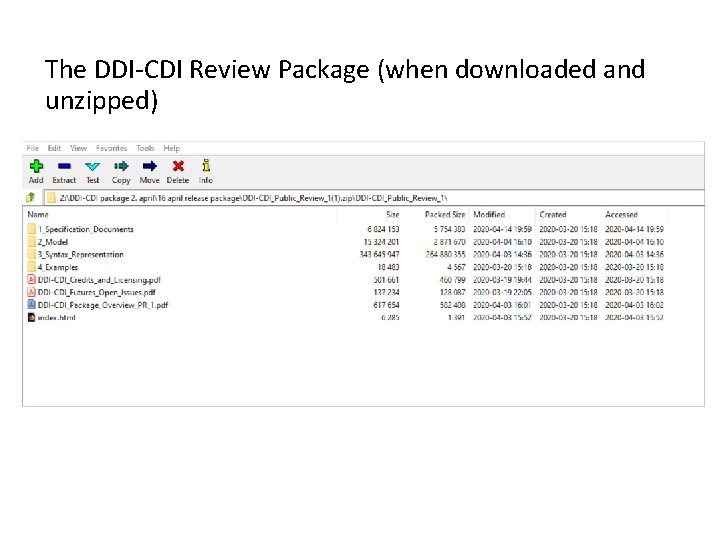
The DDI-CDI Review Package (when downloaded and unzipped)
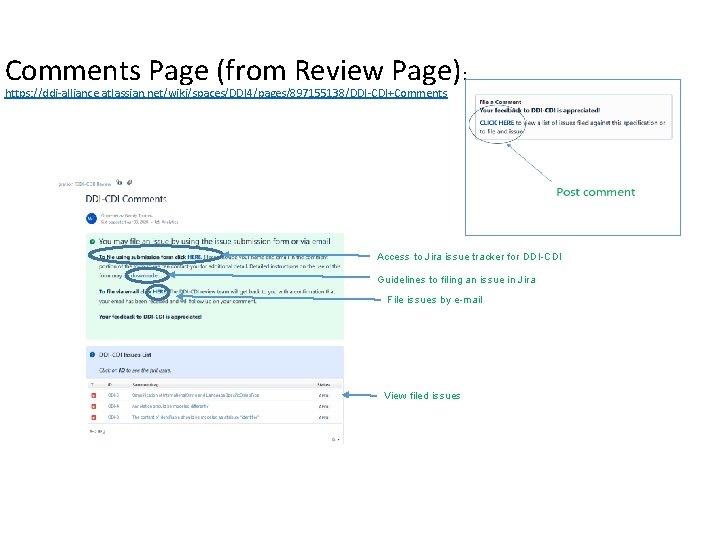
Comments Page (from Review Page): https: //ddi-alliance. atlassian. net/wiki/spaces/DDI 4/pages/897155138/DDI-CDI+Comments Access to Jira issue tracker for DDI-CDI Guidelines to filing an issue in Jira File issues by e-mail View filed issues
In-Depth Engagement… • If you are serious about review and implementation of DDI-CDI, you can also: • Contact us and discuss your planned implementation • Engage in detailed technical review with MRT members • Implement the revised specification prior to release
Your comments to the DDI-CDI are appreciated Review page: https: //ddialliance. atlassian. net/wiki/x/IQBPMw Contact: ddi-cdi@googlegroups. com joachim. wackerow@gesis. org
- Slides: 35