
An Introduction to DDI CDI Background for Public
An Introduction to DDI - CDI Background for Public Reviewers Webinar, 24 June 2020 DDI Modeling, Representation and Testing Working Group (with thanks to the CODATA Decadal Programme)
DDI-CDI and the DDI Alliance • The Data Documentation Initiative (DDI) is a membership-based alliance of data archives, data producers, research institutions, and government agencies • They have produced a series of technical specifications for data, metadata, and data management purposes • DDI – Codebook (DDI-C) • DDI – Lifecycle (DDI-L) • DDI – Cross-Domain Integration is an additional specification, designed to support new features • As a stand-alone specification • In combination with other technical specifications/models
TO REVIEW DDI-CDI!
Outline • • Background: MRT and DDI 4 Core Group and Events DDI-CDI within the DDI Product Suite DDI-CDI Features DDI-CDI Alignment with Other Standards Implementations of DDI-CDI Current Status: The Public Review
History: MRT and DDI Developments • In the margins of the 2018 European DDI User Conference (Berlin) it was agreed that a “core” of the next-generation/model based DDI work should be brought to market • A 1 -year timeframe was proposed • The Modelling, Representation and Testing (MRT) group was formed in early 2019 • The working process was to base models on implementations, tested against real-world use cases • ALPHA Network • DDI R Libraries (references: 1, 2) • Others (U. S. Bureau of Labor Statistics for time series, etc. )
Group and Events • Small group (9 members) meeting weekly (and more) for over a year • No turn-over – members have been extremely focused and disciplined • Ottawa Sprint in margins of NADDI 2019 • Dagstuhl Sprint in October 2019 • Public Review Release April 2020 • Communications with management, technical committee work, marketing, and training groups within the DDI Alliance have been emphasized
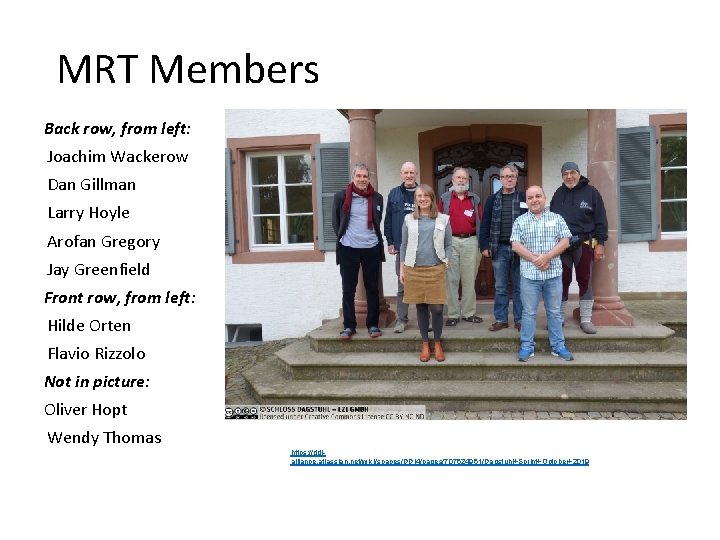
MRT Members Back row, from left: Joachim Wackerow Dan Gillman Larry Hoyle Arofan Gregory Jay Greenfield Front row, from left: Hilde Orten Flavio Rizzolo Not in picture: Oliver Hopt Wendy Thomas https: //ddialliance. atlassian. net/wiki/spaces/DDI 4/pages/707624961/Dagstuhl+Sprint+October+2019
Evolution in Purpose • DDI-CDI was expected to be the “core” of a modeldriven DDI • A “next generation” after DDI-Lifecycle • Implementation cases showed that something else was needed: a focus on data provenance and data integration • DDI-CDI has emerged as a companion to DDICodebook and DDI-Lifecycle, not a replacement for them • The Social, Behavioral, and Economic (SBE) community needs better data integration tools • So do other domains!
Real-World Trends and Requirements • Several changes have taken place in recent years which impact the requirements for DDI-CDI • Larger research projects using data sometimes coming from external domains • More data, coming from a wider range of sources • Increased ability to compute with data (Machine Learning, etc. ) • These changes result in requirements for data/metadata management • More complete, machine-actionable metadata is needed • Improved “context” for data is needed (provenance, semantics) • New data formats/structures must be described and integrated • A broader range of technology platforms require support
DDI-CDI within the Product Suite • DDI-CDI does not replace DDI-Codebook or DDILifecycle • It can and will be used in combination with other DDI specifications • It adds support for describing new types of data • It expands the ability to describe process/provenance • It provides a detailed description of integration between disparate types of data • Extends the applicability of the DDI to new domains/disciplines • As an integration tool • As a data management tool
DDI-CDI Features: Data Description and Provenance • Provides an exact understanding of data in a variety of formats from many different sources. • Flexible means of describing data that can reveal the connection between the same data existing in different formats. • Means of describing the provenance of data at a detailed level.
DDI-CDI Goals and Purpose • Design goal: Create a useful, implementable product based on real use cases • Developed with modern systems in mind • That employs a variety of models • That complies with a range of specifications, related to data description and provenance • Fills in information that other standards do not capture (align rather than replace) • For data: Description of a single data point – a Datum – that can play different roles in different data structures and formats • For process/provenance: Packaging of machine level processes into a structure that relates to business processes described at a level understood by users.
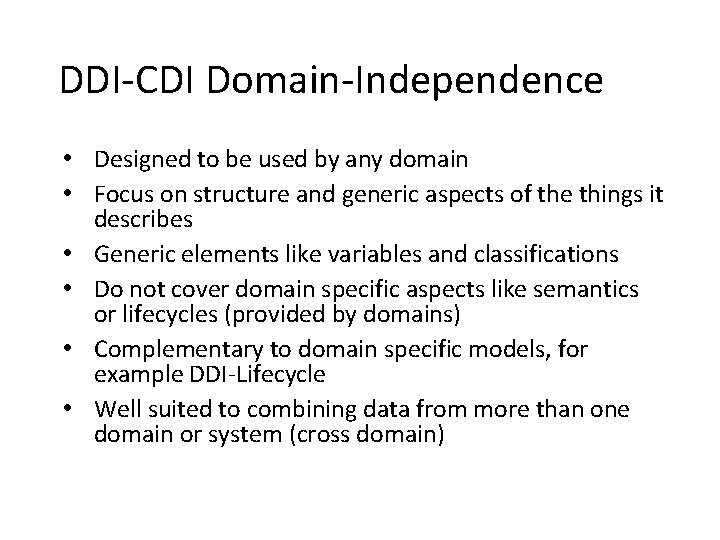
DDI-CDI Domain-Independence • Designed to be used by any domain • Focus on structure and generic aspects of the things it • • describes Generic elements like variables and classifications Do not cover domain specific aspects like semantics or lifecycles (provided by domains) Complementary to domain specific models, for example DDI-Lifecycle Well suited to combining data from more than one domain or system (cross domain)
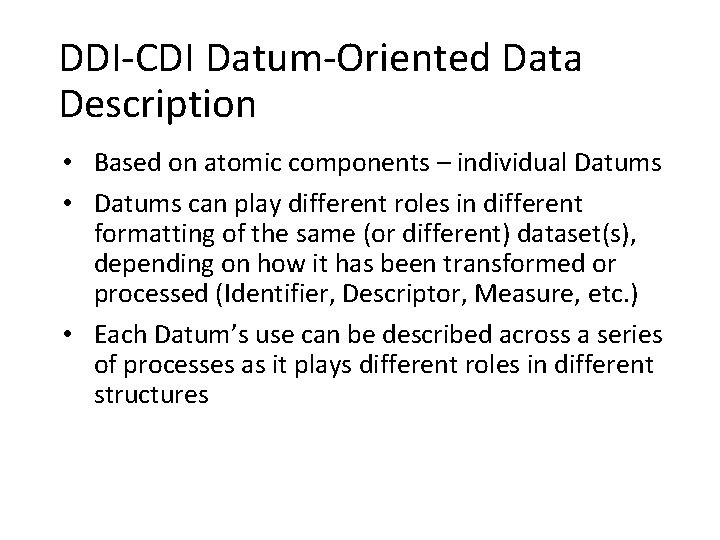
DDI-CDI Datum-Oriented Data Description • Based on atomic components – individual Datums • Datums can play different roles in different formatting of the same (or different) dataset(s), depending on how it has been transformed or processed (Identifier, Descriptor, Measure, etc. ) • Each Datum’s use can be described across a series of processes as it plays different roles in different structures
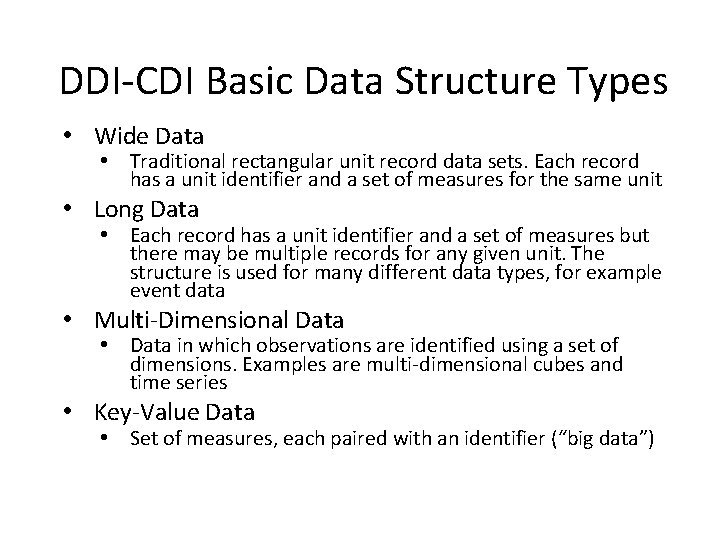
DDI-CDI Basic Data Structure Types • Wide Data • Traditional rectangular unit record data sets. Each record has a unit identifier and a set of measures for the same unit • Long Data • Each record has a unit identifier and a set of measures but there may be multiple records for any given unit. The structure is used for many different data types, for example event data • Multi-Dimensional Data • Data in which observations are identified using a set of dimensions. Examples are multi-dimensional cubes and time series • Key-Value Data • Set of measures, each paired with an identifier (“big data”)
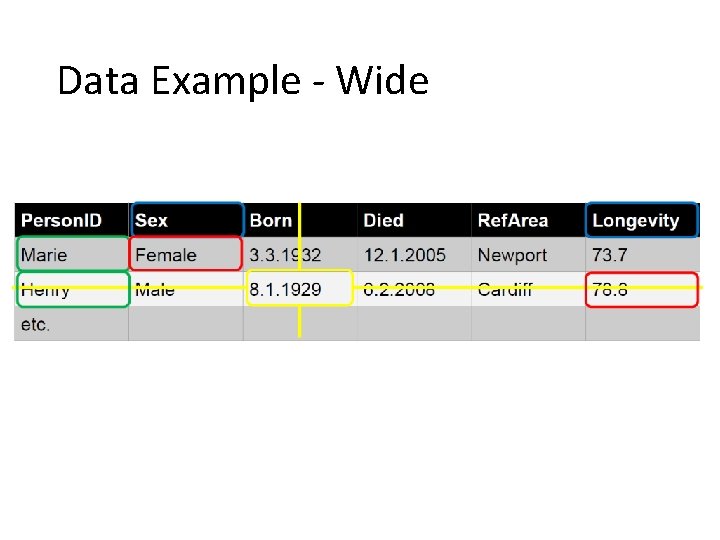
Data Example - Wide
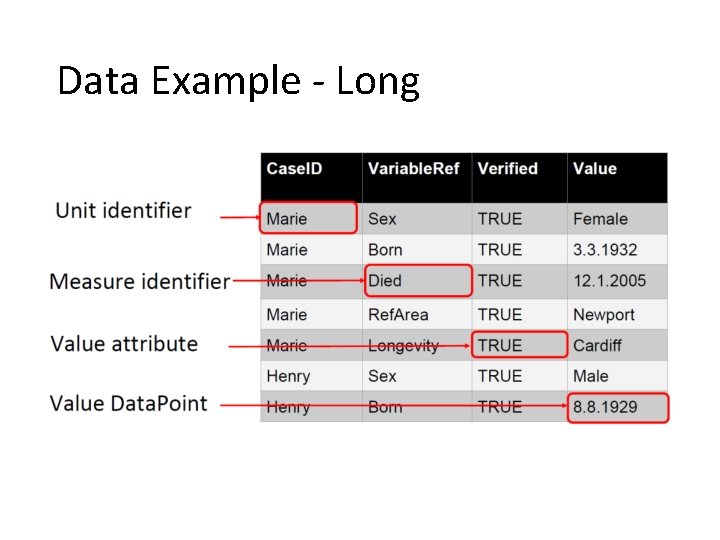
Data Example - Long
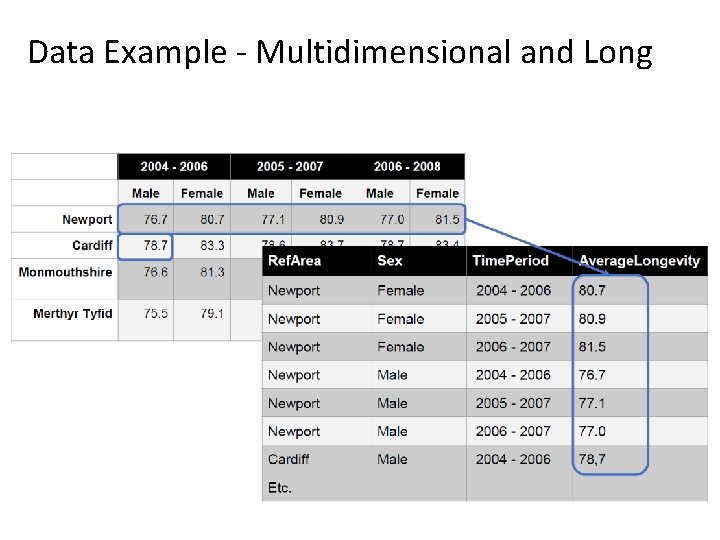
Data Example - Multidimensional and Long
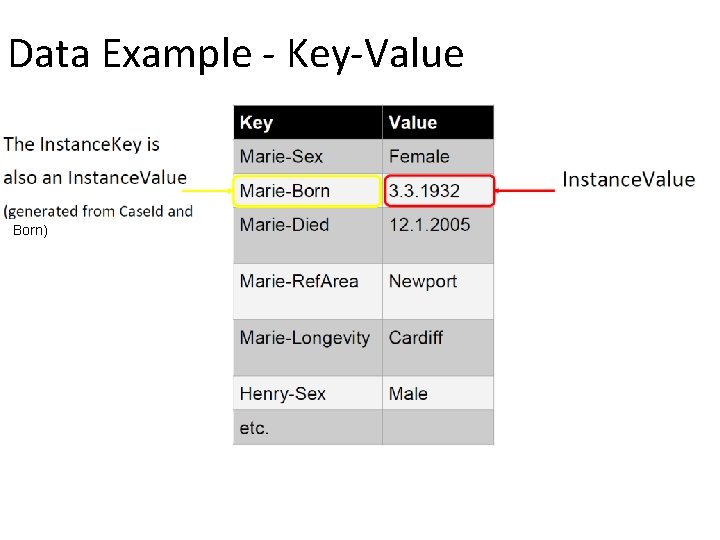
Data Example - Key-Value Born)
DDI-CDI Provenance and Process • • • To understand data we need to understand how it was processed and transformed Popular models to describe this e. g. : BPMN (Business Process Modelling and Notation), PROV Ontology (W 3 C) Syntaxes for deriving transformations, cleaning, analyses etc. , e. g. : R, SAS, Stata, Python, SPSS. Standard transformation models e. g. : Structured Data Transform Language (SDTL), Validation and Transformation Language (VTL) DDI-CDI tries to do something that compliments such models: • Connecting specific machine interpretable processes (syntax specific) with higher-level human readable business process documentation Supports both linear (flow specified in advance) and declarative processing (the system rather than the developer controls when computations are processed)
DDI-CDI Foundational Metadata • Core elements to be modelled – based on DDI 4 work • Statistical concepts and their various usages • Includes categories and variables and much more • DDI-CDI tries to adapt common terms – incorporate domain semantics • Important feature: The variable cascade • How different types of variables relate to each other • How they describe data creation, processing and use
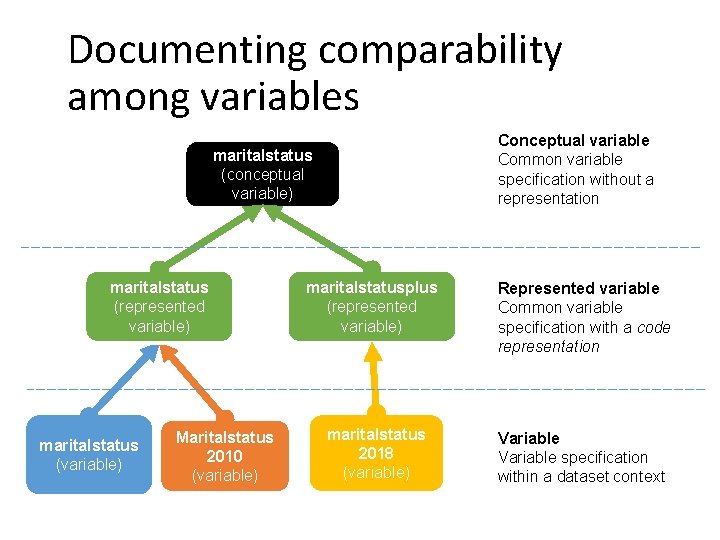
Documenting comparability among variables Conceptual variable Common variable specification without a representation maritalstatus (conceptual variable) maritalstatus (represented variable) maritalstatus (variable) Maritalstatus 2010 (variable) maritalstatusplus (represented variable) Represented variable Common variable specification with a code representation maritalstatus 2018 (variable) Variable specification within a dataset context
DDI-CDI Interoperability, Sustainability, and Standards Alignment • DDI-CDI is a model intended to be implemented across a • • • wide variety of technology platforms In combination with other models and standards, models and specifications Formalized in UML (Unified Modelling Language) – designed to be “future-proof” Provided in the form of Canonical XMI – interchange format of UML supported by many different UML tools Platform independent model, makes it more easily applicable across a broad range of applications XML Schema syntax representation is provided – RDF syntax representation now being investigated Builds on and aligns with other (defined) standards where appropriate (refined, extended, or used)
Possible DDI-CDI Implementations • To describe new kinds of data (sensors, registers, clinical records, social media, etc. ) and their provenance • To integrate new data with existing data • For analysis • For management • Support search and harmonization across collections of different data types • Variable cascade • Integrate data across domain boundaries at a detailed level (Social Sciences & Humanities Open Cloud SSHOC)
Current Status/Timeline • Public review period ongoing through July 2020 • Series of webinars to recruit meaningful review from other domains • CODATA is supporting this activity • Revised review version released in September 2020 • Focused review at intensive Dagstuhl workshop or virtual equivalent • CODATA has offered to convene a working group of reviewers from external domains to feed requirements into MRT • First production release early 2021
Review by “External” Domains We will be conducting webinars among several domains to recruit reviewers from outside the traditional DDI community: • Health/Infectious Disease • Earth sciences • Life Sciences • Engineering • Physical sciences • Sustainable Development Goals (SDGs) and other policy monitoring indicators
Further Discussions Groups will be convened to discuss the following topics in follow-up meetings: • Data Description related content • Transformation between data structures • The Variable Cascade for comparison and harmonization purposes • Process/provenance • Model related topics – UML/XMI • Relationship between DDI-CDI and other standards Please get back to us if you would be interested to discuss these topics with us, or if you have further ideas.
Welcome to the DDI-CDI review page at https: //ddi-alliance. atlassian. net/wiki/x/IQBPMw
First Things First… The Intro document (for a brief summary): https: //ddi-alliance. atlassian. net/wiki/download/ attachments/860815393/Part_1_DDI-CDI_Intro_PR_1. pdf
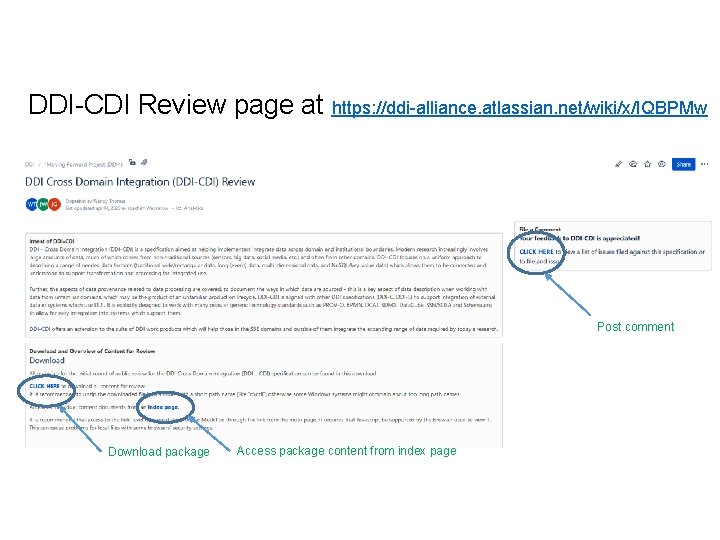
DDI-CDI Review page at https: //ddi-alliance. atlassian. net/wiki/x/IQBPMw Post comment Download package Access package content from index page
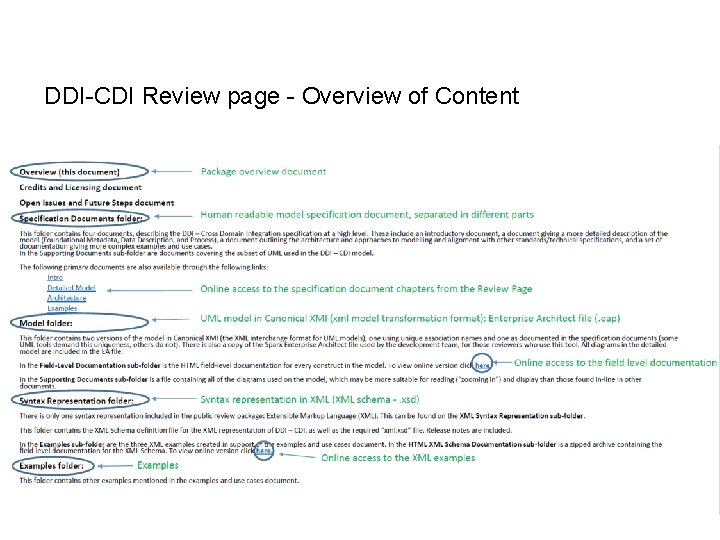
DDI-CDI Review page - Overview of Content
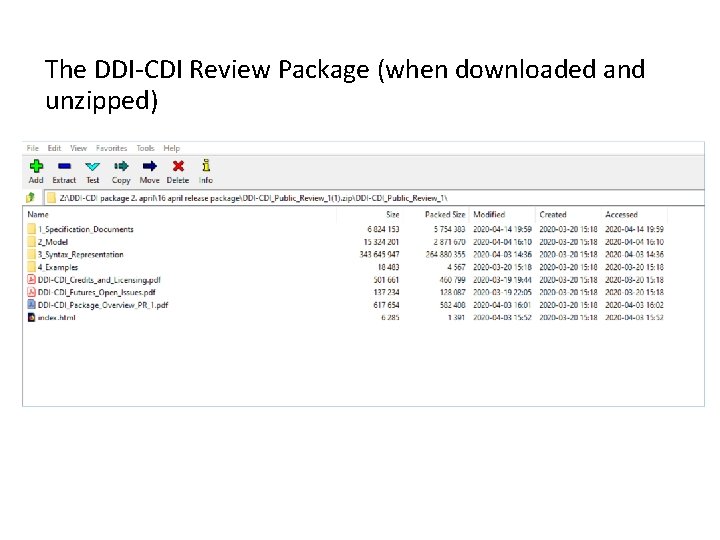
The DDI-CDI Review Package (when downloaded and unzipped)
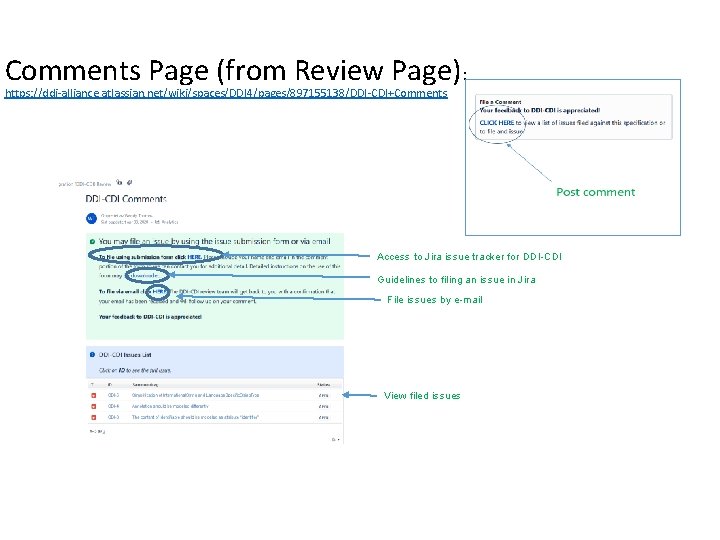
Comments Page (from Review Page): https: //ddi-alliance. atlassian. net/wiki/spaces/DDI 4/pages/897155138/DDI-CDI+Comments Access to Jira issue tracker for DDI-CDI Guidelines to filing an issue in Jira File issues by e-mail View filed issues
In-Depth Engagement… • If you are serious about review and implementation of DDI-CDI, you can also: • Contact us and discuss your planned implementation • Engage in detailed technical review with MRT members • Implement the revised specification prior to release
Your comments to the DDI-CDI are appreciated Review page: https: //ddialliance. atlassian. net/wiki/x/IQBPMw Contact: ddi-cdi@googlegroups. com joachim. wackerow@gesis. org
- Slides: 35