
An introduction to close reading of literary text
- Slides: 10
An introduction to close reading of literary text for the Common Core. This Power. Point includes… • • Rationale for close reading A protocol for close reading Teacher model Independent practice Discussion questions. A reflection activity Read like a Detective Protocol Student hand-out Cloze Notes Copyright Literacy Across the Curriculum, Katrina Groen 2013. Clipart used with permission from Microsoft. com
What does it mean to read like a detective? • • Detectives want to solve a mystery. They examine a crime scene extremely closely in order to solve this mystery. When you read like a detective, you read closely and carefully. You try to find the “deeper meaning” in the text. Copyright Literacy Across the Curriculum, Katrina Groen 2013. Clipart used with permission from Microsoft. com
Why do I need to read like a detective? • • Literary text is like a mystery. There are many layers! You may understand the simple “who, what, when, where, why” of the text, but there is often a deeper meaning. This deeper meaning is often the most important part of literary text and if you don’t read closely,
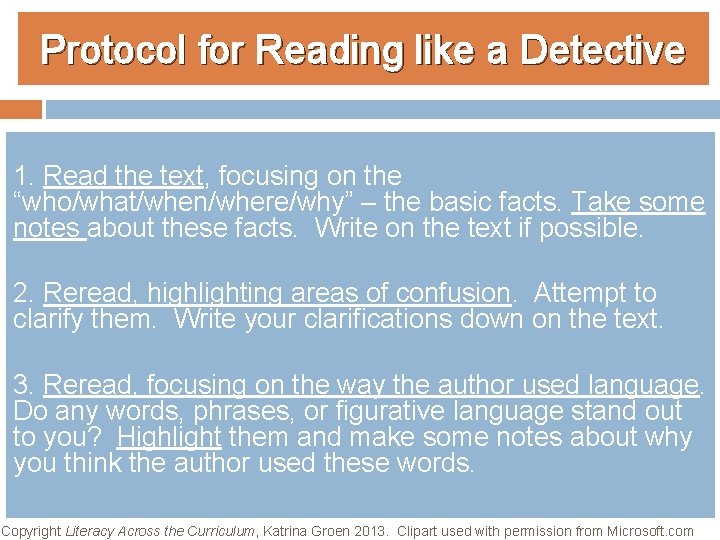
Protocol for Reading like a Detective 1. Read the text, focusing on the “who/what/when/where/why” – the basic facts. Take some notes about these facts. Write on the text if possible. 2. Reread, highlighting areas of confusion. Attempt to clarify them. Write your clarifications down on the text. 3. Reread, focusing on the way the author used language. Do any words, phrases, or figurative language stand out to you? Highlight them and make some notes about why you think the author used these words. Copyright Literacy Across the Curriculum, Katrina Groen 2013. Clipart used with permission from Microsoft. com
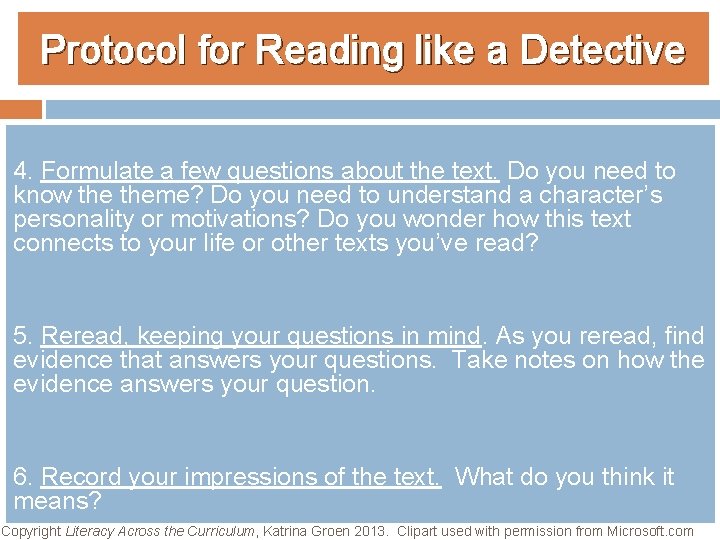
Protocol for Reading like a Detective 4. Formulate a few questions about the text. Do you need to know theme? Do you need to understand a character’s personality or motivations? Do you wonder how this text connects to your life or other texts you’ve read? 5. Reread, keeping your questions in mind. As you reread, find evidence that answers your questions. Take notes on how the evidence answers your question. 6. Record your impressions of the text. What do you think it means? Copyright Literacy Across the Curriculum, Katrina Groen 2013. Clipart used with permission from Microsoft. com
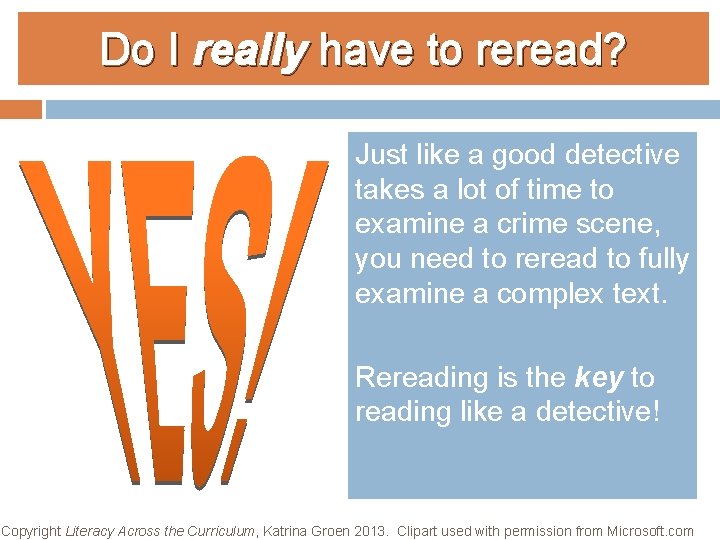
Do I really have to reread? Just like a good detective takes a lot of time to examine a crime scene, you need to reread to fully examine a complex text. Rereading is the key to reading like a detective! Copyright Literacy Across the Curriculum, Katrina Groen 2013. Clipart used with permission from Microsoft. com
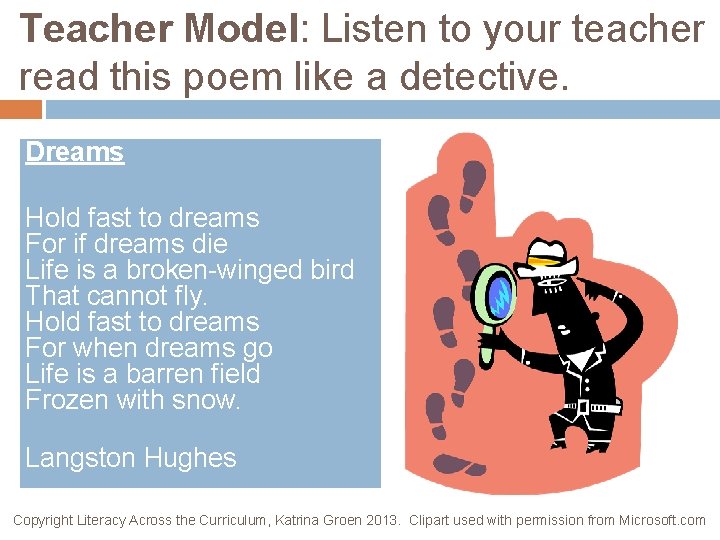
Teacher Model: Listen to your teacher read this poem like a detective. Dreams Hold fast to dreams For if dreams die Life is a broken-winged bird That cannot fly. Hold fast to dreams For when dreams go Life is a barren field Frozen with snow. Langston Hughes Copyright Literacy Across the Curriculum, Katrina Groen 2013. Clipart used with permission from Microsoft. com
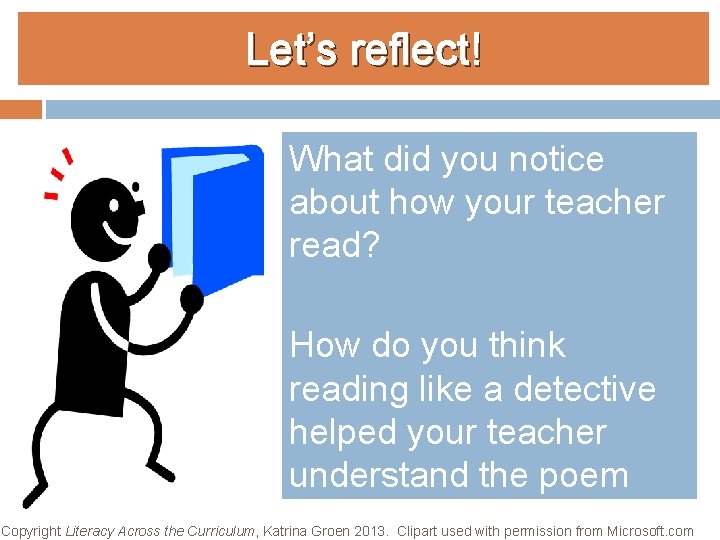
Let’s reflect! What did you notice about how your teacher read? How do you think reading like a detective helped your teacher understand the poem better? Copyright Literacy Across the Curriculum, Katrina Groen 2013. Clipart used with permission from Microsoft. com
Let me try! Read “How the Pencil was Invented and use the 6 steps of reading like a detective. Teacher note: You can find “Abandoned Farmhouse” by former US Poet laureate Ted Kooser by opening the following hyperlink in a separate tab: Poetry Foundation. Copyright Literacy Across the Curriculum, Katrina Groen 2013. Clipart used with permission from Microsoft. com
Let’s reflect! Please answer the following question in writing: How did your thinking about the poem change with each read? What new details did you notice that you had previously missed? Copyright Literacy Across the Curriculum, Katrina Groen 2013. Clipart used with permission from Microsoft. com