
An Introduction to Chemical Biological and Radiological Threat
An Introduction to Chemical, Biological, and Radiological Threat Agents Prepared for National Cooperative Highway Research Program Transportation Research Board, National Research Council Prepared by Science Applications International Corporation Mc. Lean, VA, tel. (703) 676 -4559 As part of 20 -59(19) Transportation Response Options: Scenarios of Infectious Diseases, Biological Agents, Radiological, Chemical and Other Hazardous Materials: A Guide to Transportation’s Role in Public Health Disasters Revised: September, 2005
ACKNOWLEDGMENT OF SPONSORSHIP This work was sponsored by the American Association of State Highway and Transportation Officials, in cooperation with the Federal Highway Administration, and was conducted in the National Cooperative Highway Research Program, which is administered by the Transportation Research Board of the National Research Council. DISCLAIMER This is an uncorrected draft as submitted by the research agency. The opinions and conclusions expressed or implied in the report are those of the research agency. They are not necessarily those of the Transportation Research Board, The National Research Council, the Federal Highway Administration, the American Association of State Highway and Transportation Officials, or the individual states participating in the National Cooperative Highway Research Program.
An Introduction to Chemical, Biological, and Radiological Threat Agents DANGER TOXIC CHEMICALS Revised: September 2005

“The question is, what levels of insanity do we have to prepare for? ” -- Joshua Lederberg, Nobel laureate
Contents Descriptions, effects, detection, and general responses to: • Chemical threats (Slides 7 -14) • Biological threats (Slides 15 -24) • Radiological threats (Slides 25 -32)
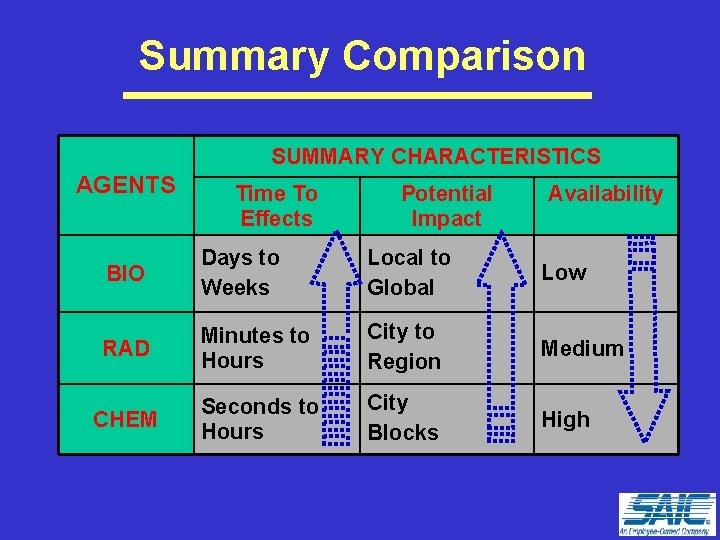
Summary Comparison SUMMARY CHARACTERISTICS AGENTS Time To Effects Potential Impact Availability BIO Days to Weeks Local to Global Low RAD Minutes to Hours City to Region Medium CHEM Seconds to Hours City Blocks High
CHEMICAL THREAT AGENT FUNDAMENTALS
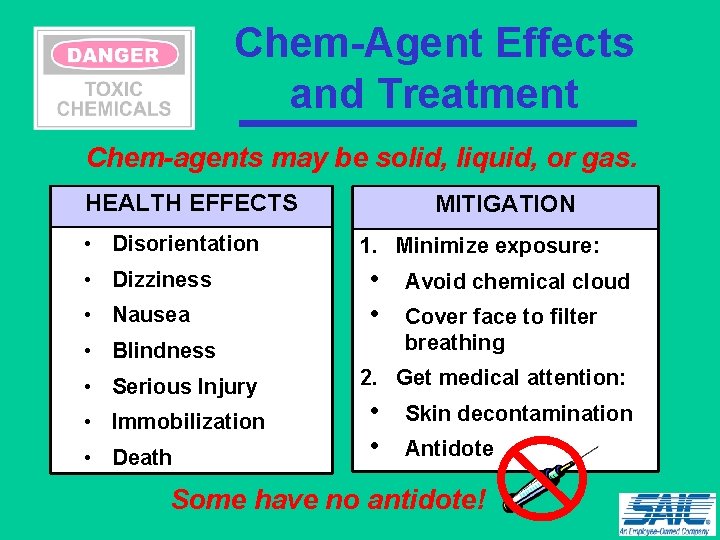
Chem-Agent Effects and Treatment Chem-agents may be solid, liquid, or gas. HEALTH EFFECTS • Disorientation • Dizziness • Nausea MITIGATION 1. Minimize exposure: • • • Blindness • Serious Injury • Immobilization • Death Avoid chemical cloud Cover face to filter breathing 2. Get medical attention: • • Skin decontamination Antidote Some have no antidote!

Types of Chem-Agents Some chem-agents are persistent, many are not persistent Persistent chemicals • remain on surfaces without evaporating or breaking down for more than 24 hours • can remain for days to weeks Non-persistent chemicals • • quickly evaporate and break down carried in bulk on commercial carriers
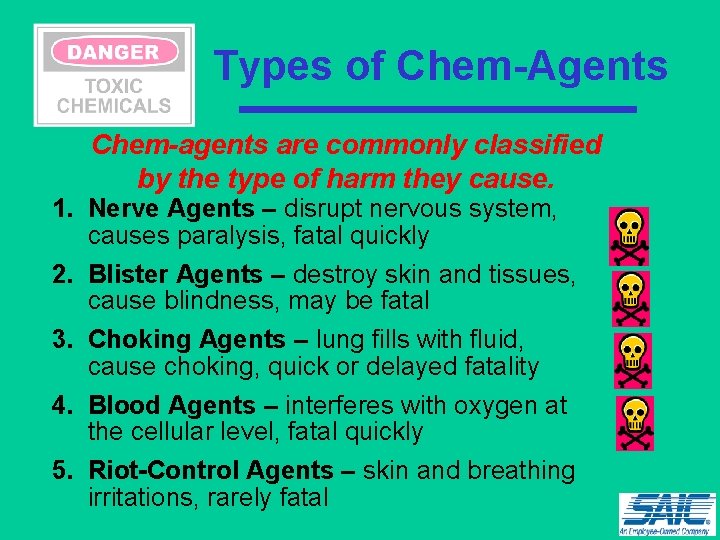
Types of Chem-Agents Chem-agents are commonly classified by the type of harm they cause. 1. Nerve Agents – disrupt nervous system, causes paralysis, fatal quickly 2. Blister Agents – destroy skin and tissues, cause blindness, may be fatal 3. Choking Agents – lung fills with fluid, cause choking, quick or delayed fatality 4. Blood Agents – interferes with oxygen at the cellular level, fatal quickly 5. Riot-Control Agents – skin and breathing irritations, rarely fatal
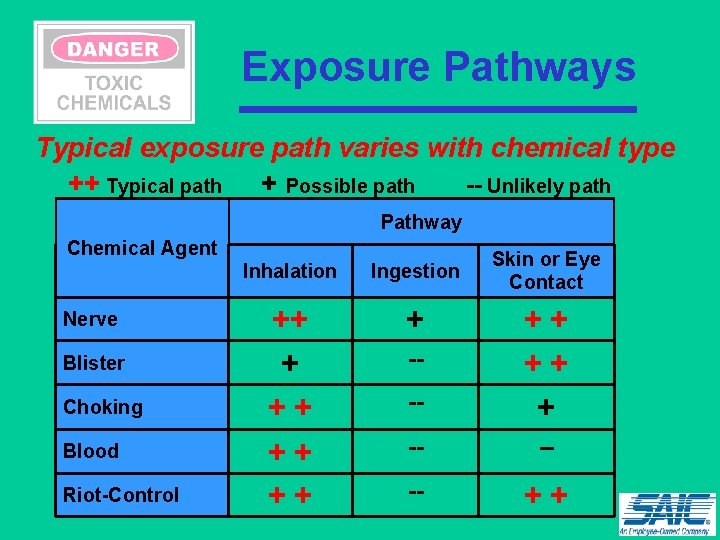
Exposure Pathways Typical exposure path varies with chemical type ++ Typical path + Possible path -- Unlikely path Pathway Chemical Agent Nerve Blister Choking Blood Riot-Control Inhalation Ingestion ++ ++ ++ + Skin or Eye Contact -- ++ ++ + -- -- -- ++ --
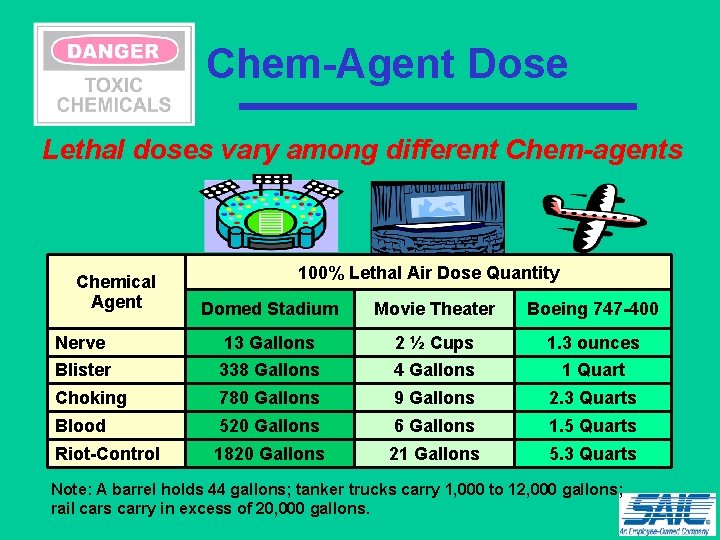
Chem-Agent Dose Lethal doses vary among different Chem-agents Chemical Agent 100% Lethal Air Dose Quantity Domed Stadium Movie Theater Boeing 747 -400 Nerve 13 Gallons 2 ½ Cups 1. 3 ounces Blister 338 Gallons 4 Gallons 1 Quart Choking 780 Gallons 9 Gallons 2. 3 Quarts Blood 520 Gallons 6 Gallons 1. 5 Quarts Riot-Control 1820 Gallons 21 Gallons 5. 3 Quarts Note: A barrel holds 44 gallons; tanker trucks carry 1, 000 to 12, 000 gallons; rail cars carry in excess of 20, 000 gallons.

Chem-Agent Detection • • Some can be seen • All can be detected by appropriate instruments Some can be smelled Some can be tasted Most can be felt (e. g. burning sensation, choking)

Chem-Agent Response • • • Call in hazmat team Identify chemical agent Isolate and contain affected area Evacuate and shelter-in-place public Provide needed medical treatment Cleanup contaminated area

BIOLOGICAL THREAT AGENT FUNDAMENTALS

The Bio-Agent Threat • Causes disease and death by inhalation, ingestion, or skin contact • Some are Contagious! (transferred from person-to-person) • • Many multiply in the body Symptoms may be delayed Some agents have NO vaccine Some survive dormant in the environment for weeks to years

Types of Bio-Agents 1. BACTERIA – Single-celled organisms – Can reproduce – Antibiotic treatment Anthrax (Bacteria) 2. VIRUSES – Live inside cells – Need host to reproduce – Vaccine and antiviral treatments Ebola (Virus) 3. BIOTOXINS – Non-living (can’t reproduce) – Produced by organisms – Antidote treatment Ricin (Toxin)

Bio-Agent Delivery Attacks can be overt or covert – method of delivery is important! Overt -- Provides notice, creates panic… Øaircraft, bombs, missiles Covert -- NO notice; spread may be unchecked for days! ØSpray fine mist (e. g. , into HVAC) ØSpread on food, water, surfaces (e. g. , mail, vehicles) ØContagious people and animals

Bio-Agent Dose A tiny amount of Bio-Agent can be very potent! • Inhalation of 1 to 500 bacteria or viruses can cause sickness and death. – 100, 000 bacteria fit on a pin head – 400 million virus fit on a pin head • Inhalation of 0. 000002 to 4. 8 micro grams of a biotoxin cause sickness – A sand grain weighs 170 to 13, 000 micrograms
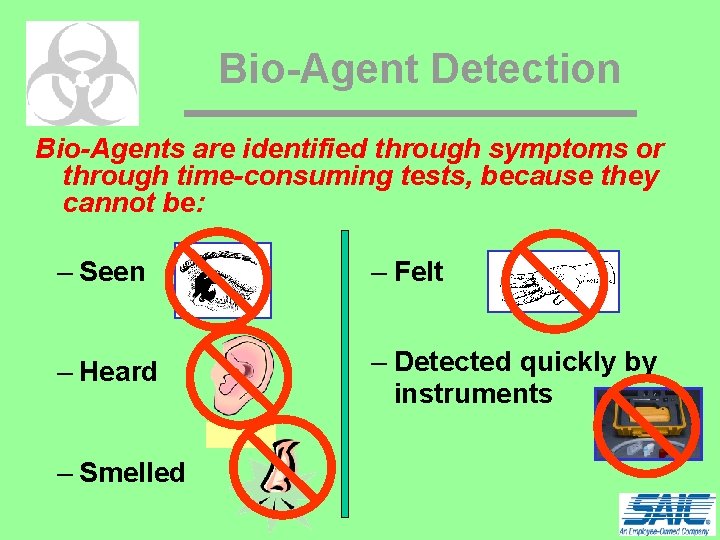
Bio-Agent Detection Bio-Agents are identified through symptoms or through time-consuming tests, because they cannot be: – Seen – Felt – Heard – Detected quickly by instruments – Smelled

Bio-Agent Indicators Since bio-agents are difficult to detect, it is critical to note indicators! • Many patients with same illness at the same time • Symptoms unusual for age • Type of infection rare to region • Dead animals before humans

Bio-Agent Response • Identify: Bio-Agent(s), source, area affected, population exposed • • Notify local medical facilities Isolate and contain affected areas and population Treat -- provide vaccine or medications to the affected population Decontaminate affected areas and population Follow-on Treatment -- continue medical treatment as appropriate • • •
Bio-Agent Decontamination • Physical removal-HEPA vacuum • Liquid decontamination • Foam decontamination • Emulsions • Fumigants Different approaches for different situations, and multiple approaches for most situations.
RADIOLOGICAL THREAT AGENT FUNDAMENTALS

Artificial Sources of Radiation Only artificial sources pose a significant threat. • • Medical Equipment Radiopharmaceuticals Industrial instruments Food irradiation facilities Nuclear research laboratories University research reactors Nuclear weapons Nuclear power plants
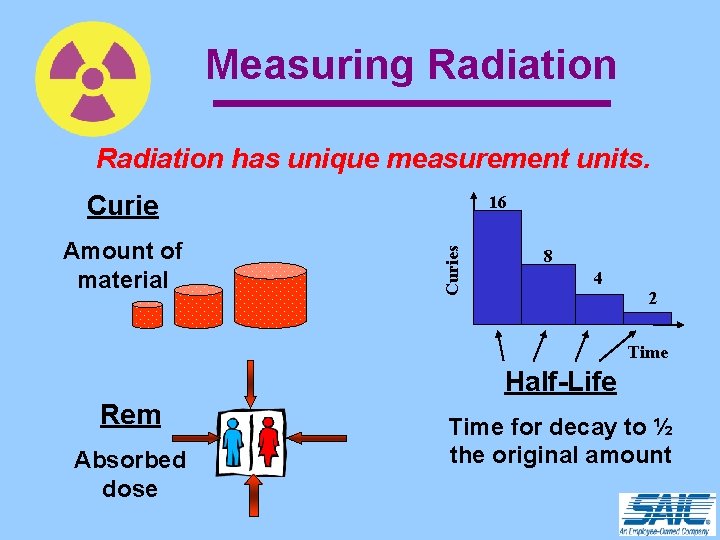
Measuring Radiation has unique measurement units. Curies Amount of material 16 8 4 2 Time Half-Life Rem Absorbed dose Time for decay to ½ the original amount

Shielding from Radiation radiates in all directions and bounces of surfaces. Protective shielding varies with the type of radiation. α [Alpha] β Skin, paper, 1 to 4 inches of air Less than ¼ inch metal, glass, concrete, 1 to 18 feet air [Beta] γn [Gamma or Neutron] 2 to 12 inches lead, 3 to 18 inches steel, 1 to 6 feet of concrete

Radiation Detection • Can not be seen • Can not be smelled • Can not be tasted • Can not be felt • Can be rapidly detected by instruments!
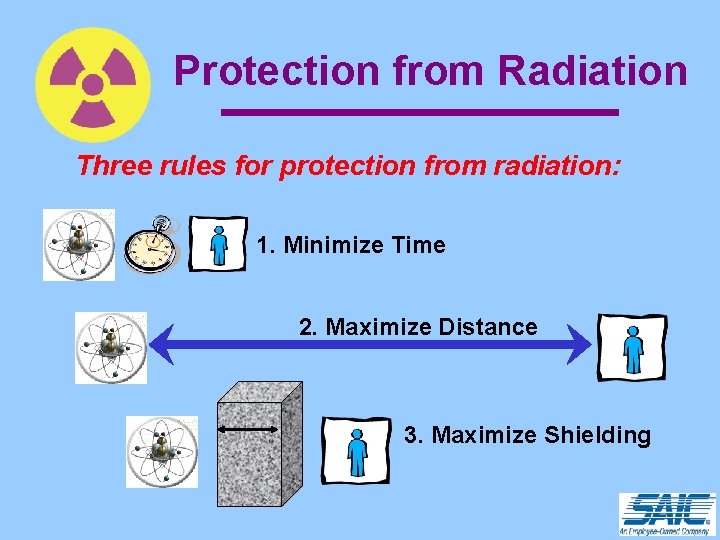
Protection from Radiation Three rules for protection from radiation: 1. Minimize Time 2. Maximize Distance 3. Maximize Shielding

Indications of a Radiological Event Explosions and symptoms of high radiation doses indicate a radiological attack. • Explosive release of fine powder or solid material • • • Skin reddening Headaches Nausea & vomiting Hair loss Weakened immune system
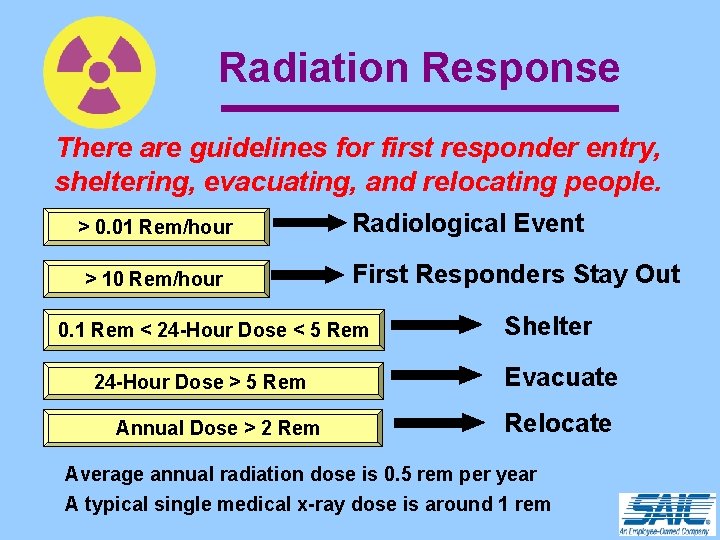
Radiation Response There are guidelines for first responder entry, sheltering, evacuating, and relocating people. > 0. 01 Rem/hour > 10 Rem/hour Radiological Event First Responders Stay Out 0. 1 Rem < 24 -Hour Dose < 5 Rem 24 -Hour Dose > 5 Rem Annual Dose > 2 Rem Shelter Evacuate Relocate Average annual radiation dose is 0. 5 rem per year A typical single medical x-ray dose is around 1 rem

Response to a Radiological Event • Identify presence of radiation beyond normal background • Isolate and contain affected area -mitigate spread of contamination • Shelter-in-place or evacuate depending on dose rates • Provide needed immediate medical treatment
“An emergency system that’s dusted off and used only during a rare event isn’t going to work. ” -- Tara O’Toole, Johns Hopkins
- Slides: 33