
An Introduction to Cardiotocography CTG Max Brinsmead MB
An Introduction to Cardiotocography – “CTG” Max Brinsmead MB BS Ph. D May 2015
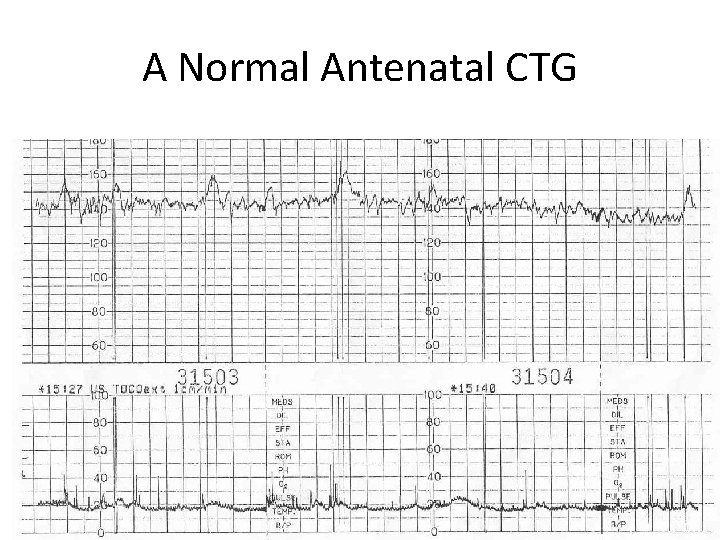
A Normal Antenatal CTG
Features of a CTG • • • Baseline Short term variability Accelerations Decelerations Response to stimuli • Contractions • Fetal movements • Other
Baseline Fetal Heart Rate 110 to 150 bpm at term Faster in early pregnancy Below 100 = baseline bradycardia Below 80 = severe bradycardia Tachycardia common with maternal fever Tachycardia with reduced STV = early hypoxia • Look for a rising baseline • • •
Accelerations Must be >15 bpm and >15 sec above baseline Should be >2 per 15 min period Always reassuring when present May not occur when fetus is “sleeping” Should occur in response to fetal movements or fetal stimulation • Non reactive periods usually do not exceed 45 min • • • (>90 min and no accelerations is worrying)
Short Term Variability (or Beat to Beat Variability with a Scalp Clip) • Should be >5 bpm • The most important feature of any CTG • Is a reflection of competing acceleratory and decelerating CNS influences on the fetal heart • And therefore represents the best measure of CNS oxygenation • Will be affected by drugs • Will be reduced in the pre term fetus
Decelerations • Early: mirrors the contraction • Typically occurs as the head enters the pelvis and is compressed, i. e. it is a vagal response • Late: Follows every contraction and exhibits a slow return to baseline • Is quite rare but is the response of a hypoxic myocardium • Variable: Show no relationship to contractions • Mild • Moderate • Severe • In practice many “decels” or “dips” are MIXED
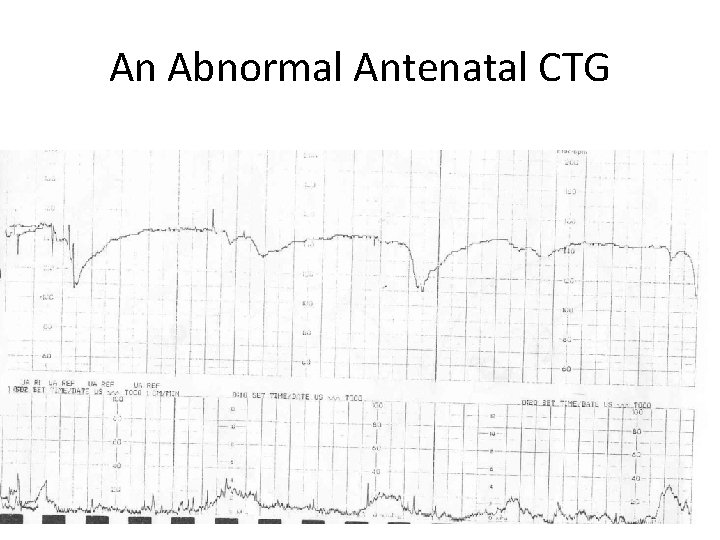
An Abnormal Antenatal CTG
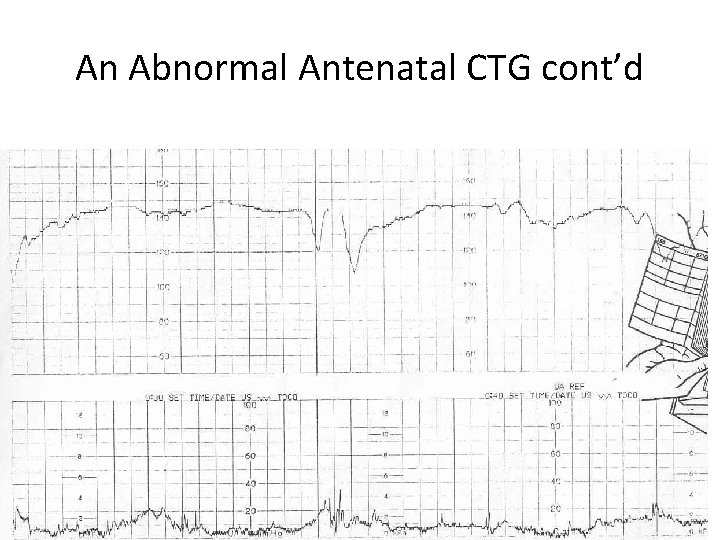
An Abnormal Antenatal CTG cont’d
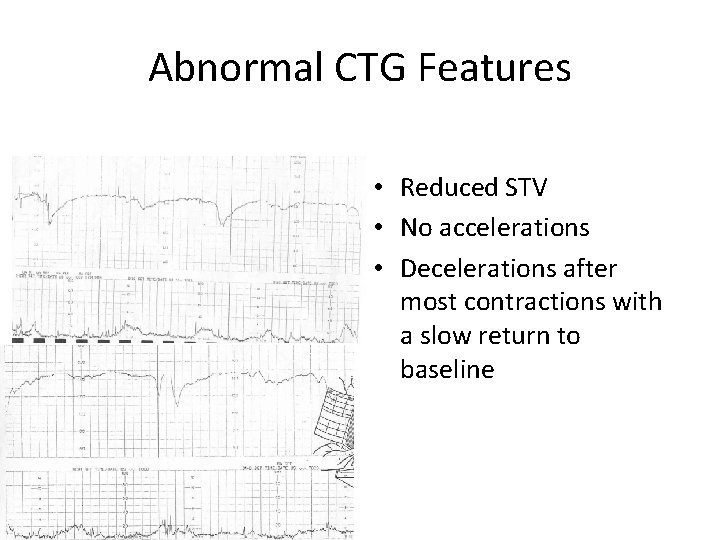
Abnormal CTG Features • Reduced STV • No accelerations • Decelerations after most contractions with a slow return to baseline
In Practice a CTG is best regarded as a screening tool: • High negative predictive value • >98% of fetuses with a normal CTG will be OK • Poor positive predictive value • 50% of fetuses with an abnormal CTG will be hypoxic and acidotic but 50% will be OK • Therefore the CTG should always be interpreted in its clinical context • And backed by fetal blood sampling PRN
Non Reassuring Features of a CTG • • • Baseline <110>100 or >160<180 STV <5 for >40 min but <90 min Early decelerations Variable decelerations A single prolonged deceleration up to 3 min
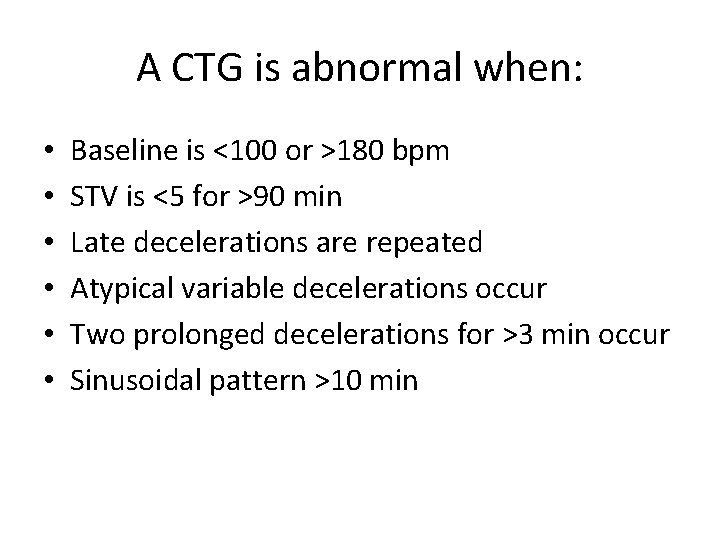
A CTG is abnormal when: • • • Baseline is <100 or >180 bpm STV is <5 for >90 min Late decelerations are repeated Atypical variable decelerations occur Two prolonged decelerations for >3 min occur Sinusoidal pattern >10 min

Any Questions or Comments? Please leave a note on the Welcome Page of this website
- Slides: 14