
An Introduction to Biomechanics PSK 4 U Lecture
An Introduction to Biomechanics PSK 4 U Lecture Series
A field within Kinesiology… The science of human movement n Applying mechanical principles to the human body (eg. Force, velocity, acceleration, centre of gravity) n Internal forces produced by muscles and tendons working against external forces of gravity, air resistance, water resistance and friction n Helps to evaluate performance of athletes and aid in recovery and prevent/examine sports injuries n In my degree…this was a 2 nd year required course n
Careers within Biomechanics? n As an ‘engineer of the body’…you might: Analyze a movement? https: //youtu. be/a. Jjv 8 t. Wbj 4 c Or https: //youtu. be/qt. Xz 6 qocci. M Help a patient recover? http: //en. wikipedia. org/wiki/Force_plate
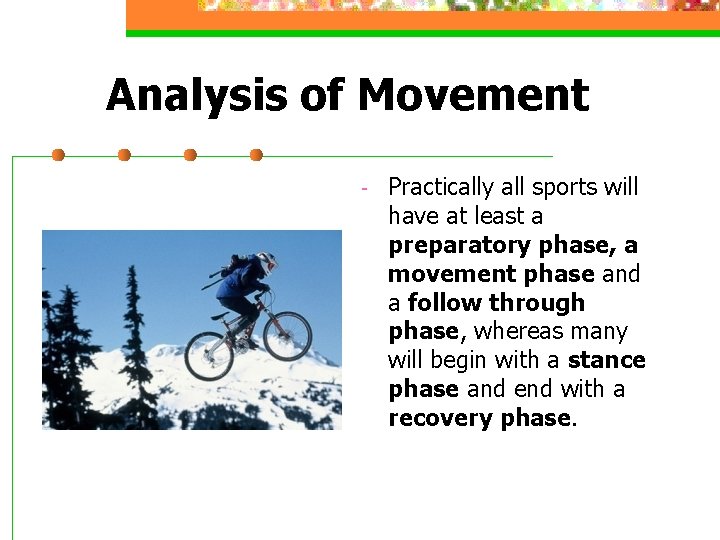
Analysis of Movement - Practically all sports will have at least a preparatory phase, a movement phase and a follow through phase, whereas many will begin with a stance phase and end with a recovery phase.
Movement Phases n Stance n n Allows the athlete to assume a comfortable and balanced body position from which to initiate the sport skill. Preparatory n Often called the wind up phase, is used to lengthen the appropriate muscles so that they concentrically contract in the next phase
Movement Phases n Movement n n Follow Through n n Sometimes called the acceleration, motion or contact (is the action of the skill) Begins immediately after the climax of the movement phase in order to bring about negative acceleration of the involved limb Recovery n Used to regain balance and positioning to be ready for the next sport demand TASK 1: Choose a familiar sport movement and describe each phase with the information you have been given.
Physics review: Newton’s 3 Laws of Motion n 1. The Law of Inertia n n 2. The Law of Acceleration n n Every object in a state of uniform motion tends to remain in that state of motion unless an external force is applied to it. Force applied to an object causes acceleration of that object proportional to the force, in the direction of the applied force, and inversely proportional to the object’s mass. 3. The Law of Reaction n For every action there is an equal and opposite reaction.
A quick quiz… n 1. 2. 3. Let’s apply these laws in the following cases: Bobsled start Hockey stop Golf ball during a putt
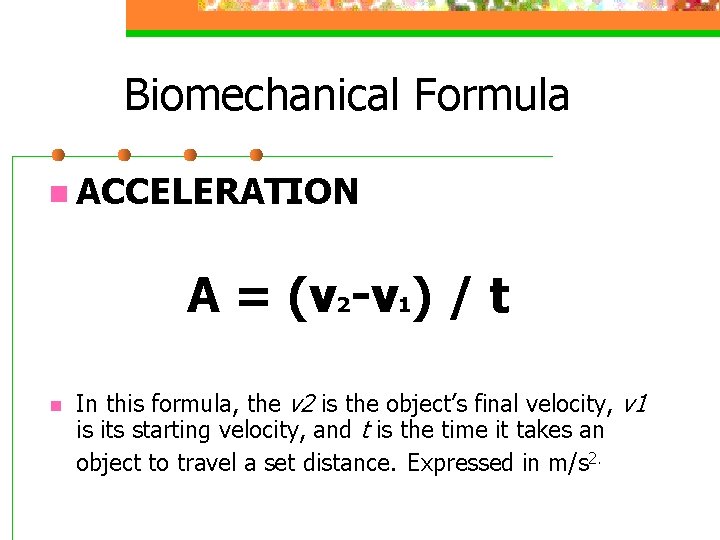
Biomechanical Formula n ACCELERATION A = (v 2 -v 1) / t n In this formula, the v 2 is the object’s final velocity, v 1 is its starting velocity, and t is the time it takes an object to travel a set distance. Expressed in m/s 2.
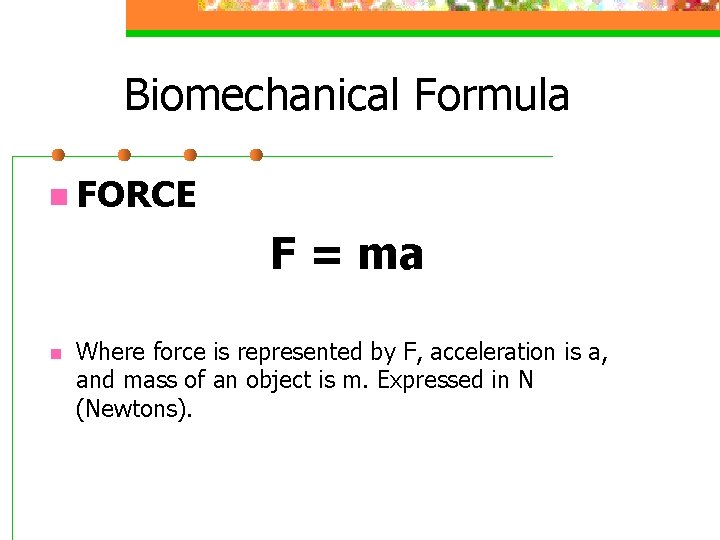
Biomechanical Formula n FORCE F = ma n Where force is represented by F, acceleration is a, and mass of an object is m. Expressed in N (Newtons).
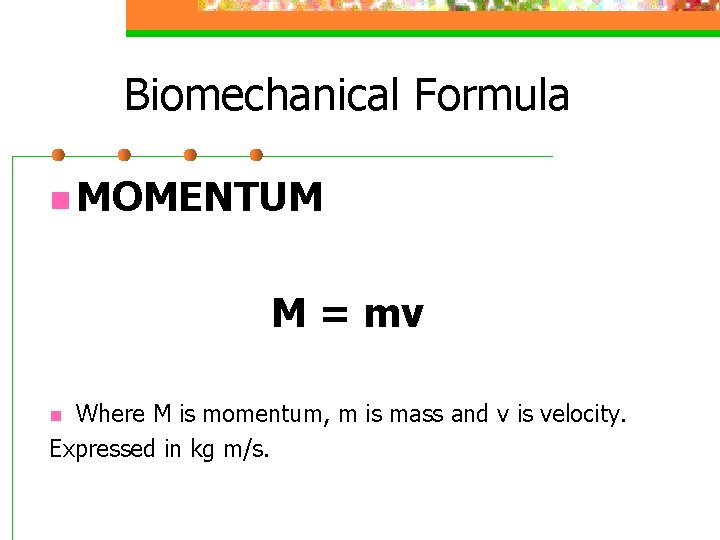
Biomechanical Formula n MOMENTUM M = mv Where M is momentum, m is mass and v is velocity. Expressed in kg m/s. n
7 Biomechanical Principles Text Chapter 12 n n n With a partner, choose one biomechanical principle and write an abstract (summary) using appropriate vocabulary and terminology. Use a sport specific example (not from the text!) to illustrate your principle. There will be class time to discuss your principle and to take notes on others’ work.
- Slides: 12