
An Introduction to Bioinformatics Algorithms www bioalgorithms info
An Introduction to Bioinformatics Algorithms www. bioalgorithms. info Graph Algorithms in Bioinformatics 1
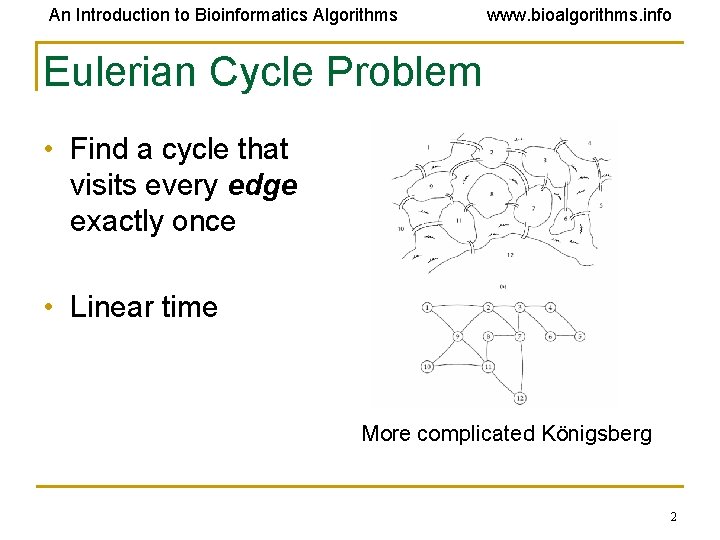
An Introduction to Bioinformatics Algorithms www. bioalgorithms. info Eulerian Cycle Problem • Find a cycle that visits every edge exactly once • Linear time More complicated Königsberg 2

An Introduction to Bioinformatics Algorithms www. bioalgorithms. info Hamiltonian Cycle Problem • Find a cycle that visits every vertex exactly once • NP – complete Game invented by Sir William Hamilton in 1857 3
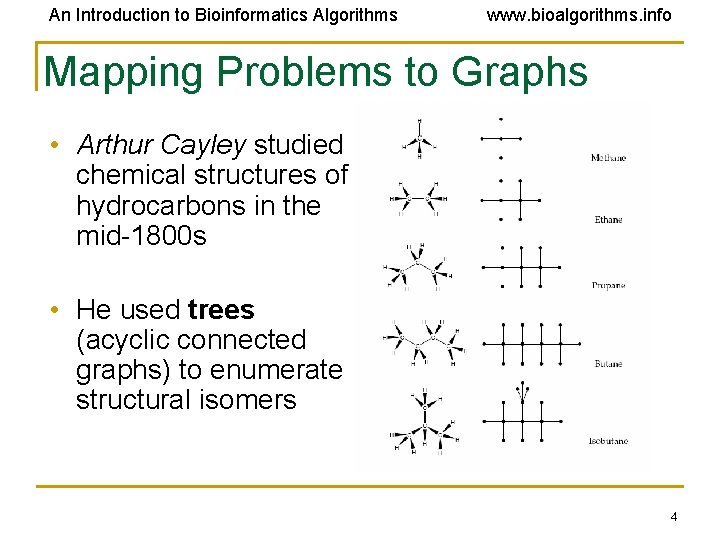
An Introduction to Bioinformatics Algorithms www. bioalgorithms. info Mapping Problems to Graphs • Arthur Cayley studied chemical structures of hydrocarbons in the mid-1800 s • He used trees (acyclic connected graphs) to enumerate structural isomers 4
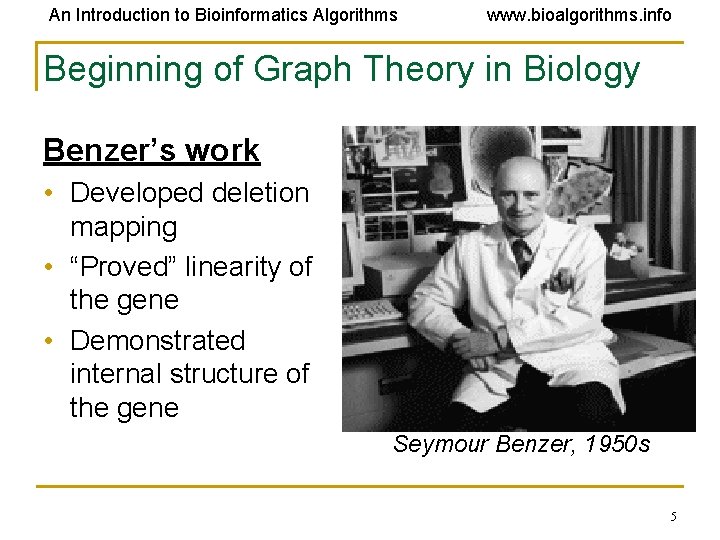
An Introduction to Bioinformatics Algorithms www. bioalgorithms. info Beginning of Graph Theory in Biology Benzer’s work • Developed deletion mapping • “Proved” linearity of the gene • Demonstrated internal structure of the gene Seymour Benzer, 1950 s 5
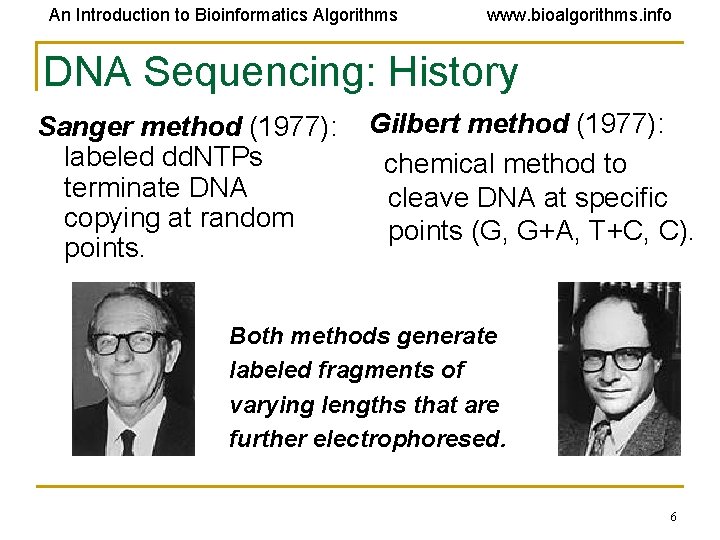
An Introduction to Bioinformatics Algorithms www. bioalgorithms. info DNA Sequencing: History Sanger method (1977): labeled dd. NTPs terminate DNA copying at random points. Gilbert method (1977): chemical method to cleave DNA at specific points (G, G+A, T+C, C). Both methods generate labeled fragments of varying lengths that are further electrophoresed. 6
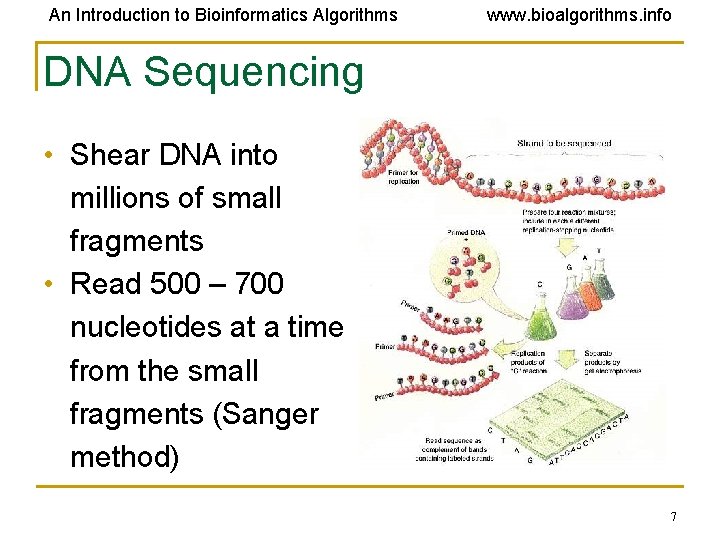
An Introduction to Bioinformatics Algorithms www. bioalgorithms. info DNA Sequencing • Shear DNA into millions of small fragments • Read 500 – 700 nucleotides at a time from the small fragments (Sanger method) 7
An Introduction to Bioinformatics Algorithms www. bioalgorithms. info Fragment Assembly • Computational Challenge: assemble individual short fragments (reads) into a single genomic sequence (“superstring”) 8
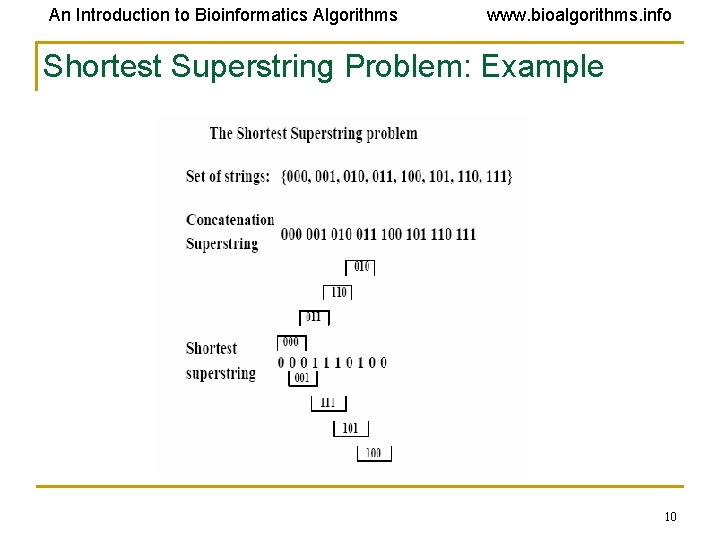
An Introduction to Bioinformatics Algorithms www. bioalgorithms. info Shortest Superstring Problem • Problem: Given a set of strings, find a shortest string that contains all of them • Input: Strings s 1, s 2, …. , sn • Output: A string s that contains all strings s 1, s 2, …. , sn as substrings, such that the length of s is minimized • Complexity: NP – complete • Note: this formulation does not take into account sequencing errors 9
An Introduction to Bioinformatics Algorithms www. bioalgorithms. info Shortest Superstring Problem: Example 10
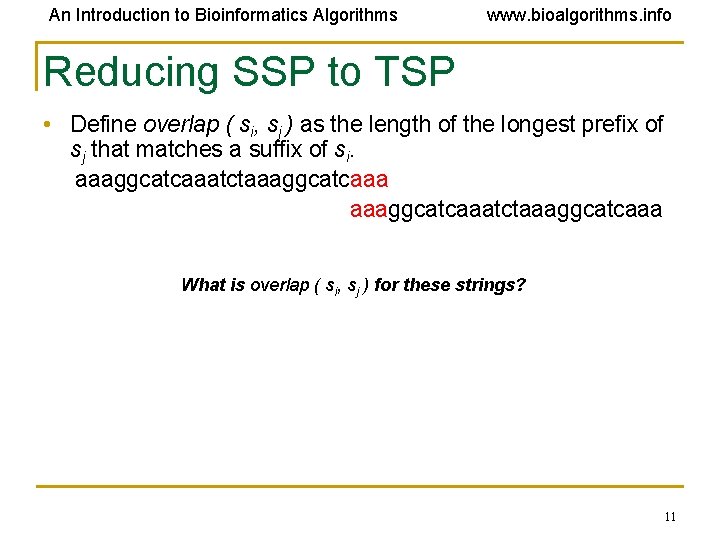
An Introduction to Bioinformatics Algorithms www. bioalgorithms. info Reducing SSP to TSP • Define overlap ( si, sj ) as the length of the longest prefix of sj that matches a suffix of si. aaaggcatcaaatctaaaggcatcaaa What is overlap ( si, sj ) for these strings? 11

An Introduction to Bioinformatics Algorithms www. bioalgorithms. info Reducing SSP to TSP • Define overlap ( si, sj ) as the length of the longest prefix of sj that matches a suffix of si. aaaggcatcaaatctaaaggcatcaaa overlap=12 12
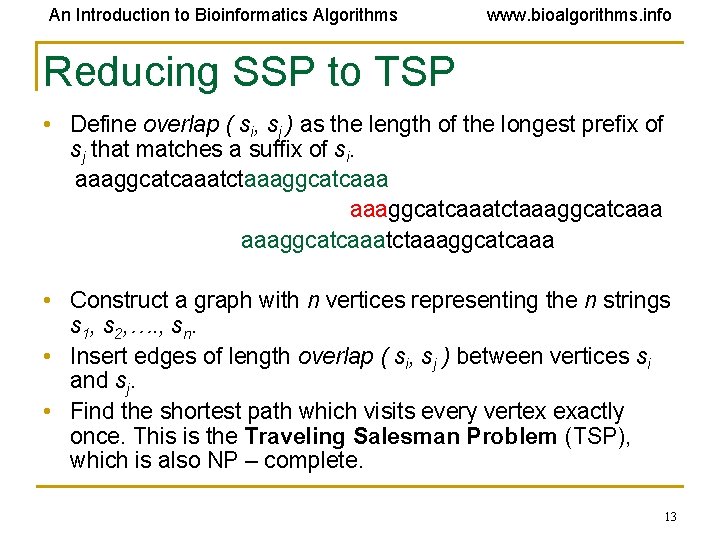
An Introduction to Bioinformatics Algorithms www. bioalgorithms. info Reducing SSP to TSP • Define overlap ( si, sj ) as the length of the longest prefix of sj that matches a suffix of si. aaaggcatcaaatctaaaggcatcaaa • Construct a graph with n vertices representing the n strings s 1, s 2, …. , sn. • Insert edges of length overlap ( si, sj ) between vertices si and sj. • Find the shortest path which visits every vertex exactly once. This is the Traveling Salesman Problem (TSP), which is also NP – complete. 13
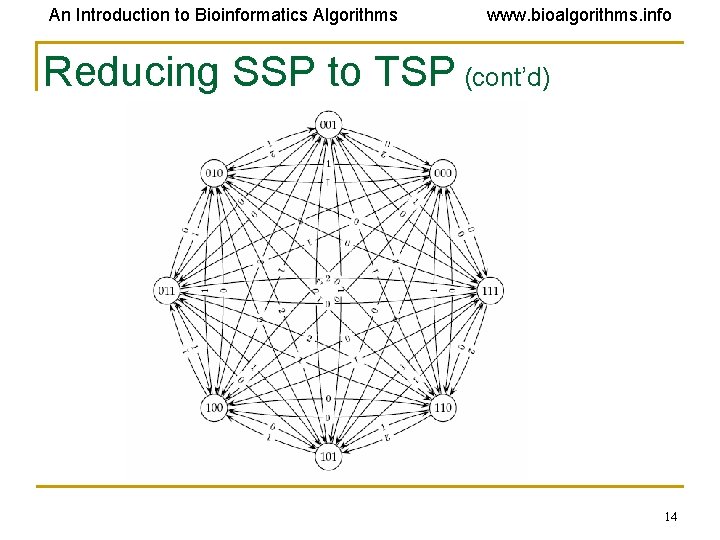
An Introduction to Bioinformatics Algorithms www. bioalgorithms. info Reducing SSP to TSP (cont’d) 14
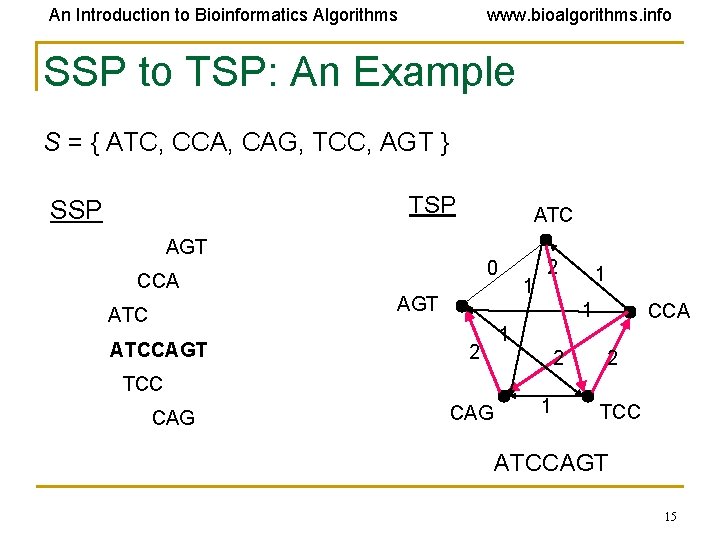
An Introduction to Bioinformatics Algorithms www. bioalgorithms. info SSP to TSP: An Example S = { ATC, CCA, CAG, TCC, AGT } TSP SSP ATC AGT 0 CCA 1 AGT ATCCAGT 1 1 2 TCC CAG 2 CAG CCA 1 2 TCC ATCCAGT 15
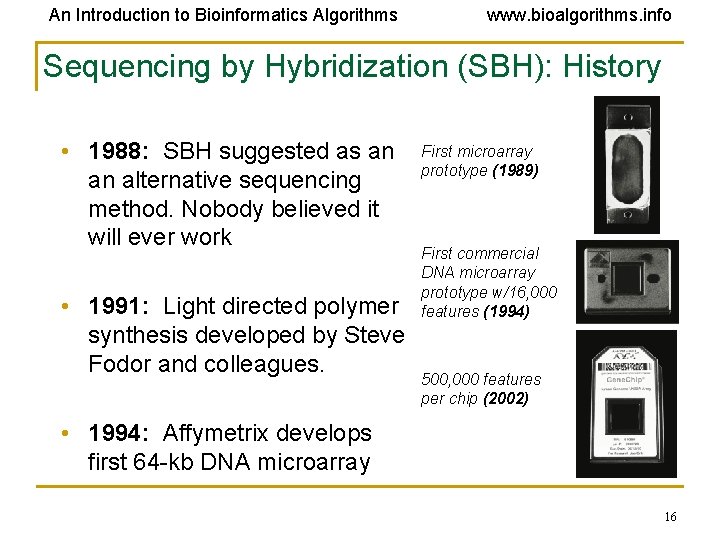
An Introduction to Bioinformatics Algorithms www. bioalgorithms. info Sequencing by Hybridization (SBH): History • 1988: SBH suggested as an an alternative sequencing method. Nobody believed it will ever work • 1991: Light directed polymer synthesis developed by Steve Fodor and colleagues. First microarray prototype (1989) First commercial DNA microarray prototype w/16, 000 features (1994) 500, 000 features per chip (2002) • 1994: Affymetrix develops first 64 -kb DNA microarray 16
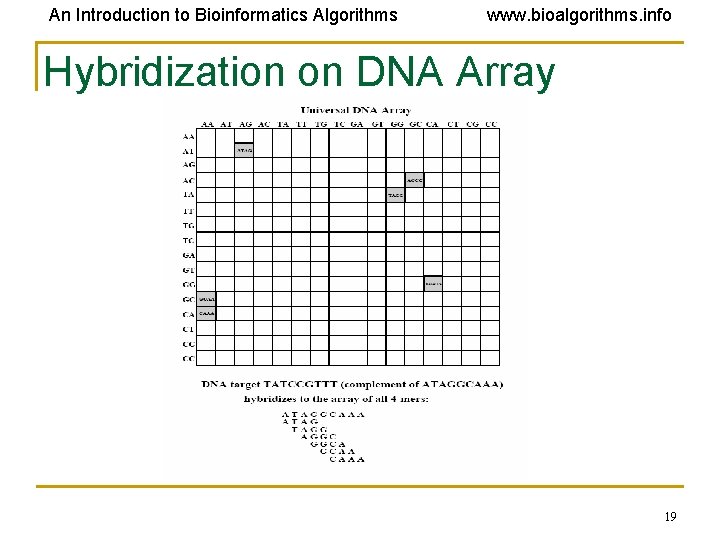
An Introduction to Bioinformatics Algorithms www. bioalgorithms. info How SBH Works • Attach all possible DNA probes of length l to a flat surface, each probe at a distinct and known location. This set of probes is called the DNA array. • Apply a solution containing fluorescently labeled DNA fragment to the array. • The DNA fragment hybridizes with those probes that are complementary to substrings of length l of the fragment. 17
An Introduction to Bioinformatics Algorithms www. bioalgorithms. info How SBH Works (cont’d) • Using a spectroscopic detector, determine which probes hybridize to the DNA fragment to obtain the l–mer composition of the target DNA fragment. • Apply the combinatorial algorithm (below) to reconstruct the sequence of the target DNA fragment from the l – mer composition. 18
An Introduction to Bioinformatics Algorithms www. bioalgorithms. info Hybridization on DNA Array 19
An Introduction to Bioinformatics Algorithms www. bioalgorithms. info l-mer composition • Spectrum ( s, l ) - unordered multiset of all possible (n – l + 1) l-mers in a string s of length n • The order of individual elements in Spectrum ( s, l ) does not matter • For s = TATGGTGC all of the following are equivalent representations of Spectrum ( s, 3 ): {TAT, ATG, TGG, GGT, GTG, TGC} {ATG, GGT, GTG, TAT, TGC, TGG} {TGG, TGC, TAT, GTG, GGT, ATG} 20
An Introduction to Bioinformatics Algorithms www. bioalgorithms. info Different sequences – the same spectrum • Different sequences may have the same spectrum: Spectrum(GTATCT, 2)= Spectrum(GTCTAT, 2)= {AT, CT, GT, TA, TC} 21
An Introduction to Bioinformatics Algorithms www. bioalgorithms. info The SBH Problem • Goal: Reconstruct a string from its l-mer composition • Input: A set S, representing all l-mers from an (unknown) string s • Output: String s such that Spectrum ( s, l ) = S 22
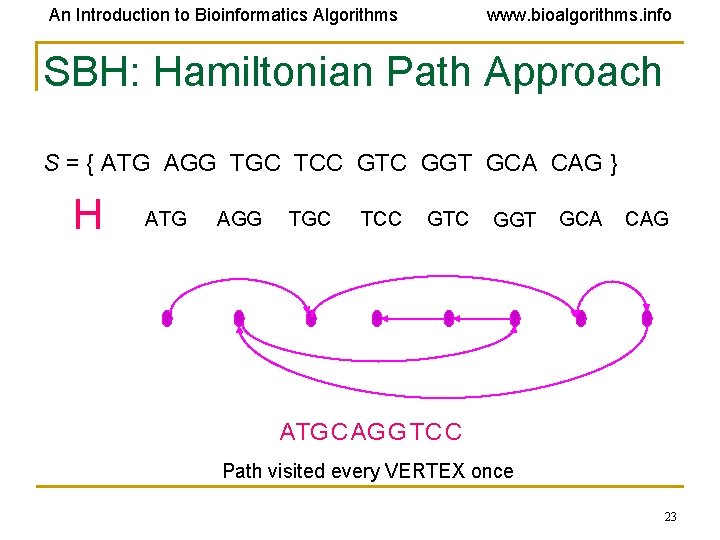
An Introduction to Bioinformatics Algorithms www. bioalgorithms. info SBH: Hamiltonian Path Approach S = { ATG AGG TGC TCC GTC GGT GCA CAG } H ATG AGG TGC TCC GTC GGT GCA CAG ATGCAGG TC C Path visited every VERTEX once 23
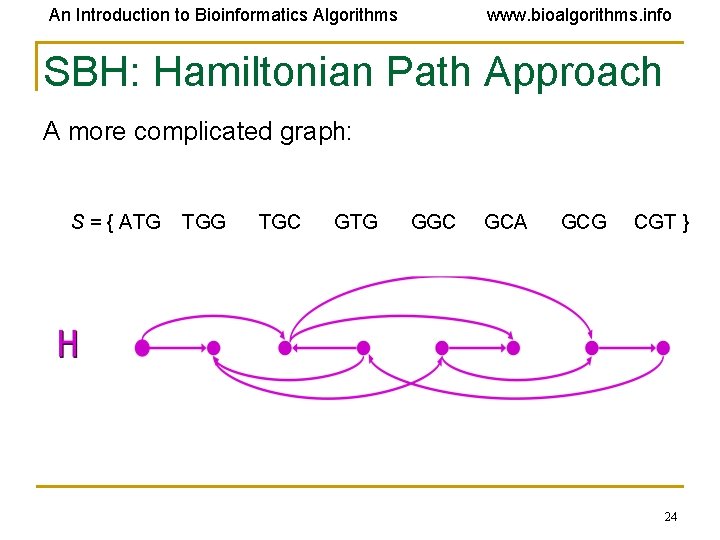
An Introduction to Bioinformatics Algorithms www. bioalgorithms. info SBH: Hamiltonian Path Approach A more complicated graph: S = { ATG TGC GTG GGC GCA GCG CGT } 24
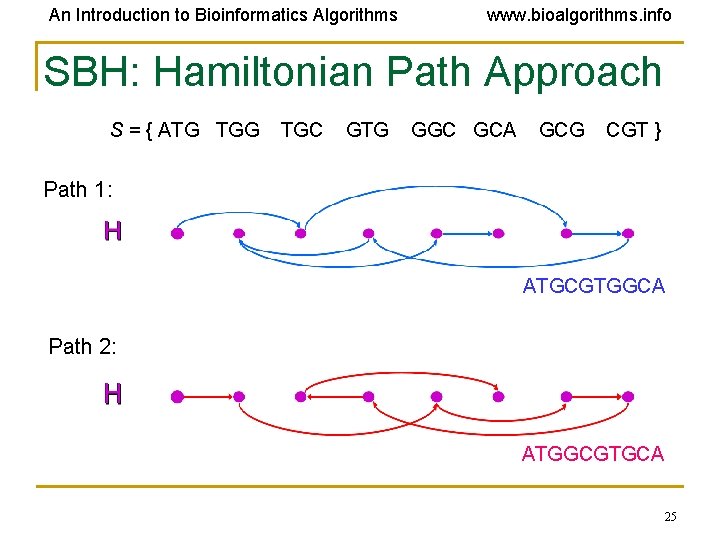
An Introduction to Bioinformatics Algorithms www. bioalgorithms. info SBH: Hamiltonian Path Approach S = { ATG TGC GTG GGC GCA GCG CGT } Path 1: ATGCGTGGCA Path 2: ATGGCGTGCA 25
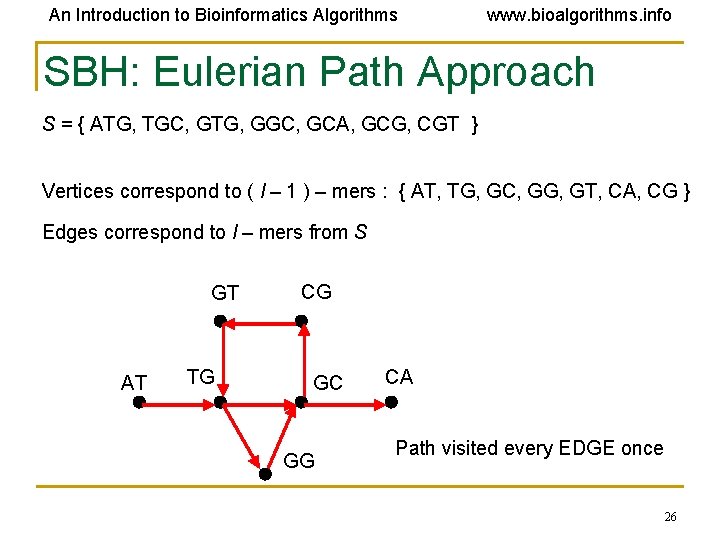
An Introduction to Bioinformatics Algorithms www. bioalgorithms. info SBH: Eulerian Path Approach S = { ATG, TGC, GTG, GGC, GCA, GCG, CGT } Vertices correspond to ( l – 1 ) – mers : { AT, TG, GC, GG, GT, CA, CG } Edges correspond to l – mers from S GT AT TG CG GC GG CA Path visited every EDGE once 26
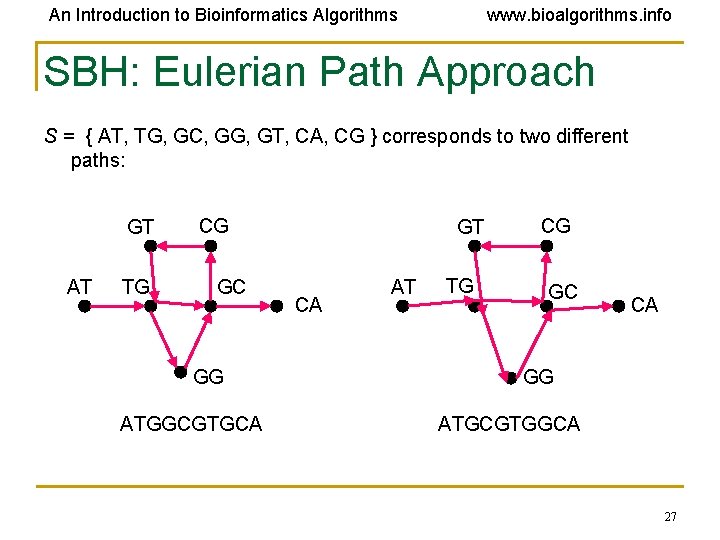
An Introduction to Bioinformatics Algorithms www. bioalgorithms. info SBH: Eulerian Path Approach S = { AT, TG, GC, GG, GT, CA, CG } corresponds to two different paths: GT AT TG CG GC GG ATGGCGTGCA GT CA AT TG CG GC CA GG ATGCGTGGCA 27
An Introduction to Bioinformatics Algorithms www. bioalgorithms. info Euler Theorem • A graph is balanced if for every vertex the number of incoming edges equals to the number of outgoing edges: in(v)=out(v) • Theorem: A connected graph is Eulerian if and only if each of its vertices is balanced. 28
An Introduction to Bioinformatics Algorithms www. bioalgorithms. info Euler Theorem: Extension • Theorem: A connected graph has an Eulerian path if and only if it contains at most two semi-balanced vertices and all other vertices are balanced. 29
An Introduction to Bioinformatics Algorithms www. bioalgorithms. info Some Difficulties with SBH • Fidelity of Hybridization: difficult to detect differences between probes hybridized with perfect matches and 1 or 2 mismatches • Array Size: Effect of low fidelity can be decreased with longer l-mers, but array size increases exponentially in l. Array size is limited with current technology. • Practicality: SBH is still impractical. As DNA microarray technology improves, SBH may become practical in the future 30
- Slides: 30