
AN INTRODUCTION TO ATOM ECONOMY HOPTON KNOCKHARDY PUBLISHING
AN INTRODUCTION TO ATOM ECONOMY ©HOPTON KNOCKHARDY PUBLISHING 2008 SPECIFICATIONS
KNOCKHARDY PUBLISHING ATOM ECONOMY INTRODUCTION This Powerpoint show is one of several produced to help students understand selected topics at AS and A 2 level Chemistry. It is based on the requirements of the AQA and OCR specifications but is suitable for other examination boards. Individual students may use the material at home for revision purposes or it may be used for classroom teaching with an interactive white board. Accompanying notes on this, and the full range of AS and A 2 topics, are available from the KNOCKHARDY SCIENCE WEBSITE at. . . www. knockhardy. org. uk/sci. htm All diagrams and animations in this Powerpoint are original and created by Jonathan Hopton. Permission must be obtained for their use in any commercial work. ©HOPTON
ATOM ECONOMY ©HOPTON
ATOM ECONOMY In most reactions you only want to make one of the resulting products Atom economy is a measure of how much of the products are useful A high atom economy means that there is less waste ©HOPTON
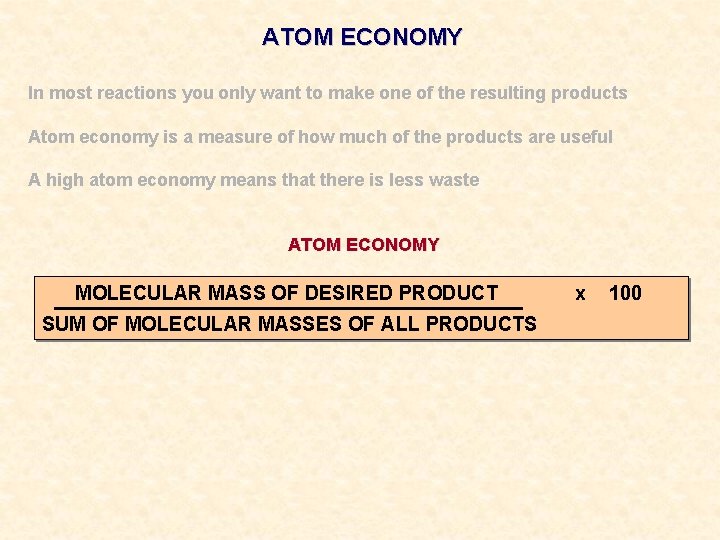
ATOM ECONOMY In most reactions you only want to make one of the resulting products Atom economy is a measure of how much of the products are useful A high atom economy means that there is less waste ATOM ECONOMY MOLECULAR MASS OF DESIRED PRODUCT SUM OF MOLECULAR MASSES OF ALL PRODUCTS ©HOPTON x 100
WORKED CALCULATIONS ©HOPTON
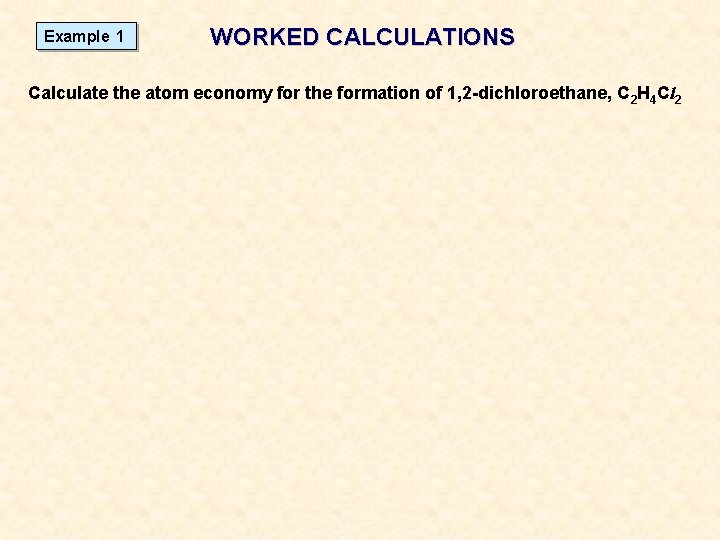
Example 1 WORKED CALCULATIONS Calculate the atom economy for the formation of 1, 2 -dichloroethane, C 2 H 4 Cl 2 ©HOPTON
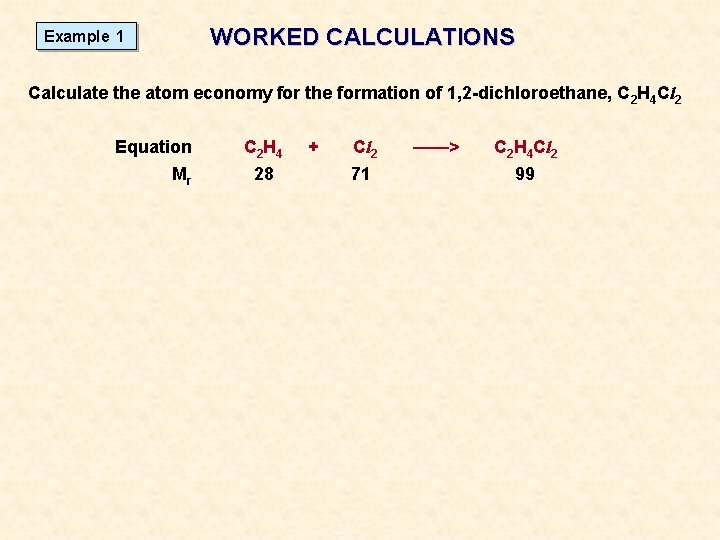
WORKED CALCULATIONS Example 1 Calculate the atom economy for the formation of 1, 2 -dichloroethane, C 2 H 4 Cl 2 Equation Mr C 2 H 4 28 + Cl 2 71 ©HOPTON ——> C 2 H 4 Cl 2 99
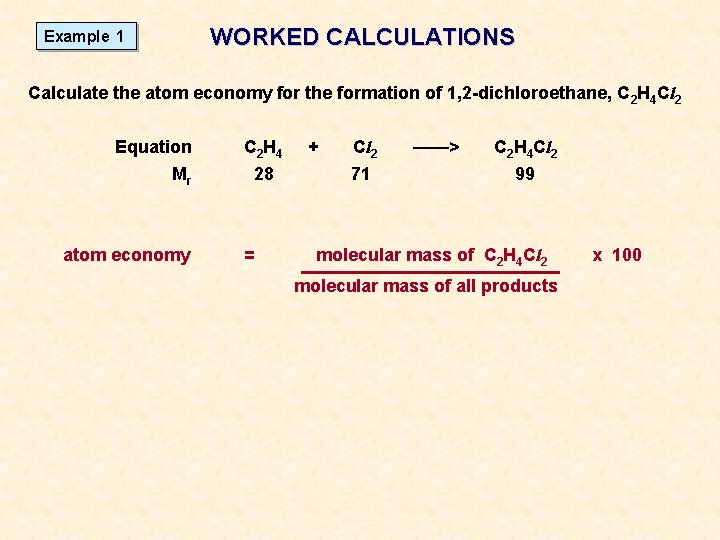
WORKED CALCULATIONS Example 1 Calculate the atom economy for the formation of 1, 2 -dichloroethane, C 2 H 4 Cl 2 Equation Mr atom economy C 2 H 4 28 = + Cl 2 71 ——> C 2 H 4 Cl 2 99 molecular mass of C 2 H 4 Cl 2 molecular mass of all products ©HOPTON x 100
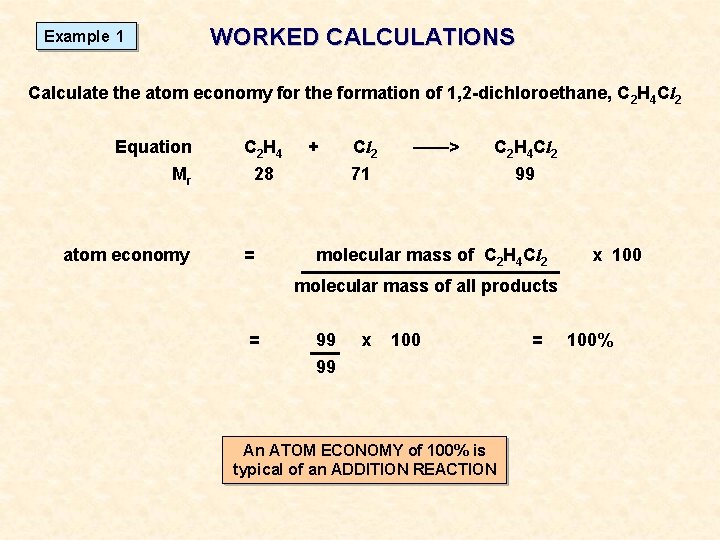
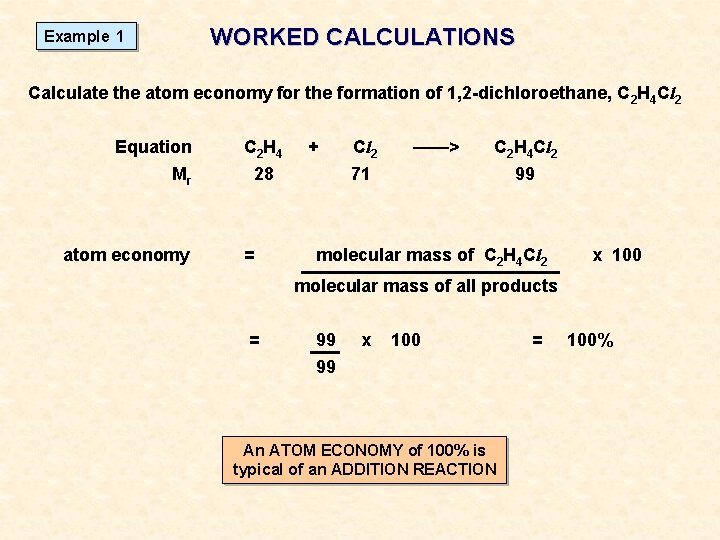
WORKED CALCULATIONS Example 1 Calculate the atom economy for the formation of 1, 2 -dichloroethane, C 2 H 4 Cl 2 Equation Mr atom economy C 2 H 4 + 28 = Cl 2 ——> C 2 H 4 Cl 2 71 99 molecular mass of C 2 H 4 Cl 2 x 100 molecular mass of all products = 99 99 x 100 An ATOM ECONOMY of 100% is typical of an ADDITION REACTION ©HOPTON = 100%
WORKED CALCULATIONS Example 1 Calculate the atom economy for the formation of 1, 2 -dichloroethane, C 2 H 4 Cl 2 Equation Mr atom economy C 2 H 4 + 28 = Cl 2 ——> C 2 H 4 Cl 2 71 99 molecular mass of C 2 H 4 Cl 2 x 100 molecular mass of all products = 99 99 x 100 An ATOM ECONOMY of 100% is typical of an ADDITION REACTION ©HOPTON = 100%
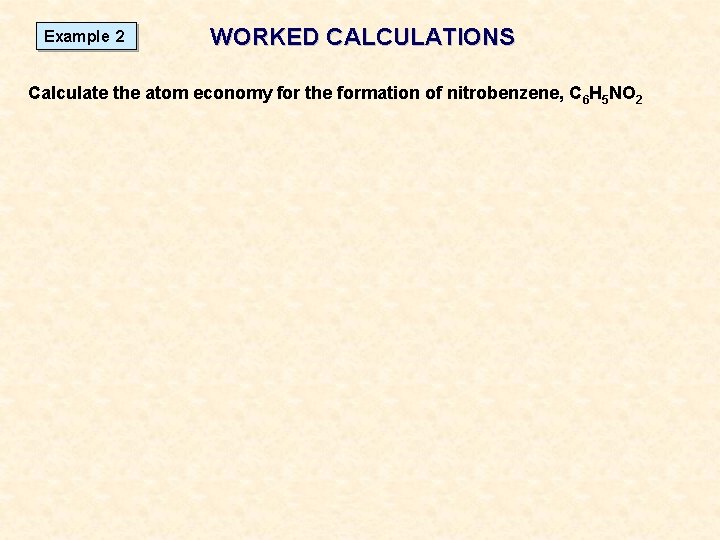
Example 2 WORKED CALCULATIONS Calculate the atom economy for the formation of nitrobenzene, C 6 H 5 NO 2 ©HOPTON
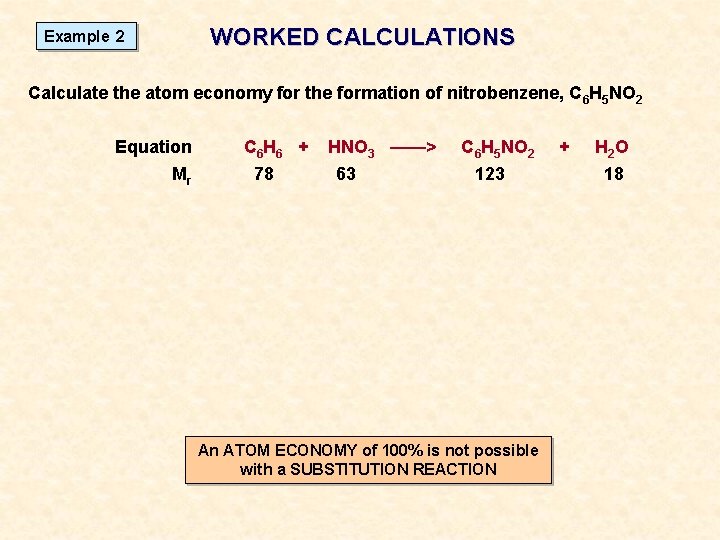
WORKED CALCULATIONS Example 2 Calculate the atom economy for the formation of nitrobenzene, C 6 H 5 NO 2 Equation Mr C 6 H 6 + 78 HNO 3 ——> 63 C 6 H 5 NO 2 123 An ATOM ECONOMY of 100% is not possible with a SUBSTITUTION REACTION ©HOPTON + H 2 O 18
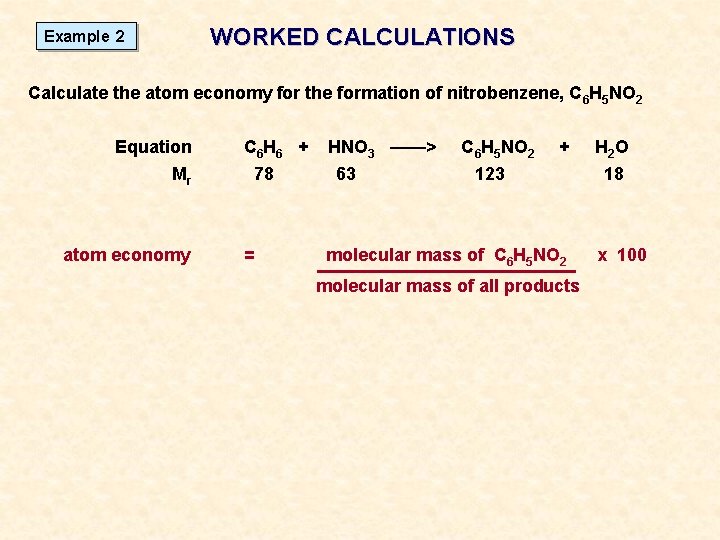
WORKED CALCULATIONS Example 2 Calculate the atom economy for the formation of nitrobenzene, C 6 H 5 NO 2 Equation Mr atom economy C 6 H 6 + 78 = HNO 3 ——> 63 C 6 H 5 NO 2 + 123 molecular mass of C 6 H 5 NO 2 molecular mass of all products ©HOPTON H 2 O 18 x 100
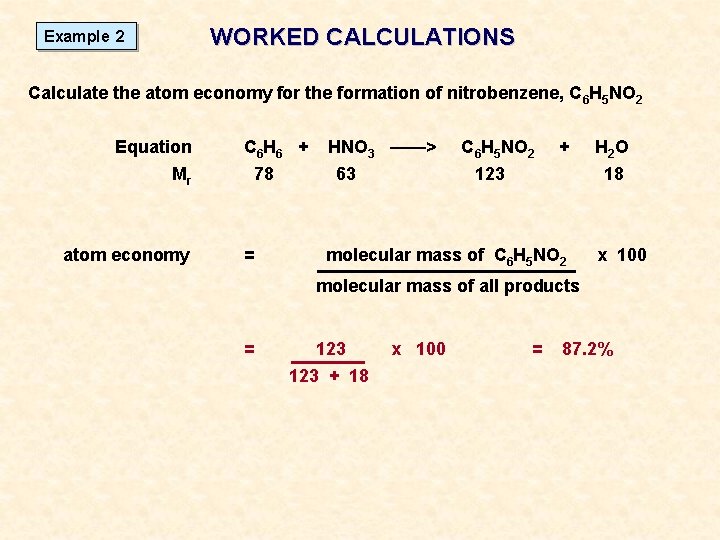
WORKED CALCULATIONS Example 2 Calculate the atom economy for the formation of nitrobenzene, C 6 H 5 NO 2 Equation Mr atom economy C 6 H 6 + 78 = HNO 3 ——> 63 C 6 H 5 NO 2 + 123 H 2 O 18 molecular mass of C 6 H 5 NO 2 x 100 molecular mass of all products = 123 + 18 x 100 ©HOPTON = 87. 2%
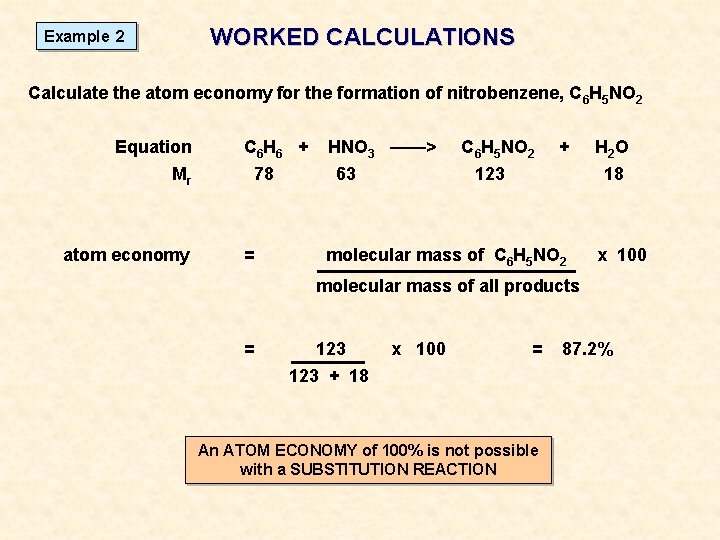
WORKED CALCULATIONS Example 2 Calculate the atom economy for the formation of nitrobenzene, C 6 H 5 NO 2 Equation Mr atom economy C 6 H 6 + 78 = HNO 3 ——> 63 C 6 H 5 NO 2 + 123 H 2 O 18 molecular mass of C 6 H 5 NO 2 x 100 molecular mass of all products = 123 + 18 x 100 = An ATOM ECONOMY of 100% is not possible with a SUBSTITUTION REACTION ©HOPTON 87. 2%
Example 3 WORKED CALCULATIONS Calculate the atom economy for the preparation of ammonia from thermal decomposition of ammonium sulphate. ©HOPTON
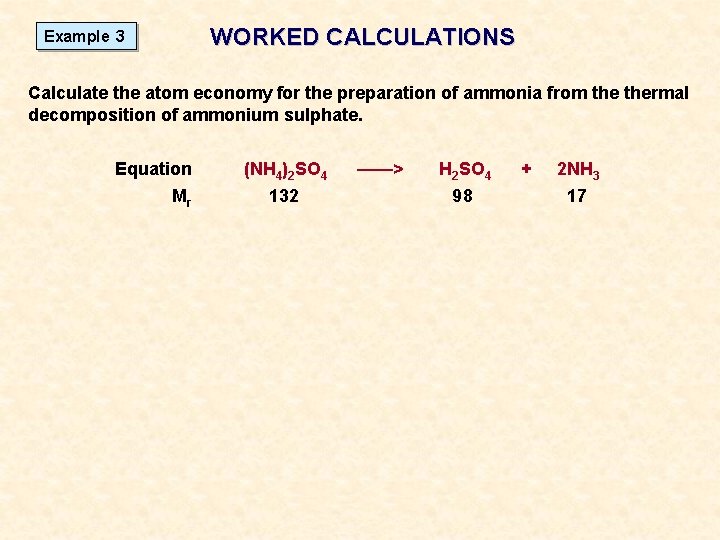
WORKED CALCULATIONS Example 3 Calculate the atom economy for the preparation of ammonia from thermal decomposition of ammonium sulphate. Equation Mr (NH 4)2 SO 4 ——> 132 H 2 SO 4 98 ©HOPTON + 2 NH 3 17
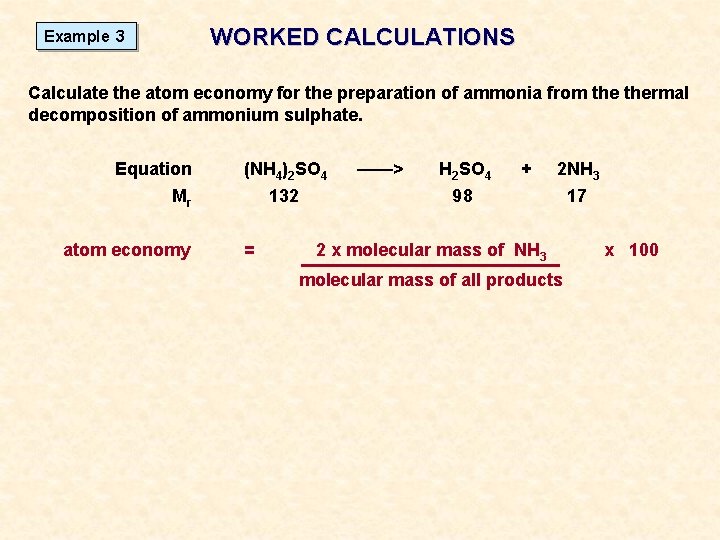
WORKED CALCULATIONS Example 3 Calculate the atom economy for the preparation of ammonia from thermal decomposition of ammonium sulphate. Equation (NH 4)2 SO 4 Mr atom economy ——> 132 = H 2 SO 4 + 2 NH 3 98 2 x molecular mass of NH 3 molecular mass of all products ©HOPTON 17 x 100
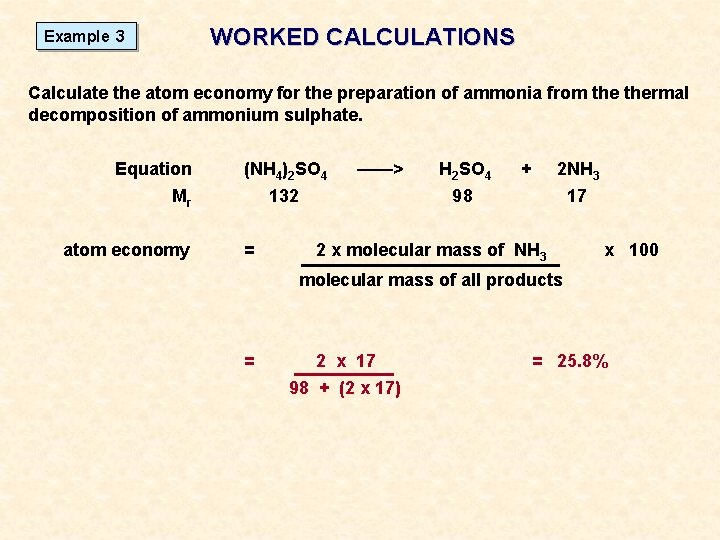
WORKED CALCULATIONS Example 3 Calculate the atom economy for the preparation of ammonia from thermal decomposition of ammonium sulphate. Equation (NH 4)2 SO 4 Mr atom economy ——> 132 = H 2 SO 4 + 2 NH 3 98 17 2 x molecular mass of NH 3 x 100 molecular mass of all products = 2 x 17 98 + (2 x 17) ©HOPTON = 25. 8%
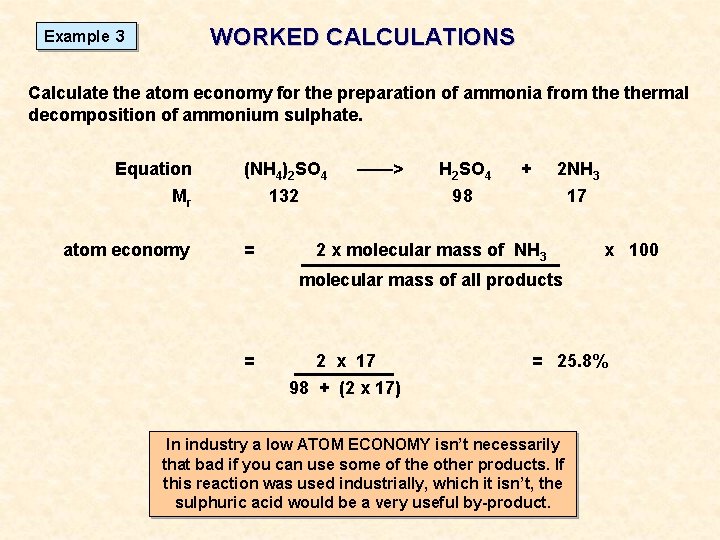
WORKED CALCULATIONS Example 3 Calculate the atom economy for the preparation of ammonia from thermal decomposition of ammonium sulphate. Equation (NH 4)2 SO 4 Mr atom economy ——> 132 = H 2 SO 4 + 2 NH 3 98 17 2 x molecular mass of NH 3 x 100 molecular mass of all products = 2 x 17 98 + (2 x 17) = 25. 8% In industry a low ATOM ECONOMY isn’t necessarily that bad if you can use some of the other products. If this reaction was used industrially, which it isn’t, the sulphuric acid would be a very useful by-product. ©HOPTON
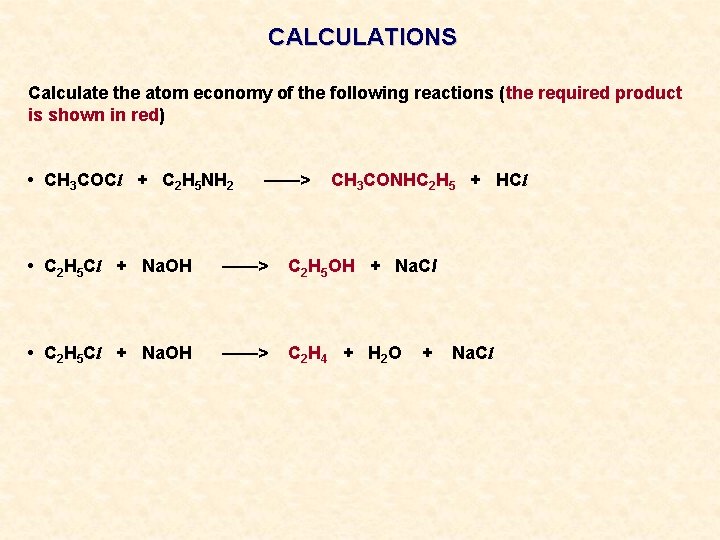
CALCULATIONS Calculate the atom economy of the following reactions (the required product is shown in red) • CH 3 COCl + C 2 H 5 NH 2 ——> CH 3 CONHC 2 H 5 + HCl • C 2 H 5 Cl + Na. OH ——> C 2 H 5 OH + Na. Cl • C 2 H 5 Cl + Na. OH ——> C 2 H 4 + H 2 O ©HOPTON + Na. Cl
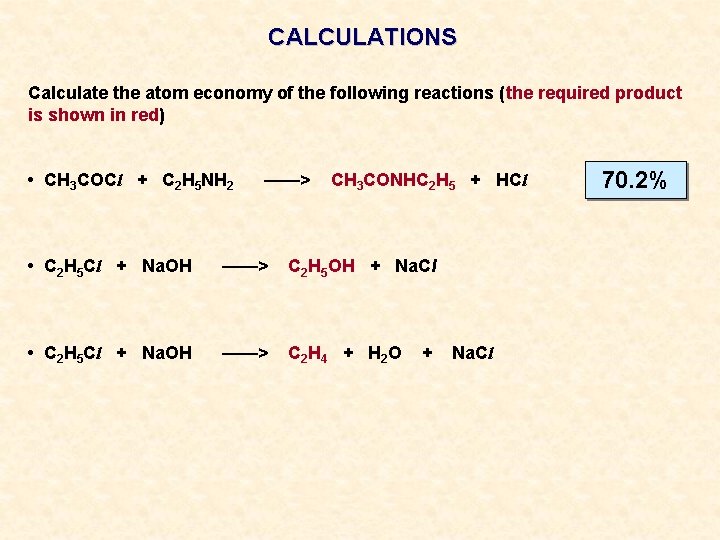
CALCULATIONS Calculate the atom economy of the following reactions (the required product is shown in red) • CH 3 COCl + C 2 H 5 NH 2 ——> CH 3 CONHC 2 H 5 + HCl • C 2 H 5 Cl + Na. OH ——> C 2 H 5 OH + Na. Cl • C 2 H 5 Cl + Na. OH ——> C 2 H 4 + H 2 O ©HOPTON + Na. Cl 70. 2%
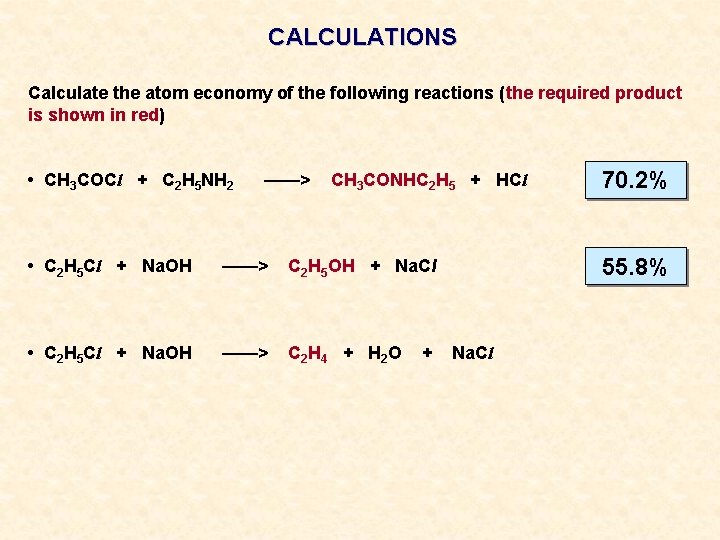
CALCULATIONS Calculate the atom economy of the following reactions (the required product is shown in red) • CH 3 COCl + C 2 H 5 NH 2 ——> CH 3 CONHC 2 H 5 + HCl • C 2 H 5 Cl + Na. OH ——> C 2 H 5 OH + Na. Cl • C 2 H 5 Cl + Na. OH ——> C 2 H 4 + H 2 O ©HOPTON + 70. 2% 55. 8% Na. Cl
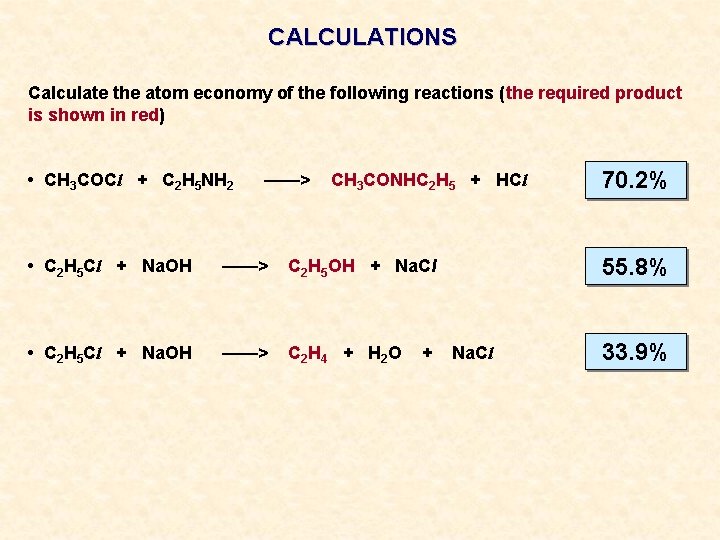
CALCULATIONS Calculate the atom economy of the following reactions (the required product is shown in red) • CH 3 COCl + C 2 H 5 NH 2 ——> CH 3 CONHC 2 H 5 + HCl • C 2 H 5 Cl + Na. OH ——> C 2 H 5 OH + Na. Cl • C 2 H 5 Cl + Na. OH ——> C 2 H 4 + H 2 O ©HOPTON + 70. 2% 55. 8% Na. Cl 33. 9%

OVERVIEW ©HOPTON
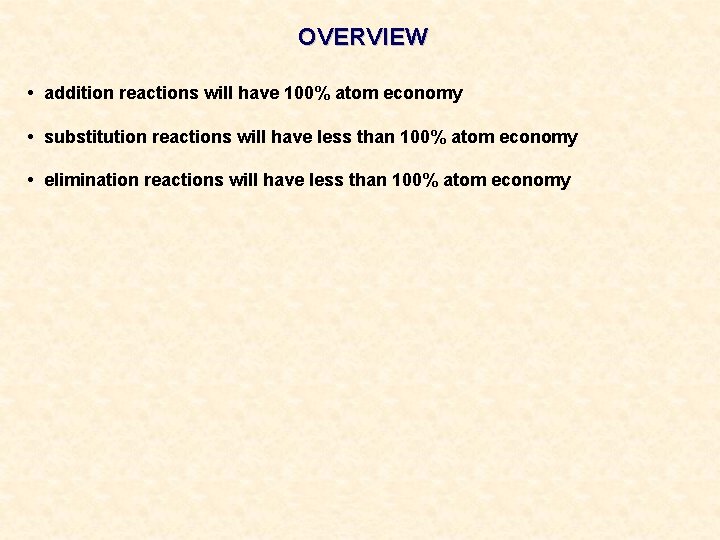
OVERVIEW • addition reactions will have 100% atom economy • substitution reactions will have less than 100% atom economy • elimination reactions will have less than 100% atom economy ©HOPTON
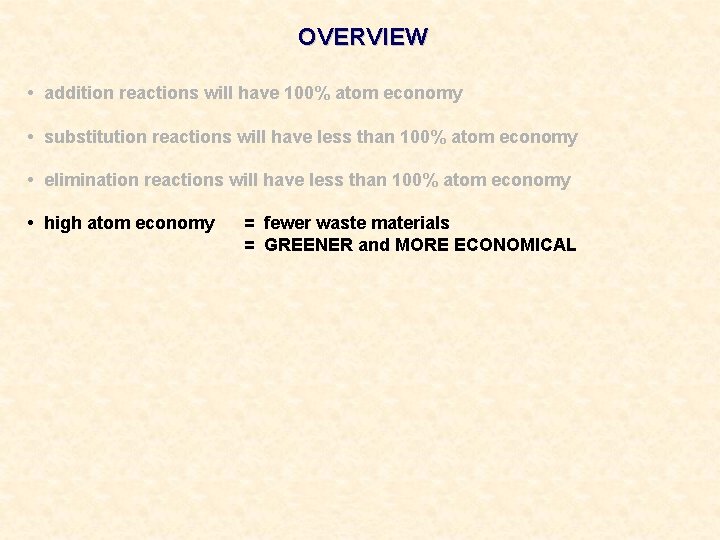
OVERVIEW • addition reactions will have 100% atom economy • substitution reactions will have less than 100% atom economy • elimination reactions will have less than 100% atom economy • high atom economy = fewer waste materials = GREENER and MORE ECONOMICAL ©HOPTON
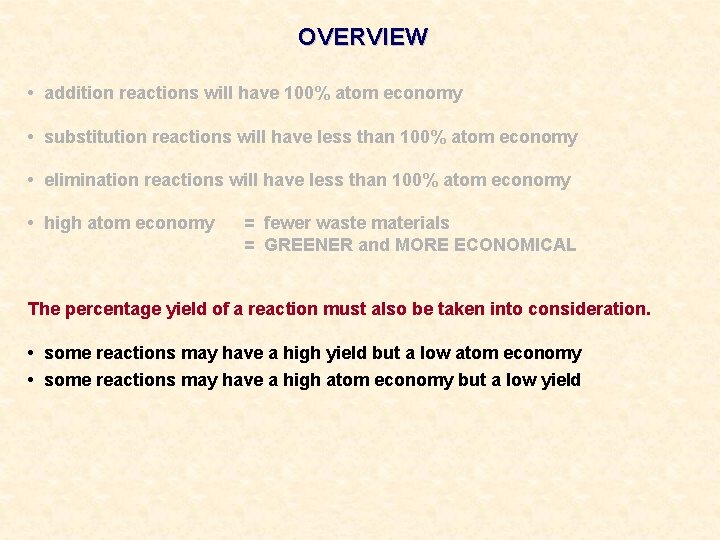
OVERVIEW • addition reactions will have 100% atom economy • substitution reactions will have less than 100% atom economy • elimination reactions will have less than 100% atom economy • high atom economy = fewer waste materials = GREENER and MORE ECONOMICAL The percentage yield of a reaction must also be taken into consideration. • some reactions may have a high yield but a low atom economy • some reactions may have a high atom economy but a low yield ©HOPTON
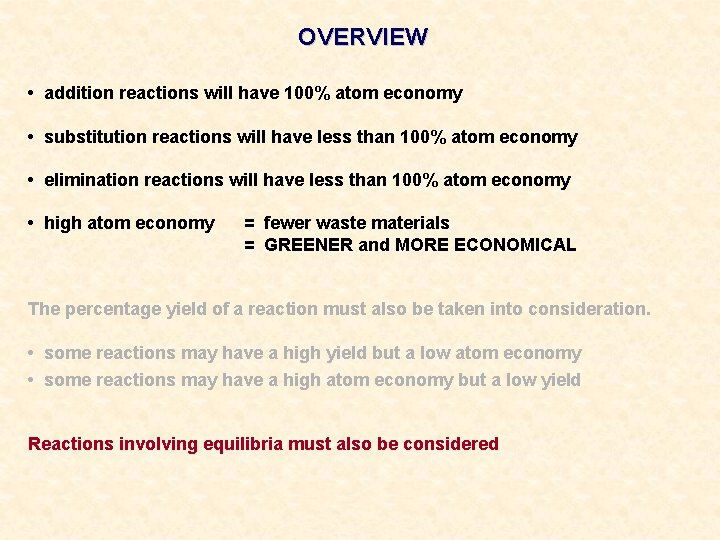
OVERVIEW • addition reactions will have 100% atom economy • substitution reactions will have less than 100% atom economy • elimination reactions will have less than 100% atom economy • high atom economy = fewer waste materials = GREENER and MORE ECONOMICAL The percentage yield of a reaction must also be taken into consideration. • some reactions may have a high yield but a low atom economy • some reactions may have a high atom economy but a low yield Reactions involving equilibria must also be considered ©HOPTON
AN INTRODUCTION TO ATOM ECONOMY THE END ©HOPTON © 2011 JONATHAN HOPTON & KNOCKHARDY PUBLISHING
- Slides: 31