
An Introduction to ASME Standards Why they exist

- Slides: 41
An Introduction to ASME Standards Why they exist and how they are developed
Overview • What is ASME? • What is a standard? • Why do we have standards? • How are standards developed? • How are standards used by an engineer?
What is the American Society of Mechanical Engineers?
ASME Mission Statement: To serve diverse global communities by advancing, disseminating and applying engineering knowledge for improving the quality of life; and communicating the excitement of engineering. Sectors: • • • Technical Events and Content Public Affairs and Outreach Group Pathways and Support Student and Early Career Development Standards and Certification
The American Society of Mechanical Engineers • Organization started in 1880 by a small group of leading industrialists • Has over 140, 000 members in the society • One of the worlds largest technical publishing operations
What is a Standard?
What is a Standard? A set of technical definitions, instructions, rules, guidelines, or characteristics set forth to provide consistent and comparable results, including: - Items manufactured uniformly, providing for interchangeability of - Tests and analyses conducted reliably, minimizing the uncertainty the results - Facilities designed and constructed for safe operation
Why do we have Standards?
Why do we have Standards? • Safety • Uniformity/Consistency • Efficiency • Commerce and Trade 9
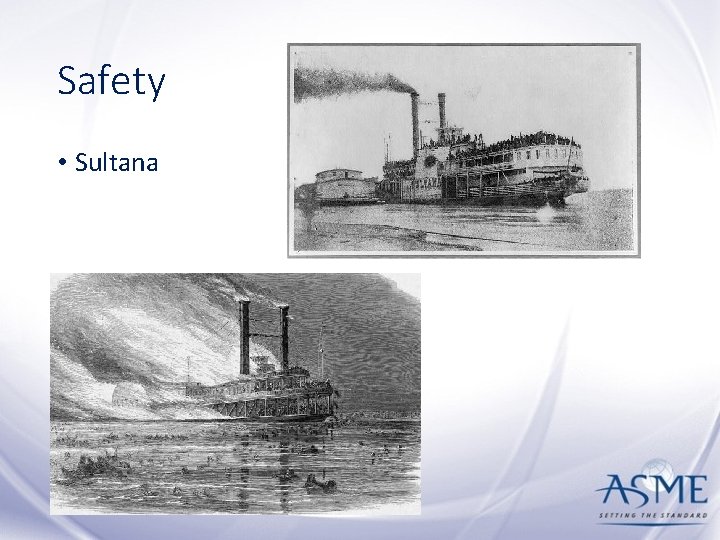
Safety • Sultana
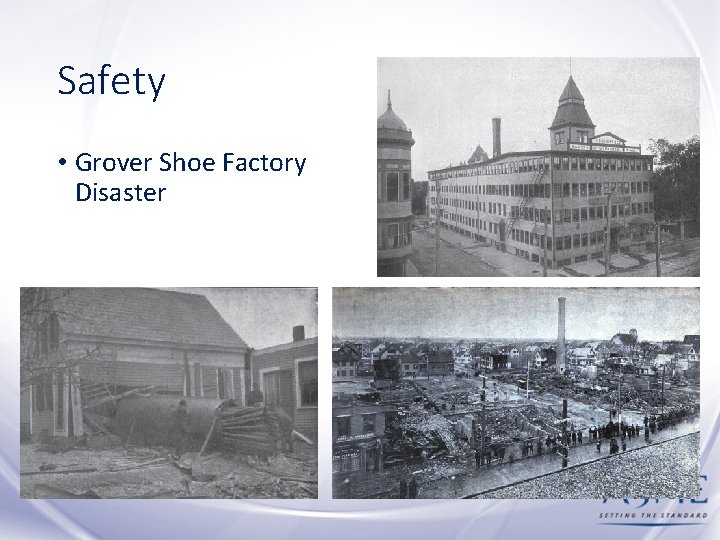
Safety • Grover Shoe Factory Disaster
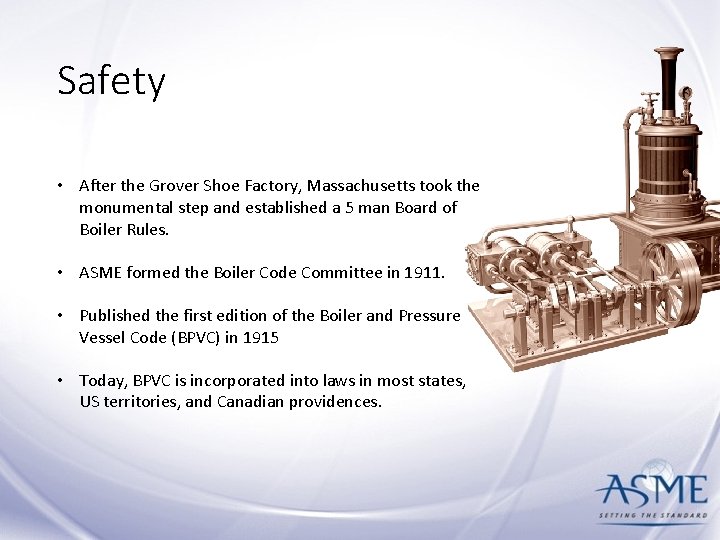
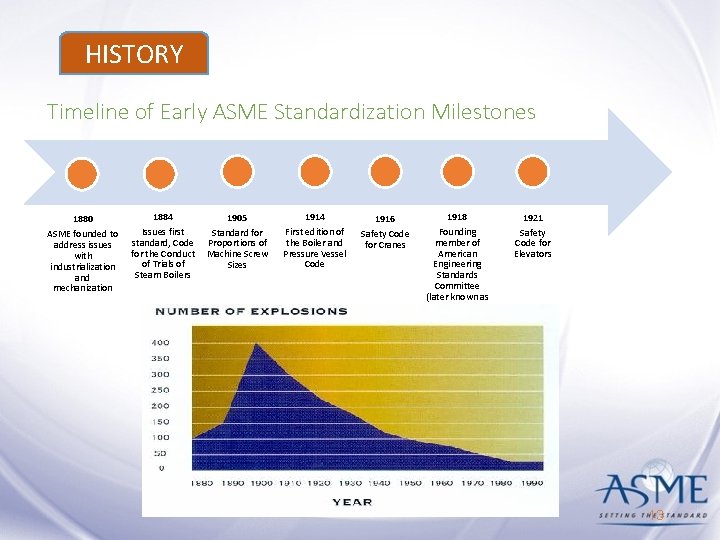
Safety • After the Grover Shoe Factory, Massachusetts took the monumental step and established a 5 man Board of Boiler Rules. • ASME formed the Boiler Code Committee in 1911. • Published the first edition of the Boiler and Pressure Vessel Code (BPVC) in 1915 • Today, BPVC is incorporated into laws in most states, US territories, and Canadian providences.
HISTORY Timeline of Early ASME Standardization Milestones 1880 1884 1905 1914 ASME founded to address issues with industrialization and mechanization Issues first standard, Code for the Conduct of Trials of Steam Boilers Standard for Proportions of Machine Screw Sizes First edition of the Boiler and Pressure Vessel Code 1916 1918 1921 Safety Code for Cranes Founding member of American Engineering Standards Committee (later known as ANSI) Safety Code for Elevators 13
Uniformity/Consistency • Standards ensure that various goods and systems are the same everywhere • • • Bolt and Screw Sizes, threading Rail gauge Material composition Plumbing fittings Computer Fonts/Typesetting 14
Efficiency • Use of standards reduces the time in developing proven technology • Standards provide a common language for all stakeholders 15
Commerce and Trade • Standards play a large role in trade • Examples of Organization Developing Standards for Worldwide market include: • • ASME ASTM ISO Standards IEEE • (Ideally) one universal standard, one universal test 16
How are Standards Developed?
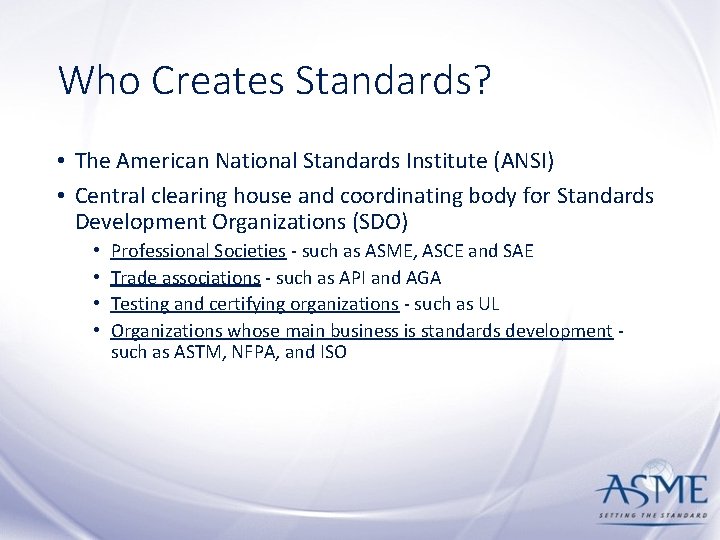
Who Creates Standards? • The American National Standards Institute (ANSI) • Central clearing house and coordinating body for Standards Development Organizations (SDO) • • Professional Societies - such as ASME, ASCE and SAE Trade associations - such as API and AGA Testing and certifying organizations - such as UL Organizations whose main business is standards development such as ASTM, NFPA, and ISO
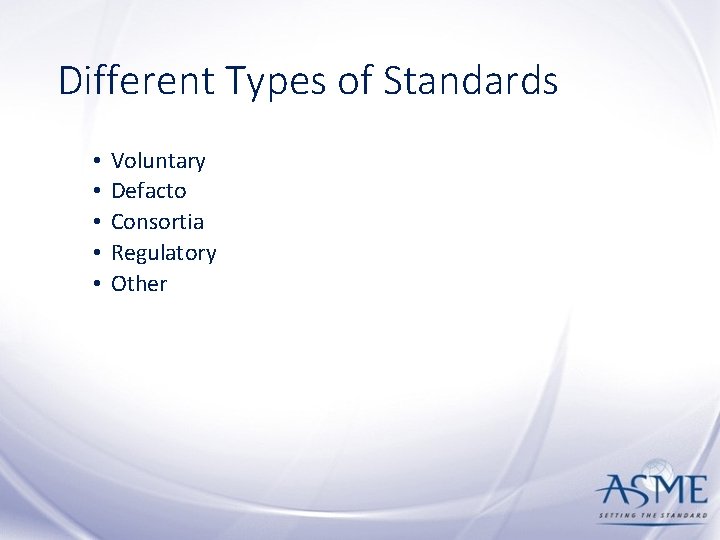
Different Types of Standards • • • Voluntary Defacto Consortia Regulatory Other
How are Standards Developed in ASME?
How are Standards Developed? • Standards are a “living document” that are constantly being developed and revised • Developed using a series of checks and balances • Written by volunteers • Approved by a consensus process • Follow procedures set by the American National Standards Institute (ANSI)
Voluntary Consensus Process ASME standards actions are approved by consensus This means: • There is substantial agreement by affected interest categories on the proposed action • All views have been considered and attempts have been made to resolve any objections from the consensus body or any other source • Unanimity is not required. For example, ASME’s accredited procedures require a 2/3 affirmative vote of the committee membership
Key Principles of Consensus Process • Openness • Balance of Interest • Due Process
From Concept to Publication • Starts with engineering problem or new idea • Research • Formation of new committee if none in place • Development • Approval • Publication
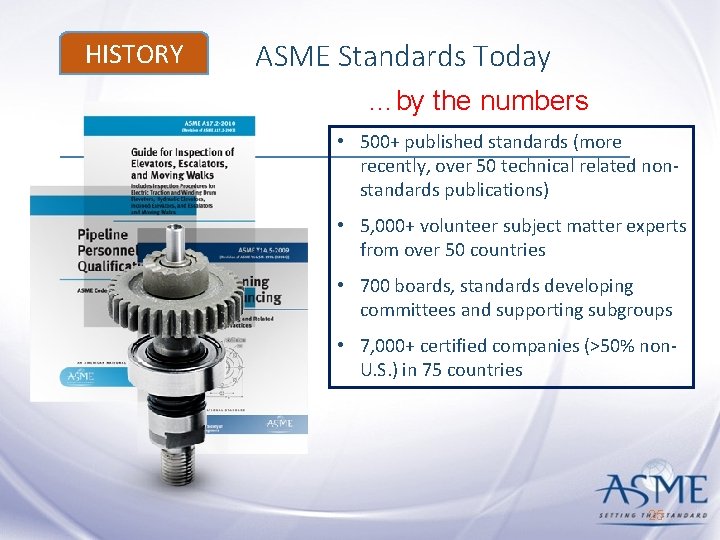
HISTORY ASME Standards Today …by the numbers • 500+ published standards (more recently, over 50 technical related nonstandards publications) • 5, 000+ volunteer subject matter experts from over 50 countries • 700 boards, standards developing committees and supporting subgroups • 7, 000+ certified companies (>50% non. U. S. ) in 75 countries 25
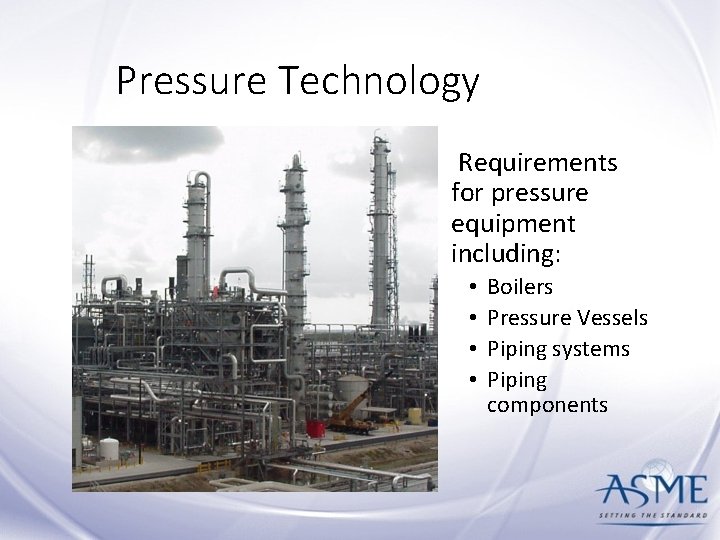
Pressure Technology Requirements for pressure equipment including: • • Boilers Pressure Vessels Piping systems Piping components
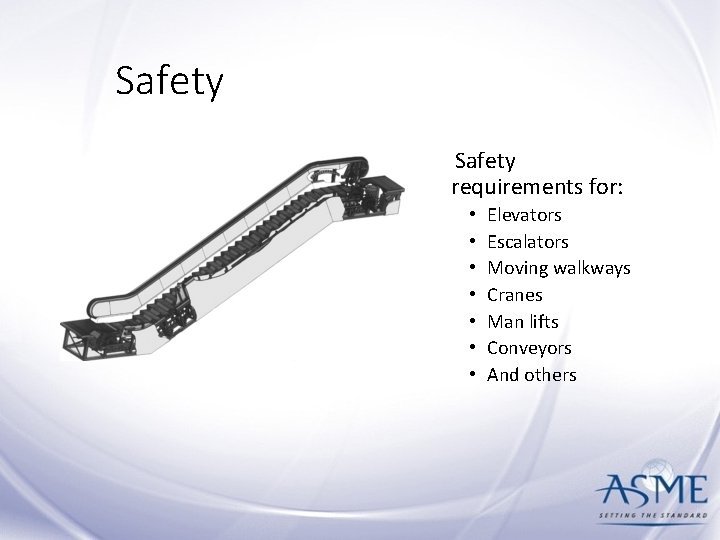
Safety requirements for: • • Elevators Escalators Moving walkways Cranes Man lifts Conveyors And others
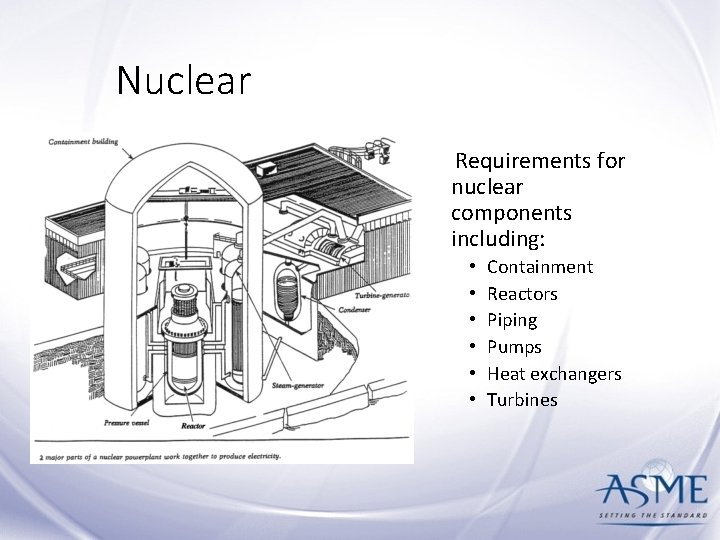
Nuclear Requirements for nuclear components including: • • • Containment Reactors Piping Pumps Heat exchangers Turbines
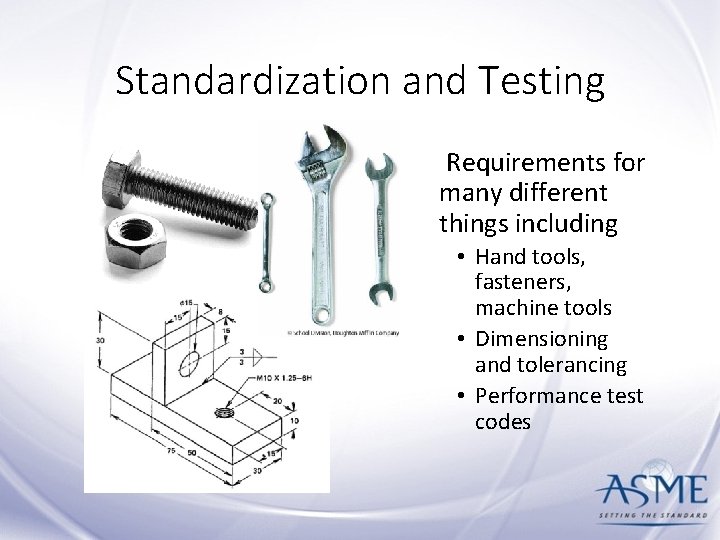
Standardization and Testing Requirements for many different things including • Hand tools, fasteners, machine tools • Dimensioning and tolerancing • Performance test codes
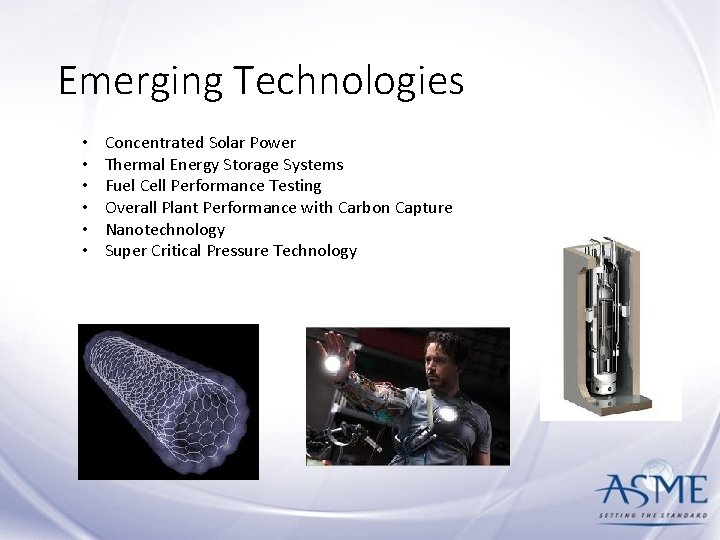
Emerging Technologies • • • Concentrated Solar Power Thermal Energy Storage Systems Fuel Cell Performance Testing Overall Plant Performance with Carbon Capture Nanotechnology Super Critical Pressure Technology
How do Standards Affect an Engineer?
How does the ASME Standard Affect an Engineer? • Material Selection • Design Requirements • Fabrication Requirements • Examination and Testing Requirements • Quality Assurance 32
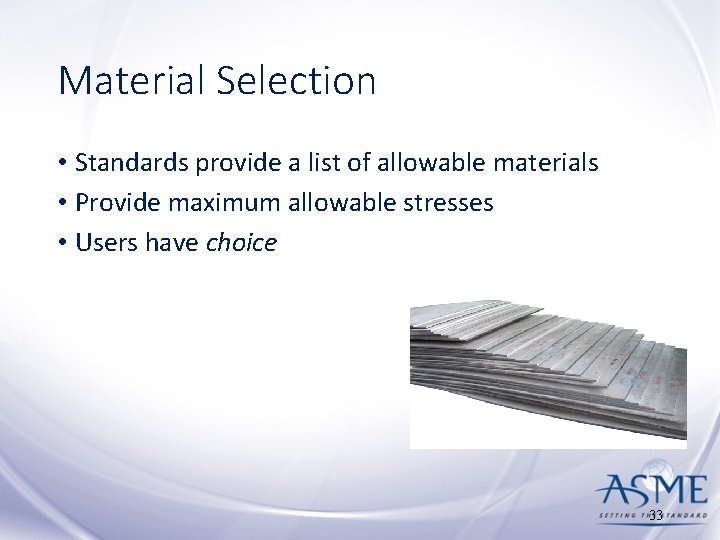
Material Selection • Standards provide a list of allowable materials • Provide maximum allowable stresses • Users have choice 33
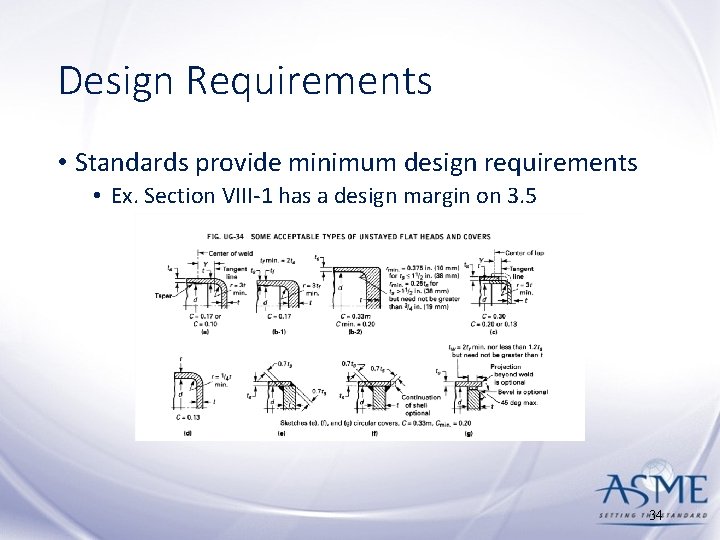
Design Requirements • Standards provide minimum design requirements • Ex. Section VIII-1 has a design margin on 3. 5 34
Design Requirements • Standards provide pertinent equations • Examples: Design Pressure, Thickness, Bearing Loads, Moments • Does not replace engineering judgement 35
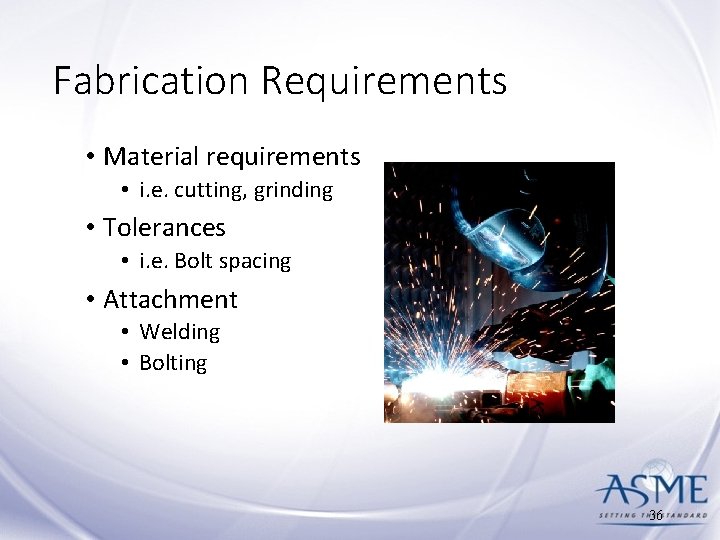
Fabrication Requirements • Material requirements • i. e. cutting, grinding • Tolerances • i. e. Bolt spacing • Attachment • Welding • Bolting 36
Examination and Testing Requirements • Nondestructive examination • Radiography, Ultrasound, Visual • Destructive Testing • Nondestructive Testing • Leak Testing • Hydrostatic • Pneumatic 37
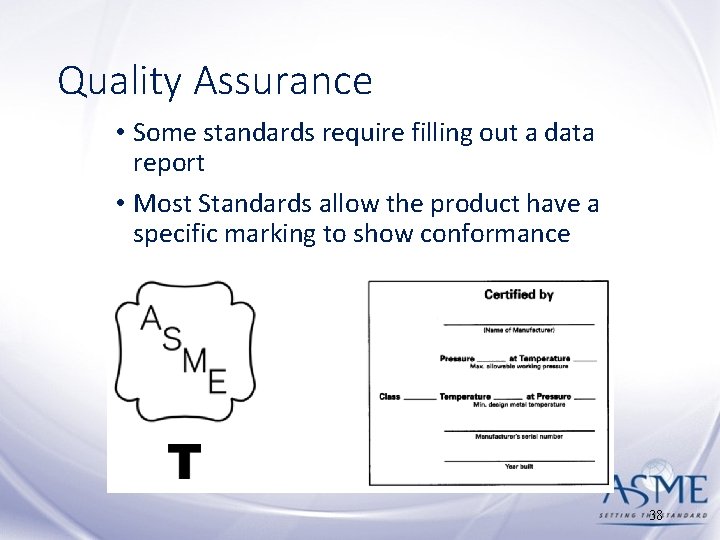
Quality Assurance • Some standards require filling out a data report • Most Standards allow the product have a specific marking to show conformance 38
ASME Conformity Assessment • Process by which a product is shown to be in full compliance with a standard • ASME accredits manufacturers who produce products compliant with their codes and standards • There are over 9, 000 ASME accreditation account holders worldwide • ASME offers product certification for the following programs Boiler Nuclear NQA (Nuclear Quality Assurance) QSC (Quality System Certificate for nuclear material suppliers) • BPE (Bioprocessing Equipment) • AIA (Authorized Inspection Agency) • • 39
Summary • Engineering Standards were developed to improve public safety, allow for uniform consistency of products, and help ensure fair and free commerce and trade • ASME develops standards using an ANSI accredited voluntary consensus approach • Standards help engineers by providing requirements for design, fabrication, materials, testing, and other areas
Questions?