
AN INTRODUCTION TO ANIMAL DIVERSITY Characteristics of Animals

- Slides: 24
AN INTRODUCTION TO ANIMAL DIVERSITY
Characteristics of Animals � � Multicellular heterotrophs Most have muscle and nervous tissue Most reproduce sexually, with a flagellated sperm and a large egg uniting to form a diploid zygote. The diploid stage dominates the life cycle.
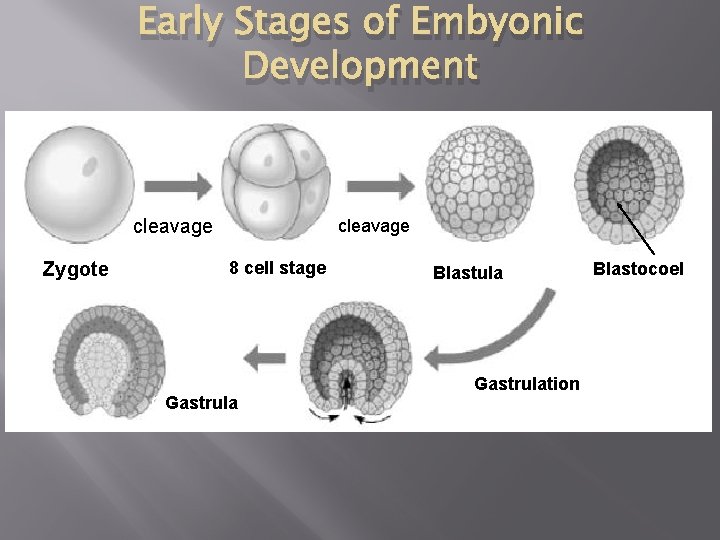
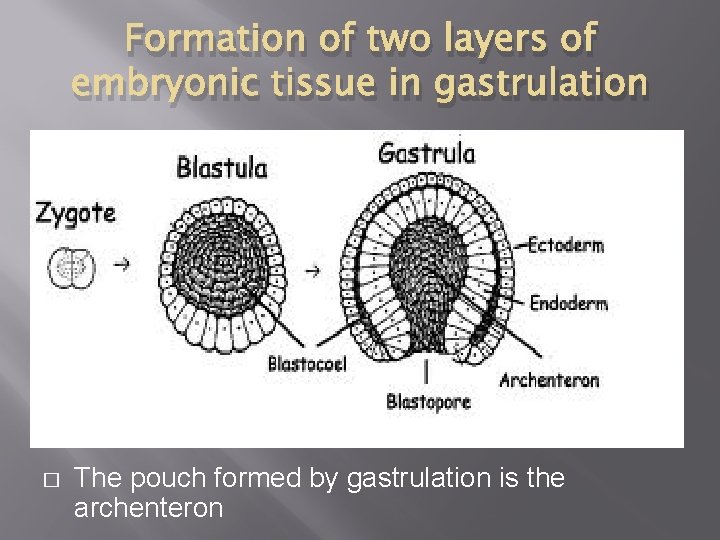
Animal Development � � � The zygote is a fertilized egg. The zygote of an animal undergoes a series of mitotic divisions called cleavage. An eight-cell embryo is formed by three rounds of cell division. Cleavage results in a multicellular stage called the blastula. The blastula is typically a hollow ball of cells around a cavity called the blastocoel. Most animals also undergo gastrulation, in which one end of the embryo folds inward to form two layers of embryonic tissue, ectoderm and endoderm; eventually fills in the blastocoel to form the gastrula.
Early Stages of Embyonic Development cleavage Zygote cleavage 8 cell stage GGastrula Blastula Gastrulation Blastocoel
Formation of two layers of embryonic tissue in gastrulation � The pouch formed by gastrulation is the archenteron
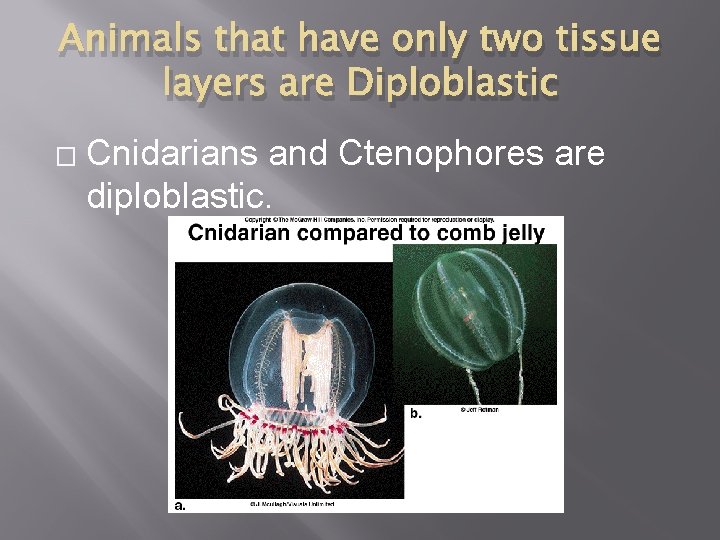
Animals that have only two tissue layers are Diploblastic � Cnidarians and Ctenophores are diploblastic.
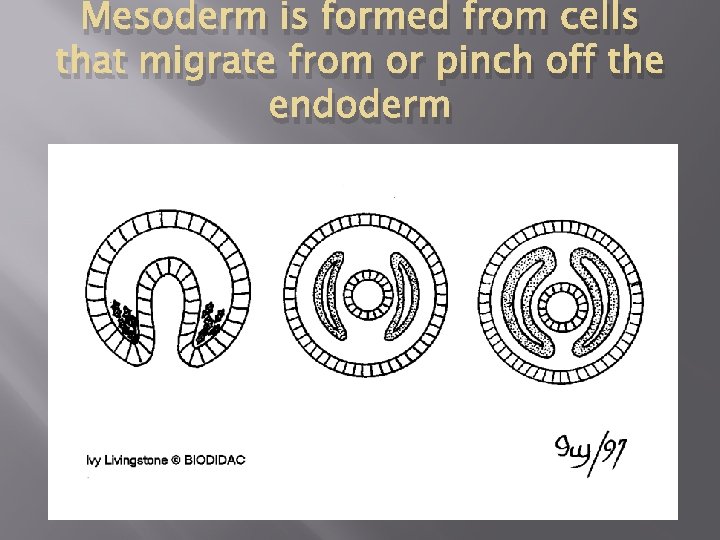
Mesoderm is formed from cells that migrate from or pinch off the endoderm
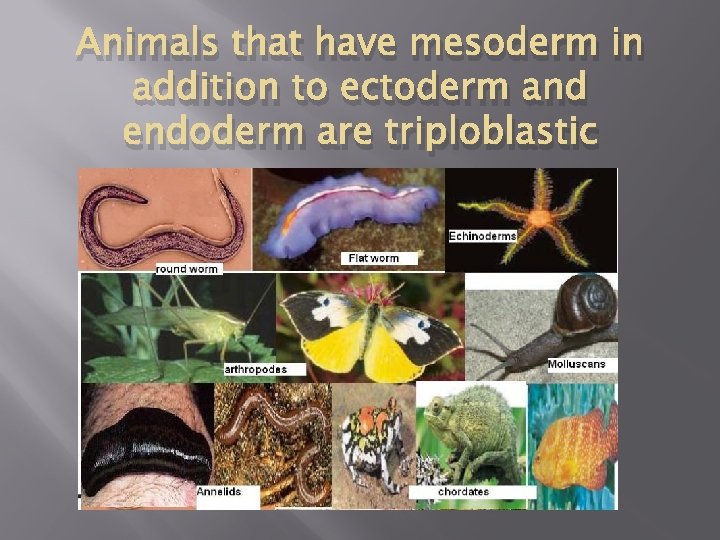
Animals that have mesoderm in addition to ectoderm and endoderm are triploblastic
Future of Embyonic Tissues � � � Ectoderm: Forms epidermal layer of the skin and nervous system Endoderm: Forms the lining of the gut the liver and the lungs. Mesoderm forms muscles, bone, kidney, gonads, and connective tissue.
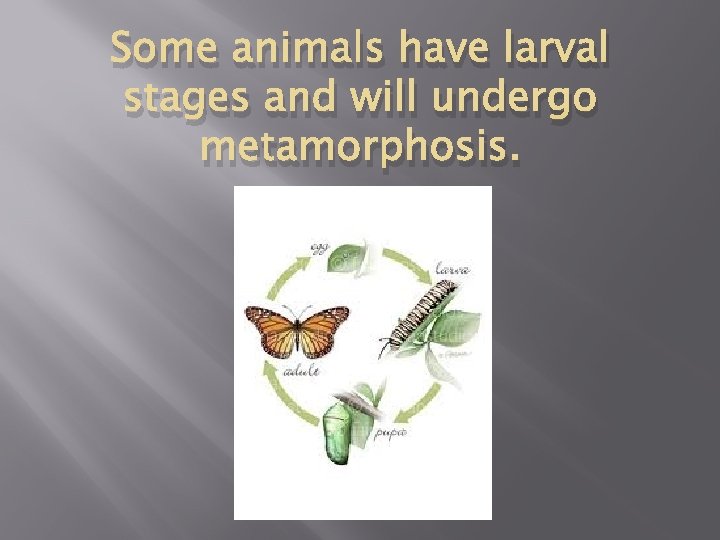
Some animals have larval stages and will undergo metamorphosis.
Animals share “HOX” genes – a unique family of genes that play important roles in development.
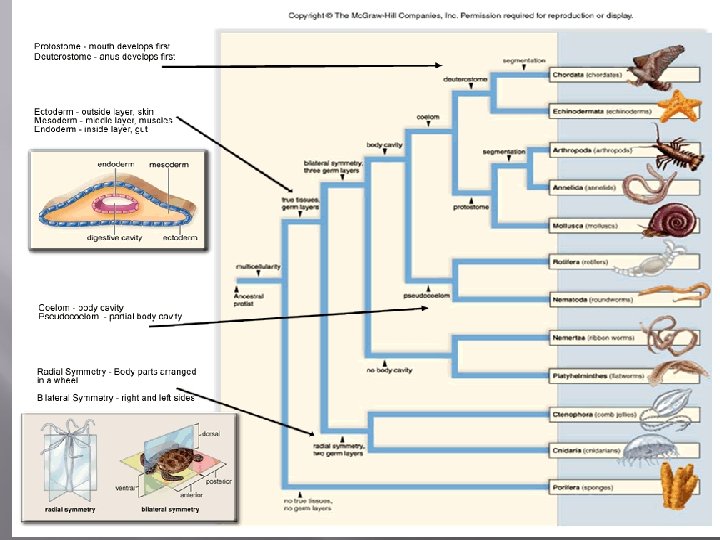
Animals can be characterized by body plans. � � � Symmetry is the overall shape of the body. If an animal is symmetrical, it can be divided along at least one plane into similar halves. Animals that have no plane of symmetry are asymmetrical. SPONGES are asymmetrical.
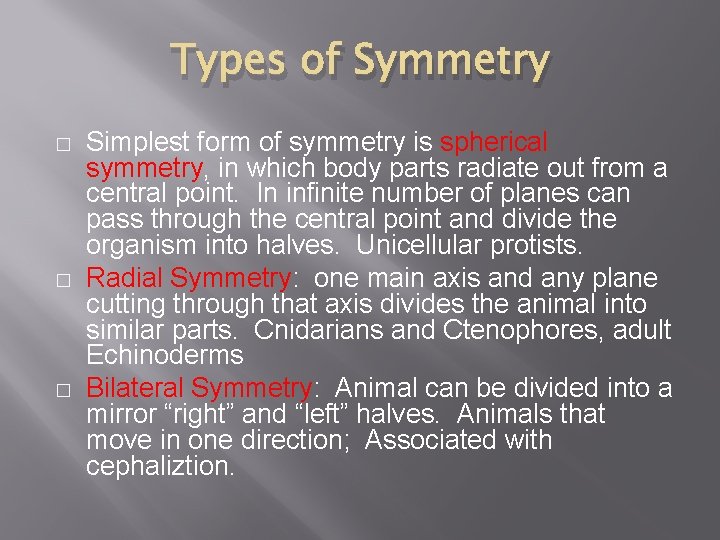
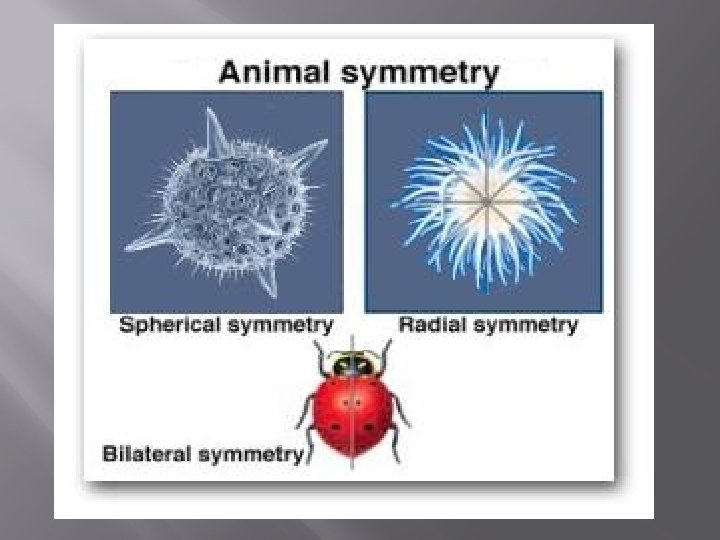
Types of Symmetry � � � Simplest form of symmetry is spherical symmetry, in which body parts radiate out from a central point. In infinite number of planes can pass through the central point and divide the organism into halves. Unicellular protists. Radial Symmetry: one main axis and any plane cutting through that axis divides the animal into similar parts. Cnidarians and Ctenophores, adult Echinoderms Bilateral Symmetry: Animal can be divided into a mirror “right” and “left” halves. Animals that move in one direction; Associated with cephaliztion.
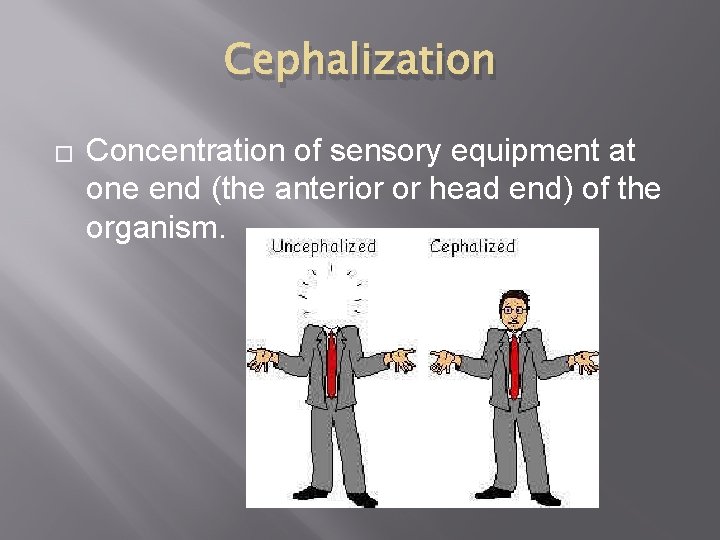
Cephalization � Concentration of sensory equipment at one end (the anterior or head end) of the organism.
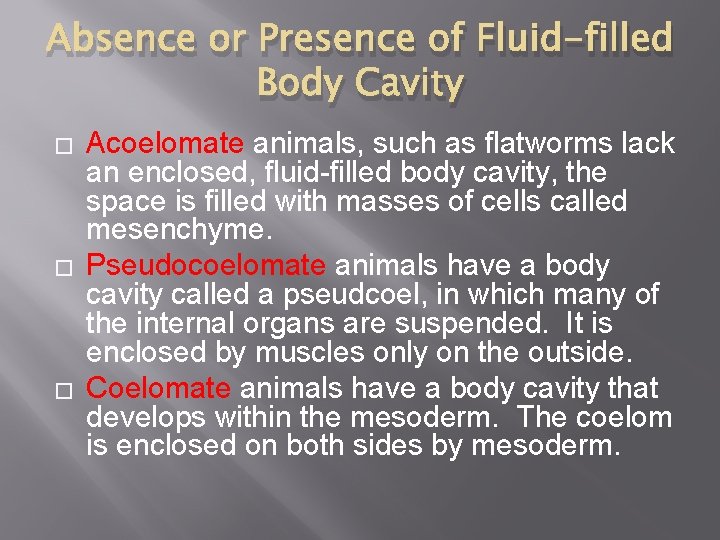
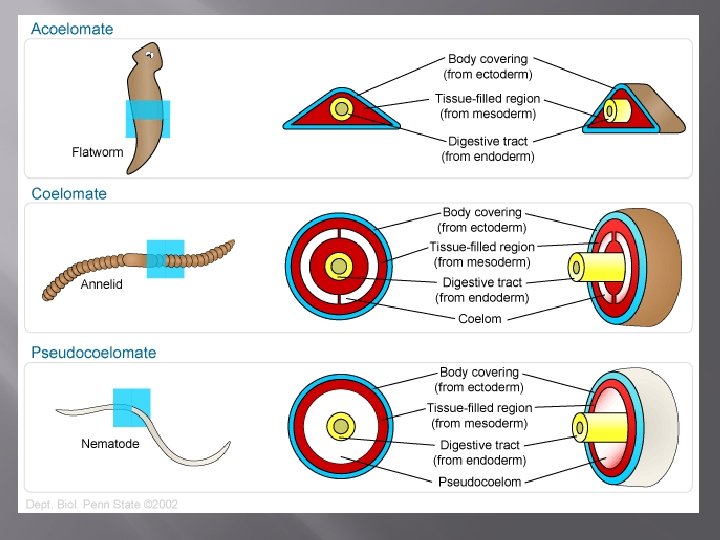
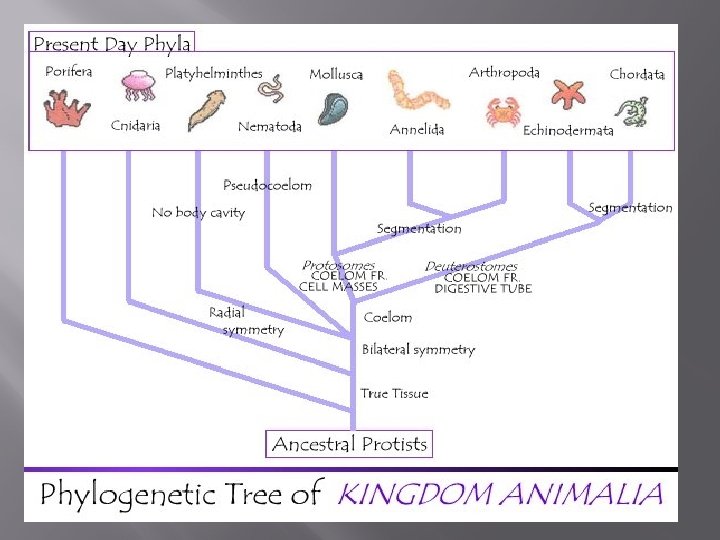
Absence or Presence of Fluid-filled Body Cavity � � � Acoelomate animals, such as flatworms lack an enclosed, fluid-filled body cavity, the space is filled with masses of cells called mesenchyme. Pseudocoelomate animals have a body cavity called a pseudcoel, in which many of the internal organs are suspended. It is enclosed by muscles only on the outside. Coelomate animals have a body cavity that develops within the mesoderm. The coelom is enclosed on both sides by mesoderm.
Functions of the Body Cavity � Cushions the suspended organs � Acts as a hydrostatic skeleton � Enables internal organs to grow and move independently
Segmentation � � � Many animals have bodies that are divided into segments. Segments allow specialization of body parts. Allow animals to alter shape of body to control movements and separate body cavity into compartments. Arthropods and Annelids show segmentation. Some animals have only internal segmentation, as in vertebrate embyos.
Triploblastic animals are divided into Protostomes and Deuterostomes � � � Protostomes: Mouth forms from the blastopore Spiral, determinate cleavage Determinate means cells are commited to a specific fate as early as two cell stage Coelom forms from splits in the mesoderm � � � Deuterostomes Mouth forms from secondary opening Radial, indeterminate cleavage Indeterminate cleavage means cells are not fated until later in development Coelom forms from outpockets of the mesoderm lining the archenteron
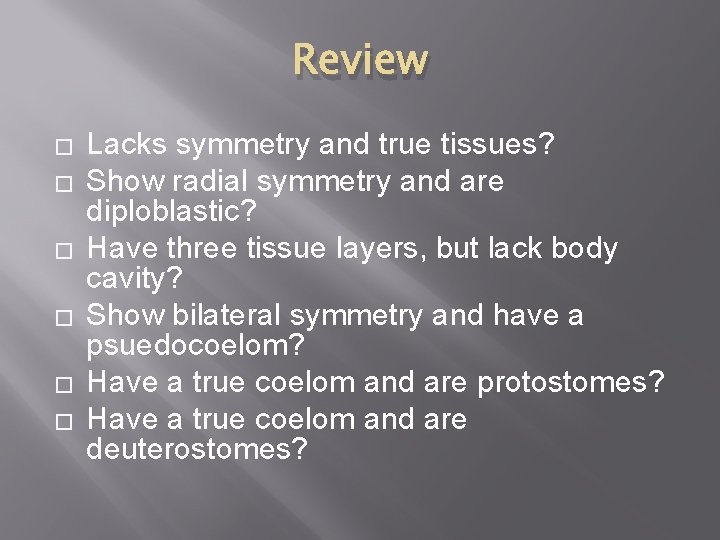
Review � � � Lacks symmetry and true tissues? Show radial symmetry and are diploblastic? Have three tissue layers, but lack body cavity? Show bilateral symmetry and have a psuedocoelom? Have a true coelom and are protostomes? Have a true coelom and are deuterostomes?