
AN INTRODUCTION TO ACCELERATOR PHYSICS LECTURE 1 INTRODUCTION

- Slides: 42
AN INTRODUCTION TO ACCELERATOR PHYSICS LECTURE 1: INTRODUCTION & TRANSVERSE MOTION Rende Steerenberg, CERN, Switzerland
Introduction & Transverse Motion Contents: Overview of the Lectures A Brief History on Particle Accelerators The Mathematics we Need Overview of the CERN Accelerator Complex Relativity, Energy and Units Accelerator Coordinates Magnetic Rigidity The Magnets we Need Hill’s Equation Phase Space, Emittance and Acceptance The Matrix Formalism Rende Steerenberg, CERN Switzerland XV Mexican School on Particle and Fields Puebla, Mexico, 6 September 2012 2
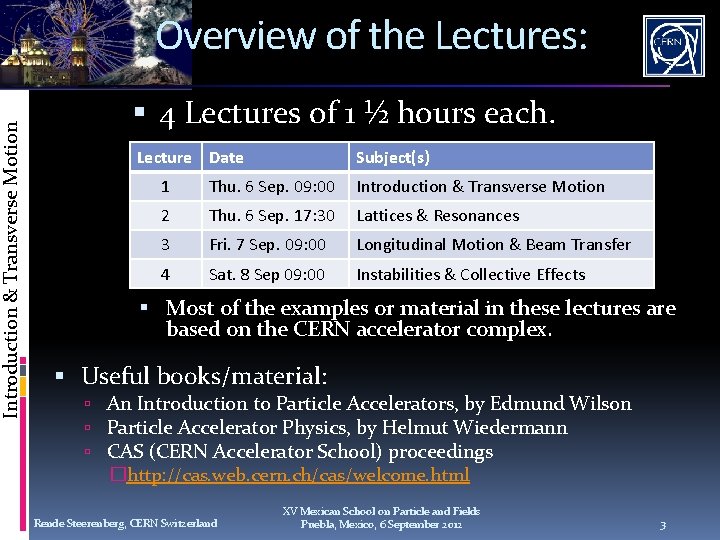
Introduction & Transverse Motion Overview of the Lectures: 4 Lectures of 1 ½ hours each. Lecture Date Subject(s) 1 Thu. 6 Sep. 09: 00 Introduction & Transverse Motion 2 Thu. 6 Sep. 17: 30 Lattices & Resonances 3 Fri. 7 Sep. 09: 00 Longitudinal Motion & Beam Transfer 4 Sat. 8 Sep 09: 00 Instabilities & Collective Effects Most of the examples or material in these lectures are based on the CERN accelerator complex. Useful books/material: An Introduction to Particle Accelerators, by Edmund Wilson Particle Accelerator Physics, by Helmut Wiedermann CAS (CERN Accelerator School) proceedings �http: //cas. web. cern. ch/cas/welcome. html Rende Steerenberg, CERN Switzerland XV Mexican School on Particle and Fields Puebla, Mexico, 6 September 2012 3
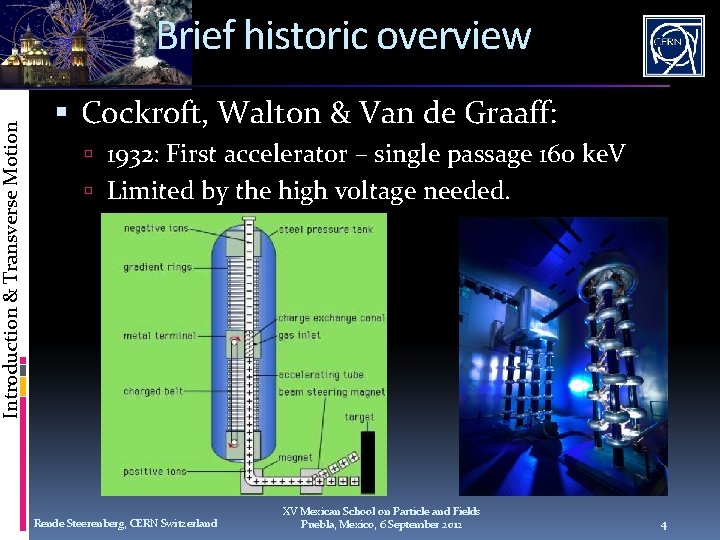
Introduction & Transverse Motion Brief historic overview Cockroft, Walton & Van de Graaff: 1932: First accelerator – single passage 160 ke. V Limited by the high voltage needed. Rende Steerenberg, CERN Switzerland XV Mexican School on Particle and Fields Puebla, Mexico, 6 September 2012 4
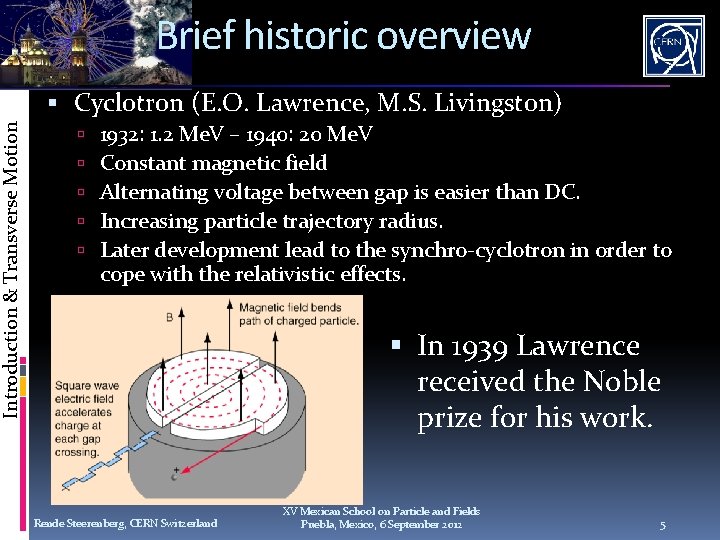
Introduction & Transverse Motion Brief historic overview Cyclotron (E. O. Lawrence, M. S. Livingston) 1932: 1. 2 Me. V – 1940: 20 Me. V Constant magnetic field Alternating voltage between gap is easier than DC. Increasing particle trajectory radius. Later development lead to the synchro-cyclotron in order to cope with the relativistic effects. In 1939 Lawrence received the Noble prize for his work. Rende Steerenberg, CERN Switzerland XV Mexican School on Particle and Fields Puebla, Mexico, 6 September 2012 5
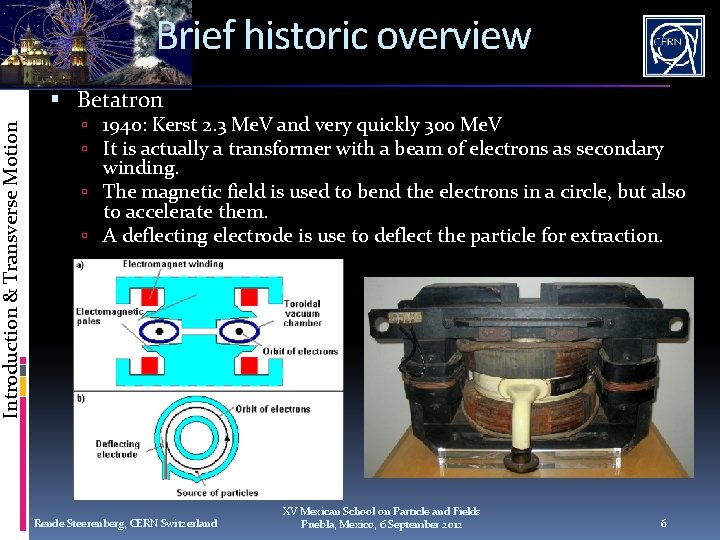
Introduction & Transverse Motion Brief historic overview Betatron 1940: Kerst 2. 3 Me. V and very quickly 300 Me. V It is actually a transformer with a beam of electrons as secondary winding. The magnetic field is used to bend the electrons in a circle, but also to accelerate them. A deflecting electrode is use to deflect the particle for extraction. Rende Steerenberg, CERN Switzerland XV Mexican School on Particle and Fields Puebla, Mexico, 6 September 2012 6
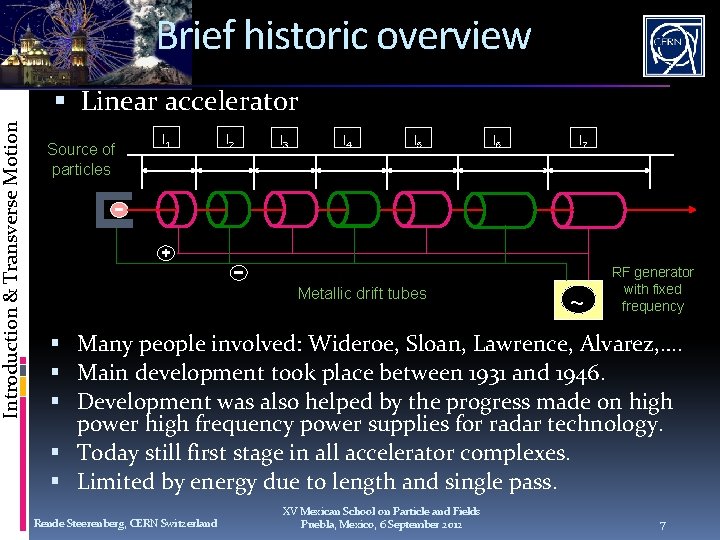
Introduction & Transverse Motion Brief historic overview Linear accelerator Source of particles l 1 l 2 l 3 l 4 l 5 Metallic drift tubes l 6 l 7 ~ RF generator with fixed frequency Many people involved: Wideroe, Sloan, Lawrence, Alvarez, …. Main development took place between 1931 and 1946. Development was also helped by the progress made on high power high frequency power supplies for radar technology. Today still first stage in all accelerator complexes. Limited by energy due to length and single pass. Rende Steerenberg, CERN Switzerland XV Mexican School on Particle and Fields Puebla, Mexico, 6 September 2012 7
Introduction & Transverse Motion Brief historic overview Synchrotron (1959: CERN PS and BNL AGS) Fixed radius for particle orbit Varying magnetic field Varying radio frequency Important focusing of particle beams Providing beam for fixed target physics Paved the way to colliders These lectures will predominantly deal with synchrotron accelerators. Rende Steerenberg, CERN Switzerland XV Mexican School on Particle and Fields Puebla, Mexico, 6 September 2012 8
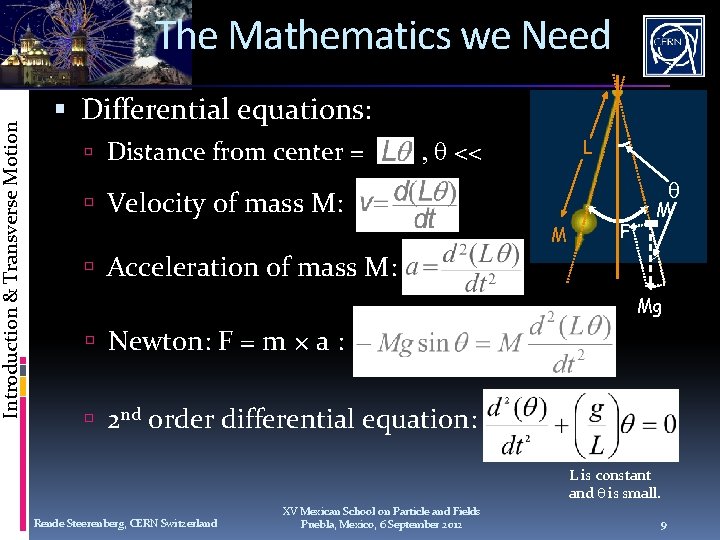
Introduction & Transverse Motion The Mathematics we Need Differential equations: Distance from center = , << L Velocity of mass M: M F M Acceleration of mass M: Mg Newton: F = m × a : 2 nd order differential equation: L is constant and is small. Rende Steerenberg, CERN Switzerland XV Mexican School on Particle and Fields Puebla, Mexico, 6 September 2012 9
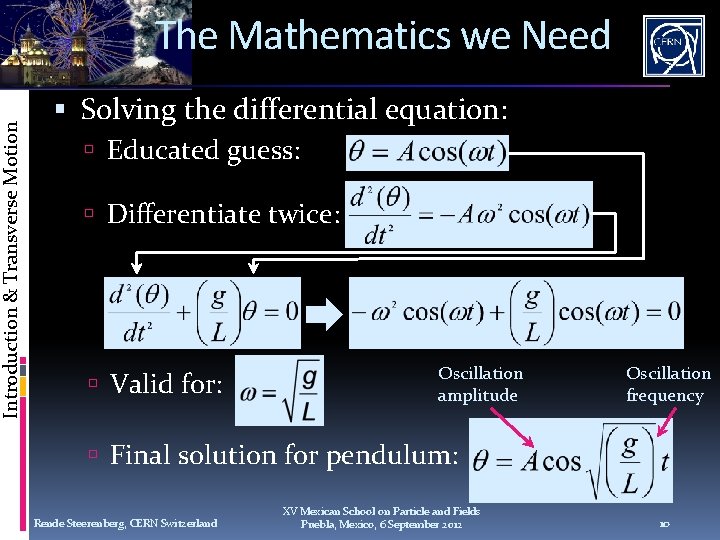
Introduction & Transverse Motion The Mathematics we Need Solving the differential equation: Educated guess: Differentiate twice: Valid for: Oscillation amplitude Oscillation frequency Final solution for pendulum: Rende Steerenberg, CERN Switzerland XV Mexican School on Particle and Fields Puebla, Mexico, 6 September 2012 10
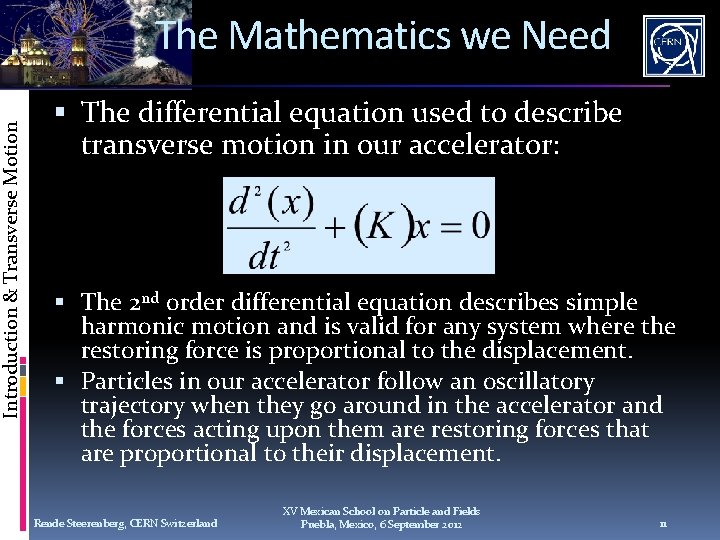
Introduction & Transverse Motion The Mathematics we Need The differential equation used to describe transverse motion in our accelerator: The 2 nd order differential equation describes simple harmonic motion and is valid for any system where the restoring force is proportional to the displacement. Particles in our accelerator follow an oscillatory trajectory when they go around in the accelerator and the forces acting upon them are restoring forces that are proportional to their displacement. Rende Steerenberg, CERN Switzerland XV Mexican School on Particle and Fields Puebla, Mexico, 6 September 2012 11
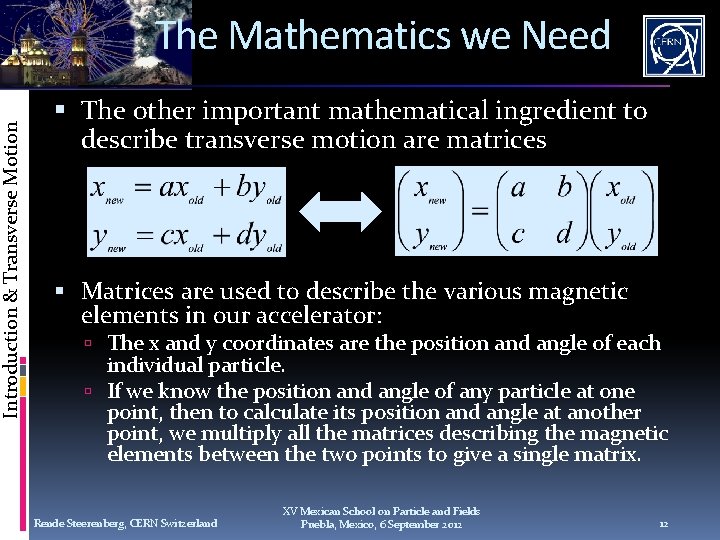
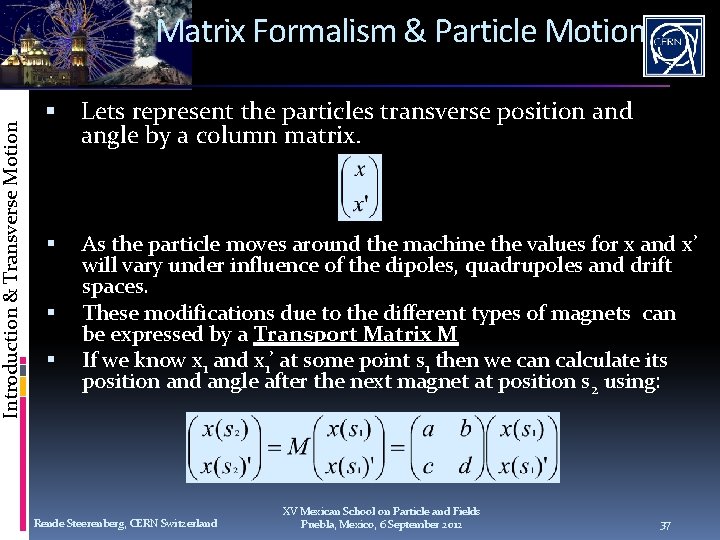
Introduction & Transverse Motion The Mathematics we Need The other important mathematical ingredient to describe transverse motion are matrices Matrices are used to describe the various magnetic elements in our accelerator: The x and y coordinates are the position and angle of each individual particle. If we know the position and angle of any particle at one point, then to calculate its position and angle at another point, we multiply all the matrices describing the magnetic elements between the two points to give a single matrix. Rende Steerenberg, CERN Switzerland XV Mexican School on Particle and Fields Puebla, Mexico, 6 September 2012 12
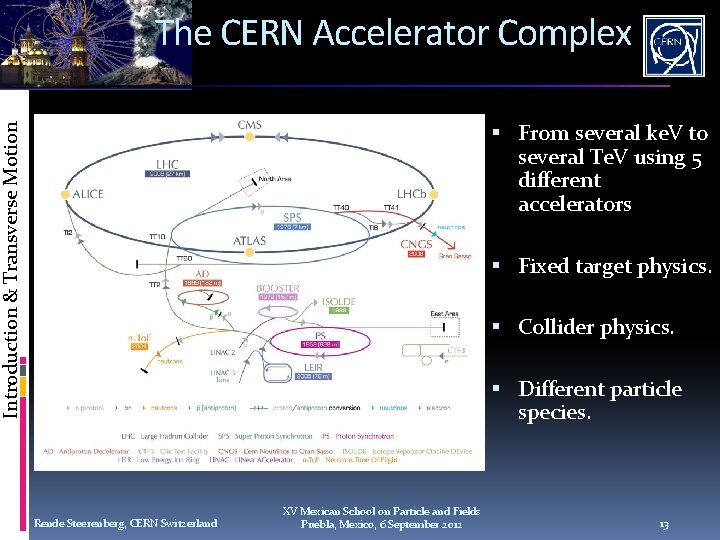
The CERN Accelerator Complex Introduction & Transverse Motion From several ke. V to several Te. V using 5 different accelerators Fixed target physics. Collider physics. Different particle species. Rende Steerenberg, CERN Switzerland XV Mexican School on Particle and Fields Puebla, Mexico, 6 September 2012 13
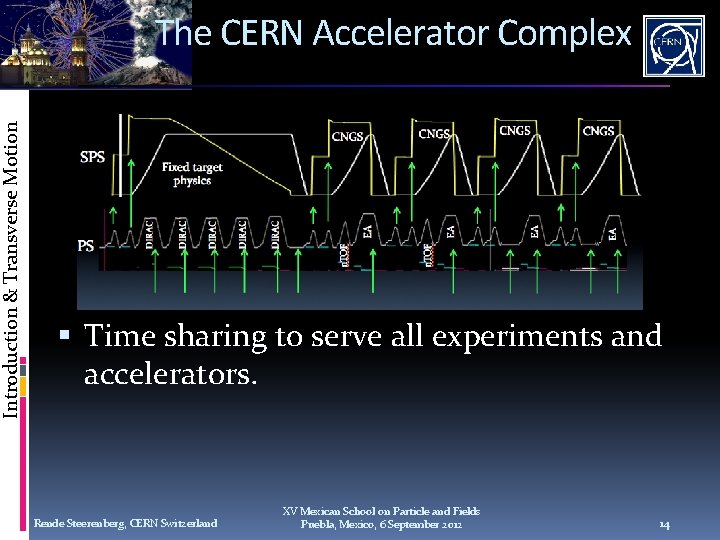
Introduction & Transverse Motion The CERN Accelerator Complex Time sharing to serve all experiments and accelerators. Rende Steerenberg, CERN Switzerland XV Mexican School on Particle and Fields Puebla, Mexico, 6 September 2012 14
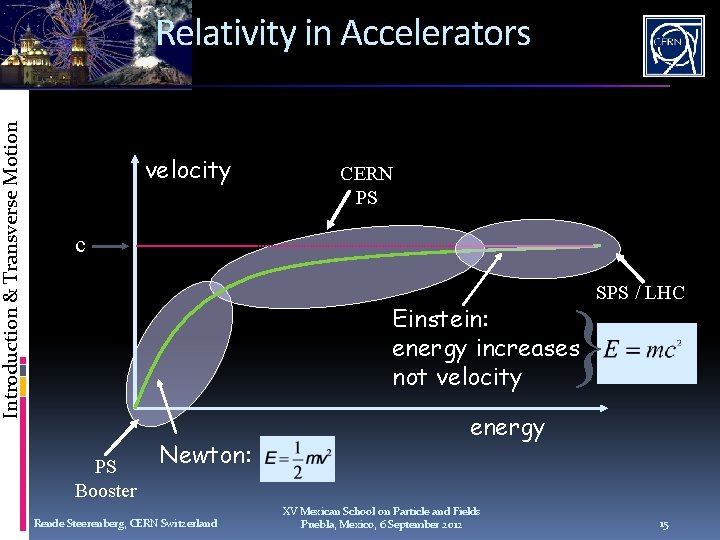
Introduction & Transverse Motion Relativity in Accelerators velocity CERN PS c SPS / LHC } Einstein: energy increases not velocity PS Booster Newton: Rende Steerenberg, CERN Switzerland energy XV Mexican School on Particle and Fields Puebla, Mexico, 6 September 2012 15
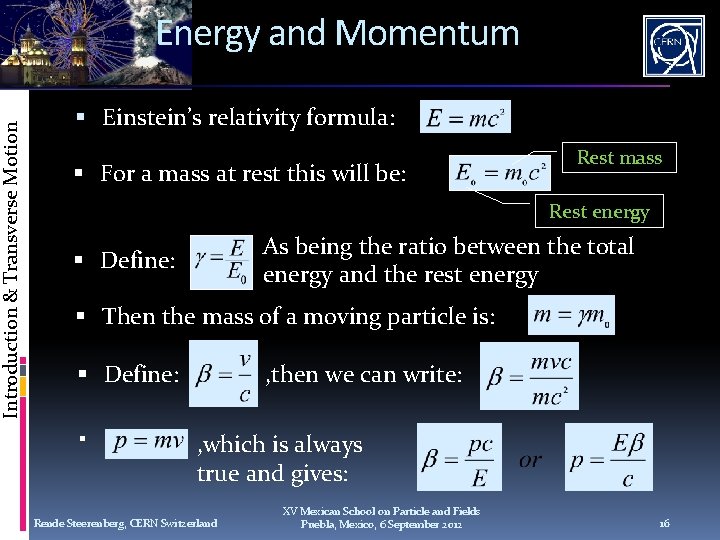
Introduction & Transverse Motion Energy and Momentum Einstein’s relativity formula: For a mass at rest this will be: Rest mass Rest energy As being the ratio between the total energy and the rest energy Define: Then the mass of a moving particle is: , then we can write: Define: , which is always true and gives: Rende Steerenberg, CERN Switzerland XV Mexican School on Particle and Fields Puebla, Mexico, 6 September 2012 16
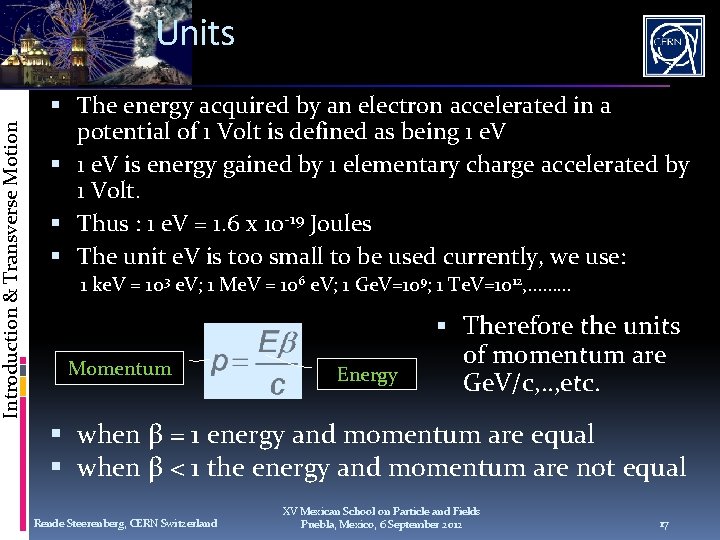
Introduction & Transverse Motion Units The energy acquired by an electron accelerated in a potential of 1 Volt is defined as being 1 e. V is energy gained by 1 elementary charge accelerated by 1 Volt. Thus : 1 e. V = 1. 6 x 10 -19 Joules The unit e. V is too small to be used currently, we use: 1 ke. V = 103 e. V; 1 Me. V = 106 e. V; 1 Ge. V=109; 1 Te. V=1012, ……… Momentum Energy Therefore the units of momentum are Ge. V/c, . . , etc. when β = 1 energy and momentum are equal when β < 1 the energy and momentum are not equal Rende Steerenberg, CERN Switzerland XV Mexican School on Particle and Fields Puebla, Mexico, 6 September 2012 17
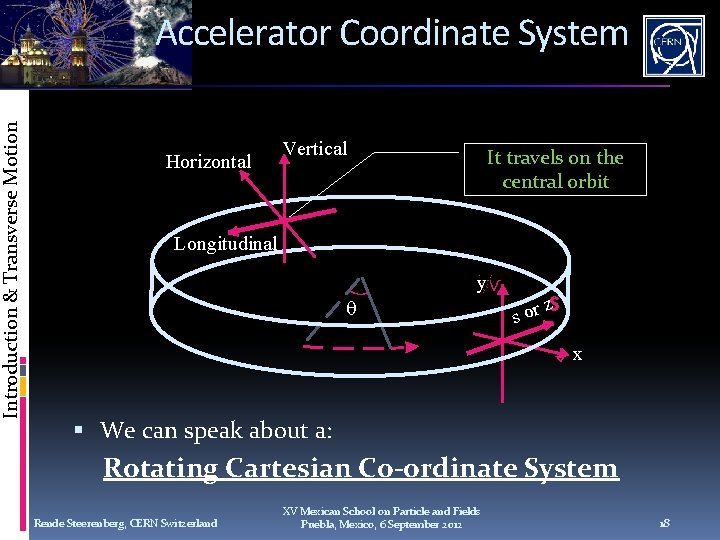
Introduction & Transverse Motion Accelerator Coordinate System Horizontal Vertical It travels on the central orbit Longitudinal y z r o s x We can speak about a: Rotating Cartesian Co-ordinate System Rende Steerenberg, CERN Switzerland XV Mexican School on Particle and Fields Puebla, Mexico, 6 September 2012 18
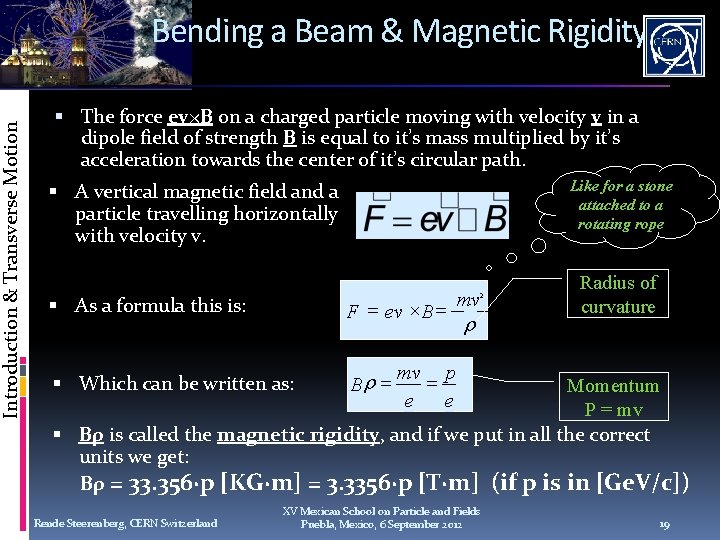
Introduction & Transverse Motion Bending a Beam & Magnetic Rigidity The force ev×B on a charged particle moving with velocity v in a dipole field of strength B is equal to it’s mass multiplied by it’s acceleration towards the center of it’s circular path. Like for a stone attached to a rotating rope A vertical magnetic field and a particle travelling horizontally with velocity v. As a formula this is: F = ev ×B = Which can be written as: Br = mv 2 r Radius of curvature mv p = e e Momentum P = mv Bρ is called the magnetic rigidity, and if we put in all the correct units we get: Bρ = 33. 356·p [KG·m] = 3. 3356·p [T·m] (if p is in [Ge. V/c]) Rende Steerenberg, CERN Switzerland XV Mexican School on Particle and Fields Puebla, Mexico, 6 September 2012 19
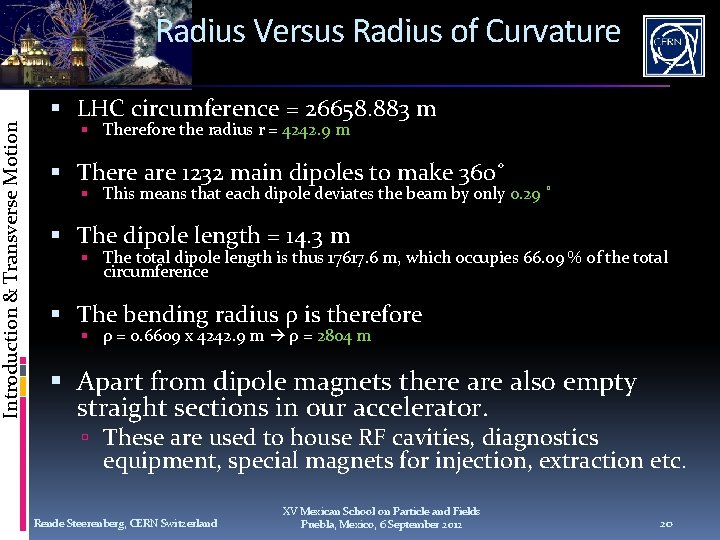
Introduction & Transverse Motion Radius Versus Radius of Curvature LHC circumference = 26658. 883 m Therefore the radius r = 4242. 9 m There are 1232 main dipoles to make 360˚ This means that each dipole deviates the beam by only 0. 29 ˚ The dipole length = 14. 3 m The total dipole length is thus 17617. 6 m, which occupies 66. 09 % of the total circumference The bending radius ρ is therefore ρ = 0. 6609 x 4242. 9 m ρ = 2804 m Apart from dipole magnets there also empty straight sections in our accelerator. These are used to house RF cavities, diagnostics equipment, special magnets for injection, extraction etc. Rende Steerenberg, CERN Switzerland XV Mexican School on Particle and Fields Puebla, Mexico, 6 September 2012 20
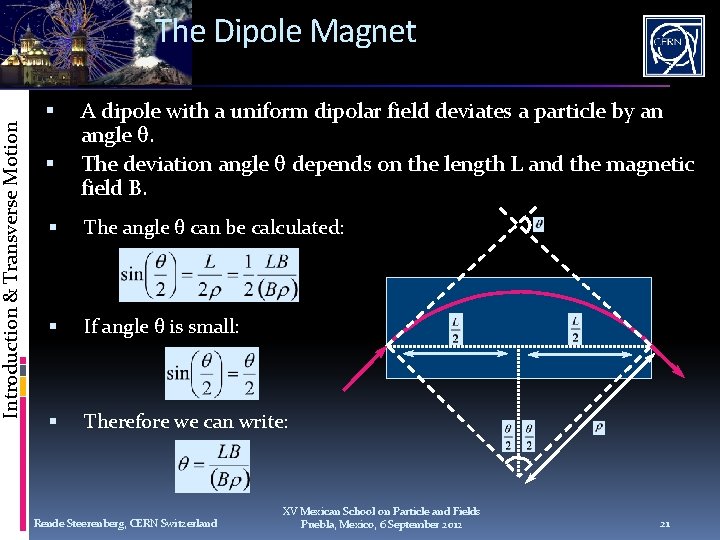
Introduction & Transverse Motion The Dipole Magnet A dipole with a uniform dipolar field deviates a particle by an angle θ. The deviation angle θ depends on the length L and the magnetic field B. The angle θ can be calculated: If angle θ is small: Therefore we can write: Rende Steerenberg, CERN Switzerland XV Mexican School on Particle and Fields Puebla, Mexico, 6 September 2012 21
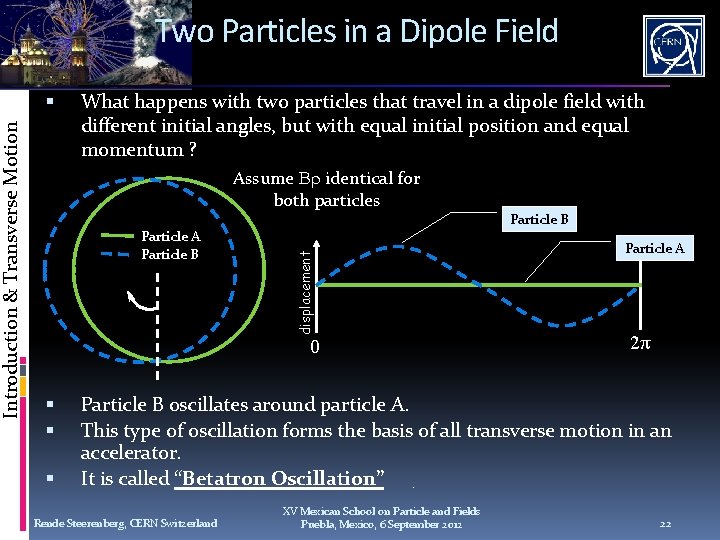
What happens with two particles that travel in a dipole field with different initial angles, but with equal initial position and equal momentum ? Assume Br identical for both particles Particle A Particle B displacement Introduction & Transverse Motion Two Particles in a Dipole Field 0 Particle B Particle A 2π Particle B oscillates around particle A. This type of oscillation forms the basis of all transverse motion in an accelerator. It is called “Betatron Oscillation” Rende Steerenberg, CERN Switzerland XV Mexican School on Particle and Fields Puebla, Mexico, 6 September 2012 22
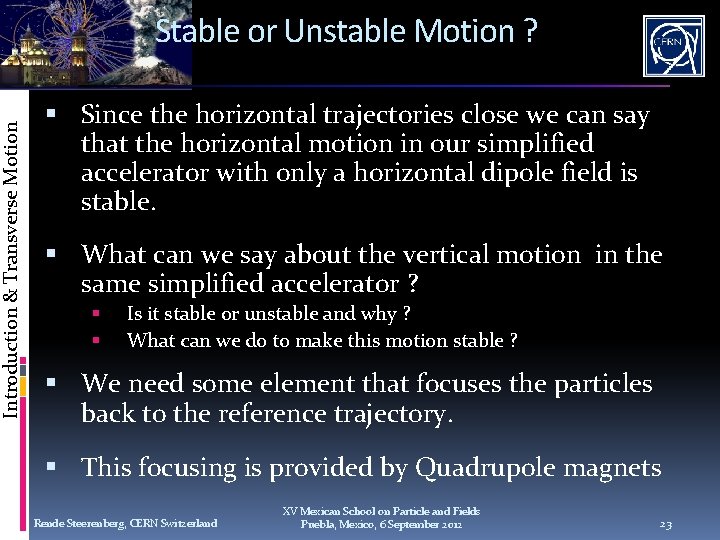
Introduction & Transverse Motion Stable or Unstable Motion ? Since the horizontal trajectories close we can say that the horizontal motion in our simplified accelerator with only a horizontal dipole field is stable. What can we say about the vertical motion in the same simplified accelerator ? Is it stable or unstable and why ? What can we do to make this motion stable ? We need some element that focuses the particles back to the reference trajectory. This focusing is provided by Quadrupole magnets Rende Steerenberg, CERN Switzerland XV Mexican School on Particle and Fields Puebla, Mexico, 6 September 2012 23
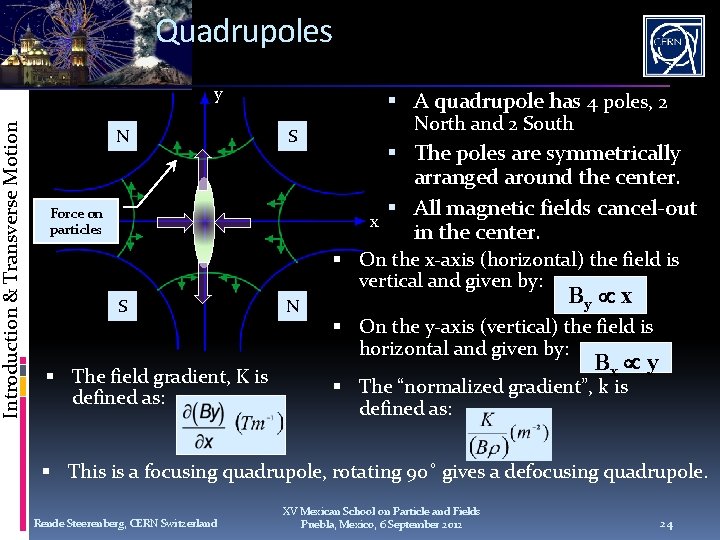
Introduction & Transverse Motion Quadrupoles y N A quadrupole has 4 poles, 2 S Force on particles North and 2 South The poles are symmetrically arranged around the center. All magnetic fields cancel-out x in the center. On the x-axis (horizontal) the field is vertical and given by: S The field gradient, K is defined as: N By x On the y-axis (vertical) the field is horizontal and given by: Bx y The “normalized gradient”, k is defined as: This is a focusing quadrupole, rotating 90˚ gives a defocusing quadrupole. Rende Steerenberg, CERN Switzerland XV Mexican School on Particle and Fields Puebla, Mexico, 6 September 2012 24
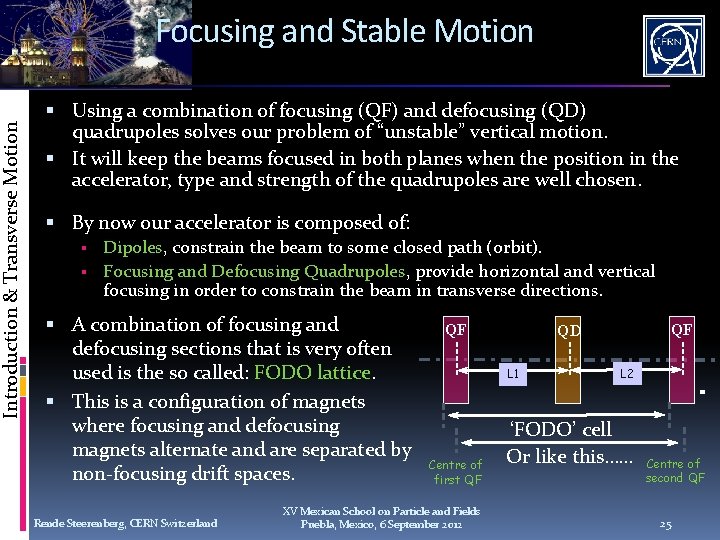
Introduction & Transverse Motion Focusing and Stable Motion Using a combination of focusing (QF) and defocusing (QD) quadrupoles solves our problem of “unstable” vertical motion. It will keep the beams focused in both planes when the position in the accelerator, type and strength of the quadrupoles are well chosen. By now our accelerator is composed of: Dipoles, constrain the beam to some closed path (orbit). Focusing and Defocusing Quadrupoles, provide horizontal and vertical focusing in order to constrain the beam in transverse directions. A combination of focusing and defocusing sections that is very often used is the so called: FODO lattice. This is a configuration of magnets where focusing and defocusing magnets alternate and are separated by non-focusing drift spaces. Rende Steerenberg, CERN Switzerland QF L 1 Centre of first QF XV Mexican School on Particle and Fields Puebla, Mexico, 6 September 2012 QF QD L 2 ‘FODO’ cell Or like this…… Centre of second QF 25
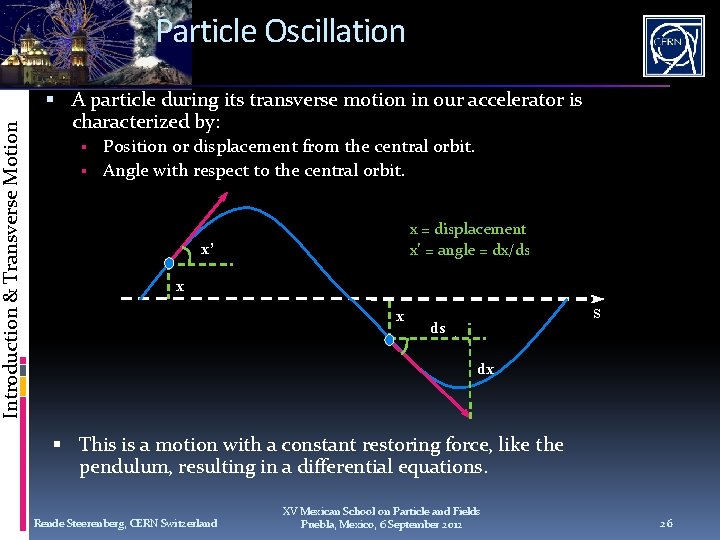
Introduction & Transverse Motion Particle Oscillation A particle during its transverse motion in our accelerator is characterized by: Position or displacement from the central orbit. Angle with respect to the central orbit. x = displacement x’ = angle = dx/ds x’ x x s ds dx This is a motion with a constant restoring force, like the pendulum, resulting in a differential equations. Rende Steerenberg, CERN Switzerland XV Mexican School on Particle and Fields Puebla, Mexico, 6 September 2012 26
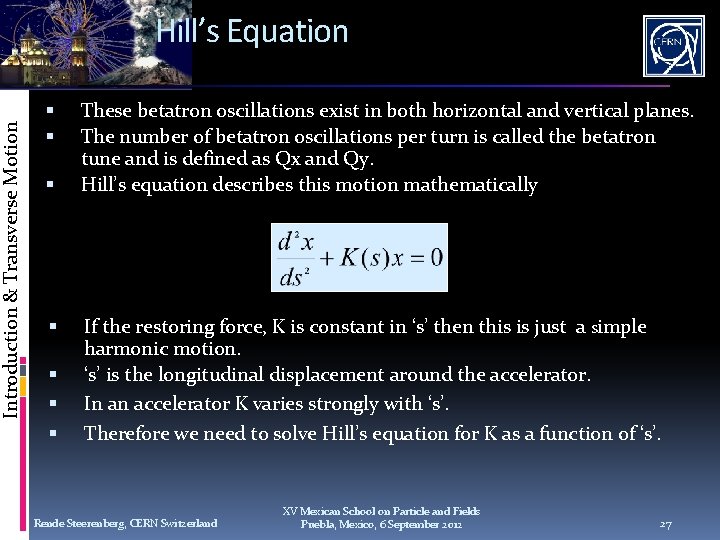
Introduction & Transverse Motion Hill’s Equation These betatron oscillations exist in both horizontal and vertical planes. The number of betatron oscillations per turn is called the betatron tune and is defined as Qx and Qy. Hill’s equation describes this motion mathematically If the restoring force, K is constant in ‘s’ then this is just a Simple harmonic motion. ‘s’ is the longitudinal displacement around the accelerator. In an accelerator K varies strongly with ‘s’. Therefore we need to solve Hill’s equation for K as a function of ‘s’. Rende Steerenberg, CERN Switzerland XV Mexican School on Particle and Fields Puebla, Mexico, 6 September 2012 27
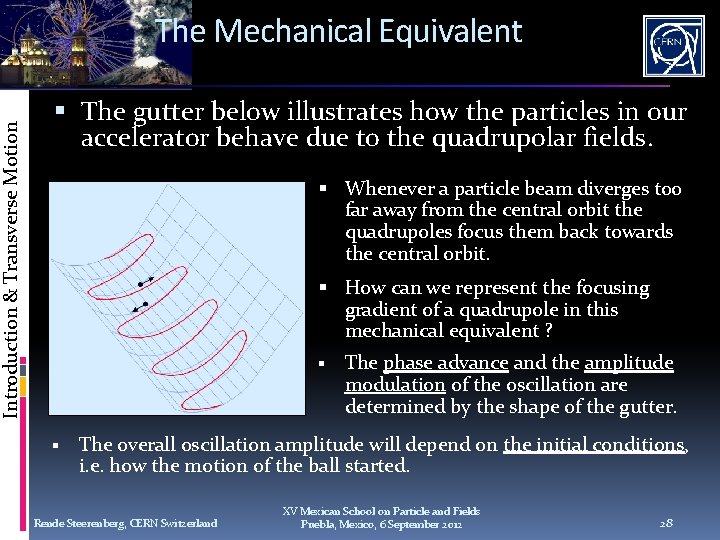
Introduction & Transverse Motion The Mechanical Equivalent The gutter below illustrates how the particles in our accelerator behave due to the quadrupolar fields. Whenever a particle beam diverges too far away from the central orbit the quadrupoles focus them back towards the central orbit. How can we represent the focusing gradient of a quadrupole in this mechanical equivalent ? The phase advance and the amplitude modulation of the oscillation are determined by the shape of the gutter. The overall oscillation amplitude will depend on the initial conditions, i. e. how the motion of the ball started. Rende Steerenberg, CERN Switzerland XV Mexican School on Particle and Fields Puebla, Mexico, 6 September 2012 28
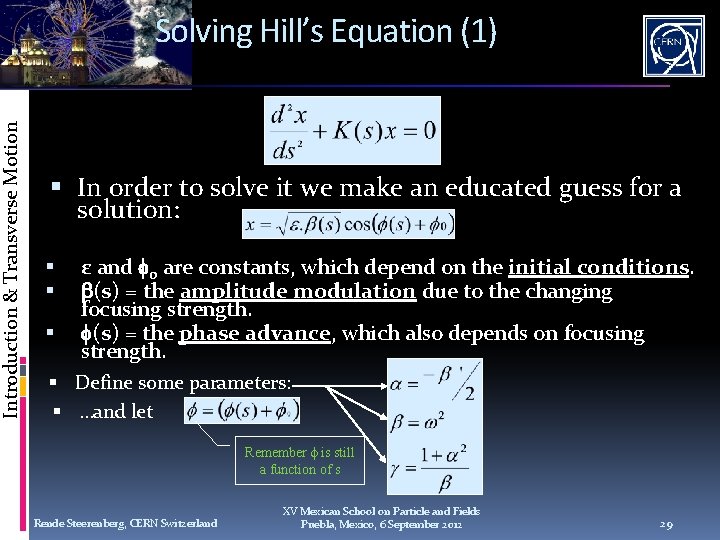
Introduction & Transverse Motion Solving Hill’s Equation (1) In order to solve it we make an educated guess for a solution: ε and 0 are constants, which depend on the initial conditions. (s) = the amplitude modulation due to the changing focusing strength. (s) = the phase advance, which also depends on focusing strength. Define some parameters: …and let Remember is still a function of s Rende Steerenberg, CERN Switzerland XV Mexican School on Particle and Fields Puebla, Mexico, 6 September 2012 29
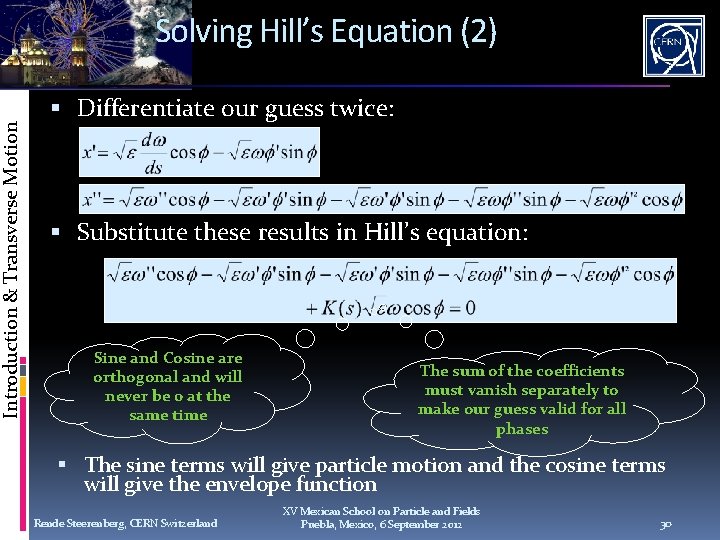
Introduction & Transverse Motion Solving Hill’s Equation (2) Differentiate our guess twice: Substitute these results in Hill’s equation: Sine and Cosine are orthogonal and will never be 0 at the same time The sum of the coefficients must vanish separately to make our guess valid for all phases The sine terms will give particle motion and the cosine terms will give the envelope function Rende Steerenberg, CERN Switzerland XV Mexican School on Particle and Fields Puebla, Mexico, 6 September 2012 30
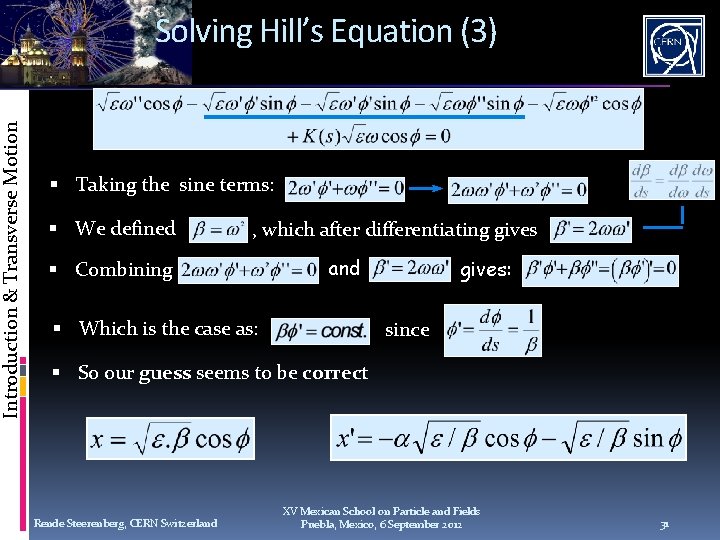
Introduction & Transverse Motion Solving Hill’s Equation (3) Taking the sine terms: We defined , which after differentiating gives Combining and Which is the case as: gives: since So our guess seems to be correct Rende Steerenberg, CERN Switzerland XV Mexican School on Particle and Fields Puebla, Mexico, 6 September 2012 31
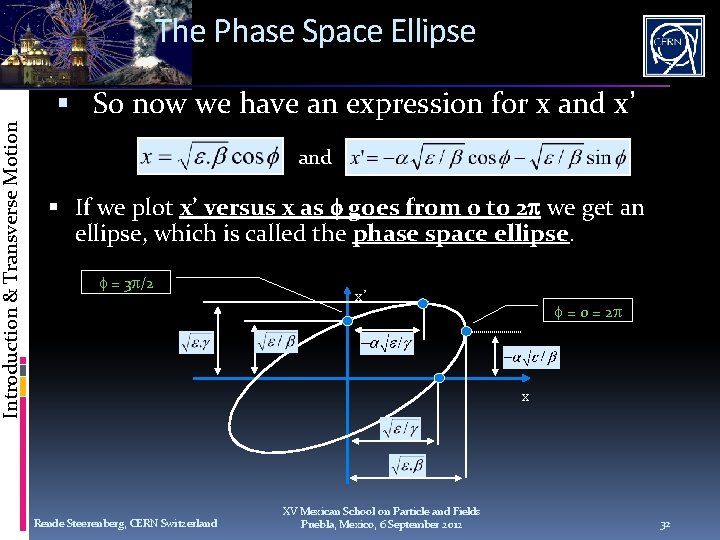
Introduction & Transverse Motion The Phase Space Ellipse So now we have an expression for x and x’ and If we plot x’ versus x as goes from 0 to 2 we get an ellipse, which is called the phase space ellipse. = 3 /2 x’ = 0 = 2 x Rende Steerenberg, CERN Switzerland XV Mexican School on Particle and Fields Puebla, Mexico, 6 September 2012 32
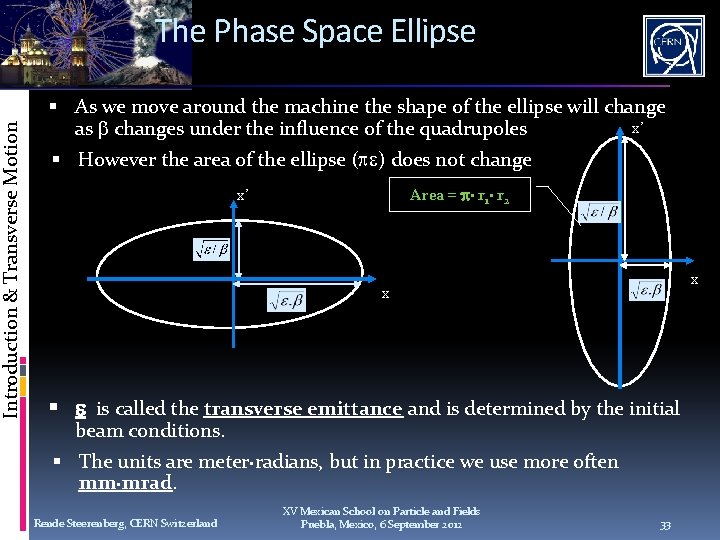
Introduction & Transverse Motion The Phase Space Ellipse As we move around the machine the shape of the ellipse will change x’ as changes under the influence of the quadrupoles However the area of the ellipse ( ) does not change Area = · r 1· r 2 x’ x x is called the transverse emittance and is determined by the initial beam conditions. The units are meter·radians, but in practice we use more often mm·mrad. Rende Steerenberg, CERN Switzerland XV Mexican School on Particle and Fields Puebla, Mexico, 6 September 2012 33
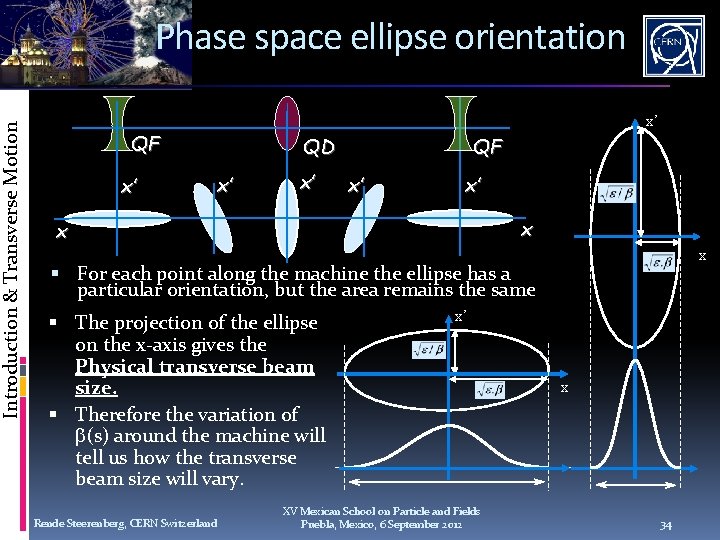
Introduction & Transverse Motion Phase space ellipse orientation x’ QF x’ QD x’ x’ QF x’ x’ x x x For each point along the machine the ellipse has a particular orientation, but the area remains the same The projection of the ellipse on the x-axis gives the Physical transverse beam size. Therefore the variation of (s) around the machine will tell us how the transverse beam size will vary. Rende Steerenberg, CERN Switzerland x’ XV Mexican School on Particle and Fields Puebla, Mexico, 6 September 2012 x 34
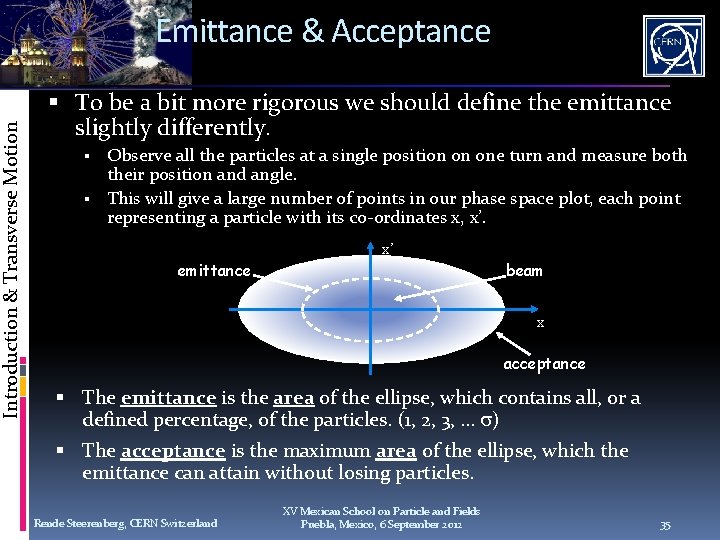
Introduction & Transverse Motion Emittance & Acceptance To be a bit more rigorous we should define the emittance slightly differently. Observe all the particles at a single position on one turn and measure both their position and angle. This will give a large number of points in our phase space plot, each point representing a particle with its co-ordinates x, x’. x’ emittance beam x acceptance The emittance is the area of the ellipse, which contains all, or a defined percentage, of the particles. (1, 2, 3, … s) The acceptance is the maximum area of the ellipse, which the emittance can attain without losing particles. Rende Steerenberg, CERN Switzerland XV Mexican School on Particle and Fields Puebla, Mexico, 6 September 2012 35
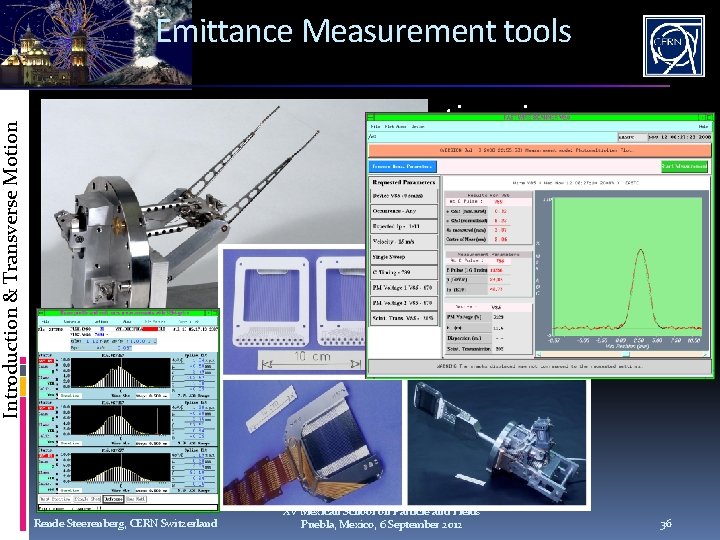
Introduction & Transverse Motion Emittance Measurement tools are also empty straight sections in our accelerator. Rende Steerenberg, CERN Switzerland XV Mexican School on Particle and Fields Puebla, Mexico, 6 September 2012 36
Introduction & Transverse Motion Matrix Formalism & Particle Motion Lets represent the particles transverse position and angle by a column matrix. As the particle moves around the machine the values for x and x’ will vary under influence of the dipoles, quadrupoles and drift spaces. These modifications due to the different types of magnets can be expressed by a Transport Matrix M If we know x 1 and x 1’ at some point s 1 then we can calculate its position and angle after the next magnet at position s 2 using: Rende Steerenberg, CERN Switzerland XV Mexican School on Particle and Fields Puebla, Mexico, 6 September 2012 37
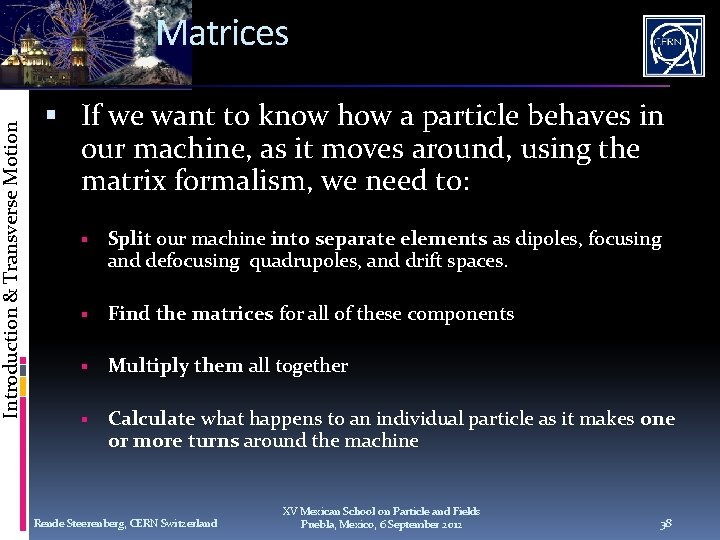
Introduction & Transverse Motion Matrices If we want to know how a particle behaves in our machine, as it moves around, using the matrix formalism, we need to: Split our machine into separate elements as dipoles, focusing and defocusing quadrupoles, and drift spaces. Find the matrices for all of these components Multiply them all together Calculate what happens to an individual particle as it makes one or more turns around the machine Rende Steerenberg, CERN Switzerland XV Mexican School on Particle and Fields Puebla, Mexico, 6 September 2012 38
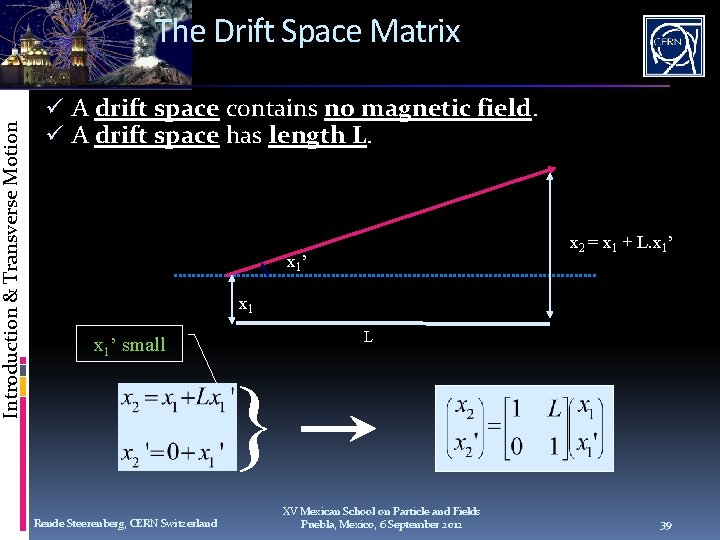
Introduction & Transverse Motion The Drift Space Matrix ü A drift space contains no magnetic field. ü A drift space has length L. x 2 = x 1 + L. x 1’ x 1 L x 1’ small } Rende Steerenberg, CERN Switzerland XV Mexican School on Particle and Fields Puebla, Mexico, 6 September 2012 39
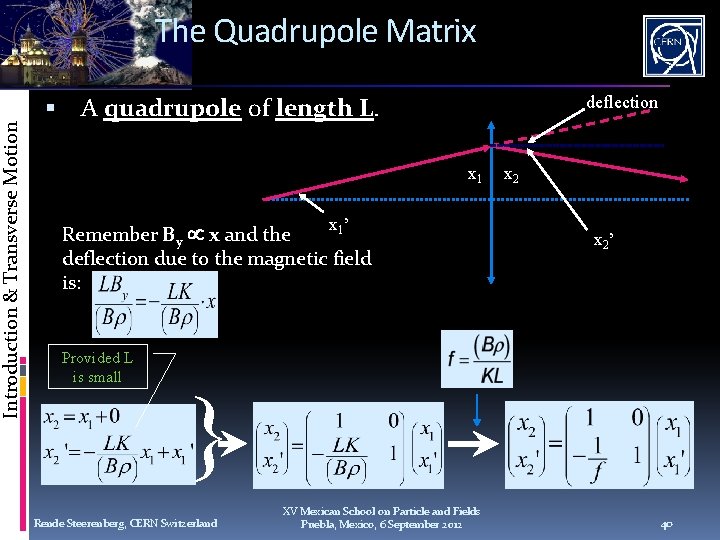
Introduction & Transverse Motion The Quadrupole Matrix deflection A quadrupole of length L. x 1 x’ 1 Remember By x and the deflection due to the magnetic field is: Provided L is small x 2’ } Rende Steerenberg, CERN Switzerland XV Mexican School on Particle and Fields Puebla, Mexico, 6 September 2012 40
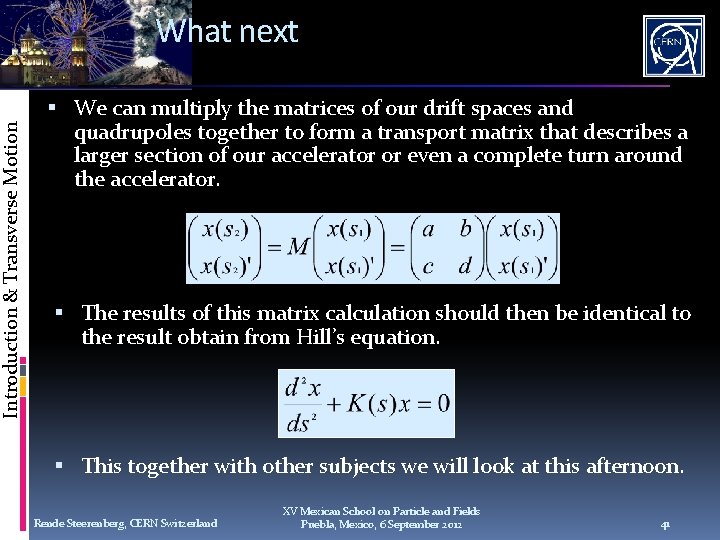
Introduction & Transverse Motion What next We can multiply the matrices of our drift spaces and quadrupoles together to form a transport matrix that describes a larger section of our accelerator or even a complete turn around the accelerator. The results of this matrix calculation should then be identical to the result obtain from Hill’s equation. This together with other subjects we will look at this afternoon. Rende Steerenberg, CERN Switzerland XV Mexican School on Particle and Fields Puebla, Mexico, 6 September 2012 41
Introduction & Transverse Motion Questions ? Rende Steerenberg, CERN Switzerland XV Mexican School on Particle and Fields Puebla, Mexico, 6 September 2012 42