
An Introduction on Machine Learning and Its Applications
- Slides: 19
An Introduction on Machine Learning and Its Applications in Networking Lecturers: Sharare Zehtabian & Siavash Khodadadeh Spring 2020
Outline ● Machine learning applications ● Types of machine learning ○ ○ ○ Supervised learning setup ■ classification ■ regression Unsupervised learning Reinforcement learning ● Neural networks and deep learning
Machine learning definition Definition by Tom Mitchell (1998): Machine Learning is the study of algorithms that ● Improve their performance P ● At some tasks T ● With experience E A well-defined learning task is given by <P, T, E>.
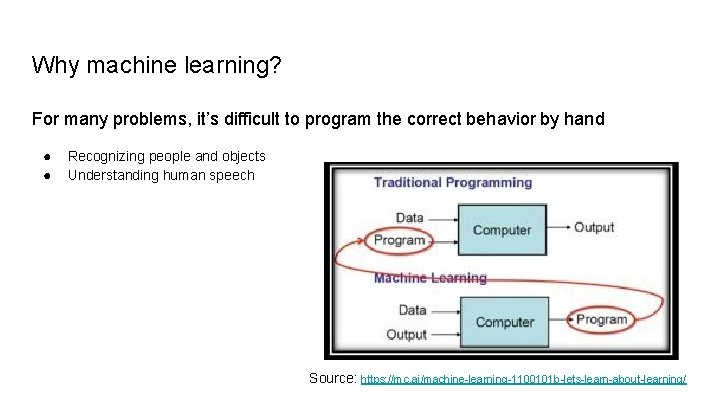
Why machine learning? For many problems, it’s difficult to program the correct behavior by hand ● ● Recognizing people and objects Understanding human speech Source: https: //mc. ai/machine-learning-1100101 b-lets-learn-about-learning/
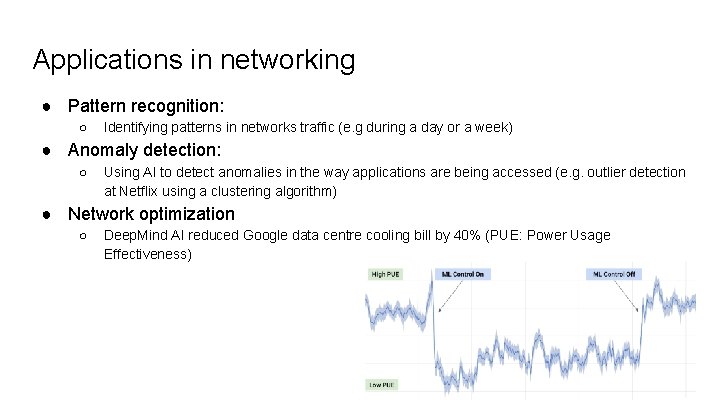
Applications in networking ● Pattern recognition: ○ Identifying patterns in networks traffic (e. g during a day or a week) ● Anomaly detection: ○ Using AI to detect anomalies in the way applications are being accessed (e. g. outlier detection at Netflix using a clustering algorithm) ● Network optimization ○ Deep. Mind AI reduced Google data centre cooling bill by 40% (PUE: Power Usage Effectiveness)
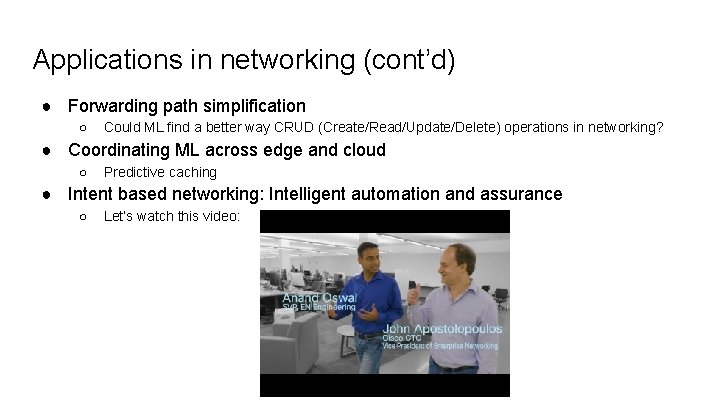
Applications in networking (cont’d) ● Forwarding path simplification ○ Could ML find a better way CRUD (Create/Read/Update/Delete) operations in networking? ● Coordinating ML across edge and cloud ○ Predictive caching ● Intent based networking: Intelligent automation and assurance ○ Let’s watch this video:
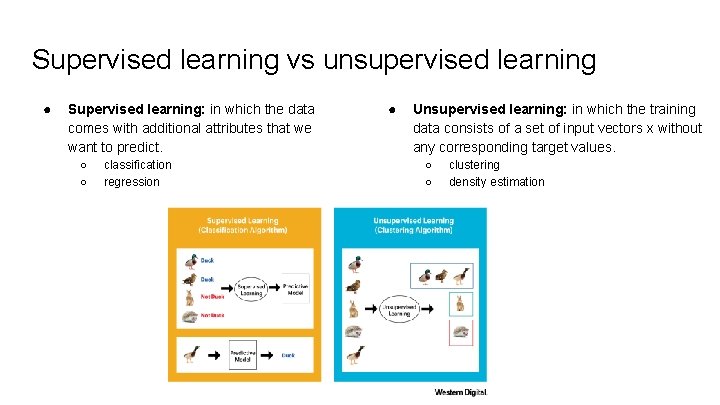
Types of machine learning ● Supervised learning: have labeled examples of the correct behavior ● Unsupervised learning: no labeled examples – instead, looking for interesting patterns in the data ● Reinforcement learning: learning system receives a reward signal, tries to learn to maximize the reward signal
Supervised learning setup ● We have a bunch of (x, y), where x∈Rd is the input instance and y is label ● Training dataset D={(x 1, y 1), …, (xn, yn)}⊆Rd×C ● ● ● Rd is the d-dimensional feature space xi is the input vector of the ith sample yi is the label of the ith sample C is the label space The training data pairs are drawn from some unknown distribution P
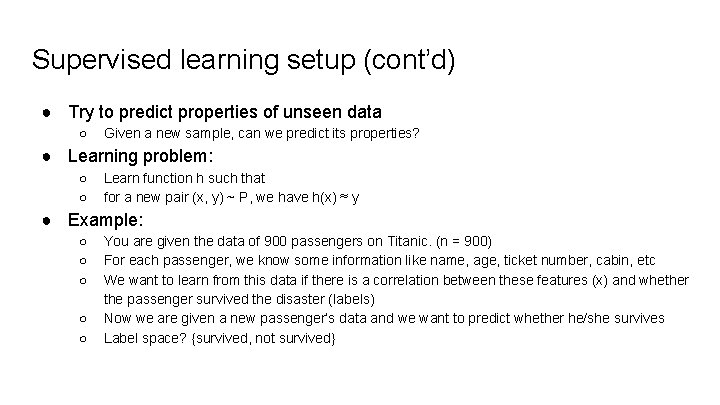
Supervised learning setup (cont’d) ● Try to predict properties of unseen data ○ Given a new sample, can we predict its properties? ● Learning problem: ○ ○ Learn function h such that for a new pair (x, y) ~ P, we have h(x) ≈ y ● Example: ○ ○ ○ You are given the data of 900 passengers on Titanic. (n = 900) For each passenger, we know some information like name, age, ticket number, cabin, etc We want to learn from this data if there is a correlation between these features (x) and whether the passenger survived the disaster (labels) Now we are given a new passenger’s data and we want to predict whether he/she survives Label space? {survived, not survived}
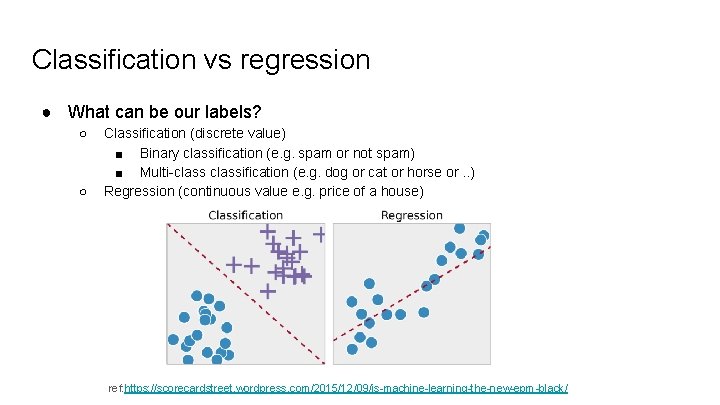
Classification vs regression ● What can be our labels? ○ ○ Classification (discrete value) ■ Binary classification (e. g. spam or not spam) ■ Multi-classification (e. g. dog or cat or horse or. . ) Regression (continuous value e. g. price of a house) ref: https: //scorecardstreet. wordpress. com/2015/12/09/is-machine-learning-the-new-epm-black/
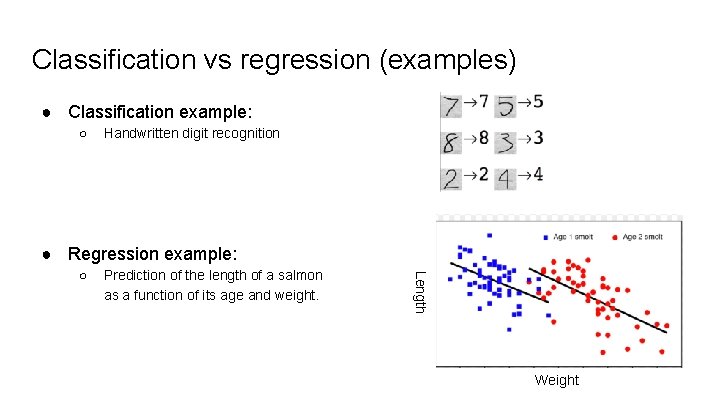
Classification vs regression (examples) ● Classification example: ○ Handwritten digit recognition ● Regression example: Prediction of the length of a salmon as a function of its age and weight. Length ○ Weight
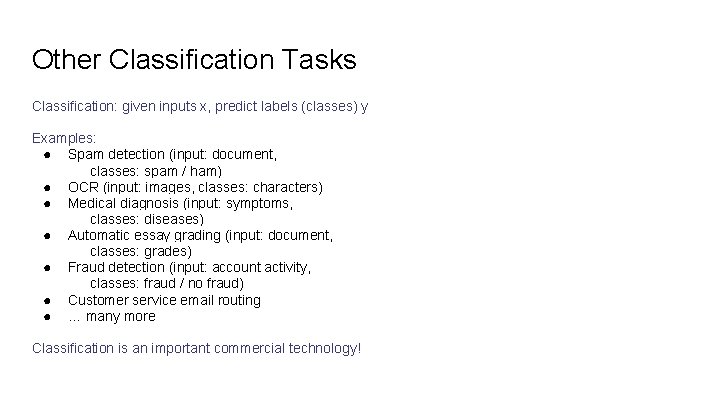
Other Classification Tasks Classification: given inputs x, predict labels (classes) y Examples: ● Spam detection (input: document, classes: spam / ham) ● OCR (input: images, classes: characters) ● Medical diagnosis (input: symptoms, classes: diseases) ● Automatic essay grading (input: document, classes: grades) ● Fraud detection (input: account activity, classes: fraud / no fraud) ● Customer service email routing ● … many more Classification is an important commercial technology!
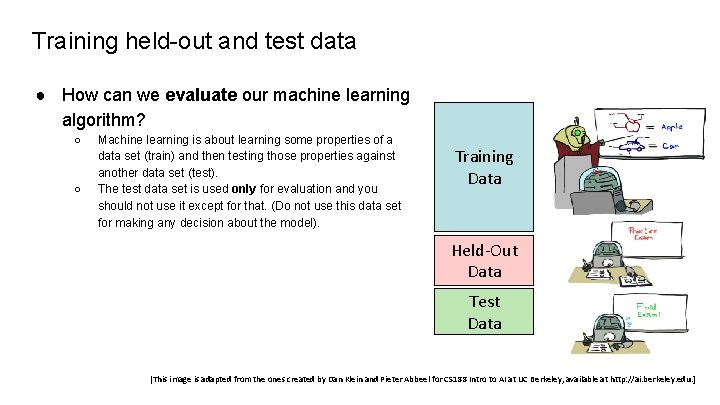
Training held-out and test data ● How can we evaluate our machine learning algorithm? ○ ○ Machine learning is about learning some properties of a data set (train) and then testing those properties against another data set (test). The test data set is used only for evaluation and you should not use it except for that. (Do not use this data set for making any decision about the model). Training Data Held-Out Data Test Data [This image is adapted from the ones created by Dan Klein and Pieter Abbeel for CS 188 Intro to AI at UC Berkeley, available at http: //ai. berkeley. edu. ]
Supervised learning vs unsupervised learning ● Supervised learning: in which the data comes with additional attributes that we want to predict. ○ ○ classification regression ● Unsupervised learning: in which the training data consists of a set of input vectors x without any corresponding target values. ○ ○ clustering density estimation
More about unsupervised learning ● Why unsupervised learning is important? ○ Labeling data costs time and resources ■ 300 hours of video are uploaded to youtube every minute ● What are different approaches for it? ○ ○ Auto encoders ■ Encode input to a latent space and reconstruct it from there Generative models ■ Two agents (neural networks) play a min-max game against each other
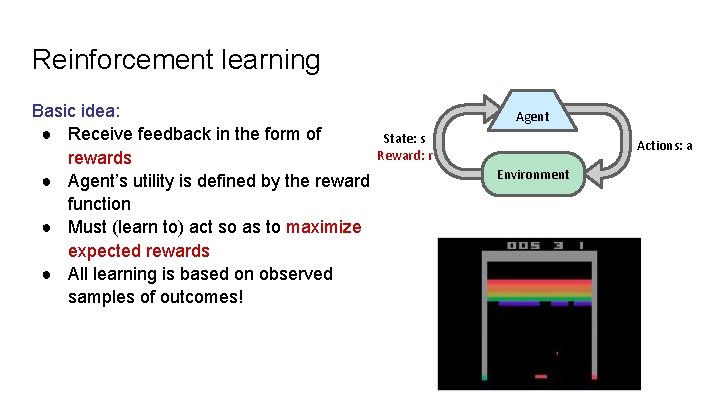
Reinforcement learning Basic idea: ● Receive feedback in the form of rewards ● Agent’s utility is defined by the reward function ● Must (learn to) act so as to maximize expected rewards ● All learning is based on observed samples of outcomes! Agent State: s Reward: r Actions: a Environment
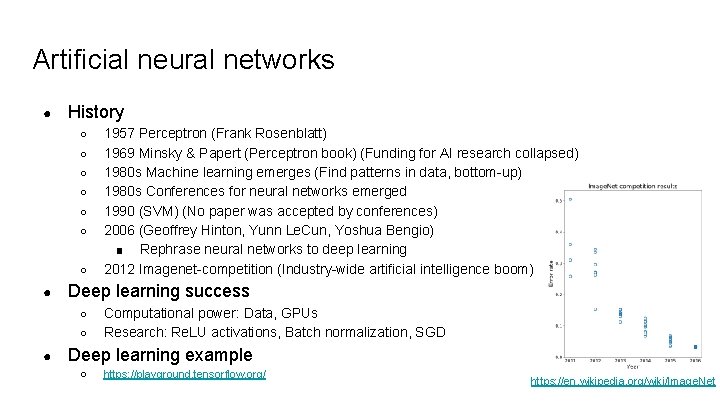
Artificial neural networks ● History ○ ○ ○ ○ ● Deep learning success ○ ○ ● 1957 Perceptron (Frank Rosenblatt) 1969 Minsky & Papert (Perceptron book) (Funding for AI research collapsed) 1980 s Machine learning emerges (Find patterns in data, bottom-up) 1980 s Conferences for neural networks emerged 1990 (SVM) (No paper was accepted by conferences) 2006 (Geoffrey Hinton, Yunn Le. Cun, Yoshua Bengio) ■ Rephrase neural networks to deep learning 2012 Imagenet-competition (Industry-wide artificial intelligence boom) Computational power: Data, GPUs Research: Re. LU activations, Batch normalization, SGD Deep learning example ○ https: //playground. tensorflow. org/ https: //en. wikipedia. org/wiki/Image. Net
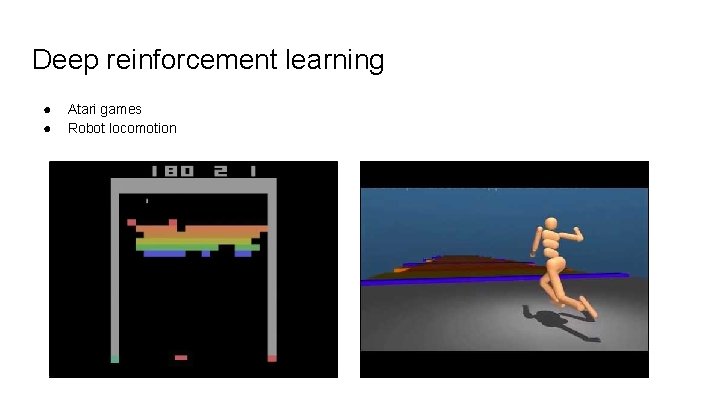
Deep reinforcement learning ● ● Atari games Robot locomotion
Conclusion ● No free lunch theorem ○ ○ ○ We can use different functions for our learning algorithm ■ Decision tree ■ Perceptron ■ SVM ■ Neural network ■ etc We have to make assumption about the function which we use There is no single solution for all ML problems ● Deep learning is used in many different domains ○ ○ ○ A function Hard to find the rules Can have a good amount of data