
An Introduction for History Taking Dr Abdelmonem Gado
An Introduction for History Taking Dr. Abdelmonem Gado, MS Surgery, FRCSI Consultant Paediatric Surgeon, Division of Paediatric Surgery, Department of Surgery

• Your professional obligations, the expectation placed upon you by the public, the law and your colleagues, start on your first day as a student and continue throughout your working life.
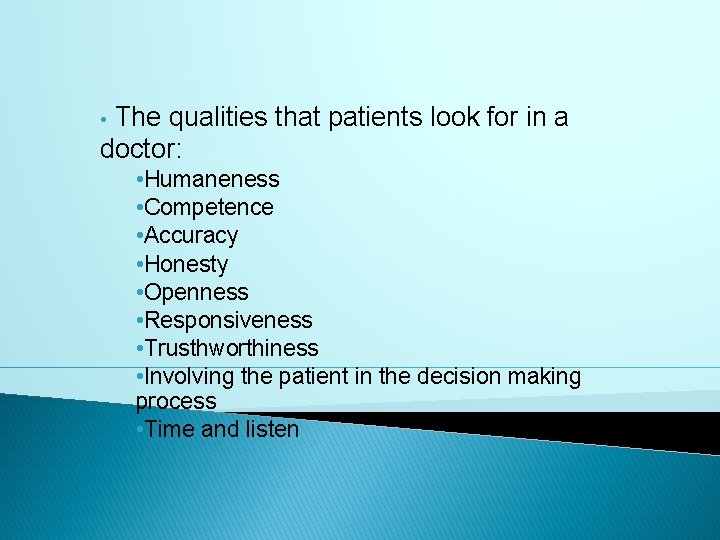
The qualities that patients look for in a doctor: • • Humaneness • Competence • Accuracy • Honesty • Openness • Responsiveness • Trusthworthiness • Involving the patient in the decision making process • Time and listen
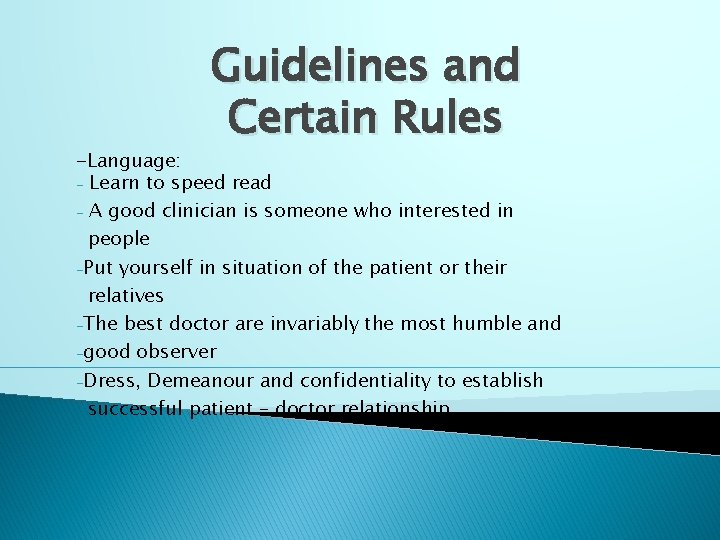
Guidelines and Certain Rules -Language: - Learn to speed read - A good clinician is someone who interested in people -Put yourself in situation of the patient or their relatives -The best doctor are invariably the most humble and -good observer -Dress, Demeanour and confidentiality to establish successful patient – doctor relationship
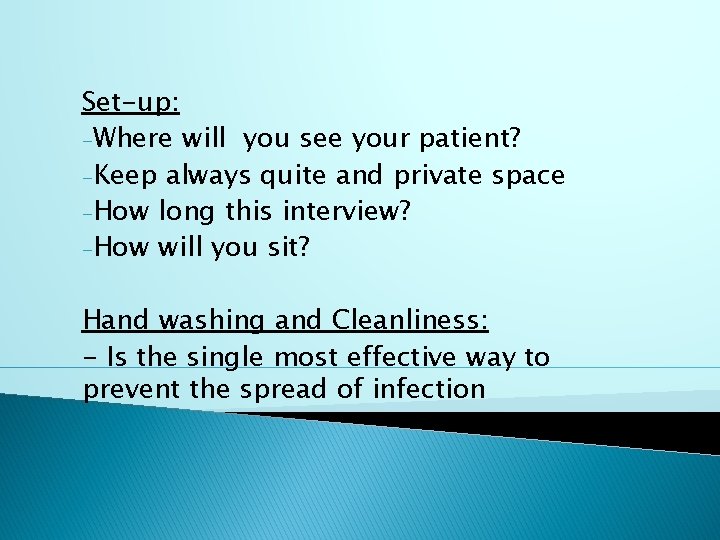
Set-up: -Where will you see your patient? -Keep always quite and private space -How long this interview? -How will you sit? Hand washing and Cleanliness: - Is the single most effective way to prevent the spread of infection
Infections that can be transmitted on the hands of healthcare workers” -Healthcare – acquired infections: -MRSA - Clostridium difficile -Diarrheal infection: - Salmonella - Shigella - E. coli - Noro virus - Respiratory Infection: - Influenza virus (RSV) - Other Infections: - Common cold Hepatitis A - Resp. Syncytial
Communication Skills, How? -Maintain good eye contact -Active listening, then write -Encourage verbal or non verbal communication -Avoiding jargon -Ability to discuss difficult issues -Going at a place that is comfortable for the patient -Diligent and frequent practice
Introduce yourself: -I am Mr…. , I am 3 rd year medical student -I have been asked to talk to you and examine you with some of my colleagues -It might take 30 minutes -Privacy -Notes (it does not mean I’m not listening to you -Are you happy with all that?
Things to remember: -Never write while talking -See the patient walking -See the accompanying person (mother, wife, friend) -Can often provide valuable information -However, many patients are inhibited from discussing their problems by the presence of third person
Guide the conversation: -Explain what you are doing, and why you are doing it, at all stages - patients know more about their complaints than you, but cannot interpret their significance: - Interpreter – short and simple questions - Leading questions - one answer - open questions - Example : Does the pain ever move? - Always ask the questions in the right way.

Principle of History taking in Surgery: History taking ? the key step in surgical diagnosis. Varies according to the complain ? specific histories ? surgical specialty

Two types of history in surgical practice: Out-pt or emergency room history ? specific complaint is pinpointed ? diagnosis Clerking of pt admitted for elective surgery object ? to assess that the treatment planned correctly indicated and pt is suitable for that operation.
History Taking Information gathered during patient interview •

Components of Patient History - Date and Time - Chief Complaint - Identifying data - Present illness - Source of referral - Past medical and surgical history - Source of history - Family History Social History - Drug History -
History Taking I. Personal Information - Age, Sex, marital status, occupation nationality, residence, etc. .
� HISTORY cont. . : 2) Present complain: - open question - closed question - write in patients words
Chief Complaint • • Symptoms that caused patient to seek care Often: • Pain • Abnormal function • Change in normal state • Unusual observation made by patient (e. g. , heart palpitations)
History: 3) History of present illness (Complaint) - Provide full, clear, chronological account of symptoms - In scientific term - Similar attacks - Determine the abnormal system
HISTORY cont. . : 4) Remaining question of abnormal system
HISTORY cont. : 5) ◦ ◦ Systemic direct question: it reveals the presence of other disorders of which the patient was unaware, or thought irrelevant -ve answers are as important as +ve answers
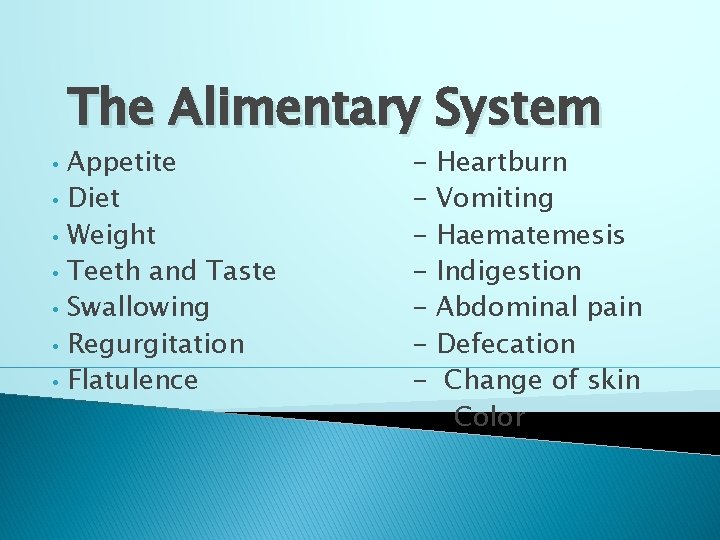
The Alimentary System • • Appetite Diet Weight Teeth and Taste Swallowing Regurgitation Flatulence - Heartburn Vomiting Haematemesis Indigestion Abdominal pain Defecation Change of skin Color
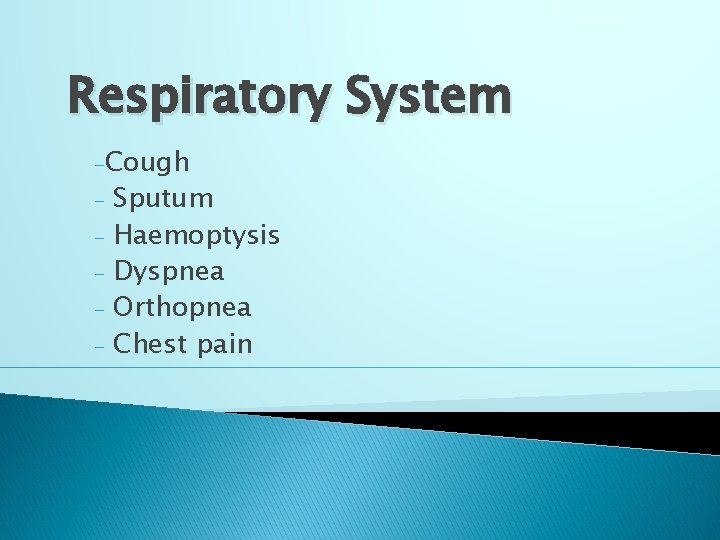
Respiratory System -Cough - Sputum Haemoptysis Dyspnea Orthopnea Chest pain
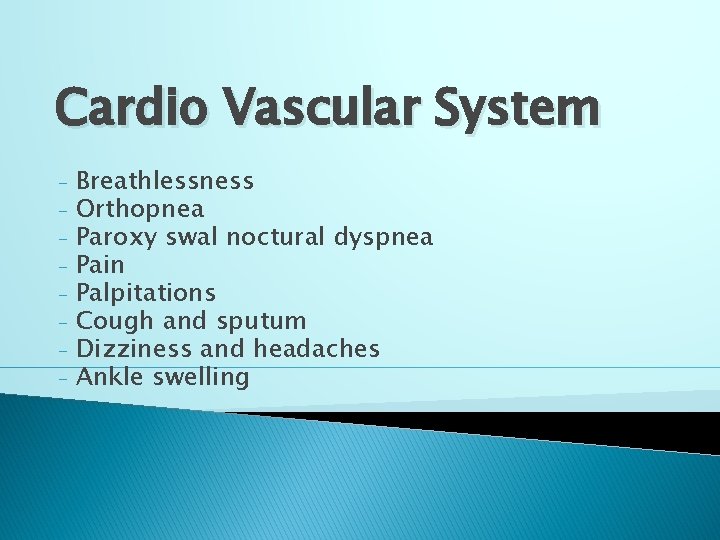
Cardio Vascular System - Breathlessness Orthopnea Paroxy swal noctural dyspnea Pain Palpitations Cough and sputum Dizziness and headaches Ankle swelling
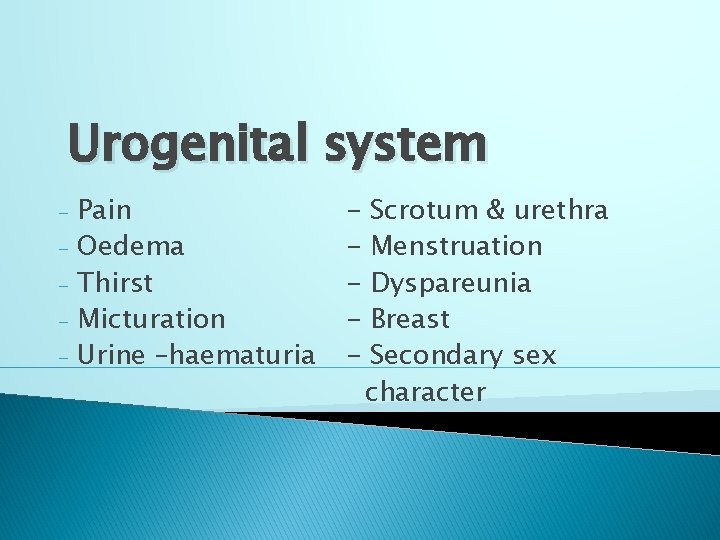
Urogenital system - Pain Oedema Thirst Micturation Urine –haematuria - Scrotum & urethra Menstruation Dyspareunia Breast Secondary sex character
�Nervous system and musculoskeletal system
Significant Past History � General ◦ ◦ state of health: Childhood illnesses Adult illnesses Accident and injuries Surgeries or hospitalizations
Family History � Health of immediate family ◦ High blood pressure, heart disease, contagious illnesses � Potential for hereditary diseases
Social History � Marital status � Occupation � Residency � The lesiure activities � Habits (smoking, alcohol, etc) � Travelled abroad.
Sensitive Topics � Alcohol � Physical � Sexual or drug use abuse or violence issues
Sensitive Questions Guidelines � Respect � Be direct and firm � Avoid � Be patient privacy confrontation nonjudgmental � Use appropriate language � Document carefully ◦ Use patient’s words when possible
Special Challenges � Silence � Overly talkative patients � Patients with multiple symptoms � Anxious patients
Special Challenges � Anger and hostility � Intoxication � Crying � Depression � Sexually attractive or seductive patients � Confusing behavior or histories � Limited intelligence � Developmental disabilities
Barriers to Communication � May result from: ◦ Social or cultural differences ◦ Sight, speech, or hearing impairments � Attempt to find assistance to aid in communication
Commonest complains in Surgery � Pain � Lump
Commonest complains in Surgery �History of pain -The site -Onset -Duration -Severity -Nature of the pain -Progression of the pain -Relieving and exacerbation factors -Radiation and refering pain
Commonest complains in Surgery �History of a lump -Site. -Duration. -What made the patient notice the lump. -course of the lump. -Associated symptoms. -Other lumps

� QUIZ

� QUESTIONS?

� THANK YOU!
- Slides: 39