
An Intersectional Approach to Serving Students with Autism

- Slides: 23
An Intersectional Approach to Serving Students with Autism Spectrum Disorder Jackie Cid Sophia Ciminello Sawyer Cook Rachel Kiemele
Overview of the Case Key Issues & Charges: • There is a significant increase in the number of students with Autism Spectrum Disorder at the institution, but services for this population have not evolved to reflect this. • Committee Members: Director of Disability Services, professional from Residence Life, a faculty member, a professional from the Office of Student Activities, and a professional from Mental Health Services • How can we provide assistance to this group of students in the development of a Disability Services program. The goals of this program are to provide personal, academic, and social integration into the campus community.
Best Practices Gelbar, Smith, and Reichow (2014) conducted a systematic review of articles describing the experience and supports available to individuals with ASD enrolled in college and university programs based on the fact that much of the research to date has focussed on lower-functioning individuals despite the fact that the number of higher-functioning individuals with ASD is rising. • There selection criteria was intentionally broad. Articles had to include (a) individuals with ASD who were attending a degree-granting college/university; (b) a first-hand description of the services, supports, and experiences of one or more individuals ; and (c) be published in English in a peer-reviewed journal After filtering an initial result of 3, 553 records, the researchers were left with a total of 20 articles which met their criteria. Out of those 20, two articles used experimental methods to investigate interventions and the remaining 18 were categorized as case studies of individuals with ASD in college. These 20 articles included the experiences 69 individuals. Limited emphasis on experimental investigative methods and the dearth of literature available indicate a need for more longitudinal research, larger sample sizes, and an expansive focus on what post-graduation life consists of for students with ASD in order to determine any sort of consistent best practices or outcomes for this particular population. Available strategies, such as those presented in Disability Compliance for Higher Education (Hope, 2014; Gomez, 2015) list practical skills, tools, and support systems for college personnel based on the Diagnostic and Statistical Manual of Mental Disorders and individual first-hand experience rather than empirical evidence.
Are College Personnel Prepared to Serve Students with ASD? Students with ASD vulnerable to mental health issues including anxiety and depression. Predictability is crucial for confident functionality (Maloret et al. , 2014). Students report needing accommodations, modifications, and auxiliary aids to help in the classroom, college living, and other settings (Gomez, 2015). Recent research trends indicate that there is an increased knowledge, awareness, and acceptance of individuals with ASD on college campuses (Glennon, 2014). In a survey of 488 college personnel responsible for designing and/or implementing support services for students with disabilities, nearly all reported working with students who had disclosed an ASD diagnosis. However, • 55% indicated they had some understanding of ASD but wanted additional information • 63% indicated their institution struggled to outline supports needed for students with ASD • 80% felt an overwhelming need to work collaboratively with high school teams to prepare students with ASD for the transition to college, but • 17% typically shared college and environmental expectations with high school teams • 21% typically surveyed their college environment for areas of difficulty/growth for students with ASD • 16% typically educated students with ASD on the “unwritten rules” of university life and campus culture
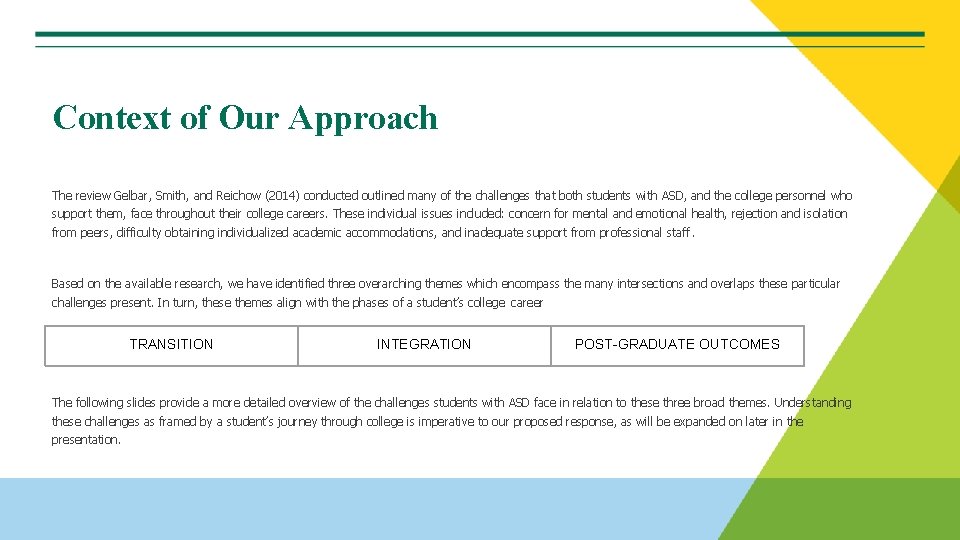
Context of Our Approach The review Gelbar, Smith, and Reichow (2014) conducted outlined many of the challenges that both students with ASD, and the college personnel who support them, face throughout their college careers. These individual issues included: concern for mental and emotional health, rejection and isolation from peers, difficulty obtaining individualized academic accommodations, and inadequate support from professional staff. Based on the available research, we have identified three overarching themes which encompass the many intersections and overlaps these particular challenges present. In turn, these themes align with the phases of a student’s college career TRANSITION INTEGRATION POST-GRADUATE OUTCOMES The following slides provide a more detailed overview of the challenges students with ASD face in relation to these three broad themes. Understanding these challenges as framed by a student’s journey through college is imperative to our proposed response, as will be expanded on later in the presentation.
Transition
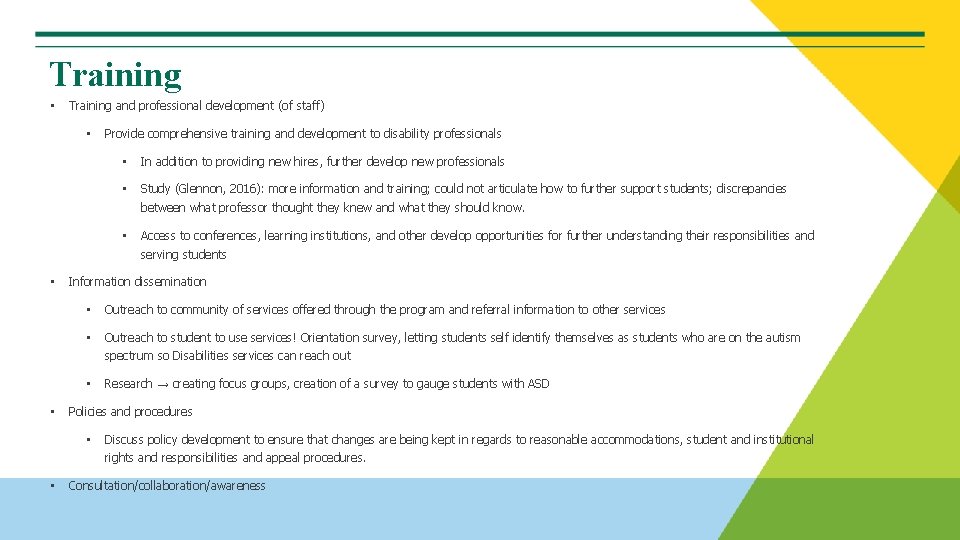
Training • Training and professional development (of staff) • Provide comprehensive training and development to disability professionals • In addition to providing new hires, further develop new professionals • Study (Glennon, 2016): more information and training; could not articulate how to further support students; discrepancies between what professor thought they knew and what they should know. • Access to conferences, learning institutions, and other develop opportunities for further understanding their responsibilities and serving students • Information dissemination • Outreach to community of services offered through the program and referral information to other services • Outreach to student to use services! Orientation survey, letting students self identify themselves as students who are on the autism spectrum so Disabilities services can reach out • • Research → creating focus groups, creation of a survey to gauge students with ASD Policies and procedures • Discuss policy development to ensure that changes are being kept in regards to reasonable accommodations, student and institutional rights and responsibilities and appeal procedures. • Consultation/collaboration/awareness
Integration
Integration As Remy and Seaman (2014) explicate, individuals with ASD often find it difficult to understand other people's perspectives. Neurotypical folks generally interpret this as a lack of empathy, but the reality is often much more complex. Individuals with ASD are often unable to process the subtle emotional cues and subtext that form the bedrock of normative communication. As a result, the characteristics that individuals with ASD present are often categorized according to what makes neurotypical individuals feel comfortable versus what they interpret as inappropriate, creating a “good behavior/bad behavior” binary. This binary forms the basis of many behavioral coaching and mentoring programs, which generally focus on teaching an individual with ASD how to respond “normally” in a variety of social contexts and situations. With this in mind, integration within a campus community is of particular importance for individuals with ASD.
Integration As Remy and Seaman (2014) explicate, individuals with ASD often find it difficult to understand other people's perspectives. Neurotypical folks generally interpret this as a lack of empathy, but the reality is often much more complex. Individuals with ASD are often unable to process the subtle emotional cues and subtext that forms the bedrock of normative communication. As a result, the characteristics that individuals with ASD present are often categorized according to what makes neurotypical individuals feel comfortable versus what they interpret as inappropriate, creating a “good behavior/bad behavior” binary. This binary forms the basis of many behavioral coaching and mentoring programs, which generally focus on teaching an individual with ASD how to respond “normally” in a variety of social contexts and situations.
Integration Communication and behavior are subject to rigid social norms and mores. Individuals with ASD often present characteristics that do not fall within the range of socially acceptable behavior. Some of these characteristics include: Speech lacking tone/pitch Lack of eye contact/excessive staring Poor impulse control Social isolation High anxiety Lack of a social “filter” Rigid adherence to routine Slower auditory, visual, or intellectual processing Perfectionist Tendencies
Post-Graduate Outcomes
Post-Graduate Outcomes The available research regarding how students with ASD experience college, be it at a 2 -year, 4 -year, public, or private institution, is incredibly limited. Despite the fact that current support services are broadly utilized across the country, according to Gelbar, Smith, and Reichow (2014 ): Evidence-based support practices are scarce It is unclear whether current practices develop the, “broad and generalized skill sets that are required for competitive employment or post-secondary success” (p. 2599) At this time, there is no common agreement regarding which, if any, theoretical paradigms best support student success when designing programming The assumption that academic achievement among “higher-functioning” individuals with ASD equates to success in college/university environments is false With this in mind, it is essential that any newly implemented series of support services for students with ASD make provisions for the program’s assessment and evaluation. If our institution cannot define what success means for members of this particular population post graduation, then any attempts at support will be guided by misinformation, opinion, and bias. There is a clear need for increased institutional research in order to define reasonable post-graduate outcomes for students with ASD.
Rationale for Response Available research indicates that supporting students with ASD requires a holistic approach that takes into account the varied components of their lives (Gomez, 2015). Any new program implementation must address the multiple intersections of our students’ identities. If we attempt to address these students’ personal, academic, and social needs as separate pieces rather than interconnected parts of a greater whole, then we will fail in our mission to support their successful transition into, and ultimately out of, this campus environment. There is no one size fits all approach to working with students with ASD. Their needs and their talents vary so much from person to person that any attempt to present a set of standardized accommodations rather than a comprehensive series of supports would be a waste of effort and fiscally irresponsible. With this in mind, our proposed plan centers on expanding the Office of Disability Services current approach to make the process more systematic, without standardizing the services offered.
Proposed Response: Action Steps The research shows that college personnel often do not feel prepared to provide adequate support to this particular student population (Glennon, 2016). With this in mind, our committee proposes to create a new position within the Office of Disability Services. This new Coordinator for Autism Spectrum Disorder Support Programs will provide a deeper level of assistance, advice, training, and support to the existing Office of Disability Services staff as well as the greater university community.
Job Responsibilities Incumbent will be charged with: Train Disability Services Staff: provide tools and strategies to aid office staff in effectively supporting the transition and integration as well as academic success of students with ASD into the campus community Create a Peer Mentor Program: offering students with ASD access to a peer consultant who helps them set goals, manage their time, develop organizational skills, and opportunities for social engagement Improve and sustain faculty resources: expand current online materials database; facilitate informational and strategy-based workshops to increase faculty’s understanding of the etiology of ASD, reasonable academic accommodations, and compliance with legal obligations Conduct Program Assessment and Evaluation: supervise 1 -2 Graduate Assistants for the purpose of program research and assessment as well as the state of campus climate for this particular student population Residential Support Community Engagement: through presentations/workshops Providing Consistent Policy Updates: reasonable accommodations Collaborate with Department of Residential Life on Home-based programs for students with ASD
Budget & Financial Considerations Coordinator for ASD Support Programs, Disability Resources Center • Salary: $40, 000 - $48, 000 • Key Responsibilities • Facilitate development of curriculum for peer mentor program • Partner with faculty liaison for research Creation of a fee-based Peer Mentor Program • • $200 - $800 per semester • Fee is scaled depending on amount of weekly interaction • Fee covers: wage costs, programmatic funding, and support services Utilize College Autism Network (CAN) sponsored materials for training of peer consultants (mentors) Allocate resources to fund institutional research and assessment of student needs and success
Peer Mentor Program Training for Peer Mentors: Self-Determination Program Description: Incoming students with ASD are matched with returning students to assist with retention and academic success. Mentors will provide support, encouragement, and resources to on-campus life to mentees of the program as well as gain community building and leadership skills Mentees will participate in structured academic and social events, develop a sense of belonging to the community, and build connections within the department and the wider campus community
Home-Based Programs Programming within the home (residence halls) are crucial to the holistic support and development for students with ASD. Research states that “home-based services in college settings would place services in the student’s current residence, typically a dormitory. Given the less structured and more socially complex nature of communal living, such home-based services may play a critical role in the student’s success at college” (Van. Beregeijk, 2008, p. 1363). Residential Life and Disability Services will collaborate to establish a comprehensive training on supporting students with ASD by providing programming and outreach techniques. This training will extend to live-in professional staff, customer service staff, and student workers (Resident Advisors). Providing a framework and strategies for community development activities that is inclusive to students with ASD would include developing relationships in the college setting, periodic check-ins with Residential staff, and inclusive programming.
Faculty Resources Remy and Seaman (2014, p. 26): “The expectation on the part of many faculty is that students are adults who are responsible for their own education” - The common characteristics students with ASD often present (such as a need for rigid structure/routine, high anxiety, perfectionistic tendencies, and difficulty prioritizing) makes this expectation unrealistic. Advising students with ASD: creating Individualized College Plans (ICPs) Instructional interventions “Individualized College Plan” (Van. Beregeijk, 2008, p. 1363) • “should outline academic modifications, independent living skills, socialization skills and goals, vocational goals, and mental health supports. ” (Van. Beregeijk, 2008, p. 1363) • Setting routine, time management; engage and transition to bridge gap of being self advocates • May help with transition planning and implementation (Hendricks & Wehman, 2009, p. 78)
Faculty Resources Here are some additional faculty tips that we believe faculty could use in order to better accommodate students with ASD: • Limit the requirements for oral presentations • Allow for extra time on written assignments or exams • Break projects and assignments down into more manageable parts • Provide a good amount of structure for group assignments and group projects • Consider ways to make rubrics more inclusive: i. e. eye contact and speaking requirements
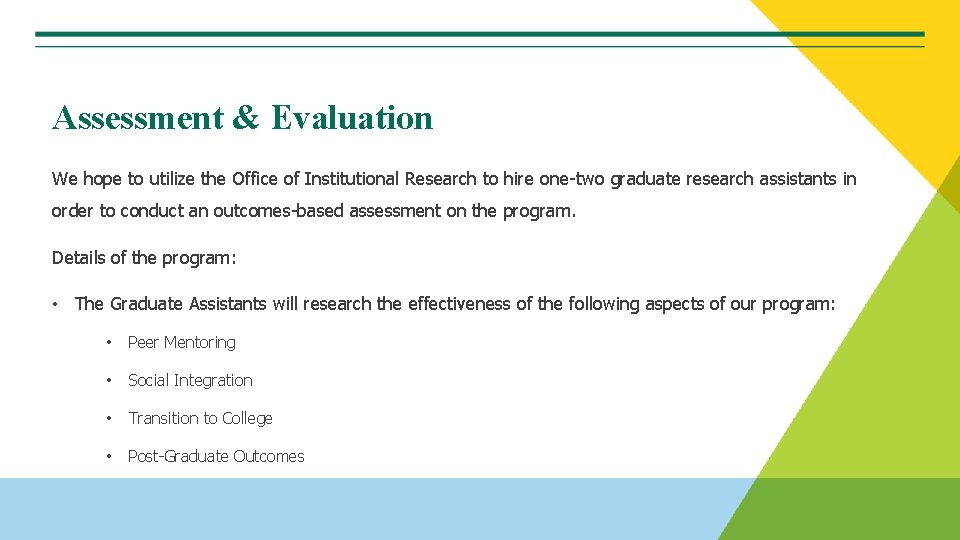
Assessment & Evaluation We hope to utilize the Office of Institutional Research to hire one-two graduate research assistants in order to conduct an outcomes-based assessment on the program. Details of the program: • The Graduate Assistants will research the effectiveness of the following aspects of our program: • Peer Mentoring • Social Integration • Transition to College • Post-Graduate Outcomes
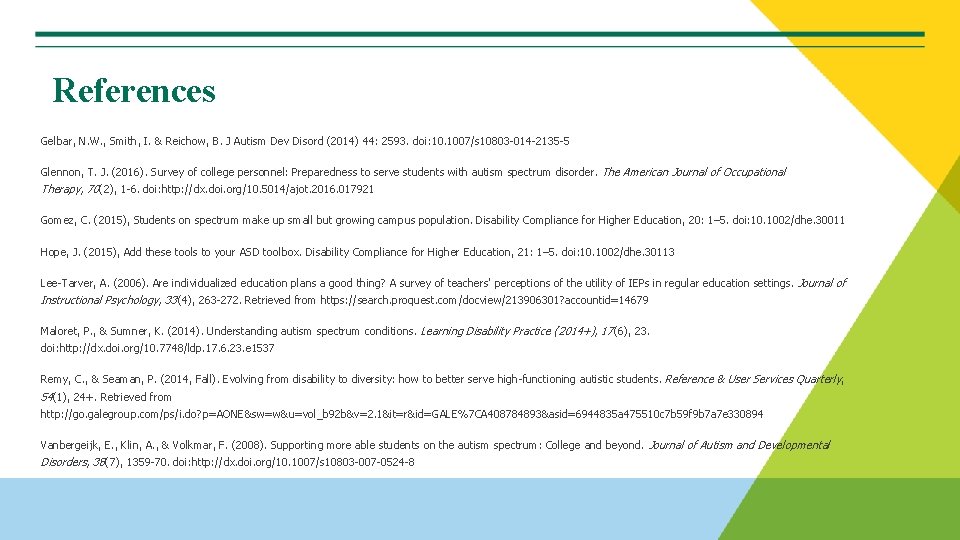
References Gelbar, N. W. , Smith, I. & Reichow, B. J Autism Dev Disord (2014) 44: 2593. doi: 10. 1007/s 10803 -014 -2135 -5 Glennon, T. J. (2016). Survey of college personnel: Preparedness to serve students with autism spectrum disorder. The American Journal of Occupational Therapy, 70(2), 1 -6. doi: http: //dx. doi. org/10. 5014/ajot. 2016. 017921 Gomez, C. (2015), Students on spectrum make up small but growing campus population. Disability Compliance for Higher Education, 20: 1– 5. doi: 10. 1002/dhe. 30011 Hope, J. (2015), Add these tools to your ASD toolbox. Disability Compliance for Higher Education, 21: 1– 5. doi: 10. 1002/dhe. 30113 Lee-Tarver, A. (2006). Are individualized education plans a good thing? A survey of teachers' perceptions of the utility of IEPs in regular education settings. Journal of Instructional Psychology, 33(4), 263 -272. Retrieved from https: //search. proquest. com/docview/213906301? accountid=14679 Maloret, P. , & Sumner, K. (2014). Understanding autism spectrum conditions. Learning Disability Practice (2014+), 17(6), 23. doi: http: //dx. doi. org/10. 7748/ldp. 17. 6. 23. e 1537 Remy, C. , & Seaman, P. (2014, Fall). Evolving from disability to diversity: how to better serve high-functioning autistic students. Reference & User Services Quarterly, 54(1), 24+. Retrieved from http: //go. galegroup. com/ps/i. do? p=AONE&sw=w&u=vol_b 92 b&v=2. 1&it=r&id=GALE%7 CA 408784893&asid=6944835 a 475510 c 7 b 59 f 9 b 7 a 7 e 330894 Vanbergeijk, E. , Klin, A. , & Volkmar, F. (2008). Supporting more able students on the autism spectrum: College and beyond. Journal of Autism and Developmental Disorders, 38(7), 1359 -70. doi: http: //dx. doi. org/10. 1007/s 10803 -007 -0524 -8