
An InterProfessional Education Delirium Simulation Pilot Project Heather
- Slides: 1
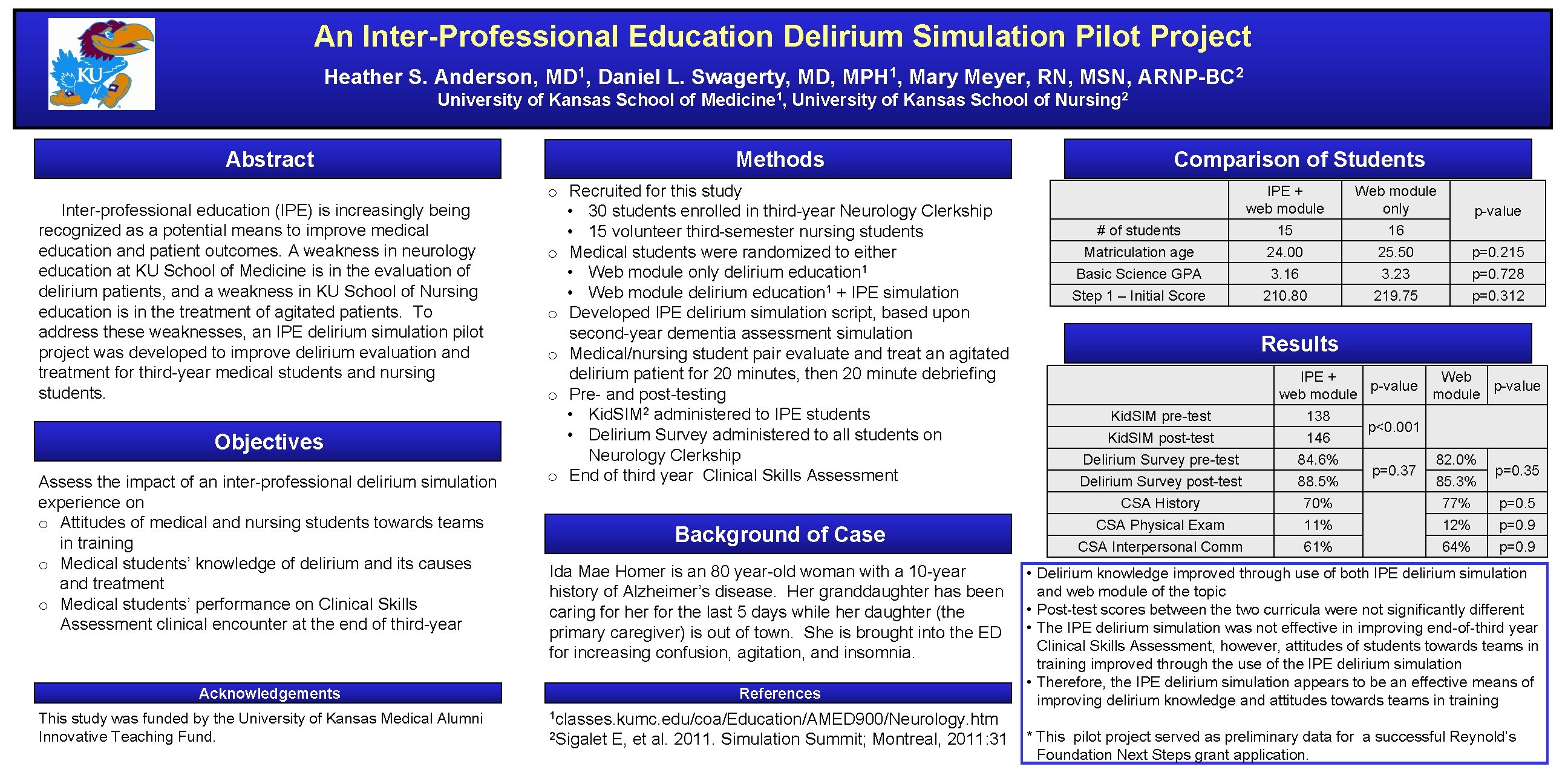
An Inter-Professional Education Delirium Simulation Pilot Project Heather S. Anderson, MD 1, Daniel L. Swagerty, MD, MPH 1, Mary Meyer, RN, MSN, ARNP-BC 2 University of Kansas School of Medicine 1, University of Kansas School of Nursing 2 Abstract Inter-professional education (IPE) is increasingly being recognized as a potential means to improve medical education and patient outcomes. A weakness in neurology education at KU School of Medicine is in the evaluation of delirium patients, and a weakness in KU School of Nursing education is in the treatment of agitated patients. To address these weaknesses, an IPE delirium simulation pilot project was developed to improve delirium evaluation and treatment for third-year medical students and nursing students. Objectives Assess the impact of an inter-professional delirium simulation experience on o Attitudes of medical and nursing students towards teams in training o Medical students’ knowledge of delirium and its causes and treatment o Medical students’ performance on Clinical Skills Assessment clinical encounter at the end of third-year Methods o Recruited for this study • 30 students enrolled in third-year Neurology Clerkship • 15 volunteer third-semester nursing students o Medical students were randomized to either • Web module only delirium education 1 • Web module delirium education 1 + IPE simulation o Developed IPE delirium simulation script, based upon second-year dementia assessment simulation o Medical/nursing student pair evaluate and treat an agitated delirium patient for 20 minutes, then 20 minute debriefing o Pre- and post-testing • Kid. SIM 2 administered to IPE students • Delirium Survey administered to all students on Neurology Clerkship o End of third year Clinical Skills Assessment Background of Case Ida Mae Homer is an 80 year-old woman with a 10 -year history of Alzheimer’s disease. Her granddaughter has been caring for her for the last 5 days while her daughter (the primary caregiver) is out of town. She is brought into the ED for increasing confusion, agitation, and insomnia. Acknowledgements This study was funded by the University of Kansas Medical Alumni Innovative Teaching Fund. References 1 classes. kumc. edu/coa/Education/AMED 900/Neurology. htm 2 Sigalet E, et al. 2011. Simulation Summit; Montreal, 2011: 31 Comparison of Students # of students Matriculation age Basic Science GPA Step 1 – Initial Score IPE + web module Web module only p-value 15 24. 00 3. 16 210. 80 16 25. 50 3. 23 219. 75 p=0. 215 p=0. 728 p=0. 312 Results IPE + Web p-value web module Kid. SIM pre-test 138 p<0. 001 Kid. SIM post-test 146 Delirium Survey pre-test 84. 6% 82. 0% p=0. 37 p=0. 35 Delirium Survey post-test 88. 5% 85. 3% Summary and Conclusions CSA History 70% 77% p=0. 5 CSA Physical Exam 11% 12% p=0. 9 CSA Interpersonal Comm 61% 64% p=0. 9 • Delirium knowledge improved through use of both IPE delirium simulation and web module of the topic • Post-test scores between the two curricula were not significantly different • The IPE delirium simulation was not effective in improving end-of-third year Clinical Skills Assessment, however, attitudes of students towards teams in training improved through the use of the IPE delirium simulation • Therefore, the IPE delirium simulation appears to be an effective means of improving delirium knowledge and attitudes towards teams in training * This pilot project served as preliminary data for a successful Reynold’s Foundation Next Steps grant application.