
An Intellectual Disability Supplement to The Irish Longitudinal
An Intellectual Disability Supplement to The Irish Longitudinal Study on Ageing Professor Mary Mc. Carron, Principal Investigator Head of School, School of Nursing & Midwifery, TCD
Celebration & Challenge of Ageing l A Success Story l How little we know about ageing l Promoting life long health l Maintaining independence l Postponing disability l Reorienting services
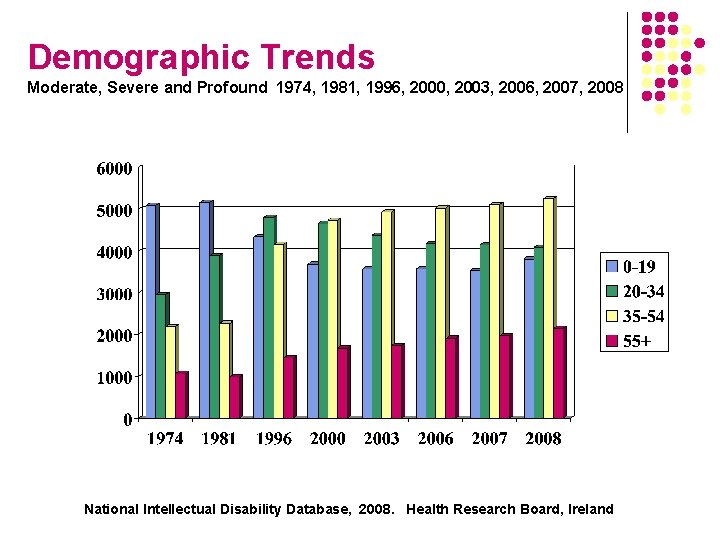
Demographic Trends Moderate, Severe and Profound 1974, 1981, 1996, 2000, 2003, 2006, 2007, 2008 National Intellectual Disability Database, 2008. Health Research Board, Ireland
National Research Position l No national research on ageing in people with intellectual disability in Ireland l Absence of people with ID in generic cross-sectional / longitudinal studies l Wealth of international research highlighting: - significant health inequalities compared to the general population (e. g. Cooper, Melville & Morrison, 2004) - higher levels of health needs than the general population (e. g. Wilson & Haire, 1990; Kapell et al, 1998) and these often go unrecognized and unmet (e. g. Lennox & Kerr, 1997) - longevity is also less compared to cohorts of persons with ID identified in the U. S. (66 yrs) and the UK (58 -74 years) (Bittles, 2002; Janicki, 1999)
Bridging the Gap - New National Opportunity Launch of TILDA study………. considerations: - Use of Geodirectory - there will be too few people with intellectual disability selected and followed as part of TILDA. - An important opportunity will be lost to understand the ageing of persons with ID, if a representative sample is not included. - Yet through the NIDD, Ireland is better placed than most other countries to select a representative sample of persons with ID.

An Intellectual Disability Supplement to The Irish Longitudinal Study on Ageing Key Milestones: l Securement of the ‘Intellectual Disability Supplement’ study to TILDA l Funding secured for pilot and part of Wave One (Health Research Board & Ph. D Stipend Funding, School of Nursing & Midwifery, TCD). CARDI grant secured to develop the framework to extend the study to Northern Ireland l First national study to include a representative sample of people with ID l First time people with ID will be represented in a longitudinal study on ageing in Europe and to the best of our knowledge, internationally Policy Context: l l l UN Convention on the Rights of Persons with Disabilities 2008 Graz Declaration on Ageing & Disability 2006 & Council of Europe Disability Action Plan 2006 -2015 Towards 2016 Ten-Year Framework Social Partnership Agreement 2006 -2015 National Disability Strategy & Equality legislation National Action Plan for Social Inclusion 2007 -2016 & National Development Plan for 2007 -2013 - Transforming Ireland Other relevant national policies (e. g. Quality & Fairness) and international agreements (e. g. Equalisation of Opportunities for People with Disabilities)
Overview of Study Design l Design: Longitudinal (10 Years) l Sample: Nationally representative sample of 800 people with intellectual disability (ID) using NIDD. Work is ongoing to extend the study to Northern Ireland l Inclusion criteria: Aged ≥ 40 years (no upper limit) and across all levels of ID l Data Collection Tools: Pre-Interview Questionnaire, Face-to-Face Interviews, Anthropometric Measurements, Carers Questionnaire and Data Linkage l Data Linkage: Close harmonisation with TILDA, HRS, ELSA, SHARE, SLAN etc. l National Collaborators: TILDA, NFVB, Inclusion Ireland, NIDD and HSE. l Development: An International Scientific Advisory Committee and national consultative workshops and focus groups with people with ID are guiding its development.
Objectives 1. To understand the health characteristics and status of persons with intellectual disability (ID) as they age. 2. To understand the key components and determinants of quality of life in ageing persons with ID and to compare such components with those found for the general population. 3. To examine the service needs and health service utilization of older persons with ID as compared to the general population.

Objectives 4. To identify disparities in the health status of older persons with intellectual disability (ID) as compared to findings yielded by TILDA for the general population. 5. To determine potential: - risk factors for ill health - facilitators of good health and longevity - biological and environmental components of successful ageing. 6. To identify the health and social needs of families and carers of older people with ID.
IDS to TILDA: A Critical Resource for Science and Policy in Ireland l Evidence based research on ageing in persons with intellectual disability (ID) in Ireland l Policy implications for health and social services l National and International comparative analyses with general and other ID population groups
Central Component: Active Involvement of People with Intellectual Disability l Produce research that is considered relevant and important by people with intellectual disability (ID) l Understand what ageing means to people with ID l Ensure that the study has a bigger and sustainable impact l Develop skills amongst people with ID l Challenge ageist and disability assumptions l Generate vital data to inform polices, programs and services
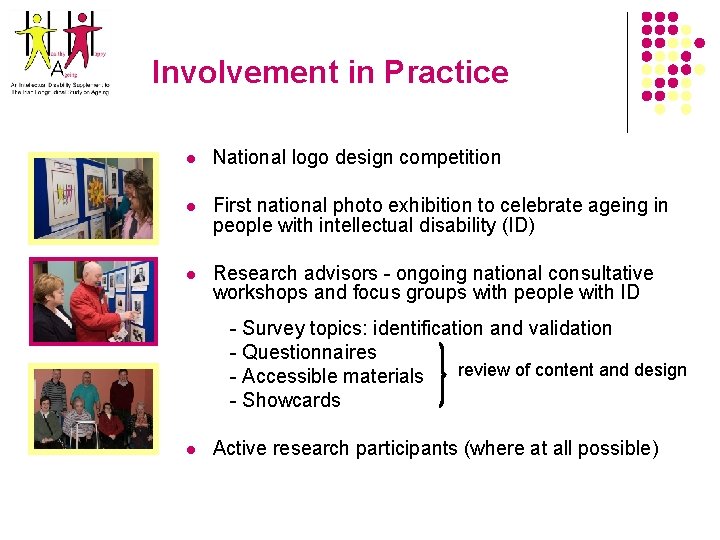
Involvement in Practice l National logo design competition l First national photo exhibition to celebrate ageing in people with intellectual disability (ID) l Research advisors - ongoing national consultative workshops and focus groups with people with ID - Survey topics: identification and validation - Questionnaires review of content and design - Accessible materials - Showcards l Active research participants (where at all possible)
Intellectual Disability Supplement to TILDA Milestones Sep 2006 Start project Dec 2008 Official launch Oct 2009 Complete pilot Nov 2009 Start Wave 1 July 2010 Clean complete file Wave 1 2010/11 Analysis Wave 1 Oct 2011 Start Wave 2 July 2012 Clean complete linked Wave 2 file 2012/13 Analysis Waves 2/1 Oct 2013 Start Wave 3 July 2014 Clean complete linked Wave 3 file 2014/15 Analysis Waves 3/2/1 Oct 2015 Start Wave 4 July 2016 Clean complete linked Wave 4 file 2016 Analysis Waves 4/3/2/1 2016 Completion of 10 year period Dec
Pilot Study Preparatory Fieldwork Phase (Sites & Sample) l l l l 3 Service Providers Selected: Western Care Association, Daughters of Charity and Aras Attracta. HRB selected a random sample of people aged ≥ 40 years from the NIDD Ethical approval was sought and granted from all three services Letters of support were sought and received from each service Information packs were prepared and placed in blank envelopes Disability Database Unit released the PINs to Regional Disability Database Managers (RDDM) RDDM extracted the names and addresses of the people selected and sent the information packs to those selected using the sealed and stamped envelopes provided Data Collection Phase l l l Commenced in June 2009 and is nearing completion Response rate 46%* (74 participants) Feedback has been very positive from participants, families, carers, staff and services. Analysis and write-up will commence on the 8 th October 2009 Minor changes will be made to the research tools to better prepare for Wave One Pilot report will be launched on the 3 rd December 2009
Key Issues and Challenges Ahead l Increasing visibility and awareness of the study locally and nationally l Overcoming logistical challenges: - Wide geographic spread of the national random sample - Applying for ethical approval in each service selected - Misplacement of information packs (key learning from pilot) - Consent process and use of agreement forms, where required l Maintaining buy in from people with intellectual disability, families, carers, support staff and service providers over the next ten years. l Secure funding to ensure roll-out and sustainability
Key Expected Benefits l Raise awareness of ageing issues for people with intellectual disability (ID) l Create new knowledge on factors that affect health and ageing l Identify and understand trends in ageing in people with ID l Identify ways to prevent disease and disability, and promote healthy ageing and improved services and supports to this population group l Develop informed policies, programs and services; and improved advocacy l Recognition of Ireland’s position as a leader in cutting edge longitudinal ageing research in persons with ID, and its potential to undertake comparative analyses with general and other ID population groups
Together let’s work towards making Ireland the best place to grow older. Intellectual Disability Supplement to TILDA The University of Dublin, Trinity College, School of Nursing & Midwifery, 24 D’Olier Street, Dublin 2 Tel: 01 -896 3186/3187 Email: idstotilda@tcd. ie
- Slides: 17