
An Integrated Approach to Observations of Preearthquake Signals
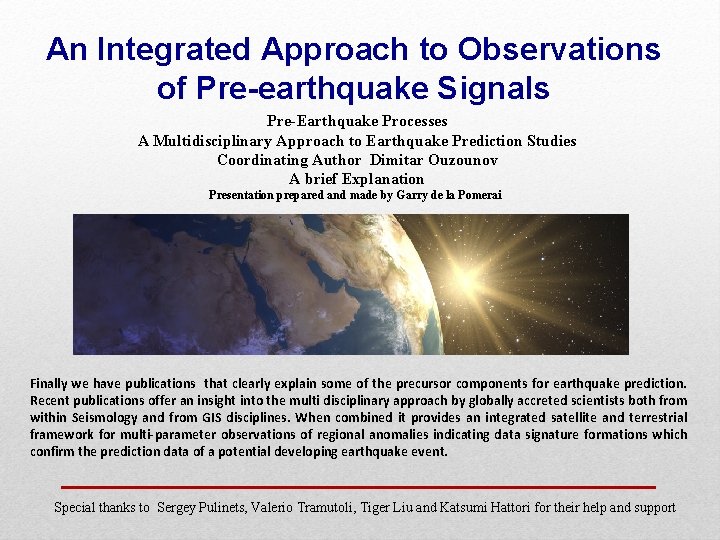
An Integrated Approach to Observations of Pre-earthquake Signals Pre-Earthquake Processes A Multidisciplinary Approach to Earthquake Prediction Studies Coordinating Author Dimitar Ouzounov A brief Explanation Presentation prepared and made by Garry de la Pomerai Finally we have publications that clearly explain some of the precursor components for earthquake prediction. Recent publications offer an insight into the multi disciplinary approach by globally accreted scientists both from within Seismology and from GIS disciplines. When combined it provides an integrated satellite and terrestrial framework for multi-parameter observations of regional anomalies indicating data signature formations which confirm the prediction data of a potential developing earthquake event. Special thanks to Sergey Pulinets, Valerio Tramutoli, Tiger Liu and Katsumi Hattori for their help and support
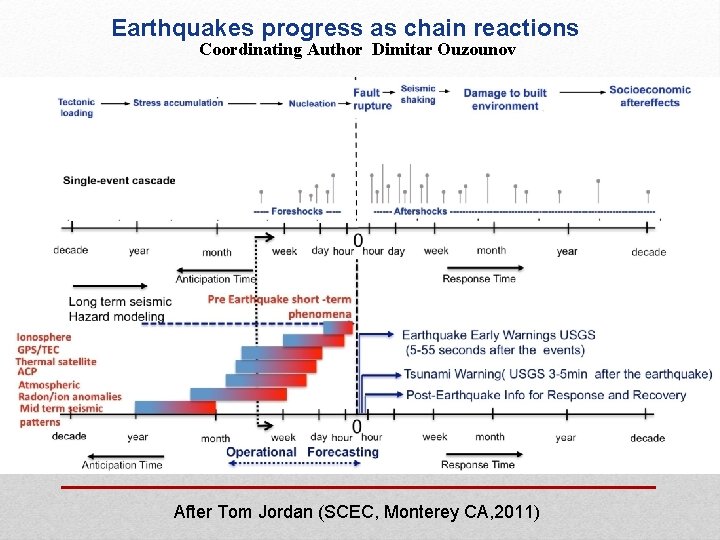
Earthquakes progress as chain reactions Coordinating Author Dimitar Ouzounov After Tom Jordan (SCEC, Monterey CA, 2011)
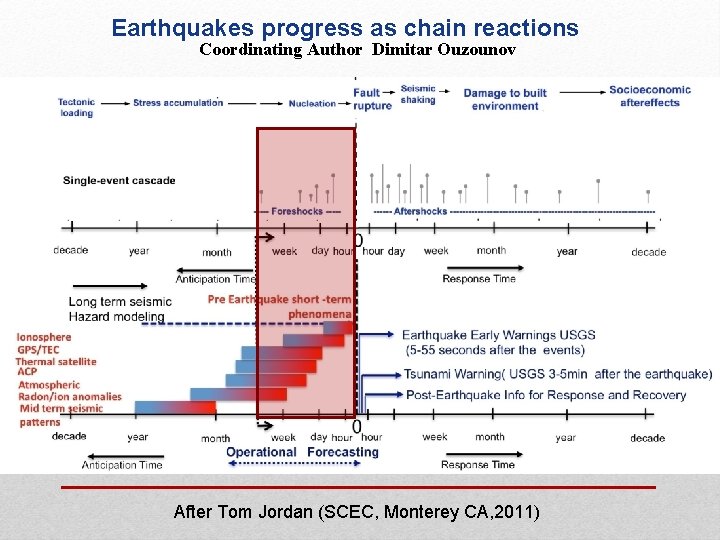
Earthquakes progress as chain reactions Coordinating Author Dimitar Ouzounov After Tom Jordan (SCEC, Monterey CA, 2011)
What is happening before large Earthquakes?
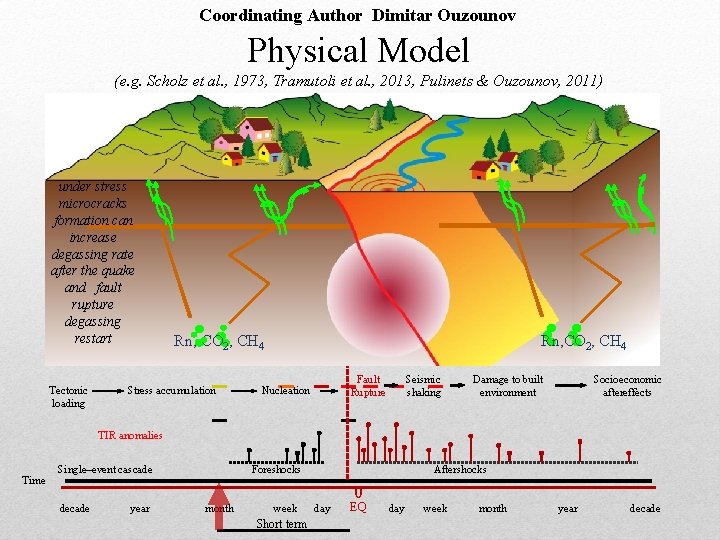
Coordinating Author Dimitar Ouzounov Physical Model (e. g. Scholz et al. , 1973, Tramutoli et al. , 2013, Pulinets & Ouzounov, 2011) under stress microcracks formation can increase degassing rate after the quake and fault rupture degassing restart Tectonic loading Rn, CO 2, CH 4 Stress accumulation Rn, CO 2, CH 4 Fault Rupture Nucleation Seismic shaking Damage to built environment Socioeconomic aftereffects TIR anomalies Time Single–event cascade Foreshocks Aftershocks 0 decade year month week Short term day EQ day week month year decade
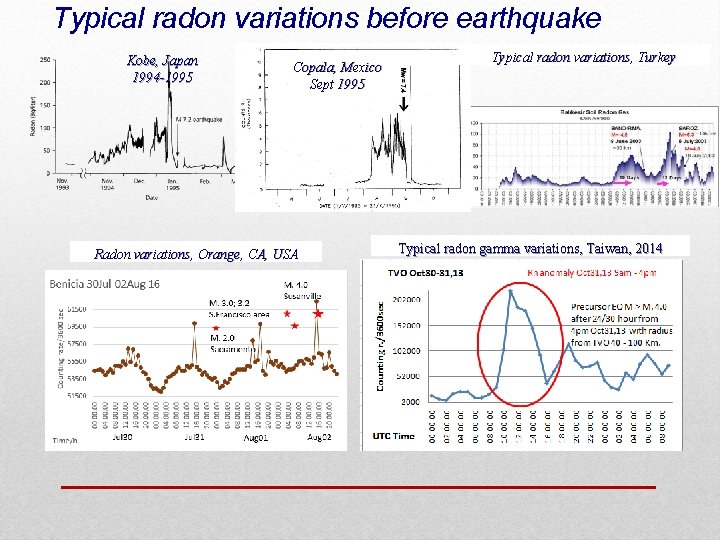
Typical radon variations before earthquake Kobe, Japan 1994 -1995 Copala, Mexico Sept 1995 Radon variations, Orange, CA, USA Typical radon variations, Turkey Typical radon gamma variations, Taiwan, 2014

Observations of pre-earthquake atmospheric signals Typical radon variations Kobe, Japan 1994 -1995 Copala, Mexico Sept 1995 Typical Thermal Anomalies M 7. 9 Gujarat 2011 India NOAA/AVHRR Saraf et al (2003) MODIS/LST] Ouzounov(2004) NOAA/AVHRR Genzano et al (2005) Typical seismo –ionospheric anomalies Good Friday Alaska 27 March 1964, M 9. 2 Wenchuan, China 12 May 2008 Tohoku, Japan 2011
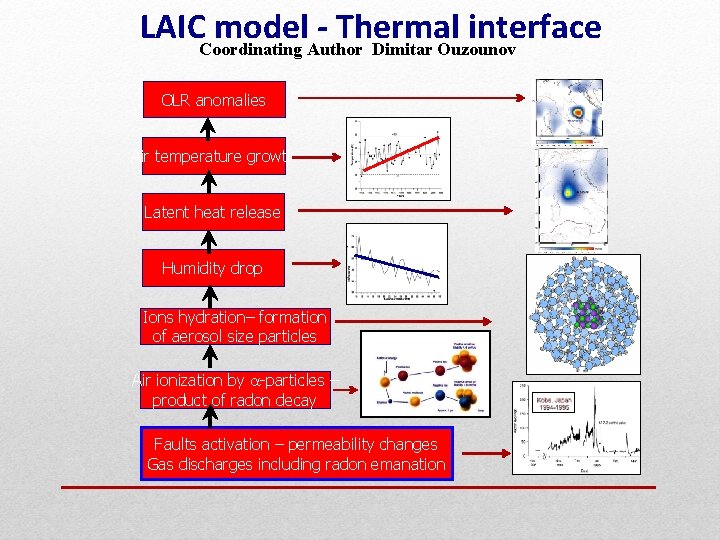
LAICCoordinating model. Author - Thermal interface Dimitar Ouzounov OLR anomalies Air temperature growth Latent heat release Humidity drop Ions hydration– formation of aerosol size particles Air ionization by -particles – product of radon decay Faults activation – permeability changes Gas discharges including radon emanation
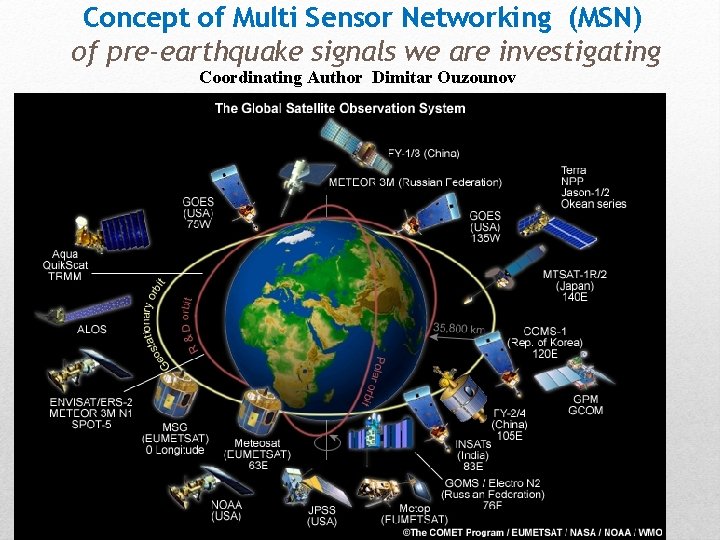
Concept of Multi Sensor Networking (MSN) of pre-earthquake signals we are investigating Coordinating Author Dimitar Ouzounov
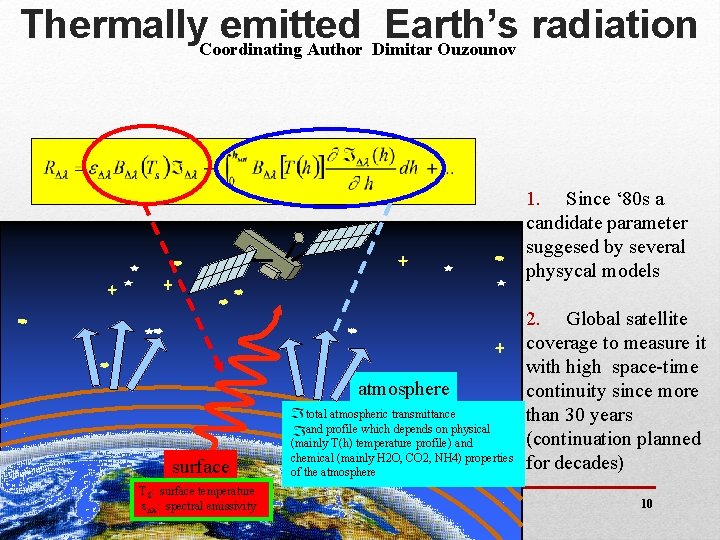
Thermally. Coordinating emitted Earth’s radiation Author Dimitar Ouzounov 1. Since ‘ 80 s a candidate parameter suggesed by several physycal models atmosphere total atmospheric transmittance and profile which depends on physical (mainly T(h) temperature profile) and chemical (mainly H 2 O, CO 2, NH 4) properties of the atmosphere surface TS: surface temperature emissivity Dl valerio. tramutoli@unibas. it e : spectral valerio. tramutoli@unibas. it 2. Global satellite coverage to measure it with high space-time continuity since more than 30 years (continuation planned for decades) 10
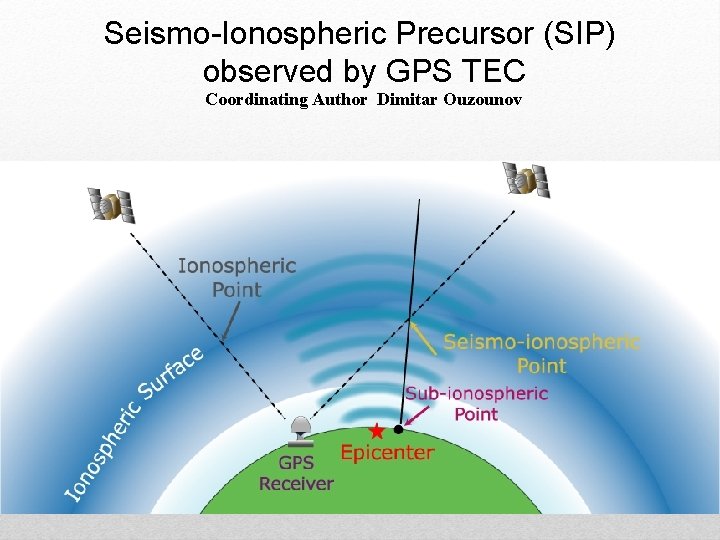
Seismo-Ionospheric Precursor (SIP) observed by GPS TEC Coordinating Author Dimitar Ouzounov
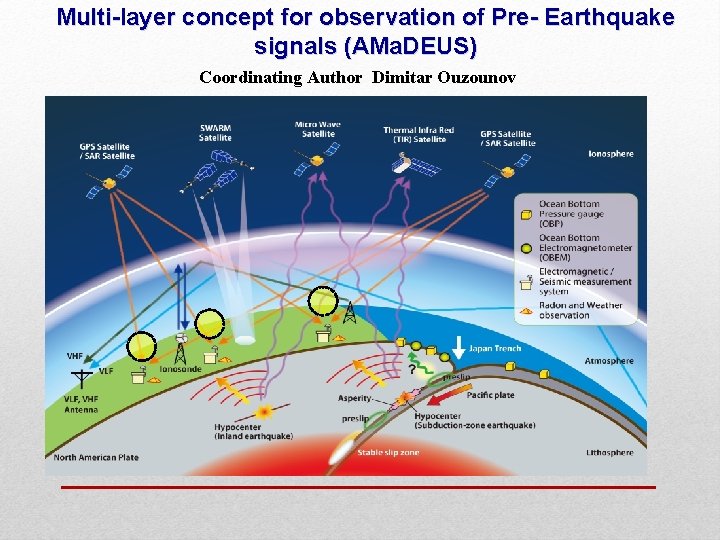
Multi-layer concept for observation of Pre- Earthquake signals (AMa. DEUS) Coordinating Author Dimitar Ouzounov
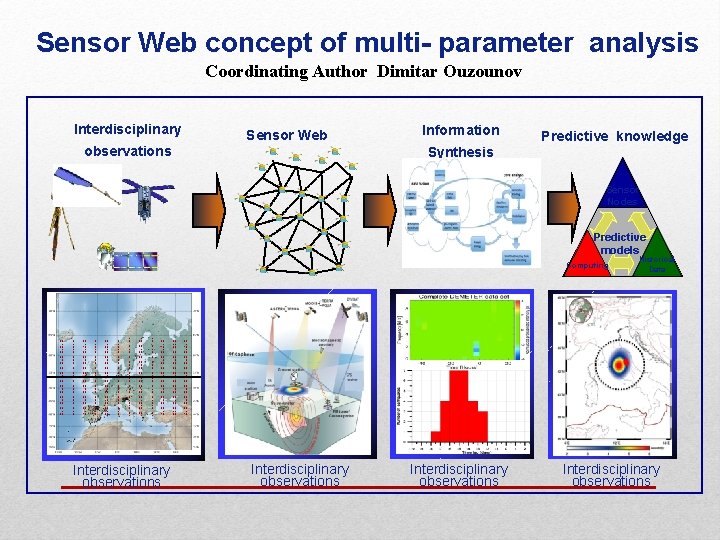
Sensor Web concept of multi- parameter analysis Coordinating Author Dimitar Ouzounov Interdisciplinary Sensor Web observations Information Synthesis Predictive knowledge Sensor Nodes Predictive models Computing Interdisciplinary observations Historical Data Interdisciplinary observations
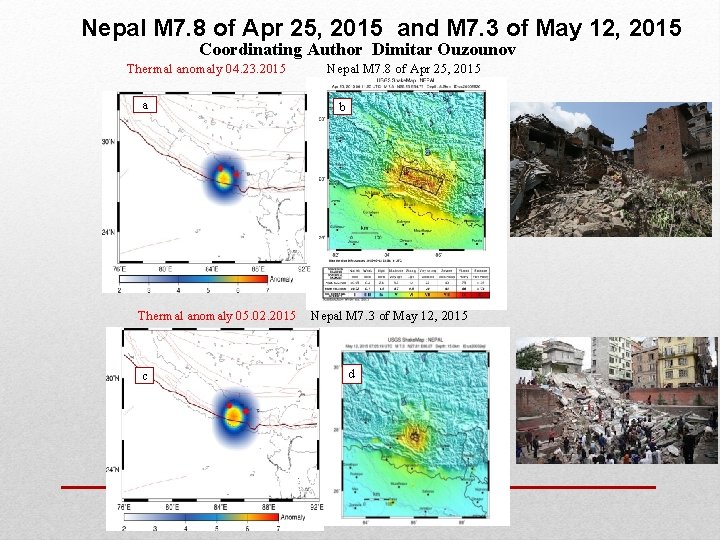
Nepal M 7. 8 of Apr 25, 2015 and M 7. 3 of May 12, 2015 Coordinating Author Dimitar Ouzounov Thermal anomaly 04. 23. 2015 a Thermal anomaly 05. 02. 2015 c Nepal M 7. 8 of Apr 25, 2015 b Nepal M 7. 3 of May 12, 2015 d
More, you can find here… Coordinating Author Dimitar Ouzounov
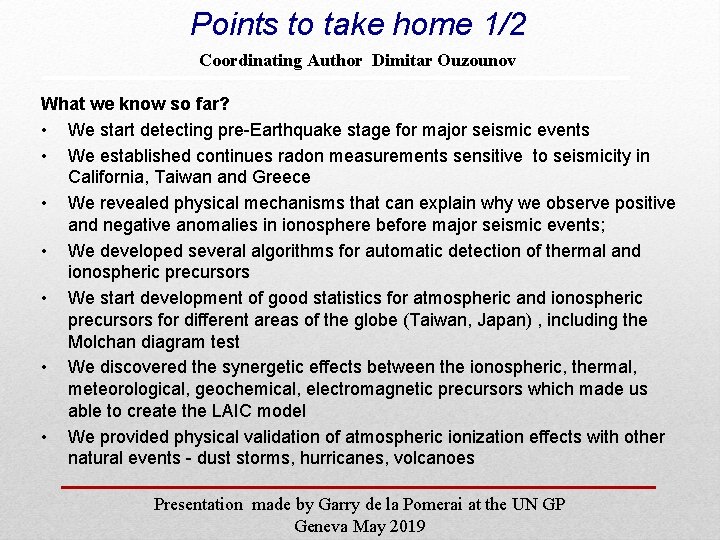
Points to take home 1/2 Coordinating Author Dimitar Ouzounov What we know so far? • We start detecting pre-Earthquake stage for major seismic events • We established continues radon measurements sensitive to seismicity in California, Taiwan and Greece • We revealed physical mechanisms that can explain why we observe positive and negative anomalies in ionosphere before major seismic events; • We developed several algorithms for automatic detection of thermal and ionospheric precursors • We start development of good statistics for atmospheric and ionospheric precursors for different areas of the globe (Taiwan, Japan) , including the Molchan diagram test • We discovered the synergetic effects between the ionospheric, thermal, meteorological, geochemical, electromagnetic precursors which made us able to create the LAIC model • We provided physical validation of atmospheric ionization effects with other natural events - dust storms, hurricanes, volcanoes Presentation made by Garry de la Pomerai at the UN GP Geneva May 2019
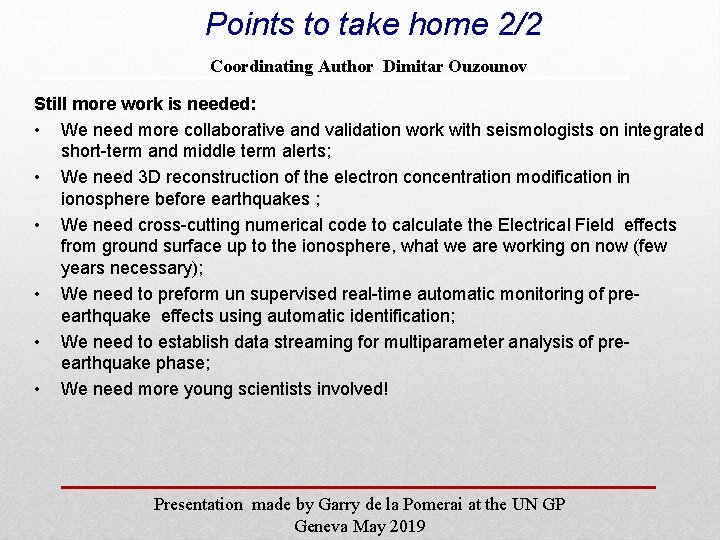
Points to take home 2/2 Coordinating Author Dimitar Ouzounov Still more work is needed: • We need more collaborative and validation work with seismologists on integrated short-term and middle term alerts; • We need 3 D reconstruction of the electron concentration modification in ionosphere before earthquakes ; • We need cross-cutting numerical code to calculate the Electrical Field effects from ground surface up to the ionosphere, what we are working on now (few years necessary); • We need to preform un supervised real-time automatic monitoring of preearthquake effects using automatic identification; • We need to establish data streaming for multiparameter analysis of preearthquake phase; • We need more young scientists involved! Presentation made by Garry de la Pomerai at the UN GP Geneva May 2019
These publications clearly combat theory that seismic events cannot be predicted. In fact 20 chapters of extended abstracts suggests the possibility that the multi disciplinary holistic approach of precursor observations potentially offers us an advancement of early warning, with the physical earthquake rupture being the final occurrence along the time line of the overall seismic event. What makes recent publications really pioneering in comparison with others is that holistic approach, trying to present and bring together the research from many different fields of science: geophysics, seismology, atmospheric science, geochemistry , satellites and space science Despite that these publications are only a snapshot of the ongoing research and not all leading scientists in the wider team have yet published , credit must be recognised for the unique source of information and citied literature of the papers so far for the editors and the authors. During the Ignite presentation we shall briefly touch on Key components of the multi disciplinary approach and explain how when combined these potentially will provide DRR with a significant tool in preparedness for larger earthquakes days and potentially weeks in advance. Topics will include a review of the historical and recent progress; types of observations including Geochemical and Electromagnetic Observations; Atmospheric/ Thermal Signals; Ionosphere Processes; the combined Interdisciplinary approach to Earthquake Predictions In summary this presentation offers an insight with many examples of cross-cutting science, into the significant advancement of understanding tectonic activities which generate the precursor anomalies and signatures of larger pending seismic events. Whilst further research and algorithms are established, this set of research papers referred to in this presentation undeniably opens serious discussion that seismic prediction is already feasible. The paradigm of disaster prevention could be very much advanced by this knowledge. Presentation made by Garry de la Pomerai at the UN GP Geneva May 2019
Describe why this presentation would be relevant for participants at the Global Platform There a variety of delegates at the GP 2019 , who will potentially benefit by having the recent advances in seismic forecasting explained. • Researchers in the cross-fields of earthquake predictabilities. The presentation provides the historical progress of the past 40 years of observation and research of pre-earthquake phenomena. The interdisciplinary approach provide understanding of the cohesion within the technology development. • Graduate students and educators within Academia. Most of the described observations and science methods cannot be found in the traditional college text books. For educators this research has a great reference value exploring cross- disciplinary education, which is a subliminal value of this project, offering inspirational research and periphery studies of resilience and sustainability in the urbanisation of society. • For Disaster Risk Reduction (DRR) and Natural Geo Hazards specialists. The knowledge and insight provided within the referenced 20 papers is of great value for understanding the pre- earthquake rupture processes, as a potential path toward advancing earthquake early warning via reliable prediction prior to rupture. This research is the first of its kind to assemble and collate the components of a multi disciplinary approach to seismic prediction which supports the suggestion that it could became feasible in the near future. • Private industry will find this useful and essential to assist develop strategy for operating within high seismic risk environments, presently either not considered viable or classed fatalistic with only the present seconds of early warning within existing early warning alarm systems; • For Response and Resilience sectors for widening the development of auto technologies that protect critical infrastructure and physical preparedness that reduces response times within society potentially in advance of destructive shake events. Presentation made by Garry de la Pomerai at the UN GP Geneva May 2019
What is innovative about this presentation? This project research is innovative collating many examples of cross-cutting Geo, GIS and Terrestrial science, generating significant pioneering advancement of understanding tectonic activities which identify the precursor anomalies and signatures of larger pending seismic events. Whilst further research and algorithms are established, this pioneering set of research papers referred to in this presentation undeniably opens serious discussion that seismic prediction is already feasible. The publications clearly explain some of the precursor components for earthquake prediction and offer an insight into the multi disciplinary approach by globally accreted scientists both from within Seismology and from GIS disciplines. When combined it provides an pioneering integrated satellite and terrestrial framework for multi-parameter observations of regional anomalies indicating data signature formations which confirm the prediction data of a potential developing earthquake event. This innovative research now combats theory that seismic events cannot be predicted. In fact 20 chapters of extended abstracts suggests the possibility that the multi disciplinary holistic approach of precursor observations potentially offers us an advancement of early warning, with the physical earthquake rupture being the final occurrence along the time line of the overall seismic event. The paradigm of disaster prevention could be very much advanced by this knowledge. What makes recent publications really pioneering in comparison with others is the holistic approach, trying to present and bring together the research from many different fields of science: geophysics, seismology, atmospheric science, geochemistry , satellites and space science Presentation made by Garry de la Pomerai at the UN GP Geneva May 2019
Presentation made by Garry de la Pomerai at the UN GP Geneva May 2019 https: //www. unisdr. org/conference/2019/global platform/programme/ignitestage/view? id=1064 • https: //youtu. be/TIehd. Oa. Q 72 E Coordinating Author Dimitar Ouzounov Special thanks to Sergey Pulinets, Valerio Tramutoli, Tiger Liu and Katsumi Hattori for their help and support
- Slides: 21