
An Inspector Calls Specimen Question and student exemplars




- Slides: 37
“An Inspector Calls” Specimen Question and student exemplars
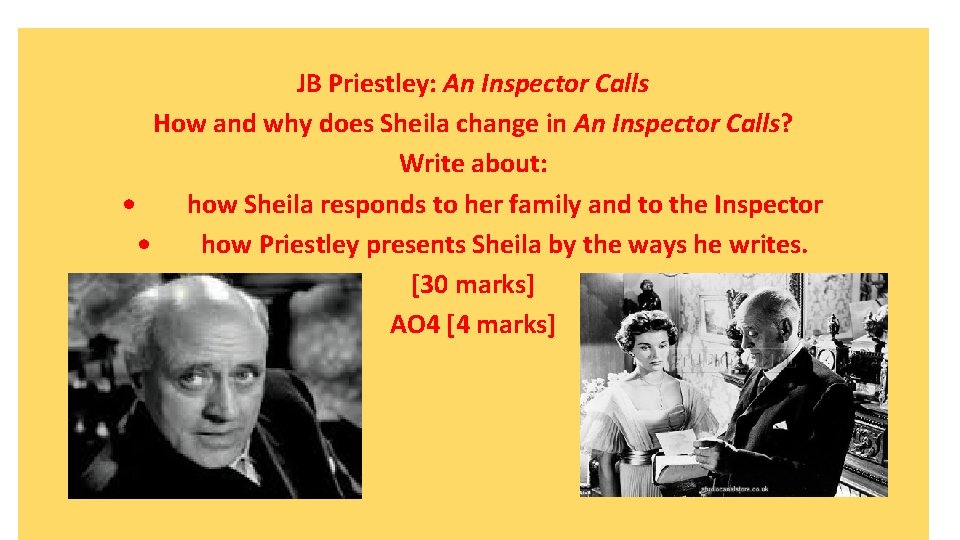
JB Priestley: An Inspector Calls How and why does Sheila change in An Inspector Calls? Write about: • how Sheila responds to her family and to the Inspector • how Priestley presents Sheila by the ways he writes. [30 marks] AO 4 [4 marks]
How is AO 4 assessed ? AO 4 - Performance descriptor Marks awarded High performance: In the context of the level of demand of the question, learners spell and punctuate with consistent accuracy, and consistently use vocabulary and sentence structures to achieve effective control of meaning. 4 marks Intermediate performance: In the context of the level of demand of the question, learners spell and punctuate with considerable accuracy, and use a considerable range of vocabulary and sentence structures to achieve general control of meaning. 2– 3 marks Threshold performance: In the context of the level of demand of the question, learners spell and punctuate with reasonable accuracy, and use a reasonable range of vocabulary and sentence structures; any errors do not hinder meaning in the response. 1 mark
Now then, what about those pesky mark schemes, eh, dear boy?
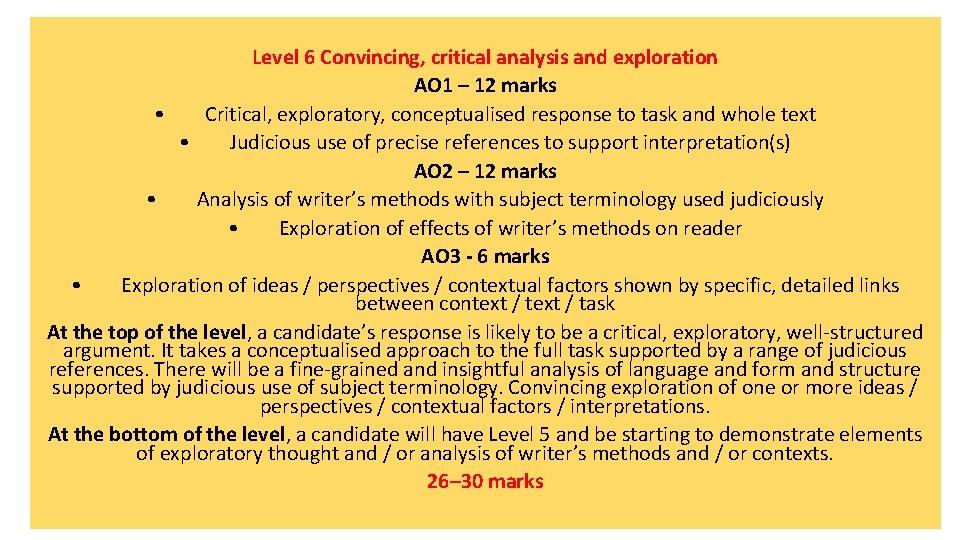
Level 6 Convincing, critical analysis and exploration AO 1 – 12 marks • Critical, exploratory, conceptualised response to task and whole text • Judicious use of precise references to support interpretation(s) AO 2 – 12 marks • Analysis of writer’s methods with subject terminology used judiciously • Exploration of effects of writer’s methods on reader AO 3 - 6 marks • Exploration of ideas / perspectives / contextual factors shown by specific, detailed links between context / task At the top of the level, a candidate’s response is likely to be a critical, exploratory, well-structured argument. It takes a conceptualised approach to the full task supported by a range of judicious references. There will be a fine-grained and insightful analysis of language and form and structure supported by judicious use of subject terminology. Convincing exploration of one or more ideas / perspectives / contextual factors / interpretations. At the bottom of the level, a candidate will have Level 5 and be starting to demonstrate elements of exploratory thought and / or analysis of writer’s methods and / or contexts. 26– 30 marks
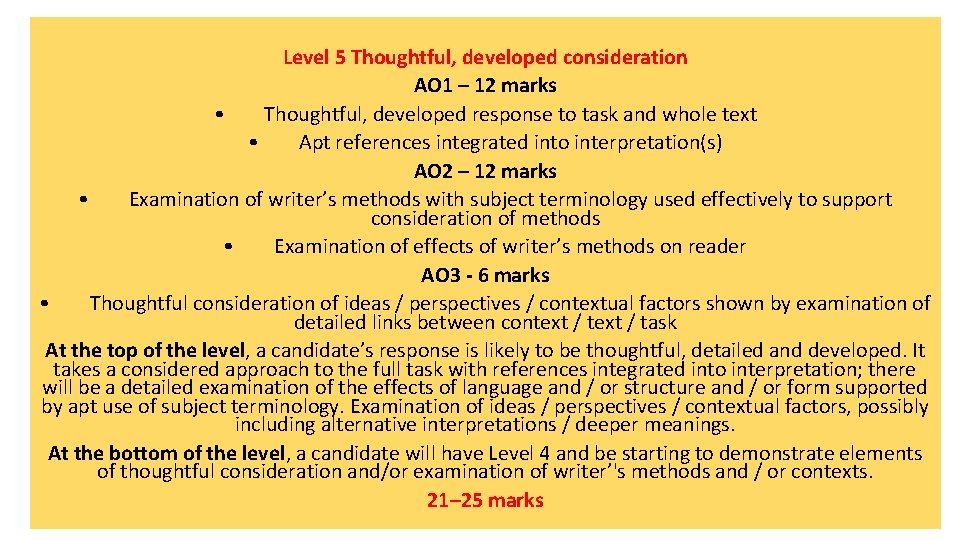
Level 5 Thoughtful, developed consideration AO 1 – 12 marks • Thoughtful, developed response to task and whole text • Apt references integrated into interpretation(s) AO 2 – 12 marks • Examination of writer’s methods with subject terminology used effectively to support consideration of methods • Examination of effects of writer’s methods on reader AO 3 - 6 marks • Thoughtful consideration of ideas / perspectives / contextual factors shown by examination of detailed links between context / task At the top of the level, a candidate’s response is likely to be thoughtful, detailed and developed. It takes a considered approach to the full task with references integrated into interpretation; there will be a detailed examination of the effects of language and / or structure and / or form supported by apt use of subject terminology. Examination of ideas / perspectives / contextual factors, possibly including alternative interpretations / deeper meanings. At the bottom of the level, a candidate will have Level 4 and be starting to demonstrate elements of thoughtful consideration and/or examination of writer’'s methods and / or contexts. 21– 25 marks
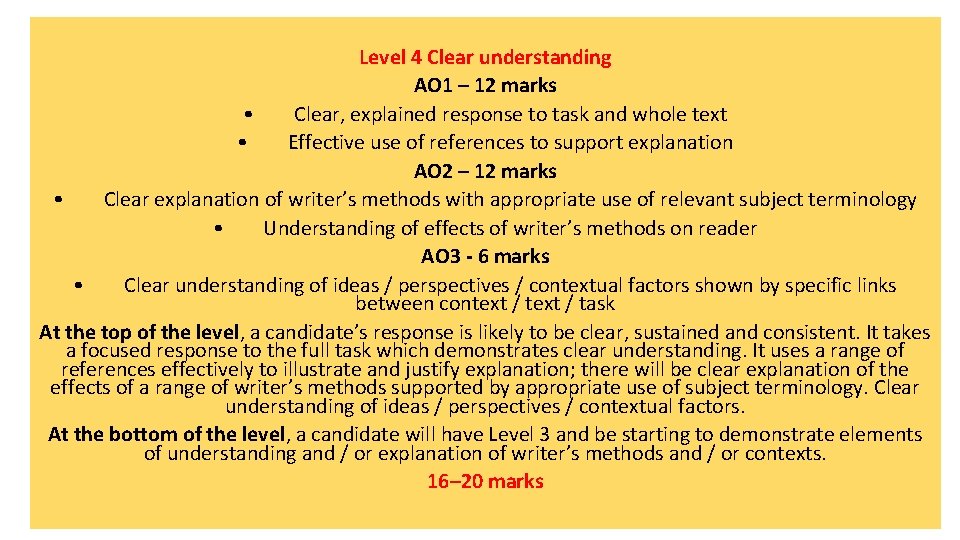
Level 4 Clear understanding AO 1 – 12 marks • Clear, explained response to task and whole text • Effective use of references to support explanation AO 2 – 12 marks • Clear explanation of writer’s methods with appropriate use of relevant subject terminology • Understanding of effects of writer’s methods on reader AO 3 - 6 marks • Clear understanding of ideas / perspectives / contextual factors shown by specific links between context / task At the top of the level, a candidate’s response is likely to be clear, sustained and consistent. It takes a focused response to the full task which demonstrates clear understanding. It uses a range of references effectively to illustrate and justify explanation; there will be clear explanation of the effects of a range of writer’s methods supported by appropriate use of subject terminology. Clear understanding of ideas / perspectives / contextual factors. At the bottom of the level, a candidate will have Level 3 and be starting to demonstrate elements of understanding and / or explanation of writer’s methods and / or contexts. 16– 20 marks
Well they ARE dull, but they are necessary, dear boy. Now, let’s get to the first chappy…
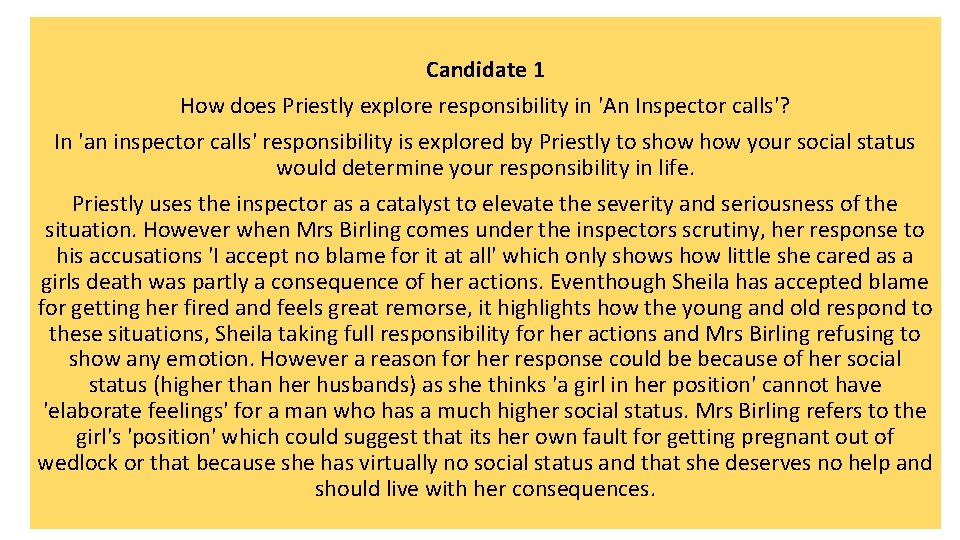
Candidate 1 How does Priestly explore responsibility in 'An Inspector calls'? In 'an inspector calls' responsibility is explored by Priestly to show your social status would determine your responsibility in life. Priestly uses the inspector as a catalyst to elevate the severity and seriousness of the situation. However when Mrs Birling comes under the inspectors scrutiny, her response to his accusations 'I accept no blame for it at all' which only shows how little she cared as a girls death was partly a consequence of her actions. Eventhough Sheila has accepted blame for getting her fired and feels great remorse, it highlights how the young and old respond to these situations, Sheila taking full responsibility for her actions and Mrs Birling refusing to show any emotion. However a reason for her response could be because of her social status (higher than her husbands) as she thinks 'a girl in her position' cannot have 'elaborate feelings' for a man who has a much higher social status. Mrs Birling refers to the girl's 'position' which could suggest that its her own fault for getting pregnant out of wedlock or that because she has virtually no social status and that she deserves no help and should live with her consequences.
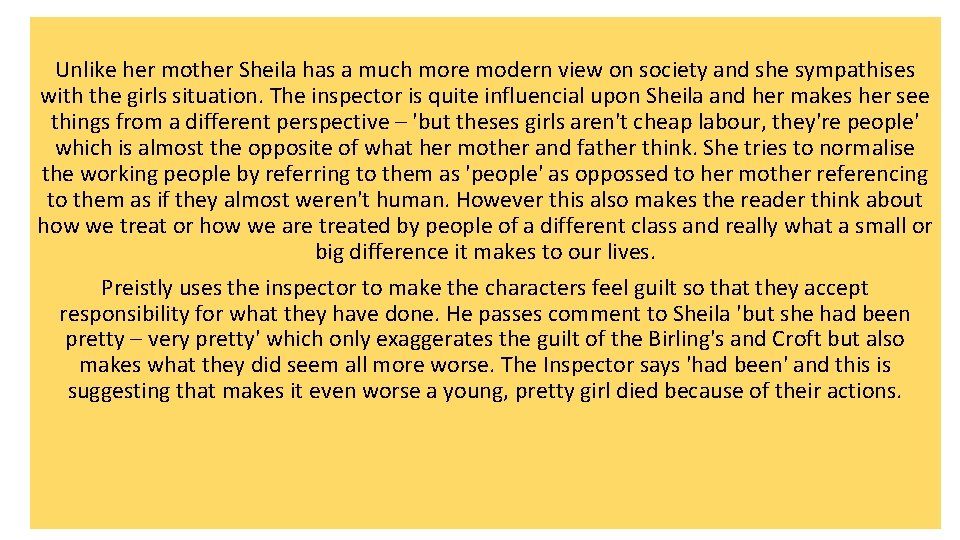
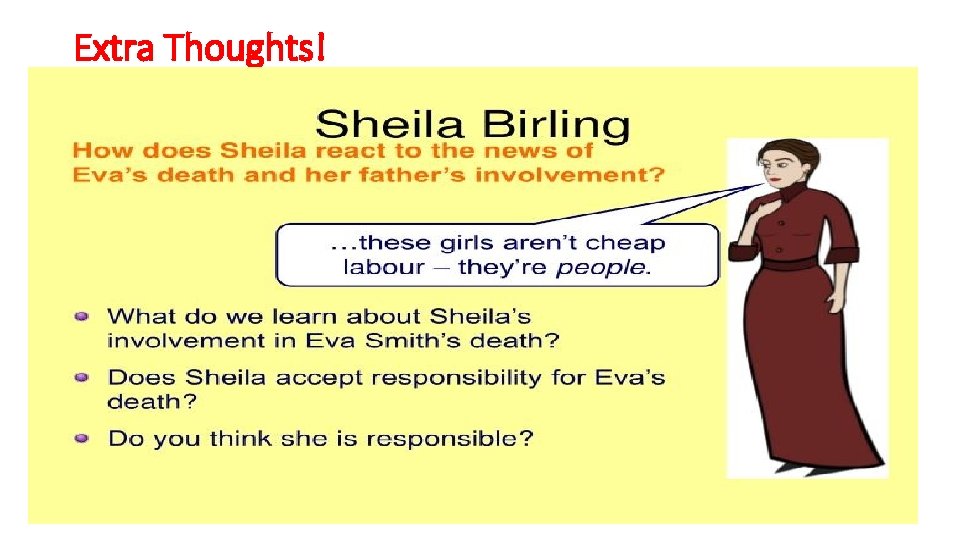
Unlike her mother Sheila has a much more modern view on society and she sympathises with the girls situation. The inspector is quite influencial upon Sheila and her makes her see things from a different perspective – 'but theses girls aren't cheap labour, they're people' which is almost the opposite of what her mother and father think. She tries to normalise the working people by referring to them as 'people' as oppossed to her mother referencing to them as if they almost weren't human. However this also makes the reader think about how we treat or how we are treated by people of a different class and really what a small or big difference it makes to our lives. Preistly uses the inspector to make the characters feel guilt so that they accept responsibility for what they have done. He passes comment to Sheila 'but she had been pretty – very pretty' which only exaggerates the guilt of the Birling's and Croft but also makes what they did seem all more worse. The Inspector says 'had been' and this is suggesting that makes it even worse a young, pretty girl died because of their actions.
What score would you give that one, dear boy?
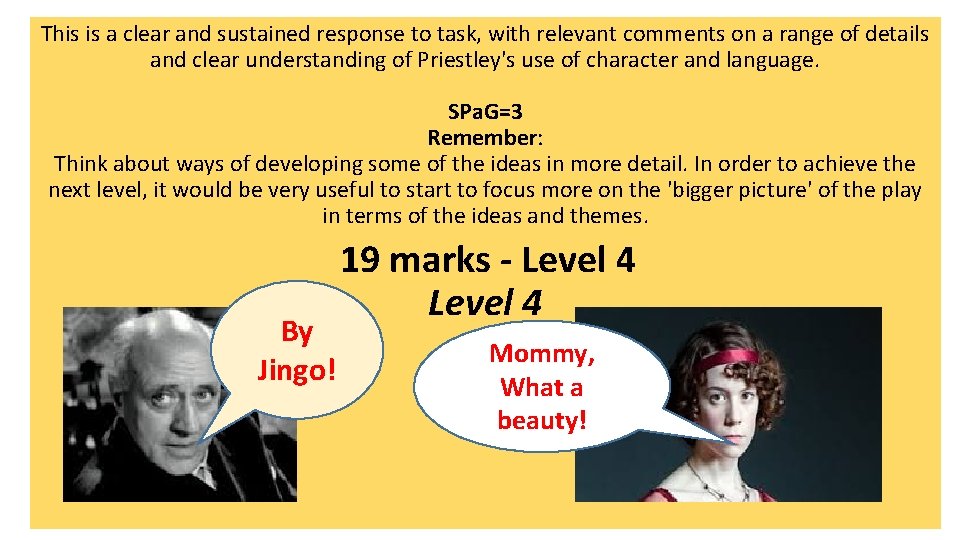
This is a clear and sustained response to task, with relevant comments on a range of details and clear understanding of Priestley's use of character and language. SPa. G=3 Remember: Think about ways of developing some of the ideas in more detail. In order to achieve the next level, it would be very useful to start to focus more on the 'bigger picture' of the play in terms of the ideas and themes. By Jingo! 19 marks - Level 4 Mommy, What a beauty!
I can think of THREE ways to make that better, dear boy. The Question is this: Can you? Remember this: There are millions and millions of John Smiths and Eva Smiths taking this exam………………how can you stand out?
Candidate 2 An Inspector Calls How and why does Sheila change in 'An inspector calls'? Sheila changes in the play from being child-like into the most assertive character of them all. Sheila responds to her mother by using the lexis 'mummy'. This could suggest that Priestly is presenting her as young, vunerable and innocent. When Sheila is initally introduced to the inspector she claims that 'mummy sent me in'. This could portray that her character looks up to her mother as she will obey and respect her. However as the play procresses Sheila is presented as being the only character who understands what the inspector is implying. and beggs her mother to 'stop!'. Here Preistly conveys Sheila as having a sharp and quick thinking mind which hints that her character has become aware of the situation and knows the circumstances. Sheila is demanding her mother to 'stop!' which depicts her character as being protective as she knows what is about to happen. Preistly also presents her as being mature as she changes from using the word 'mummy' to 'mother'. Sheila at first didn't believe she was responsible, 'so I'm really responsible'. This could suggest she is self-obsessed and couldn't believe that she could do anything wrong. As the play goes on Sheila excepts that she is partly responsible 'if I could help her now I would'. This hints that she feels guilty.
What score would you give that one, dear boy?
Level 2 overall. Level 2 9 marks By Jingo! Mommy, What a beauty!
I can think of THREE ways to make that better, dear boy. The Question is this: Can you? Remember this: There are millions and millions of John Smiths and Eva Smiths taking this exam………………how can you stand out?
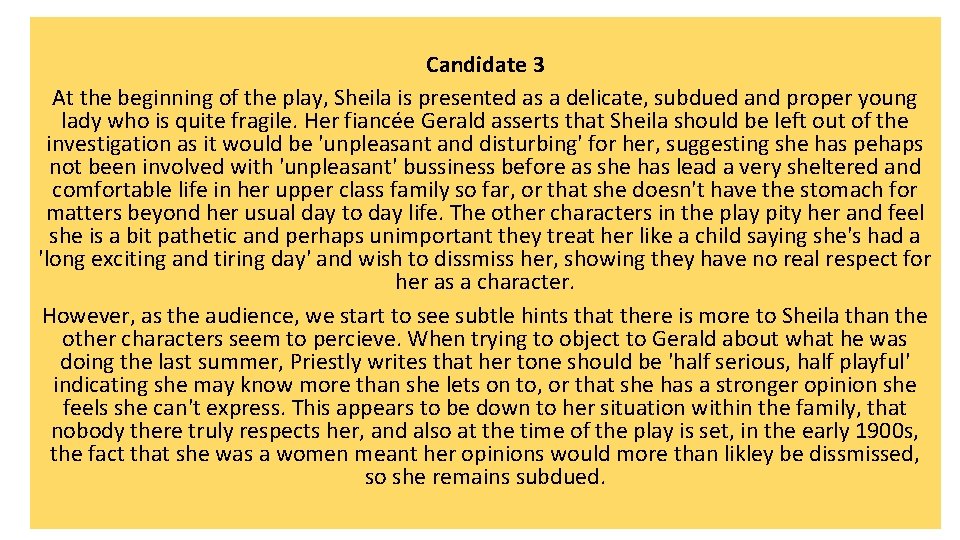
Candidate 3 At the beginning of the play, Sheila is presented as a delicate, subdued and proper young lady who is quite fragile. Her fiancée Gerald asserts that Sheila should be left out of the investigation as it would be 'unpleasant and disturbing' for her, suggesting she has pehaps not been involved with 'unpleasant' bussiness before as she has lead a very sheltered and comfortable life in her upper class family so far, or that she doesn't have the stomach for matters beyond her usual day to day life. The other characters in the play pity her and feel she is a bit pathetic and perhaps unimportant they treat her like a child saying she's had a 'long exciting and tiring day' and wish to dissmiss her, showing they have no real respect for her as a character. However, as the audience, we start to see subtle hints that there is more to Sheila than the other characters seem to percieve. When trying to object to Gerald about what he was doing the last summer, Priestly writes that her tone should be 'half serious, half playful' indicating she may know more than she lets on to, or that she has a stronger opinion she feels she can't express. This appears to be down to her situation within the family, that nobody there truly respects her, and also at the time of the play is set, in the early 1900 s, the fact that she was a women meant her opinions would more than likley be dissmissed, so she remains subdued.
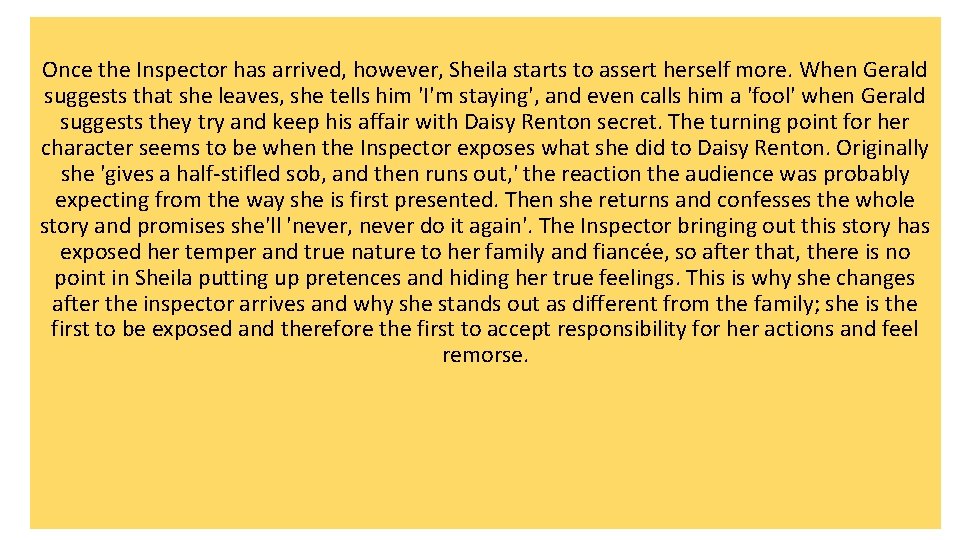
Once the Inspector has arrived, however, Sheila starts to assert herself more. When Gerald suggests that she leaves, she tells him 'I'm staying', and even calls him a 'fool' when Gerald suggests they try and keep his affair with Daisy Renton secret. The turning point for her character seems to be when the Inspector exposes what she did to Daisy Renton. Originally she 'gives a half-stifled sob, and then runs out, ' the reaction the audience was probably expecting from the way she is first presented. Then she returns and confesses the whole story and promises she'll 'never, never do it again'. The Inspector bringing out this story has exposed her temper and true nature to her family and fiancée, so after that, there is no point in Sheila putting up pretences and hiding her true feelings. This is why she changes after the inspector arrives and why she stands out as different from the family; she is the first to be exposed and therefore the first to accept responsibility for her actions and feel remorse.
By the end of the play, Sheila has completely changed from the character first presented. Originally she wouldn't express herself, by the end she is contradicting her parents as well as trying to bring to their attention the fact they should have learnt something; Sheila has really matured and opened up as a character. In the final scene, Priestly's note on the tone of her voice is 'passionatley', a stark contrast to the beggining. She points out to her parents that they 'began to learn something', but that they stopped. She recognises the fault in her parents thinking and expresses herself on it. The guilt of her part in the girls death and the realisation of her responsibility in the matter caused Sheila to open up and stand up for herself. The Inspector's visit changed her viewpoint on matters, and by the end she has changed to become a strong and forthright woman. Blimey – What a corker! Mommy, What a beauty!
What score would you give that one, dear boy?
Low Level 5 22 Marks By Jingo! Mommy, What a beauty!
I can think of THREE ways to make that better, dear boy. The Question is this: Can you? Remember this: There are millions and millions of John Smiths and Eva Smiths taking this exam………………how can you stand out?
Candidate 4 How and why does Sheila change in 'An Inspector Calls'. At the start of 'An Inspector Calls', Priestly presents that Sheila is sweet and respectful to her parents. She calls her mother 'mummy', suggesting she is childish and she repeats what the others have said. The repetition of 'go on' in her dialogue shows that she does not have her own opinions, but repeating and agreeing to what the others have said. This shows the childish behaviour of Sheila Birling at the start of 'An Inspector Calls' and before she meets the Inspector. However, Sheila's tone changes after she has met the Inspector. JB Priestley deliberately changes Sheila's use of language and tone to create the climax of the play in each act. Sheila used the word 'mummy' in Act One to show her respect to her mother and her childishness toward her family. However, her tone drops in Act Two as she is more alarmed of what is going to happen next. She uses the word 'mother' instead of 'mummy' to show that she has something very important to say and to draw her mother's attention to her.
JB Priestley deliberately uses short phrases in Sheila's dialogue, suggesting she is a baby that cannot speak in sentences with structure. The use of the word 'stop' is meant to alarm people, to 'stop' them from reaching towards danger. However, Mr. and Mrs. Birling didn't even 'stop' and listen to what Sheila is trying to say but carry on and called her an 'hysterical child'. The word 'hysterical child' suggests she has never had power or the right to speak in the family. This shows that in the society where Sheila is in, the older generation does not agree with the younger generation and the younger generation has never been trusted. As Sheila does not have a position in the family because she is behaving like a 'child', no one would listen to her.
Priestley uses rhetorical questions in Sheila's dialogues to challenge the older generation in the society. When Sheila was trying to 'stop' her parents from speaking anything wrong that may lead to further consequences, no one listened. Priestley deliberately uses the rhetorical question 'don't you see? ' to challenge the older generation from not listening to the younger generation. This suggests that Priestley is trying to use Sheila to teach the older generation a lesson, to listen to the younger generation or to change their stubborn thoughts about specific things. Sheila uses language to show her position in the family. She 'begged' and 'begged' her mother to stop, suggesting she has a low power in the family. The word 'begged' also suggests that one person is giving power to the other, to either change their action or start an action. Also, the repetition of 'begged' exaggerates how powerless Sheila is in the family, comparing to her mother.
As Sheila is powerless and she is treated as a 'child', her actions highlights even more of her childish and immature characteristics. Priestley presents Sheila to be childish, which may also be weak and fragile. This is shown when Sheila 'begins crying quietly' when her parents started shouting at her. Sheila behaves like a child as she does not argue back to her parents or defend herself. She does whatever her parents told her to, suggesting she has been brought up by very strict rules and manners when she was younger. In Act Three, Sheila changes her attitude towards her parents as she tries to 'protest'. Mr. Birling said 'sharply' to Sheila to take her mother into the drawing room, but she 'protested' and wanted to say she wanted to stay. However Mr. Birling spoke 'very sharply' at Sheila and this muted Sheila and she can only obey to what her father has said. This shows that in the society of that time, men are dominant over women and the older generation of the family can order rules to the younger generation and the youngsters must obey to the command. This suggests to the audience that perhaps the Birlings' have trained two soldiers instead of two individuals as Sheila and Eric obey rules and orders from their parents.
Sheila changes her attitude towards her parents at the end of Act Three as she is now more confident to speak to her parents and even correct them. Sheila speaks more confidently with a definite tone that as if no one can stop her from speaking her thoughts. She said 'No, it doesn't!' The double negative of the sentence emphasises her thoughts. A Corker, to be sure, – but, dear boy, better than the other corker?
What score would you give that one, dear boy?
Level 5 with a tiny flash of L 6 for AO 2 24 marks By Jingo! Mommy, What a beauty!
I can think of THREE ways to make that better, dear boy. The Question is this: Can you? Remember this: There are millions and millions of John Smiths and Eva Smiths taking this exam………………how can you stand out?
The Final Slides are coming up – pay attention !
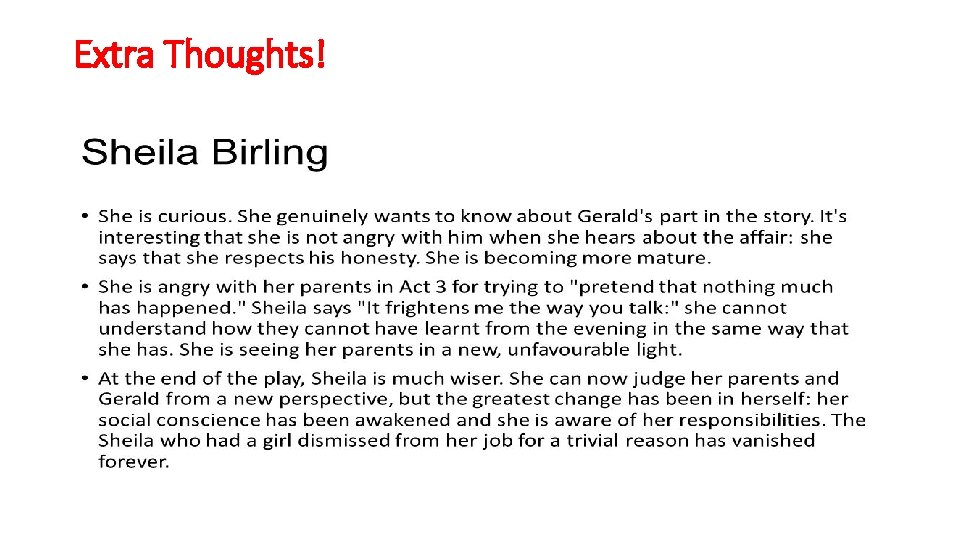
Extra Thoughts!
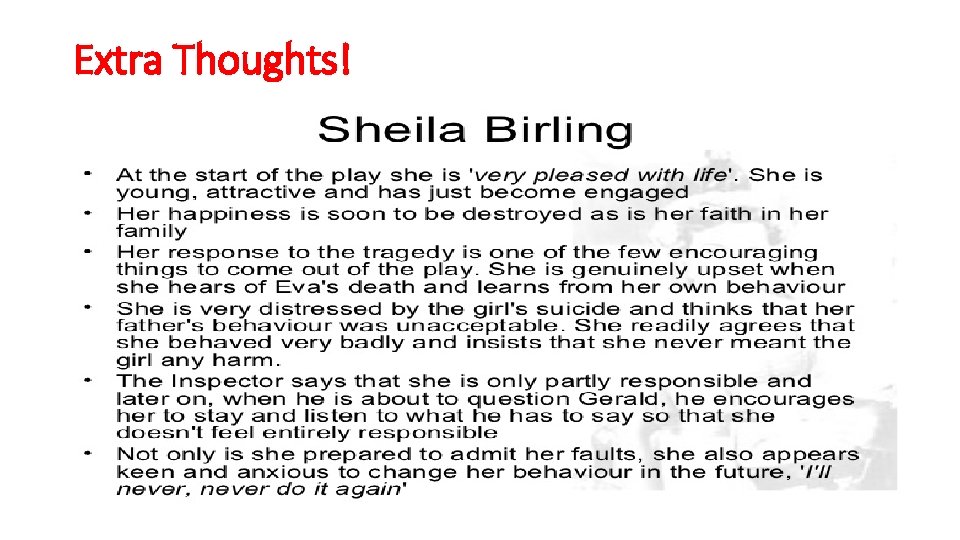
Extra Thoughts!
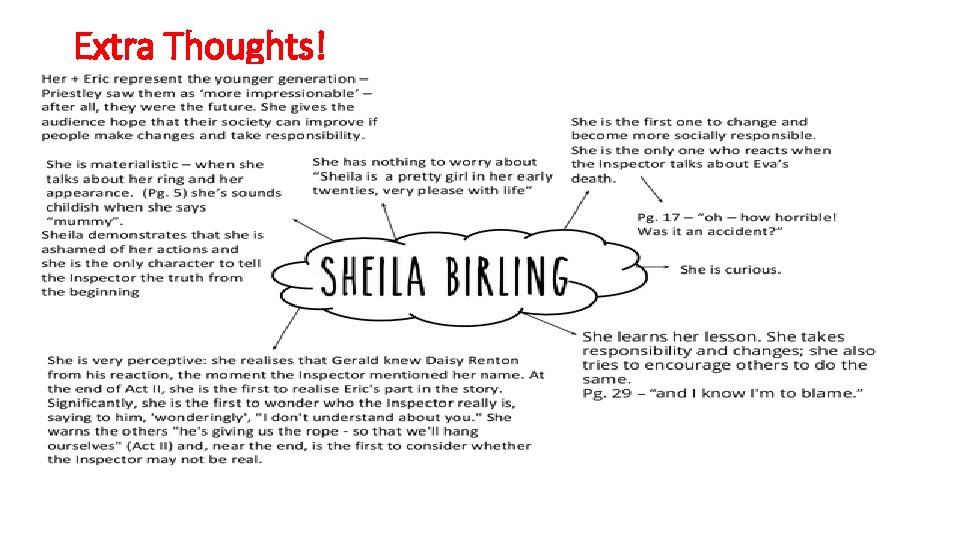
Extra Thoughts!
Extra Thoughts!
Good Luck in the Exam !