
An Inspector Calls l OBJ To establish opinion
An Inspector Calls l OBJ: To establish opinion about the Birling family l After reading the stage directions at the opening of the play, make notes on what they tell us about the Birling family. l Consider the following: l The furniture l The house l The characters
An Inspector Calls l Read Act one up to pg 5 – Sheila ‘Careful! I’ll never let it out of my sight for an instant. ’ l l l What are the Birling family celebrating? Describe Mr Birling in 3 words. What impression are we given of Eric? Why is Arthur Birling particularly pleased that his daughter is marrying Gerald Croft? What are Gerald’s parents called and where are they?
Recap of learning. l On a post it note, write something that you know about the play so far and stick it on the wipeboard.
An Inspector Calls OBJ: develop understanding of historical background Edwardian England l Priestley wrote the play in 1945 at the end of World War 2. The play is actually set in 1912, just before World War 1. This is significant as it enables Priestly to write his play as a sort of social commentary. It highlights the serious flaws in society.
An Inspector Calls l The play setting, Edwardian England (the society of the Birling family) exhibited huge social divisions. This was most evident between the higher and lower classes. 87% of the country’s personal wealth was held by 5% of the population. Millions of people were living in poverty with women earning the least of all.
L/O; Mr Birling l Expected progress; pupils will have created a spider diagram about the character. l Above expected progress; will have answered a question regarding the character. l Keyword; Character

l ‘Arthur Birling is a heavy looking, rather portentous man in his middle fifties with fairly easy manners but rather provincial in his speech. ’ l Portentous- self important or pompous l Provincial-un-sophisticated and limited.
An Inspector Calls Read pg 6 – 10 l Look again at Arthur Birling’s speech on pg 8. Using the sheet ’ 20 th Century Britain’ make a list in your exercise book when the events occur that Birling predicted would never happen. Titanic sinks 1912! Discuss: l What happened to 2 nd & 3 rd class passengers? l Who were first into the lifeboats? l What did the band/ ship’s crew do? Written Task l What does this show about values in Edwardian society? l

An Inspector Calls OBJ: develop understanding of Arthur Birling Dramatic Irony Arthur Birling is portrayed as a smug and self – satisfied man. Priestley exposes the irony in Birling’s speeches (when the audience knows something the character does not). He is worried that as his family is comfortably middle class, Lord & Lady Croft will think Sheila is beneath their upper class status. l Read pg 10 – 18 – complete character log for Mr Birling
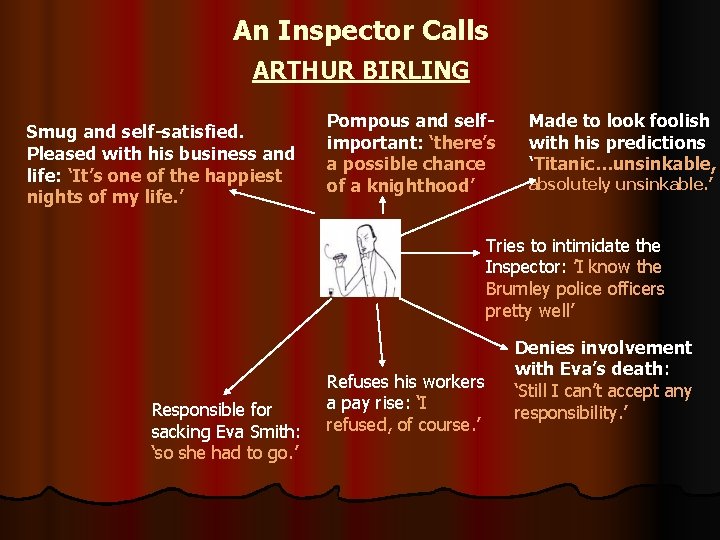
An Inspector Calls ARTHUR BIRLING Smug and self-satisfied. Pleased with his business and life: ‘It’s one of the happiest nights of my life. ’ Pompous and selfimportant: ‘there’s a possible chance of a knighthood’ Made to look foolish with his predictions ‘Titanic…unsinkable, absolutely unsinkable. ’ Tries to intimidate the Inspector: ’I know the Brumley police officers pretty well’ Responsible for sacking Eva Smith: ‘so she had to go. ’ Refuses his workers a pay rise: ‘I refused, of course. ’ Denies involvement with Eva’s death: ‘Still I can’t accept any responsibility. ’
Homework l What l List happened in Act 1? the events in your book.

Write a PEE response l How does Priestley present Birling in the stage directions? l ‘Arthur Birling is a heavy looking, rather portentous man in his middle fifties with fairly easy manners but rather provincial in his speech. ’

Write a PEE response l Birling is presented as some one who used to luxury. For example, it says ‘that he is a’ heavy looking’ man. This could mean that he is overweight which could suggest that the food he eats at the dinner parties and the port he drinks are rich luxury items and they are having a negative impact on his physique.

Using the sentence starters, write a PEE. l How l ‘’for l For does Priestley present Birling here? lower costs and higher prices…’ example… l This could mean/this shows/this suggests…
l Birling is pompous and self important. For example, he tells Gerald ‘there is a possible chance of a knighthood’. He says this in an attempt to impress Gerald and, more significantly, Gerald’s mother, Lady Croft who he has acknowledged to Gerald that he knows Lady Croft will think that his daughter, Sheila, is not good enough for her son on a social scale.
l This interaction between the two men reveals a great deal about the character of Birling and his priorities. The appearance to others is of vital importance to Birling. This could be down to his own climb up the social ladder as a ‘hard headed businessman’ and the fact that Sybil Birling comes from ‘higher social stock’. Birling’s link with the lower classes is shown when he thanks ‘cook for the meal’ and he is checked by Mrs Birling.
Think AOs l What is missing from this response?
An Inspector Calls L/O; develop understanding of Sheila Birling. l Expected progress: pupils are able to comment on Sheila Birling and her transformation in the play. l Above expected progress; Create a detailed essay plan on Sheila Birling. l Keyword: character
Think about the questions below l What l How did Sheila do to Eva Smith and why? does Sheila react? l Explain the differences between Sheila’s and her father’s reactions to the news. What does it reveal about their characters?
Let’s work it out. l When does Sheila speak in the play. l We will create a table and complete it up to Act 2. We need to complete this for the whole play. Which act? What’s happening? How is she presented? Quote

Act 1, page 176 l ‘But these girls aren't cheap labour, they're people. ' Sheila l What does this reveal about Sheila? Add to the table in your books.
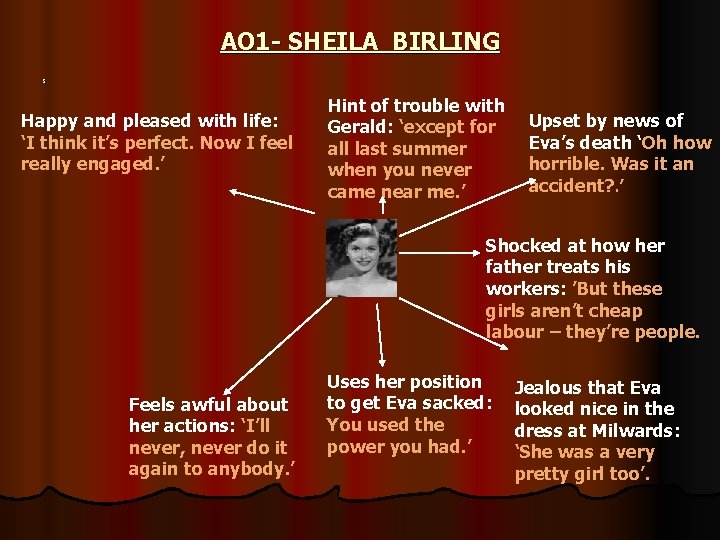
AO 1 - SHEILA BIRLING s Happy and pleased with life: ‘I think it’s perfect. Now I feel really engaged. ’ Hint of trouble with Gerald: ‘except for all last summer when you never came near me. ’ Upset by news of Eva’s death ‘Oh how horrible. Was it an accident? . ’ Shocked at how her father treats his workers: ’But these girls aren’t cheap labour – they’re people. Feels awful about her actions: ‘I’ll never, never do it again to anybody. ’ Uses her position to get Eva sacked: You used the power you had. ’ Jealous that Eva looked nice in the dress at Milwards: ‘She was a very pretty girl too’.
PQE’s l. How does Priestley present the character of Sheila in the play and why?
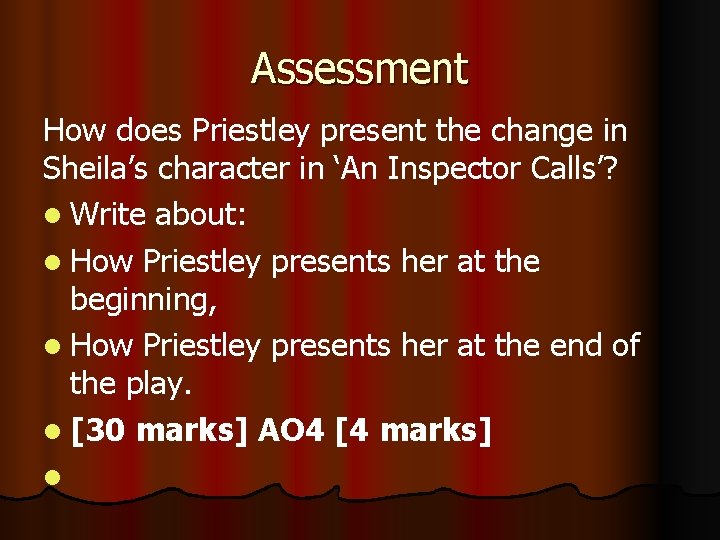
Assessment How does Priestley present the change in Sheila’s character in ‘An Inspector Calls’? l Write about: l How Priestley presents her at the beginning, l How Priestley presents her at the end of the play. l [30 marks] AO 4 [4 marks] l
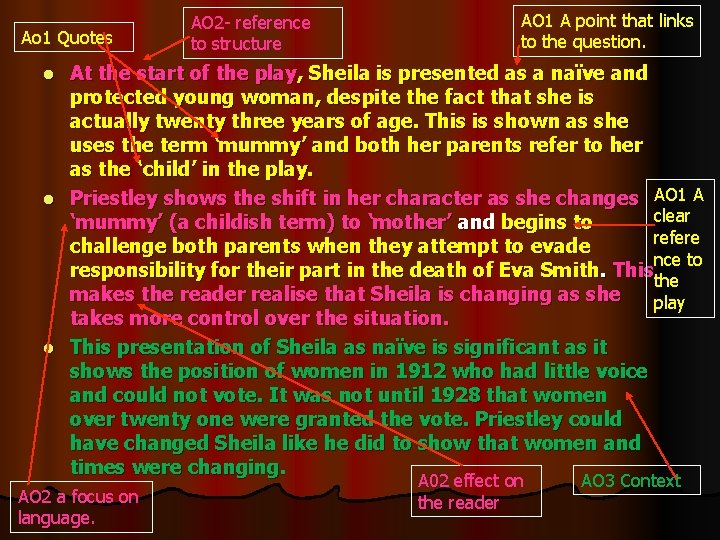
Ao 1 Quotes AO 2 - reference to structure AO 1 A point that links to the question. At the start of the play, Sheila is presented as a naïve and protected young woman, despite the fact that she is actually twenty three years of age. This is shown as she uses the term ‘mummy’ and both her parents refer to her as the ‘child’ in the play. l Priestley shows the shift in her character as she changes AO 1 A clear ‘mummy’ (a childish term) to ‘mother’ and begins to refere challenge both parents when they attempt to evade nce to responsibility for their part in the death of Eva Smith. This the makes the reader realise that Sheila is changing as she play takes more control over the situation. l This presentation of Sheila as naïve is significant as it shows the position of women in 1912 who had little voice and could not vote. It was not until 1928 that women over twenty one were granted the vote. Priestley could have changed Sheila like he did to show that women and times were changing. l AO 2 a focus on language. A 02 effect on the reader AO 3 Context
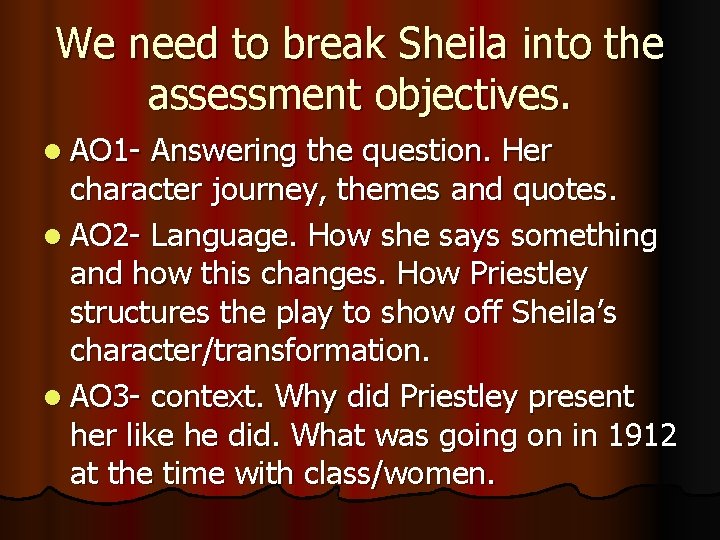
We need to break Sheila into the assessment objectives. l AO 1 - Answering the question. Her character journey, themes and quotes. l AO 2 - Language. How she says something and how this changes. How Priestley structures the play to show off Sheila’s character/transformation. l AO 3 - context. Why did Priestley present her like he did. What was going on in 1912 at the time with class/women.
Starter: l Complete the worksheet on the table! Who said it in phase 1? l Remember, you don’t get the play in the exam so you need to know these quotes!
An Inspector Calls Gerald and Mrs. Birling OBJ: To understand the characters of Gerald and Sybil Birling.
Learning Outcomes! l All. . . Will understand the significance of the two characters. l Even better if. . . you can locate important quotes relating to these characters. l Excellent when. . . you can develop these quotes into a P. E. E paragraph.
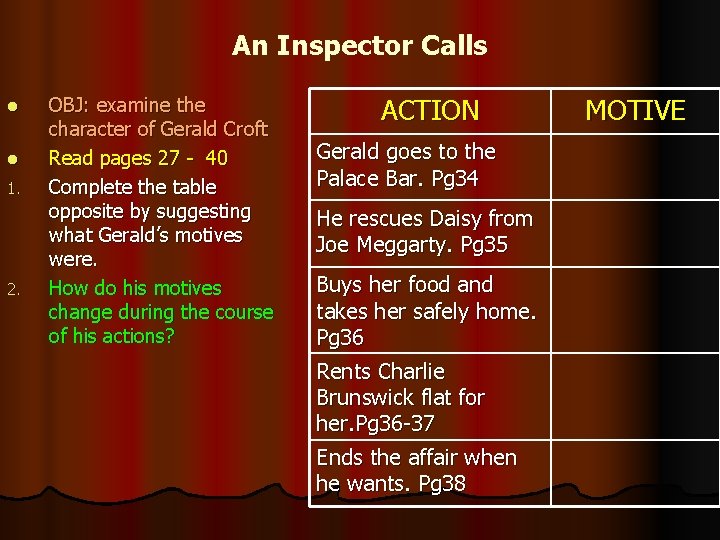
An Inspector Calls l l 1. 2. OBJ: examine the character of Gerald Croft Read pages 27 - 40 Complete the table opposite by suggesting what Gerald’s motives were. How do his motives change during the course of his actions? ACTION Gerald goes to the Palace Bar. Pg 34 He rescues Daisy from Joe Meggarty. Pg 35 Buys her food and takes her safely home. Pg 36 Rents Charlie Brunswick flat for her. Pg 36 -37 Ends the affair when he wants. Pg 38 MOTIVE

An Inspector Calls GERALD CROFT Genuinely shocked when he hears about Daisy Renton: ‘I’ve suddenly realized – she’s dead’ Meets Daisy at the Palace bar: ‘I went down into the bar for a drink’ Sets her up living in his friend’s flat: ‘I insisted on Daisy moving in there. ’ Spends the summer having an affair with her: ’She was young and pretty and warm-hearted - and intensely grateful. ’ Seems genuinely saddened by her death: ‘I’m rather more upset by this business than I appear to be Ends the affair: ‘In the first week of September. ’
An Inspector Calls OBJ: Develop understanding of Character of Mrs Birling l Read pg 40 – 49 l Mrs Birling is a very arrogant and self-righteous woman. The way she speaks is often to denigrate (put down) other people. These remarks are her way of asserting authority over other people and emphasising her own power and status. The Brumley Women’s Charity Organisation In the Edwardian era there was no social security – there were few options if you were unemployed or penniless. Local charity organisations would help ‘deserving’ cases.

MRS SYBIL BIRLING Arrogant, cold and austere woman, socially superior to Arthur: ‘You’re not supposed to say such things. ’ 3 Rude towards the Inspector: ‘May I remind you that my husband was on the bench. ’ Chairperson of the Brumley charity: ’You were in the chair. ’ Was against Eva’s case from the start as she used the name ‘Birling’: ’one of the things that prejudiced me against her case. ’ Unwittingly blames Eric for Eva’s death: ‘Go and look for the father of the child. It’s his responsibility’ Refuses to admit any wrong doing: ‘I accept no blame for it all. ’ Refuses to believe Eva could have morals: ‘As if a girl of that sort would ever refuse money. ’
An Inspector Calls l l l 1. 2. 3. 4. 5. OBJ: Develop understanding of character of Eric Birling Read pg 50 – 56 Discuss the following questions: What has Eric actually done? What do you think happened between Eric and Daisy? Why did Daisy go with Eric a second time? As he talks to the Inspector what feelings are revealed for Daisy? What is he most upset about?

An Inspector Calls ERIC BIRLING Young – early twenties, slightly unsure of himself: ‘not quite at ease. ’ Drinks quite a lot: ’He’s been steadily drinking too much for the past two years. ’ Also meets Daisy at the Palace bar: ‘In the Palace Bar’ ‘Forces’ his way in to her home: ’ I threatened to make a row. ’ Horrified by his mother’s actions resulting in the death of his unborn child: ‘you killed them both – damn you’ Feels guilty about his actions : ‘And I don’t even remember – that’s the hellish thing. ’ Now she is pregnant he steals money from his father’s company: ‘I got it – from the office –’

An Inspector Calls En 1 – Speaking & Listening v OBJ: Develop & sustain an effective role v Show order & expression l Task – to prepare a drama performance l Brumley Charity Committee OR l Character hot-seating l Your performance should last about 5 minutes l Prepare well!
An Inspector Calls l. E –communicate with the audience by sustaining a straightforward role. l D – develop a credible role which engages interest of audience. l C – develop and sustain a role which holds interest, show precise expression and communication. l B – create a challenging role shaping the audience’s reactions. l A – create a complex role using a variety of techniques.
An Inspector Calls Obj: Examine the role of the Inspector Read pg 55 -56 1. Priestley uses the Inspector as a mouthpiece for his philosophy. What does the Inspector’s final speech show? Read pg 56 – 61 (Gerald enters) What has the Inspector revealed about the Birling family and society in general? 2. How do each of the characters react immediately after the Inspector has left? 1.
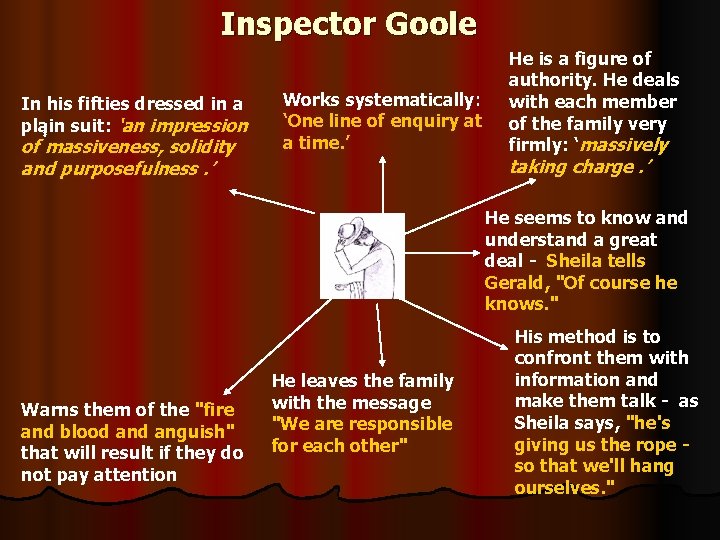
Inspector Goole In his fifties dressed in a plain suit: ‘an impression 3 1 of massiveness, solidity and purposefulness. ’ Works systematically: ‘One line of enquiry at a time. ’ He is a figure of authority. He deals with each member of the family very firmly: ‘massively taking charge. ’ He seems to know and understand a great deal - Sheila tells Gerald, "Of course he knows. " Warns them of the "fire and blood anguish" that will result if they do not pay attention He leaves the family with the message "We are responsible for each other" His method is to confront them with information and make them talk - as Sheila says, "he's giving us the rope so that we'll hang ourselves. "
An Inspector Calls Obj: Examine the role of the Inspector Read pg 61 – 66 (Eric: And so we have) Who is the Inspector? l What does his name suggest he might be? l Whose voice is he? Priestley? God? Our conscience? Bits of all? Explain your answer using PEE. l Do you have any other suggestions?
An Inspector Calls Inspector Goole There is dramatic power in the fact that there is not a single interpretation of who the Inspector is. He has a number of roles but his main purpose is to lead the others to tell the truth. Throughout the play he demonstrates how people are responsible for each other and his final speech is as much to the audience as it is the characters on stage.
- Slides: 41