
An INSGPS Navigation System with MEMS Inertial Sensors

- Slides: 9
An INS/GPS Navigation System with MEMS Inertial Sensors for Small Unmanned Aerial Vehicles 56367 Masaru Naruoka The University of Tokyo 1. Introduction and Background 2. Method 3. Numerical Simulations and Results
Introduction and Background • Needs for a new navigation system of small UAVs – Small UAV • About 1 m wingspan • Easy operation – Hope for Autonomy – The existing ones = expensive, big, heavy • What’s new? = Low cost, small, light
Method(1) Navigation System for Small UAVs • Features – Low cost – Small – Light • Unit 1. Inertial Navigation System (INS) with MEMS inertial sensors 2. Global Positioning System (GPS)
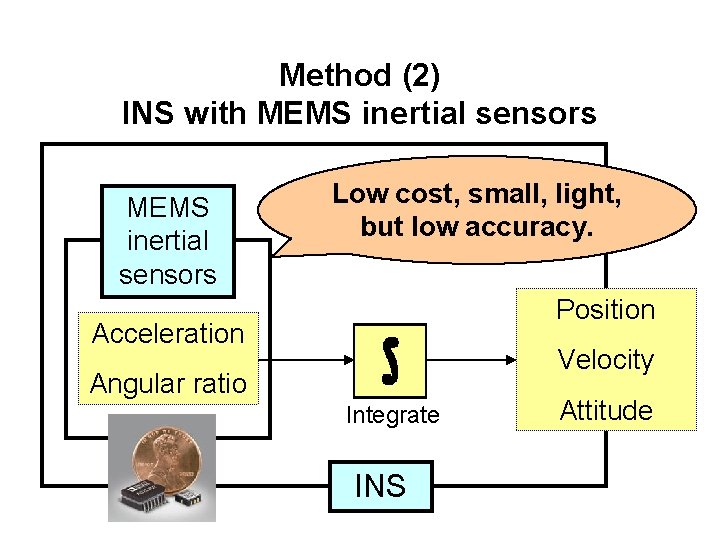
Method (2) INS with MEMS inertial sensors Low cost, small, light, but low accuracy. Position Acceleration Velocity Angular ratio Integrate INS Attitude
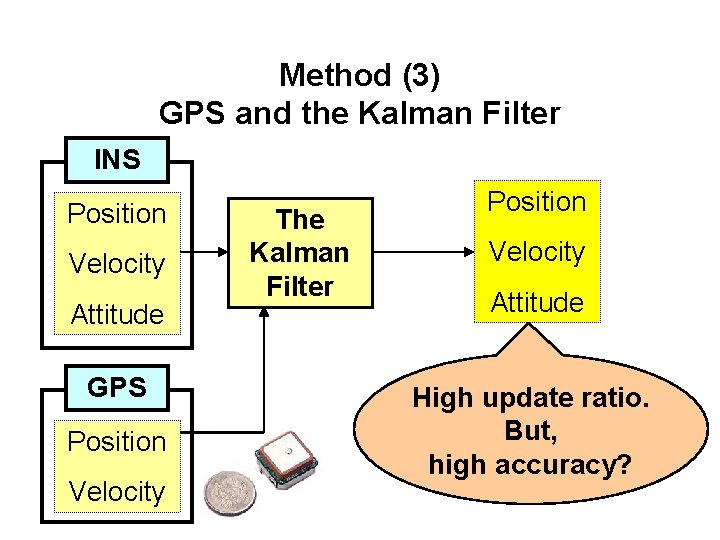
Method (3) GPS and the Kalman Filter INS Position Velocity Attitude GPS Position Velocity The Kalman Filter Position Velocity Attitude High update ratio. But, high accuracy?
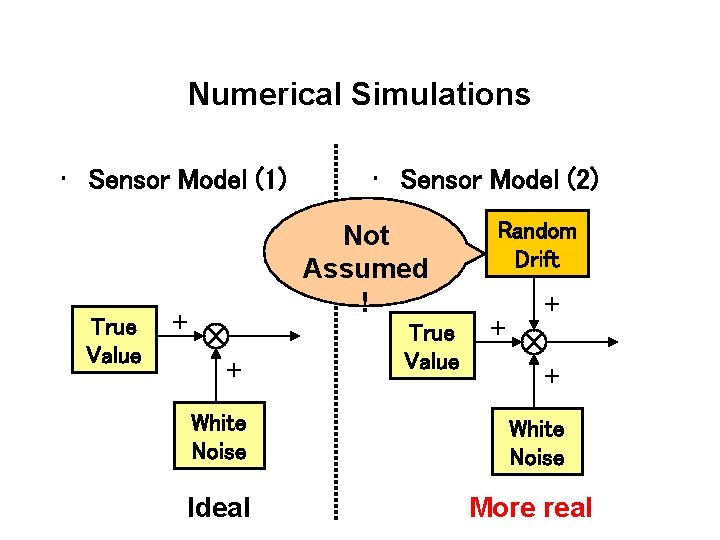
Numerical Simulations • Sensor Model (1) True Value • Sensor Model (2) Not Assumed ! + + True Value Random Drift + + + White Noise Ideal More real
Results
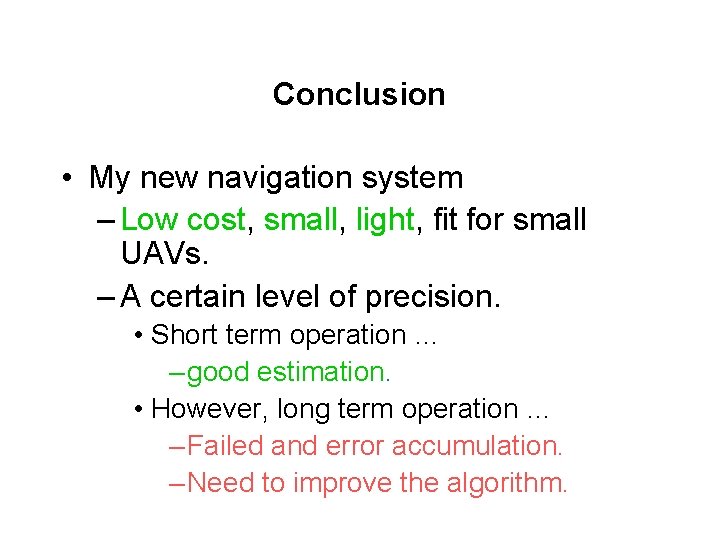
Conclusion • My new navigation system – Low cost, small, light, fit for small UAVs. – A certain level of precision. • Short term operation … – good estimation. • However, long term operation … – Failed and error accumulation. – Need to improve the algorithm.
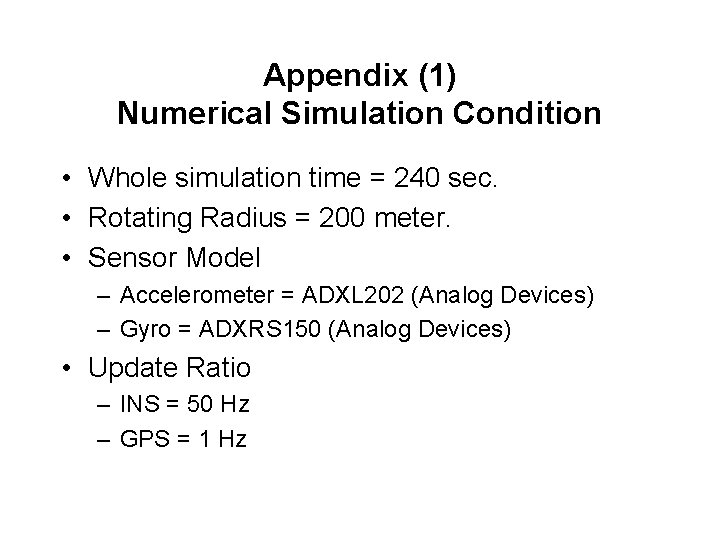
Appendix (1) Numerical Simulation Condition • Whole simulation time = 240 sec. • Rotating Radius = 200 meter. • Sensor Model – Accelerometer = ADXL 202 (Analog Devices) – Gyro = ADXRS 150 (Analog Devices) • Update Ratio – INS = 50 Hz – GPS = 1 Hz