
An Innovative Mechanical Engineering Technology Pathway Aligned with
- Slides: 19
An Innovative Mechanical Engineering Technology Pathway Aligned with Industry Needs Dr. David Spang, Rowan College at Burlington County Dr. Edem Tetteh, Rowan College at Burlington County Dr. Ratneshwar Jha, Rowan University
Introduction • Background • Rowan College at Burlington County (RCBC) and Rowan University (RU) have partnered to offer engineering technology degrees. • National Science Foundation-funded project (NSF Award 1601487). • Advanced Manufacturing led to a Mechanical Engineering Technology (MET) and Electrical Engineering Technology (EET) pathways. • Bureau of Labor Statistics (BLS) job outlook for MET careers to grow 5% for the ten-year period 2016 -2026, and EET careers to 2% for the same period. • Structured in a “ 3+1” model supported by the recommendations of the New Jersey College Affordability Study Commission identified as an opportunity to make college more affordable. – The first three years of the curriculum are delivered by the Community College at Community College tuition rates. – The fourth year is offered by the University, on the Community College campus, at a discounted tuition rate.
Innovative “ 3+1” Model
Associate Degree-Granting Institution • • Sharing of course syllabi and outcomes. Highly qualified faculty members. Create analogs of junior-level courses. Close relationship between the assessment offices. • Earn up to 90 credits to transfer to the baccalaureate degree-granting institution.
Baccalaureate Degree-Granting Institution • Share content and learning outcomes • Review credentials for faculty of third year • Solely responsible for delivering the senior year courses • Evaluate student’s candidacy for transition to the baccalaureate portion of the pathway. • Solely award the Baccalaureate degrees
“ 3+1” Associate and Baccalaureate degrees in Mechanical Engineering Technology (AAS and BS MET)
The Needs of Industry • NSF Forum engaged industry partners in skills inventory activities • Technology conference with 59 participants, from academic and industry partners, discussed the critical skills and competencies • PI and Co-PI visited several industry partner sites • Applications database development highlighting the practical applications of important scientific and technical principles • Must have an applied basis in engineering mechanics/sciences, according to ABET-ETAC.
Associate Degree Aligned with ABET-ETAC Requirements (1) An ability to apply knowledge, techniques, skills and modern tools of mathematics, science, engineering, and technology to solve well-defined engineering problems appropriate to the discipline. (2) An ability to design solutions for well-defined technical problems and assist with engineering design of systems, components, or processes appropriate to the discipline. (3) An ability to apply written, oral, and graphical communication in both technical and non-technical environments; and an ability to identify and use appropriate technical literature. (4) An ability to conduct standard tests and measurements, and to conduct, analyze, and interpret experiments. (5) An ability to function effectively as a member of a technical team.
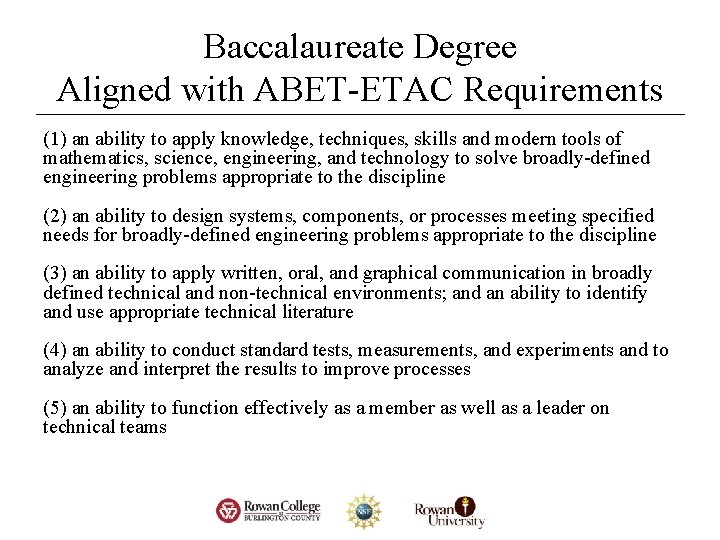
Baccalaureate Degree Aligned with ABET-ETAC Requirements (1) an ability to apply knowledge, techniques, skills and modern tools of mathematics, science, engineering, and technology to solve broadly-defined engineering problems appropriate to the discipline (2) an ability to design systems, components, or processes meeting specified needs for broadly-defined engineering problems appropriate to the discipline (3) an ability to apply written, oral, and graphical communication in broadly defined technical and non-technical environments; and an ability to identify and use appropriate technical literature (4) an ability to conduct standard tests, measurements, and experiments and to analyze and interpret the results to improve processes (5) an ability to function effectively as a member as well as a leader on technical teams
BS. MET degree • BS degree in MET with a concentration in Advanced Manufacturing. • Linked to RCBC’s AAS. MET via a “ 3+1” program pathway.
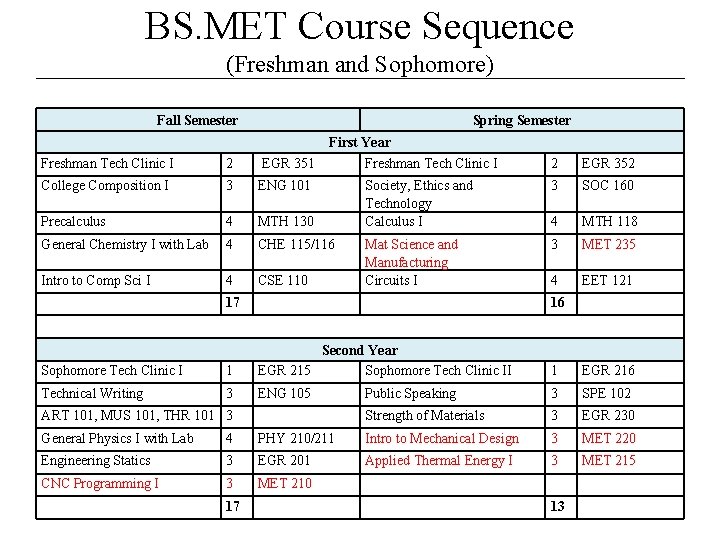
BS. MET Course Sequence (Freshman and Sophomore) Fall Semester Spring Semester First Year Freshman Tech Clinic I 2 EGR 351 2 EGR 352 College Composition I 3 ENG 101 Society, Ethics and Technology Calculus I 3 SOC 160 Precalculus 4 MTH 130 4 MTH 118 General Chemistry I with Lab 4 CHE 115/116 3 MET 235 CSE 110 Mat Science and Manufacturing Circuits I Intro to Comp Sci I 4 4 EET 121 17 16 Sophomore Tech Clinic I 1 Second Year EGR 215 Sophomore Tech Clinic II 1 EGR 216 Technical Writing 3 ENG 105 Public Speaking 3 SPE 102 ART 101, MUS 101, THR 101 3 Strength of Materials 3 EGR 230 General Physics I with Lab 4 PHY 210/211 Intro to Mechanical Design 3 MET 220 Engineering Statics 3 EGR 201 Applied Thermal Energy I 3 MET 215 CNC Programming I 3 MET 210 17 13
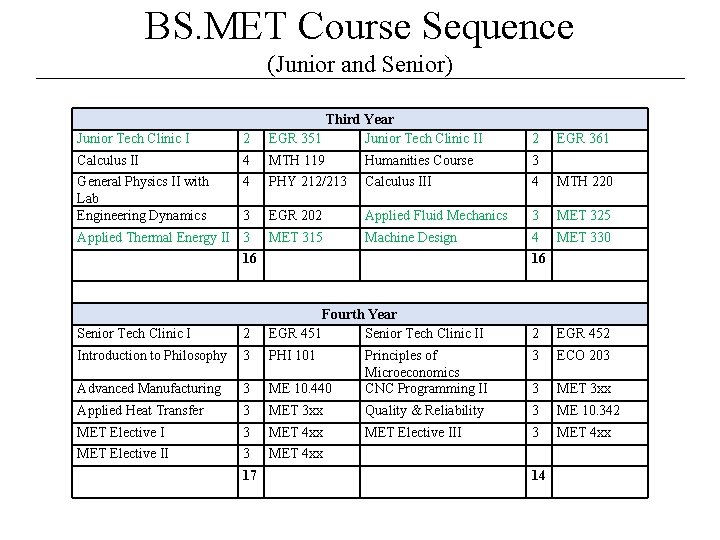
BS. MET Course Sequence (Junior and Senior) Junior Tech Clinic I 2 Third Year EGR 351 Junior Tech Clinic II Calculus II 4 MTH 119 Humanities Course 3 General Physics II with Lab Engineering Dynamics 4 PHY 212/213 Calculus III 4 MTH 220 3 EGR 202 Applied Fluid Mechanics 3 MET 325 Applied Thermal Energy II 3 MET 315 Machine Design 4 MET 330 16 2 EGR 361 Senior Tech Clinic I 2 Fourth Year EGR 451 Senior Tech Clinic II Introduction to Philosophy 3 PHI 101 Advanced Manufacturing 3 ME 10. 440 Principles of Microeconomics CNC Programming II Applied Heat Transfer 3 MET 3 xx Quality & Reliability 3 ME 10. 342 MET Elective I 3 MET 4 xx MET Elective II 3 MET 4 xx 17 14 2 EGR 452 3 ECO 203 3 MET 3 xx
Further Project Activities
Curriculum Development • Applications Database – An applications database and library will be finalized and will serve as a resource for faculty to support the relevant curriculum, and to present industry-relevant competencies within courses that meet predetermined learning outcomes.
Stackable Certificates • Certificates will provide students with the opportunity to be recognized for reaching relevant milestones as they progress through the program, and can be combined in an additive or stackable fashion.
Facilities and Infrastructure • An Advanced Manufacturing Facility will be created to support student education and development, include machining, rapid prototyping, welding, and lean manufacturing infrastructure.
Future Meetings with Stakeholders • Fall 2019 – Progress update with educational and industry partners • Spring 2020 – STEM Summit providing interactive training and workshops for pathway instructors at all levels • Summer 2020 – Project summary and sustainability conference
Acknowledgements • The authors wish to gratefully acknowledge the support of the National Science Foundation (NSF), through the Division of Undergraduate Education, DUE 1601487 which made this effort possible. Any opinions, findings, and conclusions or recommendations expressed in this material are those of the authors and do not necessarily reflect the views of the National Science Foundation. • The authors also wish to acknowledge Rowan College at Burlington County (RCBC) and Rowan University (RU) for the extensive support in the development and alignment of the mechanical engineering technology curricula.
Contact Information Dr. David Spang, Sr. Vice President & Provost, RCBC dspang@rcbc. edu Dr. Edem Tetteh, Dean of STEM, RCBC etetteh@rcbc. edu Dr. Ratneshwar Jha, Dept. Head & Professor, Rowan University jhar@rowan. edu