
An Innovative Approach to Parallel Processing Data 1
- Slides: 43
An Innovative Approach to Parallel Processing Data 1 BINA RAMAMURTHY PARTIALLY SUPPORTED BY NSF DUE GRANT: 0737243, 0920335 CSE 4/587 B. Ramamurthy 10/22/2021
The Context: Big-data 2 � Man on the moon with 32 KB (1969); my laptop had 2 GB RAM (2009) � Google collects 270 PB data in a month (2007), 20 PB a day (2008) … � 2010 census data is a huge gold mine of information � Data mining huge amounts of data collected in a wide range of domains from astronomy to healthcare has become essential for planning and performance. � We are in a knowledge economy. Data is an important asset to any organization Discovery of knowledge; Enabling discovery; annotation of data � We are looking at newer programming models, and Supporting algorithms and data structures � National Science Foundation refers to it as “data-intensive computing” and industry calls it “big-data” and “cloud computing” CSE 4/587 B. Ramamurthy 10/22/2021
More context 3 �Rear Admiral Grace Hopper: “In pioneer days they used oxen for heavy pulling, and when one ox couldn't budge a log, they didn't try to grow a larger ox. We shouldn't be trying for bigger computers, but for more systems of computers. ” ---From the Wit and Wisdom of Grace Hopper (1906 -1992), http: //www. cs. yale. edu/homes/tap/Files/hopperwit. html CSE 4/587 B. Ramamurthy 10/22/2021
Introduction : Ch. 1 (Lin and Dyer’s text) 4 �Text processing: web-scale corpora (singular corpus) �Simple word count, cross reference, n-grams, … �A simpler technique on more data beat a more sophisticated technique on less data. �Google researchers call this: “unreasonable effectiveness of data” --Alon Halevy, Peter Norvig, and Fernando Pereira. The unreasonable effectiveness of data. Communications of the ACM, 24(2): 8: 12, 2009. CSE 4/587 B. Ramamurthy 10/22/2021
Map. Reduce 5 10/22/2021 CSE 4/587 B. Ramamurthy
What is Map. Reduce? 6 � Map. Reduce is a programming model Google has used successfully in processing its “big-data” sets (~ 20 peta bytes per day in 2008) Users specify the computation in terms of a map and a reduce function, Underlying runtime system automatically parallelizes the computation across large-scale clusters of machines, and Underlying system also handles machine failures, efficient communications, and performance issues. -- Reference: Dean, J. and Ghemawat, S. 2008. Map. Reduce: simplified data processing on large clusters. Communication of ACM 51, 1 (Jan. 2008), 107 -113. CSE 4/587 B. Ramamurthy 10/22/2021
Big idea behind MR 7 �Scale-out and not scale-up: Large number of commodity servers as opposed large number of high end specialized servers Economies of scale, ware-house scale computing MR is designed to work with clusters of commodity servers Research issues: Read Barroso and Holzle’s work �Failures are norm or common: With typical reliability, MTBF of 1000 days (about 3 years), if you have a cluster of 1000, probability of at least 1 server failure at any time is nearly 100% CSE 4/587 B. Ramamurthy 10/22/2021
Big idea (contd. ) 8 �Moving “processing” to the data: not literally, data and processing are co-located versus sending data around as in HPC �Process data sequentially vs random access: analytics on large sequential bulk data as opposed to search for one item in a large indexed table �Hide system details from the user application: user application does not have to get involved in which machine does what. Infrastructure can do it. �Seamless scalability: Can add machines / server power without changing the algorithms: this is in-order to process larger data set CSE 4/587 B. Ramamurthy 10/22/2021
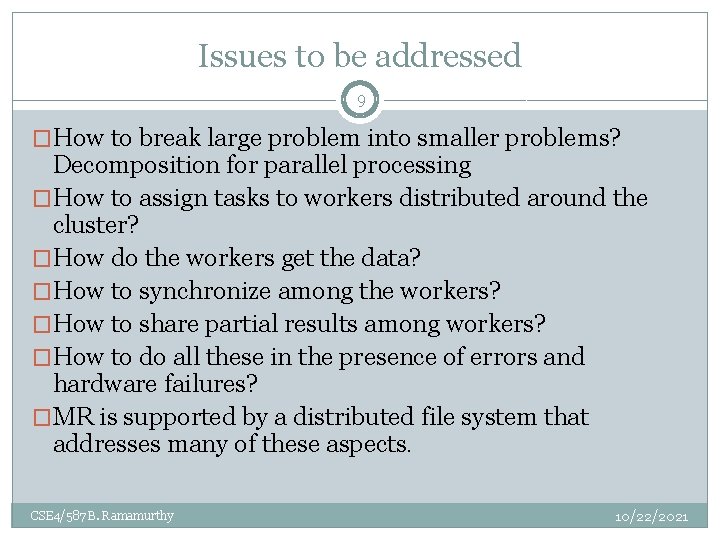
Issues to be addressed 9 �How to break large problem into smaller problems? Decomposition for parallel processing �How to assign tasks to workers distributed around the cluster? �How do the workers get the data? �How to synchronize among the workers? �How to share partial results among workers? �How to do all these in the presence of errors and hardware failures? �MR is supported by a distributed file system that addresses many of these aspects. CSE 4/587 B. Ramamurthy 10/22/2021
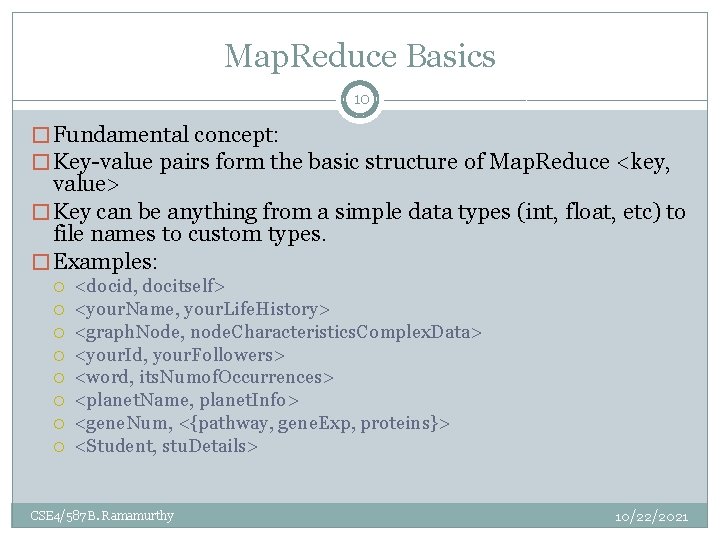
Map. Reduce Basics 10 � Fundamental concept: � Key-value pairs form the basic structure of Map. Reduce <key, value> � Key can be anything from a simple data types (int, float, etc) to file names to custom types. � Examples: <docid, docitself> <your. Name, your. Life. History> <graph. Node, node. Characteristics. Complex. Data> <your. Id, your. Followers> <word, its. Numof. Occurrences> <planet. Name, planet. Info> <gene. Num, <{pathway, gene. Exp, proteins}> <Student, stu. Details> CSE 4/587 B. Ramamurthy 10/22/2021
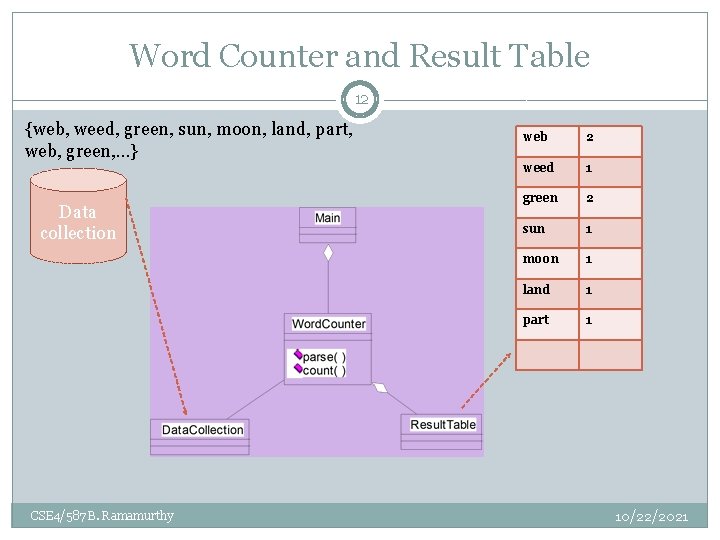
From CS Foundations to Map. Reduce (Example#1) 11 Consider a large data collection: {web, weed, green, sun, moon, land, part, web, green, …} Problem: Count the occurrences of the different words in the collection. Lets design a solution for this problem; We will start from scratch We will add and relax constraints We will do incremental design, improving the solution for performance and scalability CSE 4/587 B. Ramamurthy 10/22/2021
Word Counter and Result Table 12 {web, weed, green, sun, moon, land, part, web, green, …} Data collection CSE 4/587 B. Ramamurthy web 2 weed 1 green 2 sun 1 moon 1 land 1 part 1 10/22/2021
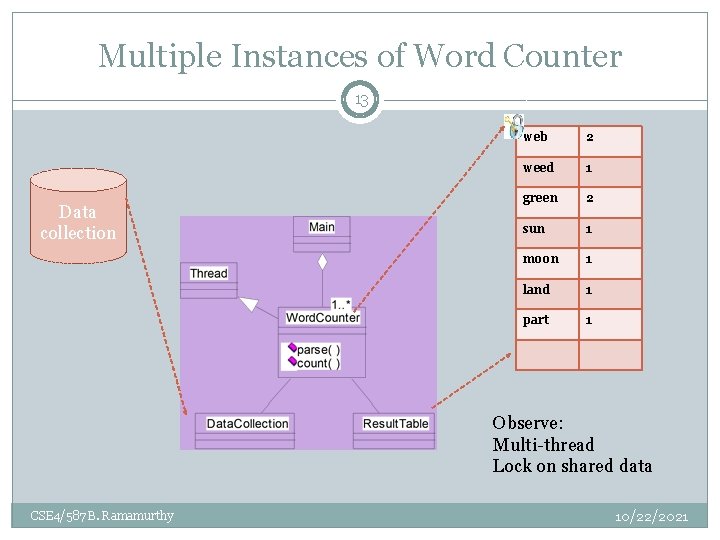
Multiple Instances of Word Counter 13 Data collection web 2 weed 1 green 2 sun 1 moon 1 land 1 part 1 Observe: Multi-thread Lock on shared data CSE 4/587 B. Ramamurthy 10/22/2021
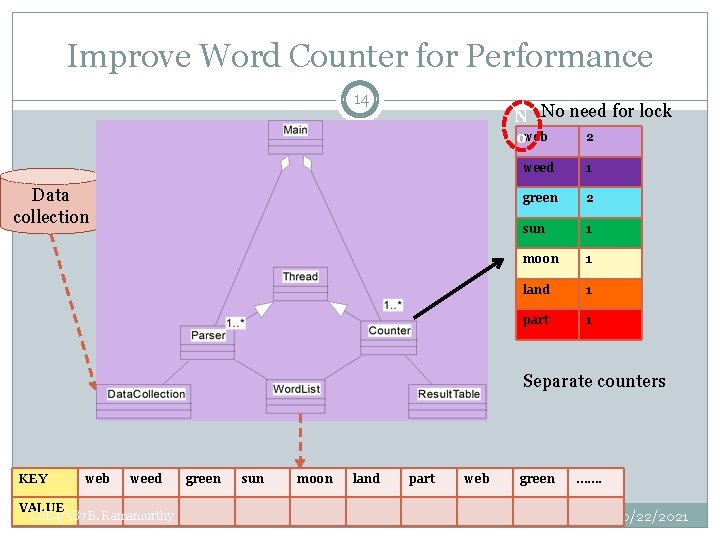
Improve Word Counter for Performance 14 N No need for lock 2 oweb Data collection weed 1 green 2 sun 1 moon 1 land 1 part 1 Separate counters KEY web weed VALUE CSE 4/587 B. Ramamurthy green sun moon land part web green ……. 10/22/2021
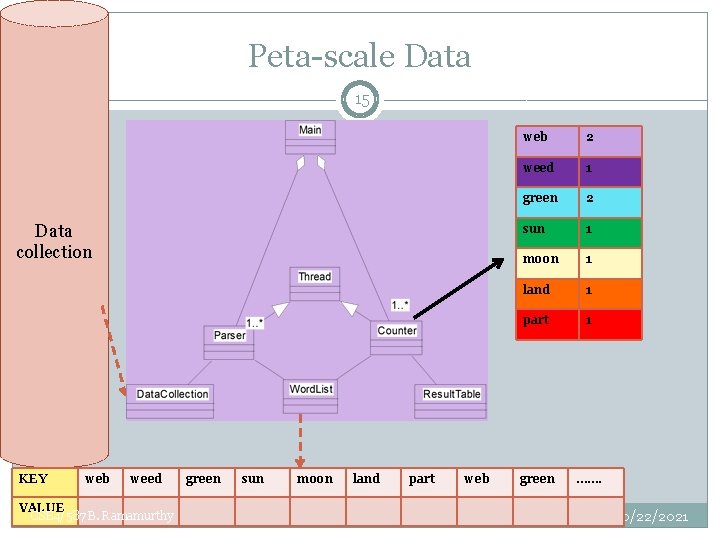
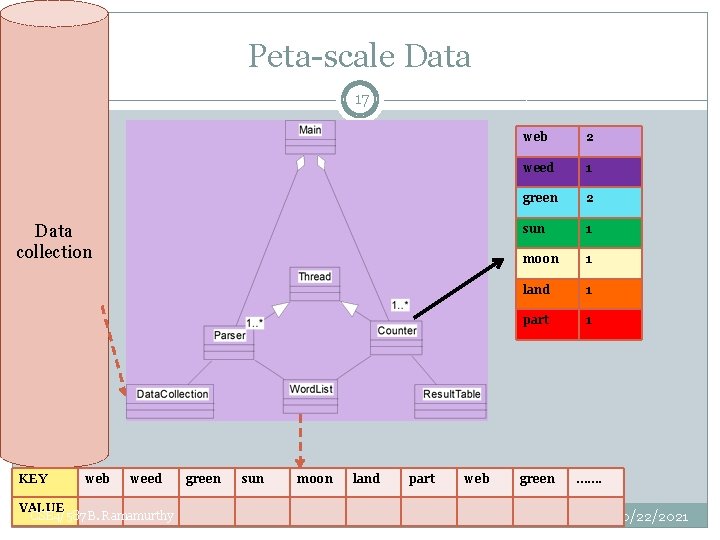
Peta-scale Data 15 Data collection KEY web weed VALUE CSE 4/587 B. Ramamurthy green sun moon land part web 2 weed 1 green 2 sun 1 moon 1 land 1 part 1 green ……. 10/22/2021
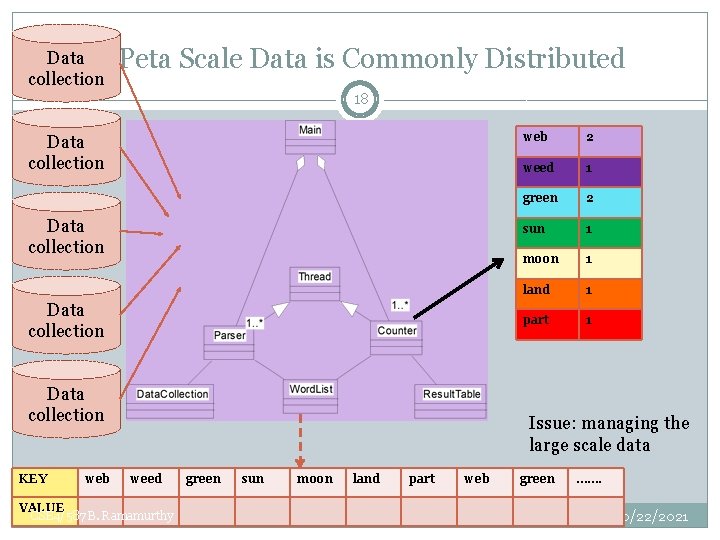
Addressing the Scale Issue 16 � Single machine cannot serve all the data: you need a distributed special (file) system � Large number of commodity hardware disks: say, 1000 disks 1 TB each Issue: With Mean time between failures (MTBF) or failure rate of 1/1000, then at least 1 of the above 1000 disks would be down at a given time. Thus failure is norm and not an exception. File system has to be fault-tolerant: replication, checksum Data transfer bandwidth is critical (location of data) � Critical aspects: fault tolerance + replication + load balancing, monitoring � Exploit parallelism afforded by splitting parsing and counting � Provision and locate computing at data locations CSE 4/587 B. Ramamurthy 10/22/2021
Peta-scale Data 17 Data collection KEY web weed VALUE CSE 4/587 B. Ramamurthy green sun moon land part web 2 weed 1 green 2 sun 1 moon 1 land 1 part 1 green ……. 10/22/2021
Data collection Peta Scale Data is Commonly Distributed 18 Data collection KEY web 2 weed 1 green 2 sun 1 moon 1 land 1 part 1 Issue: managing the large scale data weed VALUE CSE 4/587 B. Ramamurthy green sun moon land part web green ……. 10/22/2021
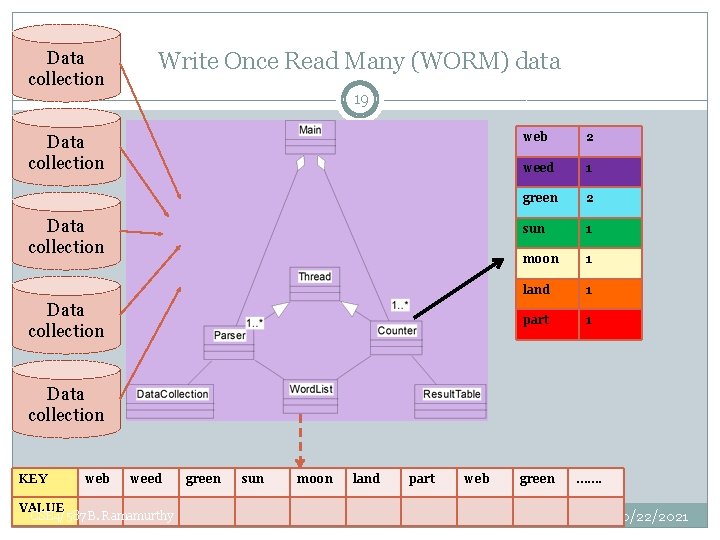
Data collection Write Once Read Many (WORM) data 19 Data collection web 2 weed 1 green 2 sun 1 moon 1 land 1 part 1 green ……. Data collection KEY web weed VALUE CSE 4/587 B. Ramamurthy green sun moon land part web 10/22/2021
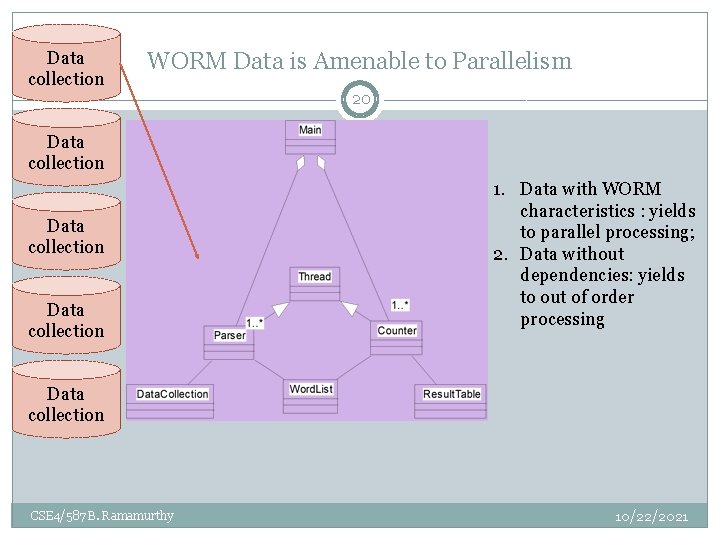
Data collection WORM Data is Amenable to Parallelism 20 Data collection 1. Data with WORM characteristics : yields to parallel processing; 2. Data without dependencies: yields to out of order processing Data collection CSE 4/587 B. Ramamurthy 10/22/2021
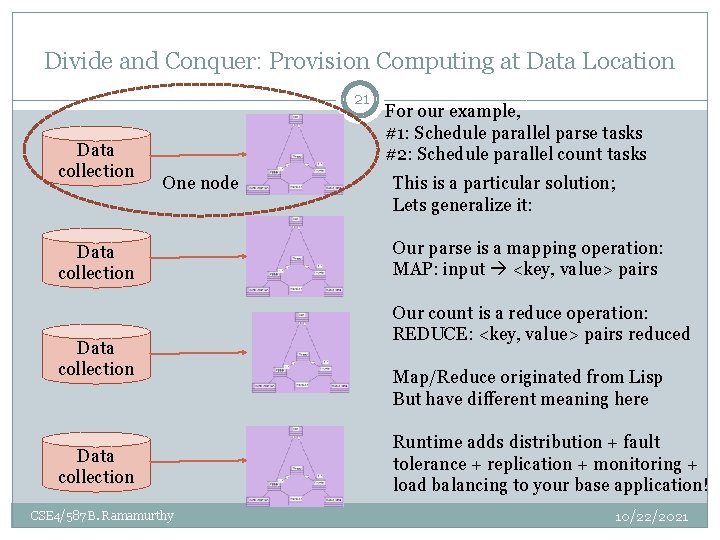
Divide and Conquer: Provision Computing at Data Location 21 Data collection One node Data collection CSE 4/587 B. Ramamurthy For our example, #1: Schedule parallel parse tasks #2: Schedule parallel count tasks This is a particular solution; Lets generalize it: Our parse is a mapping operation: MAP: input <key, value> pairs Our count is a reduce operation: REDUCE: <key, value> pairs reduced Map/Reduce originated from Lisp But have different meaning here Runtime adds distribution + fault tolerance + replication + monitoring + load balancing to your base application! 10/22/2021
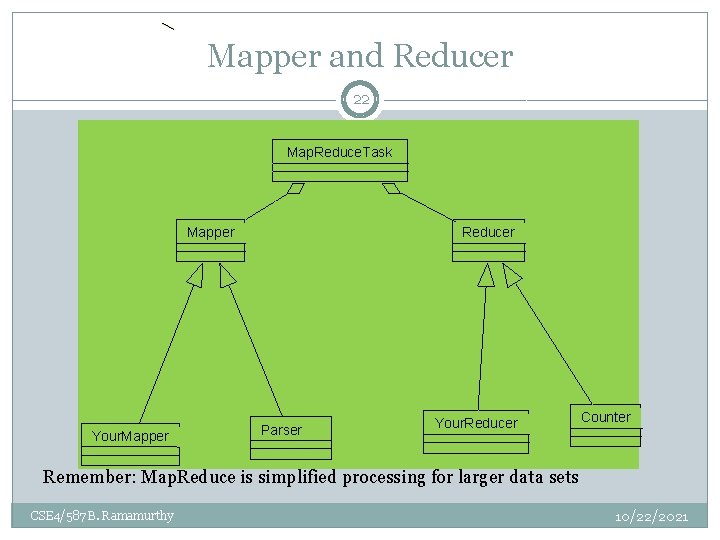
Mapper and Reducer 22 Map. Reduce. Task Mapper Your. Mapper Reducer Parser Your. Reducer Counter Remember: Map. Reduce is simplified processing for larger data sets CSE 4/587 B. Ramamurthy 10/22/2021
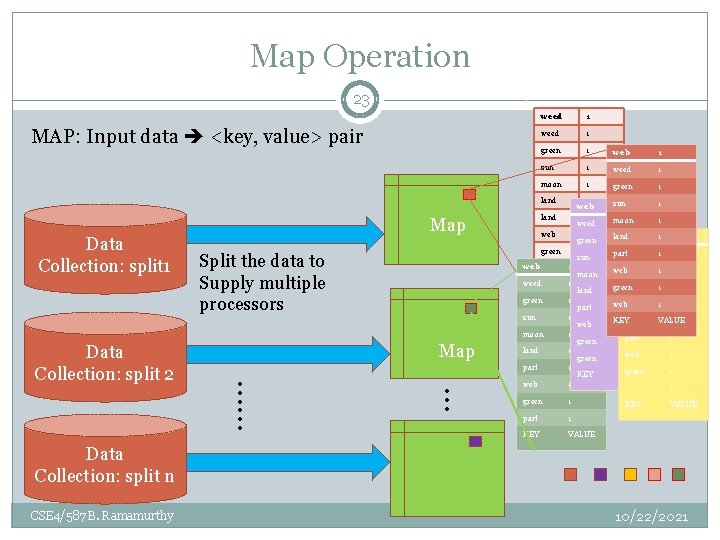
Map Operation 23 MAP: Input data <key, value> pair weed 1 green 1 web 1 sun 1 weed 1 moon 1 green 1 land Map … Data Collection: split 2 Split the data to Supply multiple processors …… Data Collection: split 1 Map 1 sun 1 web land 1 moon weed 1 web 1 land green 1 web green 1 part sun 1 weed web … 1 1 web moon 1 green weed. KEY 1 VALUEgreen land 1 sun green 1 web part 1 moon sun 1 KEY web 1 land moon 1 green 1 part land 1 green 1 web part 1 green KEY VALUE web 1 … green 1 part 1 KEY VALUE KEY 1 1 1 1 VALUE 1 1 VALUE Data Collection: split n CSE 4/587 B. Ramamurthy 10/22/2021
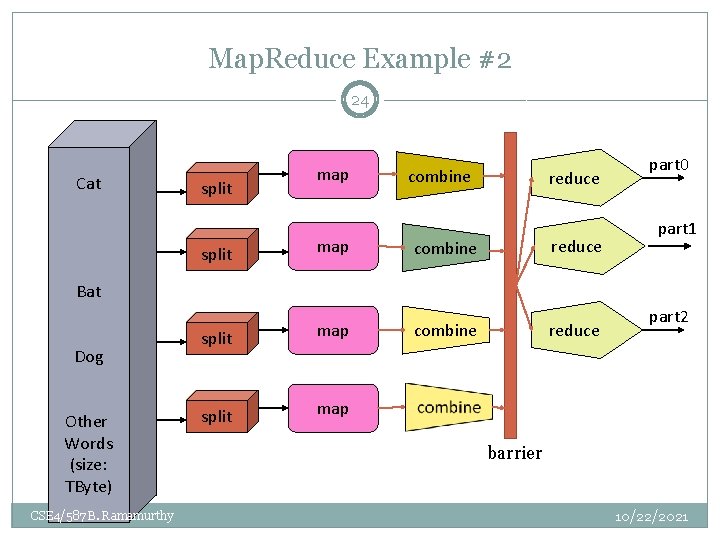
Map. Reduce Example #2 24 Cat split map combine reduce combine part 0 part 1 Bat Dog Other Words (size: TByte) CSE 4/587 B. Ramamurthy split map reduce combine part 2 barrier 10/22/2021
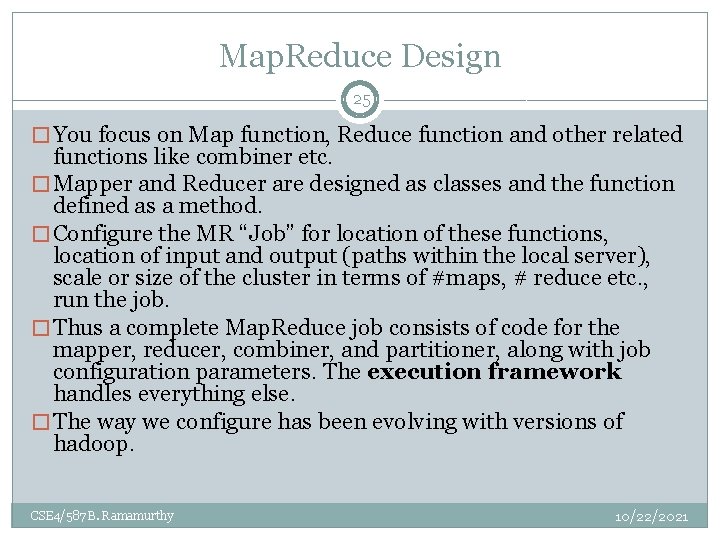
Map. Reduce Design 25 � You focus on Map function, Reduce function and other related functions like combiner etc. � Mapper and Reducer are designed as classes and the function defined as a method. � Configure the MR “Job” for location of these functions, location of input and output (paths within the local server), scale or size of the cluster in terms of #maps, # reduce etc. , run the job. � Thus a complete Map. Reduce job consists of code for the mapper, reducer, combiner, and partitioner, along with job configuration parameters. The execution framework handles everything else. � The way we configure has been evolving with versions of hadoop. CSE 4/587 B. Ramamurthy 10/22/2021
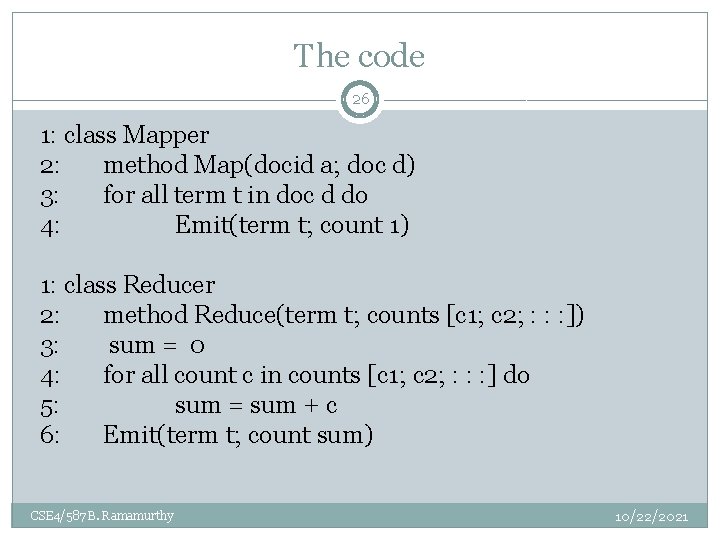
The code 26 1: class Mapper 2: method Map(docid a; doc d) 3: for all term t in doc d do 4: Emit(term t; count 1) 1: class Reducer 2: method Reduce(term t; counts [c 1; c 2; : : : ]) 3: sum = 0 4: for all count c in counts [c 1; c 2; : : : ] do 5: sum = sum + c 6: Emit(term t; count sum) CSE 4/587 B. Ramamurthy 10/22/2021
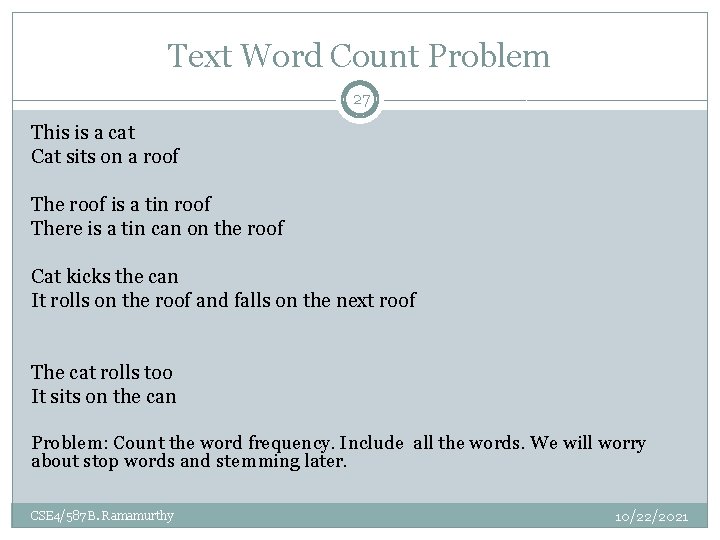
Text Word Count Problem 27 This is a cat Cat sits on a roof The roof is a tin roof There is a tin can on the roof Cat kicks the can It rolls on the roof and falls on the next roof The cat rolls too It sits on the can Problem: Count the word frequency. Include all the words. We will worry about stop words and stemming later. CSE 4/587 B. Ramamurthy 10/22/2021
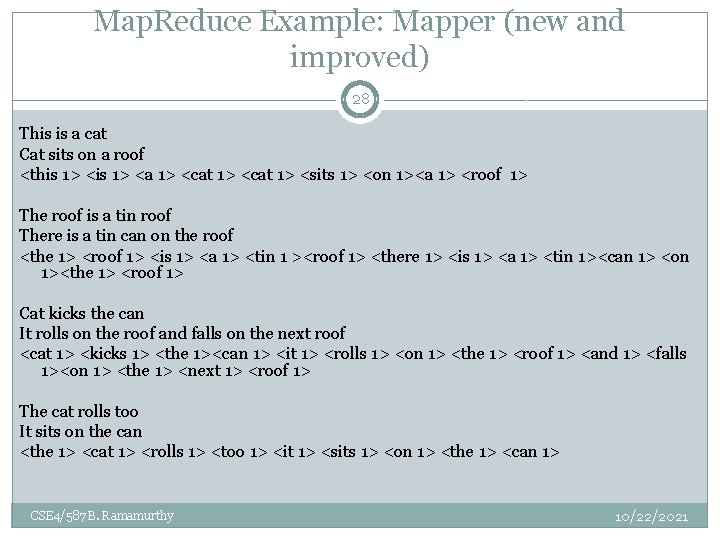
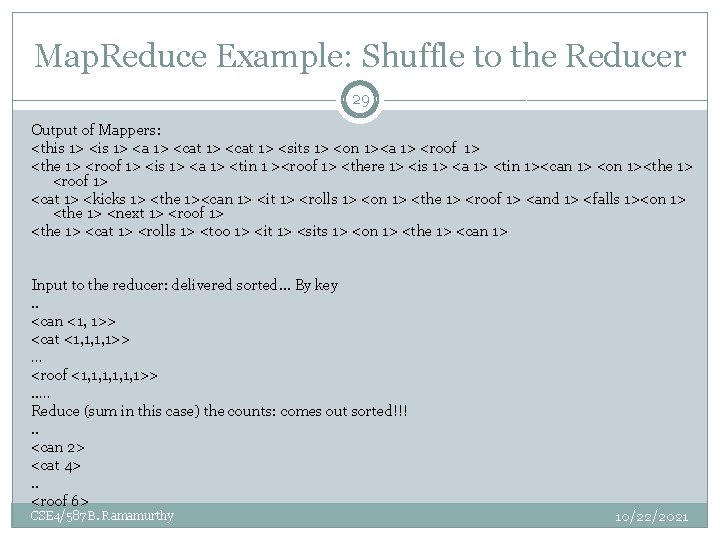
Map. Reduce Example: Mapper (new and improved) 28 This is a cat Cat sits on a roof <this 1> <a 1> <cat 1> <sits 1> <on 1><a 1> <roof 1> The roof is a tin roof There is a tin can on the roof <the 1> <roof 1> <is 1> <a 1> <tin 1 ><roof 1> <there 1> <is 1> <a 1> <tin 1><can 1> <on 1><the 1> <roof 1> Cat kicks the can It rolls on the roof and falls on the next roof <cat 1> <kicks 1> <the 1><can 1> <it 1> <rolls 1> <on 1> <the 1> <roof 1> <and 1> <falls 1><on 1> <the 1> <next 1> <roof 1> The cat rolls too It sits on the can <the 1> <cat 1> <rolls 1> <too 1> <it 1> <sits 1> <on 1> <the 1> <can 1> CSE 4/587 B. Ramamurthy 10/22/2021
Map. Reduce Example: Shuffle to the Reducer 29 Output of Mappers: <this 1> <a 1> <cat 1> <sits 1> <on 1><a 1> <roof 1> <the 1> <roof 1> <is 1> <a 1> <tin 1 ><roof 1> <there 1> <is 1> <a 1> <tin 1><can 1> <on 1><the 1> <roof 1> <cat 1> <kicks 1> <the 1><can 1> <it 1> <rolls 1> <on 1> <the 1> <roof 1> <and 1> <falls 1><on 1> <the 1> <next 1> <roof 1> <the 1> <cat 1> <rolls 1> <too 1> <it 1> <sits 1> <on 1> <the 1> <can 1> Input to the reducer: delivered sorted. . . By key. . <can <1, 1>> <cat <1, 1, 1, 1>> … <roof <1, 1, 1, 1>>. . … Reduce (sum in this case) the counts: comes out sorted!!!. . <can 2> <cat 4>. . <roof 6> CSE 4/587 B. Ramamurthy 10/22/2021
More on MR 30 �All Mappers work in parallel. �Barriers enforce all mappers completion before Reducers start. �Mappers and Reducers typically execute on the same machine �You can configure job to have other combinations besides Mapper/Reducer: ex: identify mappers/reducers for realizing “sort” (that happens to be a Benchmark) �Mappers and reducers can have side effects; this allows for sharing information between iterations. CSE 4/587 B. Ramamurthy 10/22/2021
Map. Reduce Characteristics 31 �Very large scale data: peta, exa bytes �Write once and read many data: allows for parallelism without mutexes �Map and Reduce are the main operations: simple code �There are other supporting operations such as combine and partition: we will look at those later. �Operations are provisioned near the data. �Commodity hardware and storage. �Runtime takes care of splitting and moving data for operations. �Special distributed file system: Hadoop Distributed File System and Hadoop Runtime. CSE 4/587 B. Ramamurthy 10/22/2021
Classes of problems “mapreducable” 32 � Benchmark for comparing: Jim Gray’s challenge on data- intensive computing. Ex: “Sort” � Google uses it (we think) for wordcount, adwords, pagerank, indexing data. � Simple algorithms such as grep, text-indexing, reverse indexing � Bayesian classification: data mining domain � Facebook uses it for various operations: demographics � Financial services use it for analytics � Astronomy: Gaussian analysis for locating extra-terrestrial objects. � Expected to play a critical role in semantic web and web 3. 0 CSE 4/587 B. Ramamurthy 10/22/2021
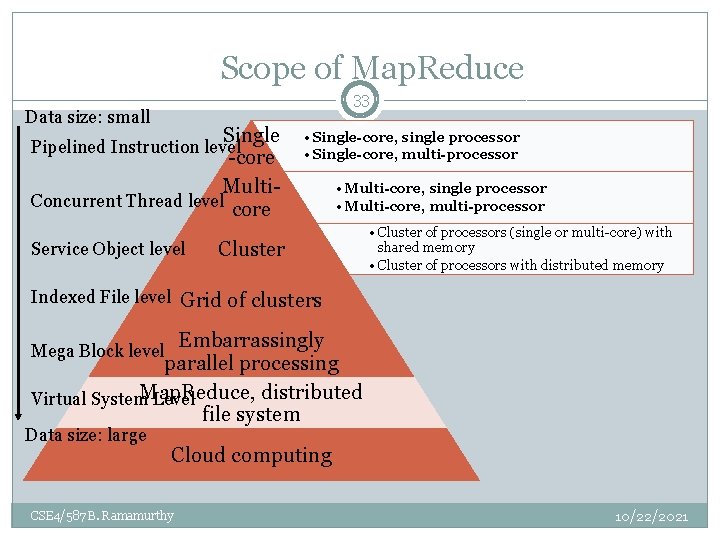
Scope of Map. Reduce 33 Data size: small Single -core Multi. Concurrent Thread level core Pipelined Instruction level Service Object level • Single-core, single processor • Single-core, multi-processor • Multi-core, single processor • Multi-core, multi-processor Cluster • Cluster of processors (single or multi-core) with shared memory • Cluster of processors with distributed memory Indexed File level Grid of clusters Embarrassingly parallel processing distributed Virtual System. Map. Reduce, Level file system Mega Block level Data size: large Cloud computing CSE 4/587 B. Ramamurthy 10/22/2021
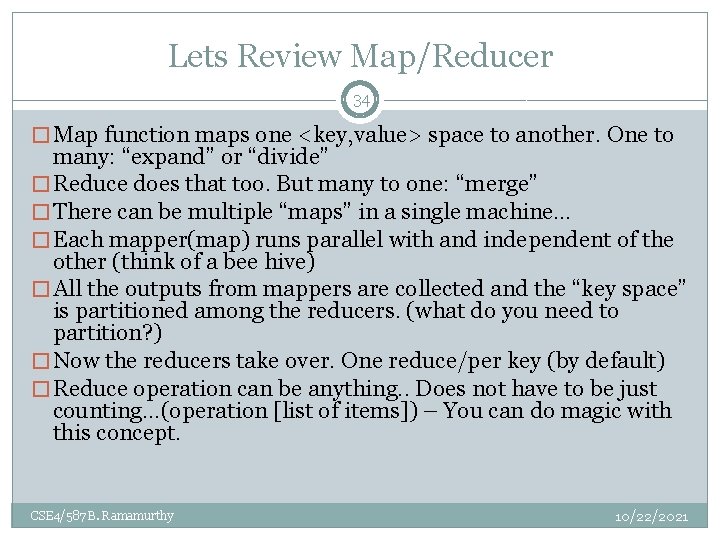
Lets Review Map/Reducer 34 � Map function maps one <key, value> space to another. One to many: “expand” or “divide” � Reduce does that too. But many to one: “merge” � There can be multiple “maps” in a single machine… � Each mapper(map) runs parallel with and independent of the other (think of a bee hive) � All the outputs from mappers are collected and the “key space” is partitioned among the reducers. (what do you need to partition? ) � Now the reducers take over. One reduce/per key (by default) � Reduce operation can be anything. . Does not have to be just counting…(operation [list of items]) – You can do magic with this concept. CSE 4/587 B. Ramamurthy 10/22/2021
Hadoop 35 10/22/2021 CSE 4/587 B. Ramamurthy
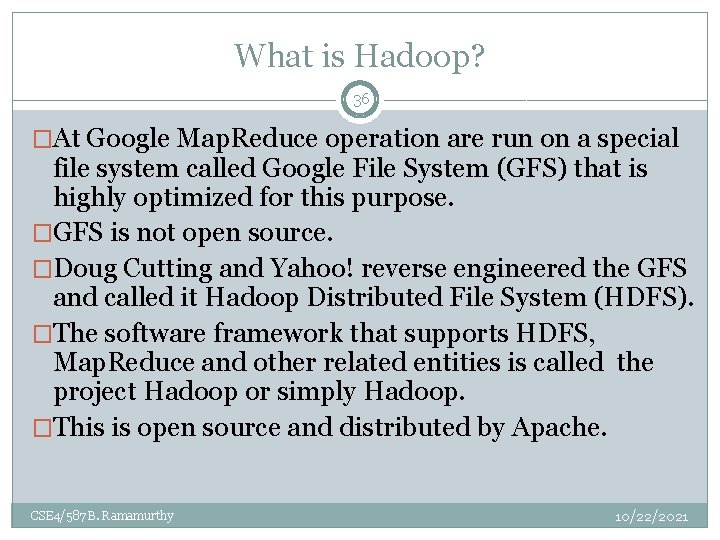
What is Hadoop? 36 �At Google Map. Reduce operation are run on a special file system called Google File System (GFS) that is highly optimized for this purpose. �GFS is not open source. �Doug Cutting and Yahoo! reverse engineered the GFS and called it Hadoop Distributed File System (HDFS). �The software framework that supports HDFS, Map. Reduce and other related entities is called the project Hadoop or simply Hadoop. �This is open source and distributed by Apache. CSE 4/587 B. Ramamurthy 10/22/2021
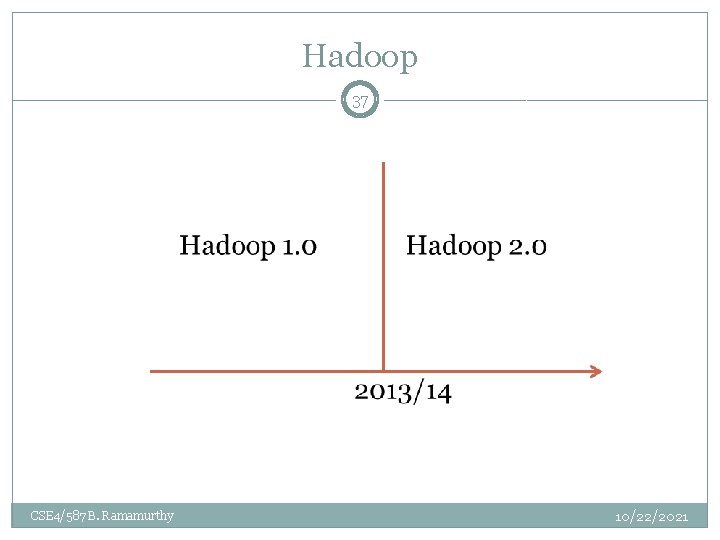
Hadoop 37 CSE 4/587 B. Ramamurthy 10/22/2021
What has changed? Hmm… 38 CSE 4/587 B. Ramamurthy 10/22/2021
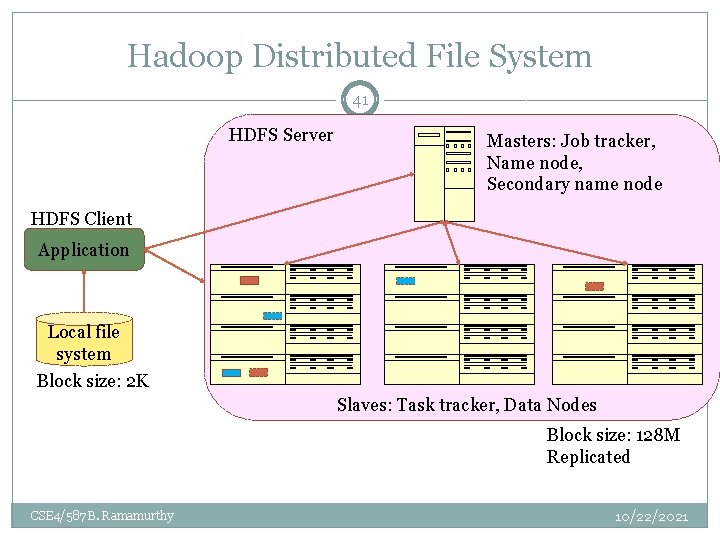
Basic Features: HDFS 39 � Highly fault-tolerant � High throughput � Suitable for applications with large data sets � Streaming access to file system data � Can be built out of commodity hardware � HDFS core principles are the same in both major releases of Hadoop. • CSE 4/587 B. Ramamurthy 10/22/2021
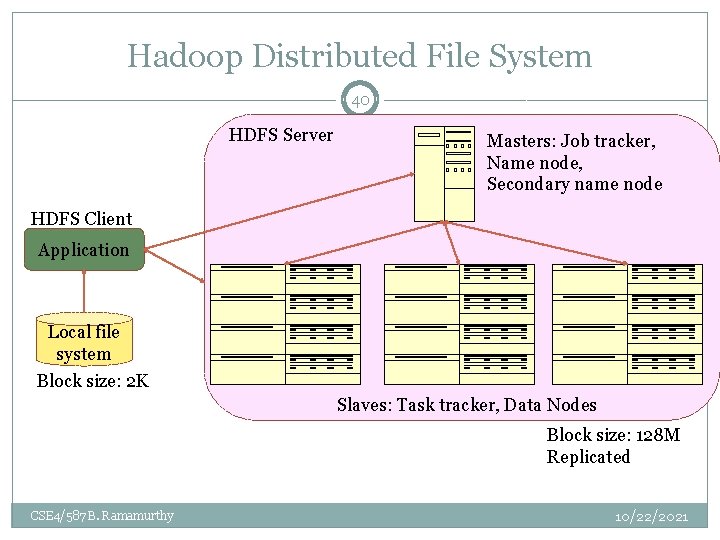
Hadoop Distributed File System 40 HDFS Server Masters: Job tracker, Name node, Secondary name node HDFS Client Application Local file system Block size: 2 K Slaves: Task tracker, Data Nodes Block size: 128 M Replicated CSE 4/587 B. Ramamurthy 10/22/2021
Hadoop Distributed File System 41 HDFS Server Masters: Job tracker, Name node, Secondary name node HDFS Client Application Local file system Block size: 2 K Slaves: Task tracker, Data Nodes Block size: 128 M Replicated CSE 4/587 B. Ramamurthy 10/22/2021
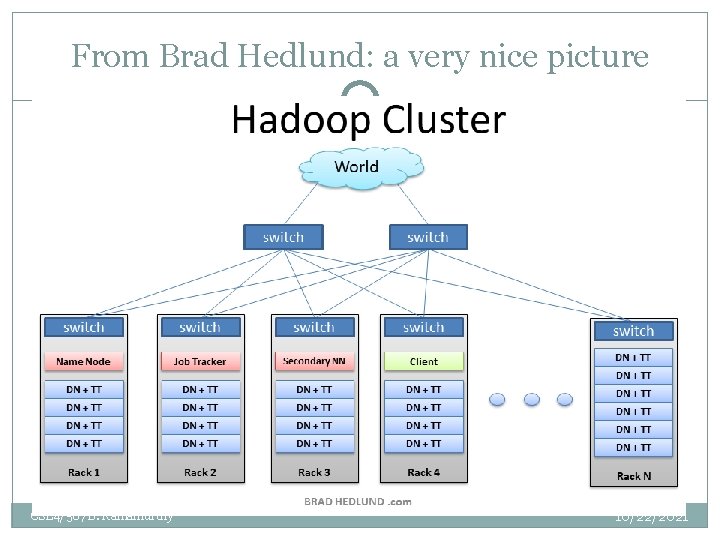
From Brad Hedlund: a very nice picture 42 CSE 4/587 B. Ramamurthy 10/22/2021
Hadoop (contd. ) 43 �What are : Job tracker, Name node, Secondary name node, data node, task tracker…? �What are their roles? �Before we discuss those: lets look a demo of mapreduce on Hadoop Map. Reduce CSE 4/587 B. Ramamurthy 10/22/2021