
An Industry Equilibrium Analysis of Downstream Vertical Integration
An Industry Equilibrium Analysis of Downstream Vertical Integration TIMOTHY W. MCGUIRE AND RICHARD STAELIN MARKETING SCIENCE, VOL. 2, NO. 2 (SPRING, 1983), PP. 161 -191
Research Question “Why a producer may want to place one or more levels of intermediary between itself and the marketplace even when the producer is capable of carrying out the selling functions with the same efficiency as the intermediary”? o This paper investigates the effect of product substitutability on Nash equilibrium distribution structures in a duopoly where each manufacturer distributes its goods through a single exclusive retailer
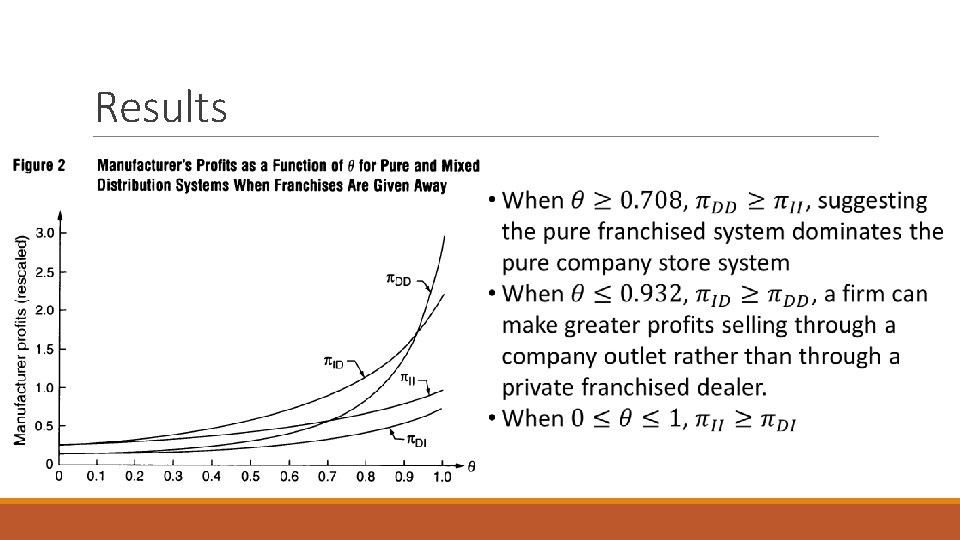
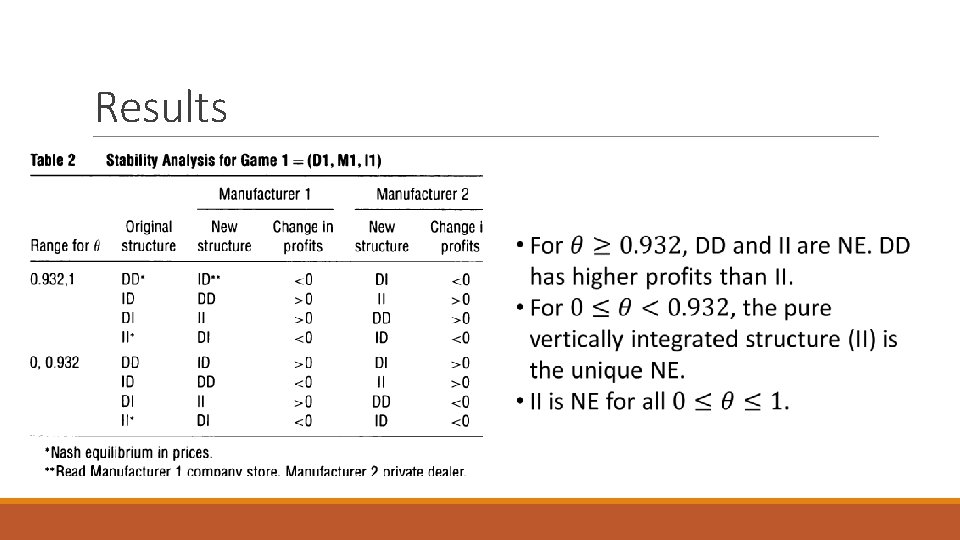
Key Insights & Contributions o Product substitutability does influence the equilibrium distribution structure o For low degrees of substitutability, each manufacturer will distribute its product through a company store; for more highly competitive goods, manufacturers will be more likely to use a decentralized distribution system. v This paper shows that vertical integration is not always optimal v It is the first example in marketing in which the optimal channel structure emerges from an equilibrium analysis of a game played between the two competing manufacturers
Equilibrium Conditions o Two manufactures produces differentiated but competing products o A manufacturer distributes its products through one retail outlet and hold most of the power in the producer-retailer dyads üA company store üA franchised outlet o Any one retail outlet carries the product line of only one manufacturer üConsumer product: Gasoline, new automobiles, soft drinks and fast food chains, etc. üIndustry product: Industrial gases, fork lift trucks and heavy farm equipment, etc.
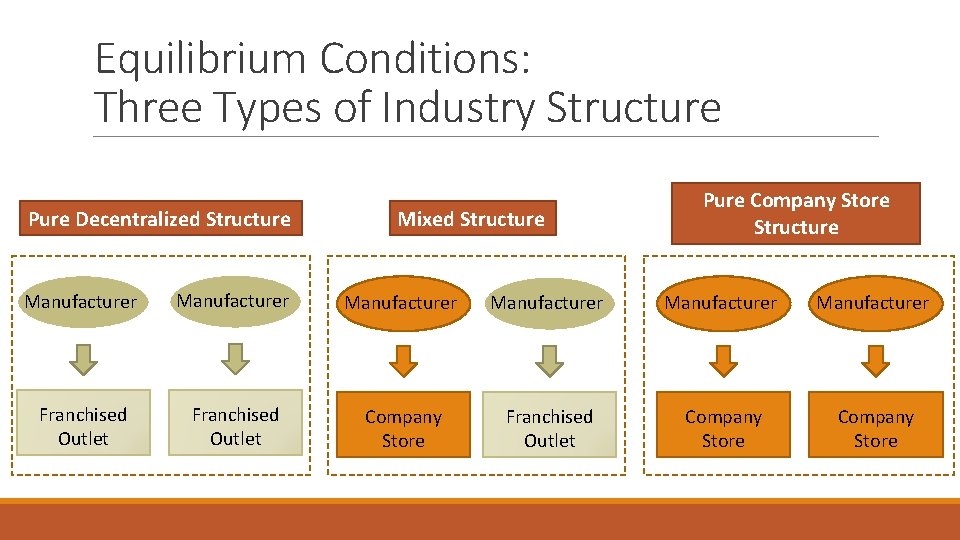
Equilibrium Conditions: Three Types of Industry Structure Pure Decentralized Structure Mixed Structure Pure Company Store Structure Manufacturer Manufacturer Franchised Outlet Company Store
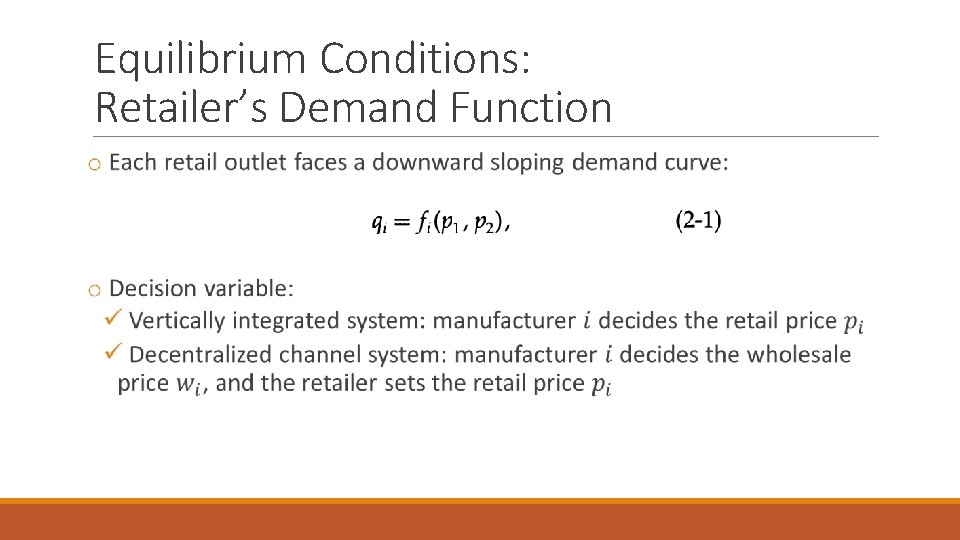
Equilibrium Conditions: Retailer’s Demand Function
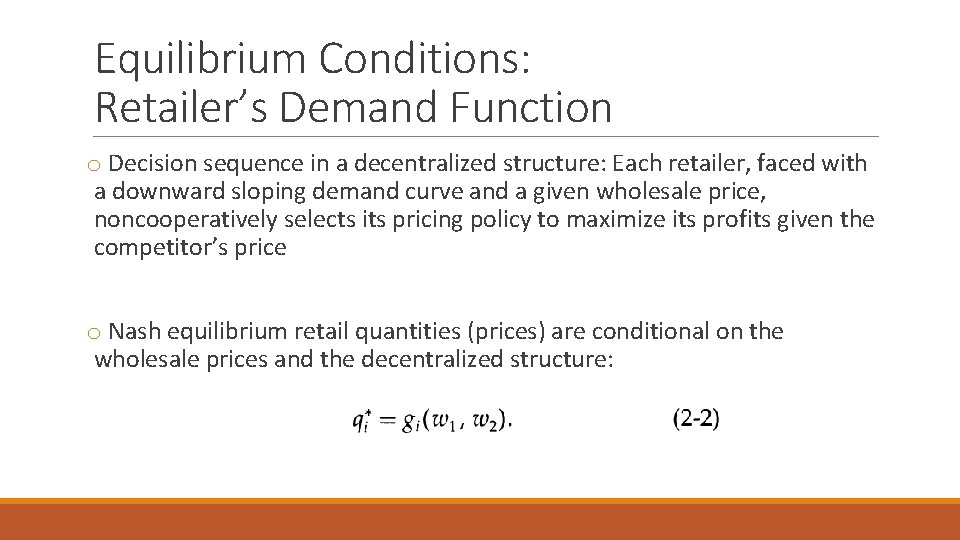
Equilibrium Conditions: Retailer’s Demand Function o Decision sequence in a decentralized structure: Each retailer, faced with a downward sloping demand curve and a given wholesale price, noncooperatively selects its pricing policy to maximize its profits given the competitor’s price o Nash equilibrium retail quantities (prices) are conditional on the wholesale prices and the decentralized structure:
![Equilibrium Conditions: Manufacture Strategy Rules o Pure decentralized structure (D 1): Each [decentralized] manufacturer](http://slidetodoc.com/presentation_image_h2/6ab07619fb8df3f818d21e5c21cecd3e/image-8.jpg "Equilibrium Conditions: Manufacture Strategy Rules o Pure decentralized structure (D 1): Each [decentralized] manufacturer")
Equilibrium Conditions: Manufacture Strategy Rules o Pure decentralized structure (D 1): Each [decentralized] manufacturer chooses its wholesale price to maximize its profits conditional on its competitor's wholesale price and on the conditional equilibrium retail price (or quantity) functions, which are functions of the two wholesale prices. That is, each manufacturer takes account of the reactions of both retailers to its moves but assumes that the competing manufacturer will not respond.
Equilibrium Conditions: Strategy Rules o Mixed structure (M 1): The integrated firm sets its [retail] price to maximize profits conditional on the decentralized retailer's price. The decentralized retailer conditions on its manufacturer's wholesale price and its competitor's retail price when selecting its profit-maximizing price. The decentralized manufacturer chooses its wholesale price to maximize profits conditional on the conditional equilibrium retail price functions, which are functions of its wholesale price. o Factory outlet structure (I 1): Each [integrated] manufacturer chooses the retail price that maximizes its profits given its competitor's retail price. o Note: retailers are assumed to be price takers
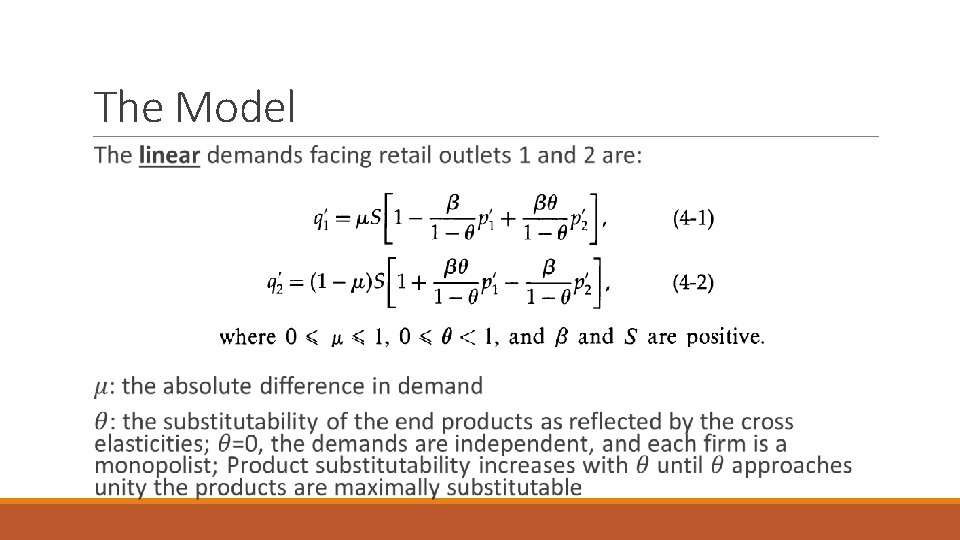
The Model
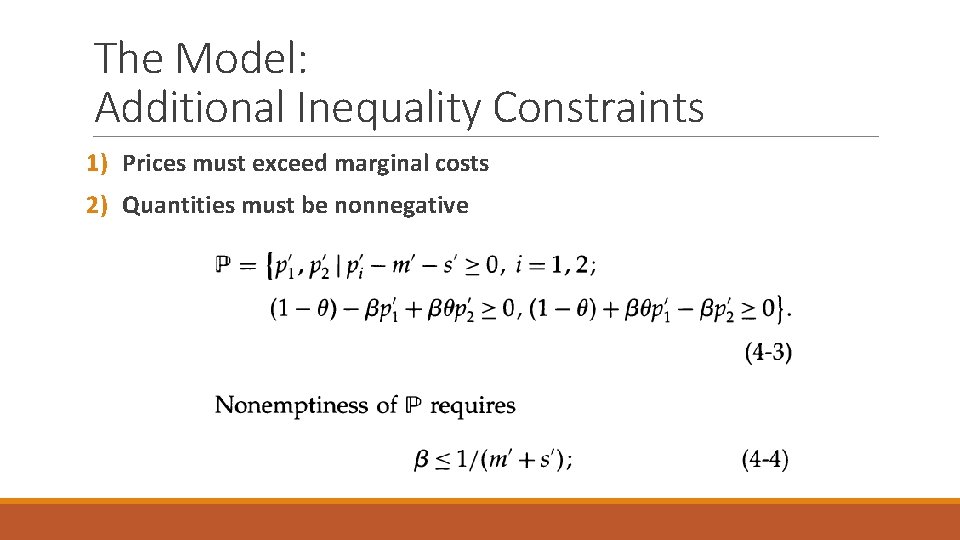
The Model: Additional Inequality Constraints 1) Prices must exceed marginal costs 2) Quantities must be nonnegative
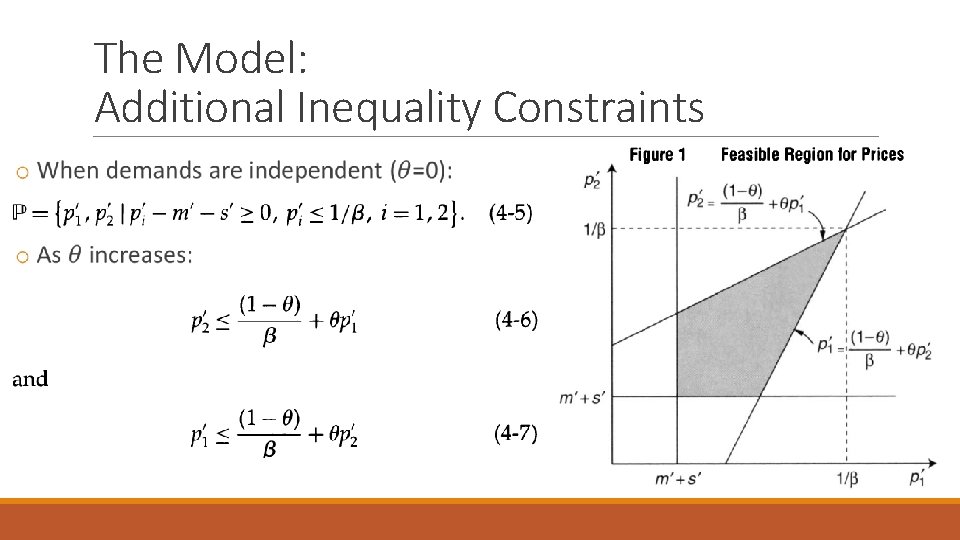
The Model: Additional Inequality Constraints
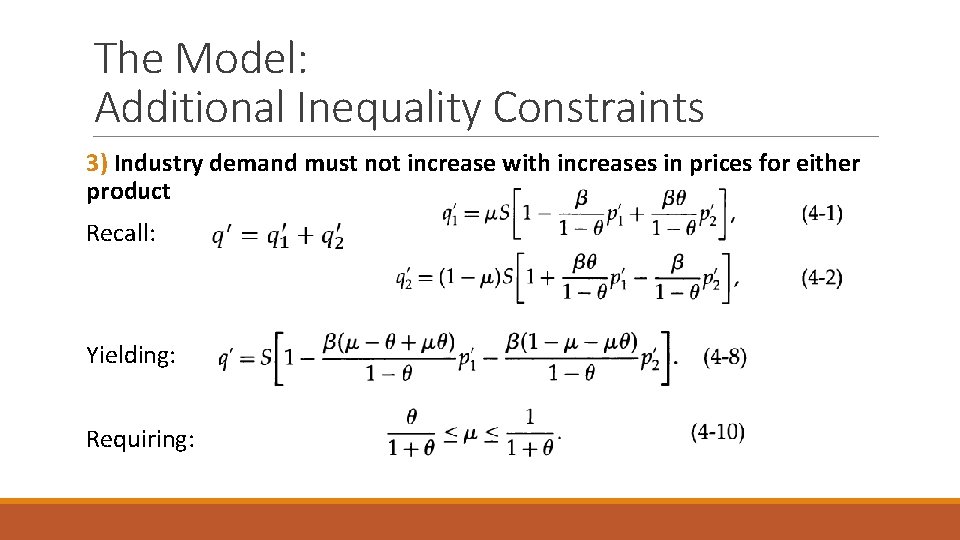
The Model: Additional Inequality Constraints 3) Industry demand must not increase with increases in prices for either product Recall: Yielding: Requiring:
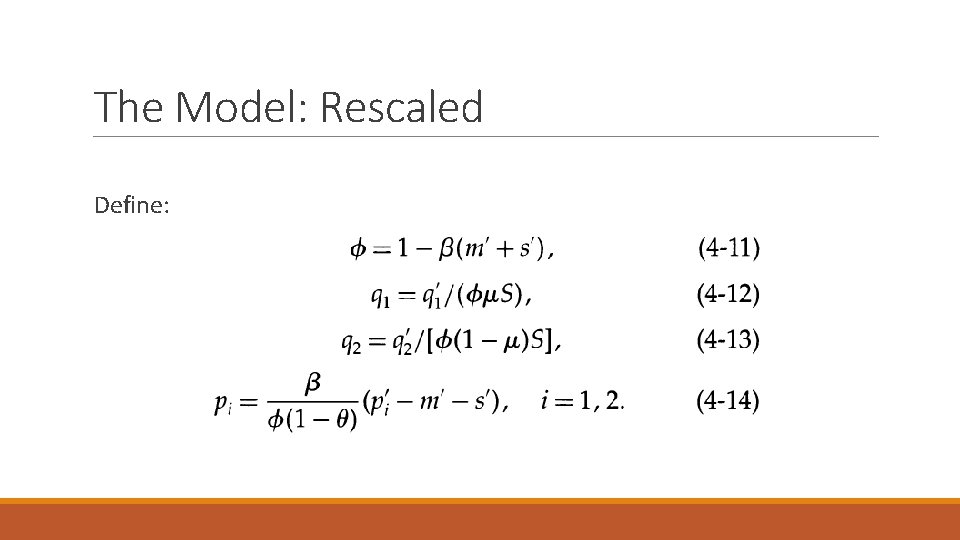
The Model: Rescaled Define:
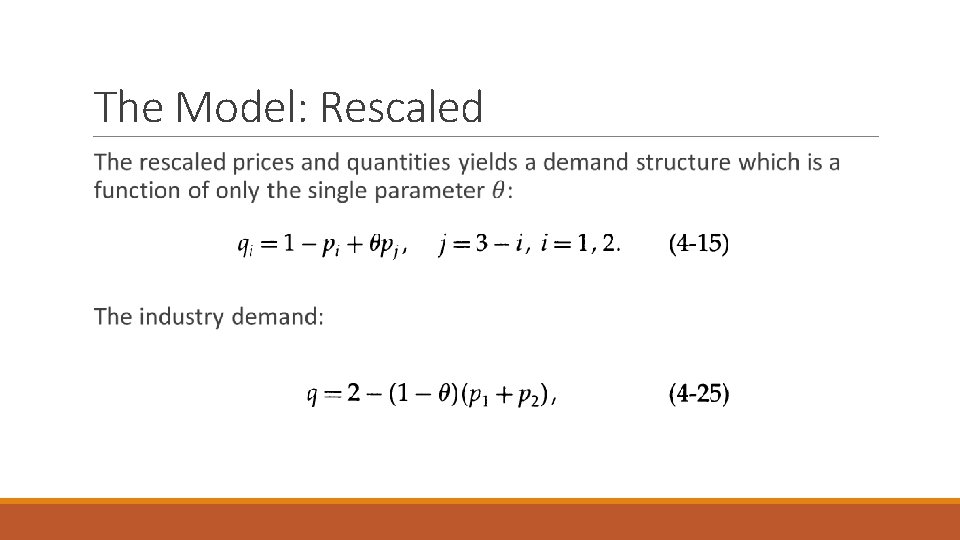
The Model: Rescaled
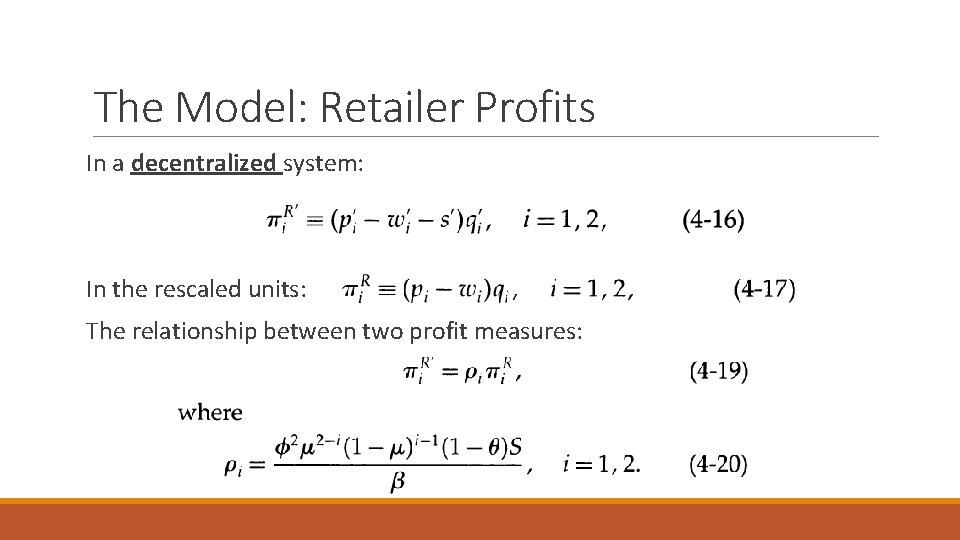
The Model: Retailer Profits In a decentralized system: In the rescaled units: The relationship between two profit measures:
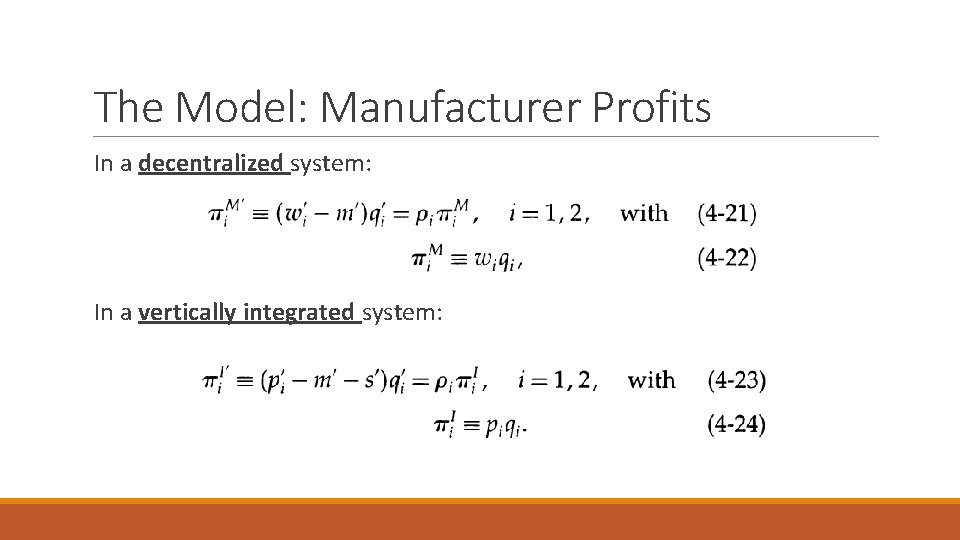
The Model: Manufacturer Profits In a decentralized system: In a vertically integrated system:
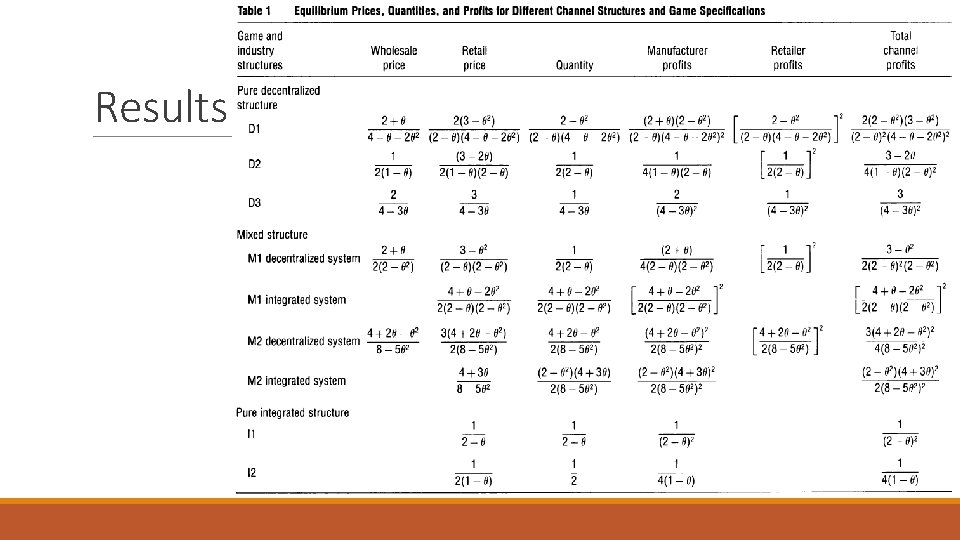
Illustrative Analysis: Derive NE for D 1 Nash Equilibrium (NE) in prices in a pure decentralized structure: o Retailer: neither retailer can increase its profits by changing its price if the wholesale price it faces and the other retailer’s price remain fixed o Manufacturer: neither manufacturer has an incentive to change its wholesale price given the wholesale price of the other manufacturer and given the decision rules of the retailers
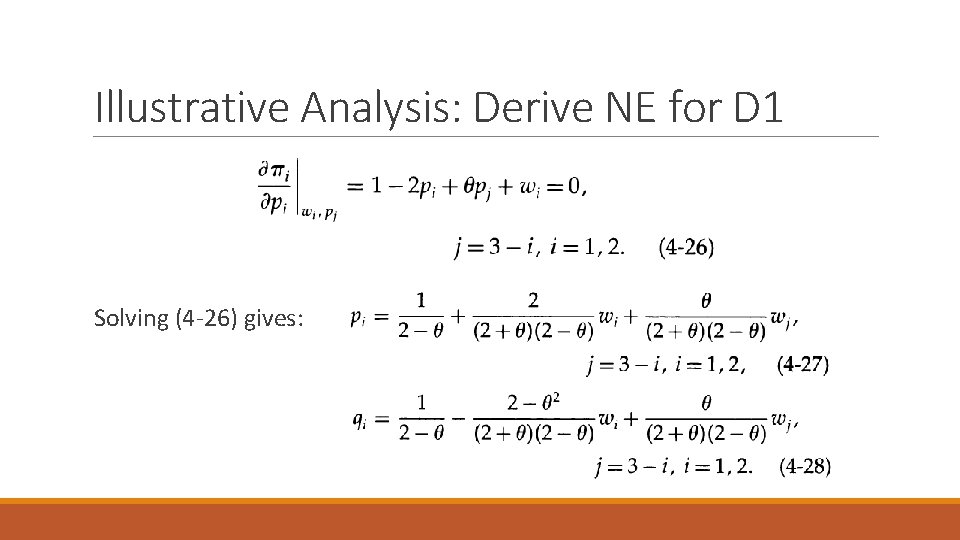
Illustrative Analysis: Derive NE for D 1 Solving (4 -26) gives:
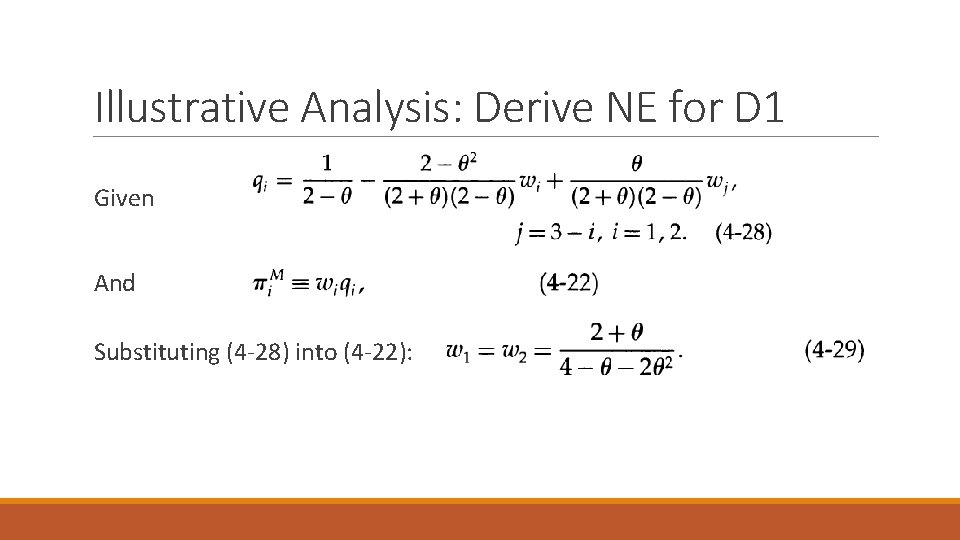
Illustrative Analysis: Derive NE for D 1 Given And Substituting (4 -28) into (4 -22):
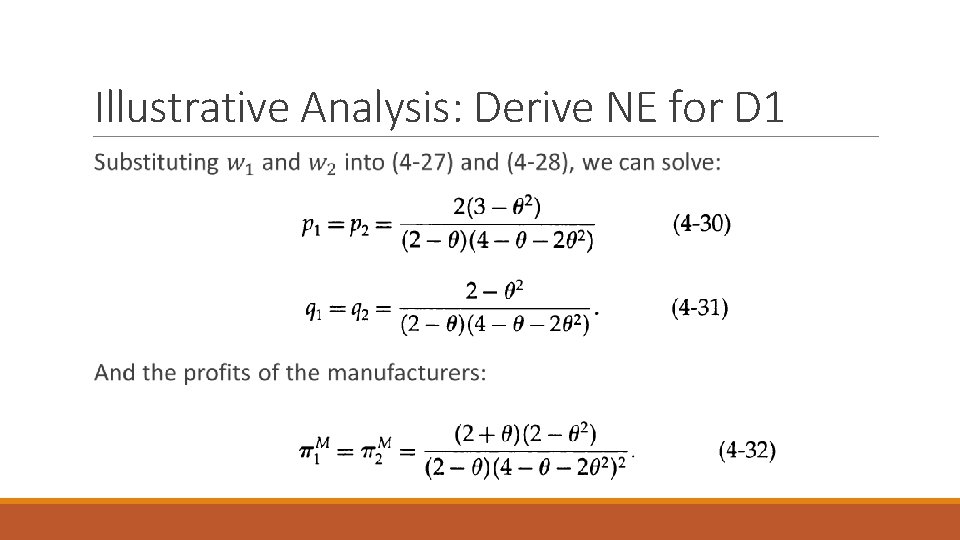
Illustrative Analysis: Derive NE for D 1
Results
Results
Results
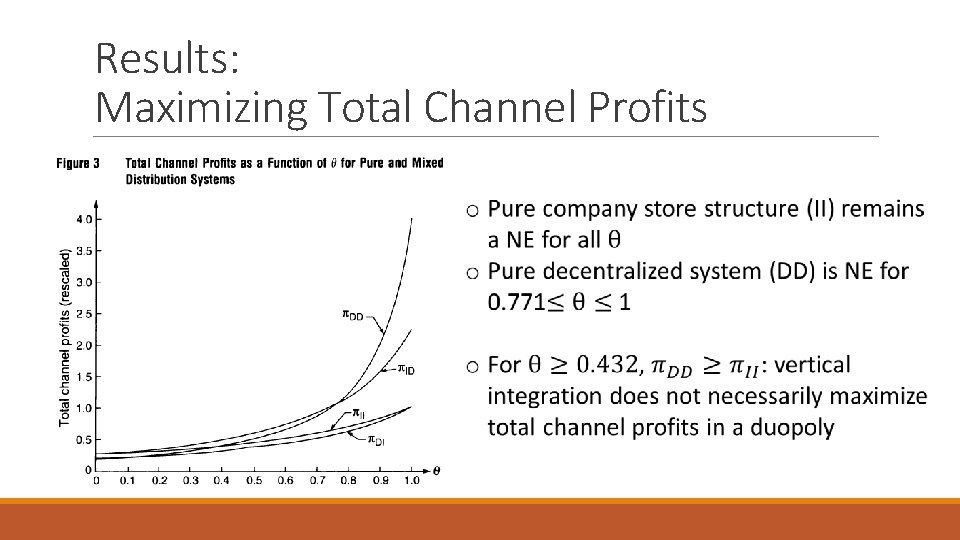
Results: Maximizing Total Channel Profits
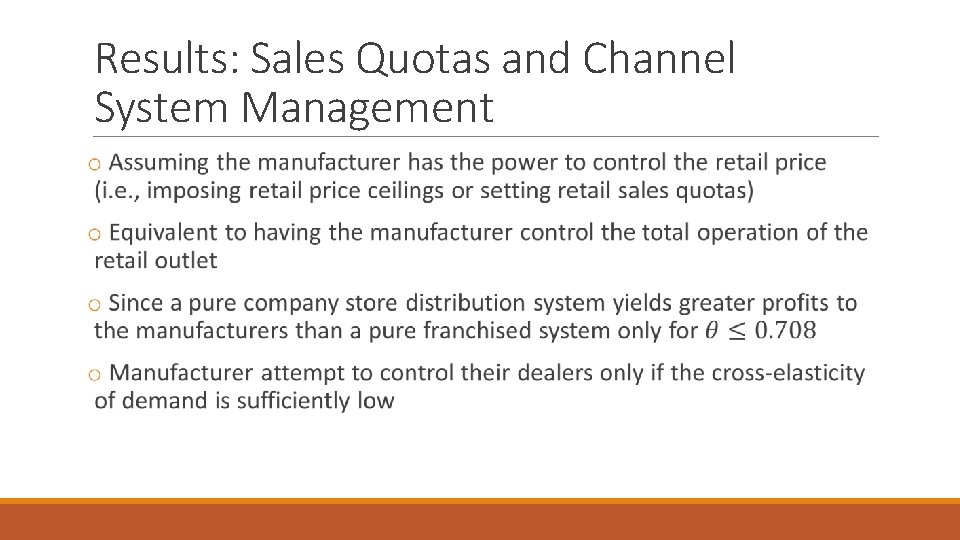
Results: Sales Quotas and Channel System Management
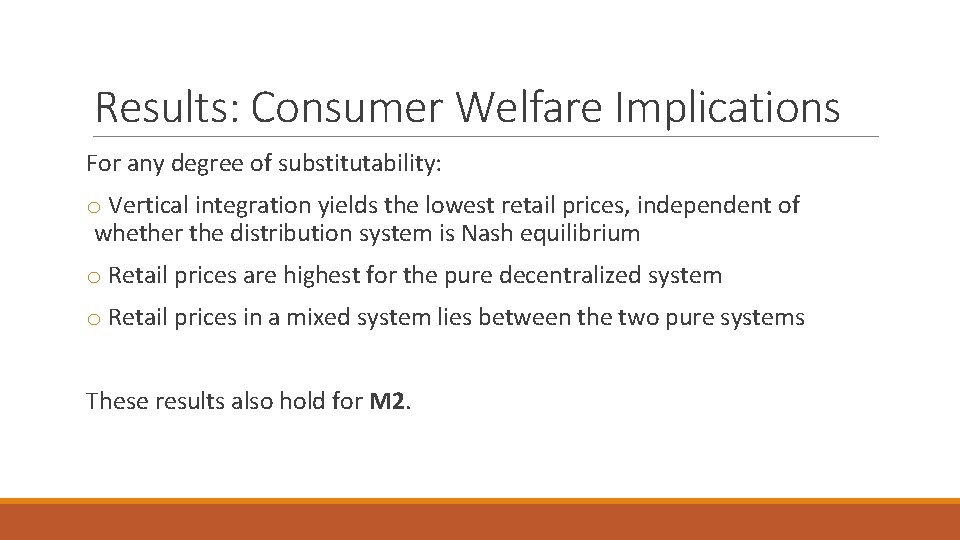
Results: Consumer Welfare Implications For any degree of substitutability: o Vertical integration yields the lowest retail prices, independent of whether the distribution system is Nash equilibrium o Retail prices are highest for the pure decentralized system o Retail prices in a mixed system lies between the two pure systems These results also hold for M 2.
![Results: Colluding Manufacturers o D 2: The two [decentralized] manufacturers set their wholesale prices](http://slidetodoc.com/presentation_image_h2/6ab07619fb8df3f818d21e5c21cecd3e/image-28.jpg "Results: Colluding Manufacturers o D 2: The two [decentralized] manufacturers set their wholesale prices")
Results: Colluding Manufacturers o D 2: The two [decentralized] manufacturers set their wholesale prices to maximize the sum of their profits conditional on the conditional equilibrium retail price (or quantity) functions o I 2: The two [integrated] manufacturers choose the retail prices that maximize the sum of their profits.
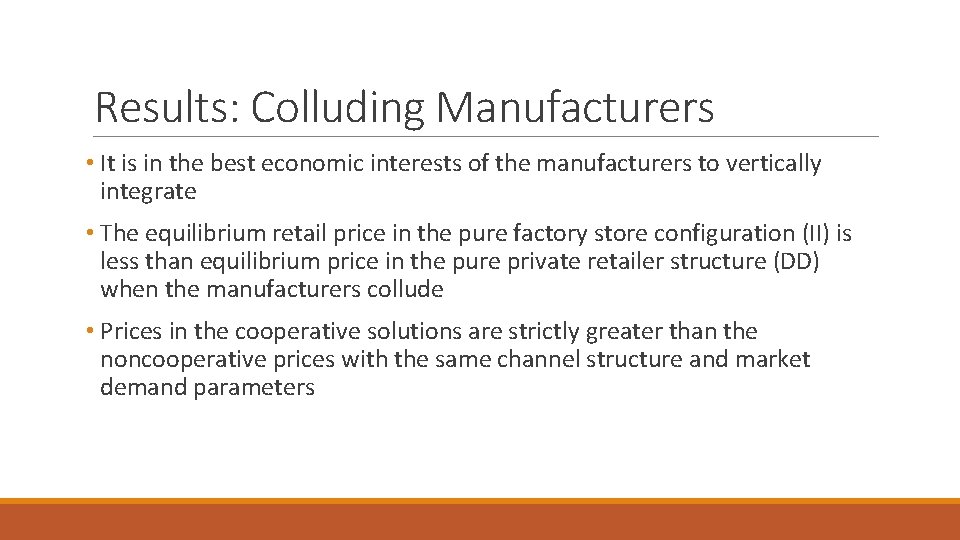
Results: Colluding Manufacturers • It is in the best economic interests of the manufacturers to vertically integrate • The equilibrium retail price in the pure factory store configuration (II) is less than equilibrium price in the pure private retailer structure (DD) when the manufacturers collude • Prices in the cooperative solutions are strictly greater than the noncooperative prices with the same channel structure and market demand parameters
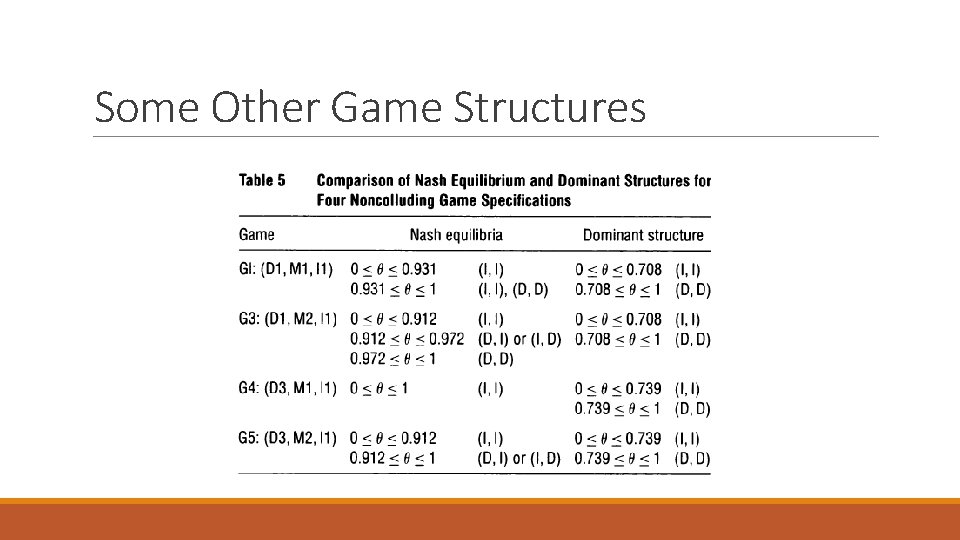
Some Other Game Structures
Summary o It is the degree of interdependence between the end-user demand for the two products which determines whether a manufacturer finds it more profitable to use an intermediary or carry out the selling and distribution functions itself. o Consumers are best off when manufacturers sell through company stores independent of whether the manufacturers are colluding or behaving noncooperatively. o It is not always in the best self-interests of a manufacturer to attempt to control the operations of a privately-owned franchised outlet. Instead, control is optimal only when the cross-elasticities of demand are reasonably low.
Summary o Total channel profits are not always greater when the manufacturer gains complete control of the system, either by vertically integrating or by imposing quotas (or setting the retail price) than when it lets the independent retailer set the retail price. o In all cases, the pure vertically integrated structure is Nash equilibrium for poor substitutes, a finding which is consistent with monopoly theory. As substitutability increases, decentralization becomes the more attractive, and sometimes Nash equilibrium, alternative. o If the manufacturers behave cooperatively, profits are greater and retail prices lower with a pure company store system than with privately owned dealers.
- Slides: 32