
An indirect object receives the action of the
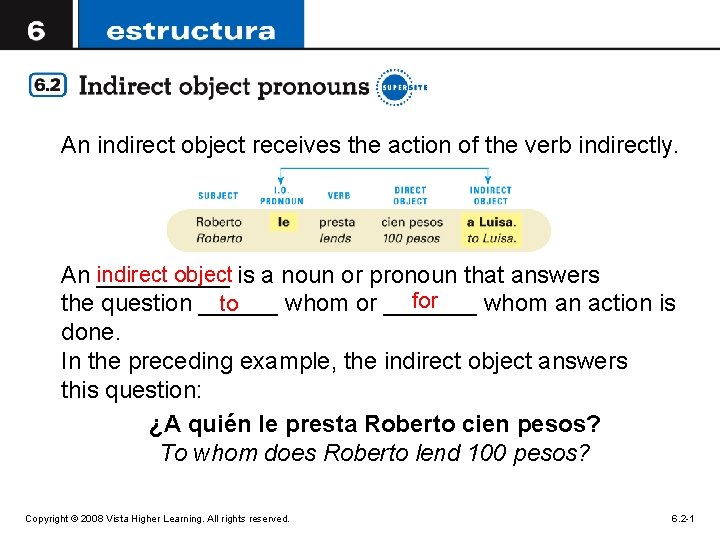
An indirect object receives the action of the verb indirectly. indirect object is a noun or pronoun that answers An _____ for to the question ______ whom or _______ whom an action is done. In the preceding example, the indirect object answers this question: ¿A quién le presta Roberto cien pesos? To whom does Roberto lend 100 pesos? Copyright © 2008 Vista Higher Learning. All rights reserved. 6. 2 -1
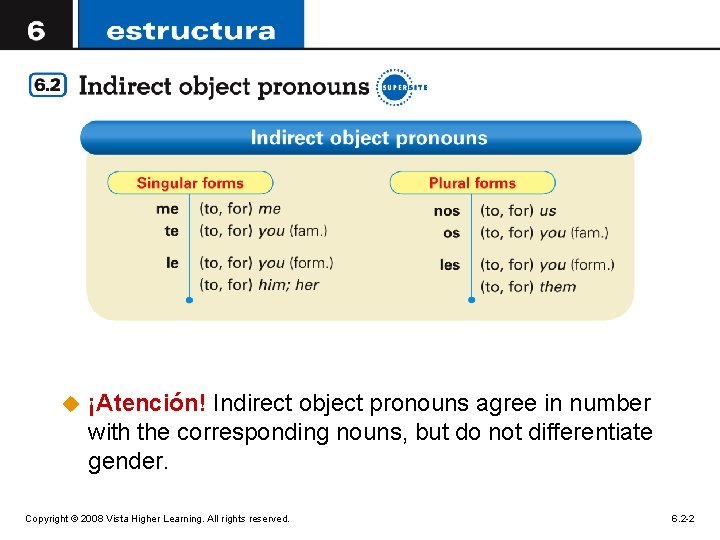
u ¡Atención! Indirect object pronouns agree in number with the corresponding nouns, but do not differentiate gender. Copyright © 2008 Vista Higher Learning. All rights reserved. 6. 2 -2
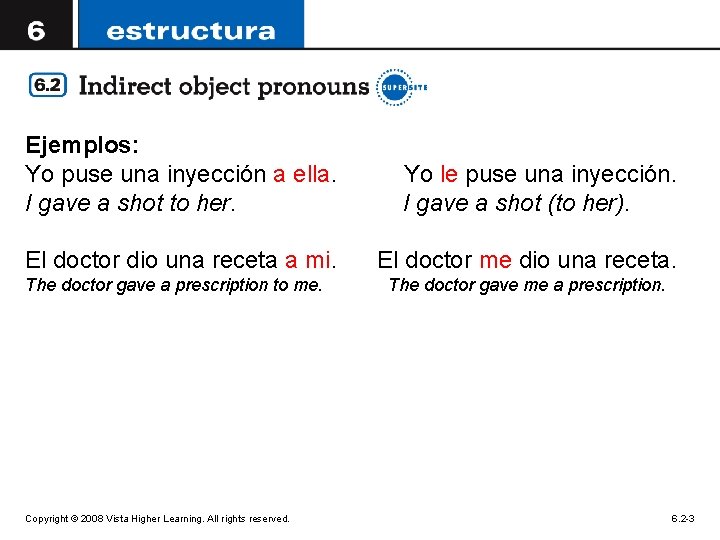
Ejemplos: Yo puse una inyección a ella. I gave a shot to her. Yo le puse una inyección. I gave a shot (to her). El doctor dio una receta a mi. El doctor me dio una receta. The doctor gave a prescription to me. Copyright © 2008 Vista Higher Learning. All rights reserved. The doctor gave me a prescription. 6. 2 -3
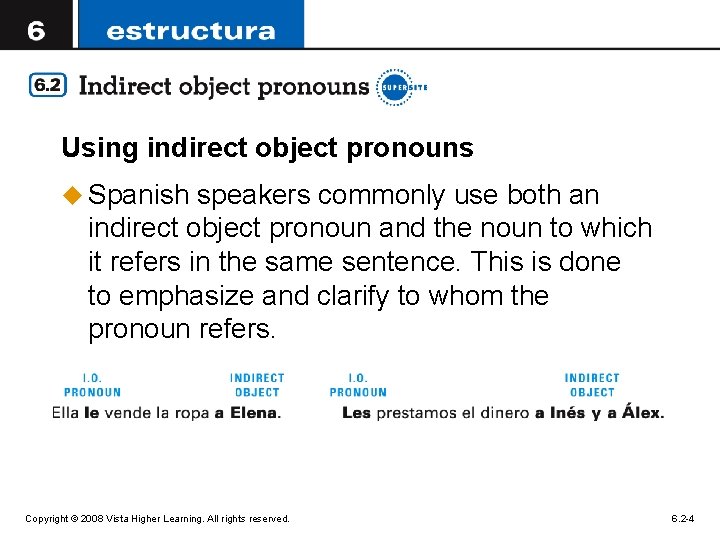
Using indirect object pronouns u Spanish speakers commonly use both an indirect object pronoun and the noun to which it refers in the same sentence. This is done to emphasize and clarify to whom the pronoun refers. Copyright © 2008 Vista Higher Learning. All rights reserved. 6. 2 -4
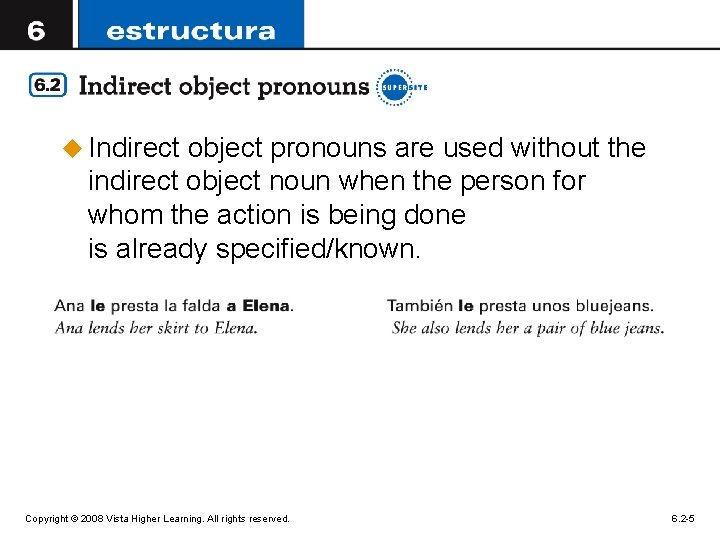
u Indirect object pronouns are used without the indirect object noun when the person for whom the action is being done is already specified/known. Copyright © 2008 Vista Higher Learning. All rights reserved. 6. 2 -5
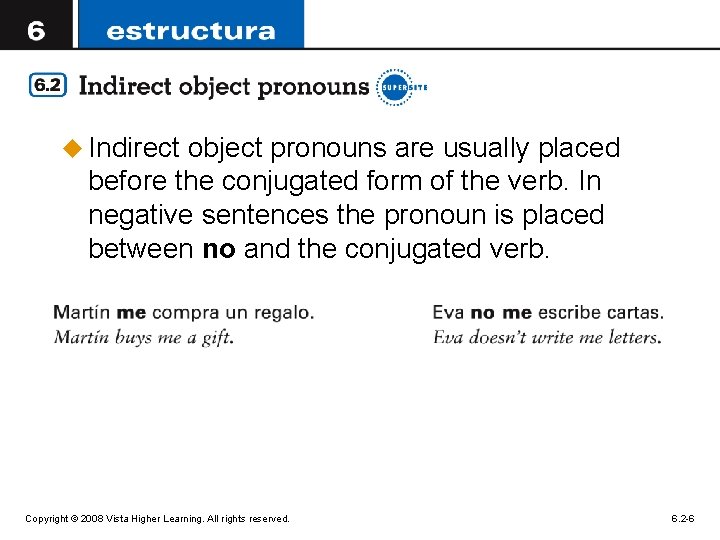
u Indirect object pronouns are usually placed before the conjugated form of the verb. In negative sentences the pronoun is placed between no and the conjugated verb. Copyright © 2008 Vista Higher Learning. All rights reserved. 6. 2 -6
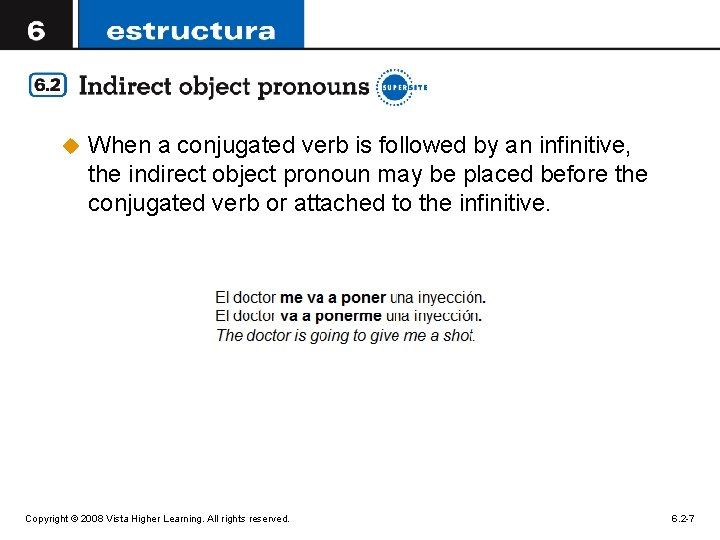
u When a conjugated verb is followed by an infinitive, the indirect object pronoun may be placed before the conjugated verb or attached to the infinitive. Copyright © 2008 Vista Higher Learning. All rights reserved. 6. 2 -7
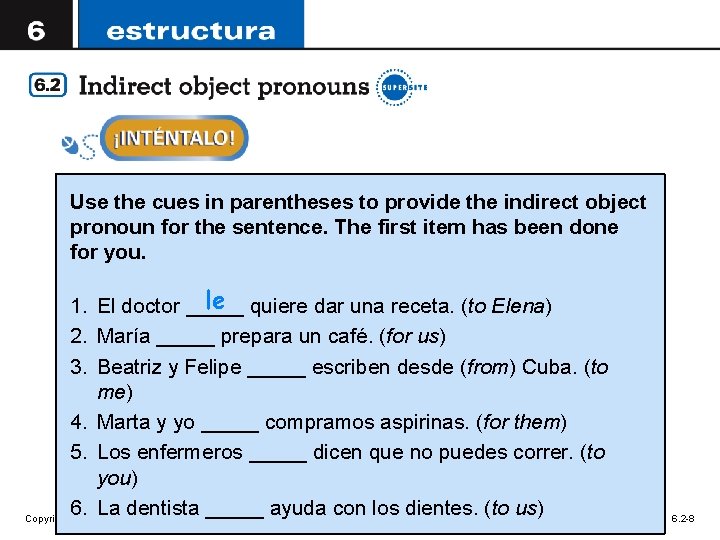
Use the cues in parentheses to provide the indirect object pronoun for the sentence. The first item has been done for you. le quiere dar una receta. (to Elena) 1. El doctor _____ 2. María _____ prepara un café. (for us) 3. Beatriz y Felipe _____ escriben desde (from) Cuba. (to me) 4. Marta y yo _____ compramos aspirinas. (for them) 5. Los enfermeros _____ dicen que no puedes correr. (to you) 6. La dentista _____ ayuda con los dientes. (to us) Copyright © 2008 Vista Higher Learning. All rights reserved. 6. 2 -8
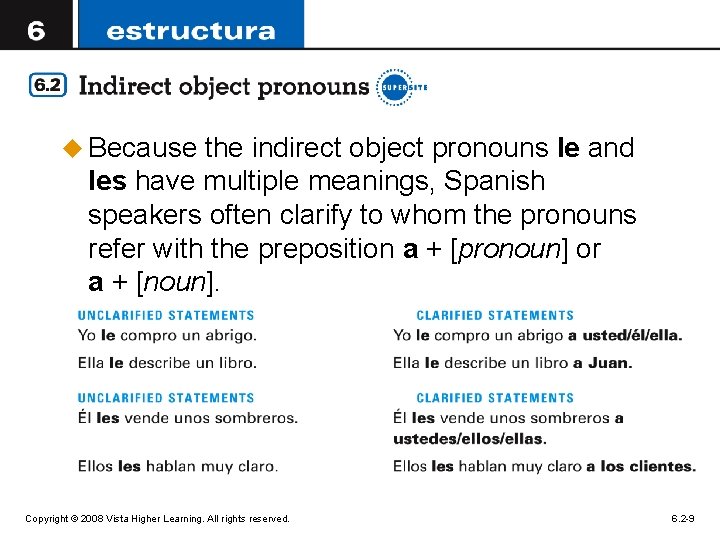
u Because the indirect object pronouns le and les have multiple meanings, Spanish speakers often clarify to whom the pronouns refer with the preposition a + [pronoun] or a + [noun]. Copyright © 2008 Vista Higher Learning. All rights reserved. 6. 2 -9
- Slides: 9