
An Improved Algorithm for Maintaining Arc Consistency in

- Slides: 13
An Improved Algorithm for Maintaining Arc Consistency in Dynamic Constraint Satisfaction Problems Roman Barták Charles University Prague Pavel Surynek Czech Technical University Prague roman. bartak@mff. cuni. cz pavel. surynek@seznam. cz
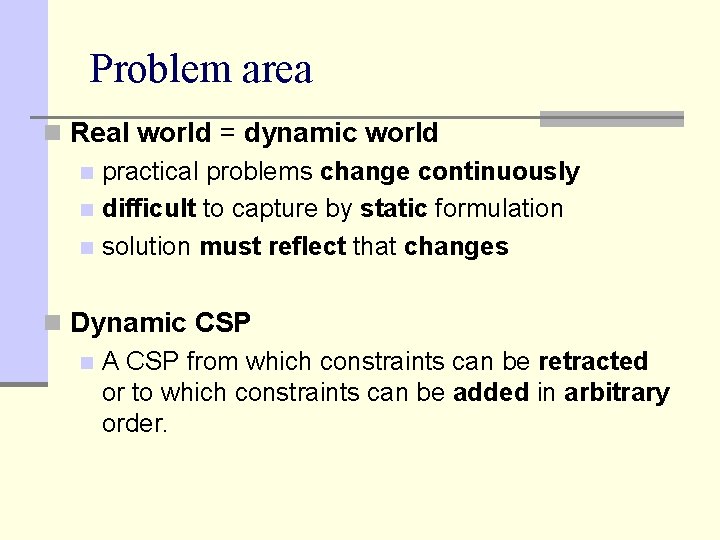
Problem area n Real world = dynamic world n practical problems change continuously n difficult to capture by static formulation n solution must reflect that changes n Dynamic CSP n A CSP from which constraints can be retracted or to which constraints can be added in arbitrary order.
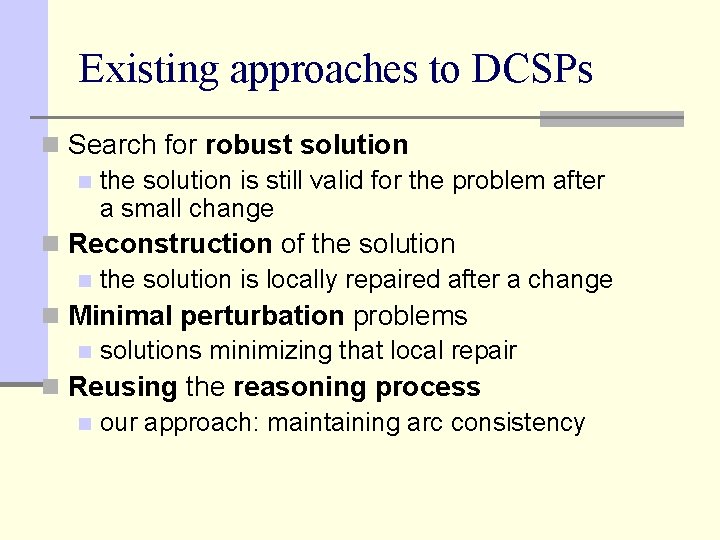
Existing approaches to DCSPs n Search for robust solution n the solution is still valid for the problem after a small change n Reconstruction of the solution n the solution is locally repaired after a change n Minimal perturbation problems n solutions minimizing that local repair n Reusing the reasoning process n our approach: maintaining arc consistency
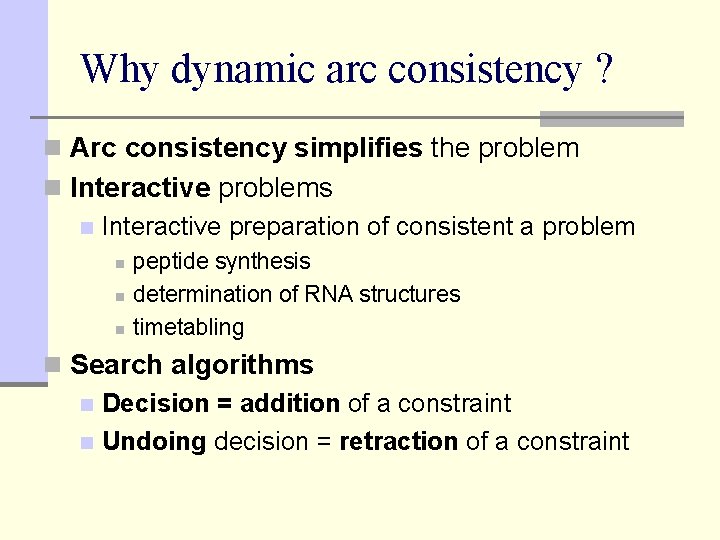
Why dynamic arc consistency ? n Arc consistency simplifies the problem n Interactive problems n Interactive preparation of consistent a problem n n n peptide synthesis determination of RNA structures timetabling n Search algorithms n Decision = addition of a constraint n Undoing decision = retraction of a constraint
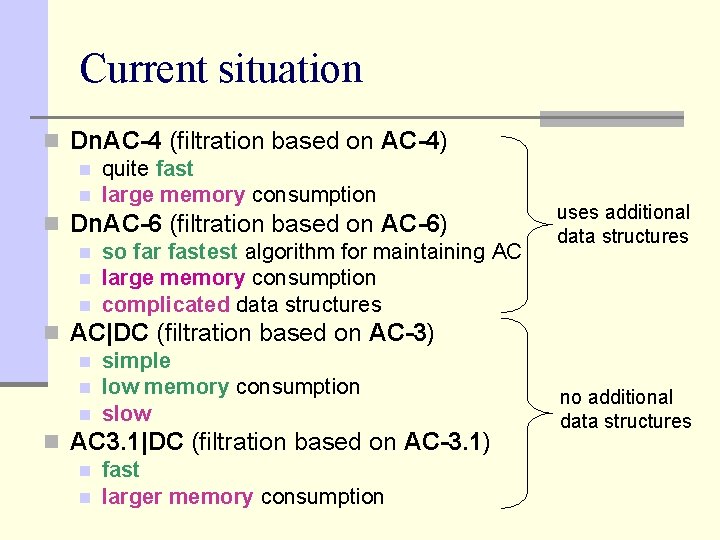
Current situation n Dn. AC-4 (filtration based on AC-4) n quite fast n large memory consumption n Dn. AC-6 (filtration based on AC-6) n so far fastest algorithm for maintaining AC n large memory consumption n complicated data structures n AC|DC (filtration based on AC-3) n simple n low memory consumption n slow n AC 3. 1|DC (filtration based on AC-3. 1) n fast n larger memory consumption uses additional data structures no additional data structures
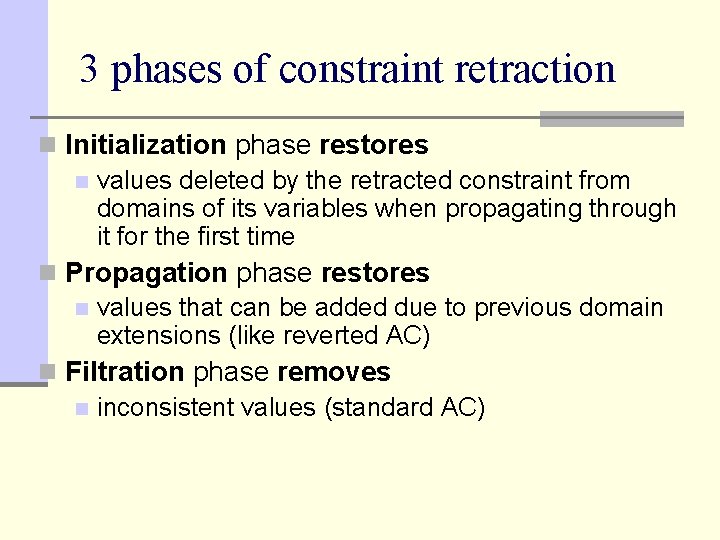
3 phases of constraint retraction n Initialization phase restores n values deleted by the retracted constraint from domains of its variables when propagating through it for the first time n Propagation phase restores n values that can be added due to previous domain extensions (like reverted AC) n Filtration phase removes n inconsistent values (standard AC)
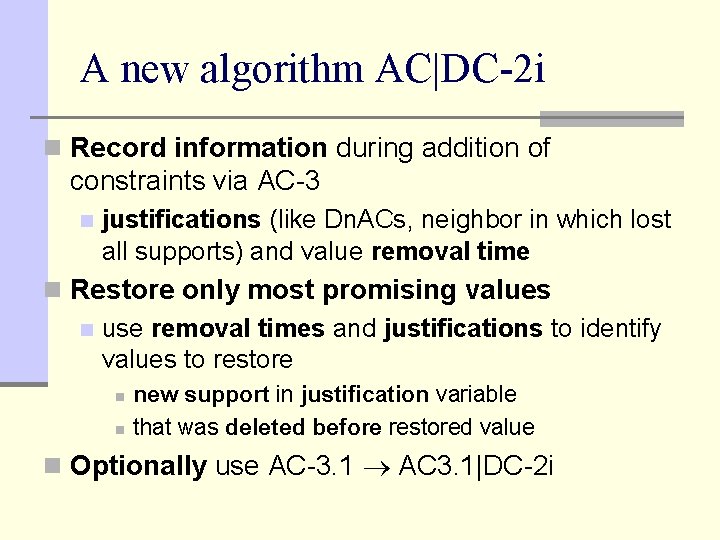
A new algorithm AC|DC-2 i n Record information during addition of constraints via AC-3 n justifications (like Dn. ACs, neighbor in which lost all supports) and value removal time n Restore only most promising values n use removal times and justifications to identify values to restore n n new support in justification variable that was deleted before restored value n Optionally use AC-3. 1 AC 3. 1|DC-2 i
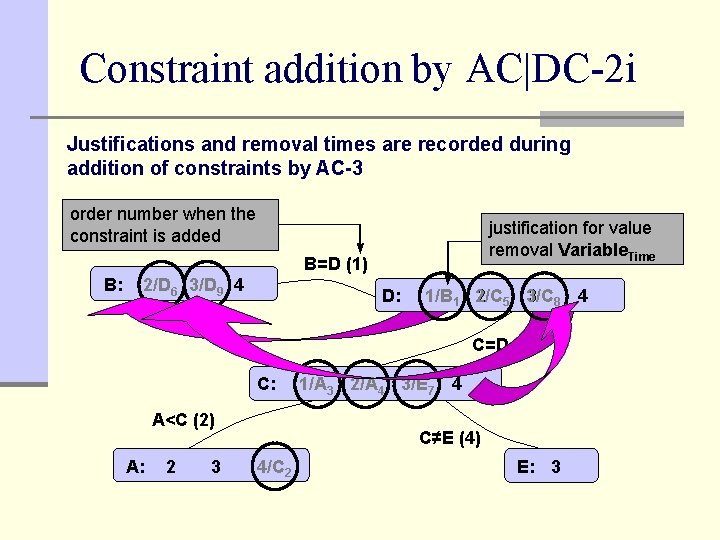
Constraint addition by AC|DC-2 i Justifications and removal times are recorded during addition of constraints by AC-3 order number when the constraint is added justification for value removal Variable. Time B=D (1) B: 2 6 3/D 2/D 3 9 4 D: 1 1 2/C 1/B 2 5 3/C 3 8 4 C=D (3) C: A<C (2) A: 2 3 1/A 1 3 2/A 2 4 3/E 3 7 4 C≠E (4) 4 2 4/C E: 3
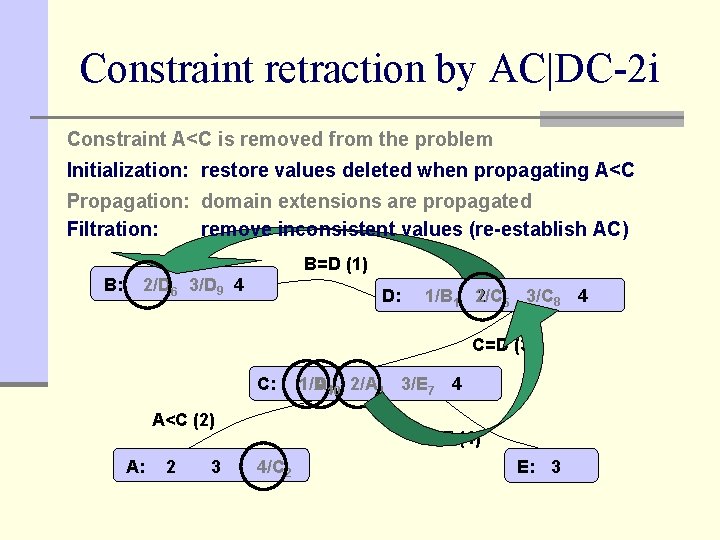
Constraint retraction by AC|DC-2 i Constraint A<C is removed from the problem Initialization: restore values deleted when propagating A<C Propagation: domain extensions are propagated Filtration: remove inconsistent values (re-establish AC) B=D (1) B: 2 6 3/D 9 4 2/D D: 2 5 3/C 8 4 1/B 1 2/C C=D (3) C: A<C (2) A: 2 3 1/A 1/D 1 10 2 4 3/E 7 4 3 2/A C≠E (4) 4/C 4 2 E: 3
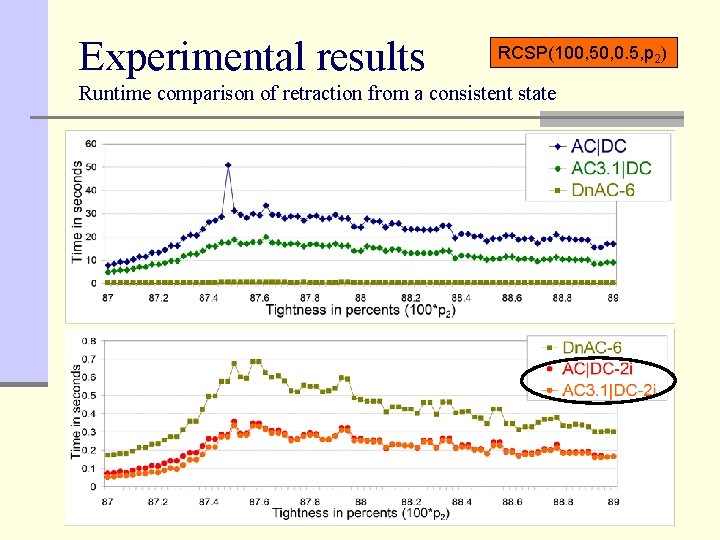
Experimental results RCSP(100, 50, 0. 5, p 2) Runtime comparison of retraction from a consistent state
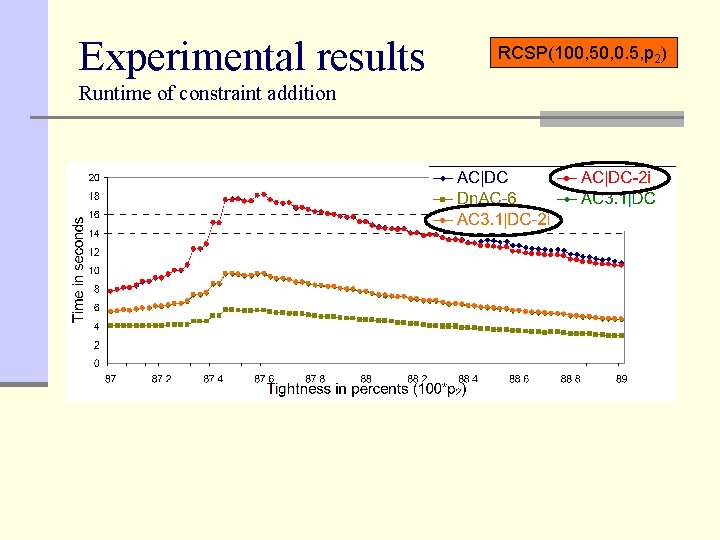
Experimental results Runtime of constraint addition RCSP(100, 50, 0. 5, p 2)
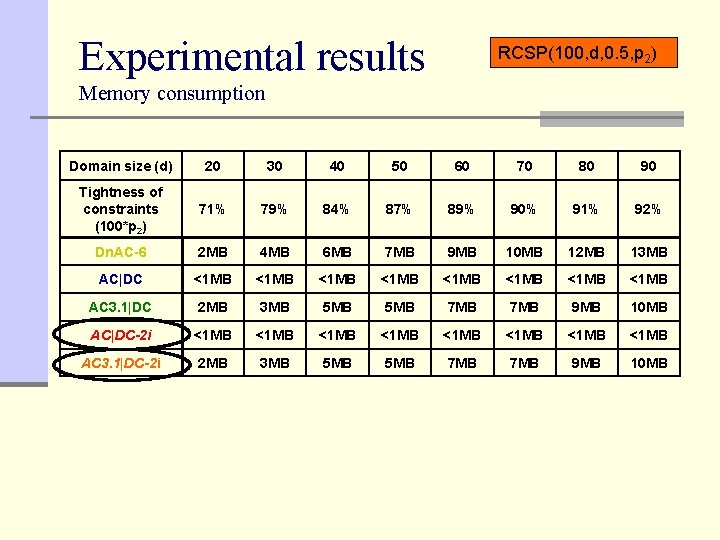
Experimental results RCSP(100, d, 0. 5, p 2) Memory consumption Domain size (d) 20 30 40 50 60 70 80 90 Tightness of constraints (100*p 2) 71% 79% 84% 87% 89% 90% 91% 92% Dn. AC-6 2 MB 4 MB 6 MB 7 MB 9 MB 10 MB 12 MB 13 MB AC|DC <1 MB <1 MB AC 3. 1|DC 2 MB 3 MB 5 MB 7 MB 9 MB 10 MB AC|DC-2 i <1 MB <1 MB AC 3. 1|DC-2 i 2 MB 3 MB 5 MB 7 MB 9 MB 10 MB
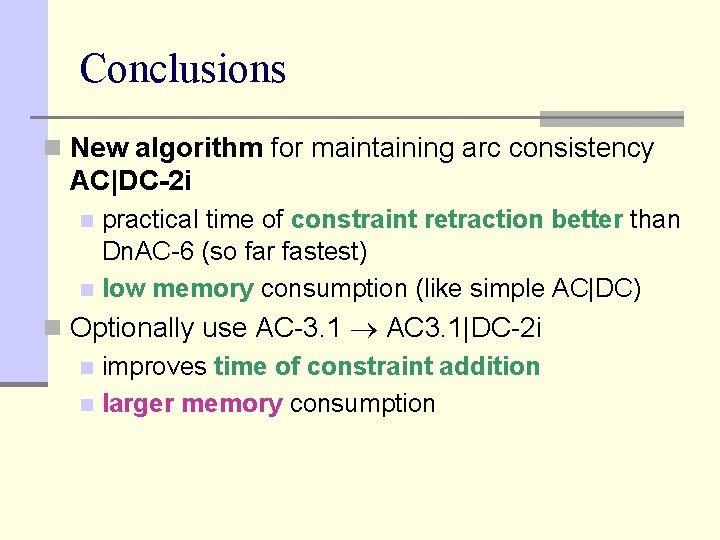
Conclusions n New algorithm for maintaining arc consistency AC|DC-2 i practical time of constraint retraction better than Dn. AC-6 (so far fastest) n low memory consumption (like simple AC|DC) n n Optionally use AC-3. 1 AC 3. 1|DC-2 i n improves time of constraint addition n larger memory consumption