
An Improved Active SLAM Algorithm for MultiRobot Exploration
An Improved Active SLAM Algorithm for Multi-Robot Exploration Viet-Cuong Pham and Jyh-Ching Juang National Cheng Kung University, Taiwan September 16, 2011 SICE 2011 Tokyo, Japan 國立成功大學 電機 程學系 機電整合實驗室 Supported by: Taiwan National Science Council Naional Cheng Kung University
Outline 1. Introduction 2. Active SLAM problem with multiple robots 3. Proposed approach v General framework v Exploration phase with global optimization strategy v Relocalization phase v Adaptive uncertainty threshold v Limited communication range 4. Simulations and Discussions 5. Conclusions 國立成功大學 電機 程學系 機電整合實驗室 Page 2
1. Introduction üExploration v Robots cover the environment with their sensors üSLAM (Simultaneous Localization and Mapping) v A mobile robot attempts to build a map v At the same time uses this map to deduce its location üOrdinary SLAMs v Only process perceived sensor data v Do not influence the motion of the mobile robot üPath control strategy can have a substantial impact on the quality of the resulting map This study: blend concepts of SLAM, active path planning, and cooperation among multiple robots 國立成功大學 電機 程學系 機電整合實驗室 Page 3
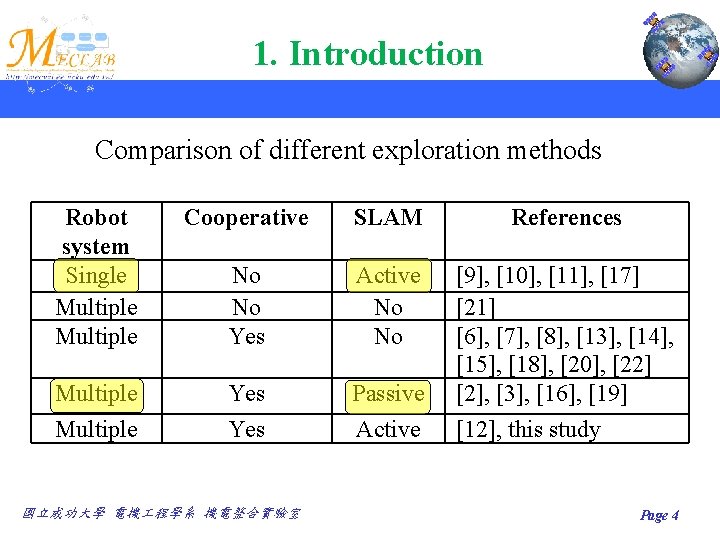
1. Introduction Comparison of different exploration methods Robot system Single Multiple Cooperative SLAM References No No Yes Active No No Multiple Yes Passive [9], [10], [11], [17] [21] [6], [7], [8], [13], [14], [15], [18], [20], [22] [2], [3], [16], [19] Multiple Yes Active [12], this study 國立成功大學 電機 程學系 機電整合實驗室 Page 4
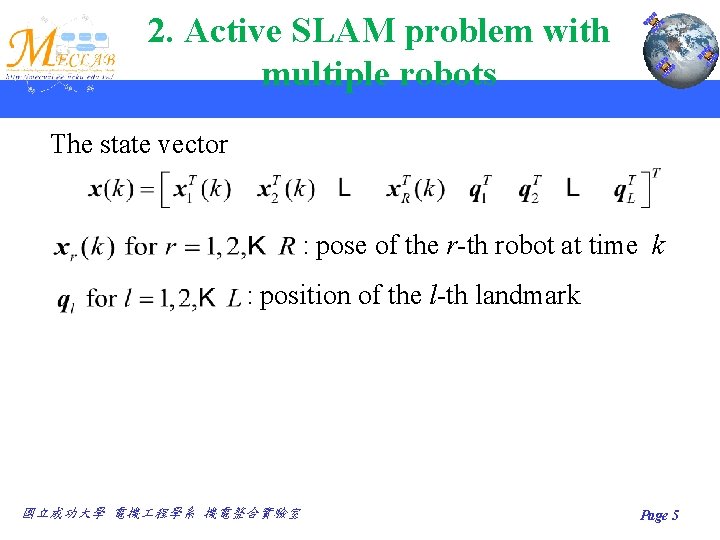
2. Active SLAM problem with multiple robots The state vector : pose of the r-th robot at time k : position of the l-th landmark 國立成功大學 電機 程學系 機電整合實驗室 Page 5

2. Active SLAM problem with multiple robots ü Process model: ü Measurement model: 國立成功大學 電機 程學系 機電整合實驗室 Page 6
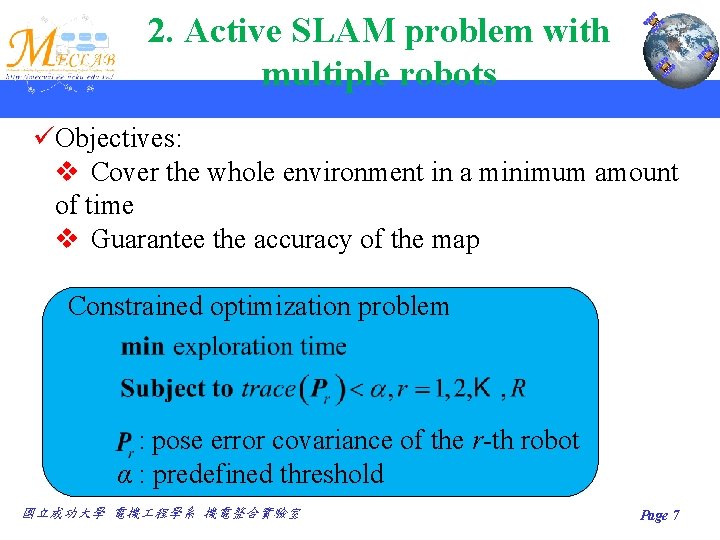
2. Active SLAM problem with multiple robots üObjectives: v Cover the whole environment in a minimum amount of time v Guarantee the accuracy of the map Constrained optimization problem : pose error covariance of the r-th robot α : predefined threshold 國立成功大學 電機 程學系 機電整合實驗室 Page 7
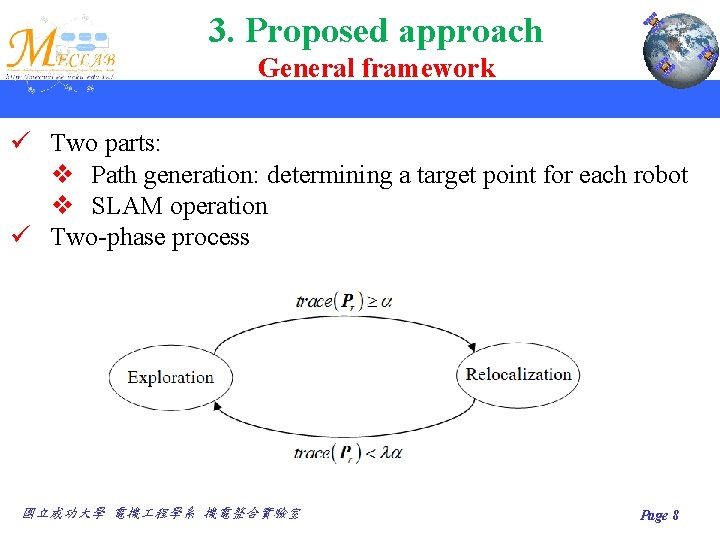
3. Proposed approach General framework ü Two parts: v Path generation: determining a target point for each robot v SLAM operation ü Two-phase process 國立成功大學 電機 程學系 機電整合實驗室 Page 8
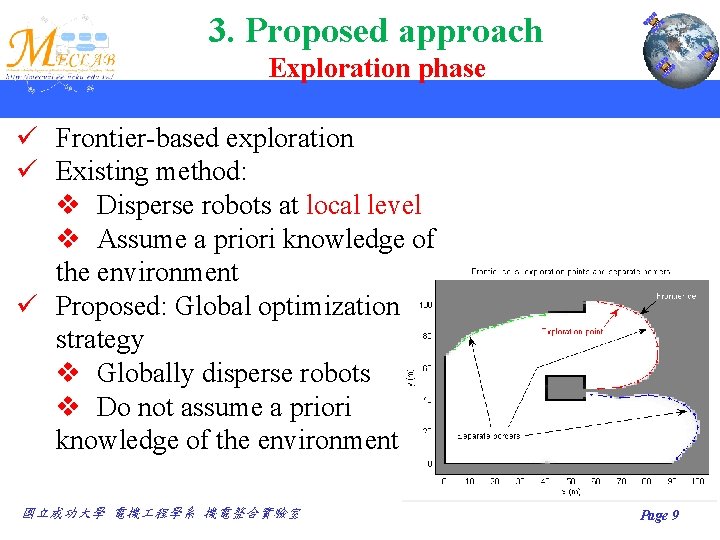
3. Proposed approach Exploration phase ü Frontier-based exploration ü Existing method: v Disperse robots at local level v Assume a priori knowledge of the environment ü Proposed: Global optimization strategy v Globally disperse robots v Do not assume a priori knowledge of the environment 國立成功大學 電機 程學系 機電整合實驗室 Page 9
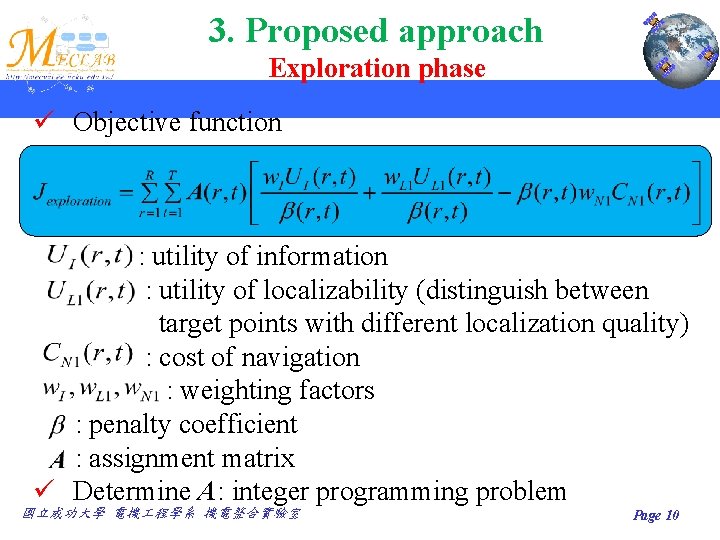
3. Proposed approach Exploration phase ü Objective function : utility of information : utility of localizability (distinguish between target points with different localization quality) : cost of navigation : weighting factors : penalty coefficient : assignment matrix ü Determine A: integer programming problem 國立成功大學 電機 程學系 機電整合實驗室 Page 10
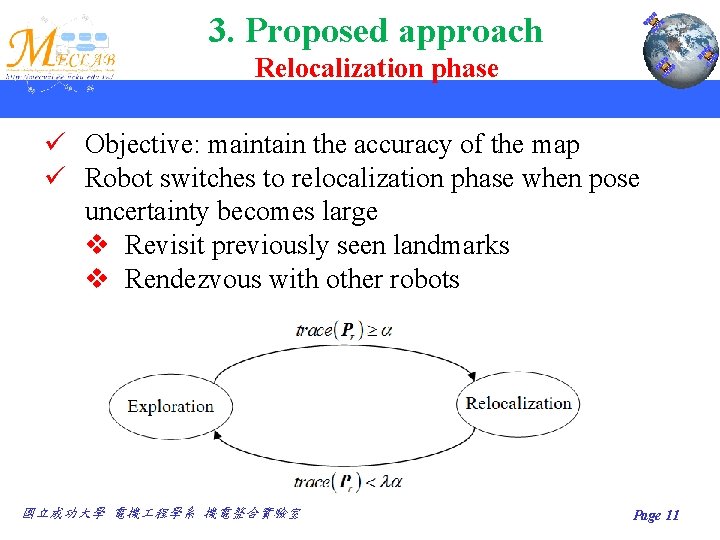
3. Proposed approach Relocalization phase ü Objective: maintain the accuracy of the map ü Robot switches to relocalization phase when pose uncertainty becomes large v Revisit previously seen landmarks v Rendezvous with other robots 國立成功大學 電機 程學系 機電整合實驗室 Page 11
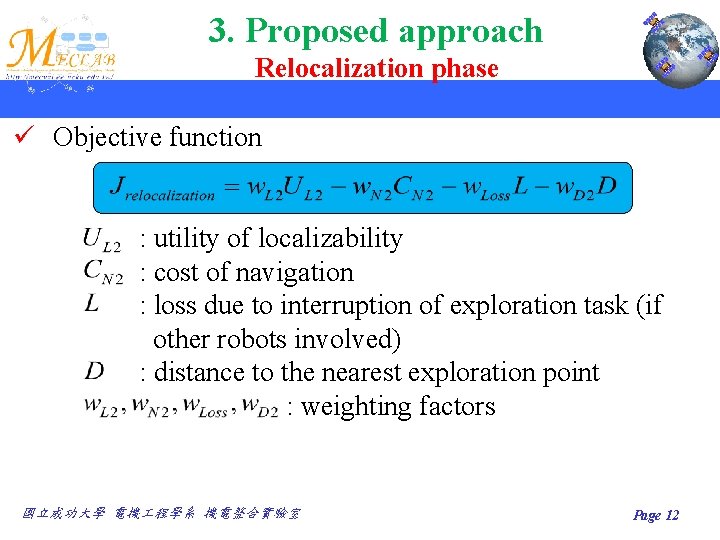
3. Proposed approach Relocalization phase ü Objective function : utility of localizability : cost of navigation : loss due to interruption of exploration task (if other robots involved) : distance to the nearest exploration point : weighting factors 國立成功大學 電機 程學系 機電整合實驗室 Page 12
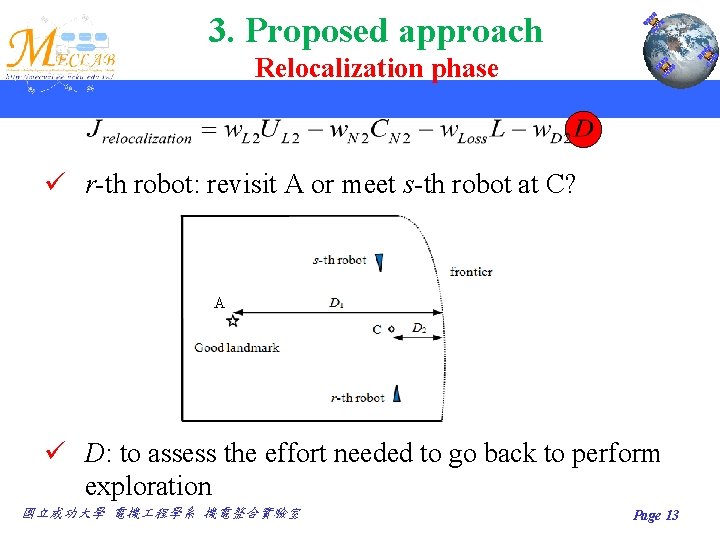
3. Proposed approach Relocalization phase ü r-th robot: revisit A or meet s-th robot at C? A ü D: to assess the effort needed to go back to perform exploration 國立成功大學 電機 程學系 機電整合實驗室 Page 13
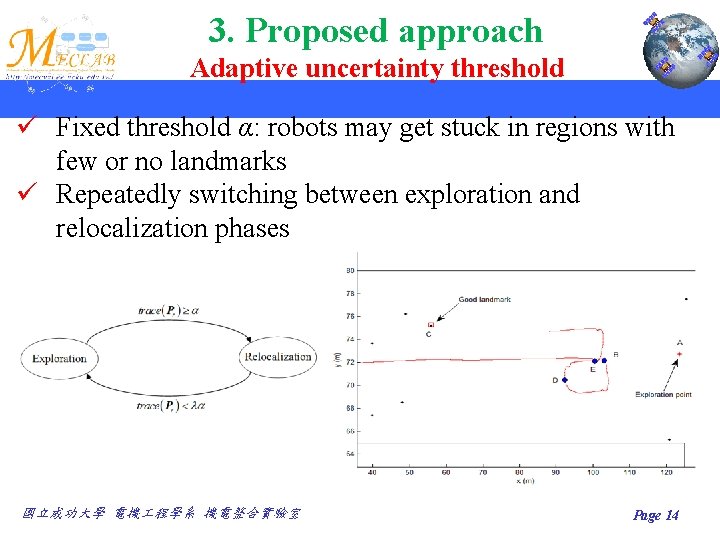
3. Proposed approach Adaptive uncertainty threshold ü Fixed threshold α: robots may get stuck in regions with few or no landmarks ü Repeatedly switching between exploration and relocalization phases 國立成功大學 電機 程學系 機電整合實驗室 Page 14
3. Proposed approach Adaptive uncertainty threshold ü Temporary increase the uncertainty threshold ü Threshold should be reduced asap: avoid large error in the exploration process afterwards. ü When to reduce? v Robot pose uncertainty decreases v Landmark density is high 國立成功大學 電機 程學系 機電整合實驗室 Page 15
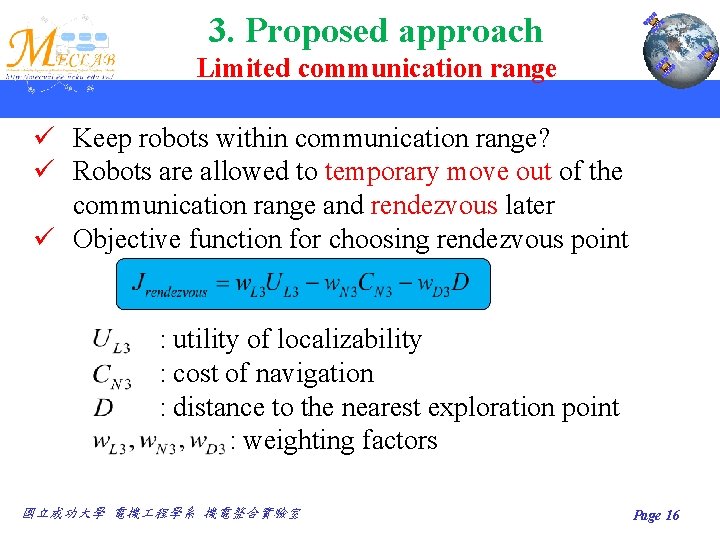
3. Proposed approach Limited communication range ü Keep robots within communication range? ü Robots are allowed to temporary move out of the communication range and rendezvous later ü Objective function for choosing rendezvous point : utility of localizability : cost of navigation : distance to the nearest exploration point : weighting factors 國立成功大學 電機 程學系 機電整合實驗室 Page 16
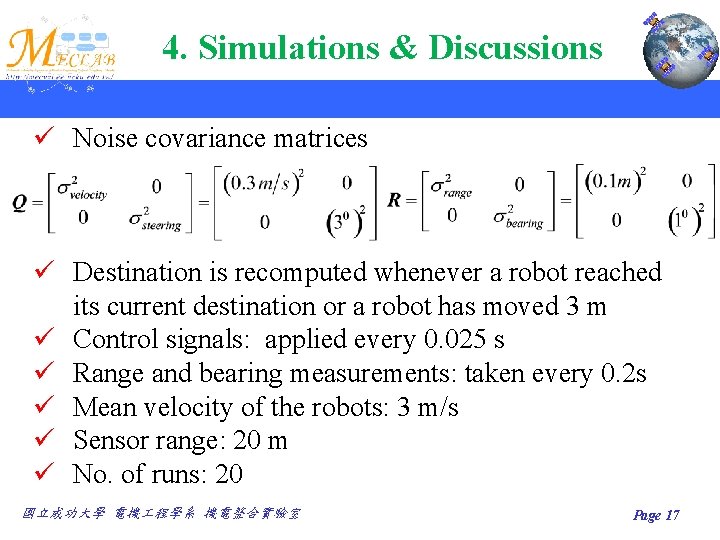
4. Simulations & Discussions ü Noise covariance matrices ü Destination is recomputed whenever a robot reached its current destination or a robot has moved 3 m ü Control signals: applied every 0. 025 s ü Range and bearing measurements: taken every 0. 2 s ü Mean velocity of the robots: 3 m/s ü Sensor range: 20 m ü No. of runs: 20 國立成功大學 電機 程學系 機電整合實驗室 Page 17
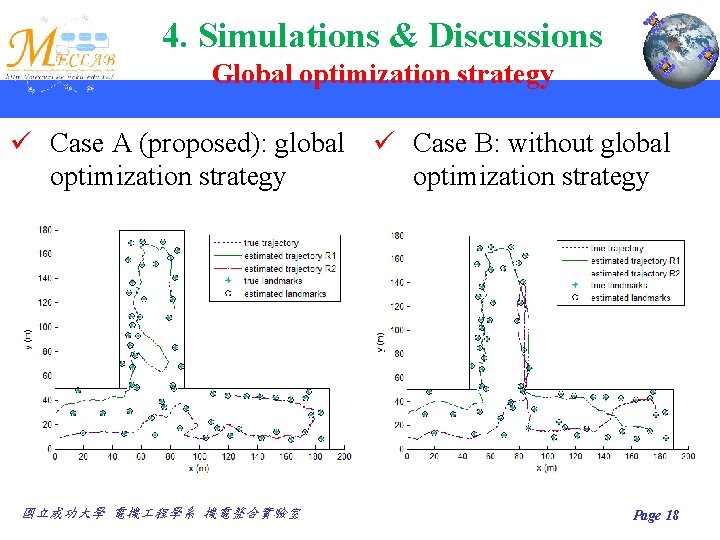
4. Simulations & Discussions Global optimization strategy ü Case A (proposed): global ü Case B: without global optimization strategy 國立成功大學 電機 程學系 機電整合實驗室 Page 18
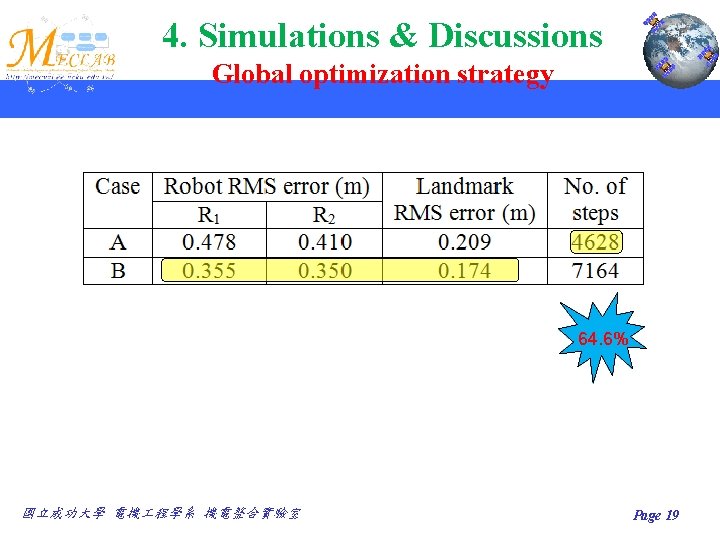
4. Simulations & Discussions Global optimization strategy 64. 6% 國立成功大學 電機 程學系 機電整合實驗室 Page 19
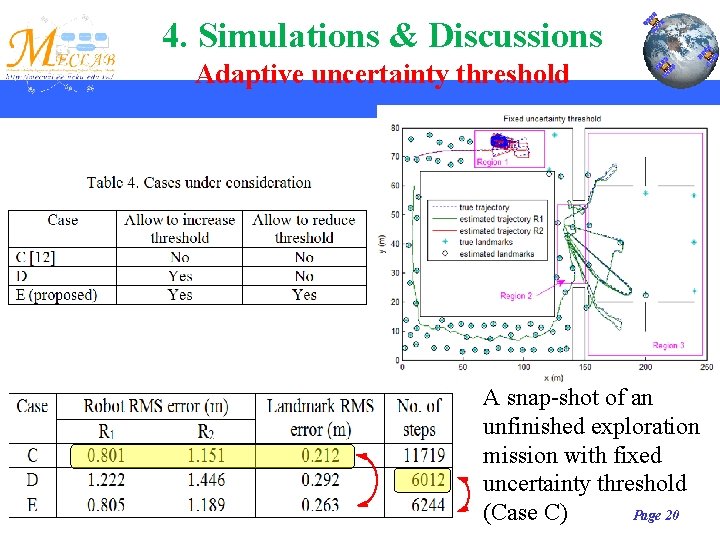
4. Simulations & Discussions Adaptive uncertainty threshold 國立成功大學 電機 程學系 機電整合實驗室 A snap-shot of an unfinished exploration mission with fixed uncertainty threshold Page 20 (Case C)
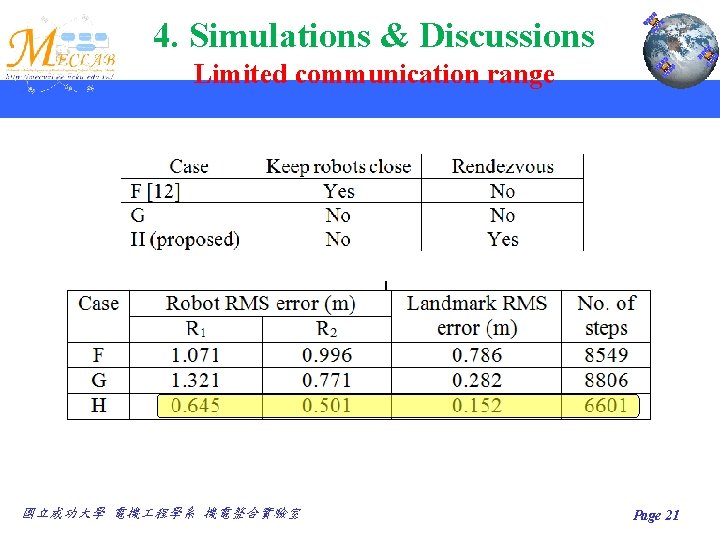
4. Simulations & Discussions Limited communication range 國立成功大學 電機 程學系 機電整合實驗室 Page 21
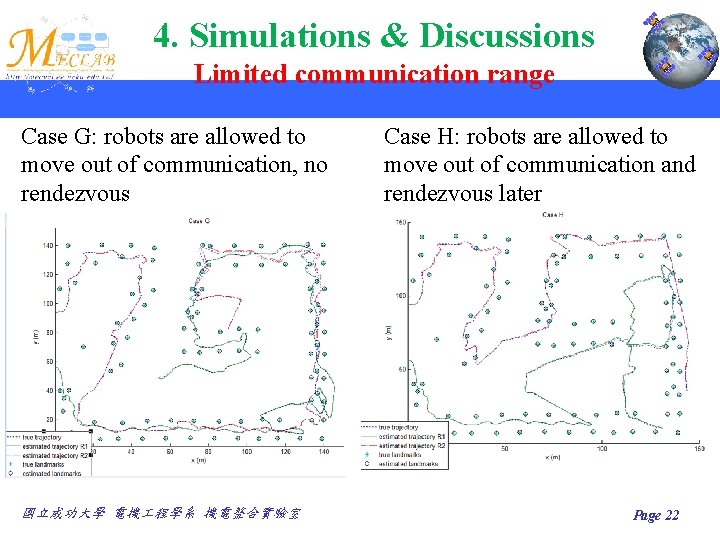
4. Simulations & Discussions Limited communication range Case G: robots are allowed to move out of communication, no rendezvous 國立成功大學 電機 程學系 機電整合實驗室 Case H: robots are allowed to move out of communication and rendezvous later Page 22
5. Conclusions ü An improved active SLAM algorithm for multi-robot exploration is presented ü Three important improvements: v A global optimization strategy in the exploration phase v An adaptive strategy: automatically adjust the threshold of the robot pose uncertainty constraints v Rendezvous technique: deal with the limited communication range problem ü Improved approach outperforms the original one 國立成功大學 電機 程學系 機電整合實驗室 Page 23
References 1. T. Bailey, J. Nieto, J. Guivant, M. Stevens, and E. Nebot, “Consistency of the EKF-SLAM Algorithm, ” Proc. IEEE/RSJ Intl. Conf. on Intelligent Robots and Systems, 2006, pp. 3562 -3568. 2. W. Burgard, M. Moors, D. Fox, R. Simmons, and S. Thrun, “Collaborative Multi-Robot Exploration, ” Proc. Intl. Conf. on Robotics and Automation, Vol. 1, 2000, pp. 476 -481. 3. W. Burgard, M. Moors, C. Stachniss, and F. Schneider, “Coordinated Multi-robot Exploration, ” IEEE Transactions on Robotics, Vol. 21, No. 3, 2005, pp. 376 -386. 4. A. Elfes, “Occupancy Grids: A Probabilistic Framework for Mobile Robot Perception and Navigation, ” Ph. D. dissertation, Carnegie Mellon Univ. , 1989. 5. J. W. Fenwick, P. M. Newman, and J. J. Leonard, “Cooperative Concurrent Mapping and Localization, ” Proc. Intl. Conf. on Robotics and Automation, Vol. 2, 2002, pp. 1810 -1817. 6. J. Hoog, S. Cameron, and A. Visser, “Role-based Autonomous Multi-Robot Exploration, ” Proceedings of Computation World: Future Computing, Service Computation, Cognitive, Content, Patterns, Nov. 2009, pp. 482 -487. 7. J. Hoog, S. Cameron, and A. Visser, “Selection of Rendezvous Points for Multi-Robot Exploration in Dynamic Environments, ” Proceedings of International Conference on Autonomous Agents and Multi-Agent Systems, May 2010. 8. J. Hoog, S. Cameron, and A. Visser, “Dynamic Team Hierarchies in Communication-Limited Multi-Robot Exploration, ” IEEE International Workshop on Safety‚ Security‚ and Rescue Robotics, July, 2010. 9. X. Ji, H. Zhang, D. Hai, and Z. Zheng, “A Decision-Theoretic Active Loop Closing Approach to Autonomous Robot Exploration and Mapping, ” Robo. Cup 2008: Robot Soccer World Cup XII, Lecture Notes in Computer Science, 2009, Volume 5399/2009, pp. 507 -518. 10. C. Leung, S. Huang, and G. Dissanayake, “Active SLAM Using Model Predictive Control and Attractor Based Exploration, ” Proc. IEEE/RSJ Intl. Conf. on Intelligent Robots and Systems, 2006, pp. 5026 -5031. 11. A. A. Makarenko, S. B. Williams, F. Bourgault, and H. F. Durrant-Whyte, “An Experiment in Integrated Exploration, ” Proc. IEEE/RSJ Intl. Conf. on Intelligent Robots and Systems, Oct. 2002, pp. 534 -539. 國立成功大學 電機 程學系 機電整合實驗室 Page 24
References 12. V. C. Pham and J. C. Juang, “Active SLAM Algorithm for Multi-Robot Exploration, ” submitted to Robotics and Autonomous Systems. 13. B. S. Pimentel and M. F. M. Campo, “Multi-Robot Exploration With Limited-Range Communication, ” Anais do XIV Congresso Brasileiro de Automática, 2002. 14. M. N. Rooker and A. Birk, “Multi Robot Exploration under the Constraints of Wireless Networking, ” Control Engineering Practice 15, 2007, pp. 435– 445. 15. W. Sheng, Q. Yang, S. Ci and N. Xi, “Multi-Robot Area Exploration with Limited-Range Communications, ” Proceedings of 2004 IEEE/RSJ International Conference on Intelligent Robots and Systems, September, 2004. 16. R. Simmons, “Coordination for Multi-Robot Exploration and Mapping, ” Proc. Conf. on Artificial Intelligence, 2000, pp. 852 -858. 17. C. Stachniss, D. Hahnel, W. Burgard, “Exploration with Active Loop-Closing for Fast. SLAM, ” Proc. IEEE/JRS Intl. Conf. on Intelligent Robots and Syst. , Vol. 2, Oct. 2004, pp. 1505 -1510. 18. J. Vazquez and C. Malcolm, “Distributed Multirobot Exploration Maintaining a Mobile Network, ” Proceedings of the second IEEE International Conference on Intelligent Systems, pp. 113– 118, Vol. 3, 2004. 19. R. Vincent, D. Fox. J. Ko, K. Konolige, B. Limketkai, B. Morisset, C. Ortiz, D. Schulz, and B. Steward, “Distributed Multirobot Exploration, Mapping, and Task Allocation, ” Annals of Mathematics and Artificial Intelligence, Vol. 52, 2008, pp. 229 -255. 20. L. Wu, D. Puig, and M. A. Garcia, “Balanced Multi-Robot Exploration through a Global Optimization Strategy, ” Journal of Physical Agents, Vol. 4, No. 1, 2010, pp. 35 -43. 21. B. Yamauchi, “Frontier-Based Exploration Using Multiple Robots, ” Proc. 2 nd Intl. Conf. on Autonomous and Agents, May 1998, pp. 47 -53. 22. R. Zlot, A. Stentz, M. B. Dias, and S. Thayer, “Multi-Robot Exploration Controlled by a Market Economy, ” Proc. IEEE Int. Conf. on Robotics and Automation, May 2002, pp. 3016 -3023. 國立成功大學 電機 程學系 機電整合實驗室 Page 25
References Thank you for your attention! 國立成功大學 電機 程學系 機電整合實驗室 Page 26
- Slides: 26