
An eye catcher in the ATC domain Influence



- Slides: 19
An eye catcher in the ATC domain: Influence of Multiple Remote Tower Operations on distribution of eye movements. Maik Friedrich Anneke Hamann Joern Jakobi
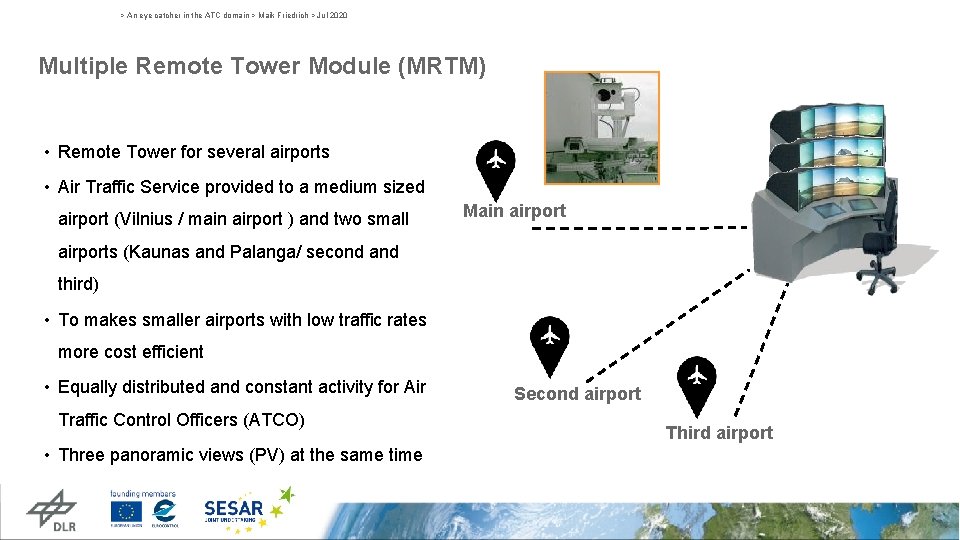
> An eye catcher in the ATC domain > Maik Friedrich > Jul 2020 Multiple Remote Tower Module (MRTM) • Remote Tower for several airports • Air Traffic Service provided to a medium sized airport (Vilnius / main airport ) and two small Main airports (Kaunas and Palanga/ second and third) • To makes smaller airports with low traffic rates more cost efficient • Equally distributed and constant activity for Air Traffic Control Officers (ATCO) • Three panoramic views (PV) at the same time Second airport Third airport
> An eye catcher in the ATC domain > Maik Friedrich > Jul 2020 Motivation • Is the distribution of eye movements influenced by the workload of Multiple Remote Tower Operations?
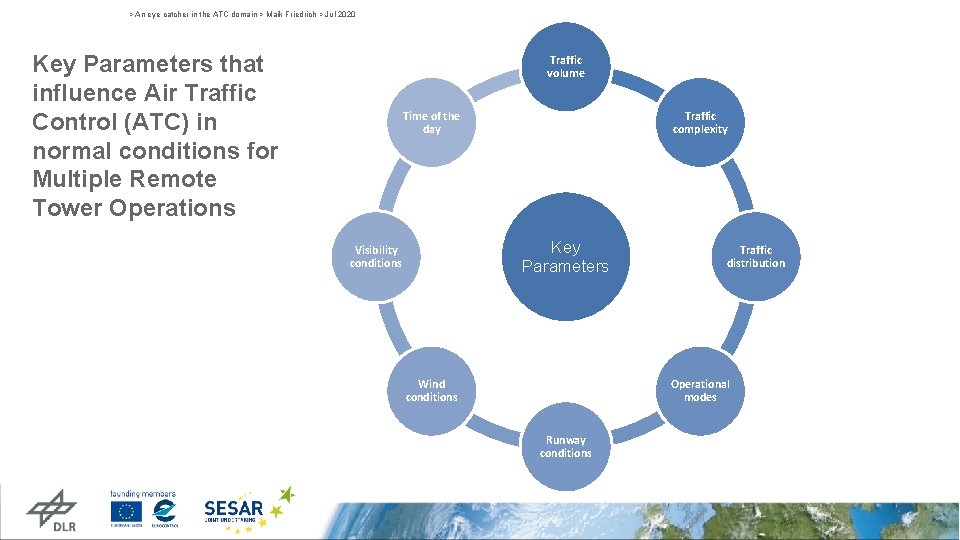
> An eye catcher in the ATC domain > Maik Friedrich > Jul 2020 Key Parameters that influence Air Traffic Control (ATC) in normal conditions for Multiple Remote Tower Operations Traffic volume Time of the day Traffic complexity Key Parameters Visibility conditions Wind conditions Traffic distribution Operational modes Runway conditions
> An eye catcher in the ATC domain > Maik Friedrich > Jul 2020 The Research Questions in relation to mental workload during working at a Multiple Remote Tower Module 1. RQ 1: Is the amount of traffic connected to the subjective mental workload? We hypothesize that more traffic leads to an increase in subjective workload. 2. RQ 2: How does the arrangement of information influence the dwell time on the different Areas of Interest (Ao. I)? We hypothesize that the information gathering process is changed, especially the distribution of dwell time onto the MRTM. 3. RQ 3: Is the subjective rating of mental workload correlated with the selected eye-tracking metrics? We assume that the selected metric will show a connection to the subjective measurement.
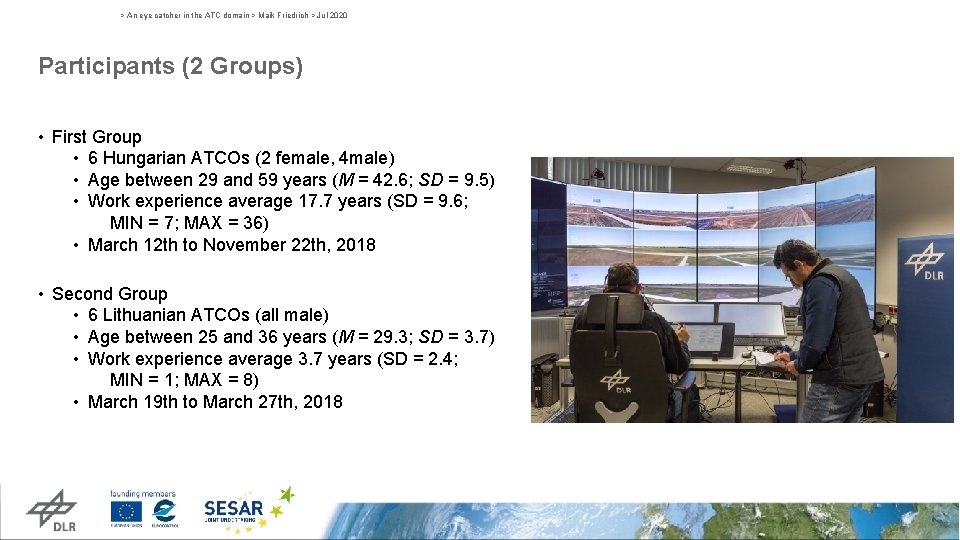
> An eye catcher in the ATC domain > Maik Friedrich > Jul 2020 Participants (2 Groups) • First Group • 6 Hungarian ATCOs (2 female, 4 male) • Age between 29 and 59 years (M = 42. 6; SD = 9. 5) • Work experience average 17. 7 years (SD = 9. 6; MIN = 7; MAX = 36) • March 12 th to November 22 th, 2018 • Second Group • 6 Lithuanian ATCOs (all male) • Age between 25 and 36 years (M = 29. 3; SD = 3. 7) • Work experience average 3. 7 years (SD = 2. 4; MIN = 1; MAX = 8) • March 19 th to March 27 th, 2018
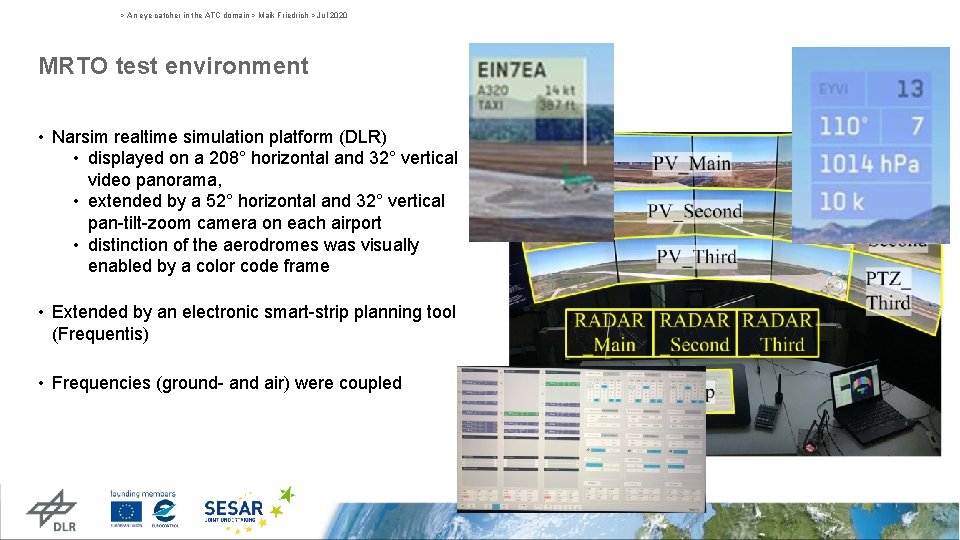
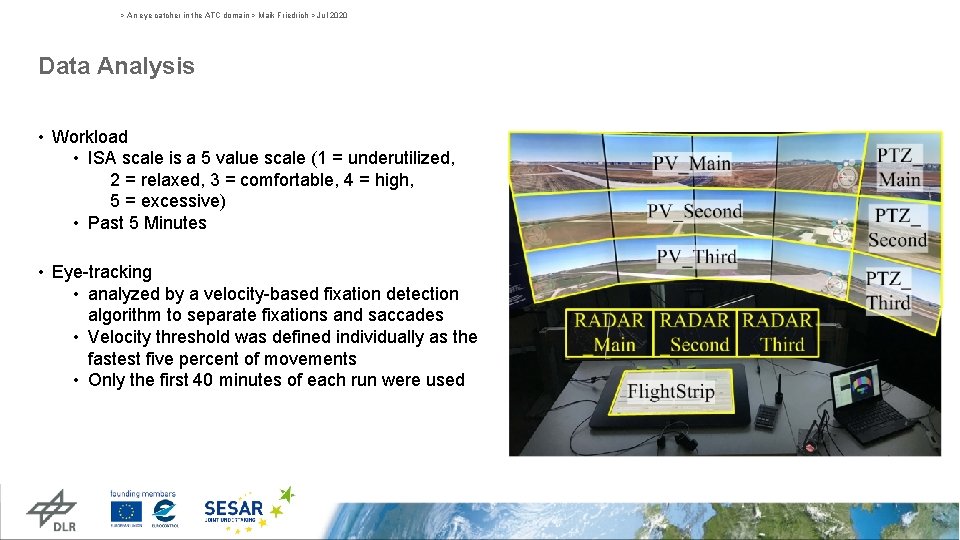
> An eye catcher in the ATC domain > Maik Friedrich > Jul 2020 MRTO test environment • Narsim realtime simulation platform (DLR) • displayed on a 208° horizontal and 32° vertical video panorama, • extended by a 52° horizontal and 32° vertical pan-tilt-zoom camera on each airport • distinction of the aerodromes was visually enabled by a color code frame • Extended by an electronic smart-strip planning tool (Frequentis) • Frequencies (ground- and air) were coupled
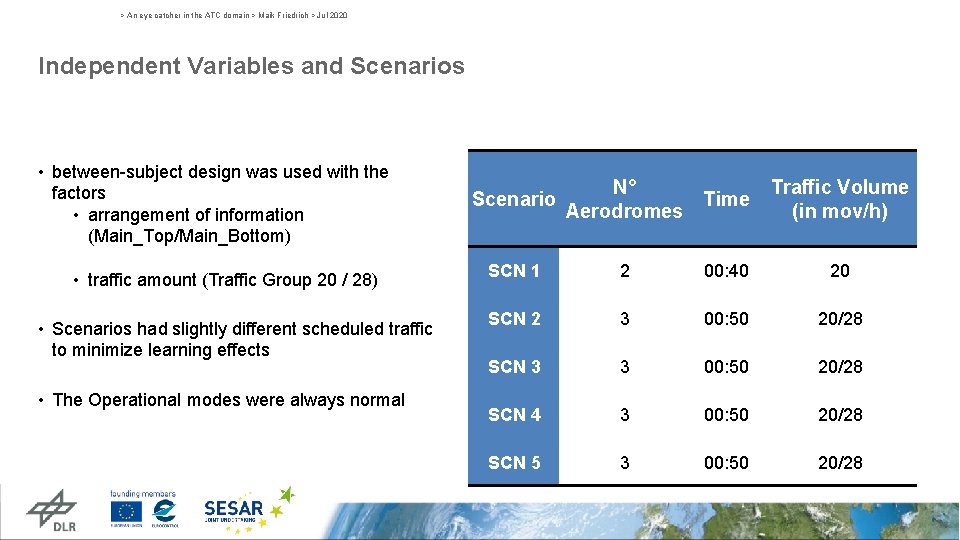
> An eye catcher in the ATC domain > Maik Friedrich > Jul 2020 Independent Variables and Scenarios • between-subject design was used with the factors • arrangement of information (Main_Top/Main_Bottom) • traffic amount (Traffic Group 20 / 28) • Scenarios had slightly different scheduled traffic to minimize learning effects • The Operational modes were always normal Scenario N° Time Aerodromes Traffic Volume (in mov/h) SCN 1 2 00: 40 20 SCN 2 3 00: 50 20/28 SCN 3 3 00: 50 20/28 SCN 4 3 00: 50 20/28 SCN 5 3 00: 50 20/28
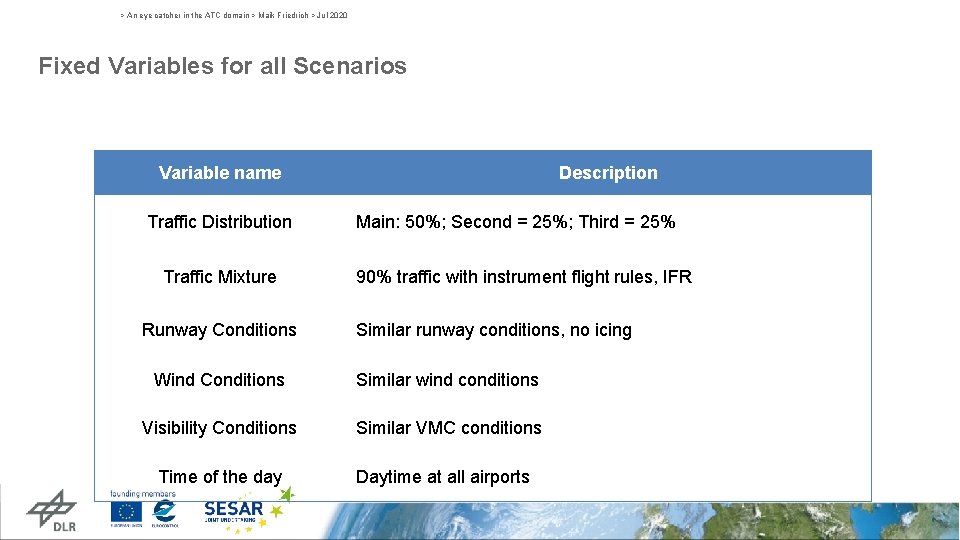
> An eye catcher in the ATC domain > Maik Friedrich > Jul 2020 Fixed Variables for all Scenarios Variable name Traffic Distribution Traffic Mixture Runway Conditions Description Main: 50%; Second = 25%; Third = 25% 90% traffic with instrument flight rules, IFR Similar runway conditions, no icing Wind Conditions Similar wind conditions Visibility Conditions Similar VMC conditions Time of the day Daytime at all airports
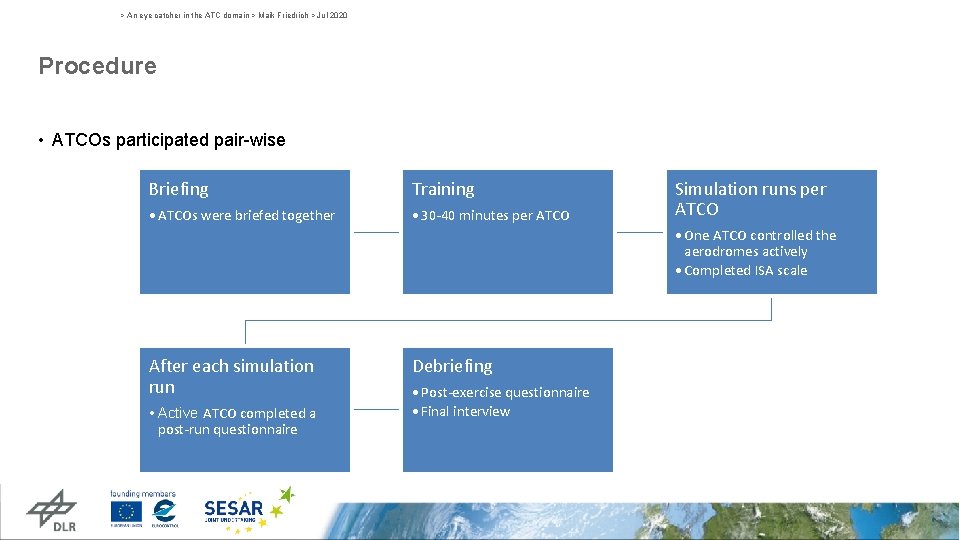
> An eye catcher in the ATC domain > Maik Friedrich > Jul 2020 Procedure • ATCOs participated pair-wise Briefing Training • ATCOs were briefed together • 30 -40 minutes per ATCO Simulation runs per ATCO • One ATCO controlled the aerodromes actively • Completed ISA scale After each simulation run • Active ATCO completed a post-run questionnaire Debriefing • Post-exercise questionnaire • Final interview
> An eye catcher in the ATC domain > Maik Friedrich > Jul 2020 Data Analysis • Workload • ISA scale is a 5 value scale (1 = underutilized, 2 = relaxed, 3 = comfortable, 4 = high, 5 = excessive) • Past 5 Minutes • Eye-tracking • analyzed by a velocity-based fixation detection algorithm to separate fixations and saccades • Velocity threshold was defined individually as the fastest five percent of movements • Only the first 40 minutes of each run were used
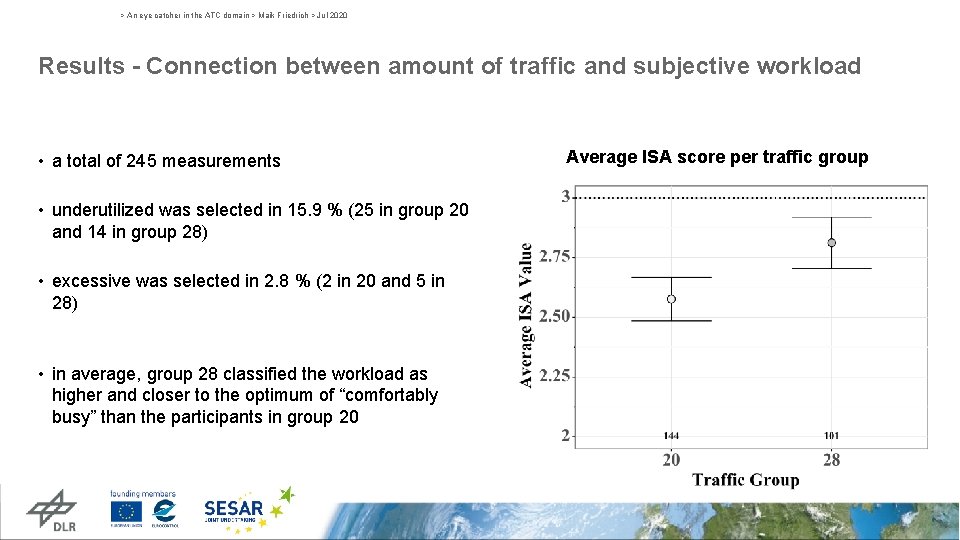
> An eye catcher in the ATC domain > Maik Friedrich > Jul 2020 Results - Connection between amount of traffic and subjective workload • a total of 245 measurements • underutilized was selected in 15. 9 % (25 in group 20 and 14 in group 28) • excessive was selected in 2. 8 % (2 in 20 and 5 in 28) • in average, group 28 classified the workload as higher and closer to the optimum of “comfortably busy” than the participants in group 20 Average ISA score per traffic group
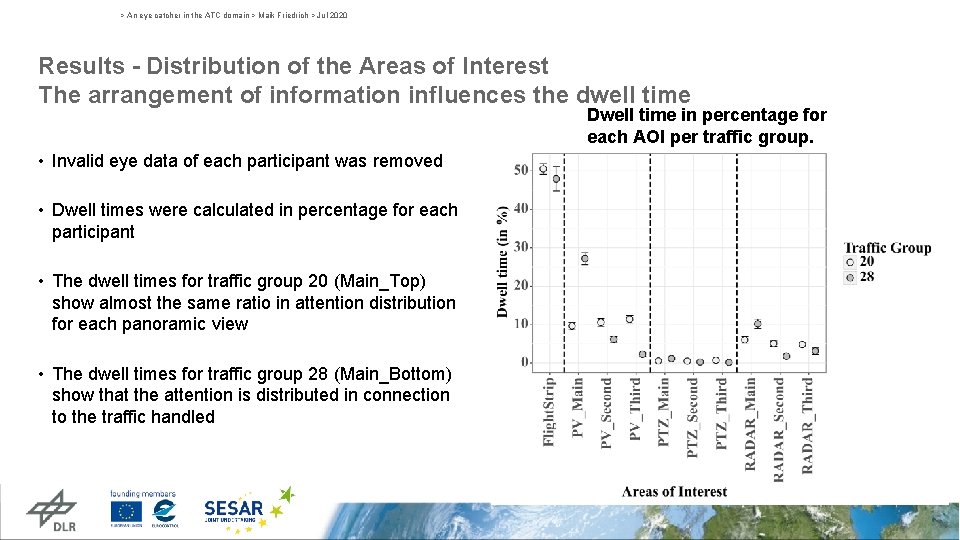
> An eye catcher in the ATC domain > Maik Friedrich > Jul 2020 Results - Distribution of the Areas of Interest The arrangement of information influences the dwell time Dwell time in percentage for each AOI per traffic group. • Invalid eye data of each participant was removed • Dwell times were calculated in percentage for each participant • The dwell times for traffic group 20 (Main_Top) show almost the same ratio in attention distribution for each panoramic view • The dwell times for traffic group 28 (Main_Bottom) show that the attention is distributed in connection to the traffic handled
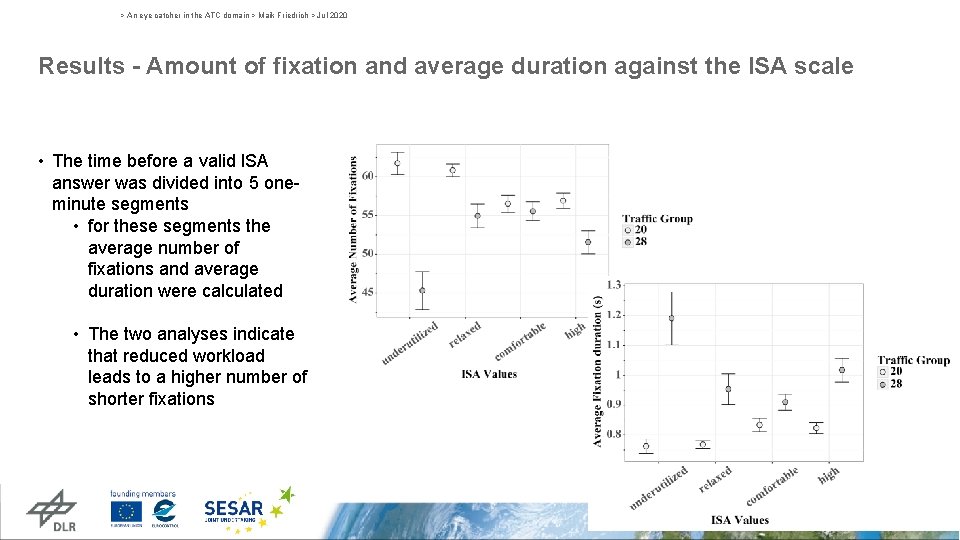
> An eye catcher in the ATC domain > Maik Friedrich > Jul 2020 Results - Amount of fixation and average duration against the ISA scale • The time before a valid ISA answer was divided into 5 oneminute segments • for these segments the average number of fixations and average duration were calculated • The two analyses indicate that reduced workload leads to a higher number of shorter fixations
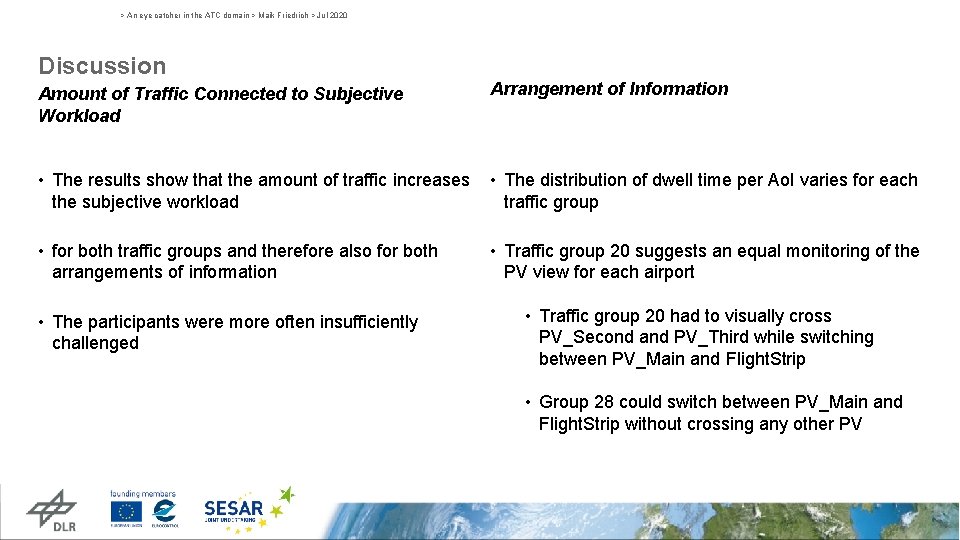
> An eye catcher in the ATC domain > Maik Friedrich > Jul 2020 Discussion Amount of Traffic Connected to Subjective Workload Arrangement of Information • The results show that the amount of traffic increases the subjective workload • The distribution of dwell time per Ao. I varies for each traffic group • for both traffic groups and therefore also for both arrangements of information • Traffic group 20 suggests an equal monitoring of the PV view for each airport • The participants were more often insufficiently challenged • Traffic group 20 had to visually cross PV_Second and PV_Third while switching between PV_Main and Flight. Strip • Group 28 could switch between PV_Main and Flight. Strip without crossing any other PV
> An eye catcher in the ATC domain > Maik Friedrich > Jul 2020 Discussion Subjective Rating in Connection to Eye-tracking Metric • Results corresponded with the arrangement of information, because the participants in traffic group 28 pay more attention to the PV_Main. • For both groups, at low subjective workload the number of fixations and the duration of fixation indicate that they monitor less Ao. Is for a longer period • The effect is reduced when workload increases to a medium level
> An eye catcher in the ATC domain > Maik Friedrich > Jul 2020 • This explorative study aimed at the evaluation of three RQ in relation to the MRTO workplace Summary and Outlook • Scan paths with the less important Ao. Is in between seems more promising with this study • The successful application of eye metrics depends on the scan path and on the arrangement of information, but seems predictable for a fixed set-up • Future work should concentrate on an experimental design that allows for inferential static analysis of the single factors that are described in this paper
> An eye catcher in the ATC domain > Maik Friedrich > Jul 2020 Thank you
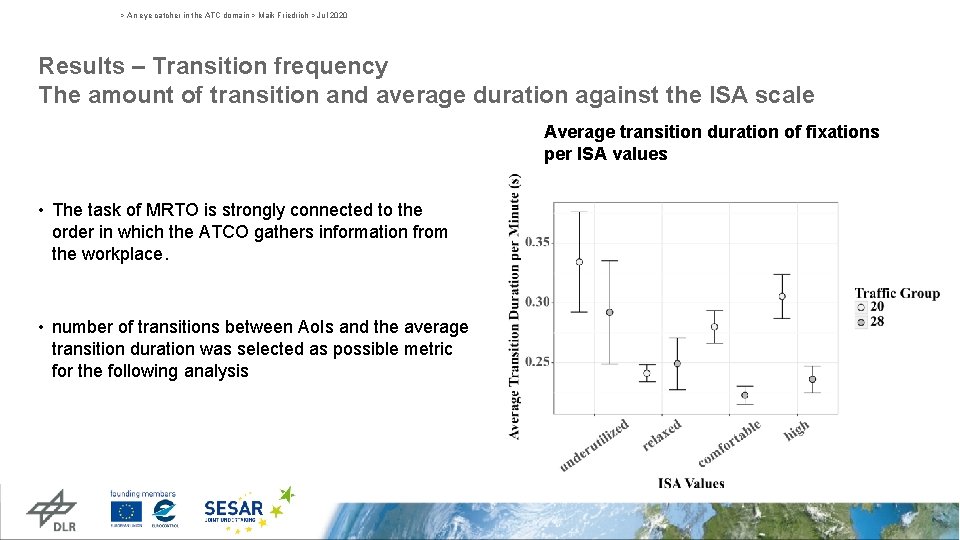
> An eye catcher in the ATC domain > Maik Friedrich > Jul 2020 Results – Transition frequency The amount of transition and average duration against the ISA scale Average transition duration of fixations per ISA values • The task of MRTO is strongly connected to the order in which the ATCO gathers information from the workplace. • number of transitions between Ao. Is and the average transition duration was selected as possible metric for the following analysis