
An experiment to detect life in other planets





- Slides: 22
An experiment to detect life in other planets Name: Hung Shui Ki A A a
Introduction – Why search for life in exoplanets? • Since the beginning of the Space Age, one of the chief drivers has been the search for life beyond Earth. But why do human search for life in exoplanets?
Any Aliens?
In every age and in every place where humans have left records, we see evidence of a marvelous instinct. As soon as societies obtained even a little product beyond the needs of bare survival, they began to create arts, languages, cultures, philosophy, religion, science and also, to wonder and theorize about the universe. It seems that human beings are born with creativity, wonder and intelligence. They are instinctive to explore the universe, the future and themselves. That is also why human societies became civilized and modern sciences and philosophy are developed.
What are the essential requirements for life survival? • Water (and in extreme cases on Earth – Ice) • Energy (Sunlight OR other energy sources) • Raw Materials (Organic matters) • Nutrients • Biological activities
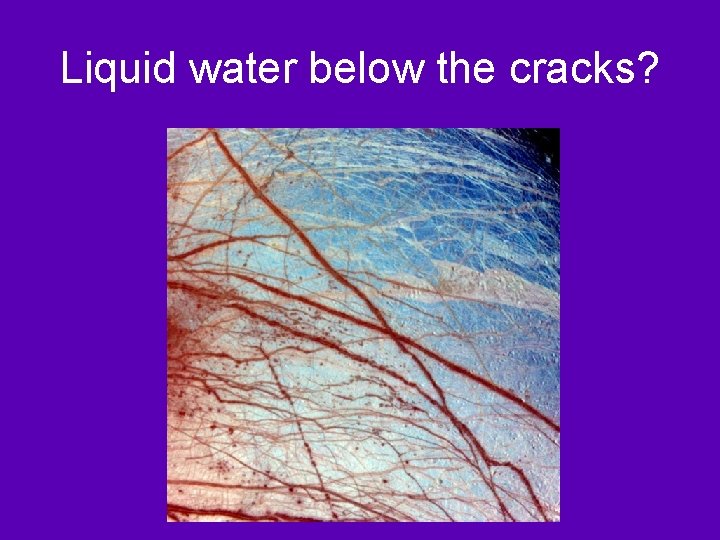
Experiments to Search for Water – Evidence of Liquid Water • Geographically – Meandering channels – River beds – Oceans – Gullies & Cliffs shaped by water flow – Below ice lakes (e. g. Europa) – Rock Layers shaped by water flow
Liquid water below the cracks?
Geologically Carbonates – Provided that the surface of the planet contains carbon dioxide. If carbonate minerals were formed on the surface by chemical reactions between water and the atmosphere, the presence of these minerals would be a clue that water had been present for a long time-perhaps long enough for life to have developed. Difficulties in searching for Water Searching for water is in fact very difficult, and it is a major obstacle to look for life right now. Until now, liquid water has not been found on the surface of Mars and other planets. Even if there is water, liquid water is going to be underground or under thick sheets of ice, which are hardly detectable.
Experiments to Search for Organic Matters – Evidence of Organic Matters • The Pyrolytic Release Experiment: • Aim: This experiment would detect the existence of organic materials in the soil. • Procedures: Following a five-day incubation period under a xenon-lamp, during which it was exposed to radioactive CO 2, surface samples were heated to high temperatures to determine if any of the radioactive CO 2 had been incorporated into molecular compounds.
Drawbacks of the PR Experiment: • Even though small concentrations of micro -organisms may be detected, the results are subsequently discounted on the basis that indigenous life-forms in the planet would have been killed by the relatively high temperatures they were exposed to in the initial incubation period.
The Gas Chromatograph -- Mass Spectrometer: • Aim: This experiment aims to determine the chemical composition of a soil sample on the surface of the planet. Apart from the primary interest for geological investigations, this experiment could also be used to detect concentrations of organic compounds that would be the constituents of micro-organisms.
Results: The amount of water and organic compounds can be obtained. An absence of organic compounds may suggest the presence of some mechanisms that were destroying the carbon compounds in meteorites that reach the planet surface.
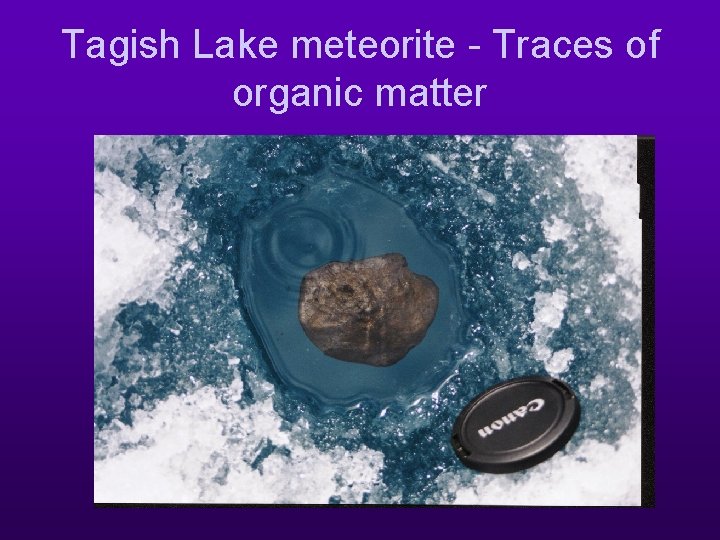
Tagish Lake meteorite - Traces of organic matter
Experiments to Search for Biological activity • 1. The Gas Exchange Experiment • Aim: To detect alterations in the composition of the gases in the test chamber as a result of biological activity. • Results: This experiment detects the change in the level of oxygen in the test chamber, yet the results should be investigated to see of they are consistent with biological activity.
2. The Labeled Release Experiment • Aims: To detect the uptake of the nutrient by micro-organisms, by used a liquid nutrient tagged (labeled) with radioactive Carbon-14. • Expected Result: A positive result would be that the soil, when wetted by the nutrient tagged (labeled) with radioactive Carbon-14, rapidly releases significant volumes of labeled gases over a period of time, e. g. several days. Also, the rate of gas release should be in a manner that is consistent with either chemical or biological activity.
Experiments to Search for Energy sources beyond Sunlight • Sunlight is NOT compulsory for Life Existence! • Scientists have discovered an isolated community of bacteria nearly two miles underground that derives all of its energy from the decay of radioactive rocks rather than from sunlight. They have been isolated from the Earth’s surface for several million years, depending exclusively on geologically produced hydrogen and sulfur compounds for nourishment. This shows that LIFE CAN INDEED EXIST IN EXTREME CONDITIONS FAR BEYOND HUMANS’ IMAGINATIONS.
Therefore, to search for extreme life-forms is indeed equivalent to search for energy sources that can be utilized by organisms. These possible energy forms include: • decay of radioactive rocks. e. g. uranium, thorium and potassium • geothermal energy. e. g. hydrothermal vents • sulfur compounds and geologically produced hydrogen – energy-rich food (instead of organic matters) • EM wave • Oxidation-Reduction • Kinetic Energy • Magnetic Field • Gravitional Forces • Tectonic Stress • Pressure Gradients
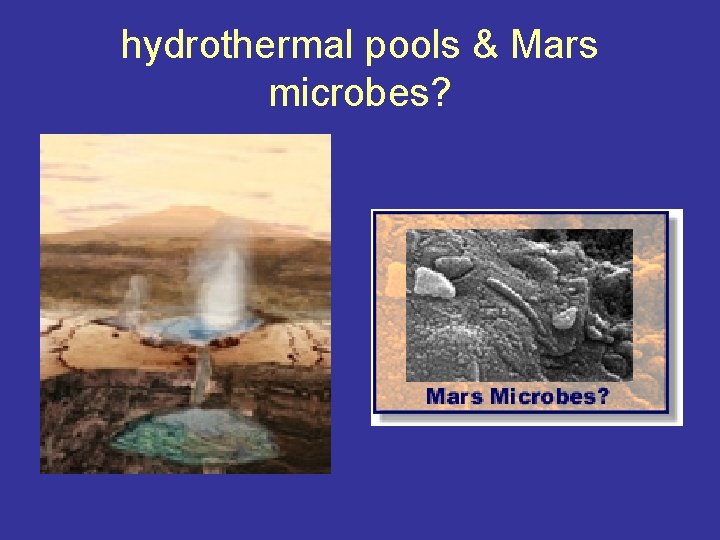
hydrothermal pools & Mars microbes?
Experiments to Search for Fossils – An easier alternative to search for Liquid Water • We have mentioned the Difficulties in searching for Water. On the other hand, fossilized bacteria might just be right there on the surface of planets, waiting for a rover to scoop it up and analyze it. • Procedure: Find a location where water once existed for some period of time. For example, where the Mars Exploration Rovers, Spirit and Opportunity, are currently roaming. In order to see fossilized bacteria, the rovers would need to be equipped with extremely sensitive microscopes and organic chemistry laboratories to analyze promising rocks.
Also, based on the experience of finding fossils on Earth, it is known only certain environments and types of deposits provide good places for fossil preservation. Therefore, regions of similar deposits on the exoplanets become targets for searching fossils. Advantages: On Earth, fossils in sedimentary rock leave a record of past life. Therefore, by finding fossils, we can determine the past life on the planets. Also, it would be easier than getting to liquid water.
Conclusion • Humans are still unable to find any kinds of lifeforms on planets other than Earth. Therefore, we should cherish our Earth – our only home ever found. Yet, with the discovery of extreme lifeforms (unusual microbes) on Earth, such as deep underground isolated from Earth surface, scientists are speculating that life could exist in similar circumstances elsewhere in the solar system. Not only do these discoveries show that living things are even more adaptable than once thought, but it would also shed light on research into the origins of life on Earth.
Reference: • 1. http: //www. astrobio. net/ • 2. http: //mars. spherix. com/ • 3. http: //www. nasa. gov/mission_pages/exploration/whywee xplore/Why_We_12. html • 4. http: //www. universetoday. com/ • 5. http: //home. worldonline. dk/winthrop/viking. html • 6. http: //mars. jpl. nasa. gov/science/life/index. html • 7. http: //www. resa. net/nasa/mars_life_viking. htm • 8. http: //archives. cnn. com/2000/TECH/space/03/02/venera ble. probes/index. html#2 • 9. http: //www. marsquestonline. org/