
An Example Using PET for Statistical Parametric Mapping
- Slides: 19
An Example Using PET for Statistical Parametric Mapping Jack L. Lancaster, Ph. D. Presented to SPM class
Example PET Study • Interest of the study in brain areas active in stutters • Stuttering can be quantified using stuttered interval count (SI) count • SI count is the # of 4 -second intervals containing stuttered speech • SI count can serve as an external measure for correlation with CBF in PET study • Need group design study to see subtle effects
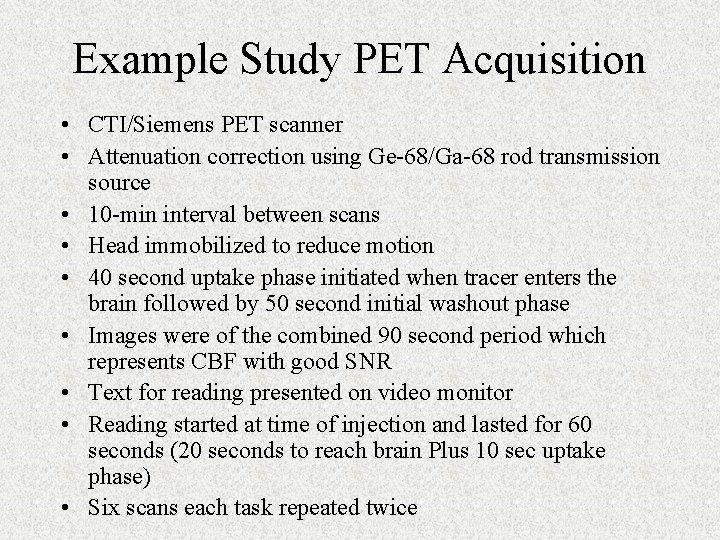
Example Study PET Acquisition • CTI/Siemens PET scanner • Attenuation correction using Ge-68/Ga-68 rod transmission source • 10 -min interval between scans • Head immobilized to reduce motion • 40 second uptake phase initiated when tracer enters the brain followed by 50 second initial washout phase • Images were of the combined 90 second period which represents CBF with good SNR • Text for reading presented on video monitor • Reading started at time of injection and lasted for 60 seconds (20 seconds to reach brain Plus 10 sec uptake phase) • Six scans each task repeated twice
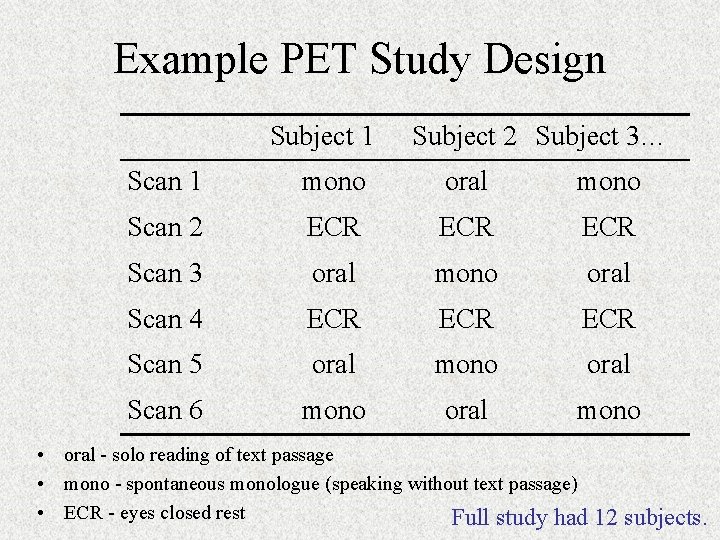
Example PET Study Design Subject 1 Subject 2 Subject 3… Scan 1 mono oral mono Scan 2 ECR ECR Scan 3 oral mono oral Scan 4 ECR ECR Scan 5 oral mono oral Scan 6 mono oral mono • oral - solo reading of text passage • mono - spontaneous monologue (speaking without text passage) • ECR - eyes closed rest Full study had 12 subjects.
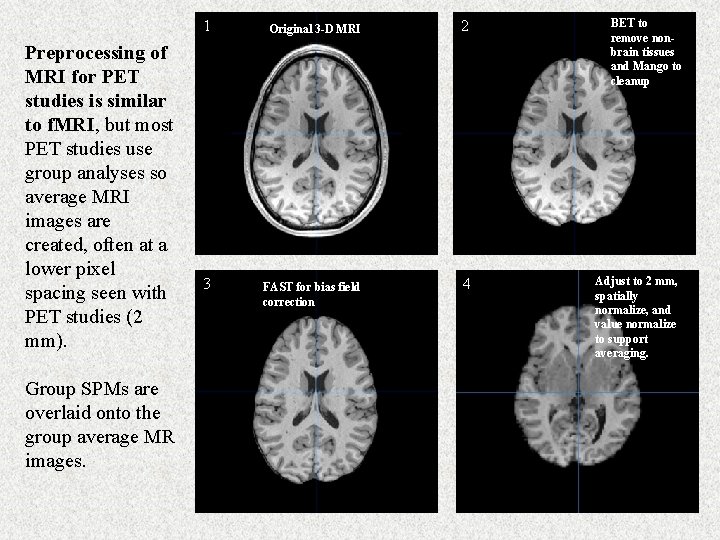
Preprocessing of MRI for PET studies is similar to f. MRI, but most PET studies use group analyses so average MRI images are created, often at a 1 lower pixel spacing seen with PET studies (2 mm). Group SPMs are overlaid onto the group average MR images. 1 Original 3 -D MRI 2 3 FAST for bias field correction 4 BET to remove nonbrain tissues and Mango to cleanup Adjust to 2 mm, spatially normalize, and value normalize to support averaging.
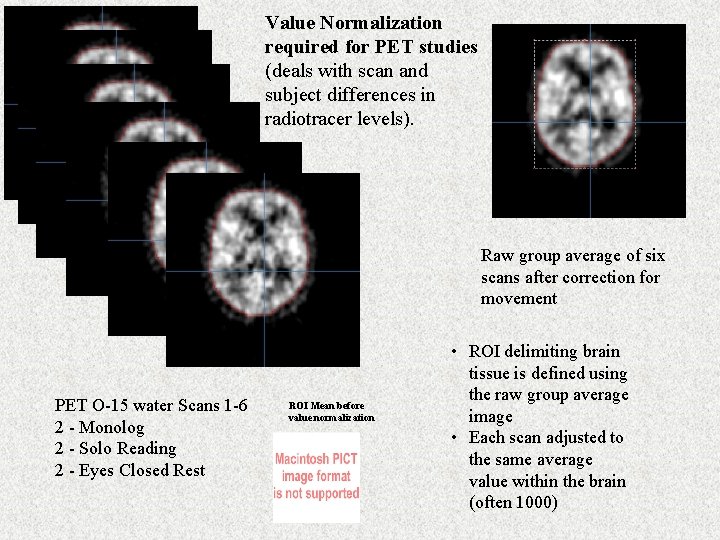
Value Normalization required for PET studies (deals with scan and subject differences in radiotracer levels). Raw group average of six scans after correction for movement PET O-15 water Scans 1 -6 2 - Monolog 2 - Solo Reading 2 - Eyes Closed Rest ROI Mean before value normalization • ROI delimiting brain tissue is defined using the raw group average image • Each scan adjusted to the same average value within the brain (often 1000)
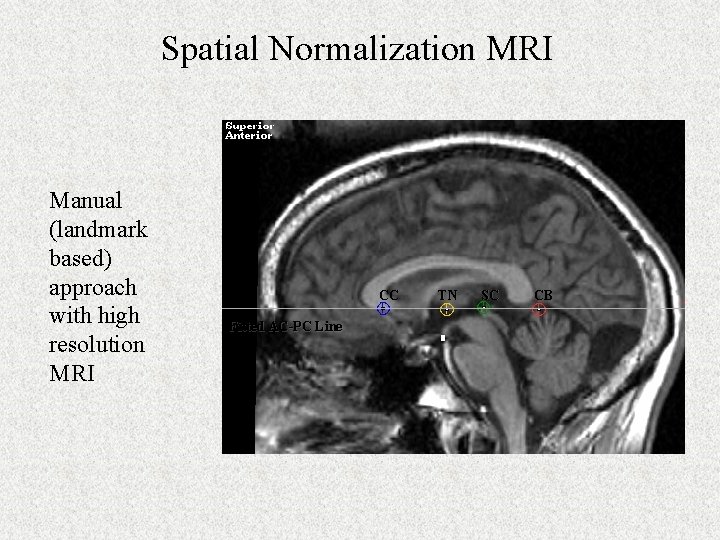
Spatial Normalization MRI Manual (landmark based) approach with high resolution MRI CC Fitted AC-PC Line TN SC CB
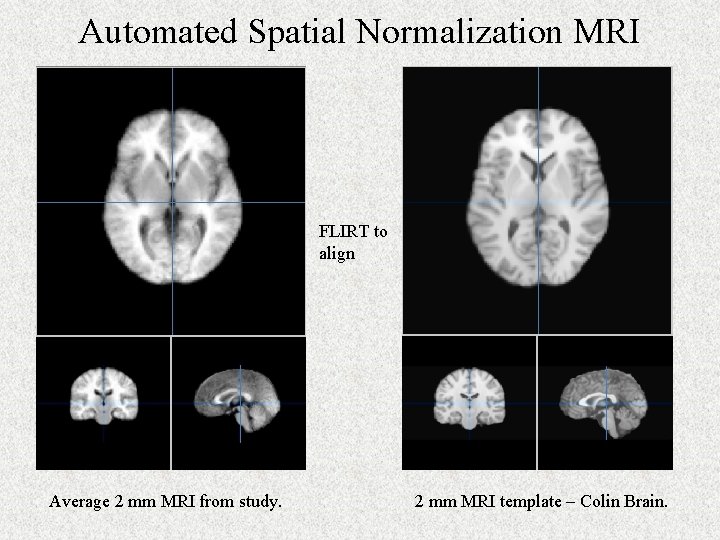
Automated Spatial Normalization MRI FLIRT to align Average 2 mm MRI from study. 2 mm MRI template – Colin Brain.
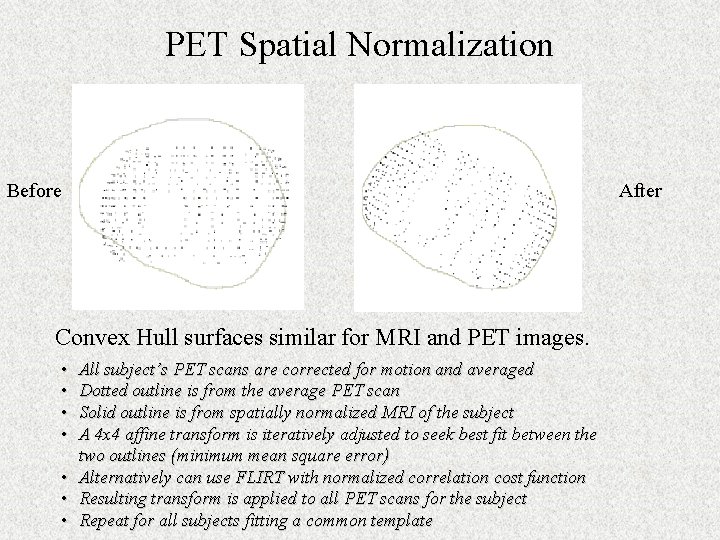
PET Spatial Normalization Before Convex Hull surfaces similar for MRI and PET images. • • All subject’s PET scans are corrected for motion and averaged Dotted outline is from the average PET scan Solid outline is from spatially normalized MRI of the subject A 4 x 4 affine transform is iteratively adjusted to seek best fit between the two outlines (minimum mean square error) • Alternatively can use FLIRT with normalized correlation cost function • Resulting transform is applied to all PET scans for the subject • Repeat for all subjects fitting a common template After
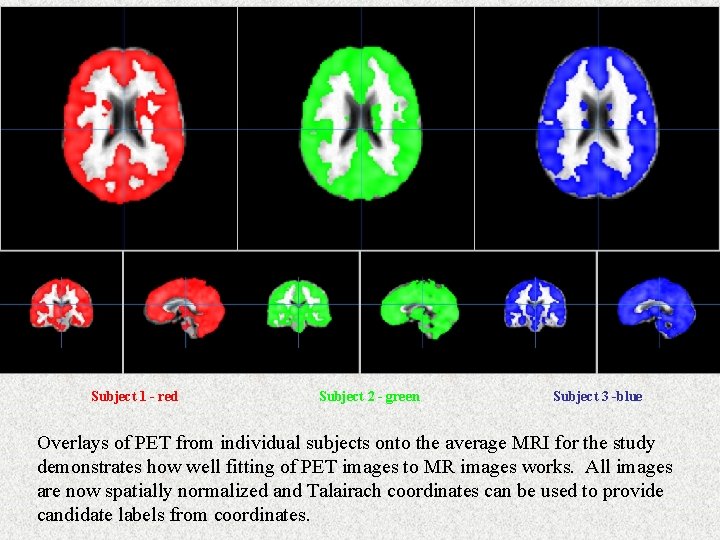
Subject 1 - red Subject 2 - green Subject 3 -blue Overlays of PET from individual subjects onto the average MRI for the study demonstrates how well fitting of PET images to MR images works. All images are now spatially normalized and Talairach coordinates can be used to provide candidate labels from coordinates.
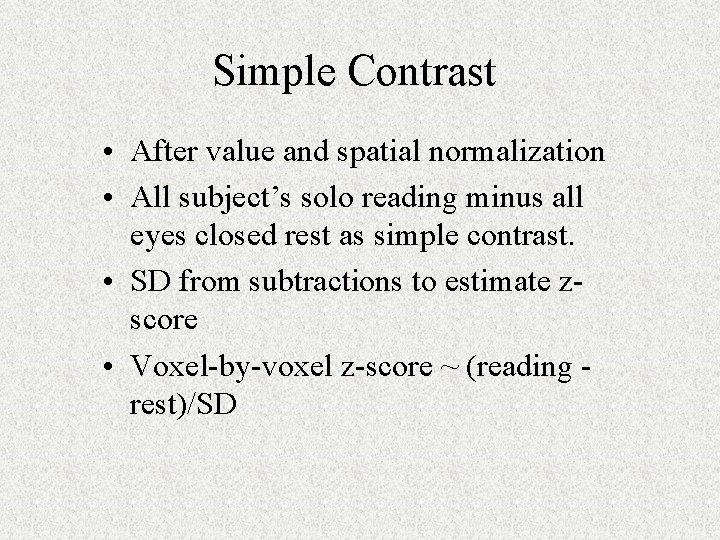
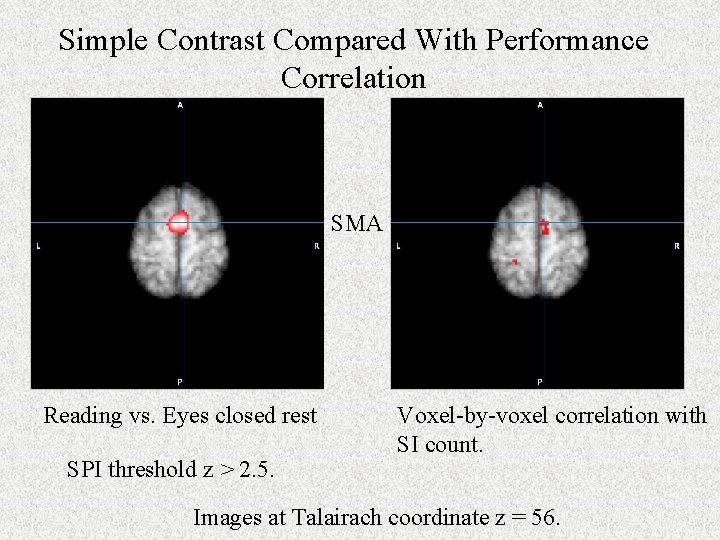
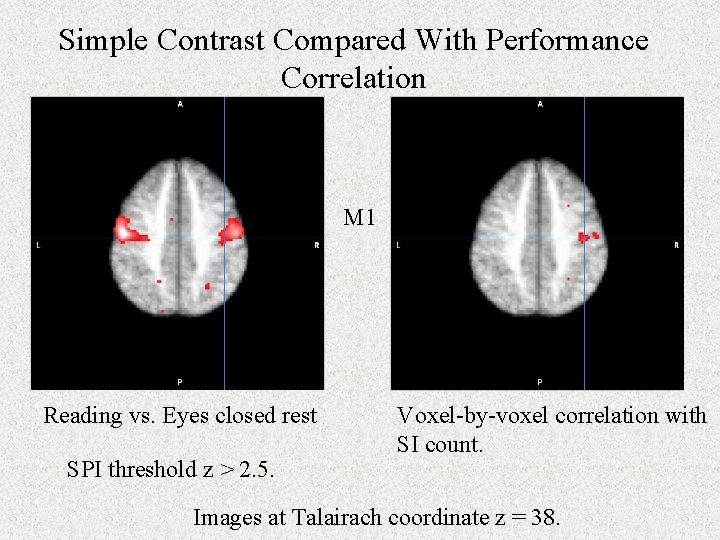
Simple Contrast • After value and spatial normalization • All subject’s solo reading minus all eyes closed rest as simple contrast. • SD from subtractions to estimate zscore • Voxel-by-voxel z-score ~ (reading rest)/SD
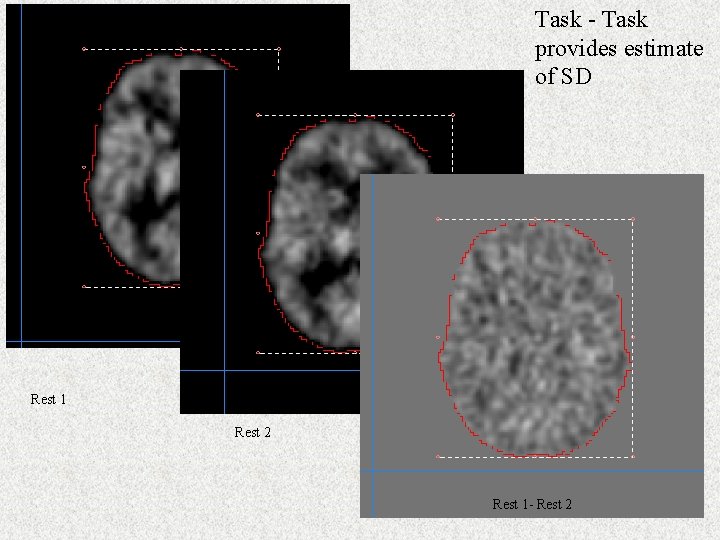
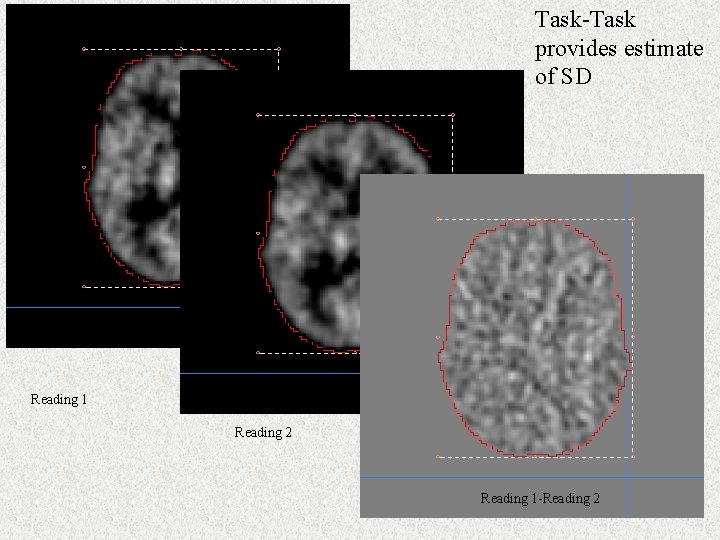
Task - Task provides estimate of SD Rest 1 Rest 2 Rest 1 - Rest 2
Task-Task provides estimate of SD Reading 1 Reading 2 Reading 1 -Reading 2
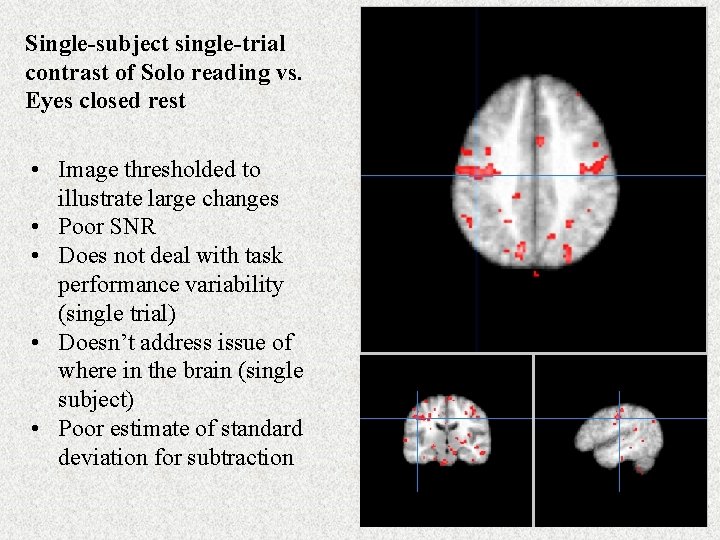
Single-subject single-trial contrast of Solo reading vs. Eyes closed rest • Image thresholded to illustrate large changes • Poor SNR • Does not deal with task performance variability (single trial) • Doesn’t address issue of where in the brain (single subject) • Poor estimate of standard deviation for subtraction
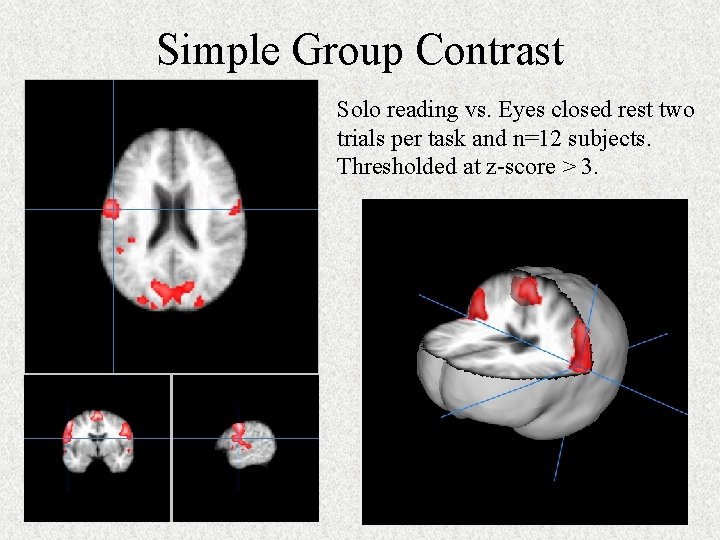
Simple Group Contrast Solo reading vs. Eyes closed rest two trials per task and n=12 subjects. Thresholded at z-score > 3.
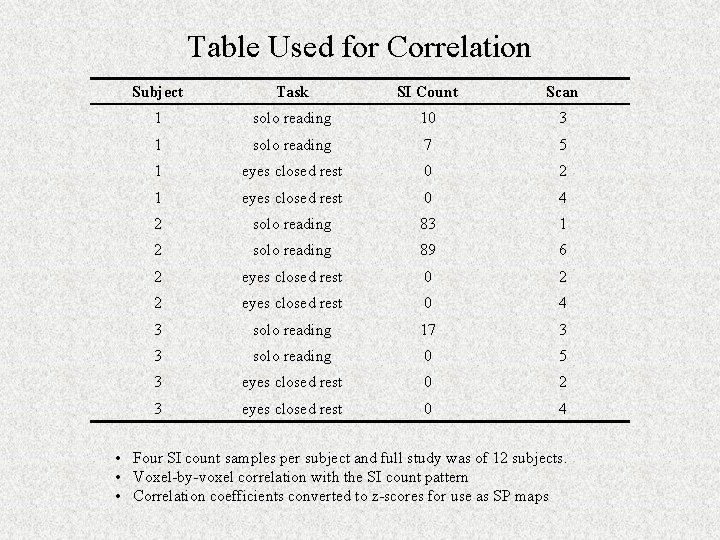
Table Used for Correlation Subject Task SI Count Scan 1 solo reading 10 3 1 solo reading 7 5 1 eyes closed rest 0 2 1 eyes closed rest 0 4 2 solo reading 83 1 2 solo reading 89 6 2 eyes closed rest 0 2 2 eyes closed rest 0 4 3 solo reading 17 3 3 solo reading 0 5 3 eyes closed rest 0 2 3 eyes closed rest 0 4 • Four SI count samples per subject and full study was of 12 subjects. • Voxel-by-voxel correlation with the SI count pattern • Correlation coefficients converted to z-scores for use as SP maps
Simple Contrast Compared With Performance Correlation SMA Reading vs. Eyes closed rest SPI threshold z > 2. 5. Voxel-by-voxel correlation with SI count. Images at Talairach coordinate z = 56.
Simple Contrast Compared With Performance Correlation M 1 Reading vs. Eyes closed rest SPI threshold z > 2. 5. Voxel-by-voxel correlation with SI count. Images at Talairach coordinate z = 38.
For More Details on PET Processing similar to what was used in this example see • Fox et al. , A PET study of the neural systems of stuttering, Nature, 1996, pp 158 -162. • Fox et al. , Functional-lesion investigation of developmental stuttering with positron emission tomography, Journal of Speech and Hearing Research, 1996, 1208 -1227. • Ingham et al. , Brain correlates of stuttering and syllable production: Gender comparison and replication, Journal of Speech, Language and Hearing Research, 2000, pp 321 -341. • Fox et al. , Brain correlates of stuttering and syllable production: A PET performance-correlation analysis, Brain, 2000, pp 19852004.