
An Examination of the Relationship between Learning Types
An Examination of the Relationship between Learning Types of Sport Rules and Future Consumption Behavior INTERNATIONAL ALLIANCE OF HEALTH, PHYSICAL EDUCATION, DANCE AND SPORT Summit 2020 University of North Florida Dr. Wanyong Choi
Introduction Ø Sport Segments § Among the most diverse industries in the business (De. Schriver & Mahony, 2011) § Rapidly developing (Bureau of Economic Analysis, 2008; Howard & Crompton, 2014) § Sport is a common leisure activity (Wann, Melnick, Russel, & Pease, 2001) Ø Sporting Events § TV right deal for professional sport (e. g. , NFL, NBA, MLB, NHL) and collegiate sport (Men’s basketball tournament) • NFL $28 b for nine-year, NCAA $10. 8 b for 14 years (Hambrecht et al. , 2012) § Types of consumption behavior • Sporting goods, media consumption, video game, spectating
Introduction Ø Definition of Sport Fans § A person who has interest in and follows a sport, teams, and players (Wann et al, 2001) § Massive consumer group related to the sport industry (Plunkett, 2008) § Chasing the experience of the peaks of ritual emotion itself (Collins, 2004) § Attending live sporting events and consuming sport media (Kwon, Trail, & James, 2007) Ø Unique Characteristics of Sport Fans § Psychological commitment toward a sport, team, and/or player (James, 1997) § Spends a great deal of money and time on sport-related activities (James, 1997) § An individual first becomes a fan of a sport, then a team, followed by an athlete (Hunt, Bristol, & Bashaw, 1999)
Introduction Ø Features of Sport Fan Behaviors § Myriad of research done on various sport fan behaviors (e. g. , Funk & James, 2001; Mahony, Madrigal, & Howard, 1999; Sutton, Mc. Donald, Milne, & Cimperman, 1997; Park, Andrew, & Mahony, 2008; Trail & James, 2001) § Motivating factors: entertainment, eustress, self-esteem, escape, learning, aesthetic, release, companionship, group affiliation, family, economics, etc. Ø Challenges of Sport Industry § § Highly competitive market climate and saturated conditions (Kim, 2008) Decreasing attendance numbers (e. g. , NFL, MLB, NBA) (WR Hambrecht report, 2012) Unable to find immediate factors or elements Necessity of new efforts to find more important and core factors (Kim, 2008)
Introduction Ø Limitation of Previous Studies § Lack of understanding of core factors of sport management § Ignorance of knowledge as a key motivating factor (Rogers, 1983; Zhang et al, 1996) § Shortage of awareness about initial stage of sport fandom (Funk & James, 2001; Mahony, Madrigal, & Howard, 1999; Sutton, Mc. Donald, Milne, & Cimperman, 1997; Trail & James, 2001) § Limited approach of sport-related knowledge • Team history, player/coach information, team records, game strategy, skillset pertinent to sport, general information about the game (Trail & James, 2001; Trail, Robinson, Dick, & Gillentine, 2003; Trail et al. , 2003) Although the rules of sport are an internal factor for enjoying sport, the approach to understand the importance of rules was not sufficient
Introduction Ø Purpose of the Study § To test the relationship and determine influence between learning sport rules on behavioral factors § To provide more practical evidence regarding the relationship between the process associated with learning sport rules and intentions regarding future consumption
Literature Review Ø Knowledge § Definitions • “The information stored within memory” (Engel, Blackwell, & Miniard, 1990, p. 281) • Understanding about a subject or an object (Rogers, 1983) • A basic element of the decision-making process regarding new activities (Rogers, 1983) § Influences of Knowledge on Sport • Perception toward initiation of behaviors (Zhang, Smith, Pease, & Mahar, 1996) • Leisure behaviors (Doyle et al. , 1980; Knecht & Zenger, 1985) • Product involvement (Bloch, 1986; Flynn & Goldsmith, 1993) • Prediction game attendance (Zhang et al, 1996) • Decision making (Brucks, 1985; Raju, Lonial, & Mangold, 1993) • Enjoyment and Emotion (Raney & Bryant, 2002; Zhou, Xu, & Ye, 2013) • Future consumption behavior (Kwak, 2009; Perry & Morris, 2005) Knowledge is a critical factor to identify and understand sport fans (Hirt & Clarkson, 2011) 7
Literature Review Ø Sport Rules as Knowledge § Sport Rules • The most basic and significant element in the stage of awareness of sport (Funk & James, 2001) • Prerequisite for a fan’s behavior concerning sports (Voss & Keller, 1983) • Significant & essential step to becoming involved, enjoying, consuming Ø Sport Consumption § Sporting goods § Influences other sport consumption behaviors (Milano & Chelladurai, 2011) §Playing sports itself as player or participants § Media consumption § Catching up on what is happening in the sport world via media outlets (Billings, 2010) § Numerous ways to consume (Billings, 2010) § Attending sporting events § An activity representative of sport consumption (Greenstein & Marcum, 1981; Schofield, 1983) § Playing of sport video games § New form of participatory experience in the sport field (Kim & Ross, 2006) 8
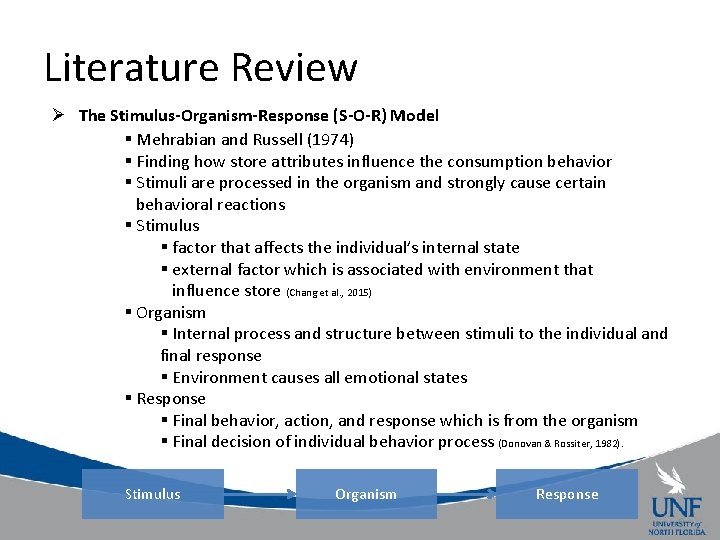
Literature Review Ø The Stimulus-Organism-Response (S-O-R) Model § Mehrabian and Russell (1974) § Finding how store attributes influence the consumption behavior § Stimuli are processed in the organism and strongly cause certain behavioral reactions § Stimulus § factor that affects the individual’s internal state § external factor which is associated with environment that influence store (Chang et al. , 2015) § Organism § Internal process and structure between stimuli to the individual and final response § Environment causes all emotional states § Response § Final behavior, action, and response which is from the organism § Final decision of individual behavior process (Donovan & Rossiter, 1982). Stimulus Organism Response 9
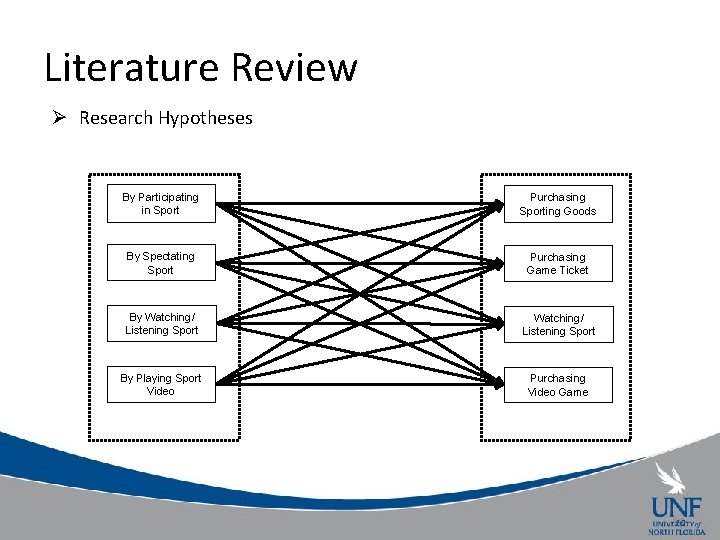
Literature Review Ø Research Hypotheses By Participating in Sport Purchasing Sporting Goods By Spectating Sport Purchasing Game Ticket By Watching/ Listening Sport By Playing Sport Video Purchasing Video Game 10 10
Methodology Ø Sample § Total of 260 respondents § Qualtrics (External on-line panel survey) § Random sampling § Nationwide population (more than three million) § To access to large and targeted samples § Filtering system- quality of data § e. g. , no missing data, streamlined responses Ø Pilot Study § 67 respondents (undergraduate courses at a large Midwestern university) § Four different classes at a Midwestern university in United States § Pilot study samples were excluded from the main study 11
Methodology Ø Measures v Rule Recognition Process Types (12 items) • Funk, Ridinger, & Moorman (2004); Kremer-Sadlik & Kim (2007) • ‘by playing their favorite sports’ • ‘by attending their favorite sporting event’ • ‘by watching/listening their favorite sport through TV/radio’ • ‘by enjoying their favorite sport through video game play’ v Sport Consumption Behavior (12 items) • Voss, Spangenberg, & Grohmann (2003) • Purchasing sporting goods, • Purchasing/attending sporting event, • Media consumption, • Purchasing sports video game, v Demographic Information (7 items) • Williams (2010) • age, gender, ethnicity, incomes, education levels, marital status, favorite sports 12

Methodology Ø Data analysis ü Statistical Package for the Social Science (SPSS) § Reliability tests of each scale/ Internal consistency coefficients § Pearson correlations (validity checks) ü AMOS § Confirmatory factor analysis (CFA) (Byrne, 2006; Hatcher, 1994) • χ2 and df, the comparative fit index (CFI), • root-mean-square error of approximation (RMSEA) • standard root-mean-squared residual (SRMR) § Structural Equation Modeling (SEM) • χ2 and df, the comparative fit index (CFI), • root-mean-square error of approximation (RMSEA) • standard root-mean-squared residual (SRMR) • average variance extracted (AVE) INDIANA UNIVERSITY 13
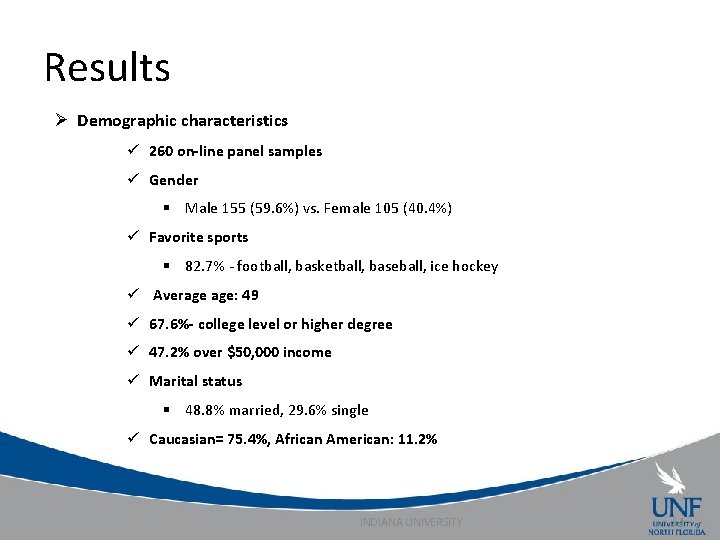
Results Ø Demographic characteristics ü 260 on-line panel samples ü Gender § Male 155 (59. 6%) vs. Female 105 (40. 4%) ü Favorite sports § 82. 7% - football, basketball, baseball, ice hockey ü Average age: 49 ü 67. 6%- college level or higher degree ü 47. 2% over $50, 000 income ü Marital status § 48. 8% married, 29. 6% single ü Caucasian= 75. 4%, African American: 11. 2% INDIANA UNIVERSITY 14
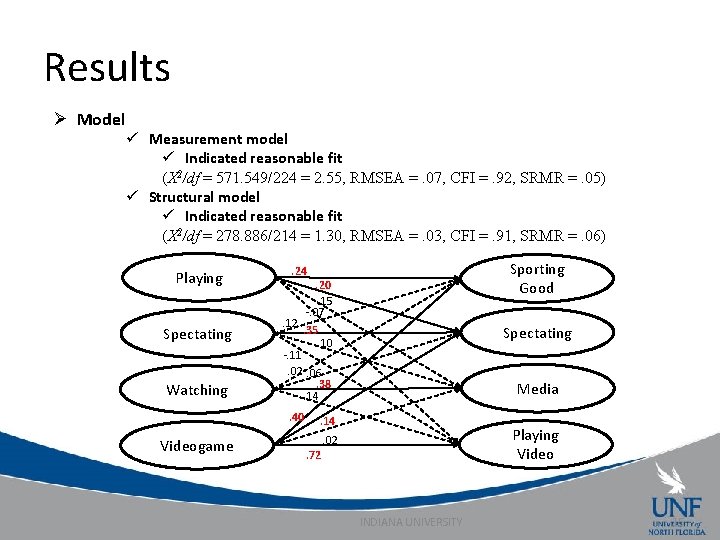
Results Ø Model ü Measurement model ü Indicated reasonable fit (Χ 2/df = 571. 549/224 = 2. 55, RMSEA =. 07, CFI =. 92, SRMR =. 05) ü Structural model ü Indicated reasonable fit (Χ 2/df = 278. 886/214 = 1. 30, RMSEA =. 03, CFI =. 91, SRMR =. 06) Playing Spectating Watching . 12 . 20. 15 -. 07 Spectating . 35. 10 -. 11. 02. 06. 38. 14. 40 Videogame Sporting Good . 24 Media . 14. 72 Playing Video . 02 INDIANA UNIVERSITY 15
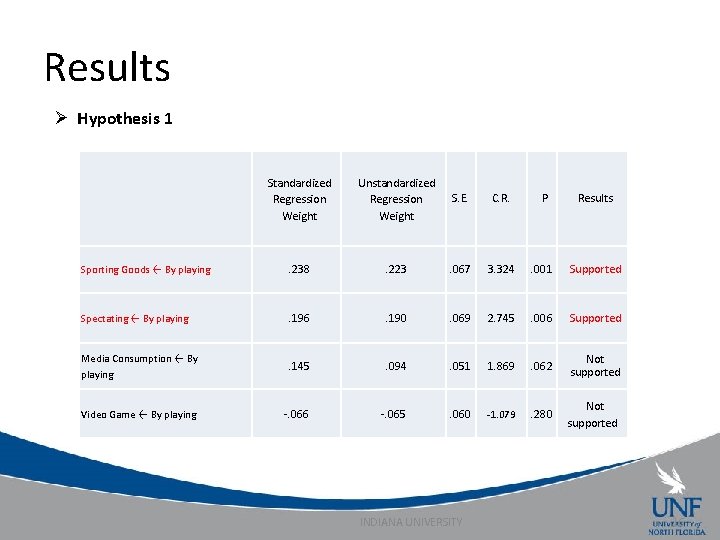
Results Ø Hypothesis 1 Standardized Regression Weight Unstandardized Regression Weight S. E. C. R. P Results Sporting Goods ← By playing . 238 . 223 . 067 3. 324 . 001 Supported Spectating ← By playing . 196 . 190 . 069 2. 745 . 006 Supported Media Consumption ← By playing . 145 . 094 . 051 1. 869 . 062 Not supported Video Game ← By playing -. 066 -. 065 . 060 -1. 079 . 280 Not supported INDIANA UNIVERSITY 16
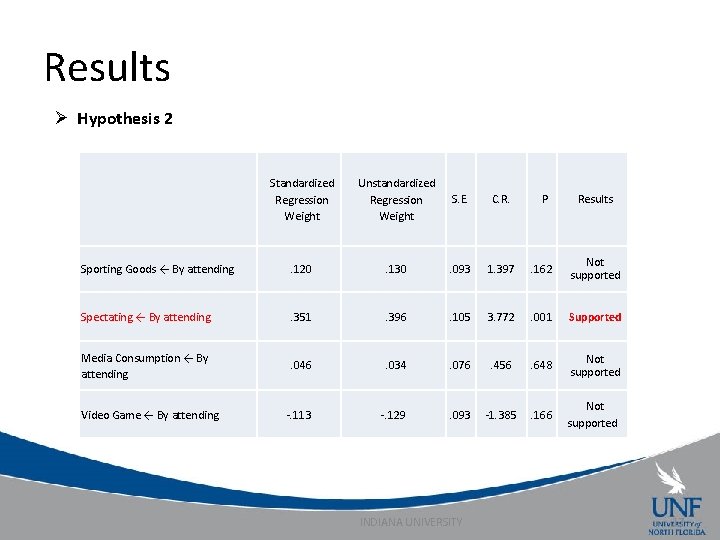
Results Ø Hypothesis 2 Standardized Regression Weight Unstandardized Regression Weight S. E. C. R. P Results Sporting Goods ← By attending . 120 . 130 . 093 1. 397 . 162 Not supported Spectating ← By attending . 351 . 396 . 105 3. 772 . 001 Supported Media Consumption ← By attending . 046 . 034 . 076 . 456 . 648 Not supported -. 113 -. 129 . 093 -1. 385 . 166 Not supported Video Game ← By attending INDIANA UNIVERSITY 17
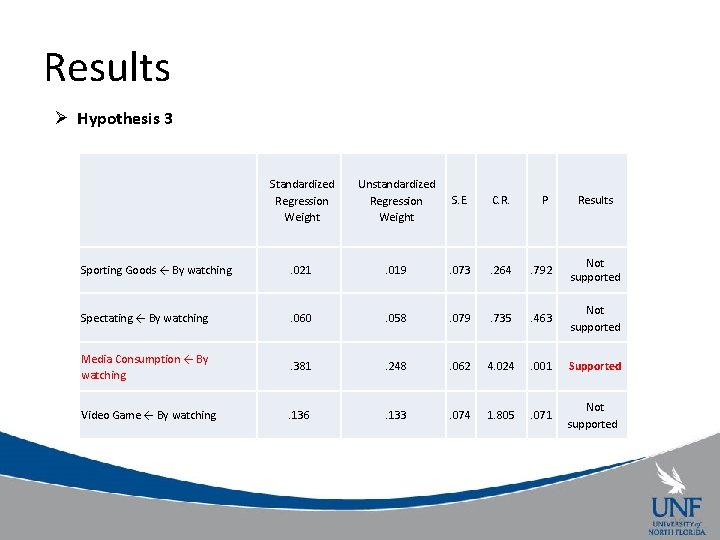
Results Ø Hypothesis 3 Standardized Regression Weight Unstandardized Regression Weight S. E. C. R. P Results Sporting Goods ← By watching . 021 . 019 . 073 . 264 . 792 Not supported Spectating ← By watching . 060 . 058 . 079 . 735 . 463 Not supported Media Consumption ← By watching . 381 . 248 . 062 4. 024 . 001 Supported Video Game ← By watching . 136 . 133 . 074 1. 805 . 071 Not supported 18
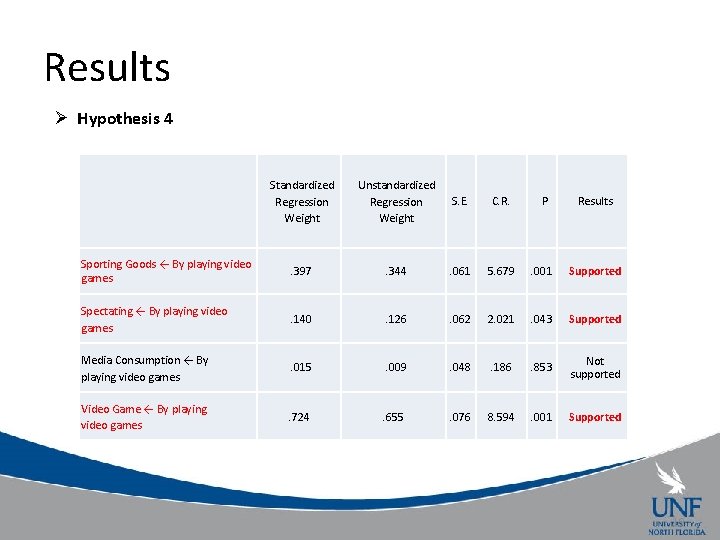
Results Ø Hypothesis 4 Standardized Regression Weight Unstandardized Regression Weight S. E. C. R. P Results Sporting Goods ← By playing video games . 397 . 344 . 061 5. 679 . 001 Supported Spectating ← By playing video games . 140 . 126 . 062 2. 021 . 043 Supported Media Consumption ← By playing video games . 015 . 009 . 048 . 186 . 853 Not supported Video Game ← By playing video games . 724 . 655 . 076 8. 594 . 001 Supported 19
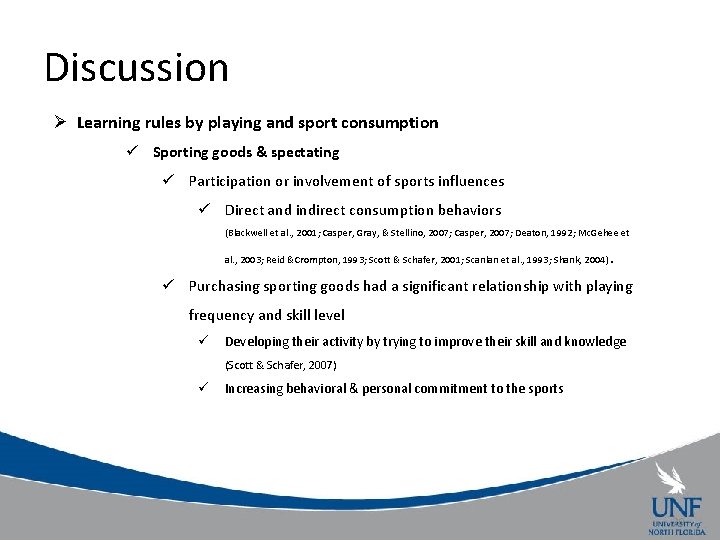
Discussion Ø Learning rules by playing and sport consumption ü Sporting goods & spectating ü Participation or involvement of sports influences ü Direct and indirect consumption behaviors (Blackwell et al. , 2001; Casper, Gray, & Stellino, 2007; Casper, 2007; Deaton, 1992; Mc. Gehee et al. , 2003; Reid &Crompton, 1993; Scott & Schafer, 2001; Scanlan et al. , 1993; Shank, 2004). ü Purchasing sporting goods had a significant relationship with playing frequency and skill level ü Developing their activity by trying to improve their skill and knowledge (Scott & Schafer, 2007) ü Increasing behavioral & personal commitment to the sports 20
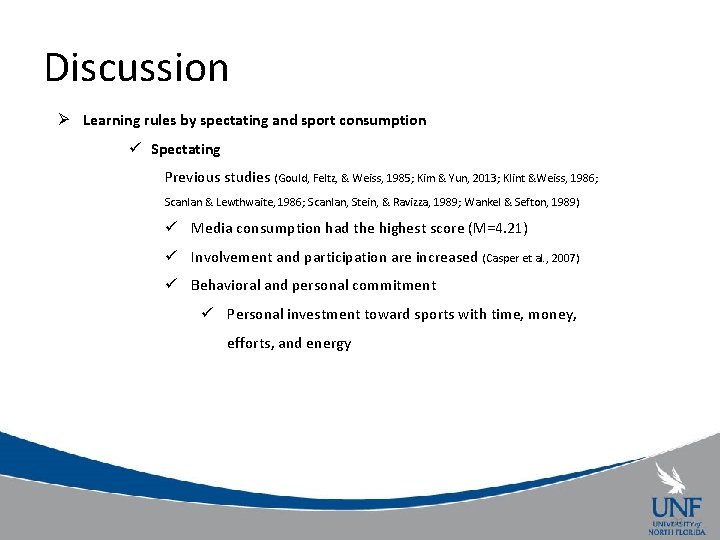
Discussion Ø Learning rules by spectating and sport consumption ü Spectating Previous studies (Gould, Feltz, & Weiss, 1985; Kim & Yun, 2013; Klint &Weiss, 1986; Scanlan & Lewthwaite, 1986; Scanlan, Stein, & Ravizza, 1989; Wankel & Sefton, 1989) ü Media consumption had the highest score (M=4. 21) ü Involvement and participation are increased (Casper et al. , 2007) ü Behavioral and personal commitment ü Personal investment toward sports with time, money, efforts, and energy 21
Discussion Ø Learning rules by watching TV and sport consumption ü Learning rules by watching TV influences only media consumption ü Easiest way to enjoy sports by supporting favorite teams and/or players (Billings, 2010; Phua, 2008) ü Providing lots of knowledge such as latest statistics, team and player information (Phua, 2008) ü Showing others their sports knowledge and trivia like walking encyclopedias, ü Making it possible to learn about sports including team, players, history, and rules (Raney, 2006). ü Learning sport rules by watching television is the most common and easiest way to gain knowledge about sports compared to other consumption behaviors 22
Discussion Ø Learning rules by playing video games and sport consumption ü Sporting goods purchasing, spectating, and playing video game had statistically significant relationship ü Supported by previous studies (Kim & Ross, 2006; Kim, Walsh, & Ross, 2008) ü Entertainment, knowledge applications, and social interaction motivations are consistent with this result ü Representative entertainment activities regarding sport-related ü Heavy consumers who engaged in sport related behaviors ü Higher level of sport-related consumption behavior, ü Consumers’ attitude toward sport, expertise of sport-related knowledge, specific game strategies ü Playing video games (Murray & Bellman, 2007) ü An extremely appropriate way to apply sport related knowledge by playing sports in person ü Connected with purchasing sport good merchandise ü It tends to involve a learning component that facilitates consumptions 23
Implication Ø Learning and understanding sport rules should be considered the most basic factor in the sport management academic field ü Role of understanding sport rules should be considered an important factor ü Understanding and predicting the sport fans’ development process and future behaviors ü Direct relationship between learning sport rules and future behaviors Ø Building efficient marketing strategies for practitioners or managers of sport -related organizations ü Specifying the marketing area that they have to focus on. ü e. g. , sporting goods company Ø Sponsoring amateur sports league/little league sports ü e. g. , sport teams’ or franchises’ Ø Rules info session 24

Questions and Comments 25
- Slides: 25