
An Examination of Insurance Pricing and Underwriting Cycles

- Slides: 26
An Examination of Insurance Pricing and Underwriting Cycles AFIR Conference, September 2003, Maastricht, NL Chris K. Madsen, GE Frankona Re, Copenhagen, Denmark Hal W. Pedersen, University of Manitoba, Winnipeg, Canada
Overview • • • Introduction Risky Cash Flows Underwriting Cycle Pricing Areas for Further Study Concluding Comments 9/25/2020 2
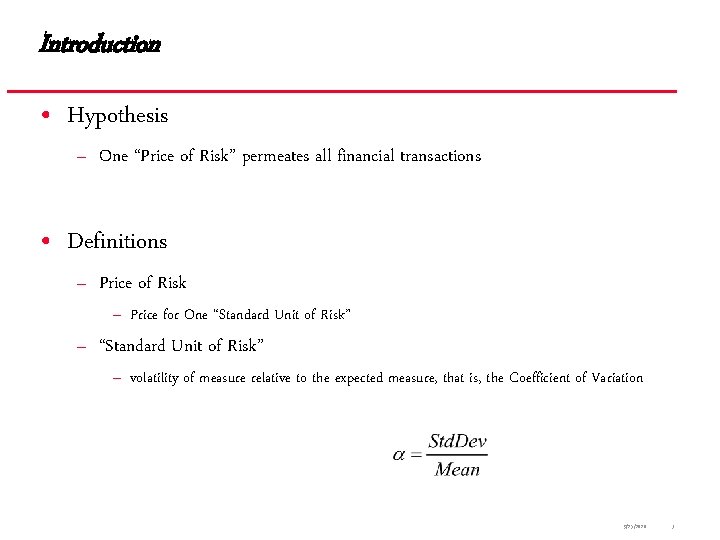
Introduction • Hypothesis – One “Price of Risk” permeates all financial transactions • Definitions – Price of Risk – Price for One “Standard Unit of Risk” – volatility of measure relative to the expected measure, that is, the Coefficient of Variation 9/25/2020 3
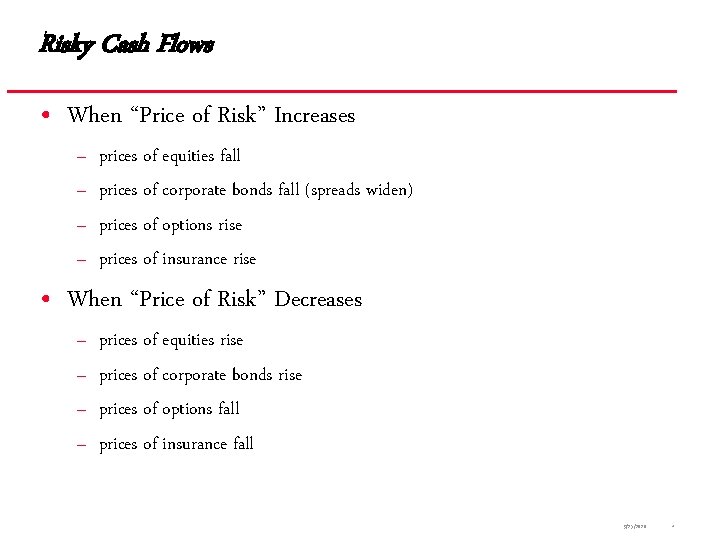
Risky Cash Flows • When “Price of Risk” Increases – – prices of equities fall prices of corporate bonds fall (spreads widen) prices of options rise prices of insurance rise • When “Price of Risk” Decreases – – prices of equities rise prices of corporate bonds rise prices of options fall prices of insurance fall 9/25/2020 4
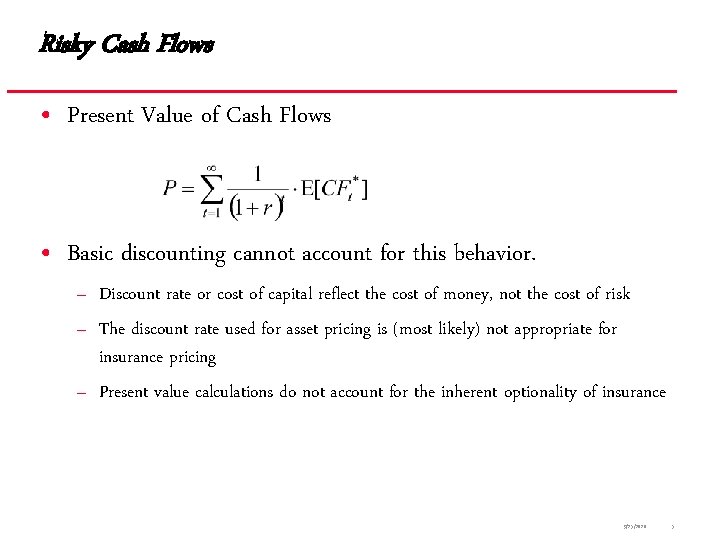
Risky Cash Flows • Present Value of Cash Flows • Basic discounting cannot account for this behavior. – Discount rate or cost of capital reflect the cost of money, not the cost of risk – The discount rate used for asset pricing is (most likely) not appropriate for insurance pricing – Present value calculations do not account for the inherent optionality of insurance 9/25/2020 5
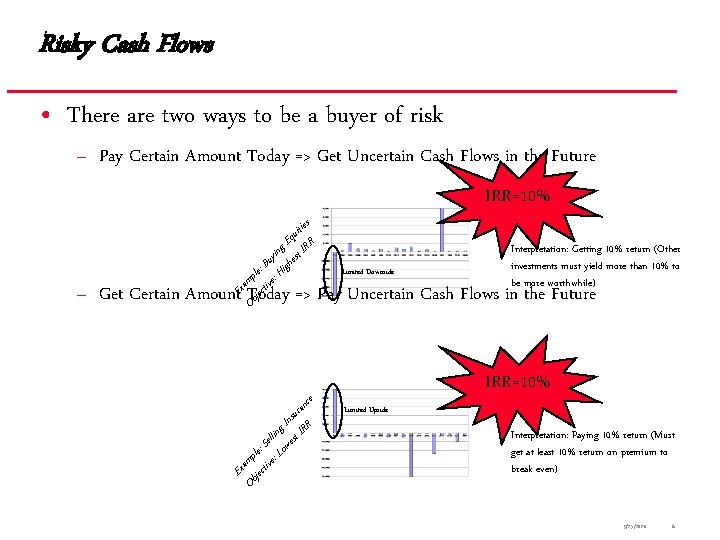
Risky Cash Flows • There are two ways to be a buyer of risk – Pay Certain Amount Today => Get Uncertain Cash Flows in the Future ies uq it g E RR yu in hest I B le: : Hig p m ve Exa bjecti O IRR=10% Limited Downside Interpretation: Getting 10% return (Other investments must yield more than 10% to be more worthwhile) – Get Certain Amount Today => Pay Uncertain Cash Flows in the Future nce a r nsu R I ng IR elli west S le: : Lo p m ve Exa bjecti O IRR=10% Limited Upside Interpretation: Paying 10% return (Must get at least 10% return on premium to break even) 9/25/2020 6
Risky Cash Flows • What is Insurance? – Financial transaction on losses – Selling (naked) call options on losses • Since insurance is an option, it would make sense to use option theory to price 9/25/2020 7
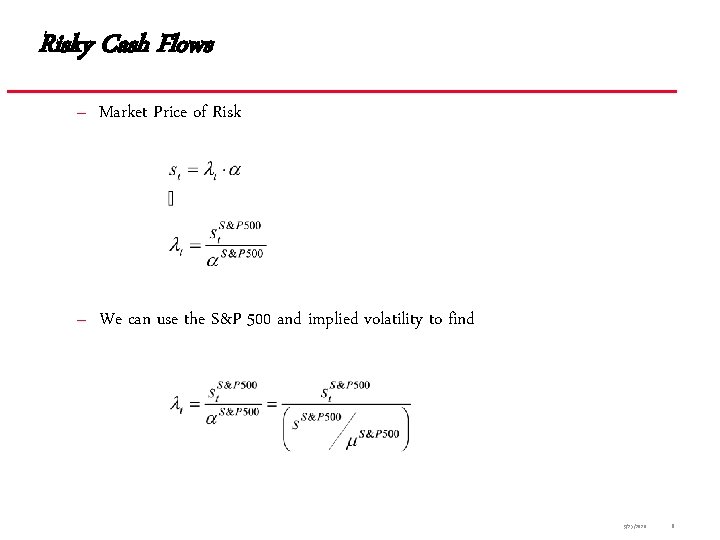
Risky Cash Flows – Market Price of Risk – We can use the S&P 500 and implied volatility to find 9/25/2020 8
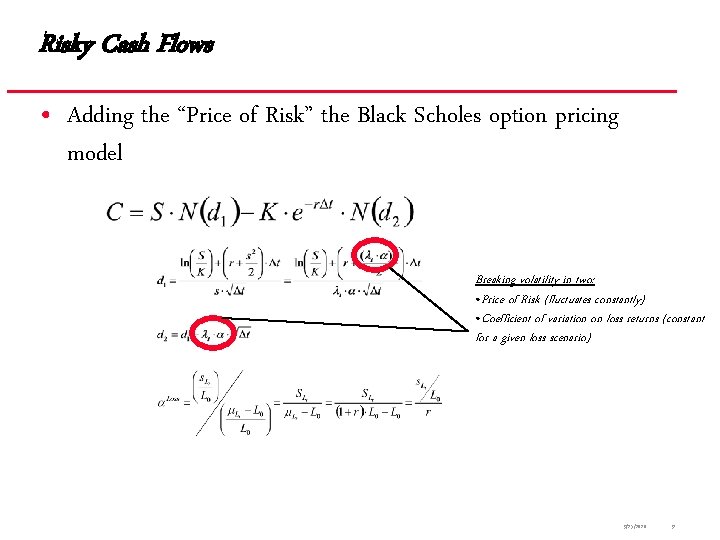
Risky Cash Flows • Adding the “Price of Risk” the Black Scholes option pricing model Breaking volatility in two: • Price of Risk (fluctuates constantly) • Coefficient of variation on loss returns (constant for a given loss scenario) 9/25/2020 9
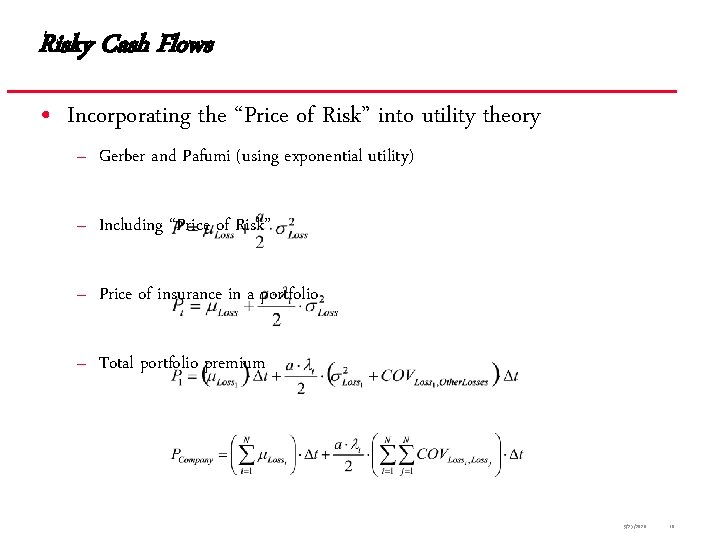
Risky Cash Flows • Incorporating the “Price of Risk” into utility theory – Gerber and Pafumi (using exponential utility) – Including “Price of Risk” – Price of insurance in a portfolio – Total portfolio premium 9/25/2020 10
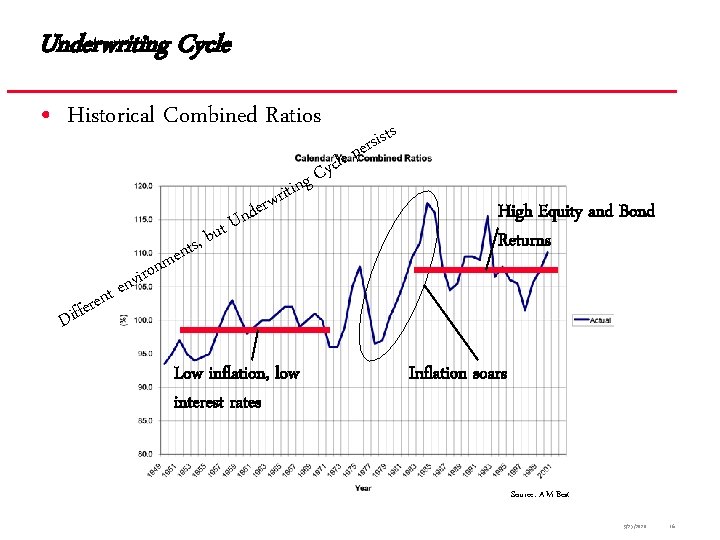
Underwriting Cycle • A. M. Best (A. M. Best Report, February, 1999) – “A. M. Best believes the property/casualty underwriting cycle has been replaced by a permanent ‘down market’” • Irving Fisher (Yale University, September, 1929) – “Stocks have been replaced by what looks like a permanently high plateau” 9/25/2020 11
Underwriting Cycle • Price of Risk 9/25/2020 12
Underwriting Cycle • Price of Risk 9/25/2020 13
Underwriting Cycle • “Fair” Price of Insurance 9/25/2020 14
Underwriting Cycle • “Fair” Price of Insurance 9/25/2020 15
Underwriting Cycle • Historical Combined Ratios n U t u t n e r iffe b , s t men i t i r w der n ro i v n e le yc C ng ts s i s r pe High Equity and Bond Returns D Low inflation, low interest rates Inflation soars Source: A. M. Best 9/25/2020 16
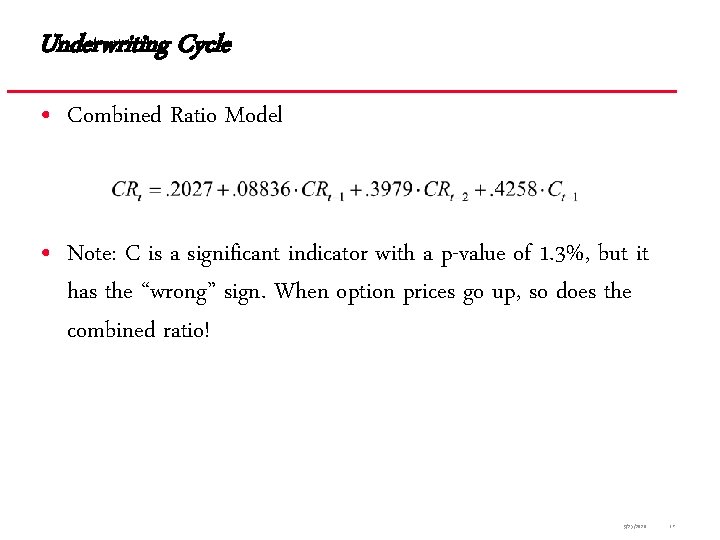
Underwriting Cycle • Combined Ratio Model • Note: C is a significant indicator with a p-value of 1. 3%, but it has the “wrong” sign. When option prices go up, so does the combined ratio! 9/25/2020 17
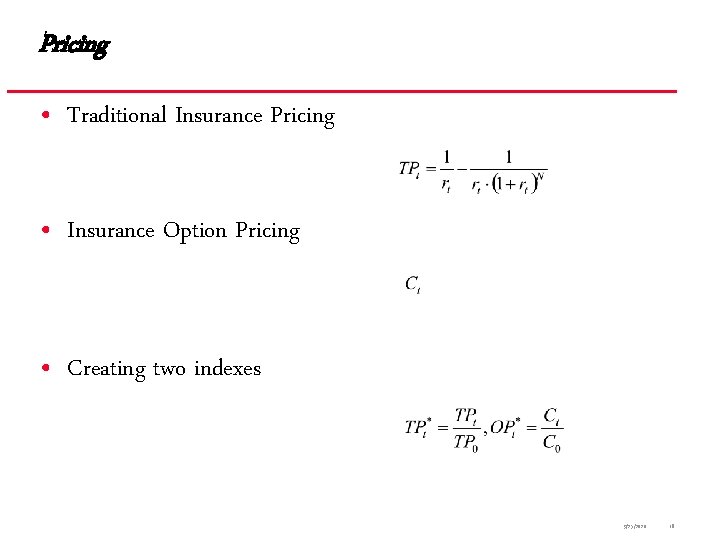
Pricing • Traditional Insurance Pricing • Insurance Option Pricing • Creating two indexes 9/25/2020 18
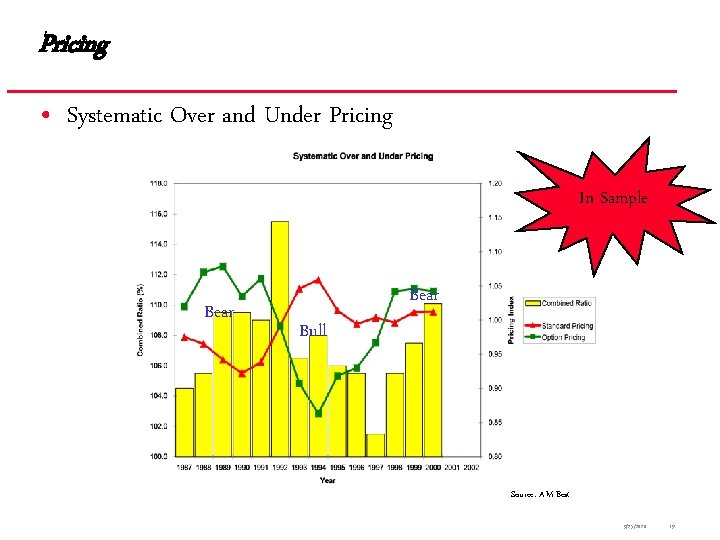
Pricing • Systematic Over and Under Pricing In Sample Bear Bull Source: A. M. Best 9/25/2020 19
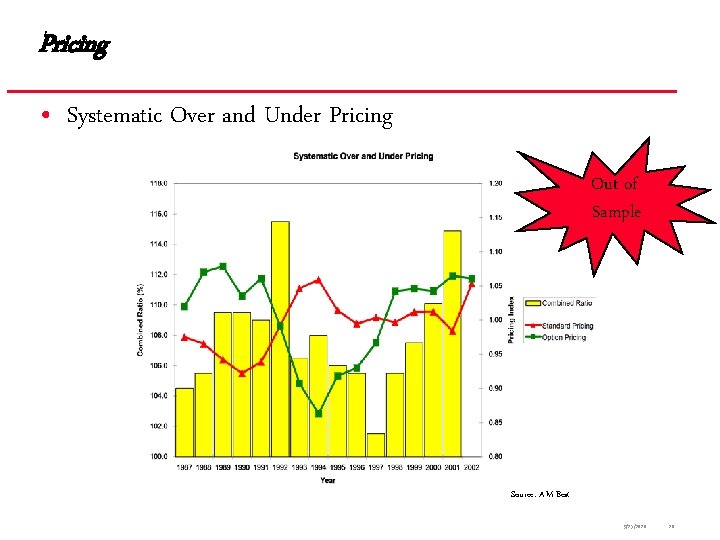
Pricing • Systematic Over and Under Pricing Out of Sample Source: A. M. Best 9/25/2020 20
Pricing • Systematic Over and Under Pricing Forecast Source: A. M. Best 9/25/2020 21
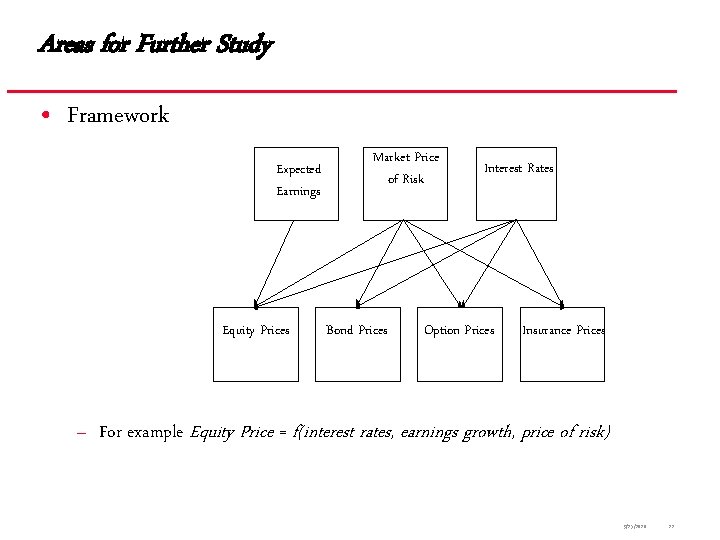
Areas for Further Study • Framework Expected Earnings Equity Prices Market Price of Risk Bond Prices Interest Rates Option Prices Insurance Prices – For example Equity Price = f(interest rates, earnings growth, price of risk) 9/25/2020 22
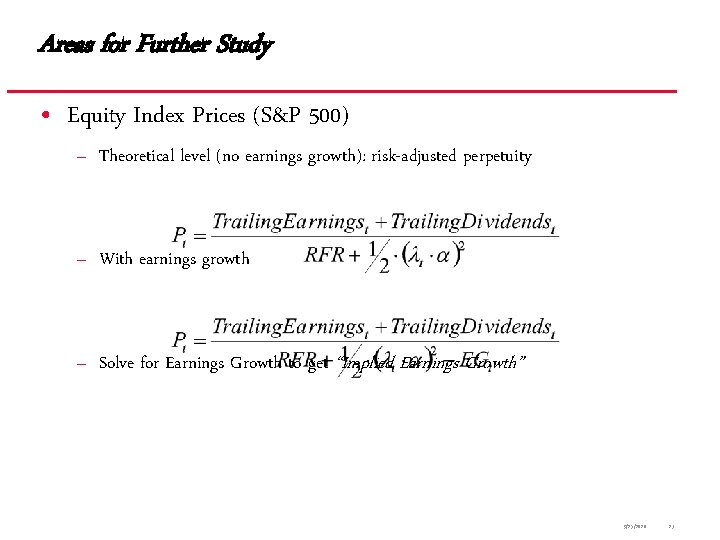
Areas for Further Study • Equity Index Prices (S&P 500) – Theoretical level (no earnings growth): risk-adjusted perpetuity – With earnings growth – Solve for Earnings Growth to get “Implied Earnings Growth” 9/25/2020 23
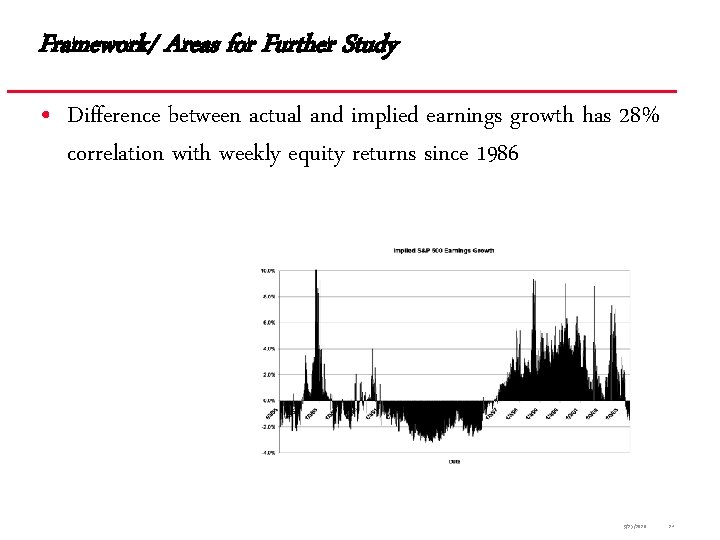
Framework/ Areas for Further Study • Difference between actual and implied earnings growth has 28% correlation with weekly equity returns since 1986 9/25/2020 24
Concluding Comments • Examination of “Price of Risk” to bridge asset pricing and insurance pricing • Development of insurance pricing option model • Review of underwriting cycle based on traditional pricing indexes and option pricing indexes • We have to get a handle on this! 9/25/2020 25
Thanks!