
An Evolution in Standards Supporting Specialty Medication Workflow
- Slides: 61
An Evolution in Standards Supporting Specialty Medication Workflow Pharmacy Informatics Town Hall December 12, 2020 | In collaboration with NCPDP 1
An Evolution in Standards Supporting Specialty Medication Workflow HIMSS is a global advisor and thought leader supporting the transformation of the health ecosystem through information and technology. As a mission-driven non-profit, HIMSS offers a unique depth and breadth of expertise in health innovation, public policy, workforce development, research and analytics to advise global leaders, stakeholders and influencers on best practices in health information and technology. With more than 350 employees, HIMSS has operations in: North America | Asia Pacific | Europe | Latin America | Middle East | United Kingdom | In collaboration with NCPDP 2
An Evolution in Standards Supporting Specialty Medication Workflow Vision Mission To realize the full health potential of every human, everywhere. Reform the global health ecosystem through the power of information and technology. | In collaboration with NCPDP
An Evolution in Standards Supporting Specialty Medication Workflow About NCPDP Founded in 1977, NCPDP is a not-for-profit, ANSI-accredited, Standards Development Organization with over 1, 500 members representing virtually every sector of the pharmacy services industry. NCPDP members have created standards such as the Telecommunication Standard and Batch Standard, the SCRIPT Standard for e-Prescribing, the Manufacturers Rebate Standard and more to improve communication within the pharmacy industry. Our data products include data. Q®, a robust database of information on more than 80, 000 pharmacies, HCIdea®, a database of continually updated information on more than 2. 5 million prescribers, and res. Q™, an industry pharmacy credentialing resource. NCPDP's Rx. Reconn® is a legislative tracking product for real-time monitoring of pharmacy-related state and national legislative and regulatory activity. www. ncpdp. org | In collaboration with NCPDP
Presentation title here Accreditation Statement The Institute for Wellness and Education, Inc. , is accredited by the Accreditation Council for Pharmacy Education (ACPE) as a provider of continuing pharmacy education. Participants of the session who complete the evaluation and provide accurate CPE Monitor e-Profile information will have their credit for 1. 0 contact hours (0. 10 CEU) submitted to CPE Monitor within 60 days of the event. Please know that if accurate CPE Monitor e-Profile number is not provided within 60 days of the event, credit cannot be claimed after that time. ACPE program numbers are: 0459 -0000 -20 -042 -H 04 -P and 0459 -0000 -20 -042 -H 04 -T Release Date: December 10, 2020 | In collaboration with NCPDP
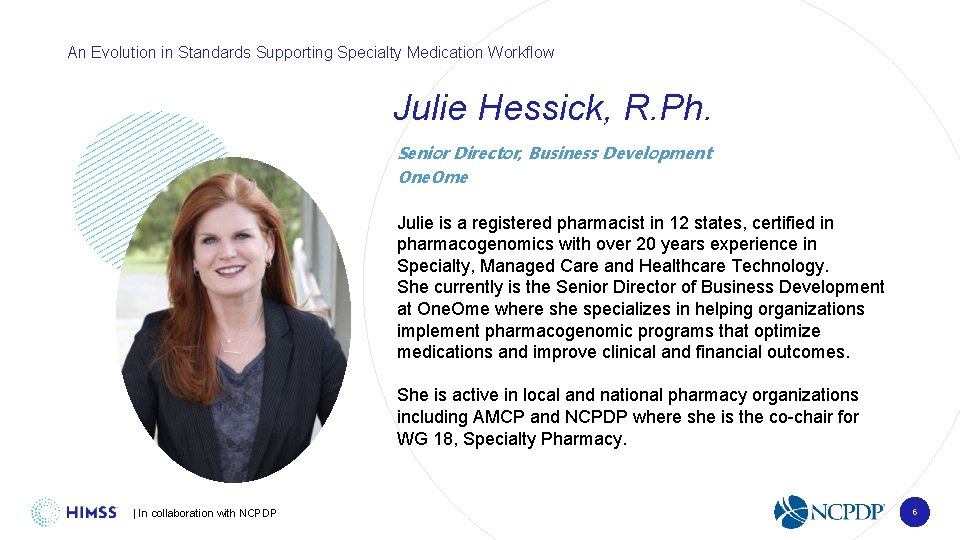
An Evolution in Standards Supporting Specialty Medication Workflow Julie Hessick, R. Ph. Senior Director, Business Development One. Ome Julie is a registered pharmacist in 12 states, certified in pharmacogenomics with over 20 years experience in Specialty, Managed Care and Healthcare Technology. She currently is the Senior Director of Business Development at One. Ome where she specializes in helping organizations implement pharmacogenomic programs that optimize medications and improve clinical and financial outcomes. She is active in local and national pharmacy organizations including AMCP and NCPDP where she is the co-chair for WG 18, Specialty Pharmacy. | In collaboration with NCPDP 6
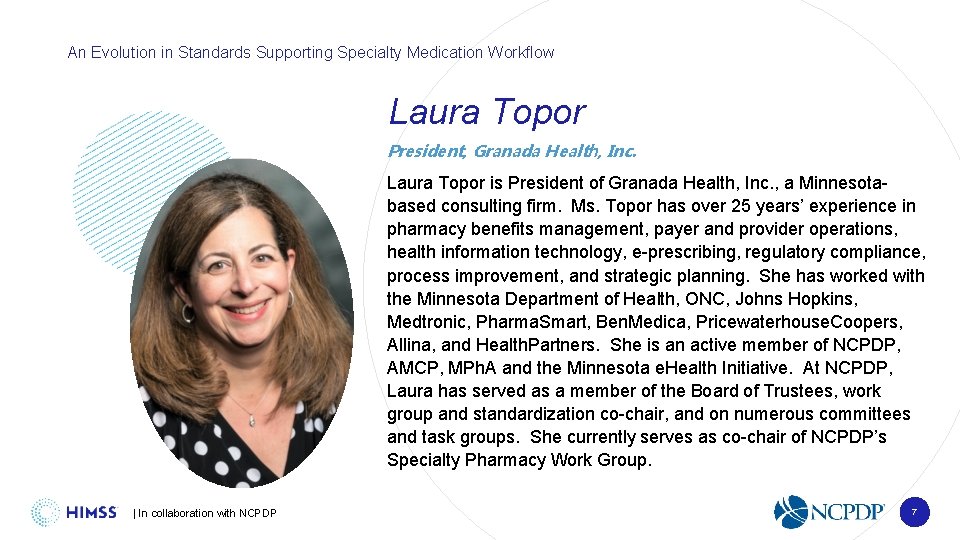
An Evolution in Standards Supporting Specialty Medication Workflow Laura Topor President, Granada Health, Inc. Laura Topor is President of Granada Health, Inc. , a Minnesotabased consulting firm. Ms. Topor has over 25 years’ experience in pharmacy benefits management, payer and provider operations, health information technology, e-prescribing, regulatory compliance, process improvement, and strategic planning. She has worked with the Minnesota Department of Health, ONC, Johns Hopkins, Medtronic, Pharma. Smart, Ben. Medica, Pricewaterhouse. Coopers, Allina, and Health. Partners. She is an active member of NCPDP, AMCP, MPh. A and the Minnesota e. Health Initiative. At NCPDP, Laura has served as a member of the Board of Trustees, work group and standardization co-chair, and on numerous committees and task groups. She currently serves as co-chair of NCPDP’s Specialty Pharmacy Work Group. | In collaboration with NCPDP 7
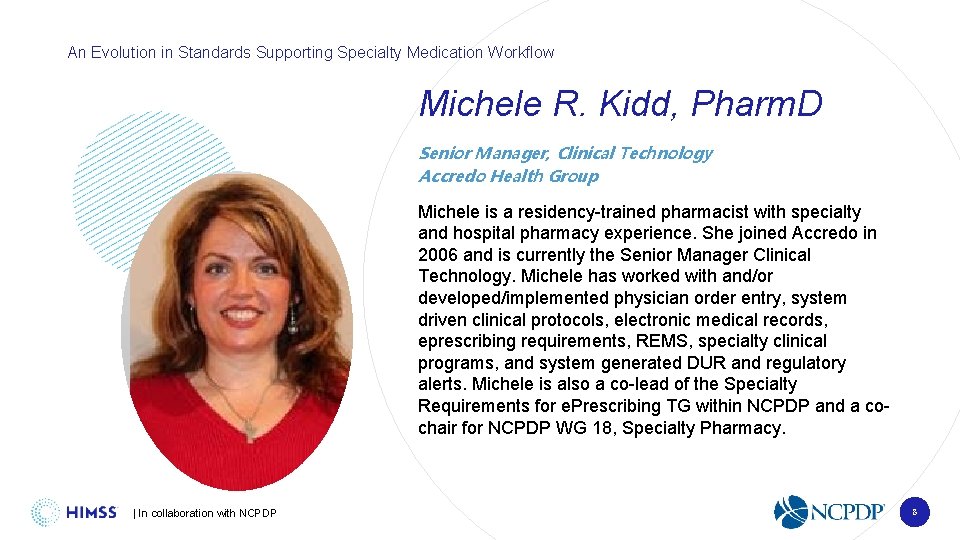
An Evolution in Standards Supporting Specialty Medication Workflow Michele R. Kidd, Pharm. D Senior Manager, Clinical Technology Accredo Health Group Michele is a residency-trained pharmacist with specialty and hospital pharmacy experience. She joined Accredo in 2006 and is currently the Senior Manager Clinical Technology. Michele has worked with and/or developed/implemented physician order entry, system driven clinical protocols, electronic medical records, eprescribing requirements, REMS, specialty clinical programs, and system generated DUR and regulatory alerts. Michele is also a co-lead of the Specialty Requirements for e. Prescribing TG within NCPDP and a cochair for NCPDP WG 18, Specialty Pharmacy. | In collaboration with NCPDP 8
An Evolution in Standards Supporting Specialty Medication Workflow Agenda • Current Specialty workflow and challenges that cause delays in therapy • Transactions to enhance Specialty process • Benefit Coverage Identification white paper • Collaboration amongst standard organizations • Specialty Work Group overview and involvement | In collaboration with NCPDP
An Evolution in Standards Supporting Specialty Medication Workflow Learning Objectives • Review the current electronic transactions available impacting Specialty to improve patient care • List key organizations collaborating to create and improve standards • Describe the areas highlighted in the NCPDP specialty pharmacy benefit coverage identification white paper • Discuss pilot opportunities with regards to reporting | In collaboration with NCPDP
An Evolution in Standards Supporting Specialty Medication Workflow Pre-Test Questions 1. Which NCPDP transactions can be utilized to automate the specialty process? 2. What data is not included in the RTPB? 3. Which organizations does NCPDP collaborate with to improve patient care? 4. Which standards organization created the 270/271 transaction designed to help with benefit coverage? 5. Which processes need an electronic solution for a specialty patient? | In collaboration with NCPDP
An Evolution in Standards Supporting Specialty Medication Workflow Current Specialty Workflow and Challenges That Cause Delays in Therapy | In collaboration with NCPDP 12
An Evolution in Standards Supporting Specialty Medication Workflow Specialty Overview Specialty continues to be the focus to provide medications and manage the expenses. • Specialty medicines were only 2. 2% of prescription volume projected in 2020 • Account for nearly 50% of the nation’s drug spending. • Specialty medicines projected to be $500 billion in 2020 • 80% of new drug approvals are considered specialty | In collaboration with NCPDP IQVIA-outlook-to-2023 specialty-pharmacy-by-the-numbers
An Evolution in Standards Supporting Specialty Medication Workflow Specialty Process Before Standards What the process looked like? • • • Delays in patient care Different and incomplete data shared Phone and fax only means for communicating No visibility for patient, provider, or pharmacy Limited and inconsistent data shared between stakeholders | In collaboration with NCPDP
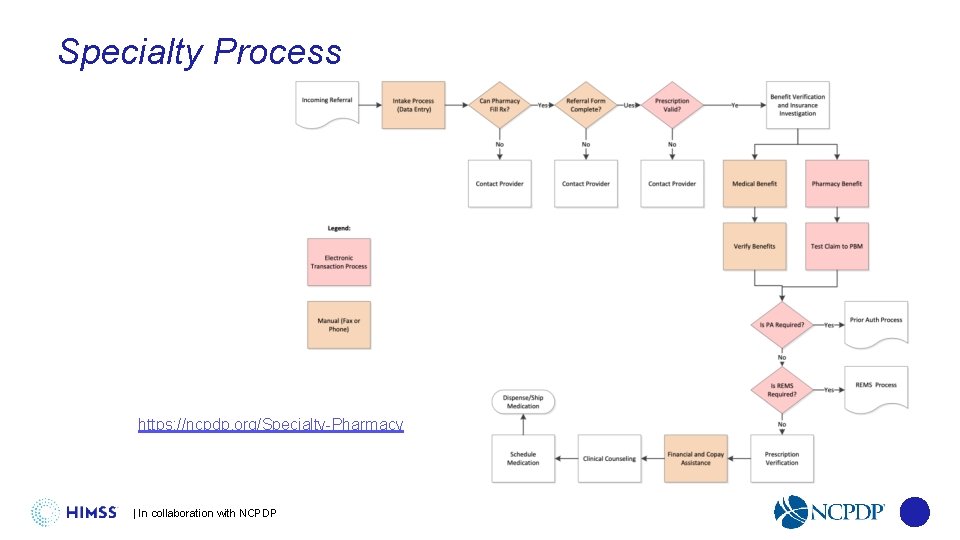
An Evolution in Standards Supporting Specialty Medication Workflow Specialty Process https: //ncpdp. org/Specialty-Pharmacy | In collaboration with NCPDP
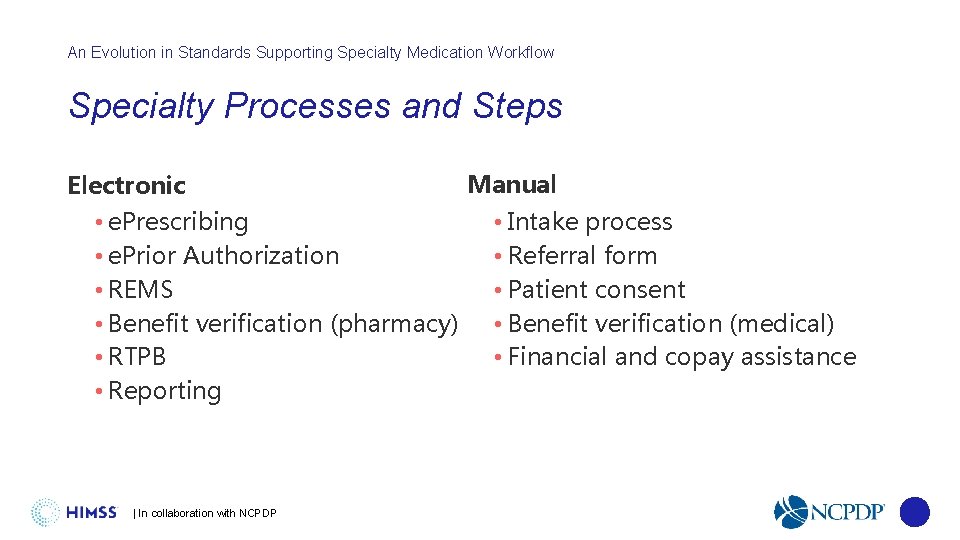
An Evolution in Standards Supporting Specialty Medication Workflow Specialty Processes and Steps Electronic • e. Prescribing • e. Prior Authorization • REMS • Benefit verification (pharmacy) • RTPB • Reporting | In collaboration with NCPDP Manual • Intake process • Referral form • Patient consent • Benefit verification (medical) • Financial and copay assistance
An Evolution in Standards Supporting Specialty Medication Workflow Specialty Challenges • No universal definition of specialty • No universal reimbursement, dispensing or administration model • Limited Distribution Drugs (LDDs) • Multiple stakeholders involvement • Information exchange differences | In collaboration with NCPDP
An Evolution in Standards Supporting Specialty Medication Workflow Goals for Enhancement • Focus on the patient journey • Improve transparency • Create automation • Work together with multiple stakeholders | In collaboration with NCPDP
An Evolution in Standards Supporting Specialty Medication Workflow Transactions to Enhance the Specialty Process | In collaboration with NCPDP 19
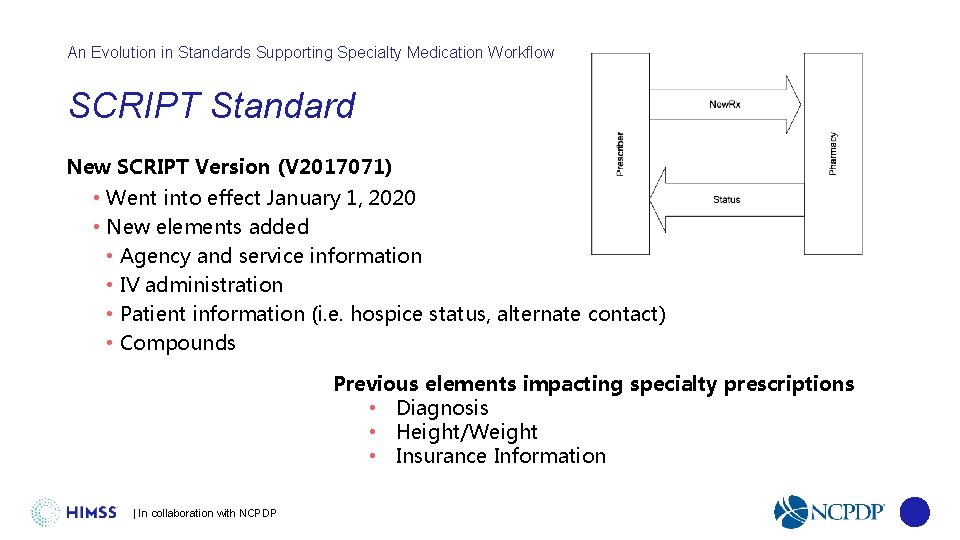
An Evolution in Standards Supporting Specialty Medication Workflow SCRIPT Standard New SCRIPT Version (V 2017071) • Went into effect January 1, 2020 • New elements added • Agency and service information • IV administration • Patient information (i. e. hospice status, alternate contact) • Compounds Previous elements impacting specialty prescriptions • Diagnosis • Height/Weight • Insurance Information | In collaboration with NCPDP
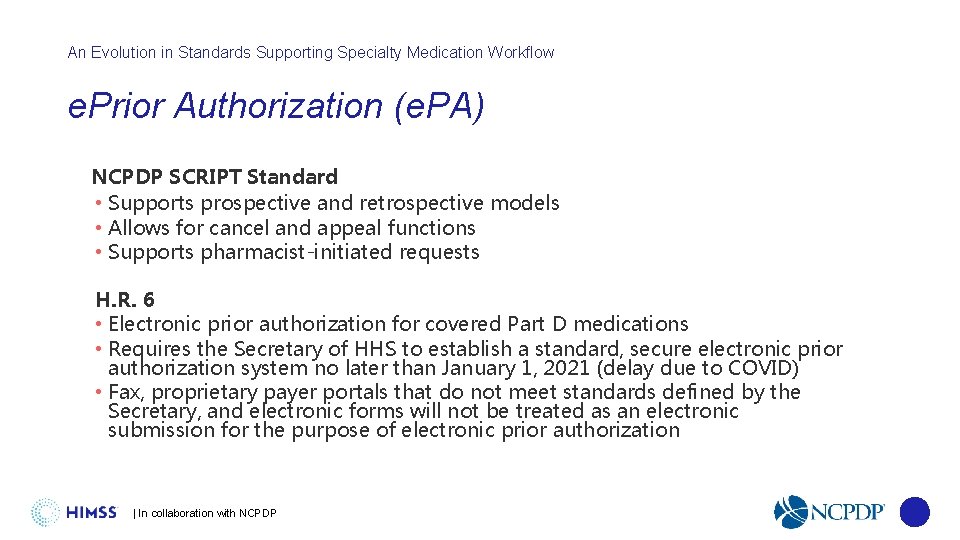
An Evolution in Standards Supporting Specialty Medication Workflow e. Prior Authorization (e. PA) NCPDP SCRIPT Standard • Supports prospective and retrospective models • Allows for cancel and appeal functions • Supports pharmacist-initiated requests H. R. 6 • Electronic prior authorization for covered Part D medications • Requires the Secretary of HHS to establish a standard, secure electronic prior authorization system no later than January 1, 2021 (delay due to COVID) • Fax, proprietary payer portals that do not meet standards defined by the Secretary, and electronic forms will not be treated as an electronic submission for the purpose of electronic prior authorization | In collaboration with NCPDP
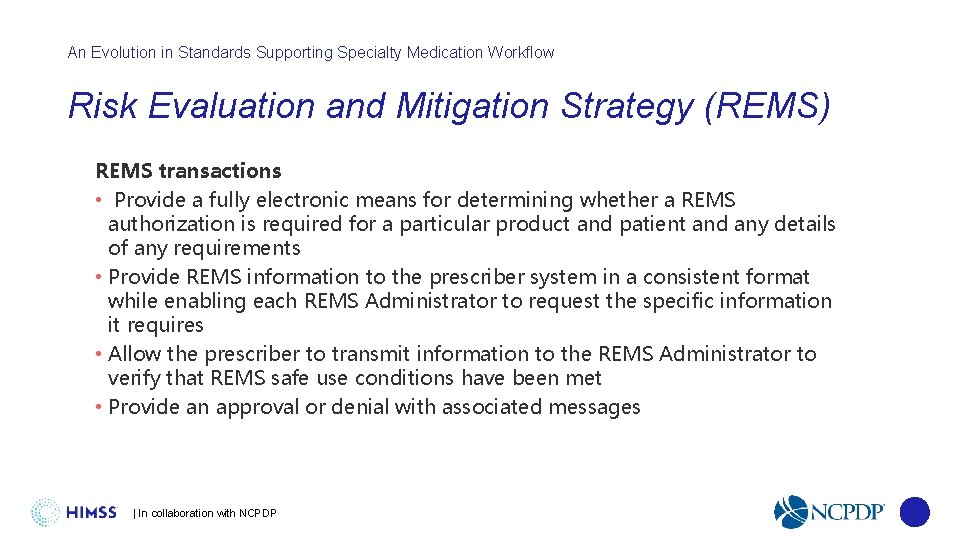
An Evolution in Standards Supporting Specialty Medication Workflow Risk Evaluation and Mitigation Strategy (REMS) REMS transactions • Provide a fully electronic means for determining whether a REMS authorization is required for a particular product and patient and any details of any requirements • Provide REMS information to the prescriber system in a consistent format while enabling each REMS Administrator to request the specific information it requires • Allow the prescriber to transmit information to the REMS Administrator to verify that REMS safe use conditions have been met • Provide an approval or denial with associated messages | In collaboration with NCPDP
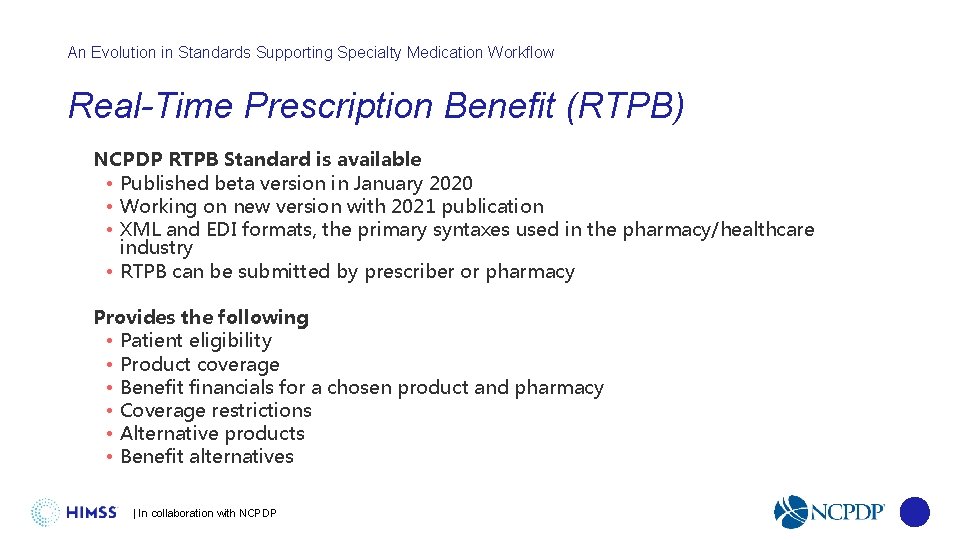
An Evolution in Standards Supporting Specialty Medication Workflow Real-Time Prescription Benefit (RTPB) NCPDP RTPB Standard is available • Published beta version in January 2020 • Working on new version with 2021 publication • XML and EDI formats, the primary syntaxes used in the pharmacy/healthcare industry • RTPB can be submitted by prescriber or pharmacy Provides the following • Patient eligibility • Product coverage • Benefit financials for a chosen product and pharmacy • Coverage restrictions • Alternative products • Benefit alternatives | In collaboration with NCPDP
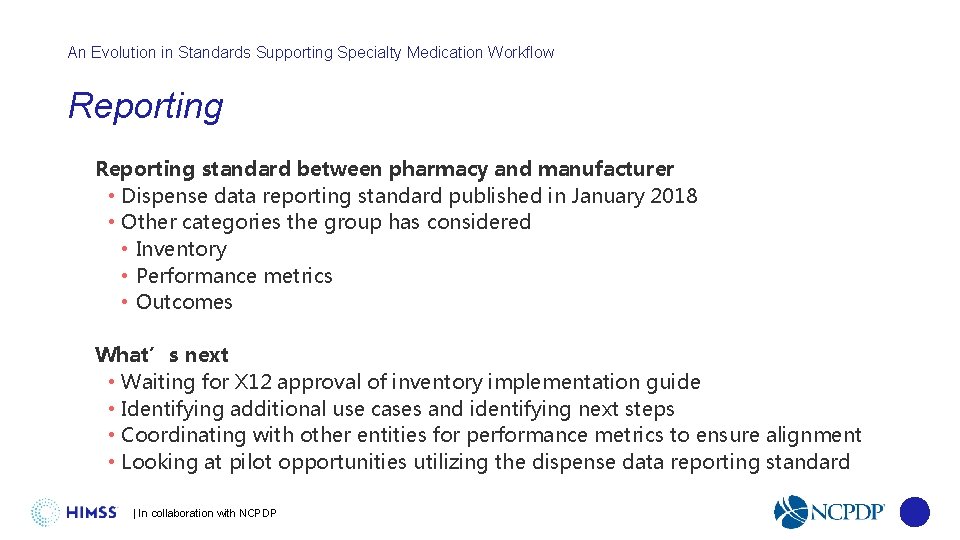
An Evolution in Standards Supporting Specialty Medication Workflow Reporting standard between pharmacy and manufacturer • Dispense data reporting standard published in January 2018 • Other categories the group has considered • Inventory • Performance metrics • Outcomes What’s next • Waiting for X 12 approval of inventory implementation guide • Identifying additional use cases and identifying next steps • Coordinating with other entities for performance metrics to ensure alignment • Looking at pilot opportunities utilizing the dispense data reporting standard | In collaboration with NCPDP
An Evolution in Standards Supporting Specialty Medication Workflow Benefit Coverage Identification White Paper | In collaboration with NCPDP 25
An Evolution in Standards Supporting Specialty Medication Workflow Specialty Pharmacy Benefit Coverage Identification White Paper • Task Group created in August 2018 • Research challenges with identifying coverage for specialty pharmacy products • Identify available technical solutions • Delineate gaps • Offer recommendations | In collaboration with NCPDP 26
An Evolution in Standards Supporting Specialty Medication Workflow White Paper Outline • Current Challenges • Current Methodology • BI Considerations • Expected roles and responsibilities • Complexities in determining coverage • Critical Success Factors • Timeline/Implementation https: //ncpdp. org/White-Papers. aspx | In collaboration with NCPDP 27
An Evolution in Standards Supporting Specialty Medication Workflow White Paper Purpose “The purpose of this white paper is to highlight current challenges experienced by providers, dispensers and organizations in being able to timely and accurately identify the appropriate benefit coverage (medical or pharmacy benefit) for a specific medication being prescribed, as well as potential out of pocket costs to the patient, at the time of care. Overall, the desired outcome of benefit identification is to provide a comprehensive benefit coverage overview electronically at the time the medication is selected and to improve a patient’s ability to begin therapy without delay. This process should be easily accessible without multiple manual steps or duplication of efforts by providers, specialty pharmacies and hubs. “ | In collaboration with NCPDP 28
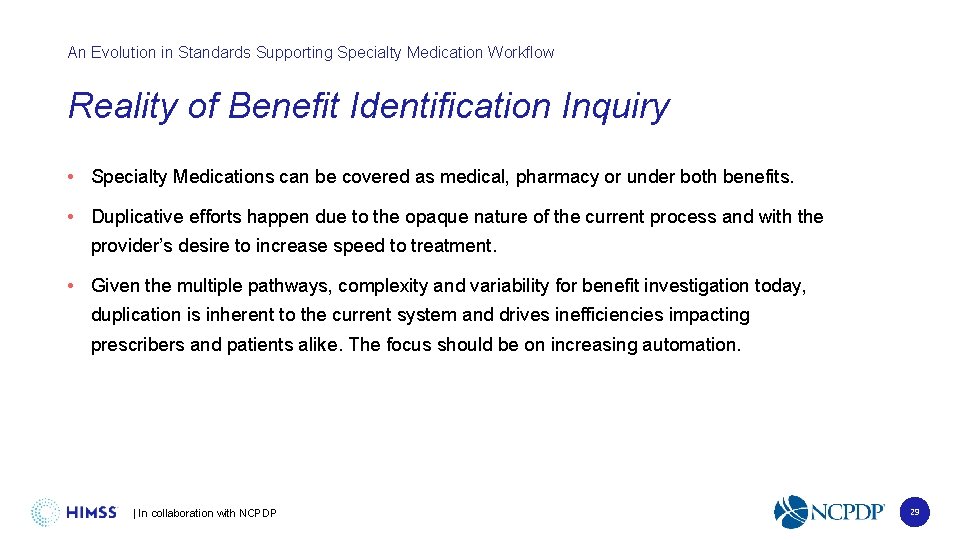
An Evolution in Standards Supporting Specialty Medication Workflow Reality of Benefit Identification Inquiry • Specialty Medications can be covered as medical, pharmacy or under both benefits. • Duplicative efforts happen due to the opaque nature of the current process and with the provider’s desire to increase speed to treatment. • Given the multiple pathways, complexity and variability for benefit investigation today, duplication is inherent to the current system and drives inefficiencies impacting prescribers and patients alike. The focus should be on increasing automation. | In collaboration with NCPDP 29
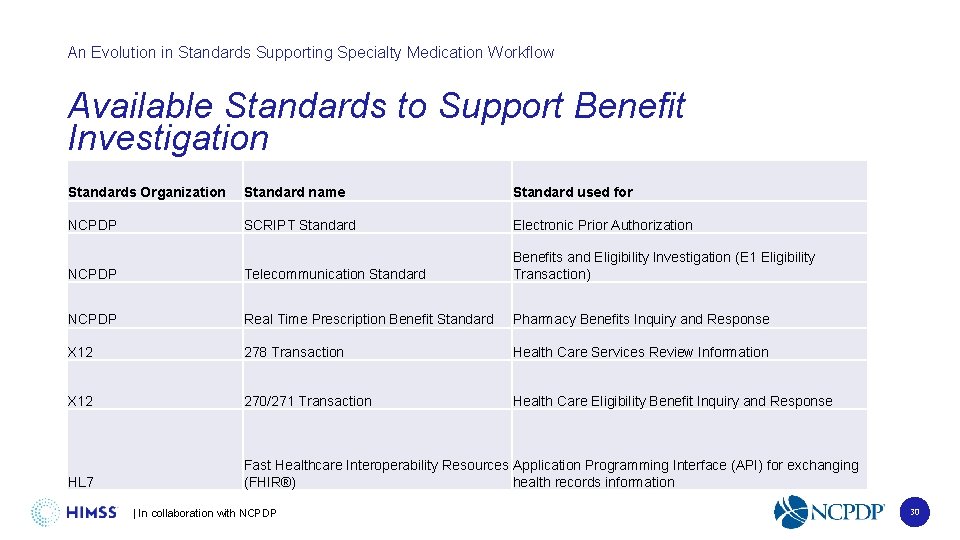
An Evolution in Standards Supporting Specialty Medication Workflow Available Standards to Support Benefit Investigation Standards Organization Standard name Standard used for NCPDP SCRIPT Standard Electronic Prior Authorization NCPDP Telecommunication Standard Benefits and Eligibility Investigation (E 1 Eligibility Transaction) NCPDP Real Time Prescription Benefit Standard Pharmacy Benefits Inquiry and Response X 12 278 Transaction Health Care Services Review Information X 12 270/271 Transaction Health Care Eligibility Benefit Inquiry and Response HL 7 Fast Healthcare Interoperability Resources Application Programming Interface (API) for exchanging (FHIR®) health records information | In collaboration with NCPDP 30
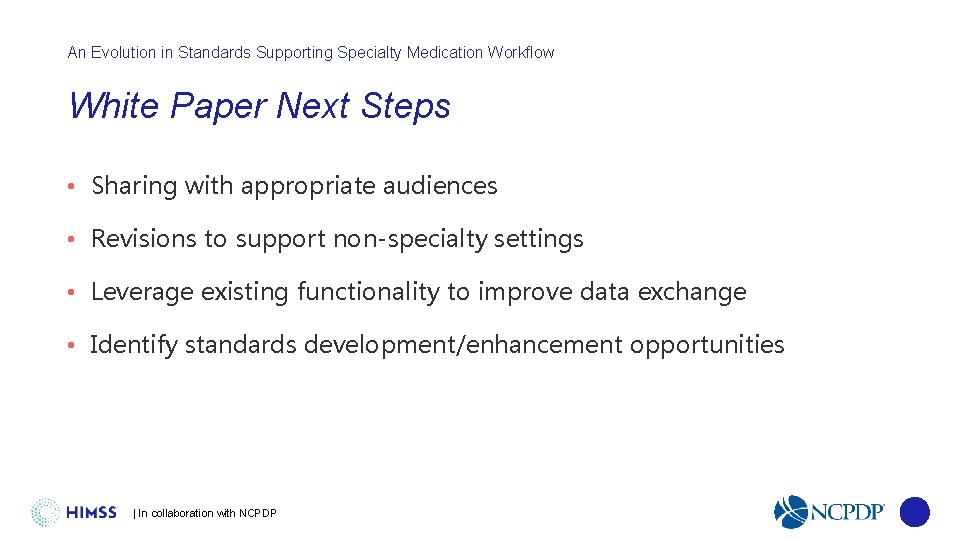
An Evolution in Standards Supporting Specialty Medication Workflow White Paper Next Steps • Sharing with appropriate audiences • Revisions to support non-specialty settings • Leverage existing functionality to improve data exchange • Identify standards development/enhancement opportunities | In collaboration with NCPDP
An Evolution in Standards Supporting Specialty Medication Workflow Collaboration Amongst Standard Organizations | In collaboration with NCPDP 32
An Evolution in Standards Supporting Specialty Medication Workflow Collaboration with other Standards Development Organizations (SDOs) • Health Level 7 (HL 7) • Use of FHIR standard to support specialty pharmacy enrollment • Exploring use of FHIR to enable exchange of patient consent data • X 12 • Worked with X 12 to develop guidance for inventory reporting • Approved by NCPDP membership; awaiting approval by X 12 membership | In collaboration with NCPDP 33
An Evolution in Standards Supporting Specialty Medication Workflow HL 7 Founded in 1987, Health Level Seven International (HL 7) is a not-for-profit, ANSIaccredited standards developing organization dedicated to providing a comprehensive framework and related standards for the exchange, integration, sharing and retrieval of electronic health information that supports clinical practice and the management, delivery and evaluation of health services. | In collaboration with NCPDP
An Evolution in Standards Supporting Specialty Medication Workflow HL 7 Standards • FHIR is an interoperability standard intended to facilitate the exchange of healthcare information between healthcare providers, patients, caregivers, payers, researchers, and any one else involved in the healthcare ecosystem. It consists of 2 main parts – a content model in the form of ‘resources’, and a specification for the exchange of these resources in the form of real-time RESTful interfaces as well as messaging and Documents. • The HL 7 Version 3 Clinical Document Architecture (CDA®) is a document markup standard that specifies the structure and semantics of "clinical documents" for the purpose of exchange between healthcare providers and patients. It defines a clinical document as having the following six characteristics: 1) Persistence, 2) Stewardship, 3) Potential for authentication, 4) Context, 5) Wholeness and 6) Human readability. • A CDA can contain any type of clinical content -- typical CDA documents would be a Discharge Summary, Imaging Report, Admission & Physical, Pathology Report and more. The most popular use is for inter-enterprise information exchange, such as is envisioned for a US Health Information Exchange (HIE). | In collaboration with NCPDP 35
An Evolution in Standards Supporting Specialty Medication Workflow X 12 • X 12, chartered by the American National Standards Institute for more than 40 years, develops and maintains EDI standards and XML schemas which drive business processes globally. X 12's diverse membership includes technologists and business process experts in health care, insurance, transportation, finance, government, supply chain and other industries. | In collaboration with NCPDP 36
An Evolution in Standards Supporting Specialty Medication Workflow X 12 Subcommittees • X 12 C – Communications and Controls • X 12 F – Finance • X 12 I – Transportation • X 12 J – Technical Assessment • X 12 M – Supply Chain • X 12 N – Insurance | In collaboration with NCPDP 37
An Evolution in Standards Supporting Specialty Medication Workflow X 12 N - Insurance • Responsible for development and maintenance of HIPAA-named transactions • Health Care Eligibility/Benefit Inquiry and Information Response (270/271) • Health Care Claim: Professional, Institutional, and Dental (837) • Health Care Payment/Advice (835) • Health Care Services Review Information (278) | In collaboration with NCPDP 38
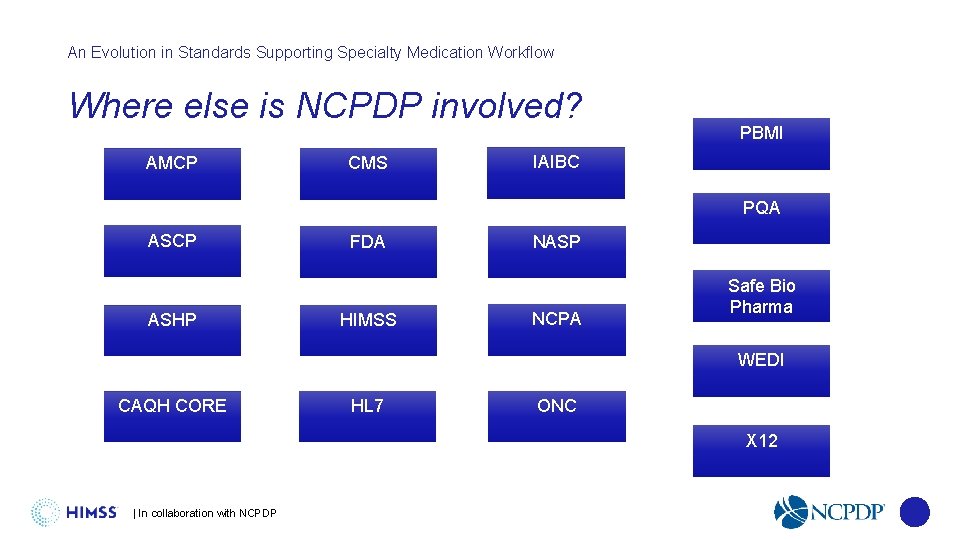
An Evolution in Standards Supporting Specialty Medication Workflow Where else is NCPDP involved? AMCP CMS PBMI IAIBC PQA ASCP ASHP FDA HIMSS NASP NCPA Safe Bio Pharma WEDI CAQH CORE HL 7 ONC X 12 | In collaboration with NCPDP
An Evolution in Standards Supporting Specialty Medication Workflow Specialty Work Group Overview and Involvement | In collaboration with NCPDP 40
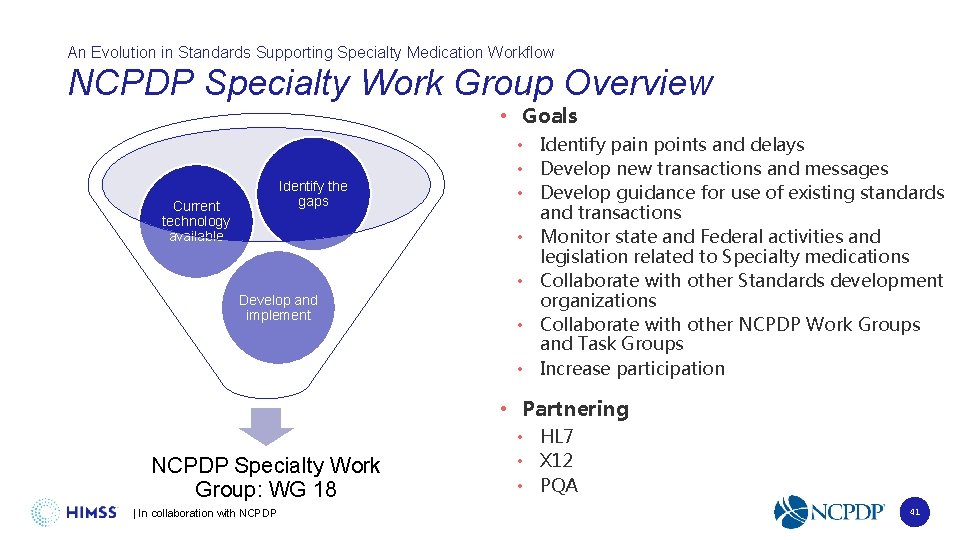
An Evolution in Standards Supporting Specialty Medication Workflow NCPDP Specialty Work Group Overview • Goals Identify the gaps Current technology available Develop and implement • Identify pain points and delays • Develop new transactions and messages • Develop guidance for use of existing standards and transactions • Monitor state and Federal activities and legislation related to Specialty medications • Collaborate with other Standards development organizations • Collaborate with other NCPDP Work Groups and Task Groups • Increase participation • Partnering NCPDP Specialty Work Group: WG 18 | In collaboration with NCPDP • HL 7 • X 12 • PQA 41
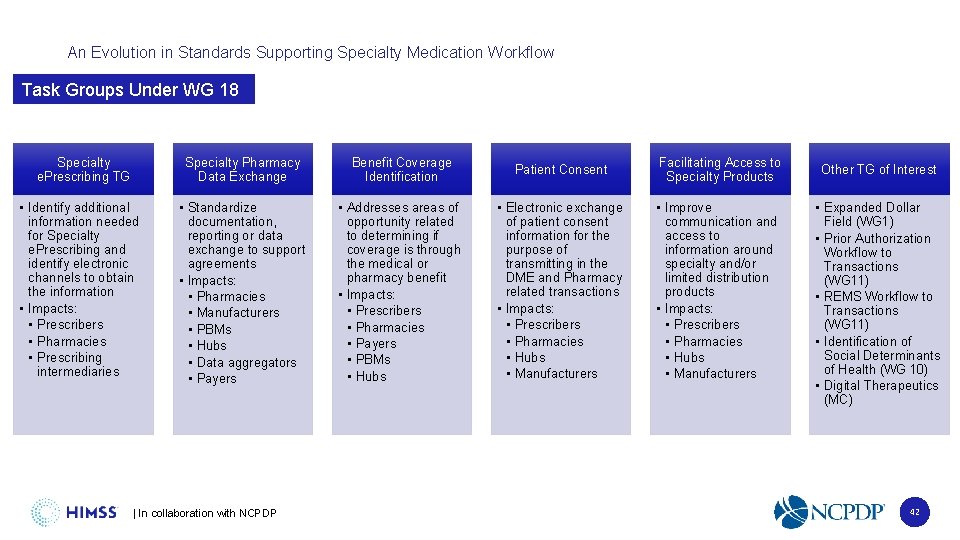
An Evolution in Standards Supporting Specialty Medication Workflow Task Groups Under WG 18 Specialty e. Prescribing TG • Identify additional information needed for Specialty e. Prescribing and identify electronic channels to obtain the information • Impacts: • Prescribers • Pharmacies • Prescribing intermediaries Specialty Pharmacy Data Exchange Benefit Coverage Identification Patient Consent Facilitating Access to Specialty Products • Standardize documentation, reporting or data exchange to support agreements • Impacts: • Pharmacies • Manufacturers • PBMs • Hubs • Data aggregators • Payers • Addresses areas of opportunity related to determining if coverage is through the medical or pharmacy benefit • Impacts: • Prescribers • Pharmacies • Payers • PBMs • Hubs • Electronic exchange of patient consent information for the purpose of transmitting in the DME and Pharmacy related transactions • Impacts: • Prescribers • Pharmacies • Hubs • Manufacturers • Improve communication and access to information around specialty and/or limited distribution products • Impacts: • Prescribers • Pharmacies • Hubs • Manufacturers | In collaboration with NCPDP Other TG of Interest • Expanded Dollar Field (WG 1) • Prior Authorization Workflow to Transactions (WG 11) • REMS Workflow to Transactions (WG 11) • Identification of Social Determinants of Health (WG 10) • Digital Therapeutics (MC) 42
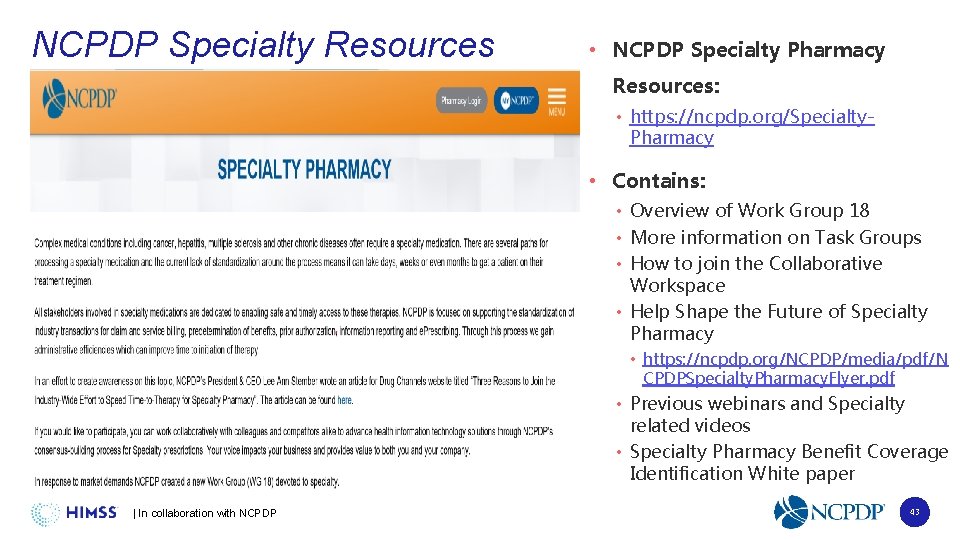
NCPDP Resources An Evolution in. Specialty Standards Supporting Specialty Medication Workflow • NCPDP Specialty Pharmacy Resources: • https: //ncpdp. org/Specialty. Pharmacy • Contains: • Overview of Work Group 18 • More information on Task Groups • How to join the Collaborative Workspace • Help Shape the Future of Specialty Pharmacy • https: //ncpdp. org/NCPDP/media/pdf/N CPDPSpecialty. Pharmacy. Flyer. pdf • Previous webinars and Specialty related videos • Specialty Pharmacy Benefit Coverage Identification White paper | In collaboration with NCPDP 43
An Evolution in Standards Supporting Specialty Medication Workflow • Join a task group • Does not require membership • Meet on a routine basis via conference calls • Meetings occur between quarterly Work Group meetings • Sign up: Go to the NCPDP Collaborative Workspace at http: //dms. ncpdp. org/ • Upcoming Events • February Work Group Meeting: February 3 -5, 2021 • NCPDP Events Calendar: https: //www. ncpdp. org/Events-Calendar. aspx • May 2021 Joint Technical Work Group Meetings (Virtual): May 3 -5, 2021 | In collaboration with NCPDP 44
An Evolution in Standards Supporting Specialty Medication Workflow Post-Test Question 1 Which NCPDP transactions can be utilized to automate the specialty process? A. e. PA B. e. Prescribing C. RTPB D. REMS E. All the above | In collaboration with NCPDP
An Evolution in Standards Supporting Specialty Medication Workflow Post-Test Question 1 Which NCPDP transactions can be utilized to automate the specialty process? A. e. PA B. e. Prescribing C. RTPB D. REMS E. All the above | In collaboration with NCPDP
An Evolution in Standards Supporting Specialty Medication Workflow Post-Test Question 2 What data is not included in the RTPB? A. Patient eligibility B. Product coverage C. Limited distribution drug status D. Benefit financials for a chosen product and pharmacy | In collaboration with NCPDP
An Evolution in Standards Supporting Specialty Medication Workflow Post-Test Question 2 What data is not included in the RTPB? A. Patient eligibility B. Product coverage C. Limited distribution drug status D. Benefit financials for a chosen product and pharmacy | In collaboration with NCPDP
An Evolution in Standards Supporting Specialty Medication Workflow Post-Test Question 3 Which organizations does NCPDP collaborate with to improve patient care? A. X 12 B. CMS C. HL 7 D. PQA E. All the above | In collaboration with NCPDP
An Evolution in Standards Supporting Specialty Medication Workflow Post-Test Question 3 Which organizations does NCPDP collaborate with to improve patient care? A. X 12 B. CMS C. HL 7 D. PQA E. All the above | In collaboration with NCPDP
An Evolution in Standards Supporting Specialty Medication Workflow Post-Test Question 4 Which standards organization created the 270/271 transaction designed to help with benefit coverage? A. NCPDP B. HL 7 C. CAQH D. X 12 | In collaboration with NCPDP
An Evolution in Standards Supporting Specialty Medication Workflow Post-Test Question 4 Which standards organization created the 270/271 transaction designed to help with benefit coverage? A. NCPDP B. HL 7 C. CAQH D. X 12 | In collaboration with NCPDP
An Evolution in Standards Supporting Specialty Medication Workflow Post-Test Question 5 Which of the following processes needs an electronic solution for a specialty patient? A. Medication prescribing B. Patient consent C. REMS D. Prior authorization | In collaboration with NCPDP
An Evolution in Standards Supporting Specialty Medication Workflow Post-Test Question 5 Which of the following processes needs an electronic solution for a specialty patient? A. Medication prescribing B. Patient consent C. REMS D. Prior authorization | In collaboration with NCPDP
An Evolution in Standards Supporting Specialty Medication Workflow Questions? | In collaboration with NCPDP 55
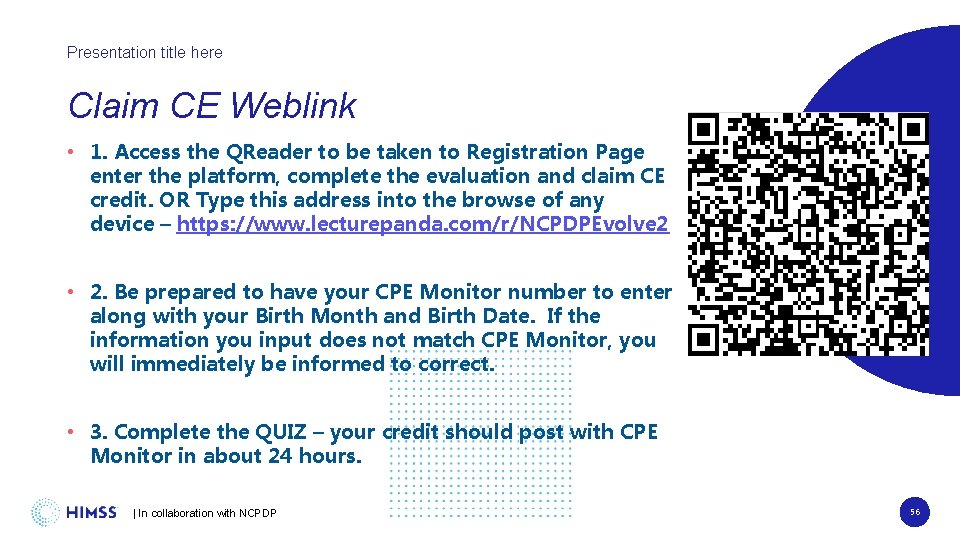
Presentation title here Claim CE Weblink • 1. Access the QReader to be taken to Registration Page enter the platform, complete the evaluation and claim CE credit. OR Type this address into the browse of any device – https: //www. lecturepanda. com/r/NCPDPEvolve 2 • 2. Be prepared to have your CPE Monitor number to enter along with your Birth Month and Birth Date. If the information you input does not match CPE Monitor, you will immediately be informed to correct. • 3. Complete the QUIZ – your credit should post with CPE Monitor in about 24 hours. | In collaboration with NCPDP 56
Presentation title here Evaluation Weblink https: //www. lecturepanda. com/r/NCPDPEvolve 2 • Please use the weblink shown above to access the online evaluation. Enter this address into the browser of your phone, tablet, laptop or desktop. The process should take less than 5 minutes. • This evaluation asks for your CPE Monitor number in order to post CE credit, so have that number ready when you start the evaluation. • Your credit will post about 4 weeks from the date of this event. • If you have questions, please email: office@instituteforwellness. org | In collaboration with NCPDP
An Evolution in Standards Supporting Specialty Medication Workflow We’re prioritizing health and safety. Concepts The HIMSS Global Conference & Exhibition will be held August 9 -13, 2021 himssconference. org | In collaboration with NCPDP 58
An Evolution in Standards Supporting Specialty Medication Workflow SAVE THE DATE: NCPDP Annual Technology & Business Conference June 29 -30, 2021 Westin Kierland Resort & Spa Scottsdale, Arizona | In collaboration with NCPDP 59
An Evolution in Standards Supporting Specialty Medication Workflow NCPDP Collaborative Workspace The Work Groups meet quarterly face to discuss issues critical to pharmacy standards. Between quarterly work group meetings, the NCPDP Task Groups meet. Task group call schedules, working papers, and detailed information on each task group can be found here. NCPDP Task Groups are open to any materially interested party (NCPDP member or not) that wishes to participate and help provide standards, guidance, and problem solve. To participate in NCPDP Task Groups, please visit the Collaborative Workspace and help improve the pharmacy industry! | In collaboration with NCPDP 60
An Evolution in Standards Supporting Specialty Medication Workflow Thank you. Contact Tammy Kwiatkoski tkwiatkoski@himss. org 312 -915 -9516 | In collaboration with NCPDP 61