
An Evolution from Web 1 0 to Web
An Evolution from Web 1. 0 to Web 4. 0 Technology Presented by Rituraj Parashar SOS in Library and Information Science Jiwaji University, Gwalior (M. P)
Abstract Ø The continued development of the Internet has opened up conflicting chances and troubles in web-based training and learning. For instance, the conventional type of the web, Web 1. 0 began as a readable medium, after customization Web 2. 0 made itself as a read/write medium. Presently creating different sorts of the web, Web 3. 0 is known as a precisely determined undertaking medium, which empowers customers to perform read/write errands and additionally fill in as part for machines To make it so explicit. In the present moment to people, Web 2. 0, Web 3. 0 and Web 4. 0 have acquainted new instruments and advancements with support electronic training and learning. A complete overview of Web 1. 0, Web 2. 0, Web 3. 0 and Web 4. 0 has been given in this paper.
IntroductionØYou all will realize that today the world is experiencing a period of progress, which includes the library, similarly this change affected the library. The current phase is changing because we need to use many new advances. It has been used these processes are being used in the library today, similarly with the state-of-the-art progress of our library. ØDue to data innovation, many strategies are accessible to effectively gather and retrieve data, by which a lot of data can be easily kept away and transferred. Due to data innovation, it should be possible to organize in libraries, collect data, use and control and administer library representatives.
Continued… Ø Due to data blast and mass explosion, due to new research, it is an on-going undertaking to collect, scan for them, retrieve data and deliver data in a short time frame with information in the library. These difficulties can be overcome by using data innovation.
WWW (World Wide Web)ØWWW similarly called w 3 or web. It is a data space through which HTML can be retrieved very effectively via HTML hyperlinks by keeping away any data content through the web program and through the web. It is the centerpiece of any data removal. ØIt is a repository of data that goes as a connection. It is a strategy through which all the PCs on the planet are connected with each other. It deals with the World Wide Web (www) HTTP, HTML, web servers, and web programs. The Internet is a collection that is connected to each other's hyperreactors. Hypertext archives contain material, images, sound and so forth. WWW (world wide web) This is web help. WWW (world wide web) was first used by Tim Berners Lee at the 1989 CERN research facility.
Continued… ØThe data is maintained as a website on the world wide web. www is a process through which every website is given an extraordinary name and is distinguished on the web by a similar name. The web and the world wide web are closely related. It is subject to both. World Wide Web is designed by Tim Berners Lee, who is seen as the creator of the web. WWW has created Web 1. 0 Web 2. 0 Web 3. 0 and web 4. 0

Web 1. 0 ØWeb 1. 0 is seen as the primary term of the Web 1. 0 (www) is the main web. Which only allows individuals to use the web. This is the primary stage of WWW which is the main tense of the web page and hyperlink. The web is used separately to understand data in it. No progress can be made on this web, nor can anything be written in it. ØIt is the main web of web innovation that customers use to view data. Customers can scan and read that data for their data without a stretch, yet they cannot make any corrections to it. Customers cannot give any input to that data. This innovation is uniquely used to understand data.

Characteristic of web 1. 0 ØIt is the basic innovation of the web. ØIt is used to be the same. ØThis is a static website. ØIt is used to view web data. ØCustomers cannot make any improvement in this web. ØThe use of this web innovation is exceptionally straightforward. ØBecause of just reading the web, customers cannot give their criticism in it. ØThis website had no connection capability.
Lack of web 1. 0 ØInteraction ØScalability ØContext

Web 2. 0ØWeb 2. 0 is the second era of web innovation. The term Web 2. 0 was first used in January 1999 by Darcy-de Nucci, who used it in his article Fragmented Future. At the time, the term Web 2. 0 was used by "Tim O'Reilly". ØIn 2004, O Relay recommended Web 2. 0 for the (www) World Wide Web in Media Open to convert the progress used in the website to one another. ØIn Web 2. 0 innovation, customers saw each other's ideas and their natural surroundings and gave them data.
Continued… ØAdministration is included with Web 2. 0. These are used for correspondence with the idea of data administration, for example, long-distance mutual communication space, site, wikiing, shared destination, and so on. With its help, data can undoubtedly be adequately visualized in various configurations, for example, visual and sound.
Web 2. 0 website type – ØAudio ØE-learning ØGames ØBookmarking ØMashups ØKnowledge Base ØE-mail
Ø Chats Ø Wiki Ø Filesharing Ø Multi-media Ø Communication Ø Blogging Ø Calendars
Characteristic of web 2. 0 ØThis is the second era of web innovation. ØIt is a social web. ØThis website has connection capability. ØDue to this mess and web creation, the client gives its input without any problems. ØThis web is called peruse and compose. ØThis web is used by the client for both perusing and composing.
Lack of Web 2. 0 ØHumanization ØTrue likelihood
Library 2. 0ØIn Library 2. 0, library services are constantly refreshed and rethought to give the best service to library users. Library 2. 0 endeavors to utilize the library user in the plan and execution of the library user by empowering input and participation. Library 2. 0 is a characterizing model for a cutting edge type of library service that mirrors progress inside the library world in the manner users are served. ØThe attention is on user-focused change and participation in building substance and network. With Library 2. 0, library services are regularly assessed and refreshed to meet the changing needs of library users.
ØLibrary 2. 0 additionally approaches libraries to support user participation and input in the turn of events and upkeep of library services. Information and thoughts streaming in the two headings - from the library to the user and from user to library - library services can create and enhance a ceaseless and quick premise. ØLibrary 2. 0 is a better approach for giving library service through new Web advancements, with an accentuation on "user-driven" change and commitment. Like Web 2. 0, a full-included Library 2. 0 OPAC turns out to be vastly improved that users are associated with the way toward collaborating with the index and sharing substance.
Web 3. 0 ØWeb 3. 0 is the third era of web innovation. The term Web 3. 0 was used by New York Times writer John Markoff. Web 3. 0 is fundamental to the use of web innovation and the advancement of connections. This involves making changes to the database. ØWeb 3. 0 is a web executing compose executed on the web. This is the semantic web, the use of man-made brainpower in this web effectively simplifies the need or understanding of the customers and gives the data to the customers by understanding its need.
Continued… ØWeb 3. 0 is a term established to improve web usage and collaboration. In this, the web can be converted into a database. Tim Berner Lee has explained. That Web 3. 0 Peruse Right is the official web. Web 3. 0 is used to create web courses and speak with multiple courses. This involves turning it into a database on the web, making it valuable to customers through multiple tests. This web is called Man-made Brainpower, Semantic Web or 3 D Web. ØIn Web 1. 0, the core of Web innovation, data was misused exclusively on websites. This data is posted on the website by the proprietor. What's more, through the web, clients can view the data as per their need from the website without any stretch, which is in the form of content.
Web 3. 0 ØWeb 3. 0 is the third era of web innovation. The term Web 3. 0 was used by New York Times writer John Markoff. Web 3. 0 is fundamental to the use of web innovation and the advancement of connections. This involves making changes to the database. ØWeb 3. 0 is a web executing compose executed on the web. This is the semantic web, the use of man-made brainpower in this web effectively simplifies the need or understanding of the customers and gives the data to the customers by understanding its need.
ØWeb 3. 0 is a term established to improve web usage and collaboration. In this, the web can be converted into a database. Tim Berner Lee has explained. That Web 3. 0 Peruse Right is the official web. Web 3. 0 is used to create web courses and speak with multiple courses. This involves turning it into a database on the web, making it valuable to customers through multiple tests. This web is called Man-made Brainpower, Semantic Web or 3 D Web. ØIn Web 1. 0, the core of Web innovation, data was misused exclusively on websites. This data is posted on the website by the proprietor. What's more, through the web, clients can view the data as per their need from the website without any stretch, which is in the form of content.
ØIn the second era of Web 2. 0, any data can be misused and manipulated. Much the same as in Facebook we can see any of our partner's posts, we can comment for it, similarly we can transfer our posts. In Web 3. 0, you can create, and execute data the same way. Due to the use of man-made brainpower on this web, it understands the interest of customers and gives them results. ØWeb 3. 0 can be understood through an example, if we search on Google who is the Chief Minister of India, then due to Google Artificial Intelligence, by reading or understanding our mind, the name of Shri Shiv raj Singh Chauhan Ji in India Refers to the Chief Minister.
Characteristic of Web 3. 0 ØThis is the third era of web innovation. ØMachine-to-machine interchange ØIt is a Perused Right Execute Web. ØIt’s is an Intelligent Web. ØWeb 3. 0 takes a shot at the Semitic Web. Ø 3 D design is used. ØWeb 3. 0 is associated with each gadget that can use its administration every-where.
Library 3. 0ØIt is considered a modern form of library service. These services can be utilized by the user from any library. Correspondingly, the utilization of innovation in libraries is additionally done by users. The use of advances like dispersed registering, semantic web mobile phones, envisioning the need of clients, empowering data content for the clients, etc is done. The collection of information is available from Library 3. 0. This library takes into account the rising needs of users. With Library 3. 0, library services are examined and assessed. Library 3. 0 is a borderless library where collection should be possible remembering the need of the users. Library 3. 0 is a virtual enhancement that gives library services to the user.
Characteristic of Library Web 3. 0 ØMobile Library Catalog ØVirtual Reference Service Ø Tagging ØWeb OPAC ØQR Code ØSemantic web ØOntology
Web 4. 0ØWeb 4. 0 can be considered as a Symbiotic web, ultra-Astute Electronics Specialist and Universal web. Interaction among humans and machines in symbiosis was the thought process behind the symbiotic web. It is ground-breaking as a human brain. Progress in the improvement of media transmission, headway in nanotechnology on the planet and controlled interfaces are utilizing web 4. 0. In straightforward words, machines would be astute in perusing the substance of the web and respond through executing and choosing what to execute first to stack the websites quick with unrivaled quality and execution and assemble additionally directing interfaces. Web 4. 0 will be perused to compose the simultaneousness web.
Ø It guarantees worldwide straightforwardness administration, dispersion, cooperation, joint effort into key communities such as industry, political, social and different communities. Web OS will be such as a middleware in which will begin working as a working framework. Web OS will be corresponding to the human brain and infers a gigantic web of exceptionally shrewd interaction. ØIt is an underground idea in progress and there is no exact meaning of how it would be. Web 4. 0 is otherwise called a symbiotic web. The fantasy behind the symbiotic web is communication among people and machines in beneficial interaction. It is attainable to build more remarkable interfaces such as brain controlled interfaces using web 4. 0. In basic words, machines would be shrewd on perusing the substance of the web and respond through executing and choosing what to execute first to stack the websites quick with unrivaled quality and execution and build more telling interfaces.
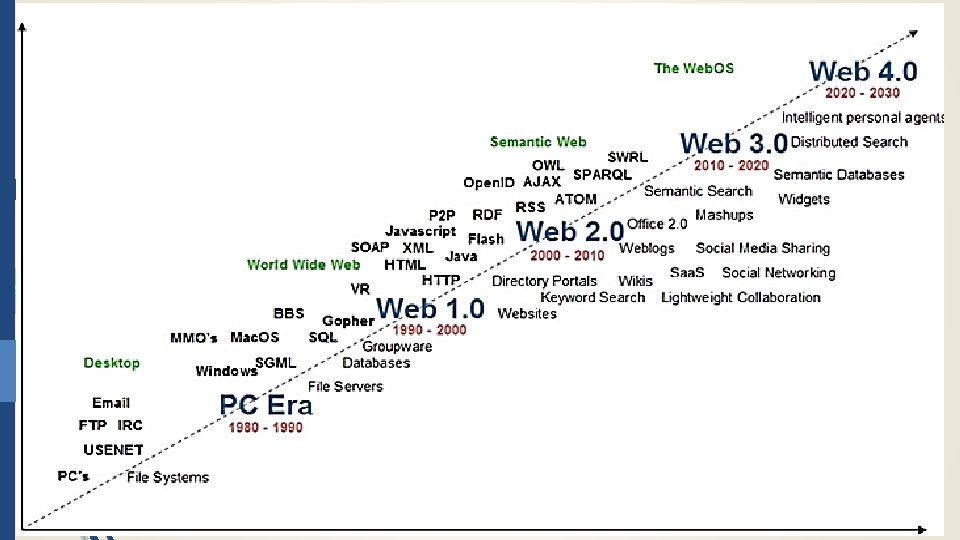
ØWeb 4. 0 will be the perused compose execution simultaneousness web. It accomplishes a minimum amount of cooperation in online systems that convey worldwide straightforwardness, administration, dispersion, interest, coordinated effort into key networks such as industry, political, social, and different networks. Web 4. 0 or web OS will be such as a middleware in which it will begin working as a working framework. The web OS will be corresponding to the human mind and infers a huge web of profoundly insightful connections. ØIn spite of the fact that there is no exact idea about web 4. 0 and its innovations, clearly the web is pushing toward using man-made brainpower to turn into a canny web.
Characteristic of Web 4. 0 ØThis is the fourth era of web innovation. ØInternet of Things ØUniversal Web ØAssociated Web ØAugmented reality ØMassive Data
Conclusion – ØThis paper has provided an overview of web technology. In this paper Web 1. 0, Web 2. 0, Web 3. 0 and Web 4. 0 were described as generations of Web. Comparisons have been made based on the characteristics of generations. It has been concluded that there has been a lot of progress in the information space since 1989 and it is moving towards using the web for highly intelligent interaction artificial and intelligence techniques in the near future.
Reference • O'Reilly, T. What Is Web : 2. 0 Design Patterns and Business Models for the Next Generation of Software. Available at http: //www. oreillynet. com/pub/a/oreilly/tim/news//2005/09/30 what-isweb-. 20 html Accessed on 07/01/2008 • World Wide Web Consortium (W 3 C). Introduction to Web Accessibility. Available at http: //www. w. 3 org/WAI/intro/accessibility. php Accessed on 04/01/2008 • Chris. Unlock knowledge with Enterprise Search. Available at http: //blog. devnet. com. au/ Accessed on 04/01/2008 • Jennifer Lang. Libraries and the Social Web: Using Web 2. 0 Applications to Deliver Information in the 21 st Century. Available at http: //jenniferlang. net/lib) /20 Accessed on (05/01/2008 • Abram, S. Web 2. 0, Library 2. 0, and Librarian : 2. 0 Preparing for the 2. 0 World. Sirsi. Dynix. One. Source. 2 Availableathttp: //www. imakenews. com/sirsi/e_article. 000505688 cfm? x=b 6 y. Rq. LJ, b 2 rp. Qh. R M Accessed on 06/01/2008 • Jeffrey Zeldman. Web. 3. 0 Available at http: //www. alistapart. com/articles/web 3 point 0 Accessed on (05/01/2008)
• IIA Blog. The Semantic Web: Web 3. 0? . Available at http: //blog. iia. ie//2007 the-semanticweb- /30 Accessed on (04/01/2008) • Steve Spalding. How to Define Web. 3. 0 Available at http: //howtosplitanatom. com/news/howto-define-web-30 -2/ (Accessed on (04/01/2008 • Brian Getting. Basic Definitions: Web 1. 0, Web. 2. 0, Web. 3. 0 Available at http: //www. practicalecommerce. com/articles//464 Basic-Definitions-Web-10 -Web-20 -Web/30 Accessed on (06/01/2008) • Wikipedia. Web. 2. 0 Available at http: //en. wikipedia. org/wiki/Web_) 2 Accessed on (06/01/2008) • Really Simple Syndication and Rich Site Summary. What is Web. 2. 0 Available at http: //www. rss-specifications. com/what-is-web-. 2 htm Accessed on (04/01/2008 • Jason Vallery. What is Web 3. 0? : A review of the ICWSM. Available at http: //vallery. net//2007/03/27 what-is-web-30 -a-review-of-the-icwsm/ Accessed on (05/01/2008 • Mind Booster Noori. What is Web 3. 0? . Available at http: //mindboosternoori. blogspot. com//2007/08 what-is-web-. 30 html Accessed on (05/01/2008

• Paul Miller. Thinking about this Web 2. 0 thing. Available at http: //paulmiller. typepad. com/thinking_about_the_future//2005/08 thinking_about_. html Accessed on (06/01/2008) • Sourav Sharma Dot Com. Web 1. 0, Web 2. 0, Web 3. 0, Web N. . 0 Available at http: //souravsharma. com/blog/webnpointzero. html Accessed on 05/01/2008 • Miller, P. Web : 2. 0 Building the New Library. Available at http: //www. ariadne. ac. uk/issue/45 miller/ Accessed on (05/01/2008) • Mills Davis. Semantic Wave. 2008 Available at http: //www. project 10 x. com/about. html Accessed on (04/01/2008) • Alexander, Ritt& Philipp, Hortler (2008), “Security Aspects in Web 2. 0 Mashup Systems”. • Christian, Fuchs & et. al. (2010), “Theoretical Foundations of the Web: Cognition Communication, and Co. Operation. Towards an Understanding of Web 1. 0, 2. 0, 3. 0”, Journal: Future Internets. • Christian, Bizer& Tom, Heath & Tim, Berners-Lee, (2009) “Linked Data - The Story So Far”, Journal Semantic Web and Information Systems.
• Gajanan P. Khiste , Yogesh P. Surwade, (2018) Publication Productivity of “Web 3. 0” By Using Science Direct During 2008 -2017, International Journal for Science and Advance Research in Technology. , Volume : 4, Issue : 3, (March 2018) Pp. 1632 -1634 • Hitendra. J. Patil, Yogesh P. Surwade, (2018) Evolution of Web 3. 0 & its Application to the Libraries, SCHOLARLY RESEARCH JOURNAL FOR INTERDISCIPLINARY STUDIES, Vol : 7/36, Jan. March 2018, pp. 127 -129 • http: //www. comptechdoc. org/independent/web/ Accessed by 08 th Jan. 2018 • Maged, N. Kamel Boulos & Steve, Wheeler (2007), “The emerging Web 2. 0 social software: an enabling suite of sociable technologies in health and health care education”, Health Information and Libraries Journal, Pp: 2 -23. • Dan, Farber (2007), ―From semantic Web (3. 0) to the Web http: //www. zdnet. com/blog/btl/from-semantic-web-30 -to-the-webos-40/4499/ • OS (4. 0)‖, Marcus, Cake (2008), “Web 1. 0, Web 2. 0, Web 3. 0 and Web 4. 0 explained”, http: //www. marcuscake. com/economicdevelopment/internet-evolution/ • Ron, Callari (2009), “Web 4. 0, Trip Down the Rabbit Hole or Brave New World? ”, http: //www. zmogo. com/web-40 trip-down-the-rabbithole-or-brave-new-world/

- Slides: 36