
An EvidenceBased Approach to TCM Patient Class Definition
An Evidence-Based Approach to TCM Patient Class Definition and Differentiation Nevin L. Zhang The Hong Kong Univ. of Sci. & Tech. http: //www. cse. ust. hk/~lzhang Joint Work with: HKUST: Yuan Shihong, Chen Tao, Wang Yi, Liu Tengfei, Poon Kin Man, Liu Hua Beijing TCM U: Wang Tianfang, Zhao Yan, Xu Wenjie, Wang Qingguo Shanghai TCM U: Xu Zhaoxia, Wang Yiqing Academy of TCM: Zhou Xuezhong, Zhang Runshun, Gong Yanbin, He Liyun, Wang Jie, Liu Baoyan Beijing Dongfang Hospital: Zhang Yongling, Chen Boxing, Fu Chen
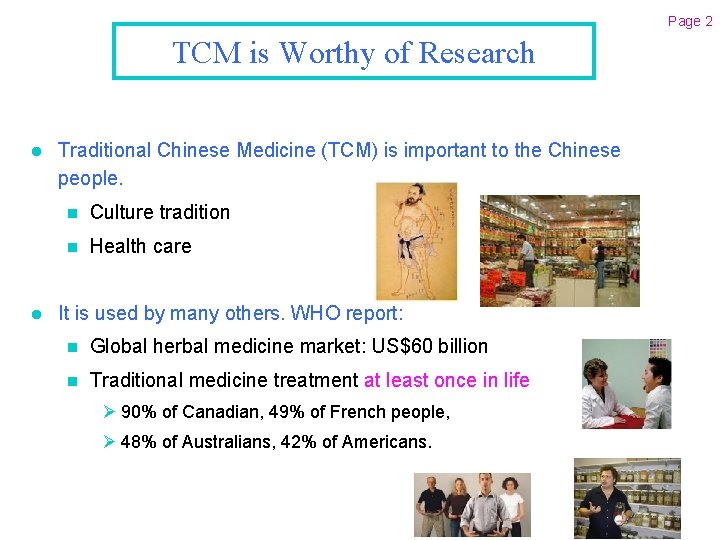
Page 2 TCM is Worthy of Research l l Traditional Chinese Medicine (TCM) is important to the Chinese people. n Culture tradition n Health care It is used by many others. WHO report: n Global herbal medicine market: US$60 billion n Traditional medicine treatment at least once in life Ø 90% of Canadian, 49% of French people, Ø 48% of Australians, 42% of Americans.
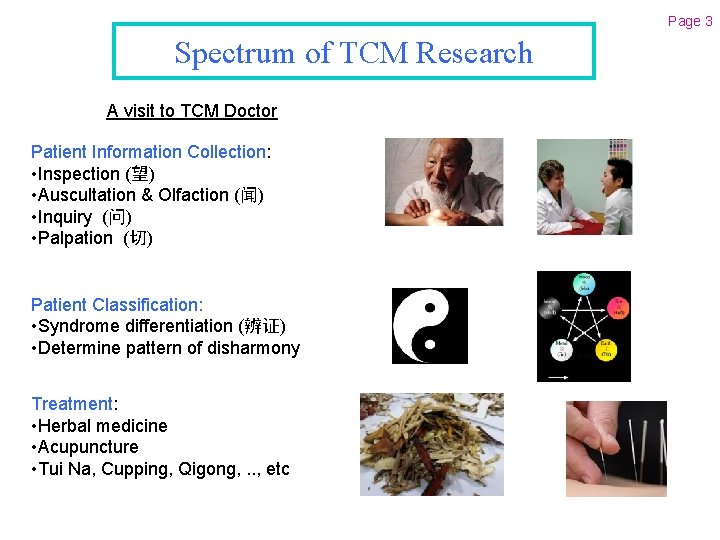
Page 3 Spectrum of TCM Research A visit to TCM Doctor Patient Information Collection: • Inspection (望)) • Auscultation & Olfaction (闻)) • Inquiry (问)) • Palpation (切)) Patient Classification: • Syndrome differentiation (辨证) • Determine pattern of disharmony Treatment: • Herbal medicine • Acupuncture • Tui Na, Cupping, Qigong, . . , etc
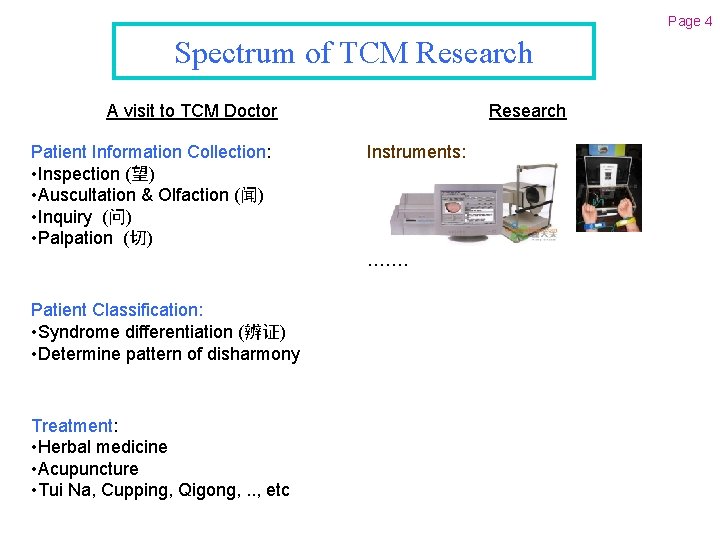
Page 4 Spectrum of TCM Research A visit to TCM Doctor Patient Information Collection: • Inspection (望)) • Auscultation & Olfaction (闻)) • Inquiry (问)) • Palpation (切)) Research Instruments: ……. Patient Classification: • Syndrome differentiation (辨证) • Determine pattern of disharmony Treatment: • Herbal medicine • Acupuncture • Tui Na, Cupping, Qigong, . . , etc
Page 5 Spectrum of TCM Research A visit to TCM Doctor Patient Information Collection: • Inspection (望)) • Auscultation & Olfaction (闻)) • Inquiry (问)) • Palpation (切)) Research Instruments: ……. Patient Classification: • Syndrome differentiation (辨证) • Determine pattern of disharmony Treatment: • Herbal medicine • Acupuncture • Tui Na, Cupping, Qigong, . . , etc • • • Efficacy Effective component of herbs Action mechanism Safety ….
Page 6 Spectrum of TCM Research A visit to TCM Doctor Patient Information Collection: • Inspection (望)) • Auscultation & Olfaction (闻)) • Inquiry (问)) • Palpation (切)) Research Instruments: ……. Patient Classification: • Syndrome differentiation (辨证) • Determine pattern of disharmony • Supervised learning Treatment: • Herbal medicine • Acupuncture • Tui Na, Cupping, Qigong, . . , etc • • • Labeled Data: Symptoms & signs, class labels assigned by expert Efficacy Effective component of herbs Action mechanism Safety ….
Page 7 Spectrum of TCM Research A visit to TCM Doctor Patient Information Collection: • Inspection (望)) • Auscultation & Olfaction (闻)) • Inquiry (问)) • Palpation (切)) Research Instruments: ……. Patient Classification: • Syndrome differentiation (辨证) • Determine pattern of disharmony • Supervised learning • • Our work: cluster analysis • Treatment: • Herbal medicine • Acupuncture • Tui Na, Cupping, Qigong, . . , etc Labeled Data: Symptoms & signs, class labels assigned by expert • • • Unlabeled Data: symptoms & signs Efficacy Effective component of herbs Action mechanism Safety ….
Page 8 Western Medicine vs TCM: A Layman view l l Western Medicine (Modern Biomedical Medicine ) n Human body: A machine with different parts, viewed at different levels: anatomic, biochemical, genetic n Disease: malfunction of some part TCM n Human body: Dynamic system of energy and functions, holistic view n Disease: Disharmony Ø Among yin, yang, qi, xuĕ, zàng-fǔ, meridians etc. and/or Ø Between of the human body and the environment
Page 9 Patient Classes l Both Modern Medicine and TCM divide patients into classes l Patient classes in modern medicine l n Correspond to diseases at certain stages: E. g. , Stage 4 COPD n Clearly defined n Have gold standard for differentiation Patient classes in TCM n Correspond to pattern of disharmony (syndrome): Yang Deficiency n Not clearly defined n Differentiation heavily influenced by subjectivity
Page 10 Data-Driven Research on Syndrome Differentiation l l Supervised learning n Labeled Data: Symptoms & signs, class labels assigned by experts n Provides quantitative summarization of experts’ know-hows n Conducive to the improvement of TCM service. Reduce variance. n However, it does not solve the subjectivity problem. Our work: cluster analysis n Unlabeled Data: symptoms & signs only n Aim at finding natural clusters among patient population, which n Can be used as objective evidence for patient class definition.
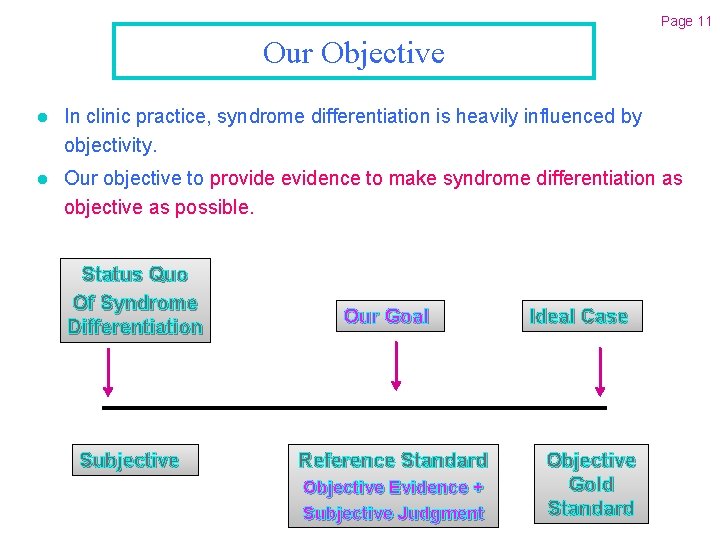
Page 11 Our Objective l In clinic practice, syndrome differentiation is heavily influenced by objectivity. l Our objective to provide evidence to make syndrome differentiation as objective as possible. Status Quo Of Syndrome Differentiation Subjective Our Goal Reference Standard Objective Evidence + Subjective Judgment Ideal Case Objective Gold Standard
Page 12 Outline l Introduction l Statistical validation of TCM postulates l Providing evidence for TCM patient class definition and differentiation l Concluding remarks
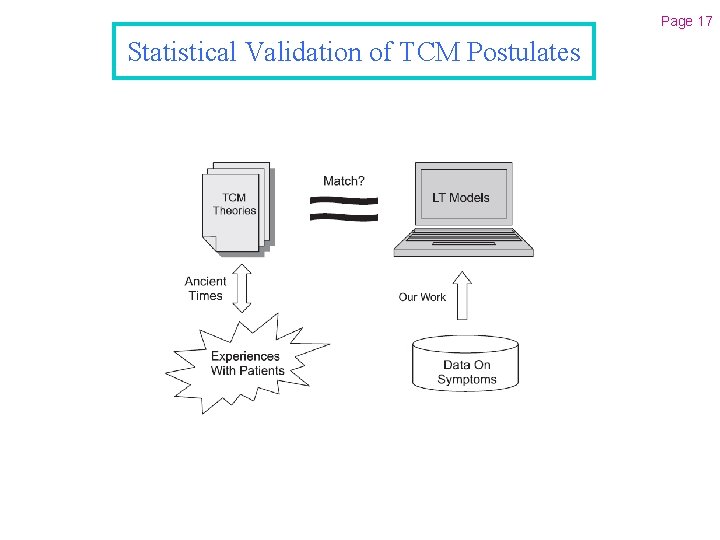
Page 13 TCM Postulates l TCM has postulates to explain occurrence of symptoms: Kidney yang is the basis of all yang in the body. When kidney yang is in deficiency, it cannot warm the body and the patient feels cold, resulting in intolerance to cold, cold limbs, and cold lumbus and back. l Key question: n l Do concepts such as “kidney yang deficiency” have scientific contents or are pure subjective notion? Efforts to provide objective evidence would be in vain in the latter case.
Page 14 Research on Objectivity of TCM Syndrome l l For more than 50 years, researchers have tried to show that n TCM syndrome factors correspond to real entities by means of biomedical laboratory tests, (recently genetic method also) n but there has been little success. We take a data-analysis approach
Page 15 TCM syndromes are latent variables l TCM postulate: Kidney yang is the basis of all yang in the body. When kidney yang is in deficiency, it cannot warm the body and the patient feels cold, resulting in intolerance to cold, cold limbs, and cold lumbus and back. l Manifest variables:Directly observed n l l Feel cold, cold limbs, intolerance to cold. Latent variable: Not directly observed n Kidney Yang deficiency n Similar to concepts such as “intelligence” Latent Structure n Relationships between latent variables and manifest variables
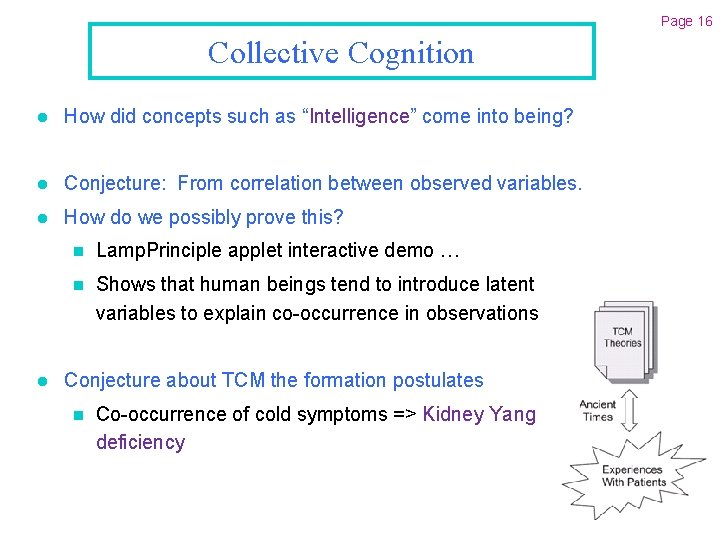
Page 16 Collective Cognition l How did concepts such as “Intelligence” come into being? l Conjecture: From correlation between observed variables. l How do we possibly prove this? l n Lamp. Principle applet interactive demo … n Shows that human beings tend to introduce latent variables to explain co-occurrence in observations Conjecture about TCM the formation postulates n Co-occurrence of cold symptoms => Kidney Yang deficiency
Page 17 Statistical Validation of TCM Postulates
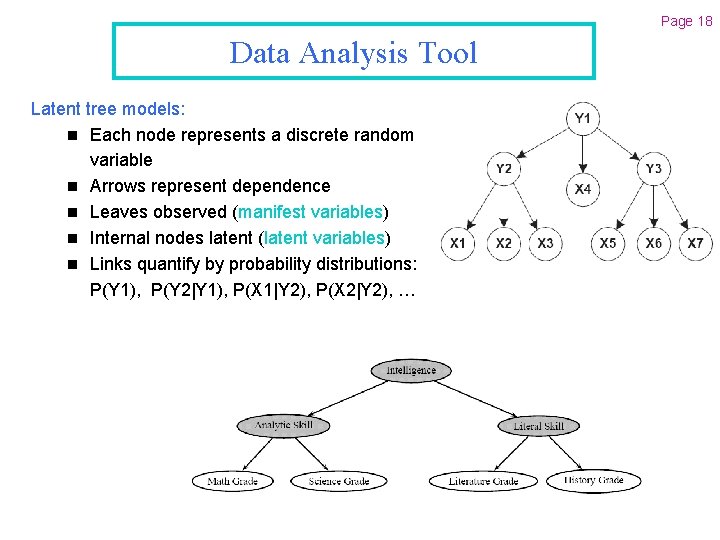
Page 18 Data Analysis Tool Latent tree models: n Each node represents a discrete random variable n Arrows represent dependence n Leaves observed (manifest variables) n Internal nodes latent (latent variables) n Links quantify by probability distributions: P(Y 1), P(Y 2|Y 1), P(X 1|Y 2), P(X 2|Y 2), …
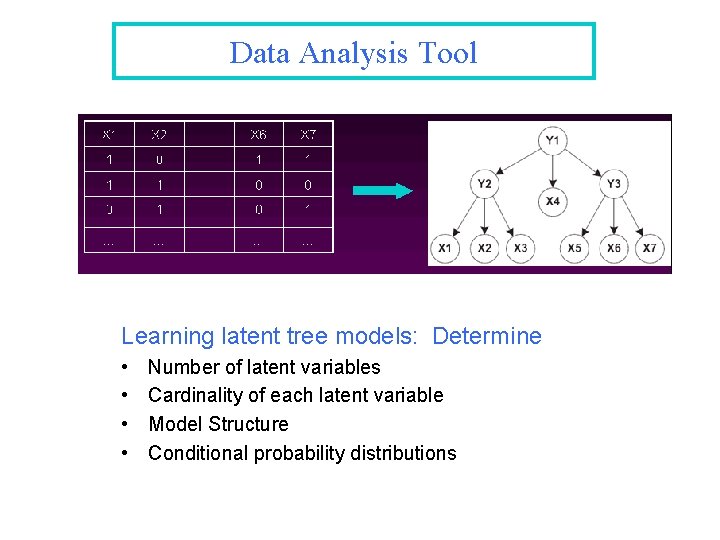
Data Analysis Tool Learning latent tree models: Determine • • Number of latent variables Cardinality of each latent variable Model Structure Conditional probability distributions
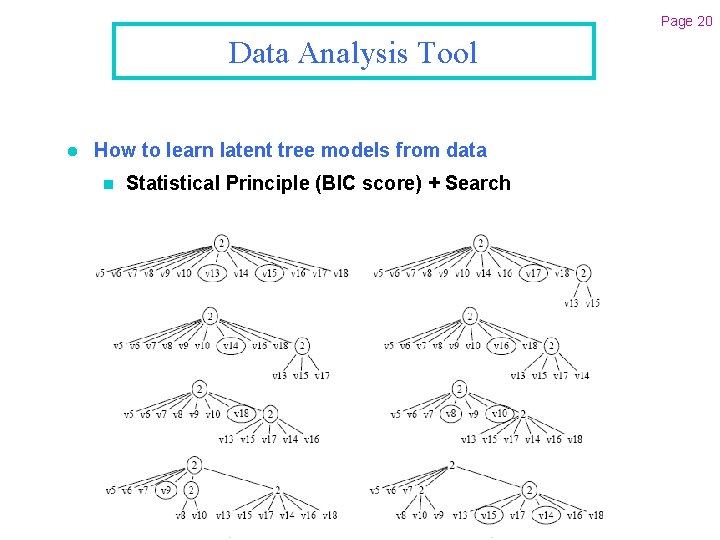
Page 20 Data Analysis Tool l How to learn latent tree models from data n Statistical Principle (BIC score) + Search
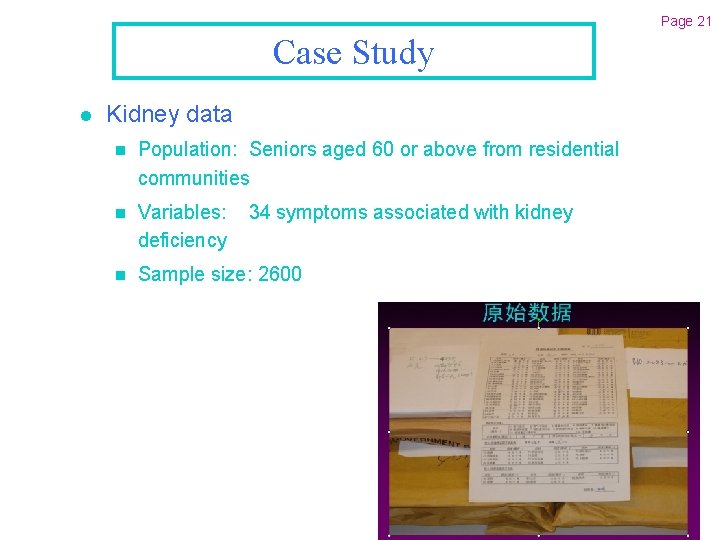
Page 21 Case Study l Kidney data n Population: Seniors aged 60 or above from residential communities n Variables: deficiency n Sample size: 2600 34 symptoms associated with kidney
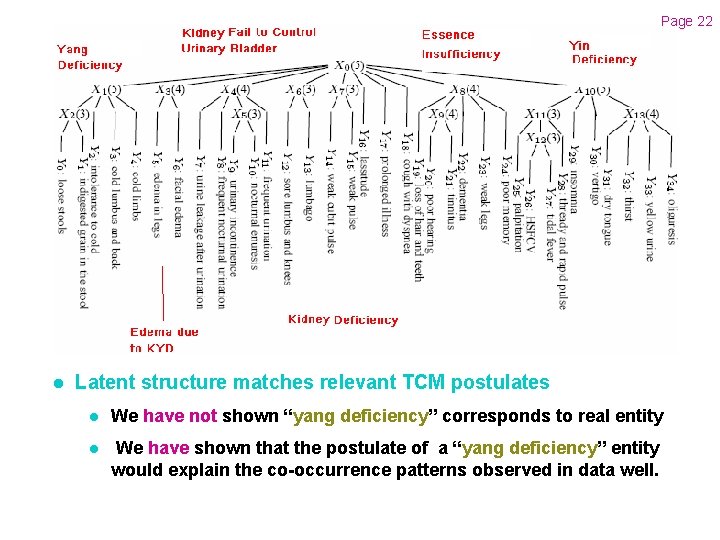
Page 22 l Latent structure matches relevant TCM postulates l We have not shown “yang deficiency” corresponds to real entity l We have shown that the postulate of a “yang deficiency” entity would explain the co-occurrence patterns observed in data well.
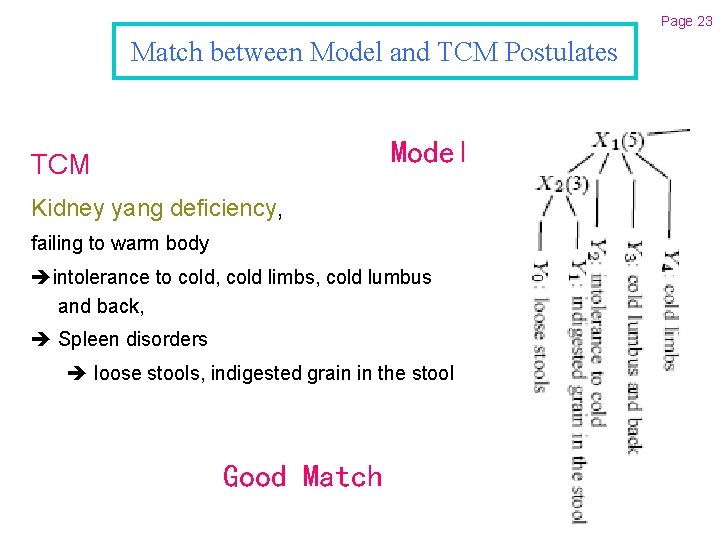
Page 23 Match between Model and TCM Postulates Model TCM Kidney yang deficiency, failing to warm body intolerance to cold, cold limbs, cold lumbus and back, Spleen disorders loose stools, indigested grain in the stool Good Match
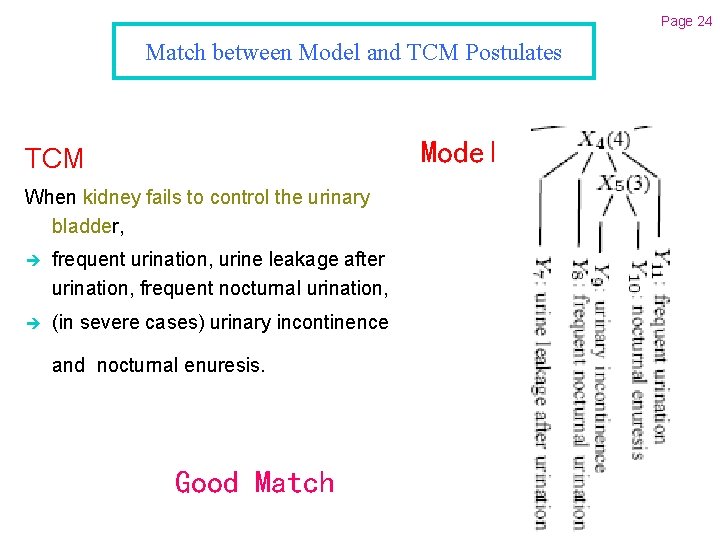
Page 24 Match between Model and TCM Postulates Model TCM When kidney fails to control the urinary bladder, frequent urination, urine leakage after urination, frequent nocturnal urination, (in severe cases) urinary incontinence and nocturnal enuresis. Good Match
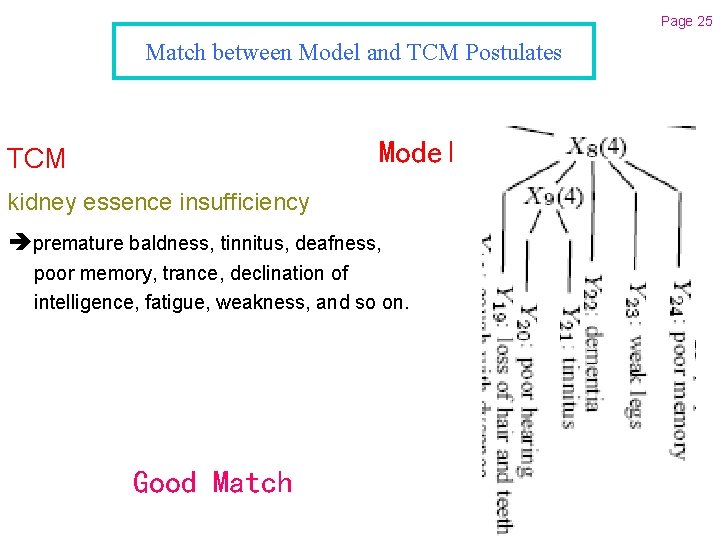
Page 25 Match between Model and TCM Postulates Model TCM kidney essence insufficiency premature baldness, tinnitus, deafness, poor memory, trance, declination of intelligence, fatigue, weakness, and so on. Good Match
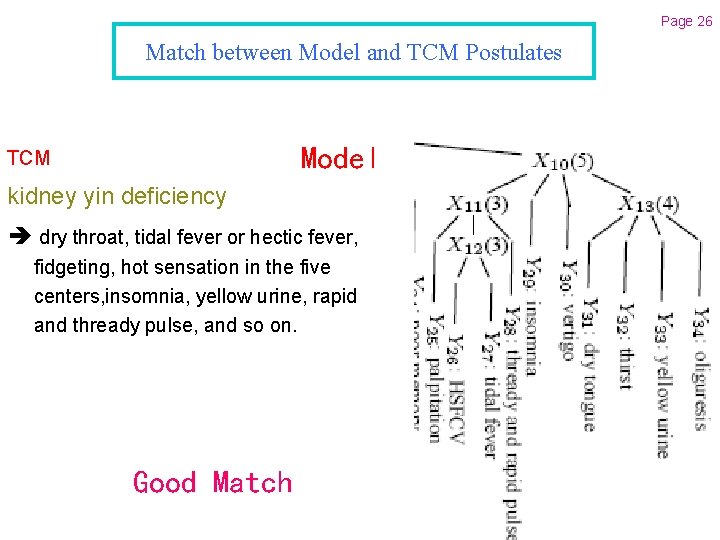
Page 26 Match between Model and TCM Postulates Model TCM kidney yin deficiency dry throat, tidal fever or hectic fever, fidgeting, hot sensation in the five centers, insomnia, yellow urine, rapid and thready pulse, and so on. Good Match
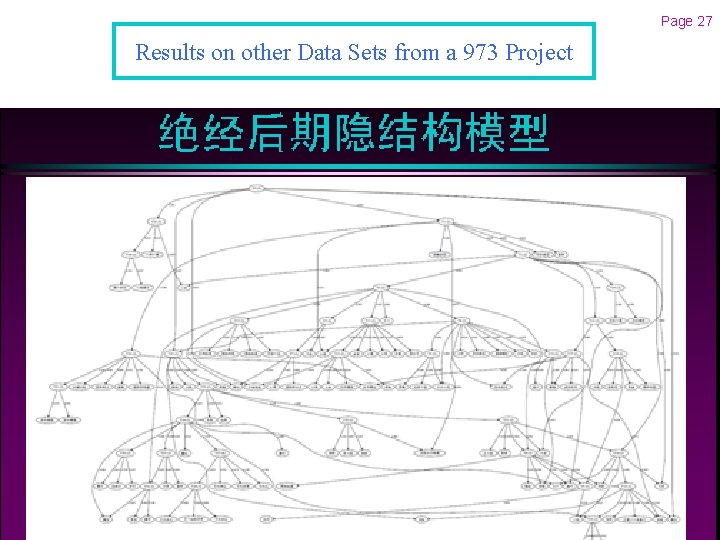
Page 27 Results on other Data Sets from a 973 Project
Page 28 Summary l We have analyzed many data sets l Latent variables obtained match the relevant TCM postulates in all cases l Conclusion: n TCM syndrome concepts do have scientific contents. n We have not shown that TCM syndromes corresponds to real entities. n We have shown that the postulate of the existence of such entities would explain the co-occurrence patterns observed in data.
Page 29 Value of Work in View of Others l D. Haughton and J. Haughton. Living Standards Analytics: Development through the Lens of Household Survey Data. Springer. 2012 n Zhang et al. provide a very interesting application of latent class models to diagnoses in traditional Chinese medicine (TCM). n The results tend to confirm known theories in Chinese traditional medicine. n This is a significant advance, since the scientific bases for these theories are not known. n The model proposed by the authors provides at least a statistical justification for them.
Page 30 Value of Work in View of Others [Review of a recent paper] I am very interested in what these authors are trying to do. They are dealing with an important epistemological problem. To go from the many symptoms and signs that patients present, to construct a consistent and other-observer identifiable constellation, is a core task of the medical practitioner. A kind of feedback occurs between what a practitioner is taught/finds listed in books, and what that practitioner encounters in the clinic. The better the constellation is understood, the more accurate the clustering of symptoms, the more consistent is the identification of syndromes among practitioners and through time. While these constellations have been worked into widely-accepted ‘disease constructs’ for biomedicine for some time which are widely accepted as ‘real, ’ this is not quite as true for TCM constellations. This latent variable study is interesting not only in itself, but also as providing evidence that what TCM ‘says’ is so, shows up during analysis as demonstrably so.
Page 31 Outline l Introduction l Statistical validation of TCM postulates l Providing evidence for TCM patient class definition and differentiation l Concluding remarks
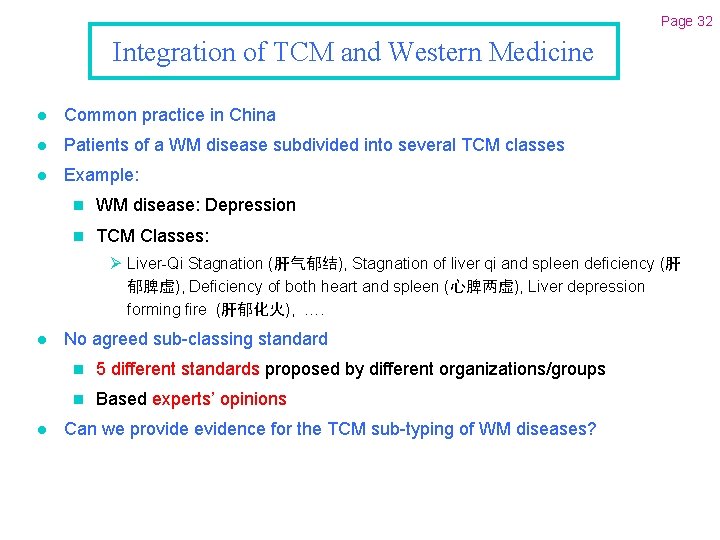
Page 32 Integration of TCM and Western Medicine l Common practice in China l Patients of a WM disease subdivided into several TCM classes l Example: n WM disease: Depression n TCM Classes: Ø Liver-Qi Stagnation (肝气郁结), Stagnation of liver qi and spleen deficiency (肝 郁脾虚), Deficiency of both heart and spleen (心脾两虚), Liver depression forming fire (肝郁化火), …. l l No agreed sub-classing standard n 5 different standards proposed by different organizations/groups n Based experts’ opinions Can we provide evidence for the TCM sub-typing of WM diseases?
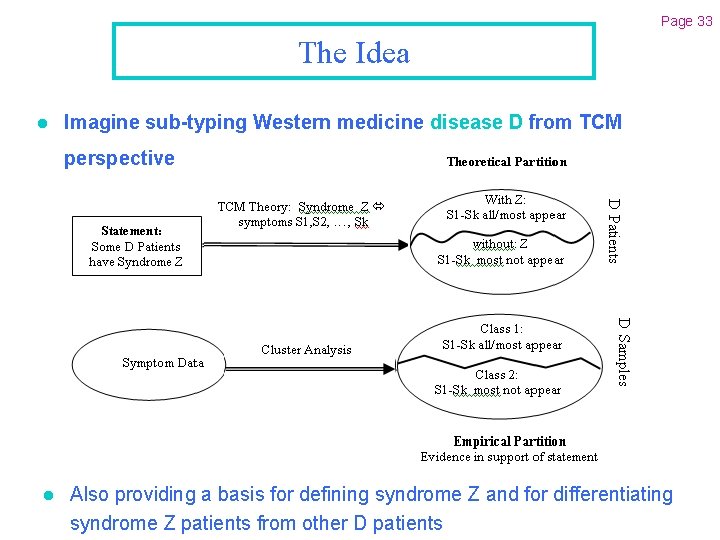
Page 33 The Idea l Imagine sub-typing Western medicine disease D from TCM perspective l Also providing a basis for defining syndrome Z and for differentiating syndrome Z patients from other D patients
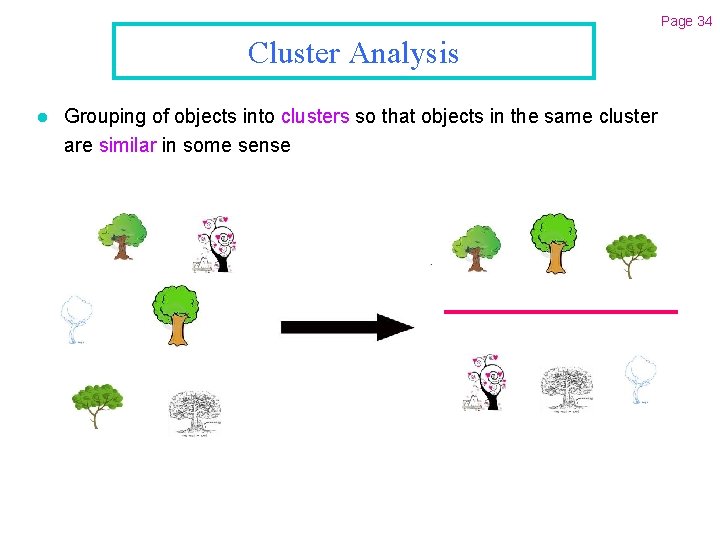
Page 34 Cluster Analysis l Grouping of objects into clusters so that objects in the same cluster are similar in some sense
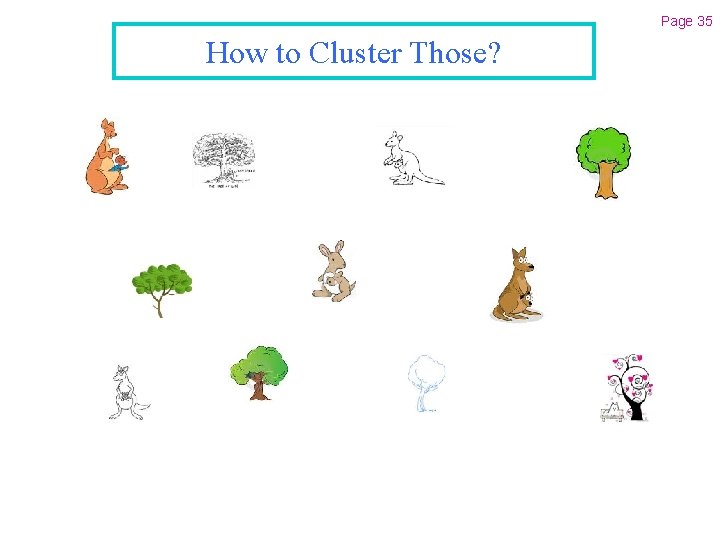
Page 35 How to Cluster Those?
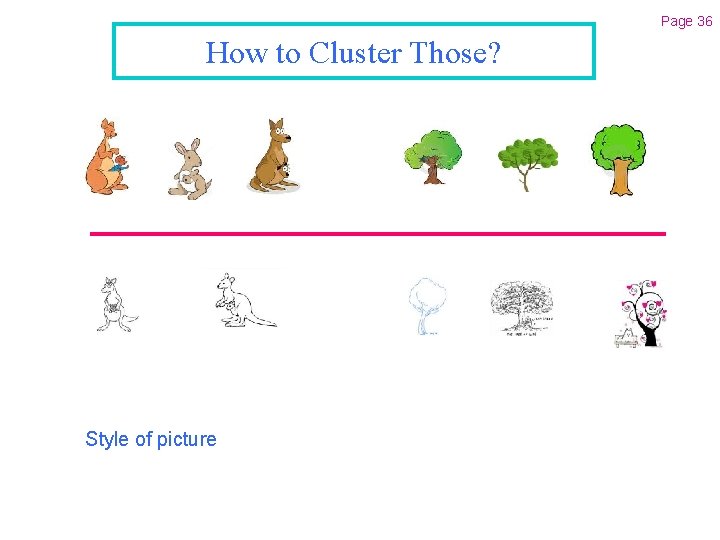
Page 36 How to Cluster Those? Style of picture
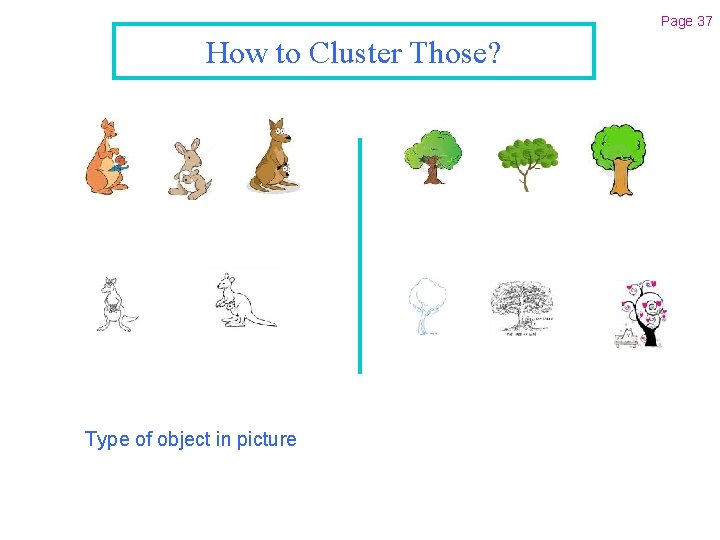
Page 37 How to Cluster Those? Type of object in picture
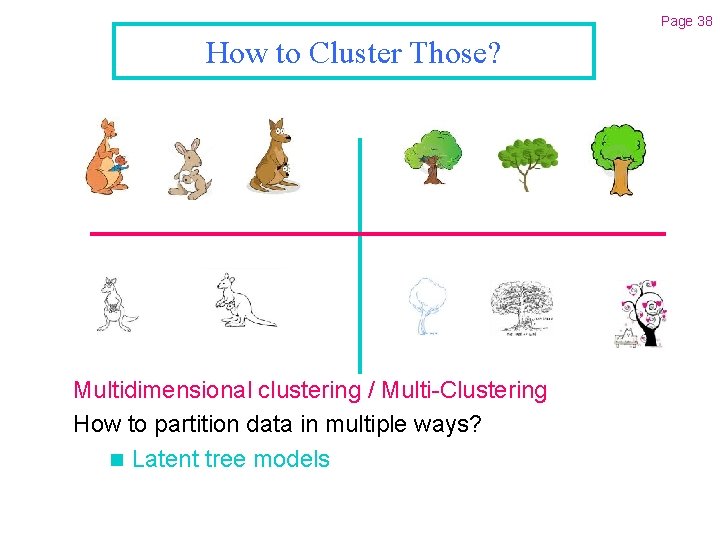
Page 38 How to Cluster Those? Multidimensional clustering / Multi-Clustering How to partition data in multiple ways? n Latent tree models
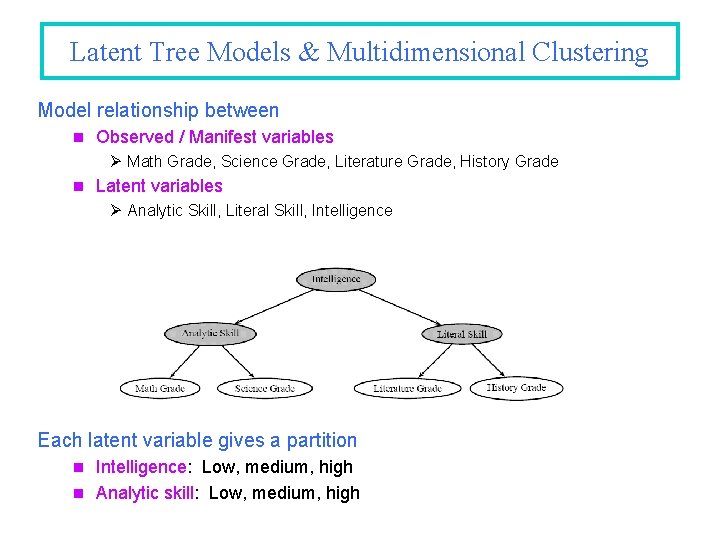
Latent Tree Models & Multidimensional Clustering Model relationship between n Observed / Manifest variables Ø Math Grade, Science Grade, Literature Grade, History Grade n Latent variables Ø Analytic Skill, Literal Skill, Intelligence Each latent variable gives a partition Intelligence: Low, medium, high n Analytic skill: Low, medium, high n
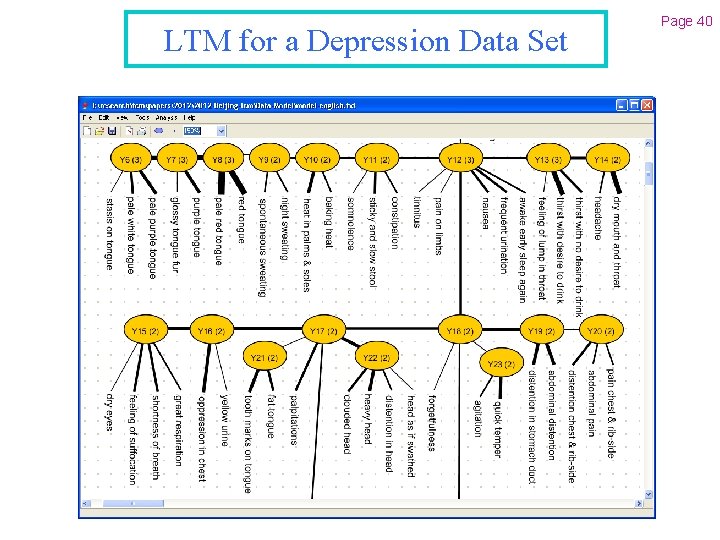
LTM for a Depression Data Set Page 40
Partition given by Y 15 Page 41
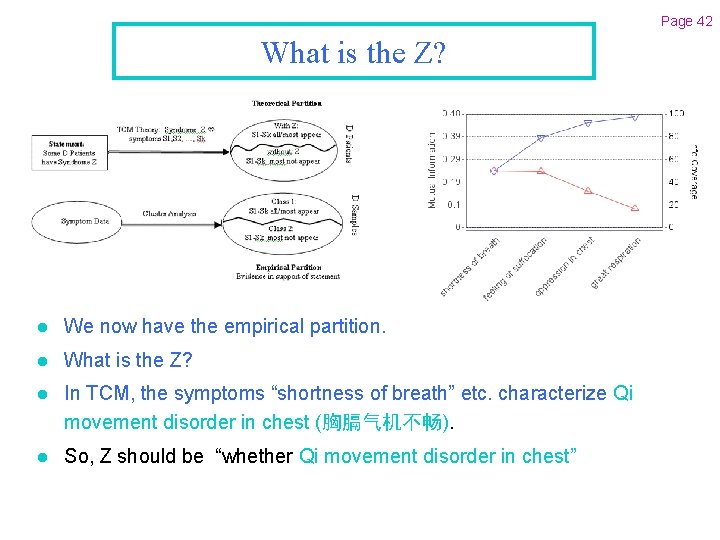
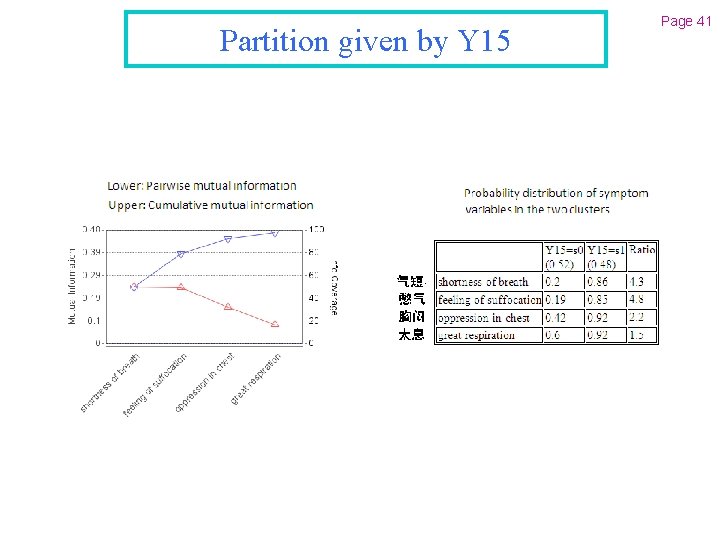
Page 42 What is the Z? l We now have the empirical partition. l What is the Z? l In TCM, the symptoms “shortness of breath” etc. characterize Qi movement disorder in chest (胸膈气机不畅). l So, Z should be “whether Qi movement disorder in chest”
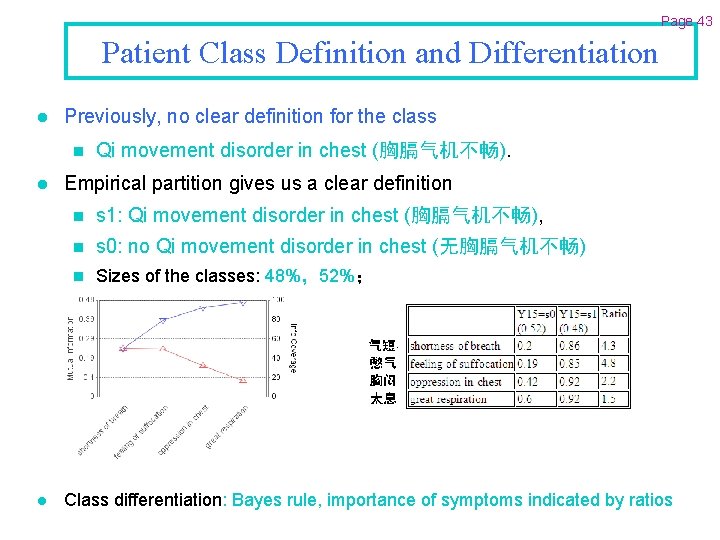
Page 43 Patient Class Definition and Differentiation l Previously, no clear definition for the class n l l Qi movement disorder in chest (胸膈气机不畅). Empirical partition gives us a clear definition n s 1: Qi movement disorder in chest (胸膈气机不畅), n s 0: no Qi movement disorder in chest (无胸膈气机不畅) n Sizes of the classes: 48%,52%; Class differentiation: Bayes rule, importance of symptoms indicated by ratios
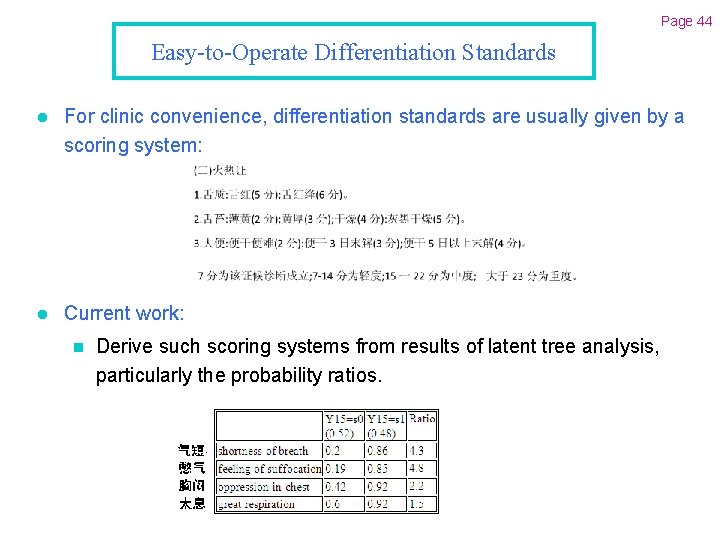
Page 44 Easy-to-Operate Differentiation Standards l For clinic convenience, differentiation standards are usually given by a scoring system: l Current work: n Derive such scoring systems from results of latent tree analysis, particularly the probability ratios.
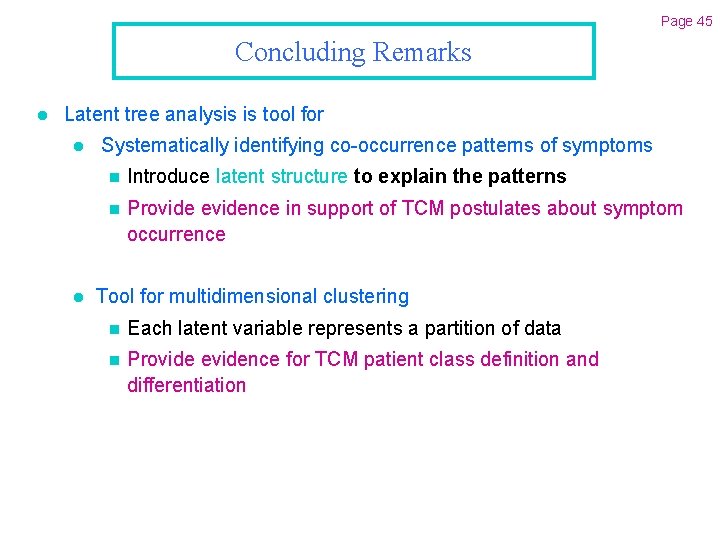
Page 45 Concluding Remarks l Latent tree analysis is tool for l l Systematically identifying co-occurrence patterns of symptoms n Introduce latent structure to explain the patterns n Provide evidence in support of TCM postulates about symptom occurrence Tool for multidimensional clustering n Each latent variable represents a partition of data n Provide evidence for TCM patient class definition and differentiation
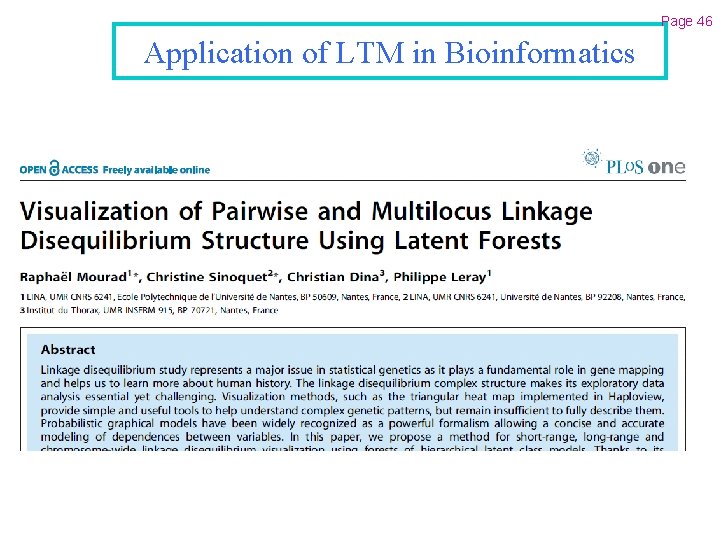
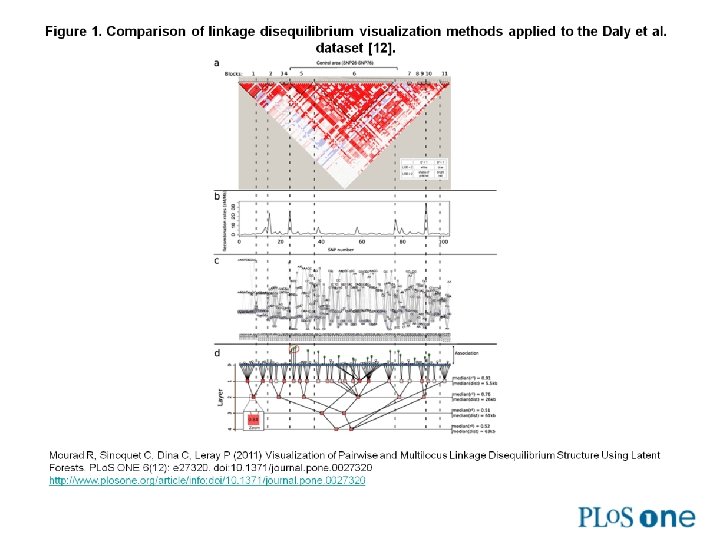
Page 46 Application of LTM in Bioinformatics
Thank You!
- Slides: 48