
An evaluation of argument patterns to reduce pitfalls






- Slides: 35
An evaluation of argument patterns to reduce pitfalls of applying Assurance Case Prof. Dr. Shuichiro Yamamoto Nagoya University Copyright Prof. Dr. Shuichiro Yamamoto 2013 1
Agenda �Pitfalls of assurance case deployment �Patterns of argument decomposition �Early evaluations of pattern applications �Future plan Copyright Prof. Dr. Shuichiro Yamamoto 2013 2
Assurance case pitfalls Necessity of Decomposition Pattern Copyright Prof. Dr. Shuichiro Yamamoto 2013
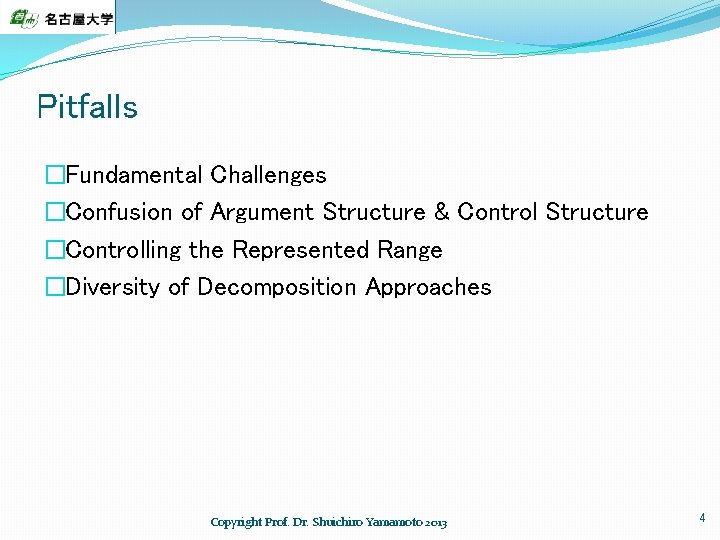
Pitfalls �Fundamental Challenges �Confusion of Argument Structure & Control Structure �Controlling the Represented Range �Diversity of Decomposition Approaches Copyright Prof. Dr. Shuichiro Yamamoto 2013 4
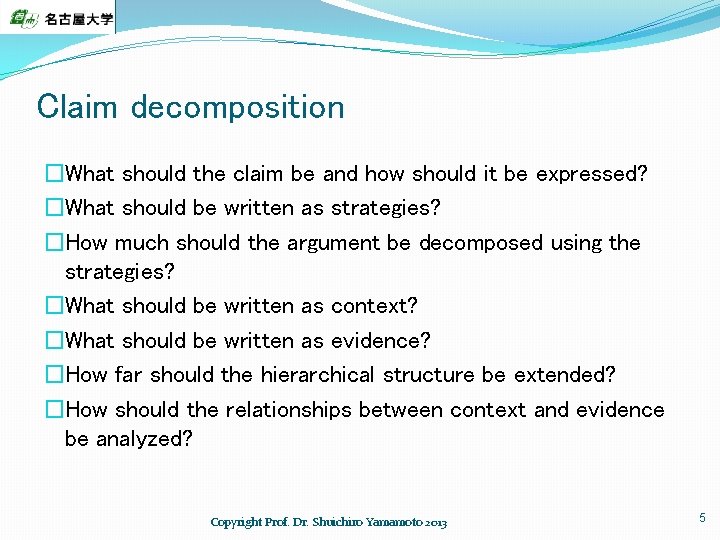
Claim decomposition �What should the claim be and how should it be expressed? �What should be written as strategies? �How much should the argument be decomposed using the strategies? �What should be written as context? �What should be written as evidence? �How far should the hierarchical structure be extended? �How should the relationships between context and evidence be analyzed? Copyright Prof. Dr. Shuichiro Yamamoto 2013 5
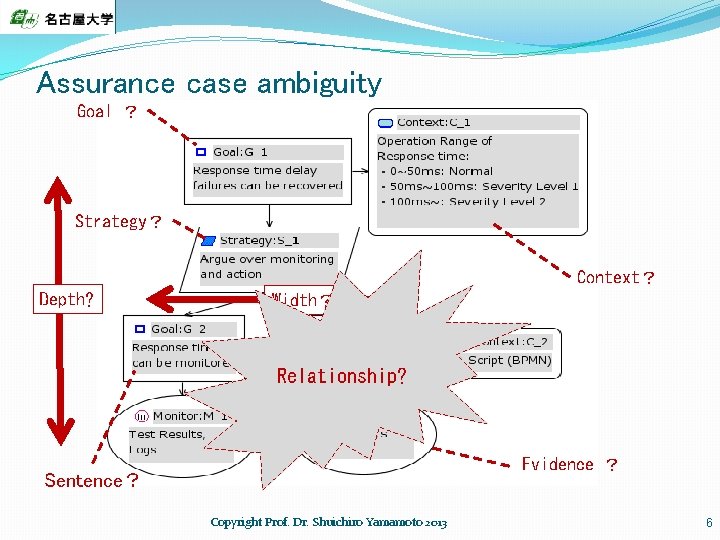
Assurance case ambiguity Goal ? Strategy? Context? Depth? Width? Relationship? Evidence ? Sentence? Copyright Prof. Dr. Shuichiro Yamamoto 2013 6
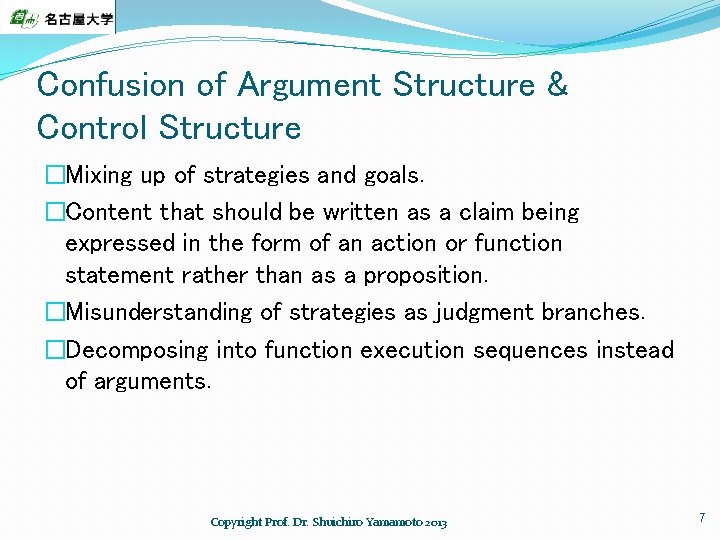
Confusion of Argument Structure & Control Structure �Mixing up of strategies and goals. �Content that should be written as a claim being expressed in the form of an action or function statement rather than as a proposition. �Misunderstanding of strategies as judgment branches. �Decomposing into function execution sequences instead of arguments. Copyright Prof. Dr. Shuichiro Yamamoto 2013 7
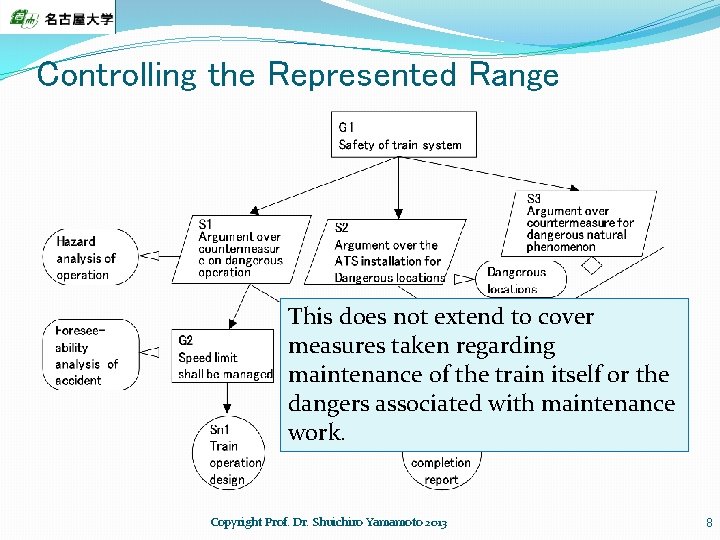
Controlling the Represented Range This does not extend to cover measures taken regarding maintenance of the train itself or the dangers associated with maintenance work. Copyright Prof. Dr. Shuichiro Yamamoto 2013 8
Basic pattern of argument decomposition n. Architecture n. Functional n. Attributes n. Infinite set n. Complete n. Monotonic nconcretion Copyright Prof. Dr. Shuichiro Yamamoto 2013 9
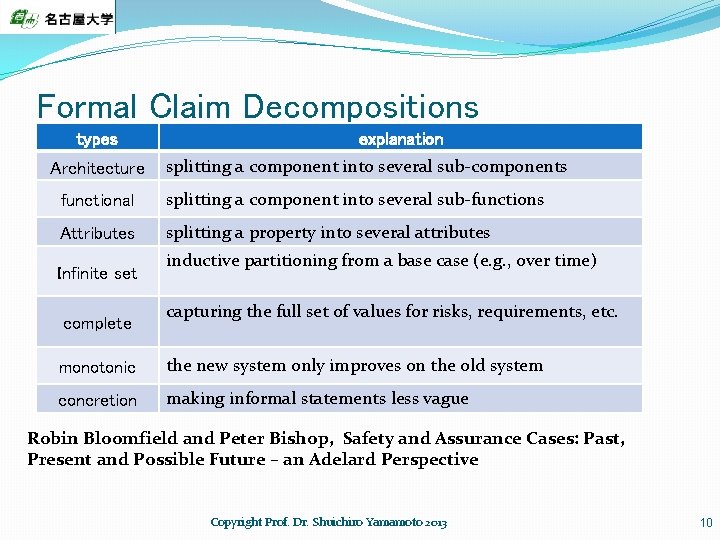
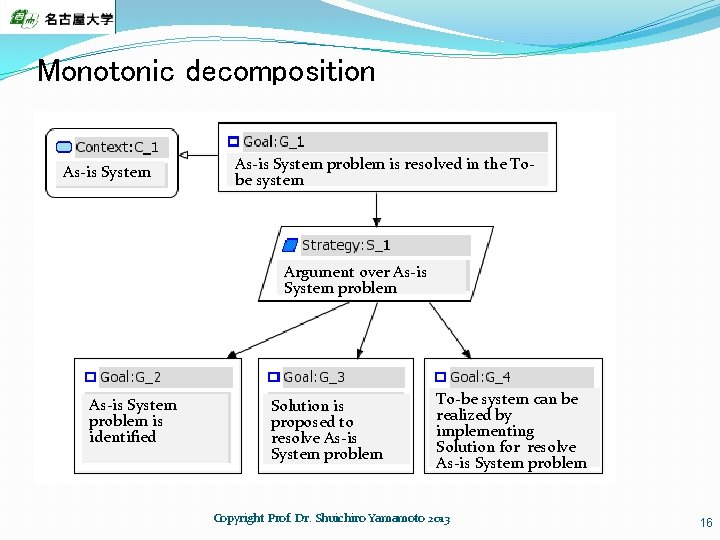
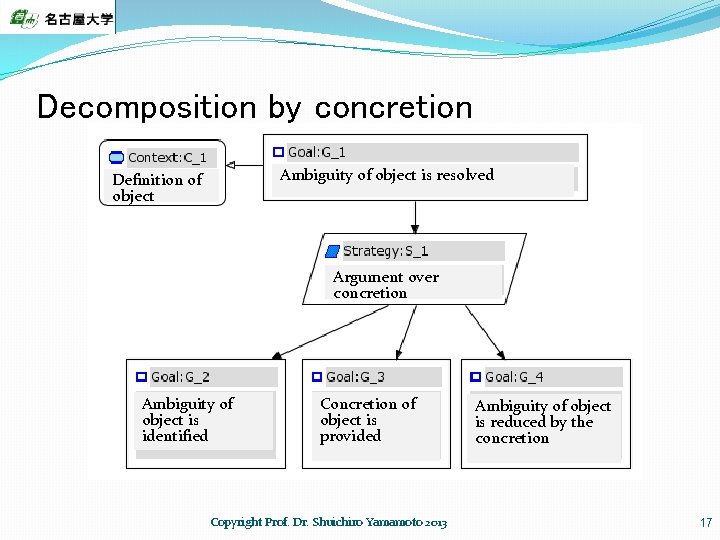
Formal Claim Decompositions types Architecture explanation splitting a component into several sub-components functional splitting a component into several sub-functions Attributes splitting a property into several attributes Infinite set complete inductive partitioning from a base case (e. g. , over time) capturing the full set of values for risks, requirements, etc. monotonic the new system only improves on the old system concretion making informal statements less vague Robin Bloomfield and Peter Bishop, Safety and Assurance Cases: Past, Present and Possible Future – an Adelard Perspective Copyright Prof. Dr. Shuichiro Yamamoto 2013 10
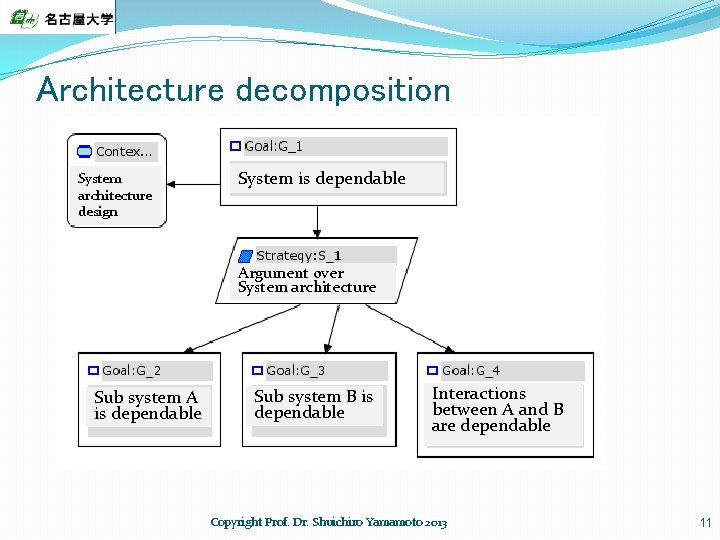
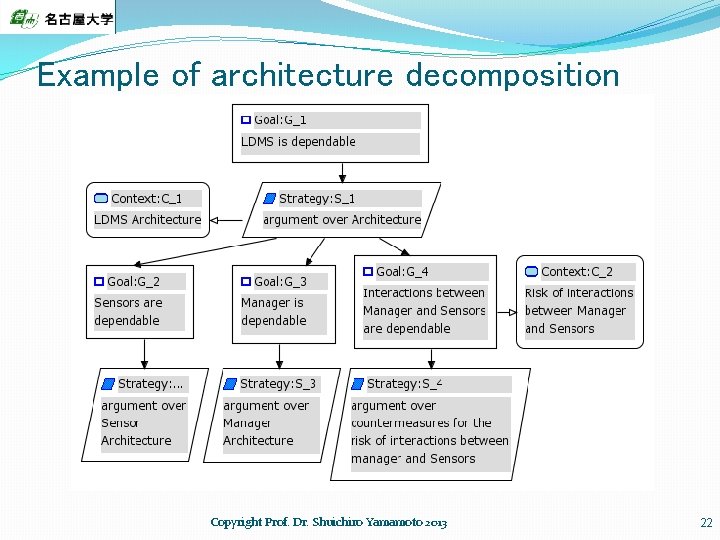
Architecture decomposition System architecture design System is dependable Argument over System architecture Sub system A is dependable Sub system B is dependable Interactions between A and B are dependable Copyright Prof. Dr. Shuichiro Yamamoto 2013 11
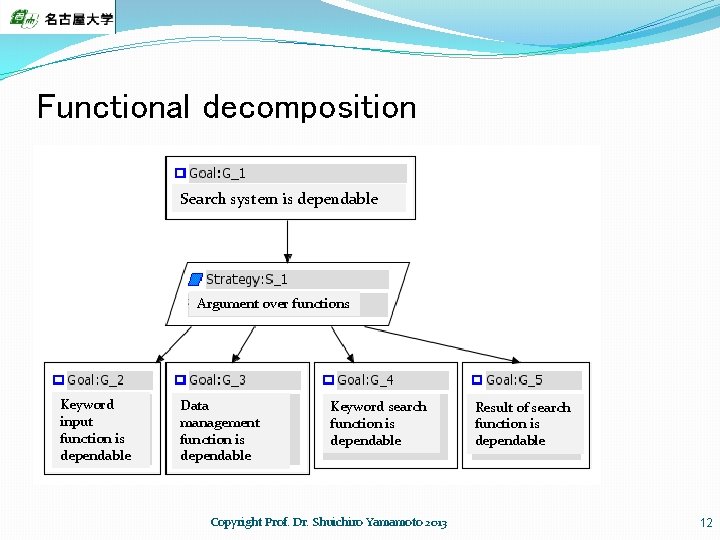
Functional decomposition Search system is dependable Argument over functions Keyword input function is dependable Data management function is dependable Keyword search function is dependable Copyright Prof. Dr. Shuichiro Yamamoto 2013 Result of search function is dependable 12
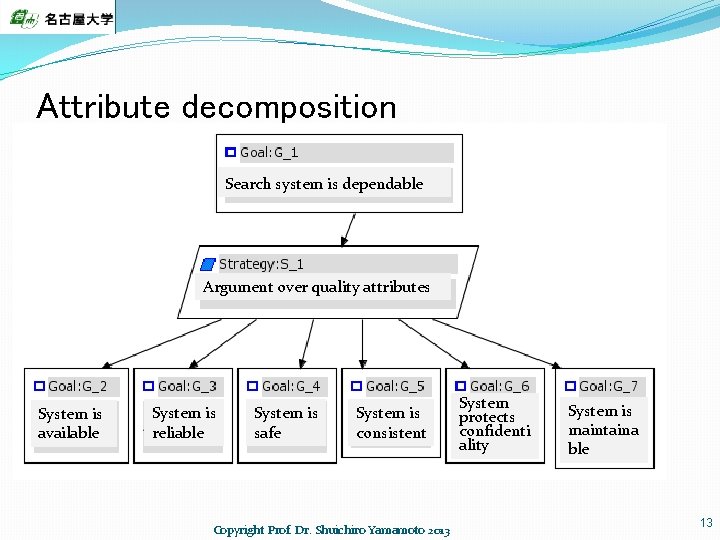
Attribute decomposition Search system is dependable Argument over quality attributes System is available System is reliable System is safe System is consistent Copyright Prof. Dr. Shuichiro Yamamoto 2013 System protects confidenti ality System is maintaina ble 13
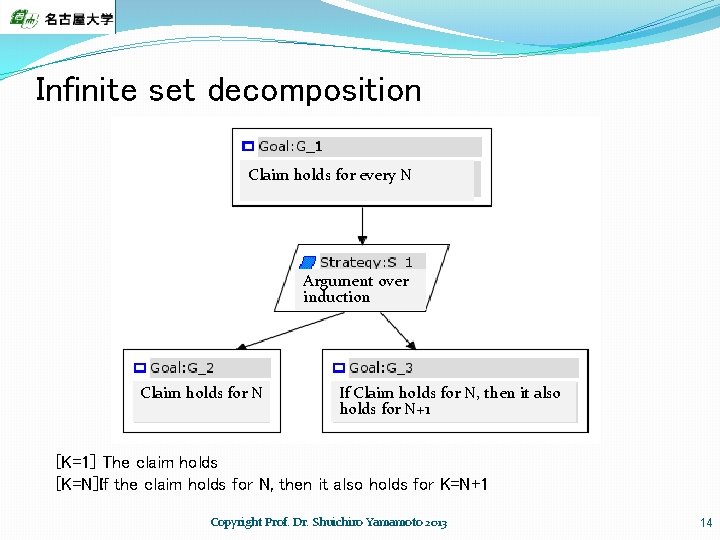
Infinite set decomposition Claim holds for every N Argument over induction Claim holds for N If Claim holds for N, then it also holds for N+1 [K=1] The claim holds [K=N]If the claim holds for N, then it also holds for K=N+1 Copyright Prof. Dr. Shuichiro Yamamoto 2013 14
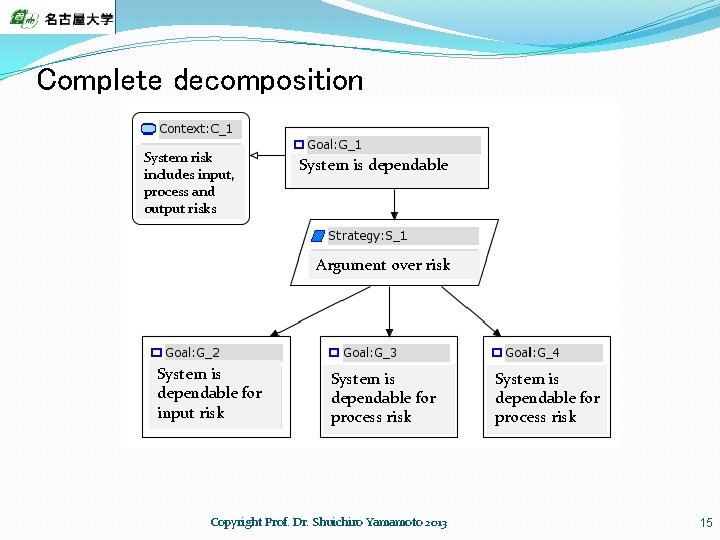
Complete decomposition System risk includes input, process and output risks System is dependable Argument over risk System is dependable for input risk System is dependable for process risk Copyright Prof. Dr. Shuichiro Yamamoto 2013 System is dependable for process risk 15
Monotonic decomposition As-is System problem is resolved in the Tobe system Argument over As-is System problem is identified Solution is proposed to resolve As-is System problem To-be system can be realized by implementing Solution for resolve As-is System problem Copyright Prof. Dr. Shuichiro Yamamoto 2013 16
Decomposition by concretion Ambiguity of object is resolved Definition of object Argument over concretion Ambiguity of object is identified Concretion of object is provided Copyright Prof. Dr. Shuichiro Yamamoto 2013 Ambiguity of object is reduced by the concretion 17
Evaluation of the decomposition patterns Copyright Prof. Dr. Shuichiro Yamamoto 2013 18
Design of experiment � Examinee is an engineer who has more than 20 years experience in the embedded system development. � 4 hour course of assurance case education was provided to the examinee. Copyright Prof. Dr. Shuichiro Yamamoto 2013 19
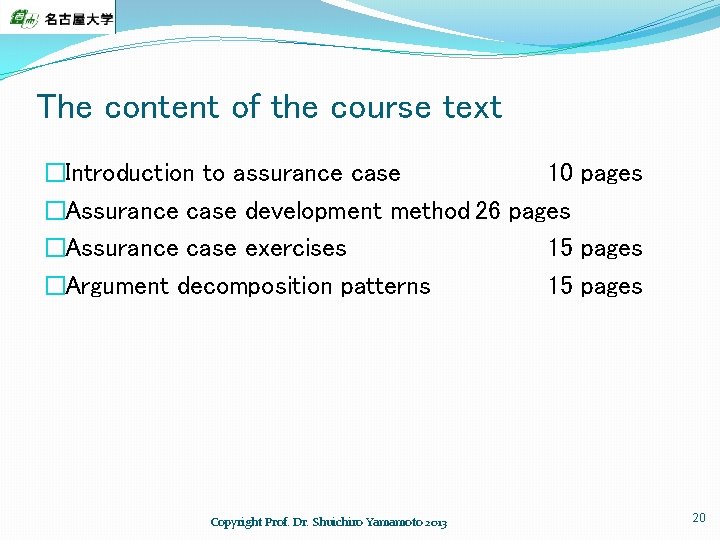
The content of the course text �Introduction to assurance case 10 pages �Assurance case development method 26 pages �Assurance case exercises 15 pages �Argument decomposition patterns 15 pages Copyright Prof. Dr. Shuichiro Yamamoto 2013 20
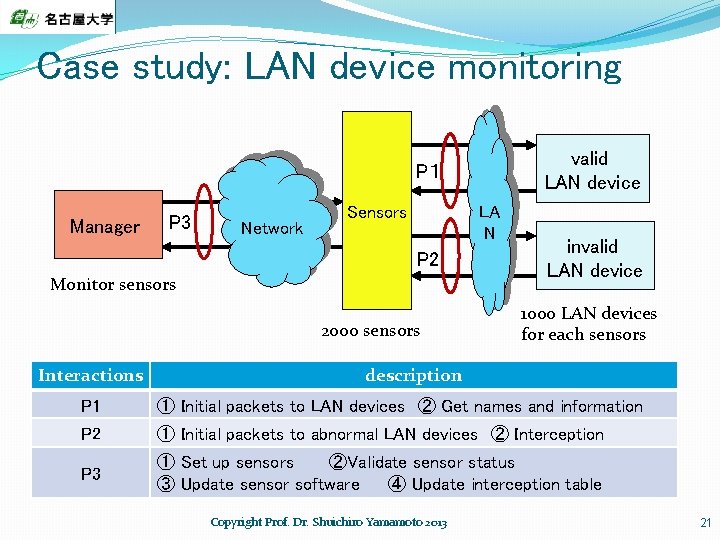
Case study: LAN device monitoring valid LAN device P1 Manager P 3 Network LA N Sensors P 2 Monitor sensors 2000 sensors Interactions invalid LAN device 1000 LAN devices for each sensors description P 1 ① Initial packets to LAN devices ② Get names and information P 2 ① Initial packets to abnormal LAN devices ② Interception P 3 ① Set up sensors ②Validate sensor status ③ Update sensor software ④ Update interception table Copyright Prof. Dr. Shuichiro Yamamoto 2013 21
Example of architecture decomposition Copyright Prof. Dr. Shuichiro Yamamoto 2013 22
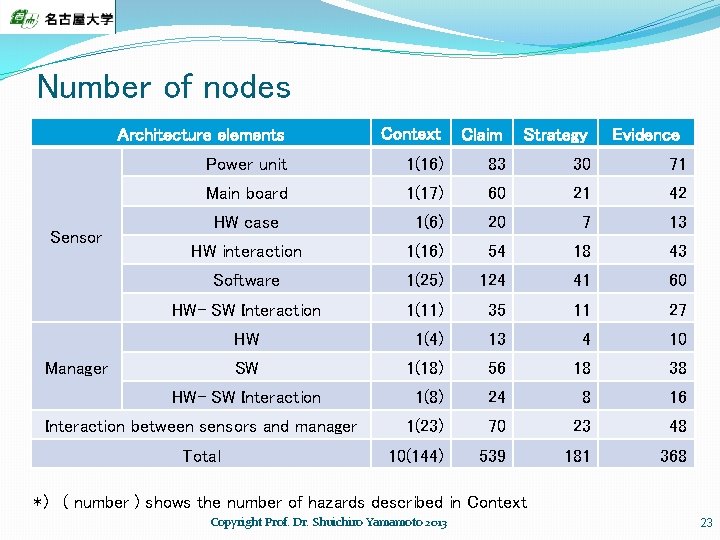
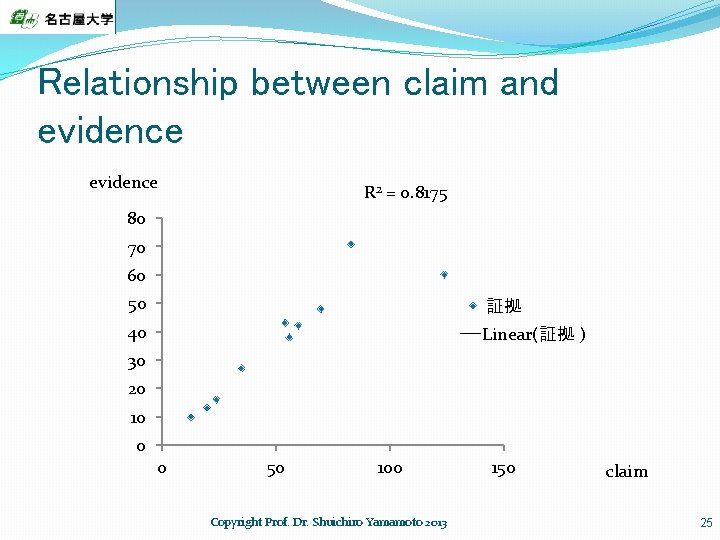
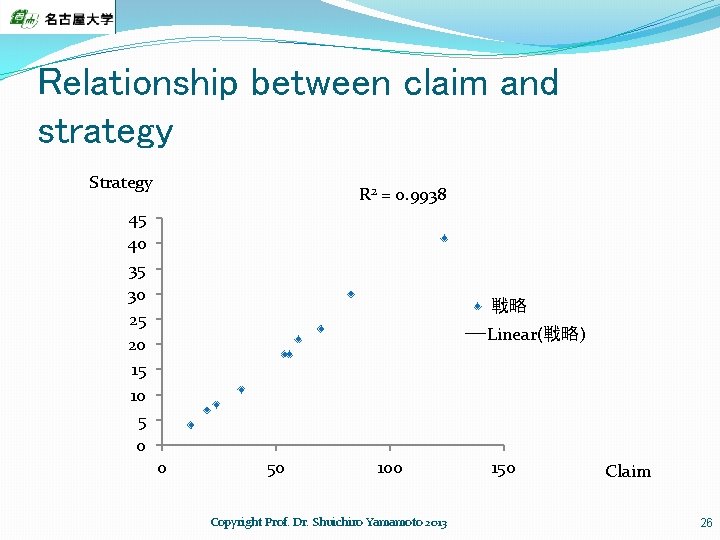
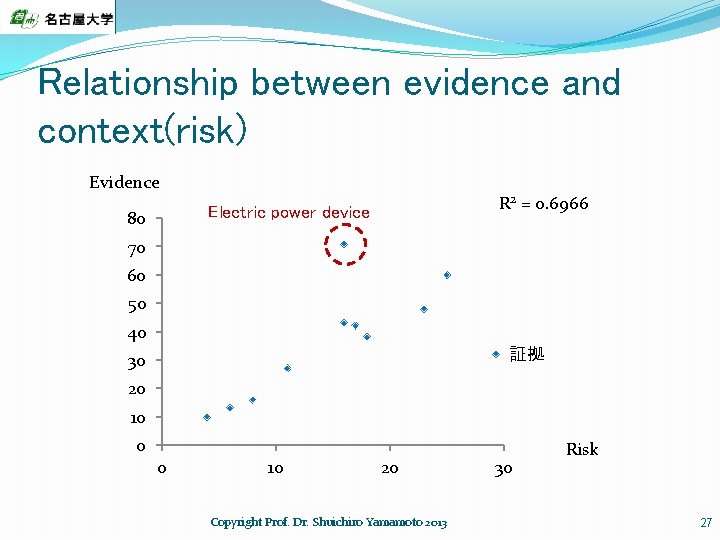
Number of nodes Sensor Architecture elements Context Claim Strategy Power unit 1(16) 83 30 71 Main board 1(17) 60 21 42 HW case 1(6) 20 7 13 HW interaction 1(16) 54 18 43 Software 1(25) 124 41 60 HW- SW Interaction 1(11) 35 11 27 HW 1(4) 13 4 10 SW 1(18) 56 18 38 HW- SW Interaction 1(8) 24 8 16 1(23) 70 23 48 10(144) 539 181 368 Manager Interaction between sensors and manager Total Evidence *) ( number ) shows the number of hazards described in Context Copyright Prof. Dr. Shuichiro Yamamoto 2013 23
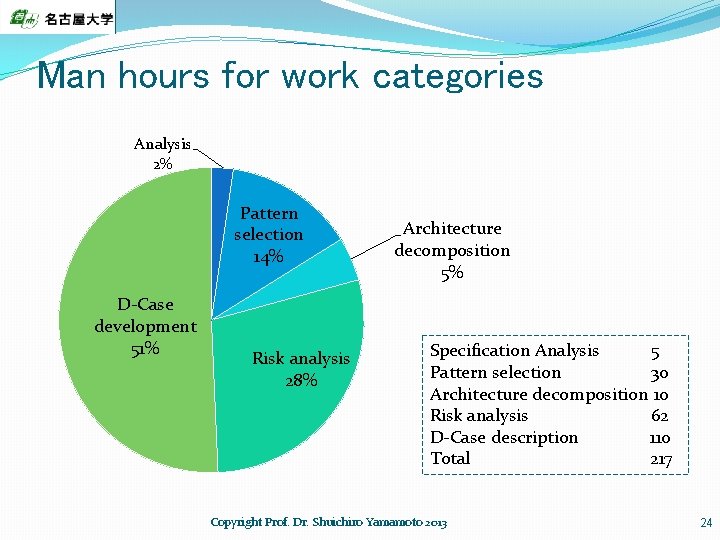
Man hours for work categories Analysis 2% Pattern selection 14% D-Case development 51% Risk analysis 28% Architecture decomposition 5% Specification Analysis 5 Pattern selection 30 Architecture decomposition 10 Risk analysis 62 D-Case description 110 Total 217 Copyright Prof. Dr. Shuichiro Yamamoto 2013 24
Relationship between claim and evidence R 2 = 0. 8175 80 70 60 50 証拠 40 Linear(証拠 ) 30 20 10 0 0 50 100 Copyright Prof. Dr. Shuichiro Yamamoto 2013 150 claim 25
Relationship between claim and strategy Strategy 45 40 35 30 25 20 15 10 5 0 R 2 = 0. 9938 戦略 Linear(戦略) 0 50 100 Copyright Prof. Dr. Shuichiro Yamamoto 2013 150 Claim 26
Relationship between evidence and context(risk) Evidence R 2 = 0. 6966 Electric power device 80 70 60 50 40 証拠 30 20 10 0 0 10 20 Copyright Prof. Dr. Shuichiro Yamamoto 2013 30 Risk 27
Discussions Copyright Prof. Dr. Shuichiro Yamamoto 2013 28
Effectiveness of argument patterns �As the examinee said, the architecture decomposition pattern was useful to analyze risk, although the decision to choose it from argument decomposition patterns needed time to understand appropriateness between the target system and argument patterns. �Many pitfalls discussed in section 2 were not observed in the course of the experiment. �This also showed the effectiveness of the argument pattern. �Without the knowledge of argument patterns, the examinee could not develop a large assurance case consists of 1098 nodes in 15 days. Copyright Prof. Dr. Shuichiro Yamamoto 2013 29
Limitations of patterns �Bloomfield's patterns do not, however, take decomposition by process or condition into considerations. For example, in argumentation by conditional judgment, a claim can be decomposed using a strategy such as that shown in Figure 2. �Here, based on evidence, a condition is defined and dependability is verified both for the case where that condition is satisfied and the case where it is not. �In other words, Goal G_4 claims that the condition is defined; Goal G_2 claims that an appropriate action is taken when the condition is satisfied; and Goal G_3 claims that an appropriate action is taken when it is not. Copyright Prof. Dr. Shuichiro Yamamoto 2013 30
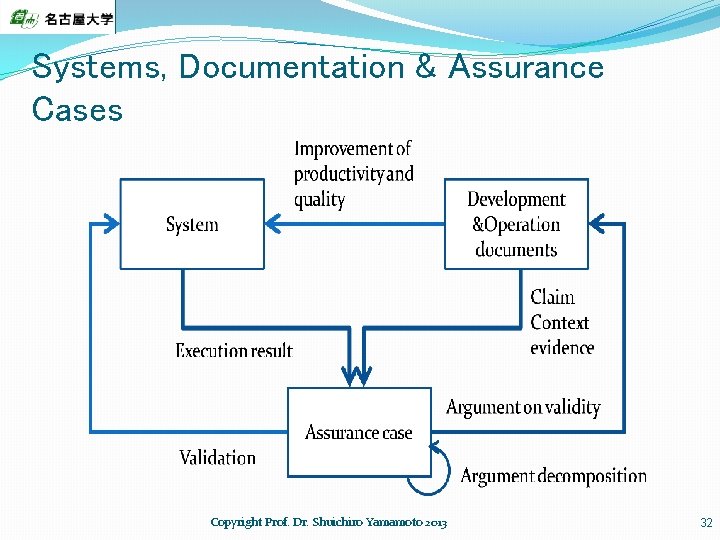
Correlation with System Development & Operation Materials �The correlation between an assurance case’s context and evidence and those documents used in system development and operation has not clearly been defined, leading to a situation where multiple documents and multiple assurance cases have simply been handled at a combined level. �Specific relationships at the element level were thus unclear, and as a result, valuable information from system development and operation documents could not be fully utilized. Copyright Prof. Dr. Shuichiro Yamamoto 2013 31
Systems, Documentation & Assurance Cases Copyright Prof. Dr. Shuichiro Yamamoto 2013 32
Creating Assurance Cases for Process Validation �(1)Establish a claim based on the goal. �(2) Argue each procedure necessary to achieve the goal according to the strategy. �(3) Establish input information using contexts. �(4) Establish the verification result for the process output as evidence. Copyright Prof. Dr. Shuichiro Yamamoto 2013 33
Summary �This paper introduced some of the pitfalls commonly encountered when developing assurance cases, as well as assurance case pattern methods for dealing with them. �Evaluation of the pattern approach was also evaluated for assuring a LAN device management system. �The experimental evaluation showed the effectiveness of the architecture pattern of argument decomposition. �The examinee developed assurance case contains more than 1000 nodes systematically in less than 2 weeks, after learned assurance case introduction course and patterns in 4 hours. �Methods for extending assurances case patterns based on process definition were also discussed. Copyright Prof. Dr. Shuichiro Yamamoto 2013 34
Thank you for your attention Copyright Prof. Dr. Shuichiro Yamamoto 2013 35