
An EUV Spectrometer for the ESA Solar Orbiter
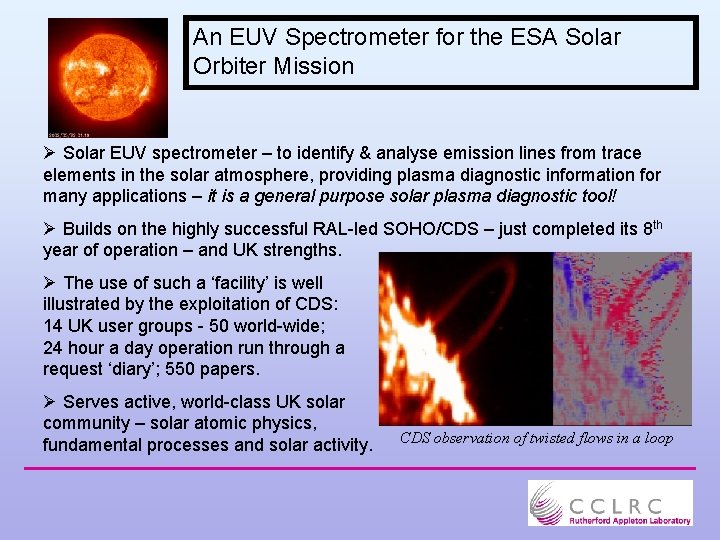
An EUV Spectrometer for the ESA Solar Orbiter Mission Ø Solar EUV spectrometer – to identify & analyse emission lines from trace elements in the solar atmosphere, providing plasma diagnostic information for many applications – it is a general purpose solar plasma diagnostic tool! Ø Builds on the highly successful RAL-led SOHO/CDS – just completed its 8 th year of operation – and UK strengths. Ø The use of such a ‘facility’ is well illustrated by the exploitation of CDS: 14 UK user groups - 50 world-wide; 24 hour a day operation run through a request ‘diary’; 550 papers. Ø Serves active, world-class UK solar community – solar atomic physics, fundamental processes and solar activity. CDS observation of twisted flows in a loop
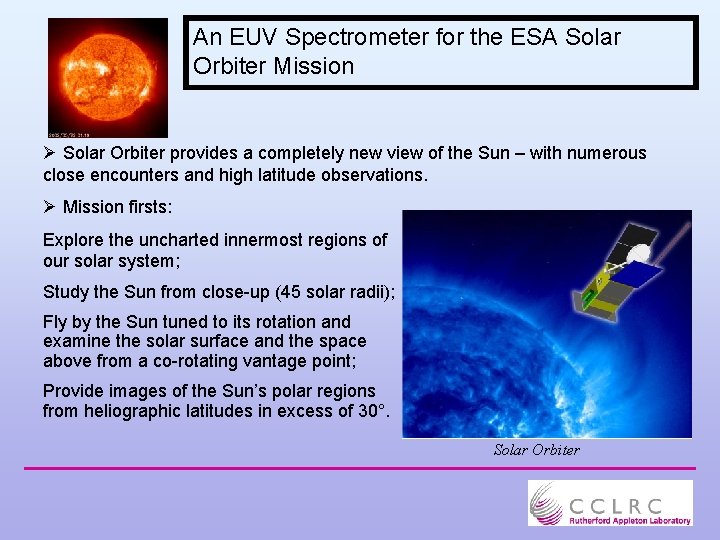
An EUV Spectrometer for the ESA Solar Orbiter Mission Ø Solar Orbiter provides a completely new view of the Sun – with numerous close encounters and high latitude observations. Ø Mission firsts: Explore the uncharted innermost regions of our solar system; Study the Sun from close-up (45 solar radii); Fly by the Sun tuned to its rotation and examine the solar surface and the space above from a co-rotating vantage point; Provide images of the Sun’s polar regions from heliographic latitudes in excess of 30°. Solar Orbiter
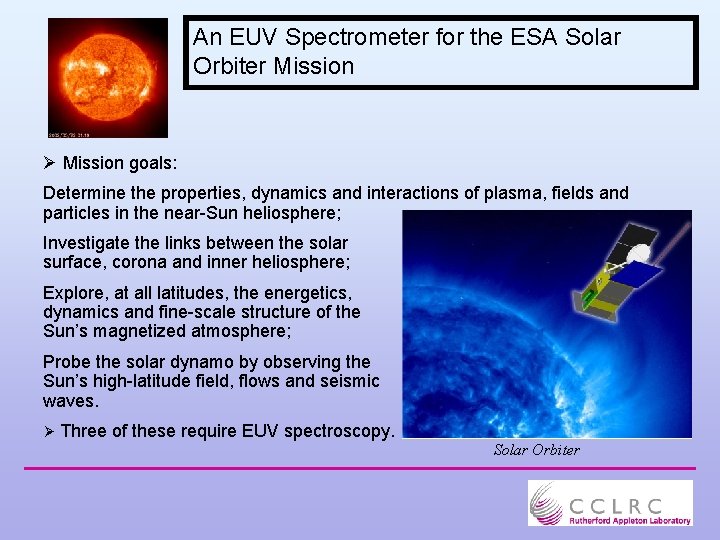
An EUV Spectrometer for the ESA Solar Orbiter Mission Ø Mission goals: Determine the properties, dynamics and interactions of plasma, fields and particles in the near-Sun heliosphere; Investigate the links between the solar surface, corona and inner heliosphere; Explore, at all latitudes, the energetics, dynamics and fine-scale structure of the Sun’s magnetized atmosphere; Probe the solar dynamo by observing the Sun’s high-latitude field, flows and seismic waves. Ø Three of these require EUV spectroscopy. Solar Orbiter
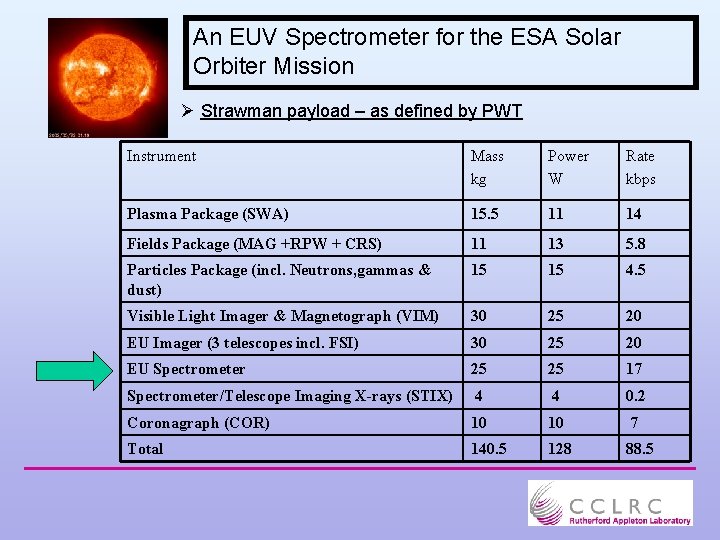
An EUV Spectrometer for the ESA Solar Orbiter Mission Ø Strawman payload – as defined by PWT Instrument Mass kg Power W Rate kbps Plasma Package (SWA) 15. 5 11 14 Fields Package (MAG +RPW + CRS) 11 13 5. 8 Particles Package (incl. Neutrons, gammas & dust) 15 15 4. 5 Visible Light Imager & Magnetograph (VIM) 30 25 20 EU Imager (3 telescopes incl. FSI) 30 25 20 EU Spectrometer 25 25 17 Spectrometer/Telescope Imaging X-rays (STIX) 4 4 0. 2 Coronagraph (COR) 10 10 7 Total 140. 5 128 88. 5

An EUV Spectrometer for the ESA Solar Orbiter Mission Ø The need for a spectrometer. . . Ø This is the best we can do now: EUV imaging to 0. 5 arcsec (350 km) and EUV spectroscopy to 2 -3 arcsec. We know that the solar atmosphere is composed of fine-scale structures and must aim to develop appropriate tools. Our target is spectroscopy at ~70 km (0. 5 arcsec at 0. 2 AU, 0. 1 arcsec at 1 AU).
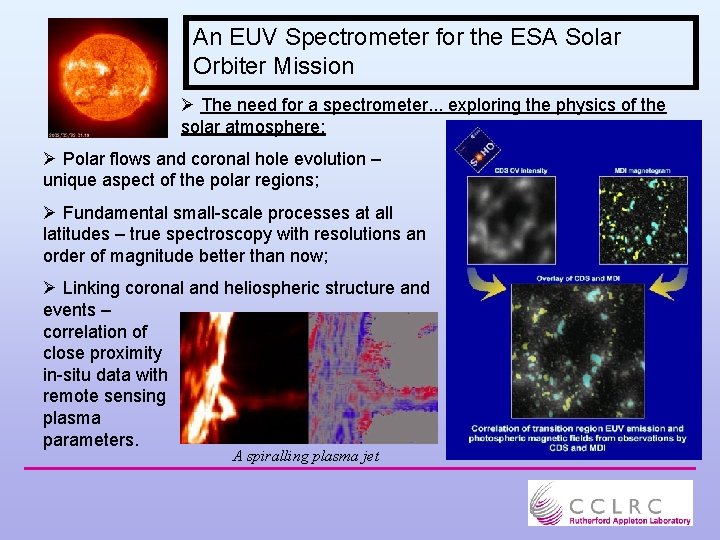
An EUV Spectrometer for the ESA Solar Orbiter Mission Ø The need for a spectrometer. . . exploring the physics of the solar atmosphere: Ø Polar flows and coronal hole evolution – unique aspect of the polar regions; Ø Fundamental small-scale processes at all latitudes – true spectroscopy with resolutions an order of magnitude better than now; Ø Linking coronal and heliospheric structure and events – correlation of close proximity in-situ data with remote sensing plasma parameters. A spiralling plasma jet
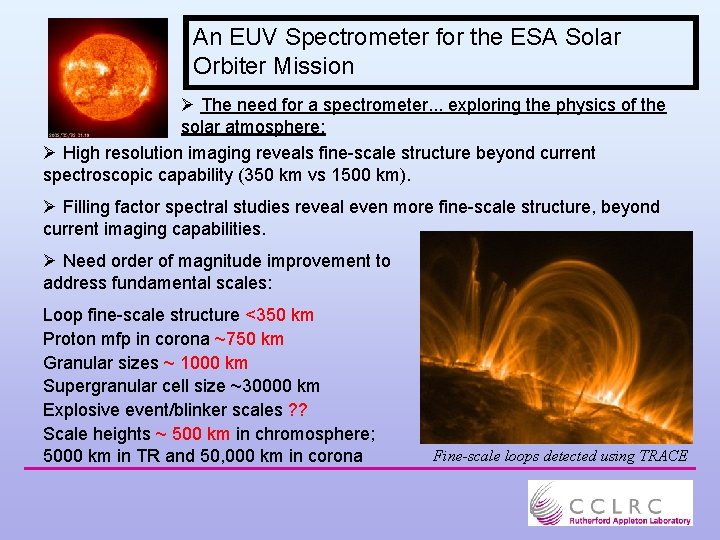
An EUV Spectrometer for the ESA Solar Orbiter Mission Ø The need for a spectrometer. . . exploring the physics of the solar atmosphere: Ø High resolution imaging reveals fine-scale structure beyond current spectroscopic capability (350 km vs 1500 km). Ø Filling factor spectral studies reveal even more fine-scale structure, beyond current imaging capabilities. Ø Need order of magnitude improvement to address fundamental scales: Loop fine-scale structure <350 km Proton mfp in corona ~750 km Granular sizes ~ 1000 km Supergranular cell size ~30000 km Explosive event/blinker scales ? ? Scale heights ~ 500 km in chromosphere; 5000 km in TR and 50, 000 km in corona Fine-scale loops detected using TRACE
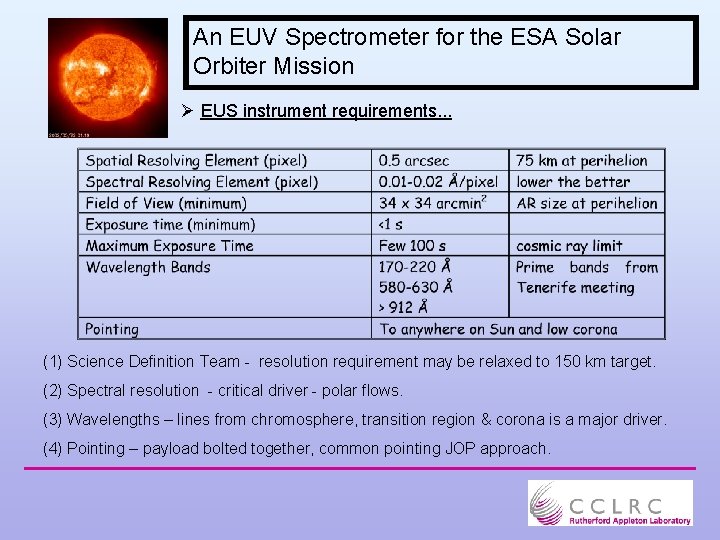
An EUV Spectrometer for the ESA Solar Orbiter Mission Ø EUS instrument requirements. . . (1) Science Definition Team - resolution requirement may be relaxed to 150 km target. (2) Spectral resolution - critical driver - polar flows. (3) Wavelengths – lines from chromosphere, transition region & corona is a major driver. (4) Pointing – payload bolted together, common pointing JOP approach.
An EUV Spectrometer for the ESA Solar Orbiter Mission Ø EUS instrument plans Ø Next-generation CDS led from RAL proposed at PPARC SOI; Ø Proto-consortium has met four times – in 2001, 2002 and 2003, and dedicated wavelength meeting in 2003; Ø Pre-proposal to PPARC - end of Oct. – consortium includes UK solar hardware groups at RAL, MSSL and Birmingham (SMM, CHASE, Yohkoh, SOHO, Solar-B, STEREO…) Ø Consortium Web site - http: //www. orbiter. rl. ac. uk: 1. Concept document (‘Blue Book’) 2. Technical studies e. g. Wavelength selection; Orbiter goals; Optical design requirements; Detector requirements 3. Meeting reports, including ppt talks. 4. Contacts, links, mission notes/documents. . .

An EUV Spectrometer for the ESA Solar Orbiter Mission Ø EUS instrument concept & initial design strategy. . . Ø Two design concepts now under discussion Ø Off-axis single mirror NI telescope with VLS grating Ø Wolter II GI telescope with VLS grating
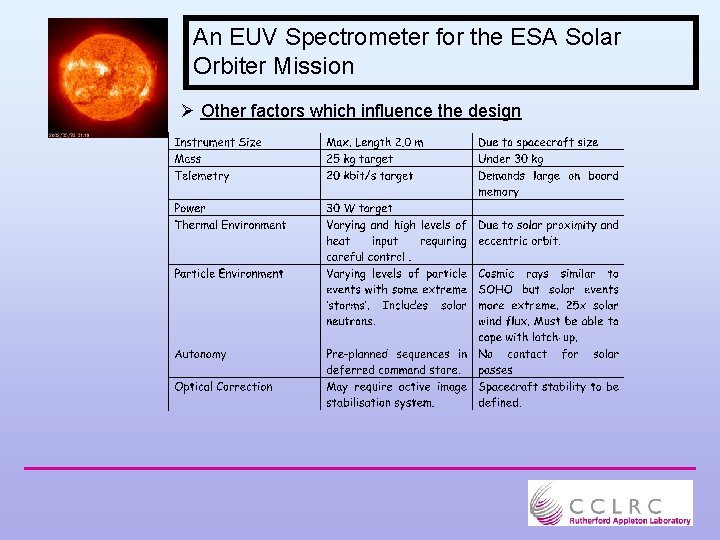
An EUV Spectrometer for the ESA Solar Orbiter Mission Ø Other factors which influence the design
An EUV Spectrometer for the ESA Solar Orbiter Mission Thermal Loads Ø 149 day cycle = 2, 142 to 34, 275 W/m 2 (0. 8 to 0. 2 AU). Ø Need to address thermal balance for high load values and for variation of thermal input. Ø We must validate the designs through extensive modelling.
An EUV Spectrometer for the ESA Solar Orbiter Mission Particle Environment at 0. 2 AU Ø Cosmic Rays: - Non-solar cosmic rays about the same as for SOHO, or less. Ø Solar Wind: - Projecting from 1 AU (~10 p/m 3), might expect 250 p/m 3 in quiet conditions, with v ~ 400 km/s. Thus, we expect 106 hits/cm 2. s (25 x SOHO flux). Ø Neutrons: - 15 min half life means that we may expect them. Concern over their cross section at the silicon lattice relative to protons. Needs investigation. Ø Flares and shock (CME) particles: - Dose difficult to predict. May be more events than SOHO. Events 25 x stronger. Note: Hadrons can cause damage to a CCD silicon lattice which causes traps that can ‘steal’ charge which can be transferred to other parts of the image. Note: What about particle effects on optical surfaces?
An EUV Spectrometer for the ESA Solar Orbiter Mission Ø Thermal-Mechanical Issues Ø Mass allocation for payload under 140 kg. Allocation for spectrometer <30 kg (CDS 100 kg, EIS 60 kg) Ø CFRP option and Si. C option being studied with initial mass breakdown in Payload Definition Document – strategy includes low-mass detector option, no pointing system… Ø In parallel, second phase of thermal modelling (149 -day prime orbit, 0. 2 to 0. 8 AU – 34, 275 to 2, 142 Wm-2) Ø Thermal strategy – off-axis = heat stop, primary radiator, with active ‘smoothing’ of extremes using heat switches…
An EUV Spectrometer for the ESA Solar Orbiter Mission Ø Detectors Ø Particle environment rules out CCD detector approach Ø 4 k x 4 k 5μm pixel array currently baselined (precludes CCD option) Ø Low mass option – on-chip electronics Ø Conclusion: Active Pixel Sensor option (RAL/E 2 V) APS detectors are being suggested for a range of Solar Orbiter instruments, including the EUV spectrometer, EUV imager and coronagraph – and have advantages for a range of future missions, not necessarily solar oriented.
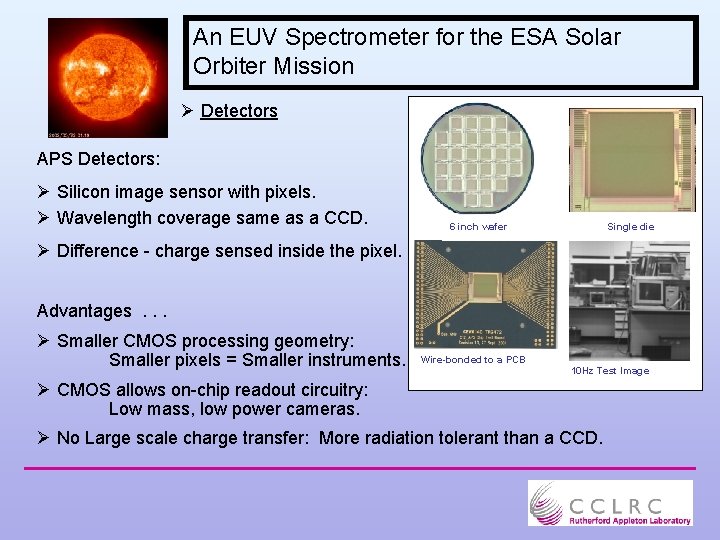
An EUV Spectrometer for the ESA Solar Orbiter Mission Ø Detectors APS Detectors: Ø Silicon image sensor with pixels. Ø Wavelength coverage same as a CCD. 6 inch wafer Single die Ø Difference - charge sensed inside the pixel. Advantages. . . Ø Smaller CMOS processing geometry: Smaller pixels = Smaller instruments. Wire-bonded to a PCB 10 Hz Test Image Ø CMOS allows on-chip readout circuitry: Low mass, low power cameras. Ø No Large scale charge transfer: More radiation tolerant than a CCD.
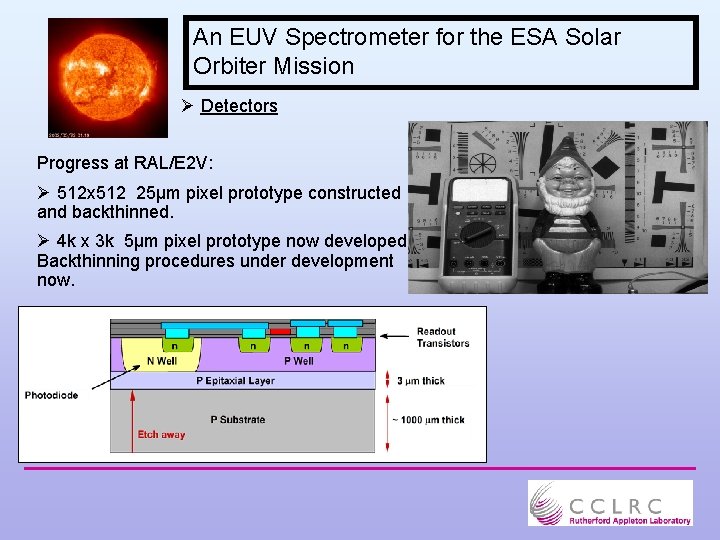
An EUV Spectrometer for the ESA Solar Orbiter Mission Ø Detectors Progress at RAL/E 2 V: Ø 512 x 512 25μm pixel prototype constructed and backthinned. Ø 4 k x 3 k 5μm pixel prototype now developed. Backthinning procedures under development now.
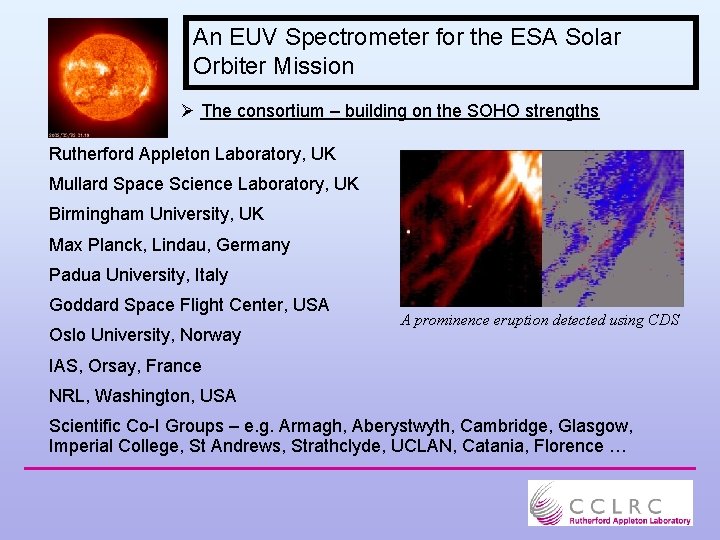
An EUV Spectrometer for the ESA Solar Orbiter Mission Ø The consortium – building on the SOHO strengths Rutherford Appleton Laboratory, UK Mullard Space Science Laboratory, UK Birmingham University, UK Max Planck, Lindau, Germany Padua University, Italy Goddard Space Flight Center, USA Oslo University, Norway A prominence eruption detected using CDS IAS, Orsay, France NRL, Washington, USA Scientific Co-I Groups – e. g. Armagh, Aberystwyth, Cambridge, Glasgow, Imperial College, St Andrews, Strathclyde, UCLAN, Catania, Florence …
An EUV Spectrometer for the ESA Solar Orbiter Mission Ø Solar Orbiter History – UK interest Ø ESA Solar Physics Planning Group & First Tenerife Meeting (1998) Ø ESA Pre-Assessment Study (1999) Ø Statement of Interest (Jan 2000) & Delta ‘Study’ Ø Proposal (July 2000) & Presentation to ESA Committees (Sept 2000) Ø Selection as F-mission (Oct 2000) Ø Payload Working Group (Remote Sensing) (2002/3) Ø Science Definition Team (2003) Ø ESA programme ‘reconstruction’ (2003) – reconfirmed!
- Slides: 19