
An Enthalpy Model for Dendrite Growth Vaughan Voller
- Slides: 47
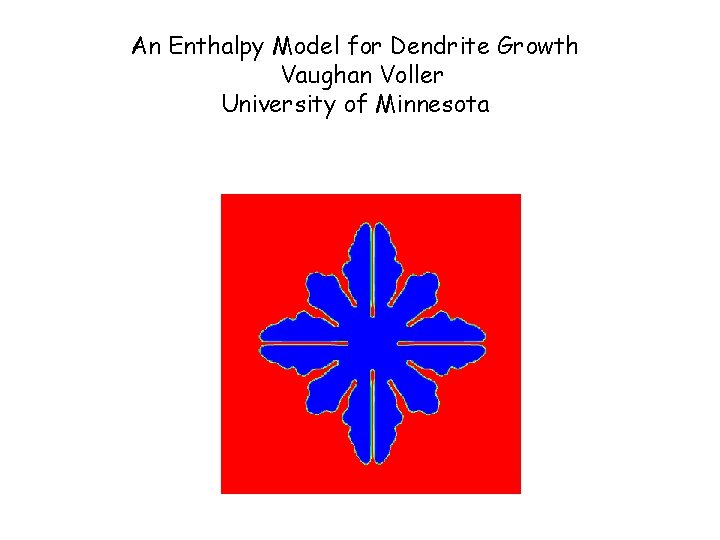
An Enthalpy Model for Dendrite Growth Vaughan Voller University of Minnesota
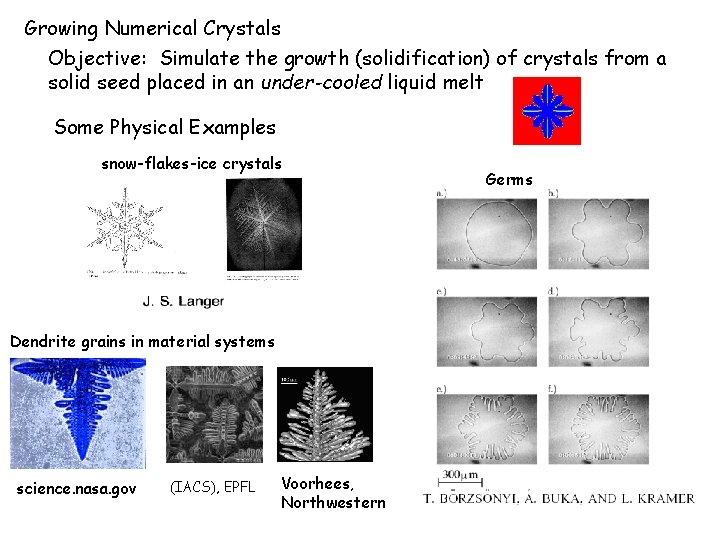
Growing Numerical Crystals Objective: Simulate the growth (solidification) of crystals from a solid seed placed in an under-cooled liquid melt Some Physical Examples snow-flakes-ice crystals Dendrite grains in material systems science. nasa. gov (IACS), EPFL Voorhees, Northwestern Germs
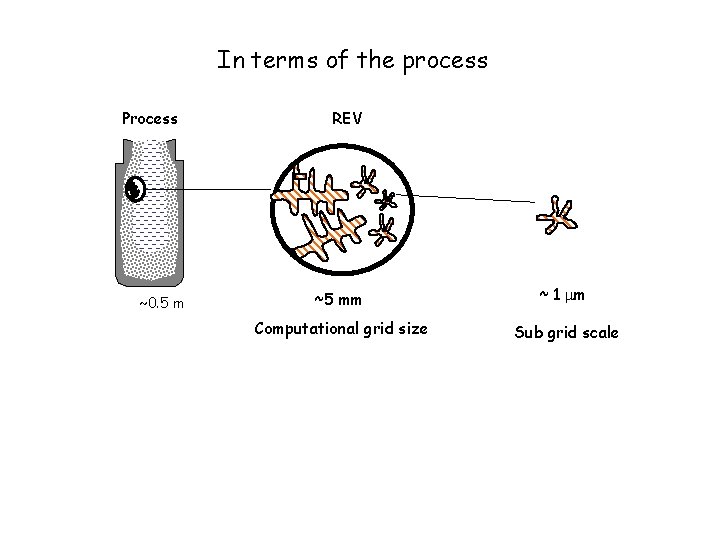
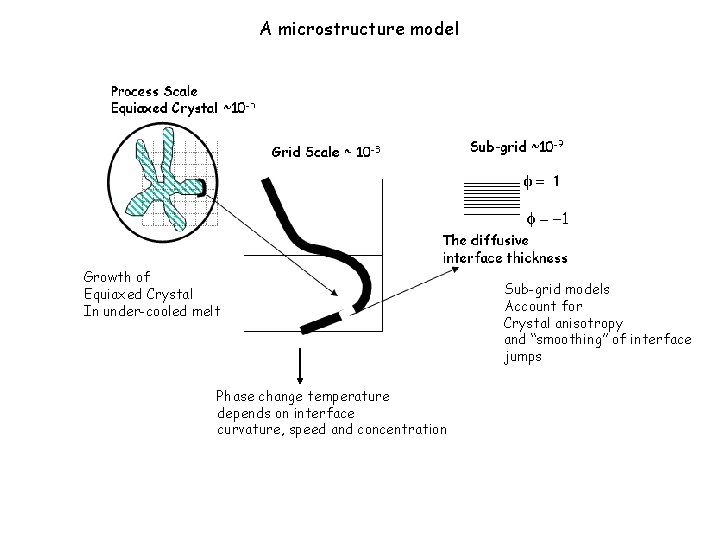
In terms of the process Process ~0. 5 m REV ~5 mm ~ 1 mm Computational grid size Sub grid scale
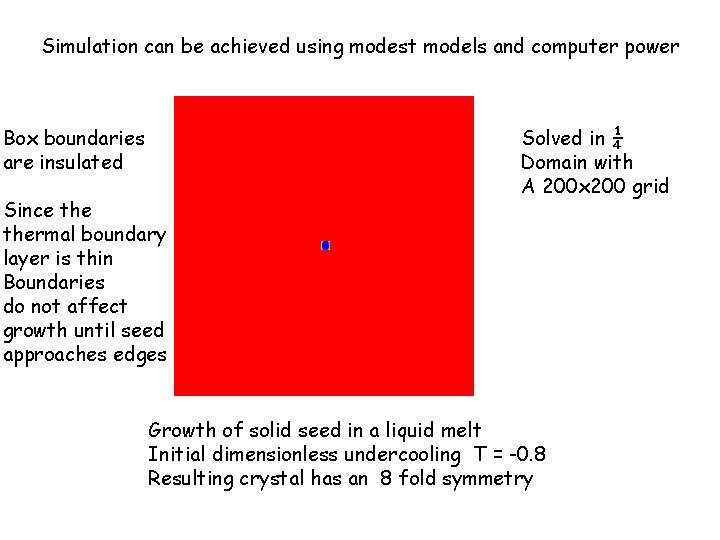
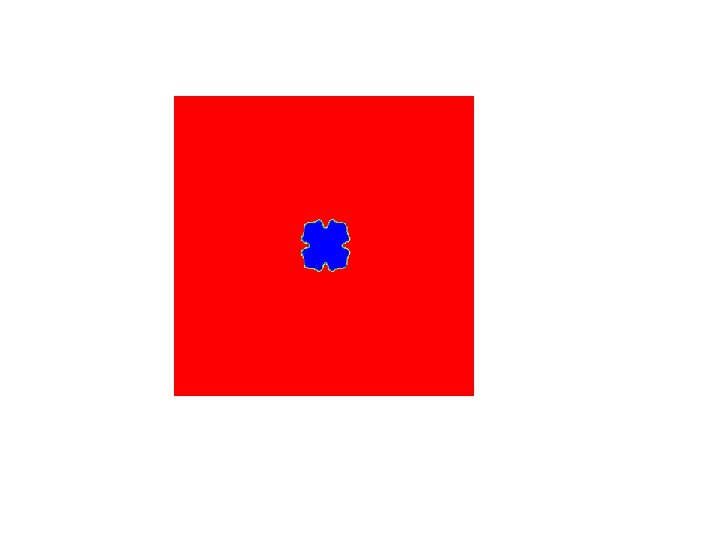
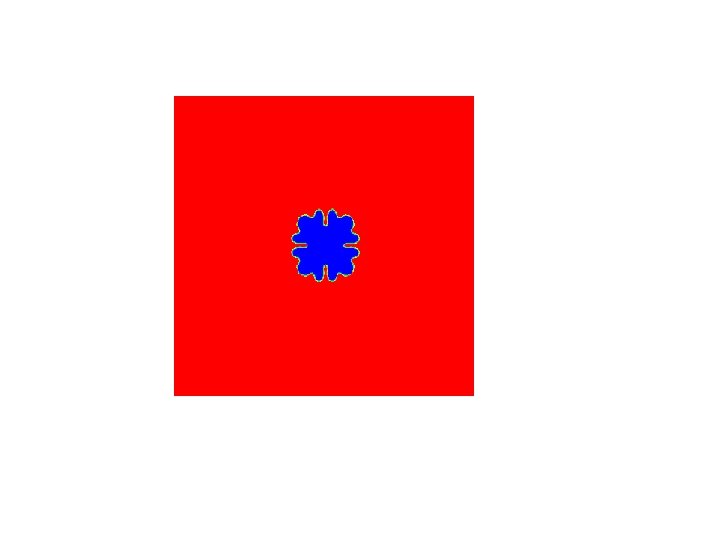
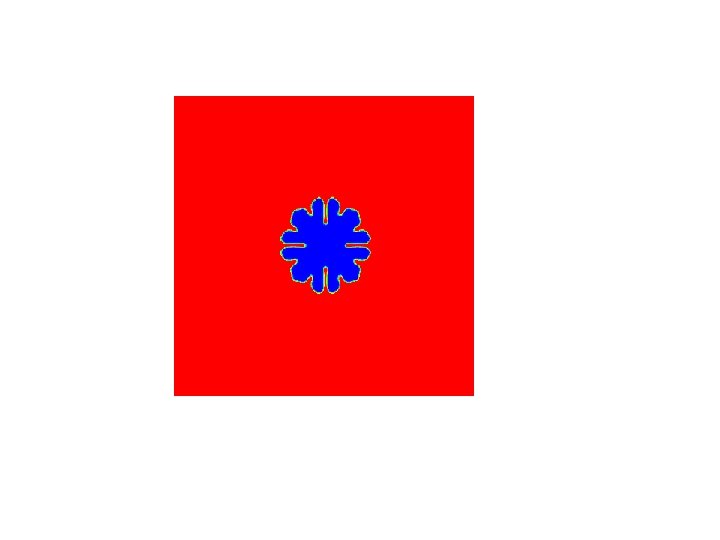
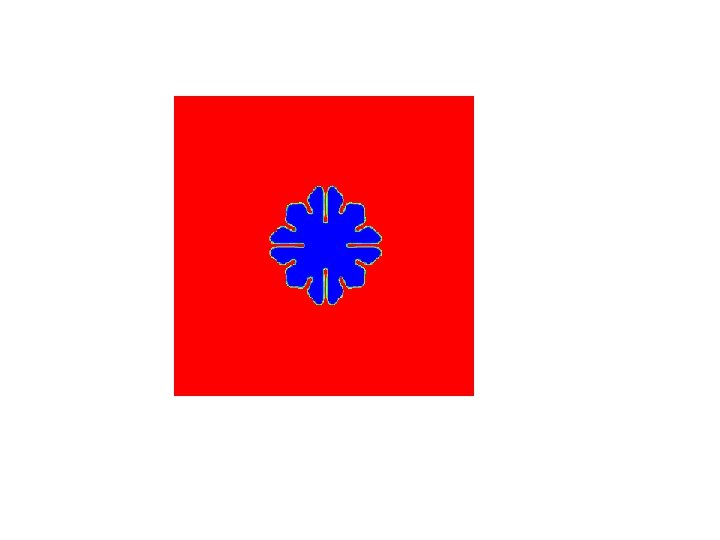
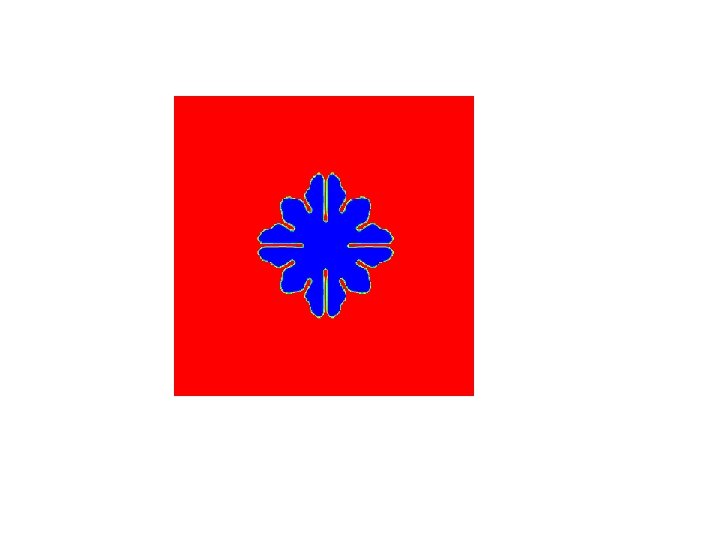
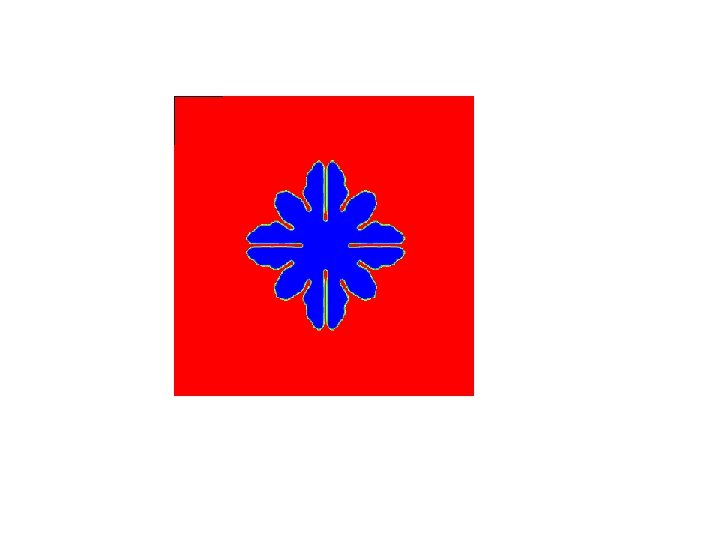
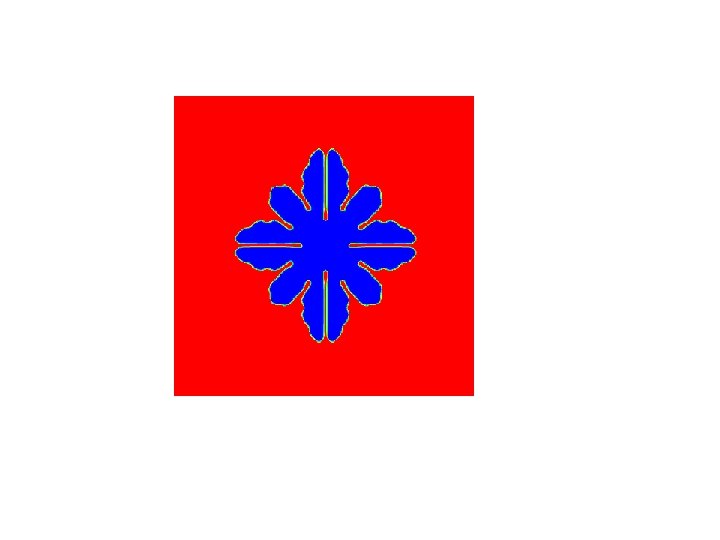
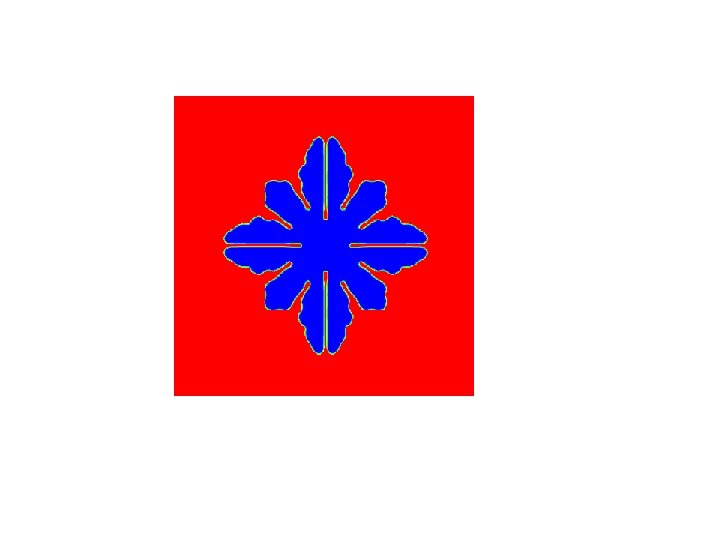
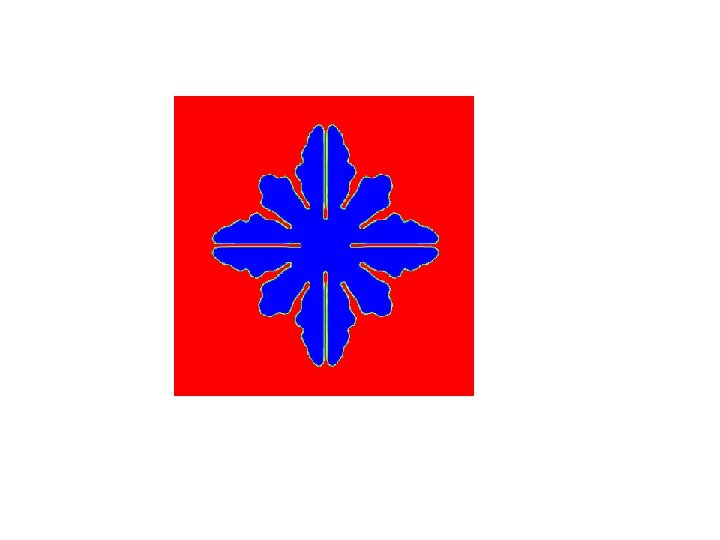
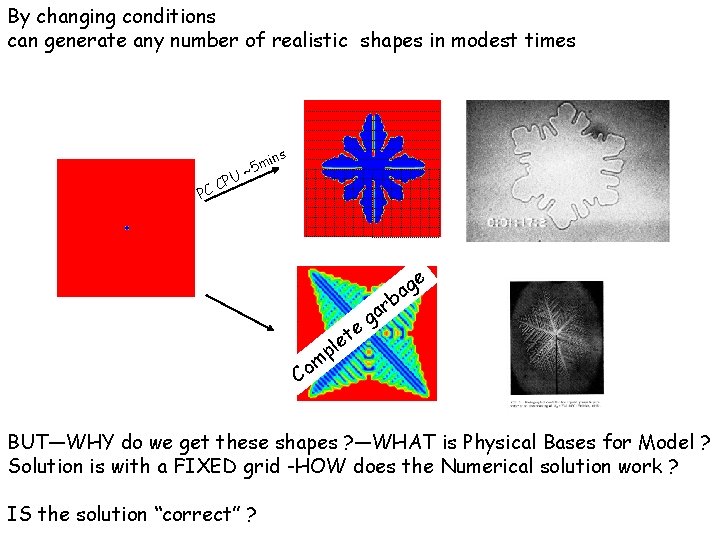
Simulation can be achieved using modest models and computer power Box boundaries are insulated Since thermal boundary layer is thin Boundaries do not affect growth until seed approaches edges Solved in ¼ Domain with A 200 x 200 grid Growth of solid seed in a liquid melt Initial dimensionless undercooling T = -0. 8 Resulting crystal has an 8 fold symmetry
By changing conditions can generate any number of realistic shapes in modest times s CPU C P min 5 ~ ge a b e t le p m Co r ga BUT—WHY do we get these shapes ? —WHAT is Physical Bases for Model ? Solution is with a FIXED grid -HOW does the Numerical solution work ? IS the solution “correct” ?
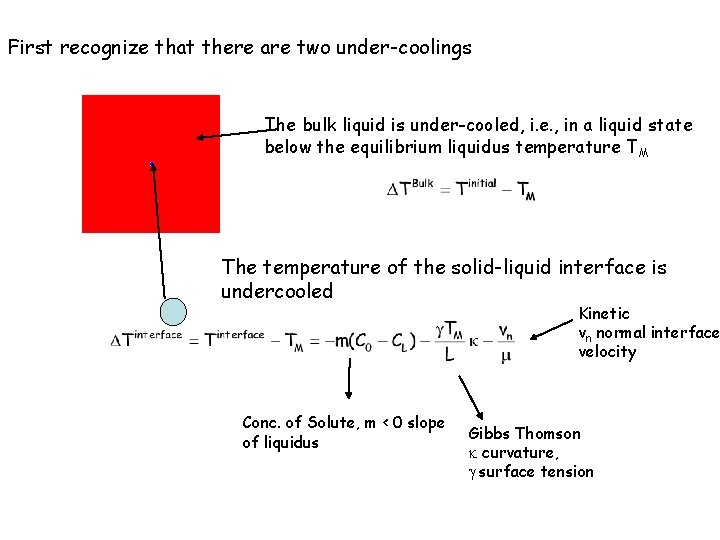
First recognize that there are two under-coolings The bulk liquid is under-cooled, i. e. , in a liquid state below the equilibrium liquidus temperature TM The temperature of the solid-liquid interface is undercooled Kinetic vn normal interface velocity Conc. of Solute, m < 0 slope of liquidus Gibbs Thomson k curvature, g surface tension
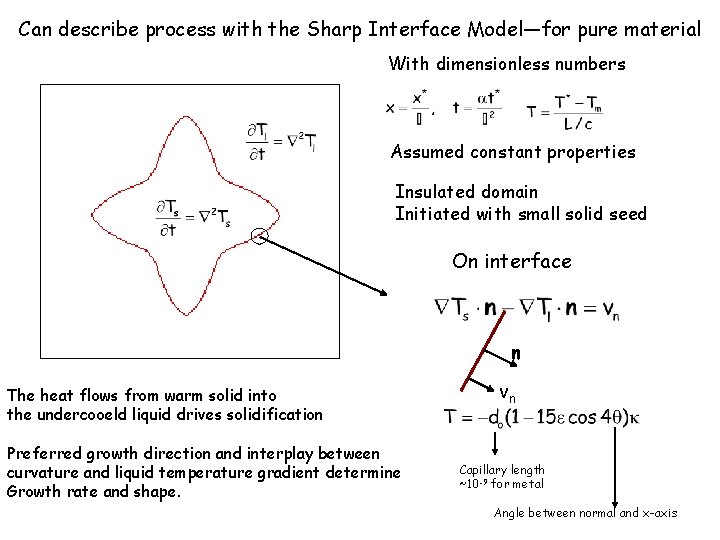
Can describe process with the Sharp Interface Model—for pure material With dimensionless numbers Assumed constant properties Insulated domain Initiated with small solid seed On interface n The heat flows from warm solid into the undercooeld liquid drives solidification Preferred growth direction and interplay between curvature and liquid temperature gradient determine Growth rate and shape. vn Capillary length ~10 -9 for metal Angle between normal and x-axis
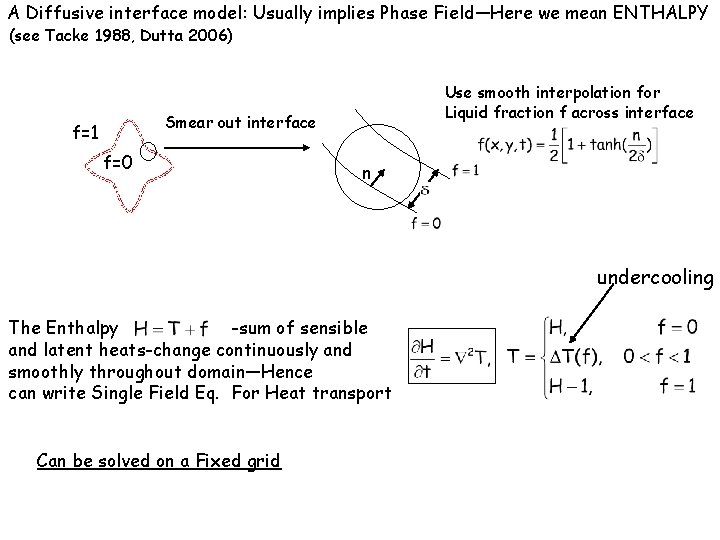
A Diffusive interface model: Usually implies Phase Field—Here we mean ENTHALPY (see Tacke 1988, Dutta 2006) Use smooth interpolation for Liquid fraction f across interface Smear out interface f=1 f=0 n undercooling The Enthalpy -sum of sensible and latent heats-change continuously and smoothly throughout domain—Hence can write Single Field Eq. For Heat transport Can be solved on a Fixed grid
A microstructure model Growth of Equiaxed Crystal In under-cooled melt Phase change temperature depends on interface curvature, speed and concentration Sub-grid models Account for Crystal anisotropy and “smoothing” of interface jumps
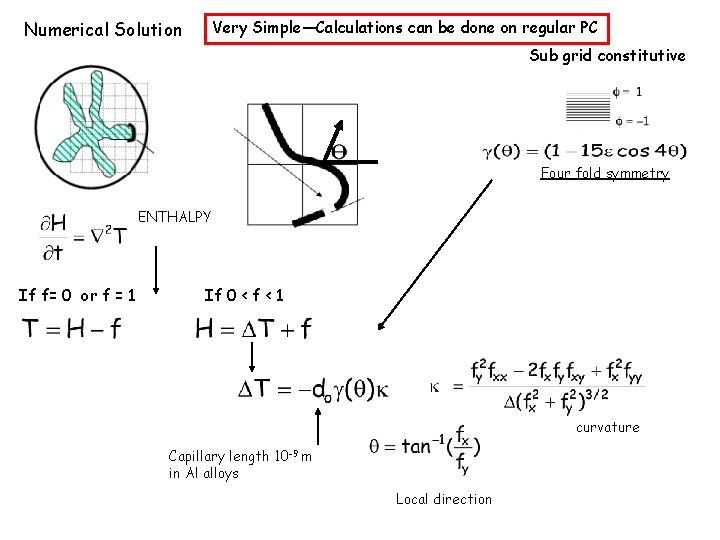
Very Simple—Calculations can be done on regular PC Numerical Solution Sub grid constitutive Four fold symmetry ENTHALPY If f= 0 or f = 1 If 0 < f < 1 curvature Capillary length 10 -9 m in Al alloys Local direction
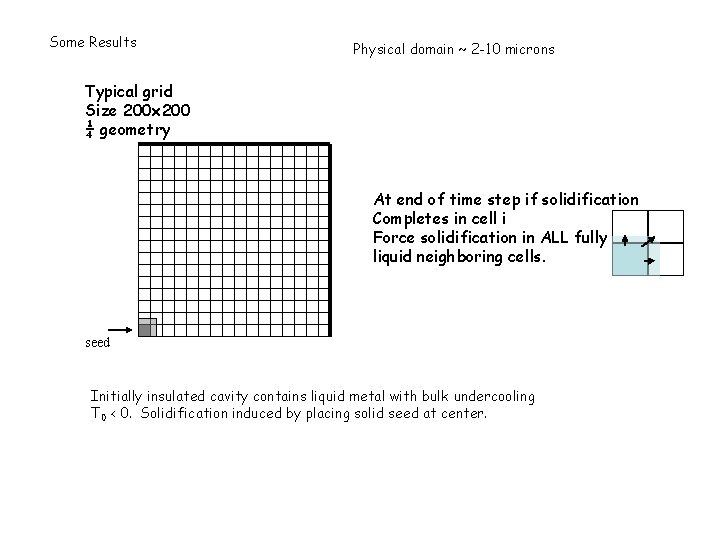
Some Results Physical domain ~ 2 -10 microns Typical grid Size 200 x 200 ¼ geometry At end of time step if solidification Completes in cell i Force solidification in ALL fully liquid neighboring cells. seed Initially insulated cavity contains liquid metal with bulk undercooling T 0 < 0. Solidification induced by placing solid seed at center.
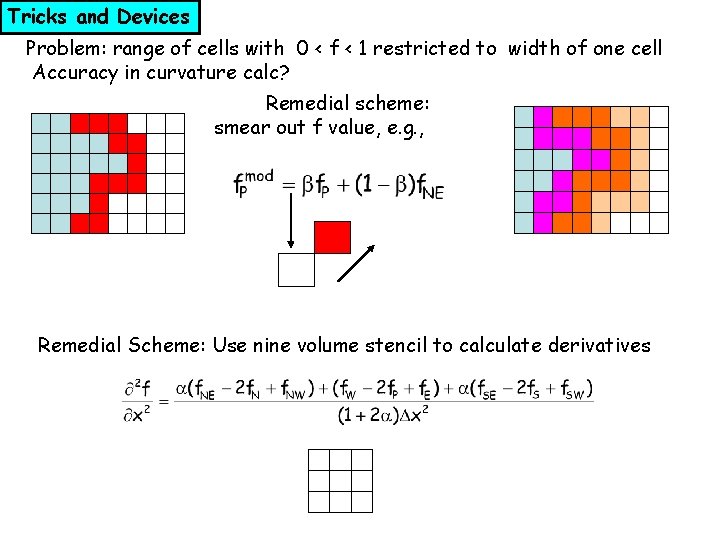
Tricks and Devices Problem: range of cells with 0 < f < 1 restricted to width of one cell Accuracy in curvature calc? Remedial scheme: smear out f value, e. g. , Remedial Scheme: Use nine volume stencil to calculate derivatives
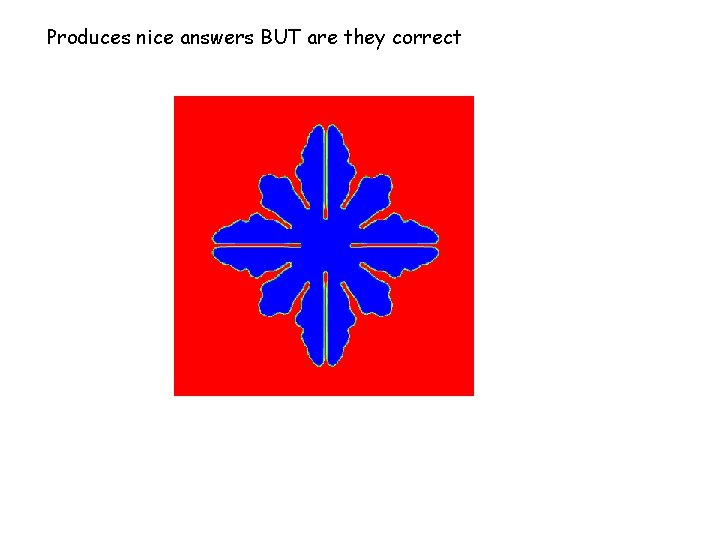
Produces nice answers BUT are they correct
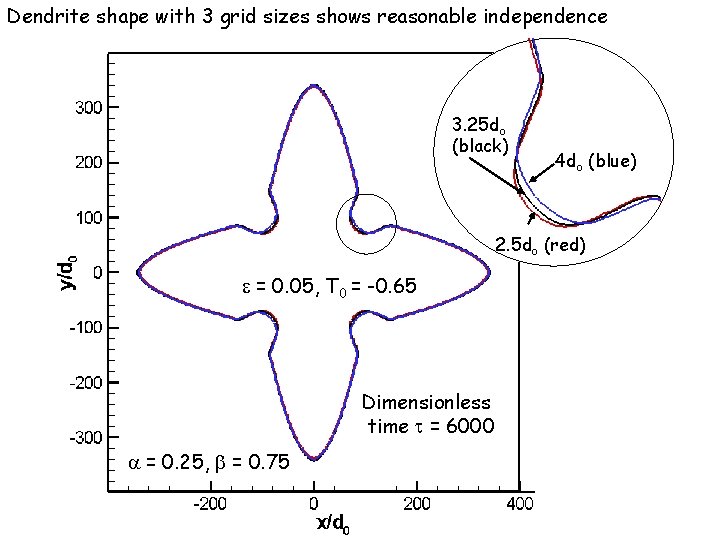
Dendrite shape with 3 grid sizes shows reasonable independence 3. 25 do (black) 4 do (blue) 2. 5 do (red) e = 0. 05, T 0 = -0. 65 Dimensionless time t = 6000 a = 0. 25, b = 0. 75
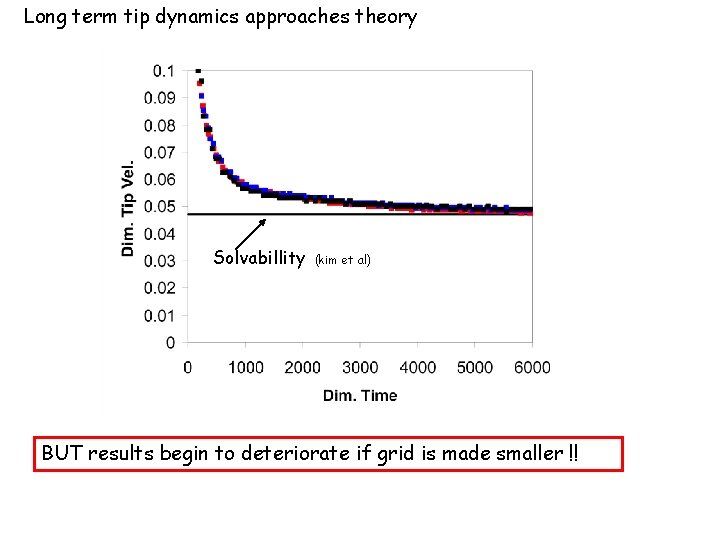
Long term tip dynamics approaches theory Solvabillity (kim et al) BUT results begin to deteriorate if grid is made smaller !!
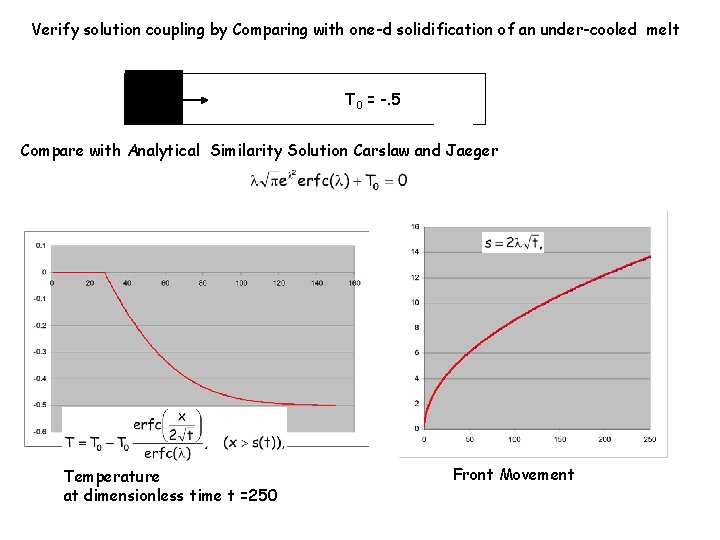
Verify solution coupling by Comparing with one-d solidification of an under-cooled melt T 0 = -. 5 Compare with Analytical Similarity Solution Carslaw and Jaeger Temperature at dimensionless time t =250 Front Movement
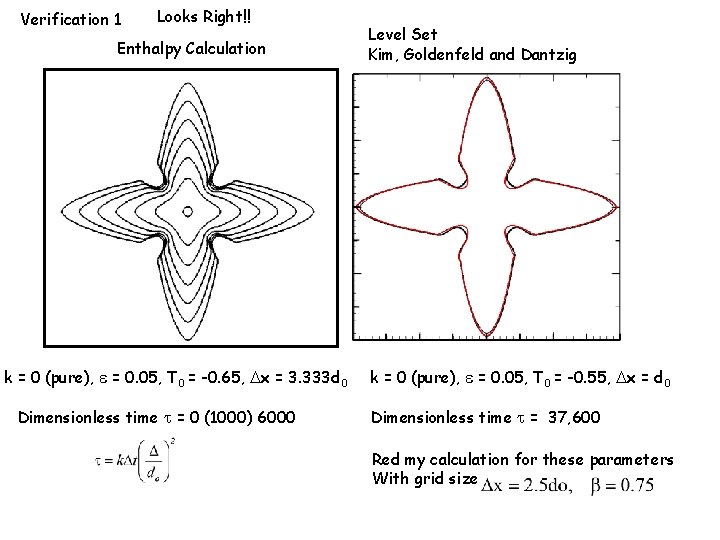
Verification 1 Looks Right!! Enthalpy Calculation k = 0 (pure), e = 0. 05, T 0 = -0. 65, Dx = 3. 333 d 0 Dimensionless time t = 0 (1000) 6000 Level Set Kim, Goldenfeld and Dantzig k = 0 (pure), e = 0. 05, T 0 = -0. 55, Dx = d 0 Dimensionless time t = 37, 600 Red my calculation for these parameters With grid size
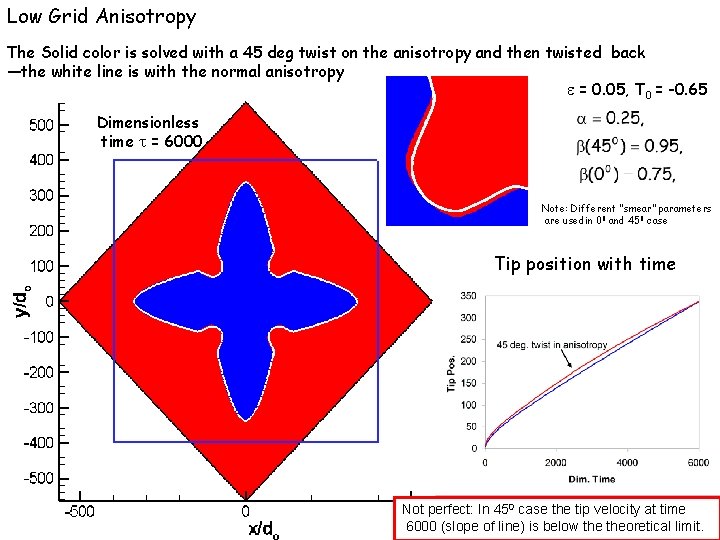
Low Grid Anisotropy The Solid color is solved with a 45 deg twist on the anisotropy and then twisted back —the white line is with the normal anisotropy e = 0. 05, T 0 = -0. 65 Dimensionless time t = 6000 Note: Different “smear” parameters are usedin 00 and 450 case Tip position with time Not perfect: In 450 case the tip velocity at time 6000 (slope of line) is below theoretical limit.
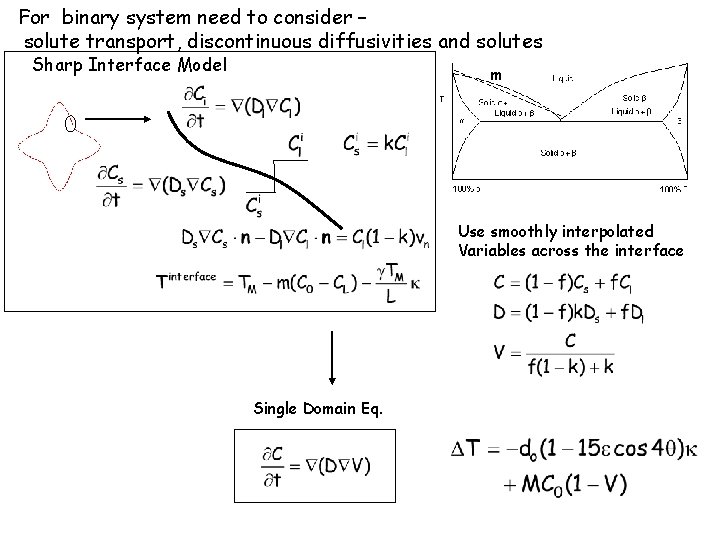
For binary system need to consider – solute transport, discontinuous diffusivities and solutes Sharp Interface Model m Use smoothly interpolated Variables across the interface Single Domain Eq.
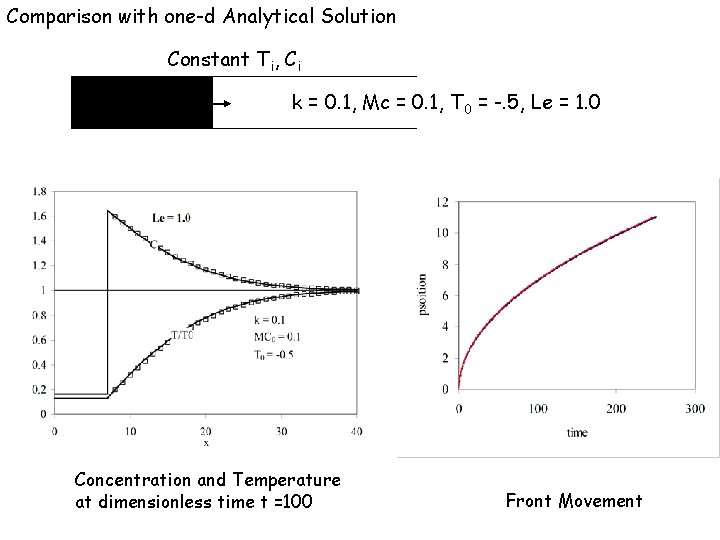
Comparison with one-d Analytical Solution Constant Ti, Ci k = 0. 1, Mc = 0. 1, T 0 = -. 5, Le = 1. 0 Concentration and Temperature at dimensionless time t =100 Front Movement
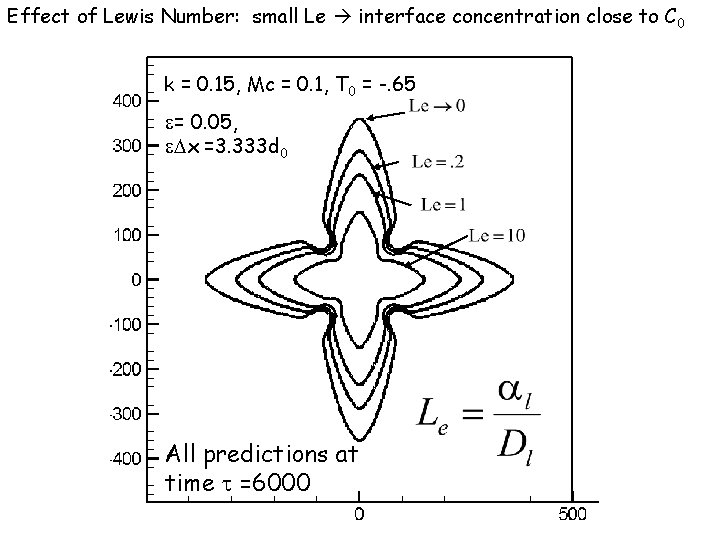
Effect of Lewis Number: small Le interface concentration close to C 0 k = 0. 15, Mc = 0. 1, T 0 = -. 65 e= 0. 05, e. Dx =3. 333 d 0 All predictions at time t =6000
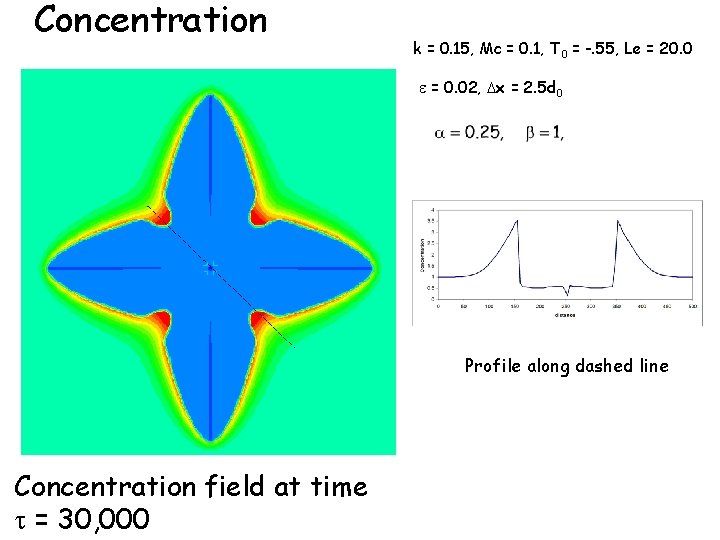
Concentration k = 0. 15, Mc = 0. 1, T 0 = -. 55, Le = 20. 0 e = 0. 02, Dx = 2. 5 d 0 Profile along dashed line Concentration field at time t = 30, 000
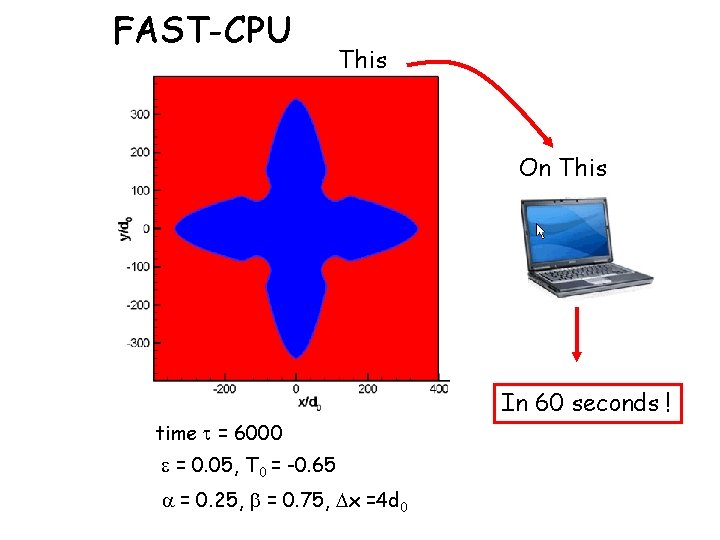
FAST-CPU This On This In 60 seconds ! time t = 6000 e = 0. 05, T 0 = -0. 65 a = 0. 25, b = 0. 75, Dx =4 d 0
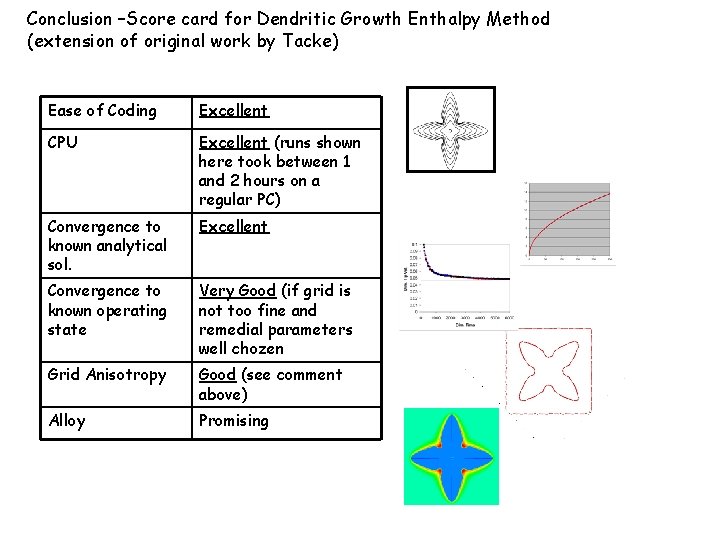
Conclusion –Score card for Dendritic Growth Enthalpy Method (extension of original work by Tacke) Ease of Coding Excellent CPU Excellent (runs shown here took between 1 and 2 hours on a regular PC) Convergence to known analytical sol. Excellent Convergence to known operating state Very Good (if grid is not too fine and remedial parameters well chozen Grid Anisotropy Good (see comment above) Alloy Promising
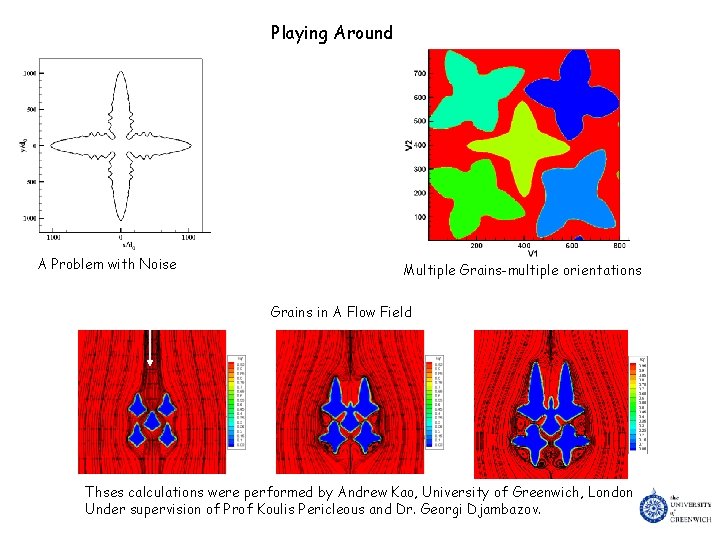
Playing Around A Problem with Noise Multiple Grains-multiple orientations Grains in A Flow Field Thses calculations were performed by Andrew Kao, University of Greenwich, London Under supervision of Prof Koulis Pericleous and Dr. Georgi Djambazov.
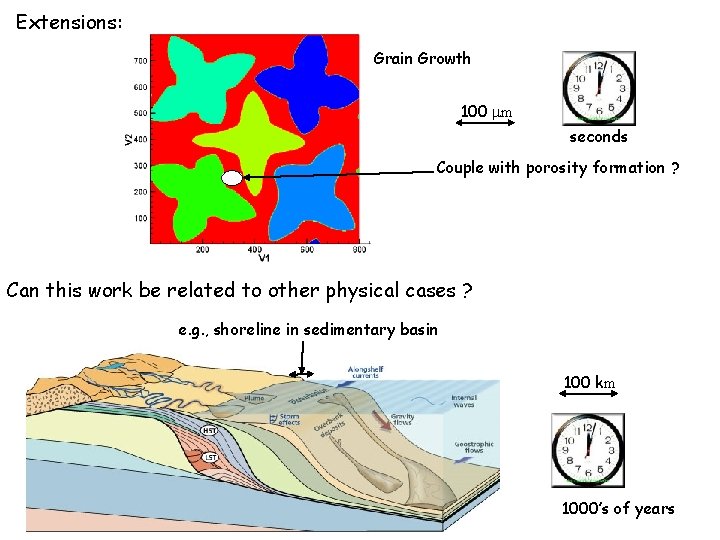
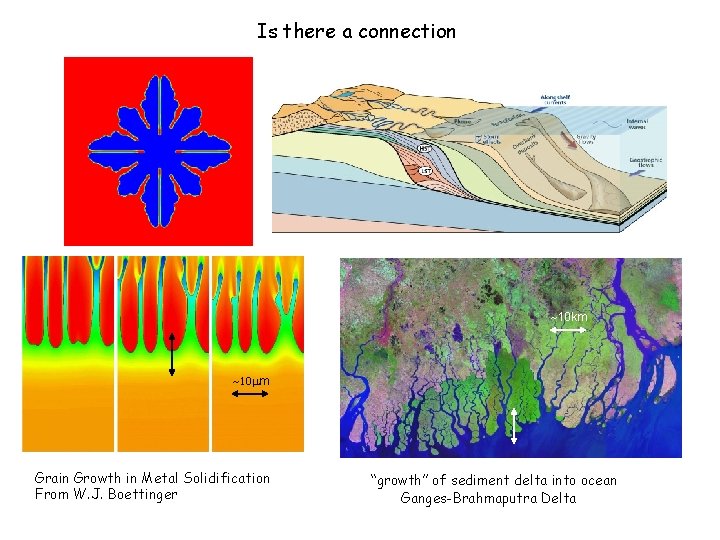
Extensions: Grain Growth 100 mm seconds Couple with porosity formation ? Can this work be related to other physical cases ? e. g. , shoreline in sedimentary basin 100 km 1000’s of years
NCED’s purpose: to catalyze development of an integrated, predictive science of the processes shaping the surface of the Earth, in order to transform management of ecosystems, resources, and land use The surface is the environment!
Who we are: 19 Principal Investigators at 9 institutions across the U. S. Research fields • • Geomorphology Hydrology Sedimentary geology Ecology Civil engineering Environmental economics Biogeochemistry Lead institution: University of Minnesota
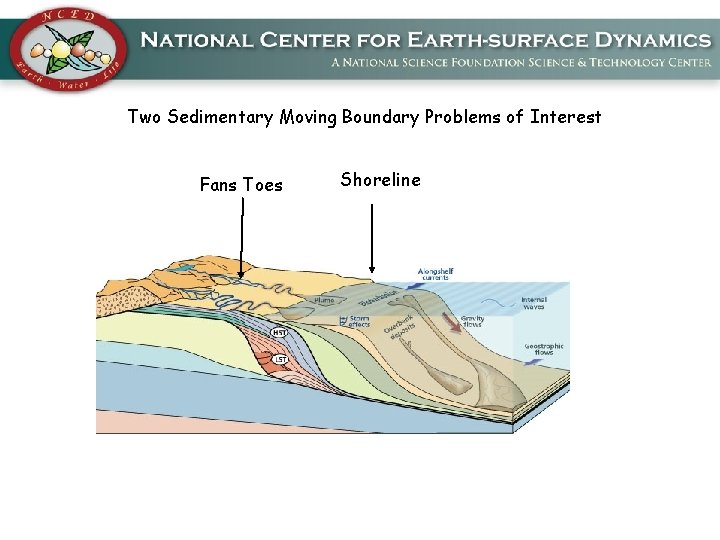
Moving Boundaries in Sediment Transport Two Sedimentary Moving Boundary Problems of Interest Fans Toes Shoreline
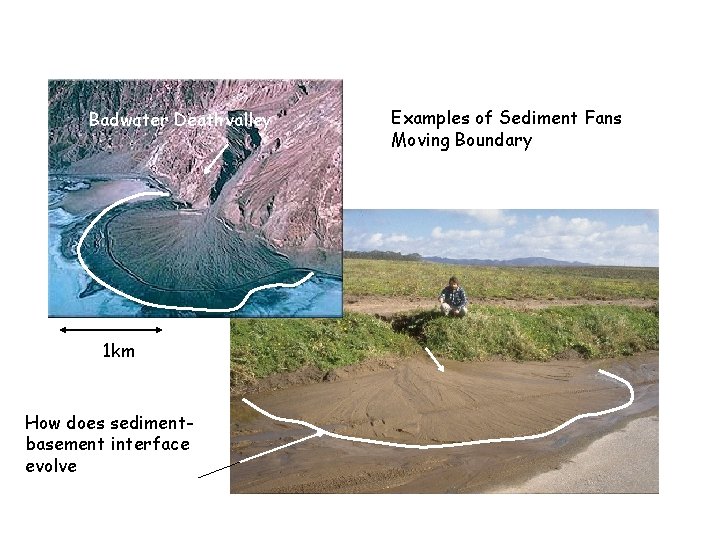
Badwater Deathvalley 1 km How does sedimentbasement interface evolve Examples of Sediment Fans Moving Boundary
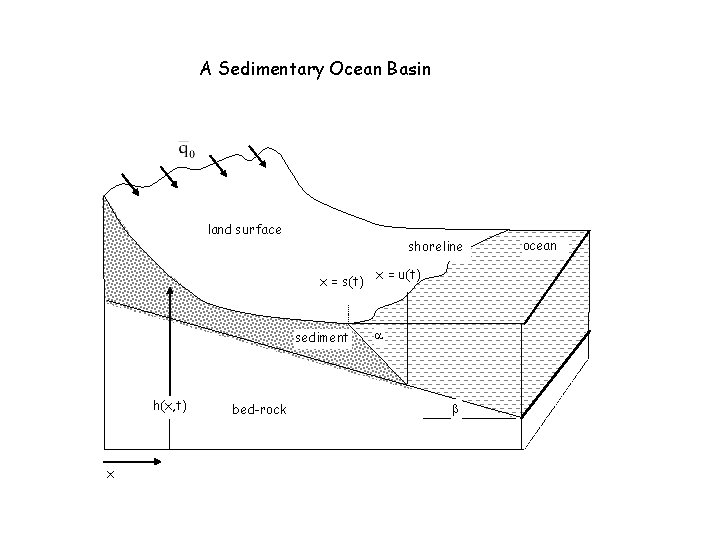
A Sedimentary Ocean Basin land surface shoreline x = s(t) sediment h(x, t) x bed-rock x = u(t) a b ocean
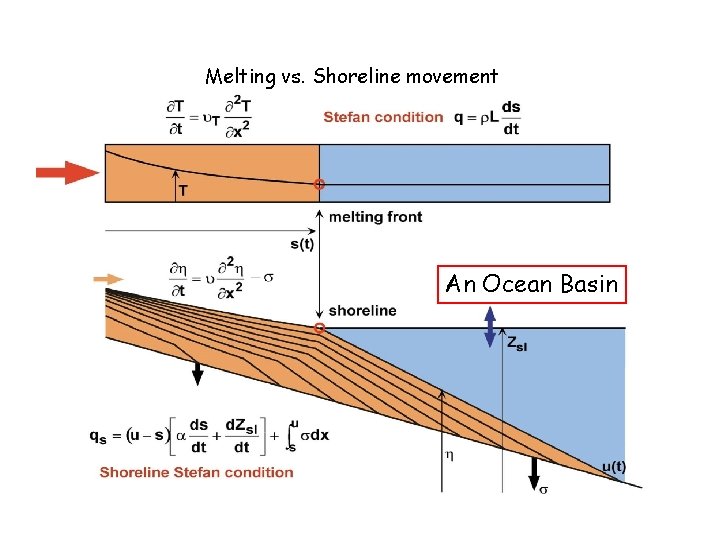
Melting vs. Shoreline movement An Ocean Basin
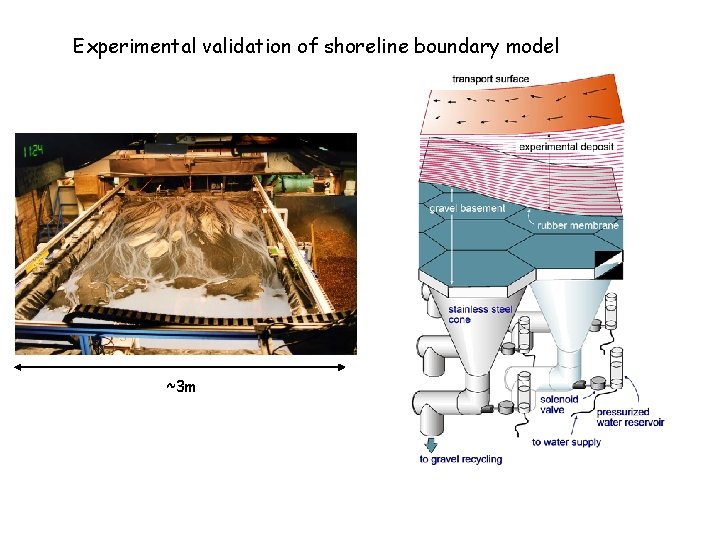
Experimental validation of shoreline boundary model ~3 m
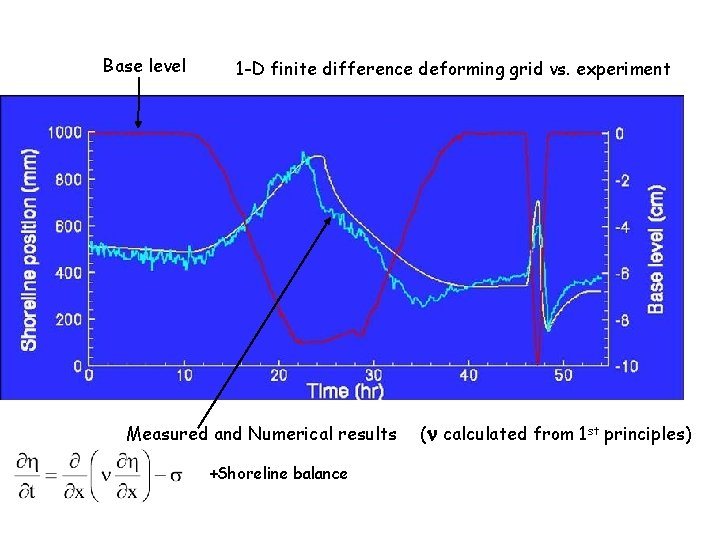
Base level 1 -D finite difference deforming grid vs. experiment Measured and Numerical results +Shoreline balance (n calculated from 1 st principles)
Is there a connection ~10 km ~10 mm Grain Growth in Metal Solidification From W. J. Boettinger “growth” of sediment delta into ocean Ganges-Brahmaputra Delta