
An Embedding Approach to Anomaly Detection Renjun Hu

An Embedding Approach to Anomaly Detection Renjun Hu 1, Charu Aggarwal 2, Shuai Ma 1, and Jinpeng Huai 1 1 SKLSDE Lab, Beihang University, China 2 IBM T. J. Watson Research Center, USA 1
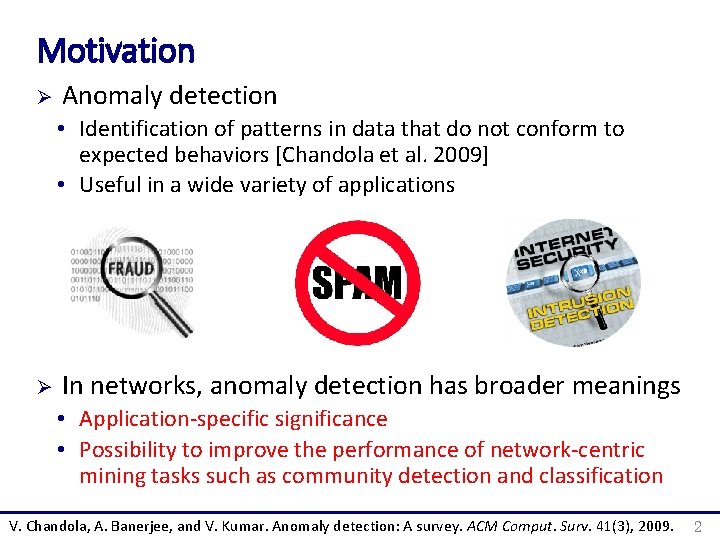
Motivation Ø Anomaly detection • Identification of patterns in data that do not conform to expected behaviors [Chandola et al. 2009] • Useful in a wide variety of applications Ø In networks, anomaly detection has broader meanings • Application-specific significance • Possibility to improve the performance of network-centric mining tasks such as community detection and classification V. Chandola, A. Banerjee, and V. Kumar. Anomaly detection: A survey. ACM Comput. Surv. 41(3), 2009. 2
![Motivation Ø Structural hole theory [Burt 1992, 2004] • Theory of social capital •](http://slidetodoc.com/presentation_image/4b710f9f2058ae17dfcf87c89b12dcb2/image-3.jpg "Motivation Ø Structural hole theory [Burt 1992, 2004] • Theory of social capital •")
Motivation Ø Structural hole theory [Burt 1992, 2004] • Theory of social capital • A structural hole is a gap between two nodes who have complementary sources to information Prof. Ronald S. Burt u How to detect social brokers? A formal quantitative definition is needed in the first place! v • Node A (social broker) is more likely to get novel information than B, even though they have the same number of links. Burt, Ronald S. (1992). Structural holes: the social structure of competition. Harvard University Press. Burt, Ronald S. (2004). Structural Holes and Good Ideas. American Journal of Sociology 110 (2): 349– 399. 3
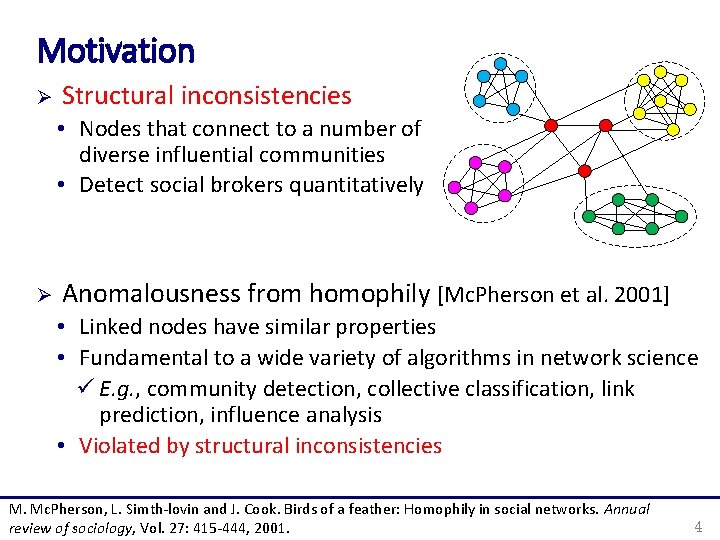
Motivation Ø Structural inconsistencies • Nodes that connect to a number of diverse influential communities • Detect social brokers quantitatively Ø Anomalousness from homophily [Mc. Pherson et al. 2001] • Linked nodes have similar properties • Fundamental to a wide variety of algorithms in network science ü E. g. , community detection, collective classification, link prediction, influence analysis • Violated by structural inconsistencies M. Mc. Pherson, L. Simth-lovin and J. Cook. Birds of a feather: Homophily in social networks. Annual review of sociology, Vol. 27: 415 -444, 2001. 4
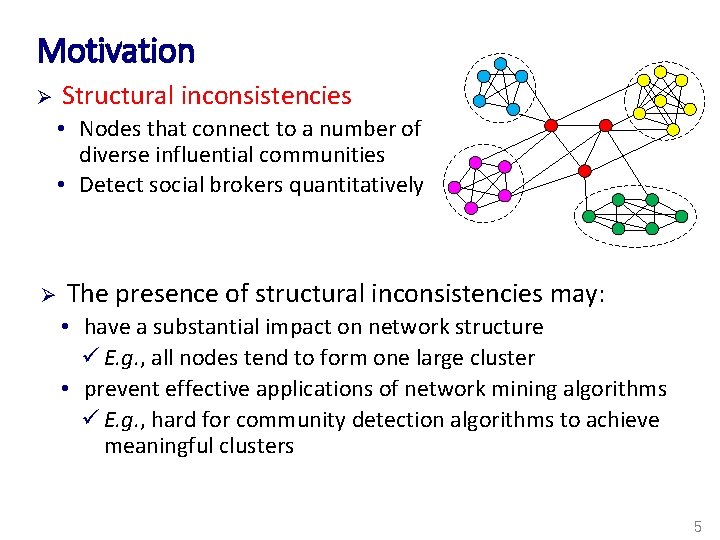
Motivation Structural inconsistencies Ø • Nodes that connect to a number of diverse influential communities • Detect social brokers quantitatively Ø The presence of structural inconsistencies may: • have a substantial impact on network structure ü E. g. , all nodes tend to form one large cluster • prevent effective applications of network mining algorithms ü E. g. , hard for community detection algorithms to achieve meaningful clusters 5
Outline Ø Anomaly detection model • Graph embedding • A quantitative measure of anomaly Ø Algorithm optimization techniques Ø Evaluation 6
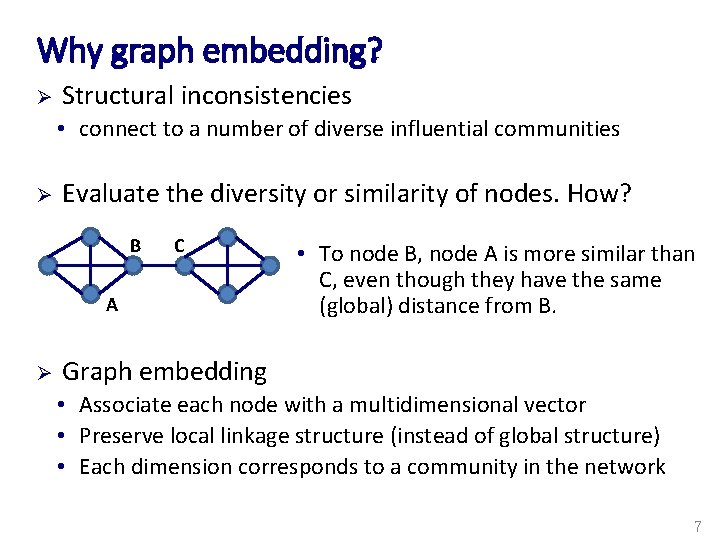
Why graph embedding? Ø Structural inconsistencies • connect to a number of diverse influential communities Ø Evaluate the diversity or similarity of nodes. How? B C A Ø • To node B, node A is more similar than C, even though they have the same (global) distance from B. Graph embedding • Associate each node with a multidimensional vector • Preserve local linkage structure (instead of global structure) • Each dimension corresponds to a community in the network 7
Why graph embedding? Ø Structural inconsistencies • connect to a number of diverse influential communities Ø An alternative option: doing community detection followed by anomaly detection • Do not distinguish anomalies from normal nodes • The presence of anomalies has certain impacts on the results of community detection • Community detection is a heavy task. • Fail to detect structural inconsistencies! 8

Graph embedding Ø Given an undirected graph G=(V, E), associate each node i with a d-dimensional vector Xi • V = {1, 2, …, n} • d : number of communities • Xi : correlation between node i and the d communities A reasonable selection of d suffices for anomaly detection. Not necessary to use the number of real-life communities. 9
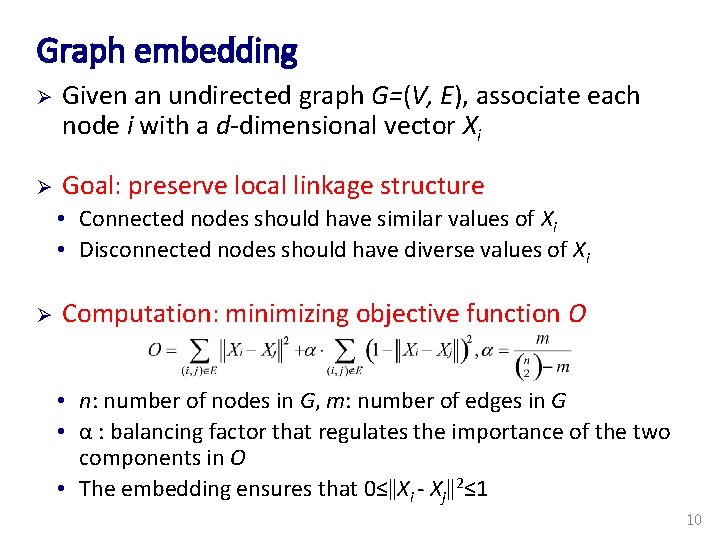
Graph embedding Ø Given an undirected graph G=(V, E), associate each node i with a d-dimensional vector Xi Ø Goal: preserve local linkage structure • Connected nodes should have similar values of Xi • Disconnected nodes should have diverse values of Xi Ø Computation: minimizing objective function O • n: number of nodes in G, m: number of edges in G • α : balancing factor that regulates the importance of the two components in O • The embedding ensures that 0≤‖Xi - Xj‖ 2≤ 1 10
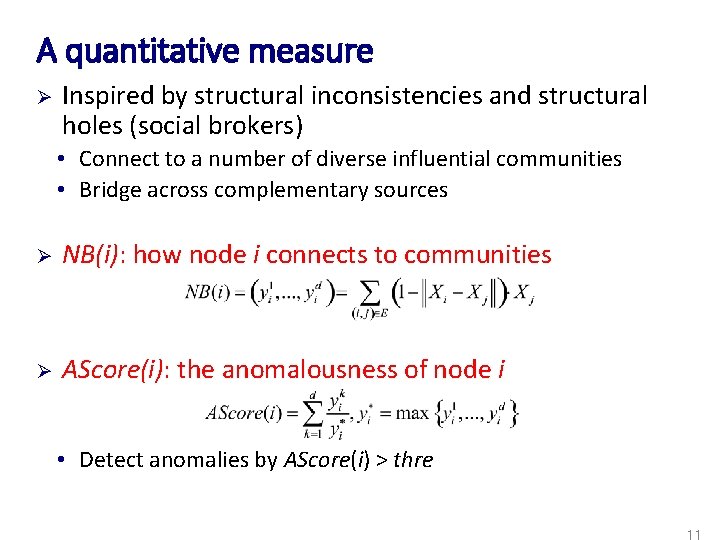
A quantitative measure Ø Inspired by structural inconsistencies and structural holes (social brokers) • Connect to a number of diverse influential communities • Bridge across complementary sources Ø NB(i): how node i connects to communities Ø AScore(i): the anomalousness of node i • Detect anomalies by AScore(i) > thre
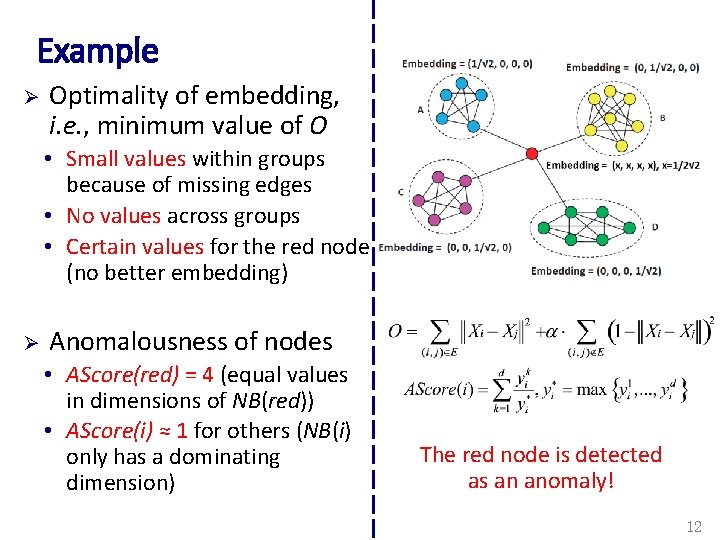
Example Ø Optimality of embedding, i. e. , minimum value of O • Small values within groups because of missing edges • No values across groups • Certain values for the red node (no better embedding) Ø Anomalousness of nodes • AScore(red) = 4 (equal values in dimensions of NB(red)) • AScore(i) ≈ 1 for others (NB(i) only has a dominating dimension) The red node is detected as an anomaly! 12
Outline Ø Anomaly detection model Ø Algorithm optimization techniques • Sampling • Graph partitioning based initialization • Dimension reduction Ø Evaluation 13
Issues in the model Ø Objective function O is a sum over O(n 2) terms • Forbidden in large social networks Ø Optimizing O uses a gradient descent method • Critically dependent on a good initialization Ø Dimensionality of embedding (i. e. , d) could be large • E. g. , 8, 353 for You. Tube and 6, 288, 363 for Orkut [Yang & Leskovec 2012] J. Yang and J. Leskovec. Defining and evaluation network communities based on ground-truth. In ICDM, 14 2012.

Sampling Ø Objective function O is a sum over O(n 2) terms Ø Observation: balancing factor α is close to 0 • Very inefficient • Possible to approximately represent O by sampling Ø Sampled objective function O • |Es| = |E| = m 15
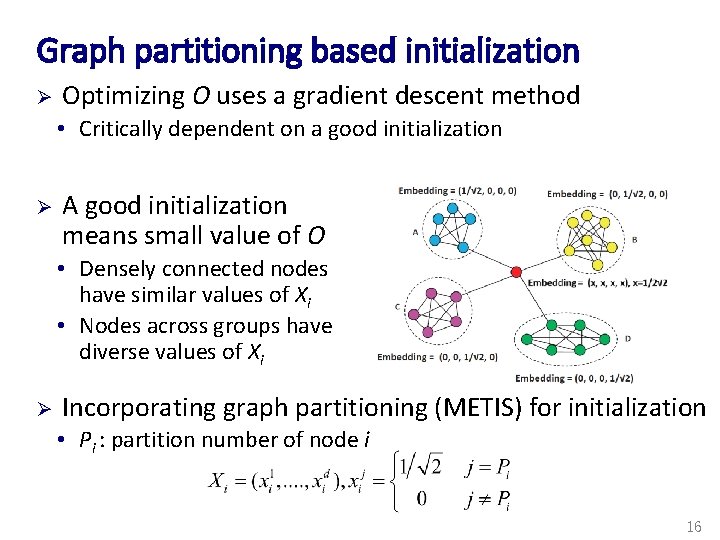
Graph partitioning based initialization Ø Optimizing O uses a gradient descent method • Critically dependent on a good initialization Ø A good initialization means small value of O • Densely connected nodes have similar values of Xi • Nodes across groups have diverse values of Xi Ø Incorporating graph partitioning (METIS) for initialization • Pi : partition number of node i 16
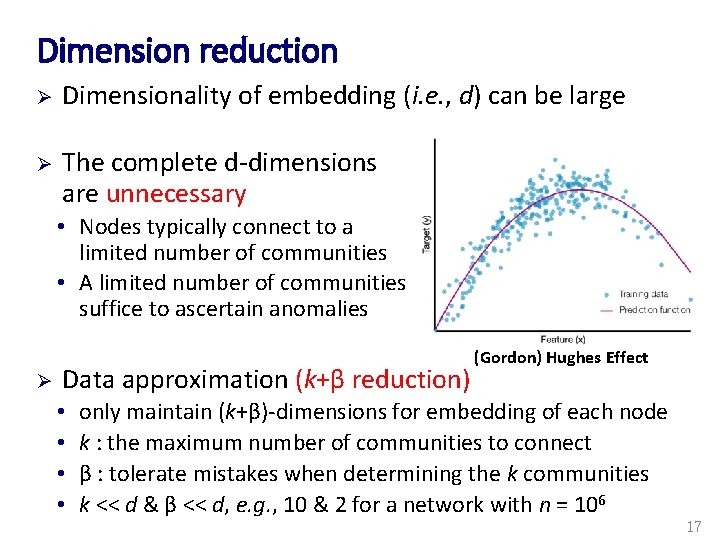
Dimension reduction Ø Dimensionality of embedding (i. e. , d) can be large Ø The complete d-dimensions are unnecessary • Nodes typically connect to a limited number of communities • A limited number of communities suffice to ascertain anomalies (Gordon) Hughes Effect Ø Data approximation (k+β reduction) • • only maintain (k+β)-dimensions for embedding of each node k : the maximum number of communities to connect β : tolerate mistakes when determining the k communities k << d & β << d, e. g. , 10 & 2 for a network with n = 106 17
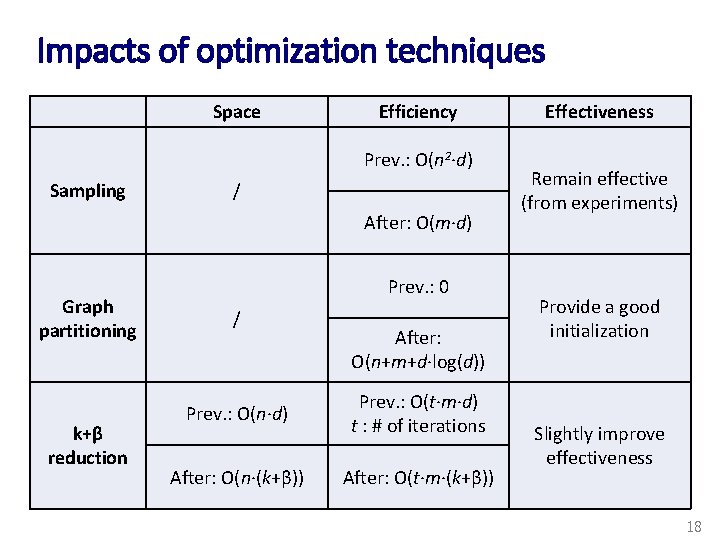
Impacts of optimization techniques Space Efficiency Prev. : O(n 2∙d) Sampling / After: O(m∙d) Graph partitioning k+β reduction Prev. : 0 / After: O(n+m+d∙log(d)) Prev. : O(n∙d) Prev. : O(t∙m∙d) t : # of iterations After: O(n∙(k+β)) After: O(t∙m∙(k+β)) Effectiveness Remain effective (from experiments) Provide a good initialization Slightly improve effectiveness 18
Outline Ø Anomaly detection model Ø Algorithm optimizations Ø Evaluation 19
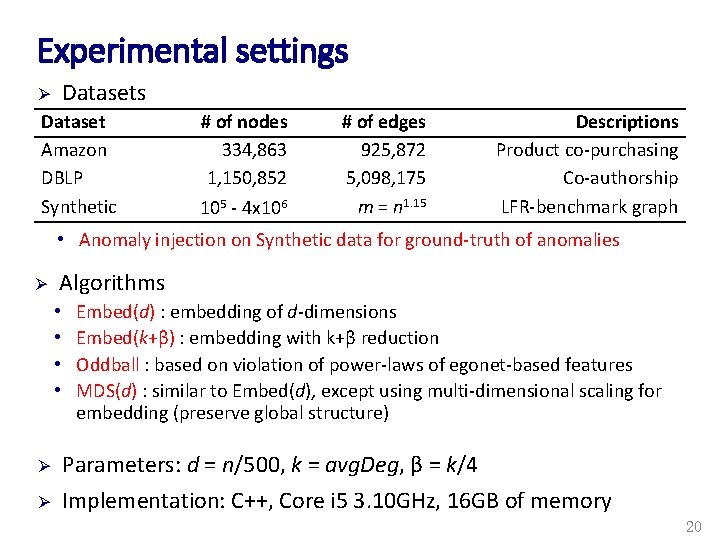
Experimental settings Datasets Ø Dataset Amazon DBLP Synthetic # of nodes 334, 863 1, 150, 852 105 - 4 x 10⁶ # of edges 925, 872 5, 098, 175 m = n 1. 15 Descriptions Product co-purchasing Co-authorship LFR-benchmark graph • Anomaly injection on Synthetic data for ground-truth of anomalies Ø Algorithms • • Ø Ø Embed(d) : embedding of d-dimensions Embed(k+β) : embedding with k+β reduction Oddball : based on violation of power-laws of egonet-based features MDS(d) : similar to Embed(d), except using multi-dimensional scaling for embedding (preserve global structure) Parameters: d = n/500, k = avg. Deg, β = k/4 Implementation: C++, Core i 5 3. 10 GHz, 16 GB of memory 20

Case study on DBLP Ø Different people with the same name Wei Wang • 84 people named Wei Wang [DBLP, May 10 2016] • University of Waterloo (Canada), Fudan University (China), University of California, San Diego (USA), etc. Ø People with many collaborators in diverse institutes Dr. Ajith Abraham • Director of intelligence research labs which has members from more than 100 countries • Work in a multi-disciplinary environment involving machine intelligence, cyber security, sensor networks and data mining • Teach in 23 universities all over the world 21
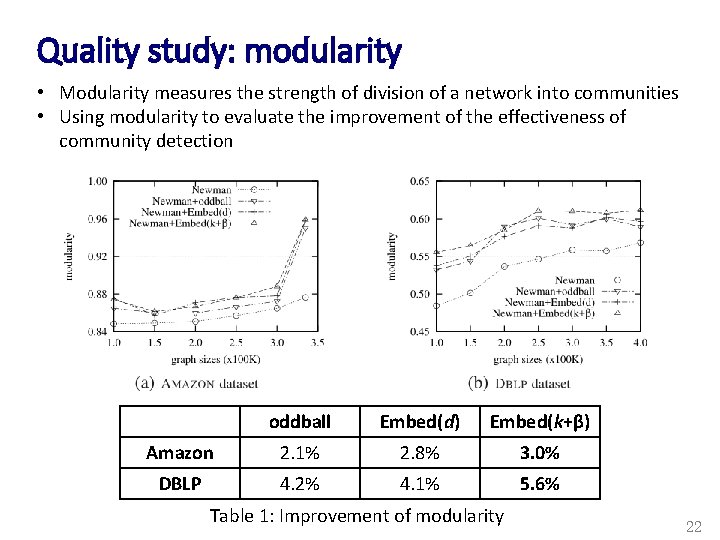
Quality study: modularity • Modularity measures the strength of division of a network into communities • Using modularity to evaluate the improvement of the effectiveness of community detection oddball Embed(d) Embed(k+β) Amazon 2. 1% 2. 8% 3. 0% DBLP 4. 2% 4. 1% 5. 6% Table 1: Improvement of modularity 22
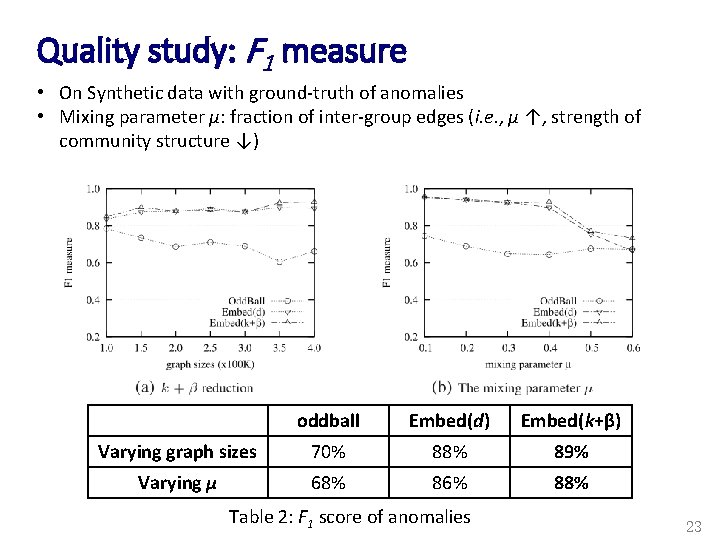
Quality study: F 1 measure • On Synthetic data with ground-truth of anomalies • Mixing parameter μ: fraction of inter-group edges (i. e. , μ ↑, strength of community structure ↓) oddball Embed(d) Embed(k+β) Varying graph sizes 70% 88% 89% Varying μ 68% 86% 88% Table 2: F 1 score of anomalies 23
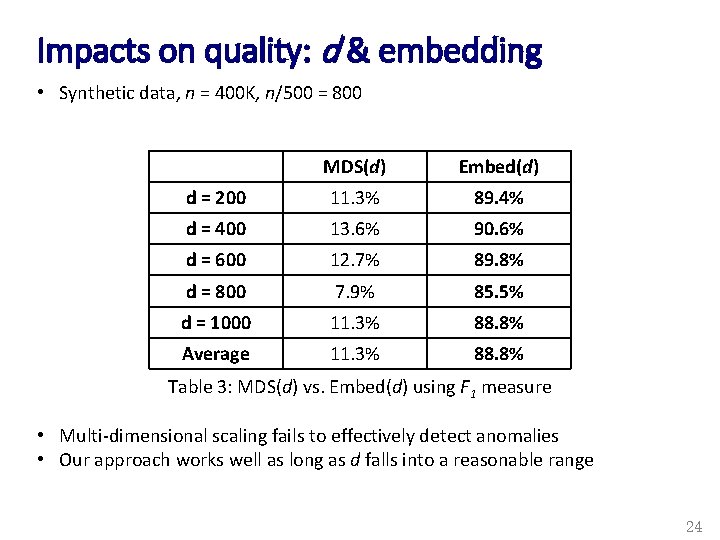
Impacts on quality: d & embedding • Synthetic data, n = 400 K, n/500 = 800 MDS(d) Embed(d) d = 200 11. 3% 89. 4% d = 400 13. 6% 90. 6% d = 600 12. 7% 89. 8% d = 800 7. 9% 85. 5% d = 1000 11. 3% 88. 8% Average 11. 3% 88. 8% Table 3: MDS(d) vs. Embed(d) using F 1 measure • Multi-dimensional scaling fails to effectively detect anomalies • Our approach works well as long as d falls into a reasonable range 24
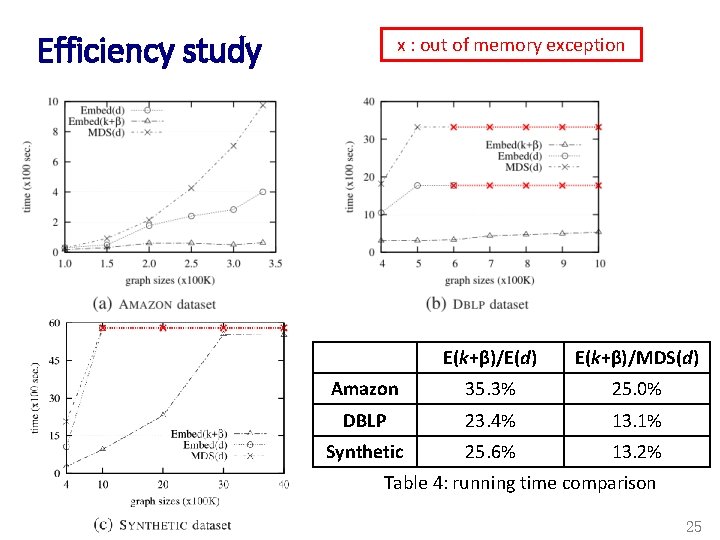
Efficiency study x : out of memory exception E(k+β)/E(d) E(k+β)/MDS(d) Amazon 35. 3% 25. 0% DBLP 23. 4% 13. 1% Synthetic 25. 6% 13. 2% Table 4: running time comparison 25
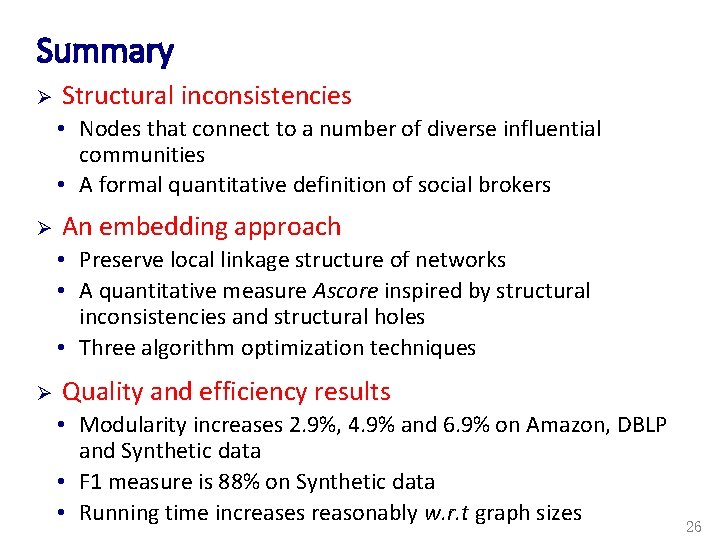
Summary Ø Structural inconsistencies • Nodes that connect to a number of diverse influential communities • A formal quantitative definition of social brokers Ø An embedding approach • Preserve local linkage structure of networks • A quantitative measure Ascore inspired by structural inconsistencies and structural holes • Three algorithm optimization techniques Ø Quality and efficiency results • Modularity increases 2. 9%, 4. 9% and 6. 9% on Amazon, DBLP and Synthetic data • F 1 measure is 88% on Synthetic data • Running time increases reasonably w. r. t graph sizes 26

Thanks! Q&A 27
- Slides: 27