
An Embedded Design Example A Thorax Simulator for
An Embedded Design Example: A Thorax Simulator for Testing and Calibration of Impedance Cardiographs by P. C. Pandey EE Dept. , IIT Bombay December 2008
Presentation Overview pcpandey@ee. iitb. ac. in ▪ Introduction ▪ Thorax simulator model ▪ Simulator circuit : embedded design ▪ Results ▪ Conclusion Intro. Thorax simulator Simulator circuit Results & con. 2/19
Introduction 1/6 1. Introduction To embed To fix firmly in the surrounding mass or environment. System pcpandey@ee. iitb. ac. in A set of connected things or parts that form a whole or work together. A set of rules, practices, or principles forming a philosophy or government A method of classification, notation, or measurement. Embedded Electronic System with a strong coupling with its surroundings Very tight coupling between I/O, data processing, memory · Generally real-time processing and control Intro. Thorax simulator Simulator circuit Results & con. 3/19
Embedded System H/W Introduction 2/6 Chip count minimization High reliability Compact size Power management Embedded System S/W Modest ROM and RAM, often no secondary storage Single or limited number of application programs Design pcpandey@ee. iitb. ac. in A plan of detailed steps or drawings for making something Problem specification Conceptualization of parts and interconnections (h/w and s/w partitioning) Simulation Construction or Assembly Testing and Result Analysis Preparation of Design Document Intro. Thorax simulator Simulator circuit Results & con. 4/19
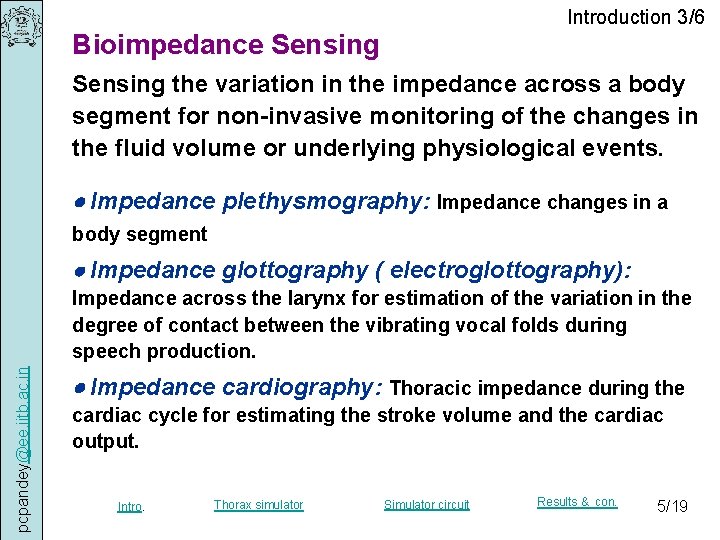
Introduction 3/6 Bioimpedance Sensing the variation in the impedance across a body segment for non-invasive monitoring of the changes in the fluid volume or underlying physiological events. Impedance plethysmography: Impedance changes in a body segment Impedance glottography ( electroglottography): pcpandey@ee. iitb. ac. in Impedance across the larynx for estimation of the variation in the degree of contact between the vibrating vocal folds during speech production. Impedance cardiography: Thoracic impedance during the cardiac cycle for estimating the stroke volume and the cardiac output. Intro. Thorax simulator Simulator circuit Results & con. 5/19
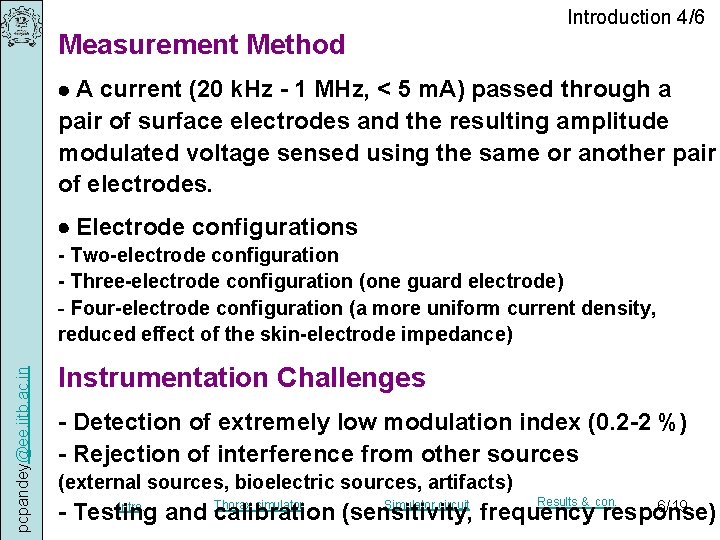
Introduction 4/6 Measurement Method A current (20 k. Hz - 1 MHz, < 5 m. A) passed through a pair of surface electrodes and the resulting amplitude modulated voltage sensed using the same or another pair of electrodes. Electrode configurations pcpandey@ee. iitb. ac. in - Two-electrode configuration - Three-electrode configuration (one guard electrode) - Four-electrode configuration (a more uniform current density, reduced effect of the skin-electrode impedance) Instrumentation Challenges - Detection of extremely low modulation index (0. 2 -2 %) - Rejection of interference from other sources (external sources, bioelectric sources, artifacts) Results & con. Simulator circuit Thorax simulator Intro. 6/19 - Testing and calibration (sensitivity, frequency response)

Introduction 5/6 pcpandey@ee. iitb. ac. in Impedance Cardiograph Impedance detector • Voltage sense amplifier • Demodulator • Drift cancellation circuit Intro. Thorax simulator Simulator circuit Results & con. 7/19
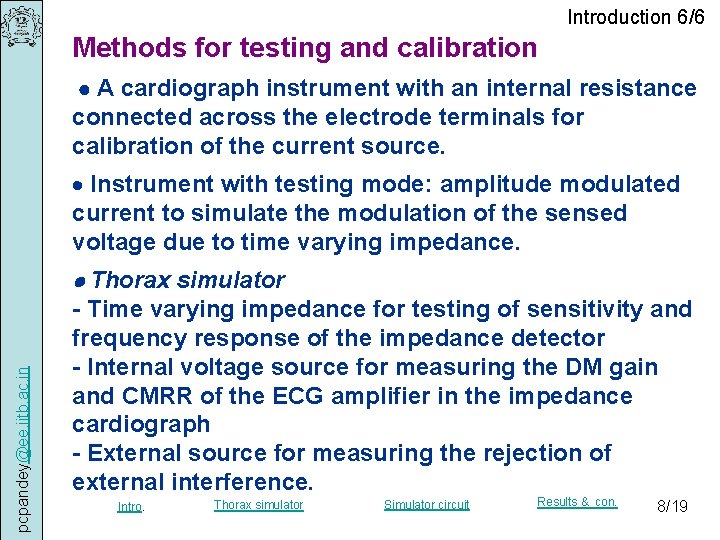
Introduction 6/6 Methods for testing and calibration A cardiograph instrument with an internal resistance connected across the electrode terminals for calibration of the current source. · Instrument with testing mode: amplitude modulated current to simulate the modulation of the sensed voltage due to time varying impedance. pcpandey@ee. iitb. ac. in Thorax simulator - Time varying impedance for testing of sensitivity and frequency response of the impedance detector - Internal voltage source for measuring the DM gain and CMRR of the ECG amplifier in the impedance cardiograph - External source for measuring the rejection of external interference. Intro. Thorax simulator Simulator circuit Results & con. 8/19
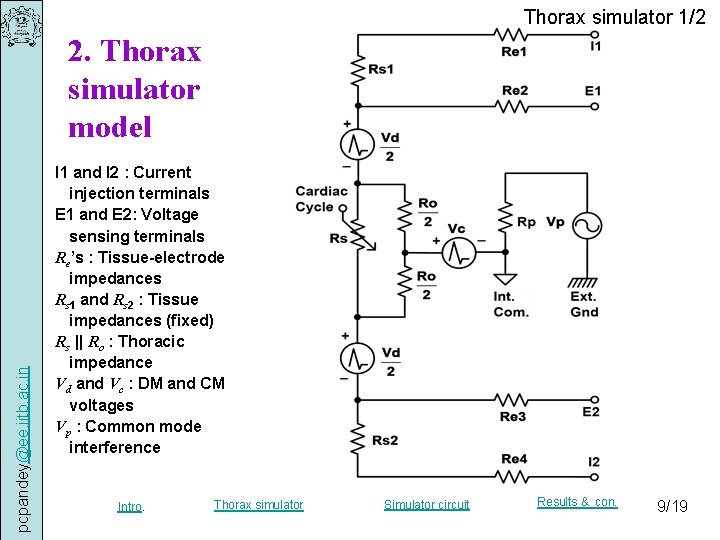
Thorax simulator 1/2 pcpandey@ee. iitb. ac. in 2. Thorax simulator model I 1 and I 2 : Current injection terminals E 1 and E 2: Voltage sensing terminals Re’s : Tissue-electrode impedances Rs 1 and Rs 2 : Tissue impedances (fixed) Rs || Ro : Thoracic impedance Vd and Vc : DM and CM voltages Vp : Common mode interference Intro. Thorax simulator Simulator circuit Results & con. 9/19
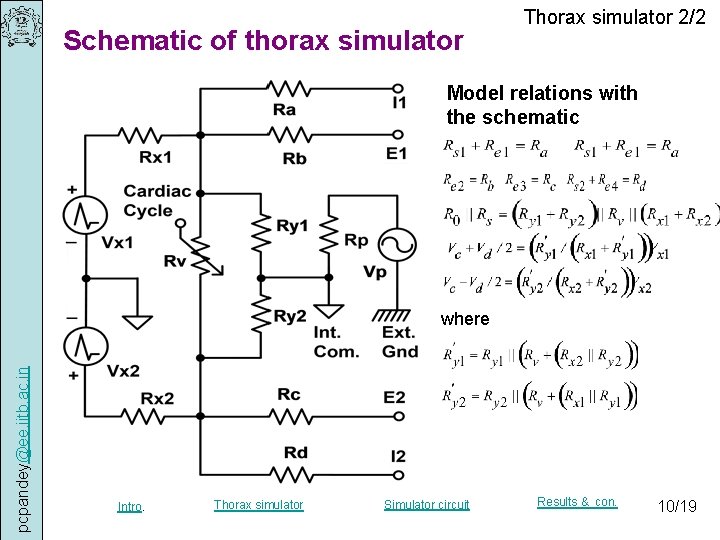
Schematic of thorax simulator Thorax simulator 2/2 Model relations with the schematic pcpandey@ee. iitb. ac. in where Intro. Thorax simulator Simulator circuit Results & con. 10/19
Simulator circuit 1/6 3. Simulator Circuit : Embedded Design Desired Features ● Parameter selection without wiring related pick-ups ● Operation with single supply voltage pcpandey@ee. iitb. ac. in Realization of Thorax Simulator ● Impedance variation using digital potentiometer ● ECG (DM and CM) using two digital potentiometers ● Parameter selection and waveform generation by microcontroller ● Split power supply for analog circuit Intro. Thorax simulator Simulator circuit Results & con. 11/19
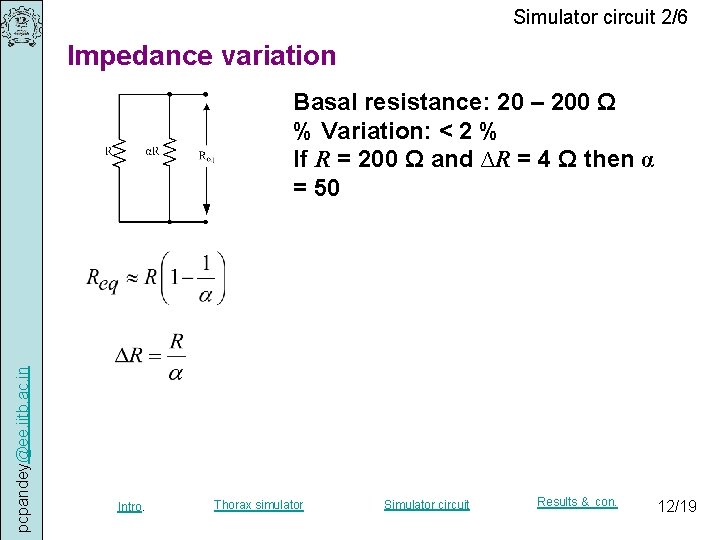
Simulator circuit 2/6 Impedance variation pcpandey@ee. iitb. ac. in Basal resistance: 20 – 200 Ω % Variation: < 2 % If R = 200 Ω and ∆R = 4 Ω then α = 50 Intro. Thorax simulator Simulator circuit Results & con. 12/19
Simulator circuit 3/6 pcpandey@ee. iitb. ac. in Thorax simulator circuit Intro. Thorax simulator Simulator circuit Results & con. 13/19
Simulator circuit 4/6 pcpandey@ee. iitb. ac. in The controller and power supply circuit Intro. Thorax simulator Simulator circuit Results & con. 14/19
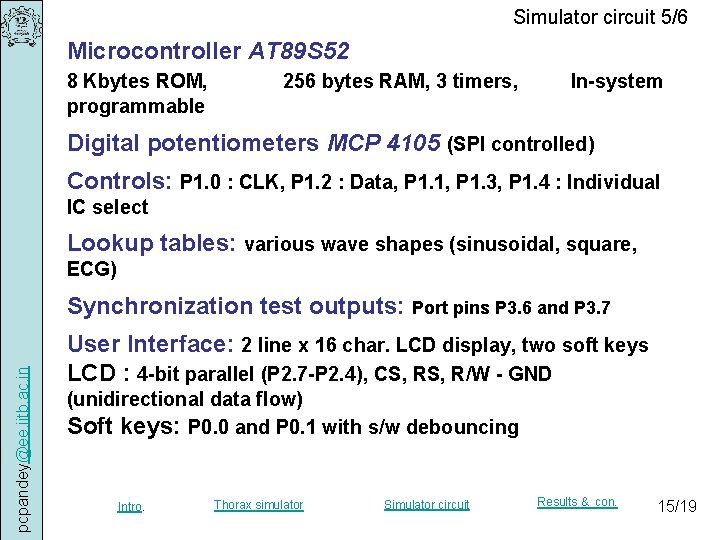
Simulator circuit 5/6 Microcontroller AT 89 S 52 8 Kbytes ROM, programmable 256 bytes RAM, 3 timers, In-system Digital potentiometers MCP 4105 (SPI controlled) Controls: P 1. 0 : CLK, P 1. 2 : Data, P 1. 1, P 1. 3, P 1. 4 : Individual IC select Lookup tables: various wave shapes (sinusoidal, square, ECG) pcpandey@ee. iitb. ac. in Synchronization test outputs: Port pins P 3. 6 and P 3. 7 User Interface: 2 line x 16 char. LCD display, two soft keys LCD : 4 -bit parallel (P 2. 7 -P 2. 4), CS, R/W - GND (unidirectional data flow) Soft keys: P 0. 0 and P 0. 1 with s/w debouncing Intro. Thorax simulator Simulator circuit Results & con. 15/19
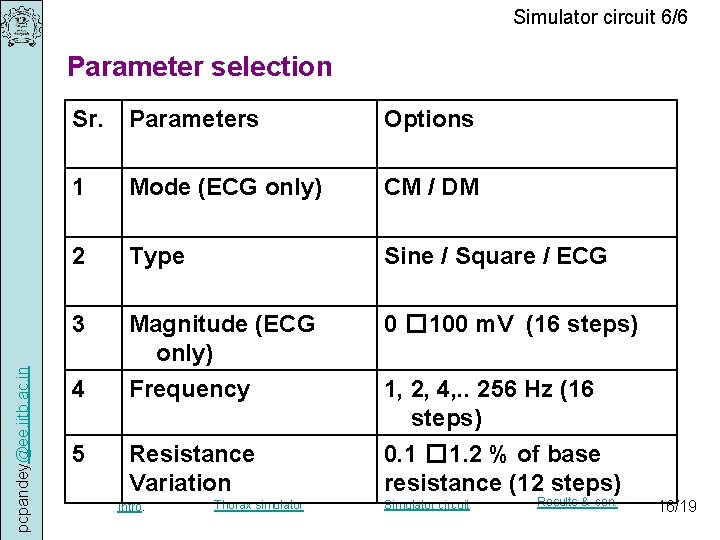
Simulator circuit 6/6 pcpandey@ee. iitb. ac. in Parameter selection Sr. Parameters Options 1 Mode (ECG only) CM / DM 2 Type Sine / Square / ECG 3 Magnitude (ECG only) Frequency 0 � 100 m. V (16 steps) 4 5 Resistance Variation Intro. Thorax simulator 1, 2, 4, . . 256 Hz (16 steps) 0. 1 � 1. 2 % of base resistance (12 steps) Simulator circuit Results & con. 16/19
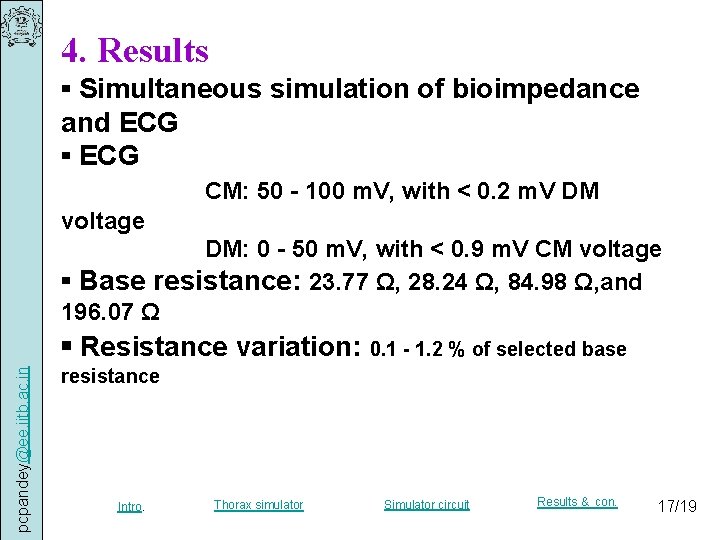
4. Results ▪ Simultaneous simulation of bioimpedance and ECG ▪ ECG CM: 50 - 100 m. V, with < 0. 2 m. V DM voltage DM: 0 - 50 m. V, with < 0. 9 m. V CM voltage ▪ Base resistance: 23. 77 Ω, 28. 24 Ω, 84. 98 Ω, and 196. 07 Ω pcpandey@ee. iitb. ac. in ▪ Resistance variation: 0. 1 - 1. 2 % of selected base resistance Intro. Thorax simulator Simulator circuit Results & con. 17/19
5. Conclusion pcpandey@ee. iitb. ac. in A thorax simulator developed using embedded design approach for testing and calibration of the instruments for impedance cardigraphy Intro. Thorax simulator Simulator circuit Results & con. 18/19
![pcpandey@ee. iitb. ac. in References [1] J. Nyboer, Electrical Impedance Plethysmography, 2 nd ed.](http://slidetodoc.com/presentation_image_h2/d1761401a653055daff659a9ef44cbec/image-19.jpg "pcpandey@ee. iitb. ac. in References [1] J. Nyboer, Electrical Impedance Plethysmography, 2 nd ed.")
pcpandey@ee. iitb. ac. in References [1] J. Nyboer, Electrical Impedance Plethysmography, 2 nd ed. , Charles C. Thomas, Springfield, Massachusetts, 1970. [2] L. Cromwell, F. J. Weibell, and E. A. Pfeiffer, Biomedical Instrumentation and Measurements, 2 nd ed. , Prentice Hall, New Delhi, 1990. [3] A. K. Krishnamurthy and D. C. Childers, "Two-channel speech analysis", IEEE Trans. Acoustics, Speech Signal Proc. , vol. ASSP - 34, pp. 730 - 743, 1986. [4] L. E. Baker, "Principles of impedance technique", IEEE Eng. Med. Biol. Mag. , vol. 8, pp. 11 - 15, 1989. [5] R. P. Patterson, "Fundamentals of impedance cardiography", IEEE Eng. Med. Biol. Mag. , vol. 8, pp. 35 38, 1989. [6] J. Wtorek and A. Polinski, "Multifrequency impedance plethysmograph", in Proc. IEEE Inst. Meas. Tech. Conf. , Brussels, Belgium, 1996, pp. 1452 - 1455. [7] J. Fortin, W. Habenbacher, and A. Heller, "Non-invasive beat-to-beat cardiac output monitoring by an improved method of transthoracic bioimpedance measurement", Comp. Bio. Med. , vol. 36, pp. 1185 - 1203, 2006. [8 ] F. Mora, G. Villegas, A. Hernandez, W. Coronado, R. Justiniano, and G. Passariello, "Design of an instrumentation system for a neurocardiology laboratory", in Proc. 2 nd Int. Conf. IEEE Dev. , Cir. and Sys. , Carcas, Venezuela, 1998, pp. 272 - 277. [9] V. Vondra, J. Halamek, I. Viscor, and P. Jurak, "Two channel bioimpedance monitor for impedance cardiography", in Proc. 28 th Annu. Int. Conf. IEEE Eng. Med. Biol. Soc. , 2006, pp. 6061 - 6063. [10] G. Panfili, L. Piccini, L. Maggi, S. Parini, and G. Andreoni, "A wearable device for continuous monitoring of heart mechanical function based on Impedance Cardiography", in Proc. 28 th Annu. Int. Conf. IEEE Eng. Med. Biol. Soc. , 2006, pp. 5968 - 5971. [11] G. D. Jindal and J. P. Babu, "Calibration of dz/dt in impedance plethysmography", Med. Biol. Eng. Comp. , vol. 23, pp. 279 - 280, 1985. [12] V. K. Pandey, P. C. Pandey, and J. N. Sarvaiya, "Impedance simulator for testing of instruments for bioimpedance sensing", IETE Journal of Research, vol. 54, no. 3, pp. 203 - 207, 2008. [13] N. S. Manigandan, V. K. Pandey, and P. C. Pandey, "Thoracic simulator for impedance cardio‑ graphy", in Proc. National Symposium on Instrumentation (NSI-28), Pantnagar, India, 2003. [14] L. Venkatchalam / P. C. Pandey (Supervisor), “Development of hardware for impedance cardio‑graphy”, M. Tech. Dissertation, Biomedical Engineering Group, School of Biosciences and Bioengineering, Indian Institute of Technology Bombay, 2006. Results & con. (Eds. ), 19/19 [15] B. M. Oliver, andsimulator pulse testing of linear Simulator systems, circuit in B. M. Oliver and J. M. Cage Thorax Intro. Square-wave Electronic Measurements and Instrumentation, Mc. Graw Hill, Singapore 1975.
- Slides: 19