
An Elementary Diversity Index Developed Using Taylor Series




- Slides: 21
An Elementary Diversity Index Developed Using Taylor Series and Lagrange Multipliers by Donald E. Hooley Bluffton College Bluffton, OH www. bluffton. edu/mat/seminar/
An Elementary Diversity Index • • • A Diversity Question Properties of Diversity Indices Shannon’s Diversity Index Taylor Series Approximation Lagrange Multipliers and Equiprobability • Results • Project Ideas
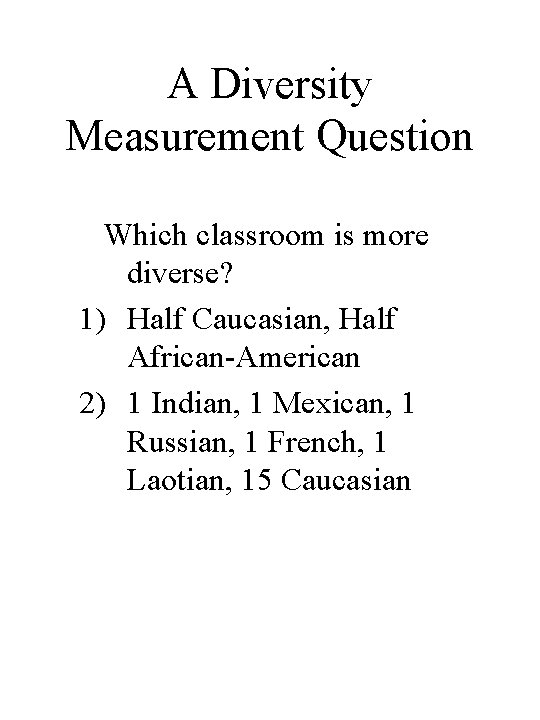
A Diversity Measurement Question Which classroom is more diverse? 1) Half Caucasian, Half African-American 2) 1 Indian, 1 Mexican, 1 Russian, 1 French, 1 Laotian, 15 Caucasian
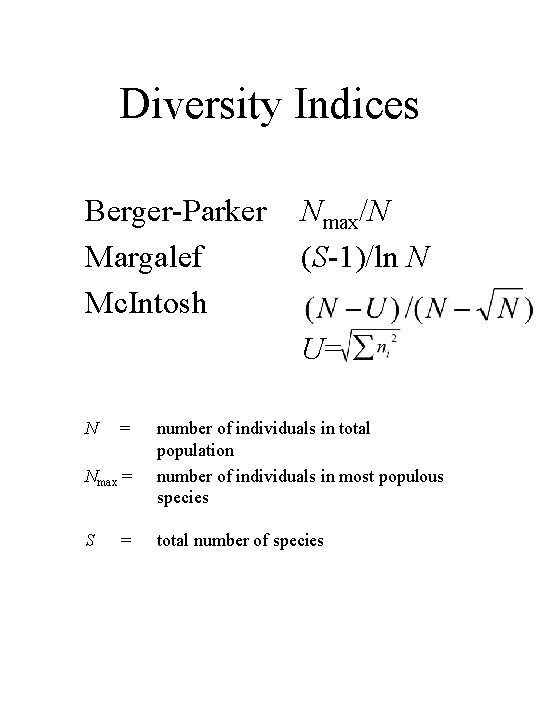
Diversity Indices Berger-Parker Margalef Mc. Intosh Nmax/N (S-1)/ln N U= N = Nmax = S = number of individuals in total population number of individuals in most populous species total number of species
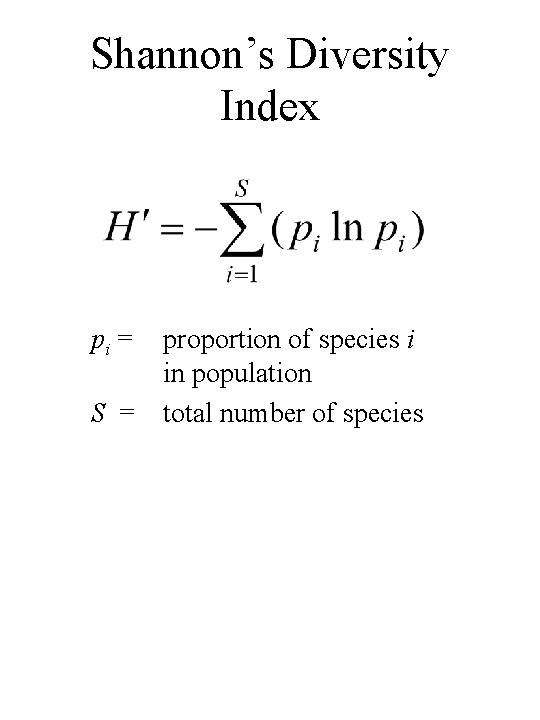
Diversity Indices Shannon Simpson pi = ni = N= S= proportion of species i in population number of individuals of species i number of individuals in total population total number of species in population
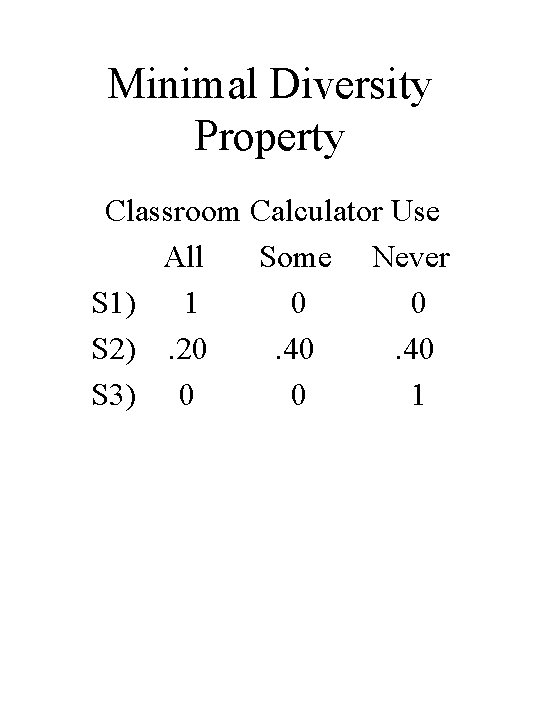
Minimal Diversity Property Classroom Calculator Use All Some Never S 1) 1 0 0 S 2). 20. 40 S 3) 0 0 1
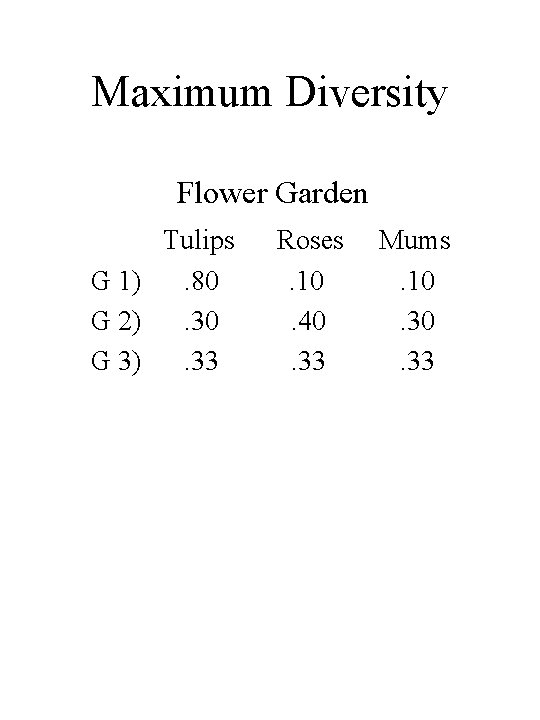
Maximum Diversity Flower Garden Tulips G 1). 80 G 2). 30 G 3). 33 Roses. 10. 40. 33 Mums. 10. 33
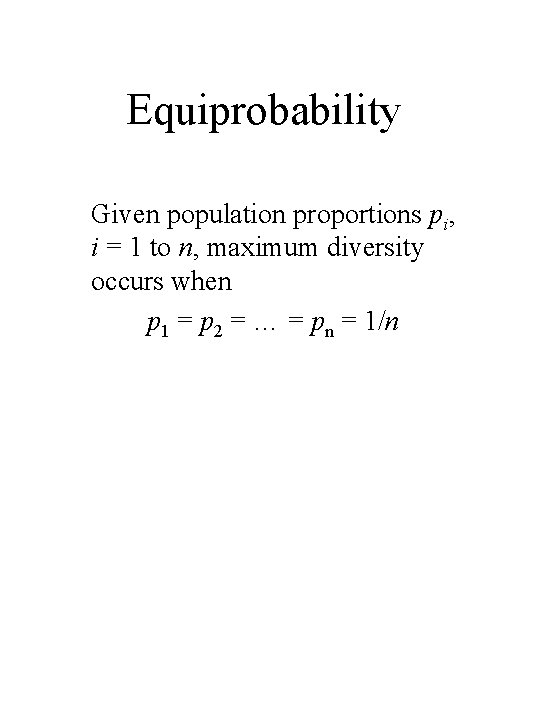
Equiprobability Given population proportions pi, i = 1 to n, maximum diversity occurs when p 1 = p 2 = … = pn = 1/n
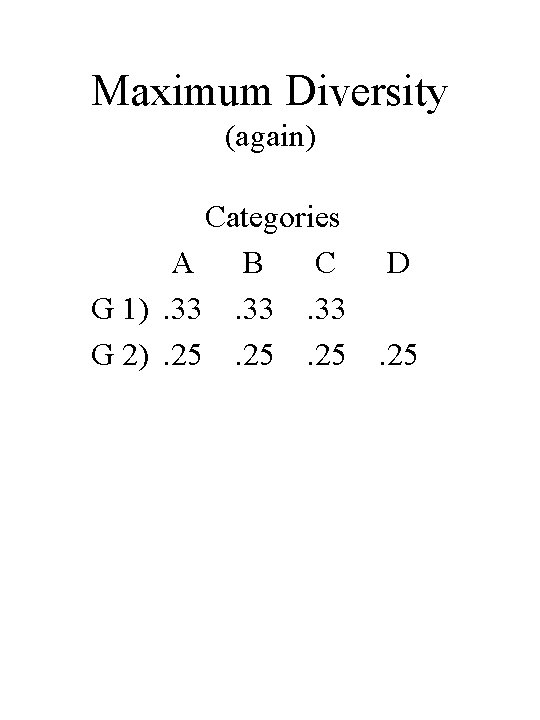
Maximum Diversity (again) Categories A B C G 1). 33. 33 G 2). 25. 25 D. 25
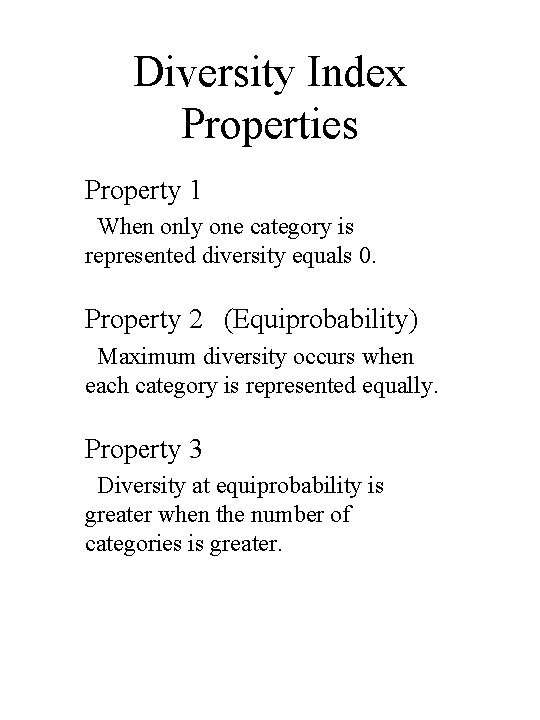
Diversity Index Properties Property 1 When only one category is represented diversity equals 0. Property 2 (Equiprobability) Maximum diversity occurs when each category is represented equally. Property 3 Diversity at equiprobability is greater when the number of categories is greater.
Shannon’s Diversity Index pi = S = proportion of species i in population total number of species
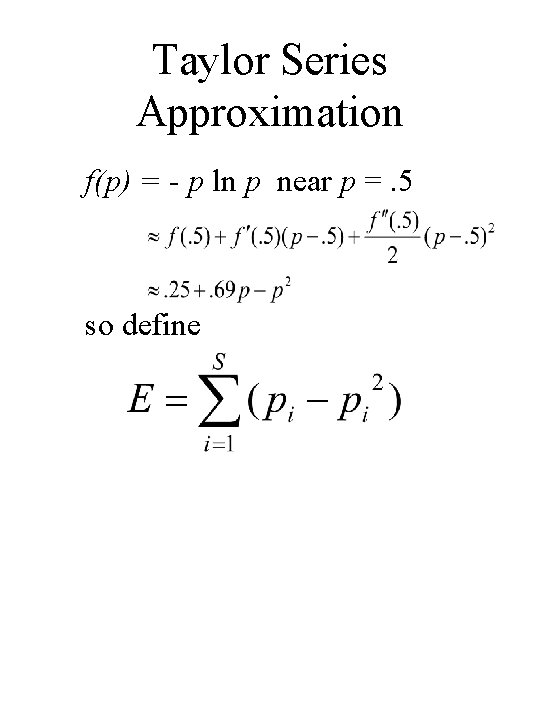
Taylor Series Approximation f(p) = - p ln p near p =. 5 so define
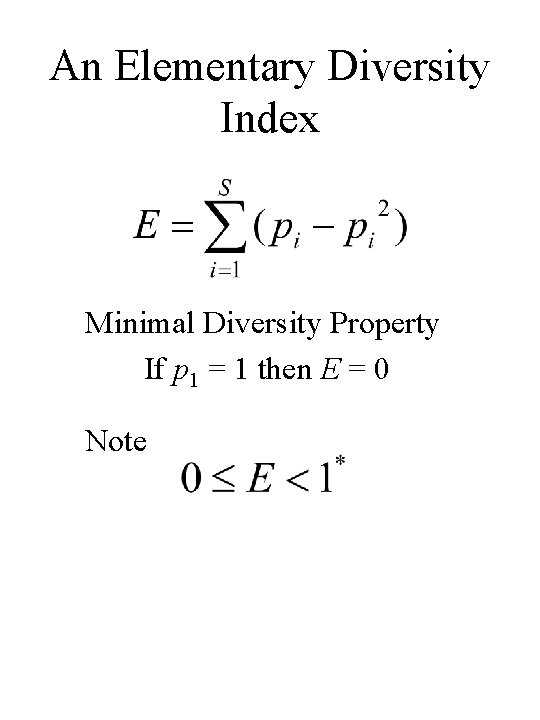
An Elementary Diversity Index Minimal Diversity Property If p 1 = 1 then E = 0 Note
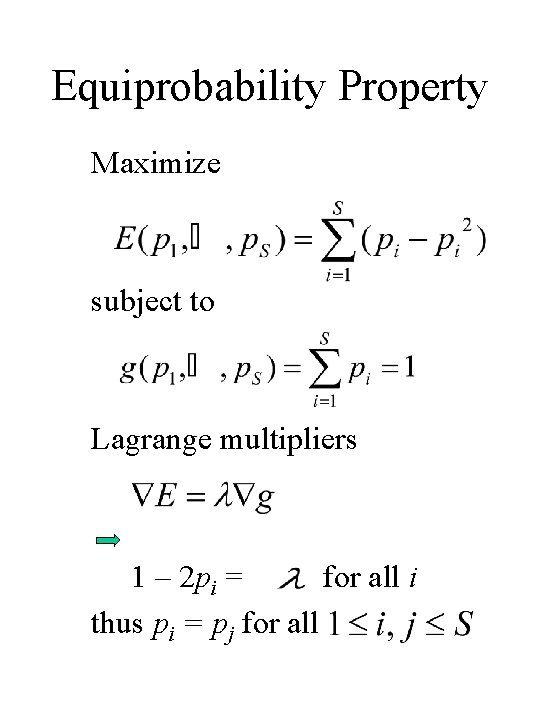
Equiprobability Property Maximize subject to Lagrange multipliers 1 – 2 pi = for all i thus pi = pj for all
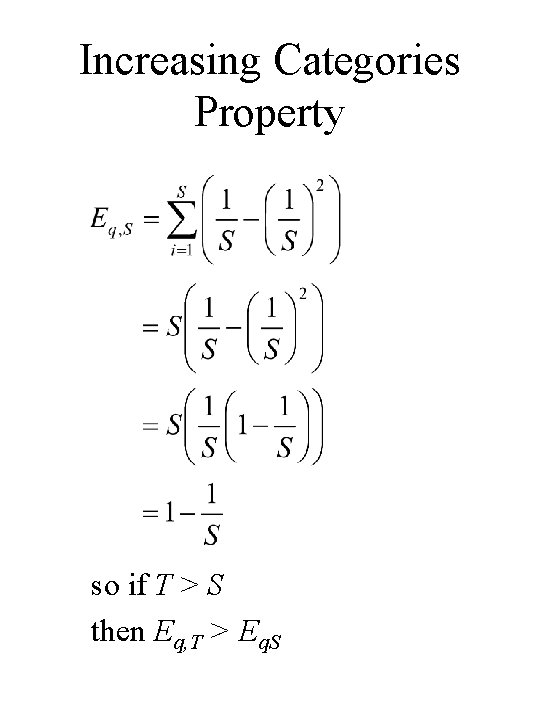
Increasing Categories Property so if T > S then Eq, T > Eq. S
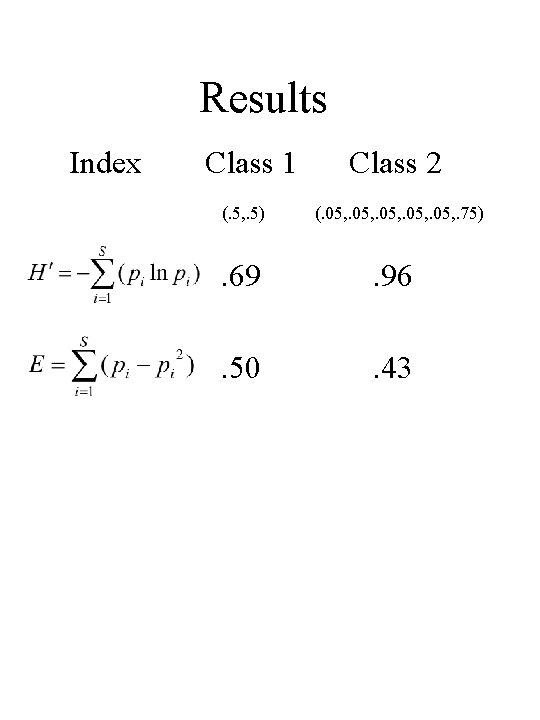
Results Index Class 1 (. 5, . 5) Class 2 (. 05, . 75) . 69 . 96 . 50 . 43
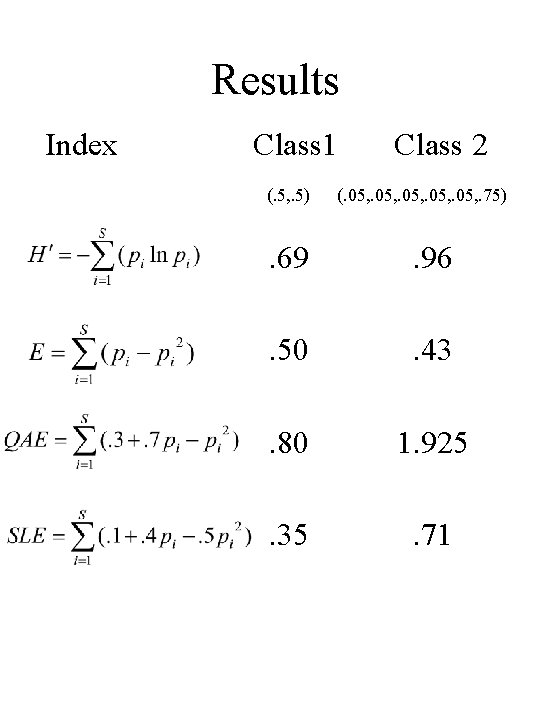
Results Index Class 1 (. 5, . 5) Class 2 (. 05, . 75) . 69 . 96 . 50 . 43 . 80 1. 925 . 35 . 71
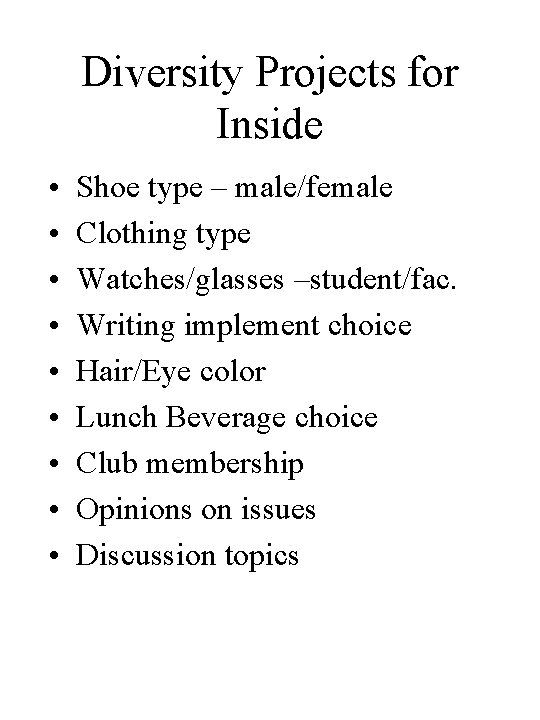
Diversity Projects for Inside • • • Shoe type – male/female Clothing type Watches/glasses –student/fac. Writing implement choice Hair/Eye color Lunch Beverage choice Club membership Opinions on issues Discussion topics
Biological Diversity Projects • Flower type • Leaf shape • Species – lawn/woodlot park/woods garden/weedlot • Insect – lawn/log Sampling – select area adjust size to pop. equal organism count
Sociological Diversity Projects • Automobile color • Automobile type • Automobile license origin - student/faculty lots - campus/town lots - mall/grocery • Topics of discussion - town meeting/PTA - concert intermission/club
Bibliography Abramson, Norman. 1963. Information Theory and Coding, New York: Mc. Graw-Hill. Ash, Robert. 1965. Information Theory, New York: John Wiley and Sons. Gold, Harvey. 1977. Mathematical Modeling of Biological Systems – An Introductory Guidebook, New York: John Wiley and Sons. Kolmes, Steven, and Mitchell, Kevin. 1991. Information Theory and Biological Diversity, UMAP Module 705, Arlington, MA: Comap, Inc. Magurran, Anne E. 1988. Ecological Diversity and Its Measurment, Princeton, NJ: Princeton University Press. www. bluffton. edu/mat/seminar/ Email: hooleyd@bluffton. edu