
An Efficient Sliding Window Approach for Approximate Entity
![PREFIX FILTER [CHAUDHURI ET AL. 2006] • Sort the tokens by a global ordering](https://slidetodoc.com/presentation_image_h/7c77080c4a0ae6fceac52f49c2ec0e4c/image-14.jpg "PREFIX FILTER [CHAUDHURI ET AL. 2006] • Sort the tokens by a global ordering")
![EFFECTIVENESS • Baseline methods – Jaccard – Fuzzy Jaccard(FJ) [Wang et al. 2011]: considering](https://slidetodoc.com/presentation_image_h/7c77080c4a0ae6fceac52f49c2ec0e4c/image-22.jpg "EFFECTIVENESS • Baseline methods – Jaccard – Fuzzy Jaccard(FJ) [Wang et al. 2011]: considering")
![EFFICIENCY: END-TO-END RESULT • Extending state-of-the-art methods – Faerie. R [Deng et al. 2015]](https://slidetodoc.com/presentation_image_h/7c77080c4a0ae6fceac52f49c2ec0e4c/image-24.jpg "EFFICIENCY: END-TO-END RESULT • Extending state-of-the-art methods – Faerie. R [Deng et al. 2015]")

- Slides: 29
An Efficient Sliding Window Approach for Approximate Entity Extraction with Synonyms Jin Wang (UCLA) Chunbin Lin (Amazon AWS) Mingda Li (UCLA) Carlo Zaniolo (UCLA)
OUTLINE • • • Motivation Preliminaries Framework and Techniques Experiments Conclusion
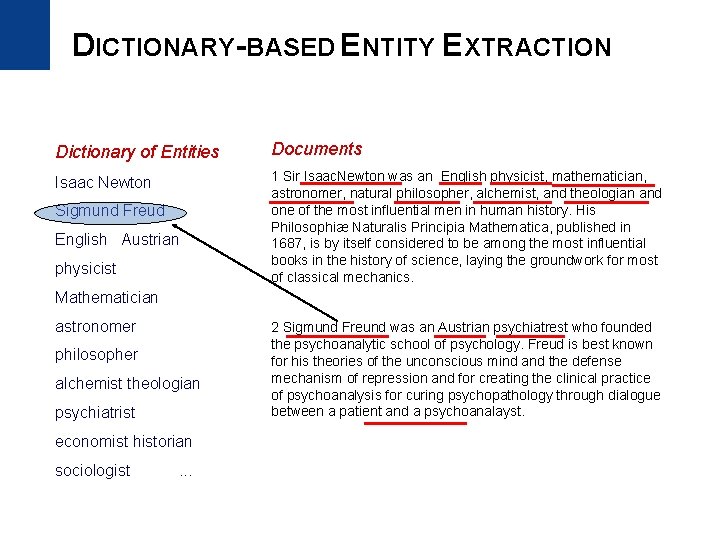
DICTIONARY-BASED ENTITY EXTRACTION Dictionary of Entities Documents Isaac Newton 1 Sir Isaac. Newton was an English physicist, mathematician, astronomer, natural philosopher, alchemist, and theologian and one of the most influential men in human history. His Philosophiæ Naturalis Principia Mathematica, published in 1687, is by itself considered to be among the most influential books in the history of science, laying the groundwork for most of classical mechanics. Sigmund Freud English Austrian physicist Mathematician astronomer philosopher alchemist theologian psychiatrist economist historian sociologist . . . 2 Sigmund Freund was an Austrian psychiatrest who founded the psychoanalytic school of psychology. Freud is best known for his theories of the unconscious mind and the defense mechanism of repression and for creating the clinical practice of psychoanalysis for curing psychopathology through dialogue between a patient and a psychoanalayst.
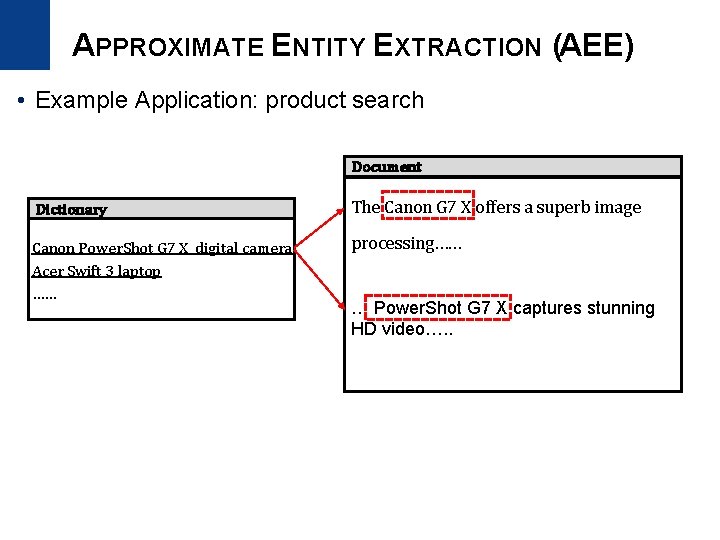
APPROXIMATE ENTITY EXTRACTION (AEE) • Example Application: product search Document Dictionary The Canon G 7 X offers a superb image Canon Power. Shot G 7 X digital camera Acer Swift 3 laptop …… processing…… … Power. Shot G 7 X captures stunning HD video…. .
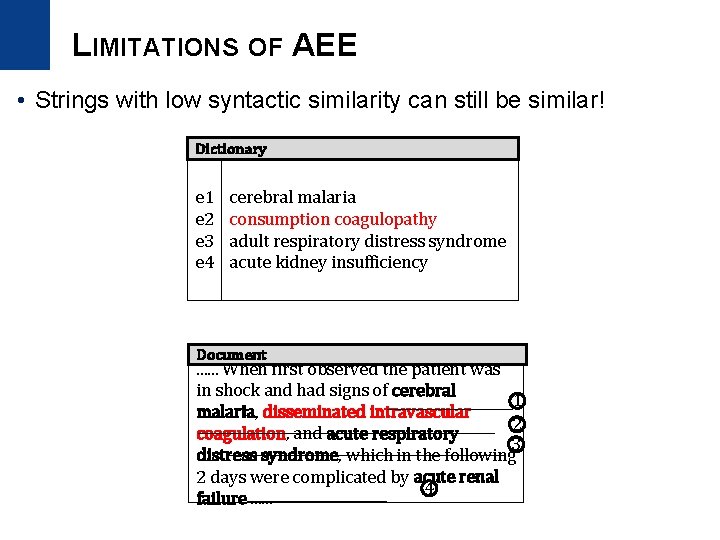
LIMITATIONS OF AEE • Strings with low syntactic similarity can still be similar! Dictionary e 1 e 2 e 3 e 4 cerebral malaria consumption coagulopathy adult respiratory distress syndrome acute kidney insufficiency Document . . . When first observed the patient was in shock and had signs of cerebral 1 malaria, disseminated intravascular 2 coagulation, and acute respiratory 3 distress syndrome, which in the following 2 days were complicated by acute renal 4 failure. . .
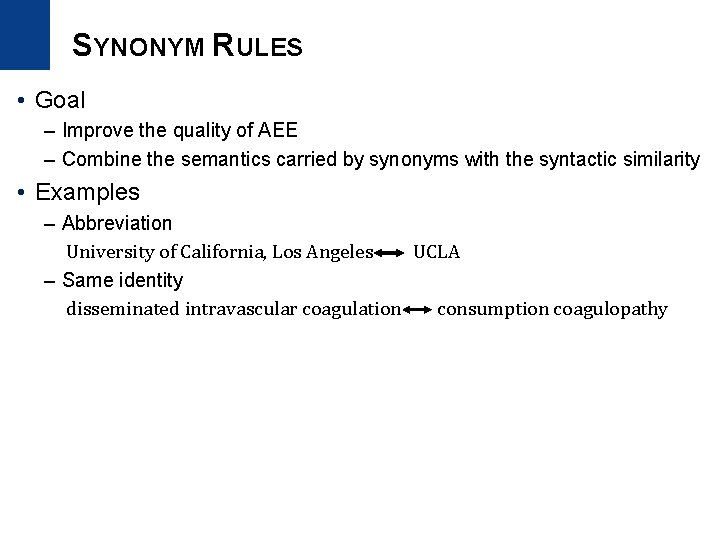
SYNONYM RULES • Goal – Improve the quality of AEE – Combine the semantics carried by synonyms with the syntactic similarity • Examples – Abbreviation University of California, Los Angeles UCLA – Same identity disseminated intravascular coagulation consumption coagulopathy
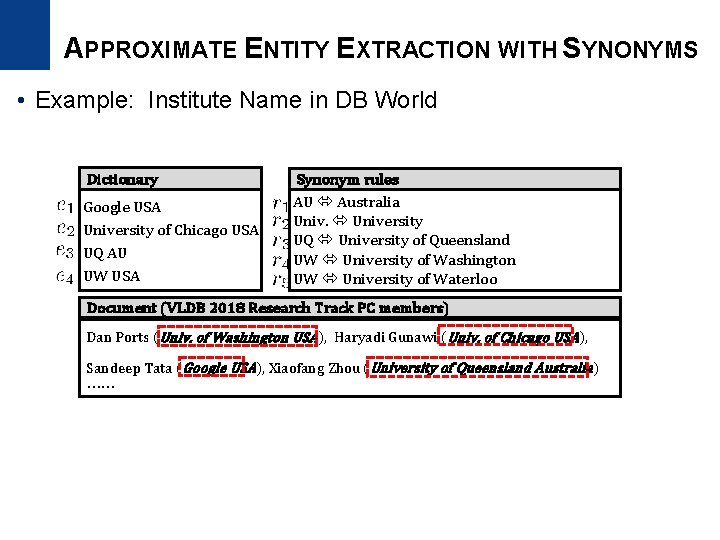
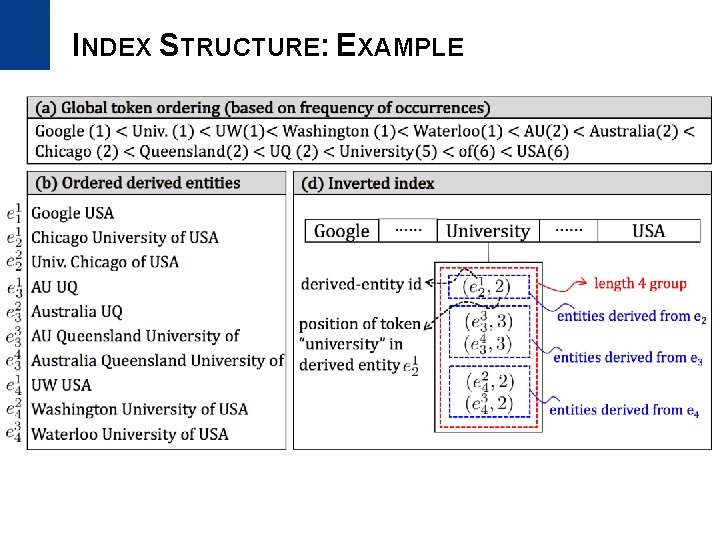
APPROXIMATE ENTITY EXTRACTION WITH SYNONYMS • Example: Institute Name in DB World Dictionary Google USA University of Chicago USA UQ AU UW USA Synonym rules AU Australia University UQ University of Queensland UW University of Washington UW University of Waterloo Document (VLDB 2018 Research Track PC members) Dan Ports (Univ. of Washington USA), Haryadi Gunawi (Univ. of Chicago USA), Sandeep Tata (Google USA), Xiaofang Zhou (University of Queensland Australia) ……
OUTLINE • • • Motivation Preliminaries Framework and Techniques Experiments Conclusion
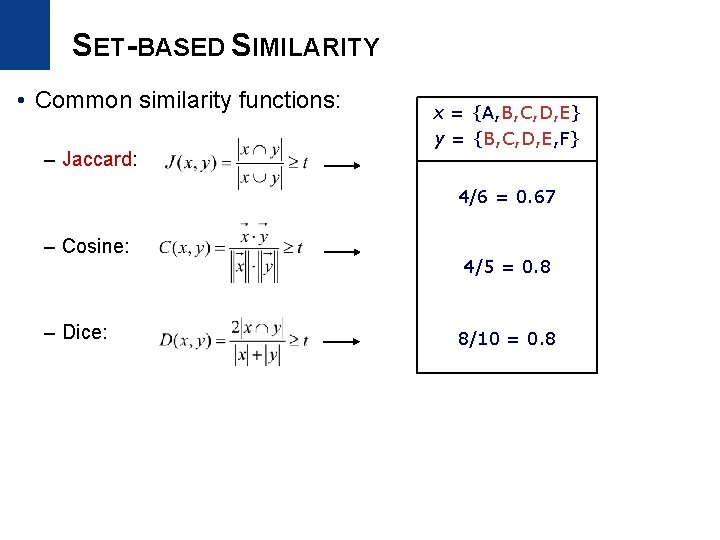
SET-BASED SIMILARITY • Common similarity functions: – Jaccard: x = {A, B, C, D, E} y = {B, C, D, E, F} 4/6 = 0. 67 – Cosine: – Dice: 4/5 = 0. 8 8/10 = 0. 8
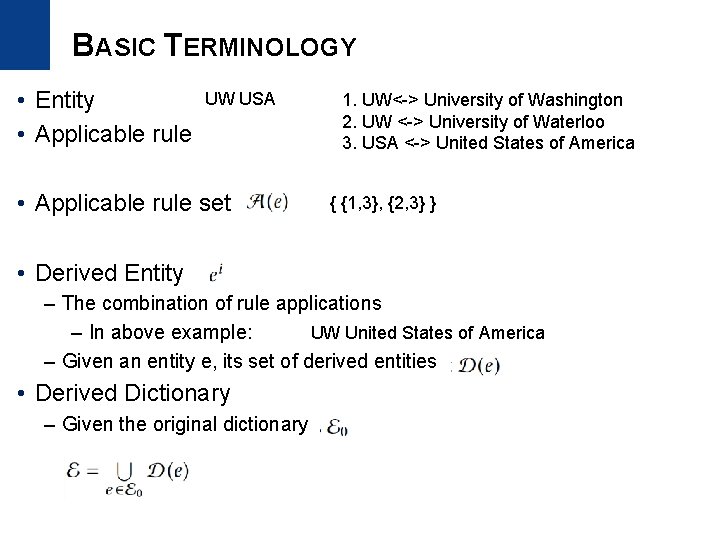
BASIC TERMINOLOGY • Entity • Applicable rule UW USA • Applicable rule set 1. UW<-> University of Washington 2. UW <-> University of Waterloo 3. USA <-> United States of America { {1, 3}, {2, 3} } • Derived Entity – The combination of rule applications – In above example: UW United States of America – Given an entity e, its set of derived entities • Derived Dictionary – Given the original dictionary
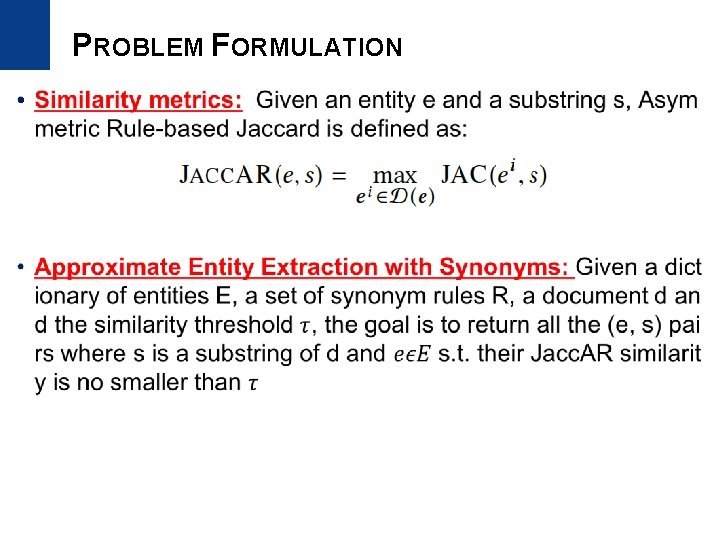
PROBLEM FORMULATION •
OUTLINE • • • Motivation Preliminaries Framework and Techniques Experiments Conclusion
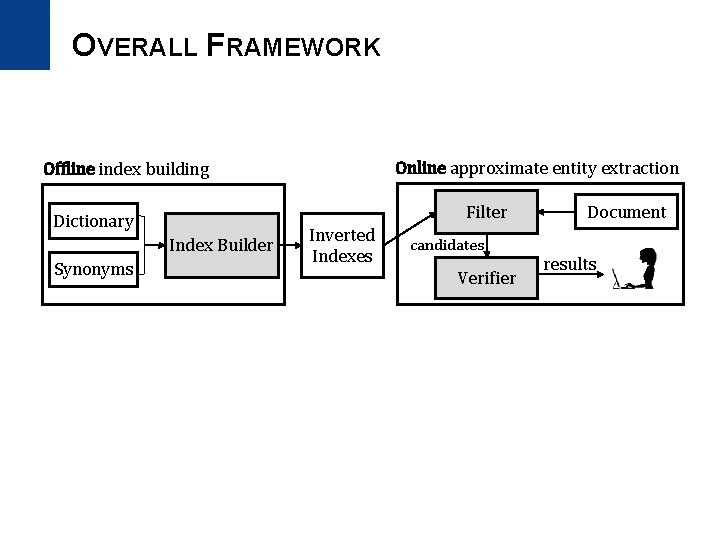
OVERALL FRAMEWORK Online approximate entity extraction Offline index building Filter Dictionary Index Builder Synonyms Inverted Indexes Document candidates Verifier results
PREFIX FILTER [CHAUDHURI ET AL. 2006] • Sort the tokens by a global ordering – E. g. increasing order of document frequency • Only need to index the first few tokens (prefix) for each record • Example: – jaccard t = 0. 8 |x y| 4 if |x|=|y|=5 – x = sorted C D E F G A B E F G – y = prefix upper bound. O(x, y) = 3 < 4! X sorted • Must share at least one token in prefix to be a candidate pair – For jaccard, prefix length = |x| * (1 – t) + 1 each t is associated with a prefix length
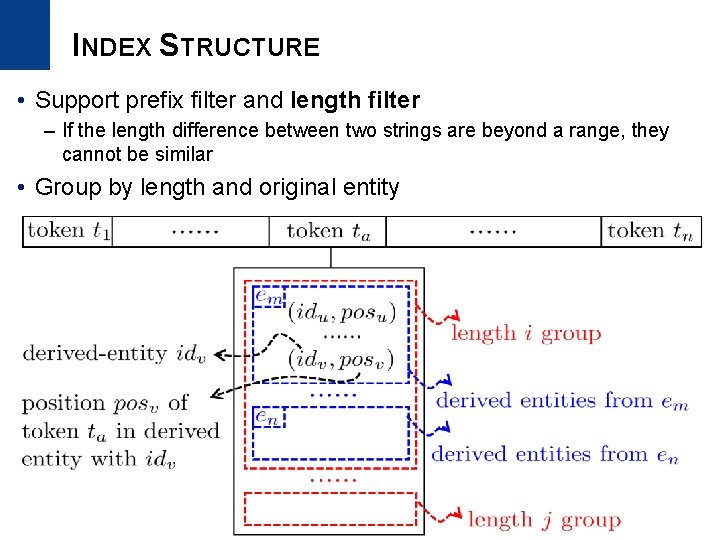
INDEX STRUCTURE • Support prefix filter and length filter – If the length difference between two strings are beyond a range, they cannot be similar • Group by length and original entity
INDEX STRUCTURE: EXAMPLE
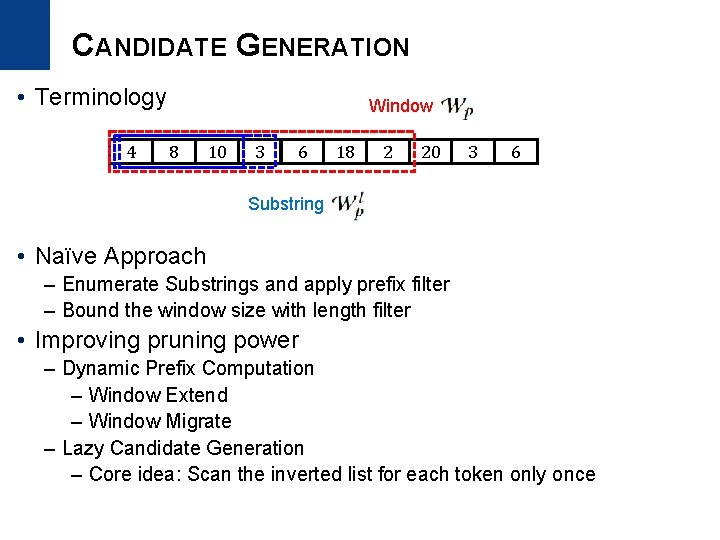
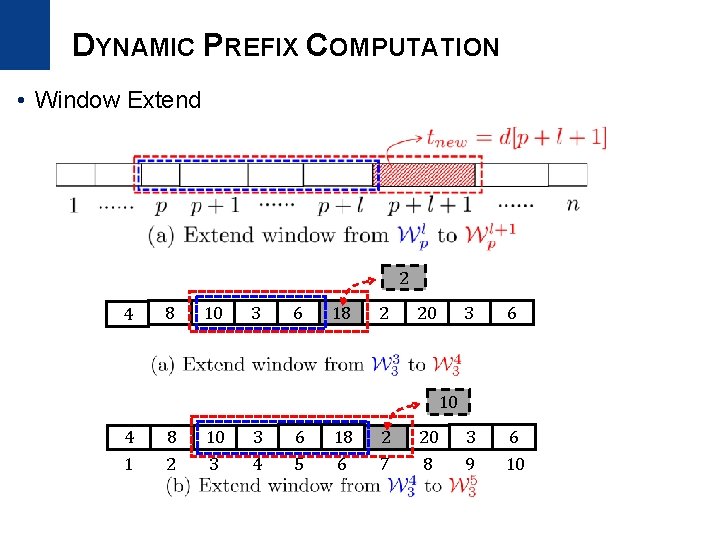
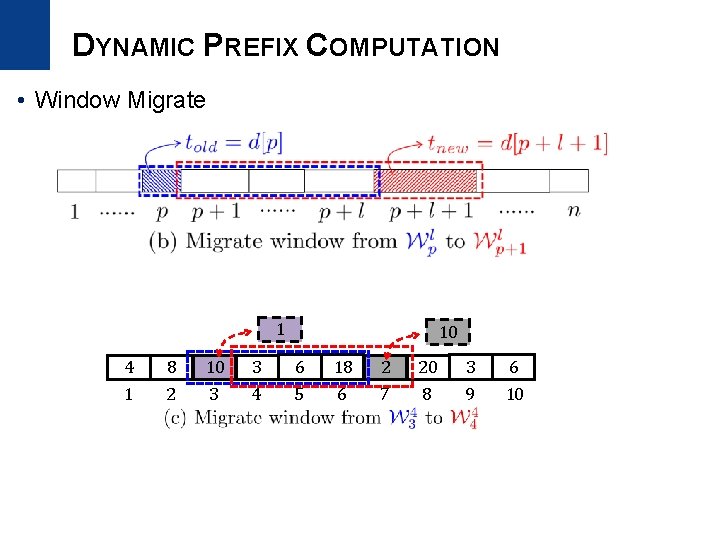
CANDIDATE GENERATION • Terminology 4 Window 8 10 3 6 18 2 20 3 6 Substring • Naïve Approach – Enumerate Substrings and apply prefix filter – Bound the window size with length filter • Improving pruning power – Dynamic Prefix Computation – Window Extend – Window Migrate – Lazy Candidate Generation – Core idea: Scan the inverted list for each token only once
DYNAMIC PREFIX COMPUTATION • Window Extend 2 4 8 10 3 6 18 2 20 3 6 3 9 6 10 10 4 1 8 2 10 3 3 4 6 5 18 6 2 7 20 8
DYNAMIC PREFIX COMPUTATION • Window Migrate 1 4 1 8 2 10 3 3 4 10 6 5 18 6 2 7 20 8 3 9 6 10
OUTLINE • • • Motivation Preliminaries Framework and Techniques Experiments Conclusion
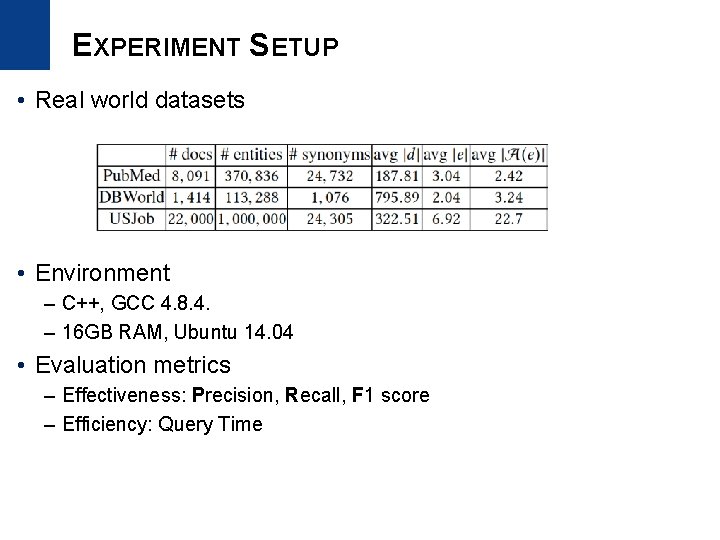
EXPERIMENT SETUP • Real world datasets • Environment – C++, GCC 4. 8. 4. – 16 GB RAM, Ubuntu 14. 04 • Evaluation metrics – Effectiveness: Precision, Recall, F 1 score – Efficiency: Query Time
EFFECTIVENESS • Baseline methods – Jaccard – Fuzzy Jaccard(FJ) [Wang et al. 2011]: considering edit similarity • Sample Ground Truth
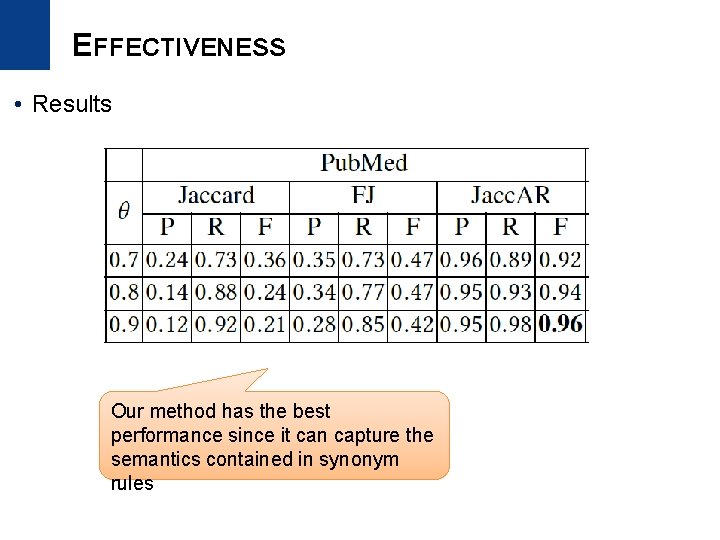
EFFECTIVENESS • Results Our method has the best performance since it can capture the semantics contained in synonym rules
EFFICIENCY: END-TO-END RESULT • Extending state-of-the-art methods – Faerie. R [Deng et al. 2015] Our method outperforms the best existing method by one to two orders of magnitude
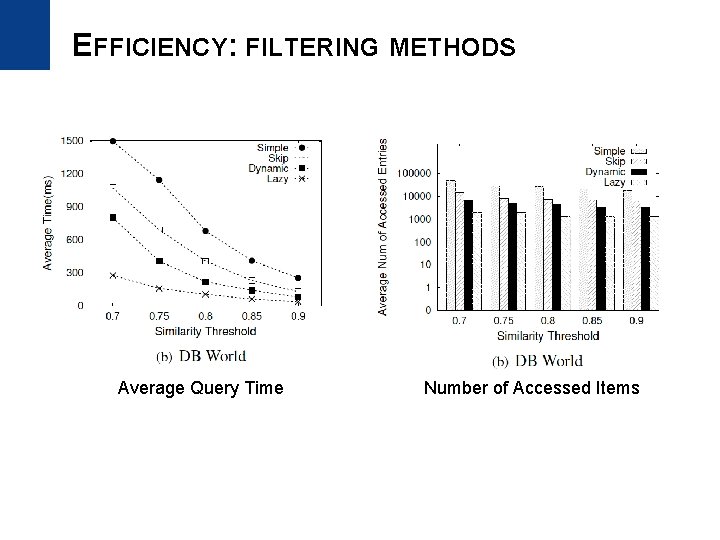
EFFICIENCY: FILTERING METHODS Average Query Time Number of Accessed Items
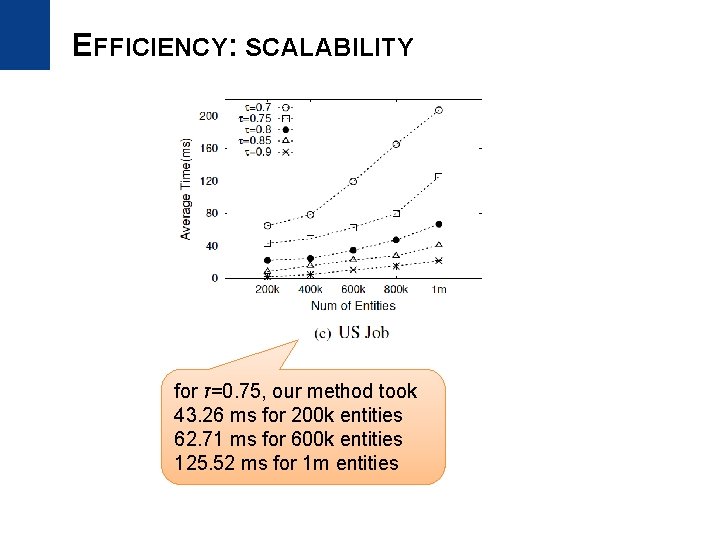
EFFICIENCY: SCALABILITY for τ=0. 75, our method took 43. 26 ms for 200 k entities 62. 71 ms for 600 k entities 125. 52 ms for 1 m entities
OUTLINE • • • Motivation Preliminaries Framework and Techniques Experiments Conclusion
CONCLUSION • A new problem: AEES • A filter-and-verification framework – Clustered indexing structures – Effective pruning techniques • Experimental results show that our methods significantly outperform existing methods