
An Efficient Qo S Scheduling Architecture for IEEE


![Effective Bandwidth Utilization Vs Offered Load [Scenario 1] Offered load by UGS > rt.](https://slidetodoc.com/presentation_image_h2/7fe5c1ec0e588f556434d4cc589fe88c/image-23.jpg "Effective Bandwidth Utilization Vs Offered Load [Scenario 1] Offered load by UGS > rt.")
![Effective Bandwidth Utilization Vs Offered Load [Scenario 2] Offered load by UGS < rt.](https://slidetodoc.com/presentation_image_h2/7fe5c1ec0e588f556434d4cc589fe88c/image-24.jpg "Effective Bandwidth Utilization Vs Offered Load [Scenario 2] Offered load by UGS < rt.")
![Effective Bandwidth Utilization Vs Number of SS [Scenario 1] Offered load by UGS >](https://slidetodoc.com/presentation_image_h2/7fe5c1ec0e588f556434d4cc589fe88c/image-25.jpg "Effective Bandwidth Utilization Vs Number of SS [Scenario 1] Offered load by UGS >")
![Effective Bandwidth Utilization Vs Number of SS [Scenario 2] Offered load by UGS <](https://slidetodoc.com/presentation_image_h2/7fe5c1ec0e588f556434d4cc589fe88c/image-26.jpg "Effective Bandwidth Utilization Vs Number of SS [Scenario 2] Offered load by UGS <")
![Average Delay Vs Time [Scenario 1] Offered load by UGS > rt. PS >](https://slidetodoc.com/presentation_image_h2/7fe5c1ec0e588f556434d4cc589fe88c/image-28.jpg "Average Delay Vs Time [Scenario 1] Offered load by UGS > rt. PS >")
![Average Delay Vs Time [Scenario 2] Offered load by UGS < rt. PS <](https://slidetodoc.com/presentation_image_h2/7fe5c1ec0e588f556434d4cc589fe88c/image-29.jpg "Average Delay Vs Time [Scenario 2] Offered load by UGS < rt. PS <")
![Average Delay Vs Time [Scenario 3] Three SSs with different type of uplink flows.](https://slidetodoc.com/presentation_image_h2/7fe5c1ec0e588f556434d4cc589fe88c/image-30.jpg "Average Delay Vs Time [Scenario 3] Three SSs with different type of uplink flows.")
- Slides: 34
An Efficient Qo. S Scheduling Architecture for IEEE 802. 16 Wireless MANs Supriya Maheshwari Under the guidance of Prof. Sridhar Iyer and Prof. Krishna Paul
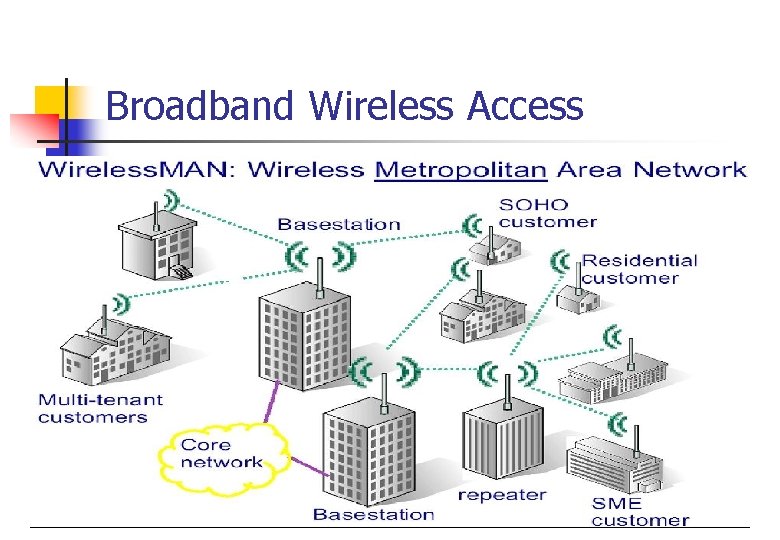
Broadband Wireless Access
Broadband Wireless Access (Contd…) n n High demand for “last-mile” broadband access. Advantages of Broadband Wireless Access n n Fast deployment and high scalability. High speed network access at low cost. Broad geographic area. IEEE 802. 16 Wireless. MAN standard for Broadband Wireless Access systems.
Need for a Qo. S Scheduling Architecture for IEEE 802. 16 n n n IEEE 802. 16 has been designed to support Qo. S in both downlink and uplink directions. IEEE 802. 16 proposes uplink scheduling services and request-grant mechanisms to provide different levels of services for various classes of uplink traffic. Main component to accomplish this task i. e. packet scheduling mechanism is unspecified.
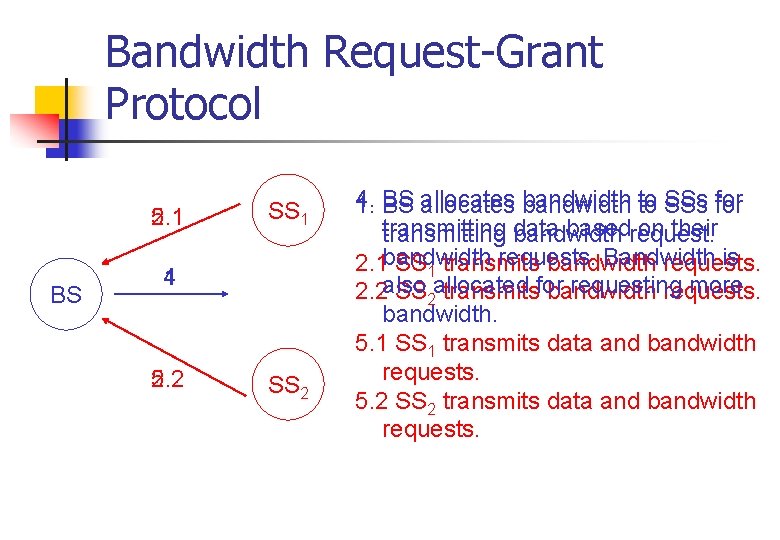
Bandwidth Request-Grant Protocol 2. 1 5. 1 BS SS 1 1 4 2. 2 5. 2 SS 2 4. 1. BS BS allocates bandwidth to to SSs for transmitting basedrequest. on their transmitting data bandwidth requests. Bandwidth is 2. 1 bandwidth SS 1 transmits bandwidth requests. requesting more 2. 2 also SS 2 allocated transmitsfor bandwidth requests. bandwidth. 5. 1 SS 1 transmits data and bandwidth requests. 5. 2 SS 2 transmits data and bandwidth requests.
Need for a Qo. S Scheduling Architecture for IEEE 802. 16 n n BS completely controls transmission in downlink direction. Request-Grant protocol is used for uplink bandwidth allocation which involves both BS and SS. Uplink Scheduling is complex as it needs to be in accordance with uplink Qo. S provisions provided by IEEE 802. 16. Therefore, a single scheduling algorithm for the whole system does not suffice.
Problem Statement n n Propose an efficient Qo. S scheduling architecture for IEEE 802. 16 Wireless MANs. Design Goals n n n To provide delay and bandwidth guarantees for various kinds of applications. To maintain fairness among various flows based on their priority. To achieve high bandwidth utilization.
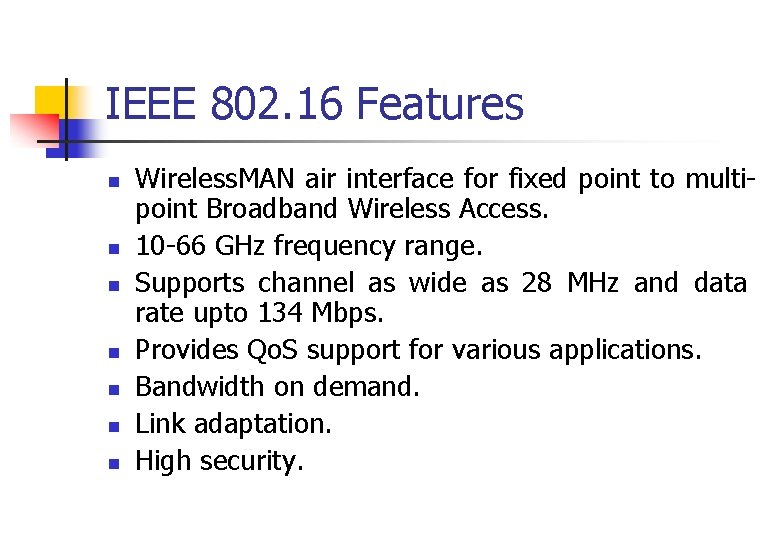
IEEE 802. 16 Features n n n n Wireless. MAN air interface for fixed point to multipoint Broadband Wireless Access. 10 -66 GHz frequency range. Supports channel as wide as 28 MHz and data rate upto 134 Mbps. Provides Qo. S support for various applications. Bandwidth on demand. Link adaptation. High security.
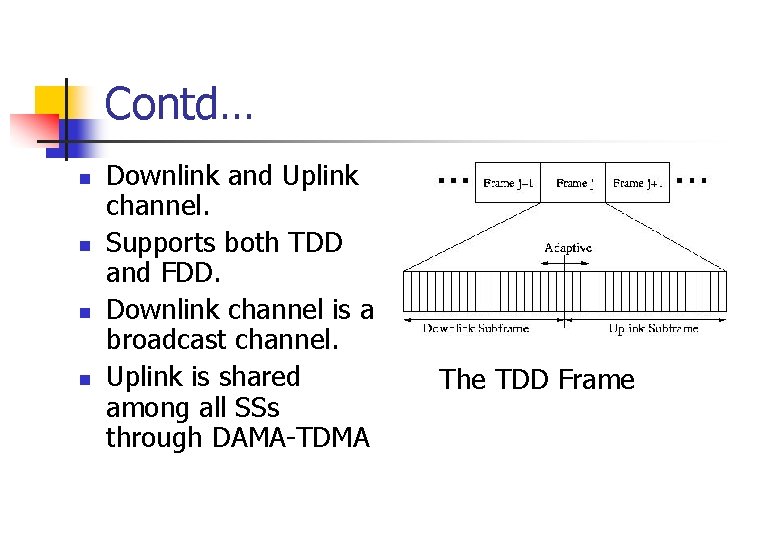
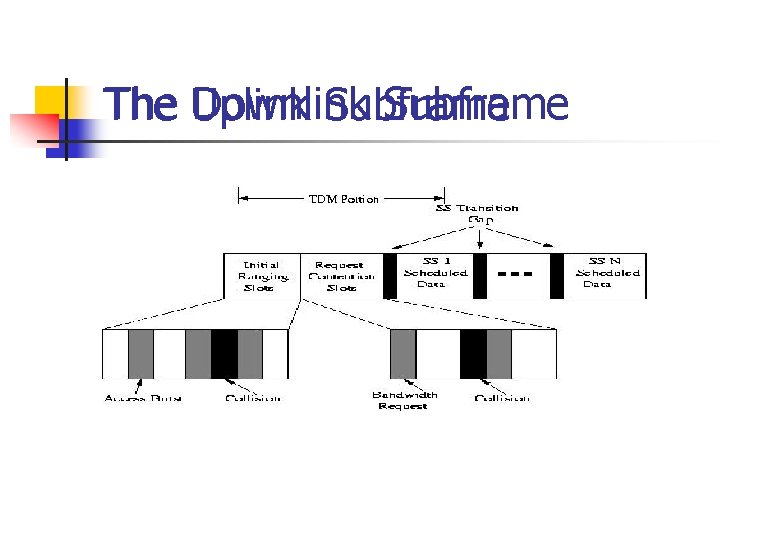
Contd… n n Downlink and Uplink channel. Supports both TDD and FDD. Downlink channel is a broadcast channel. Uplink is shared among all SSs through DAMA-TDMA The TDD Frame
The Uplink Downlink Subframe
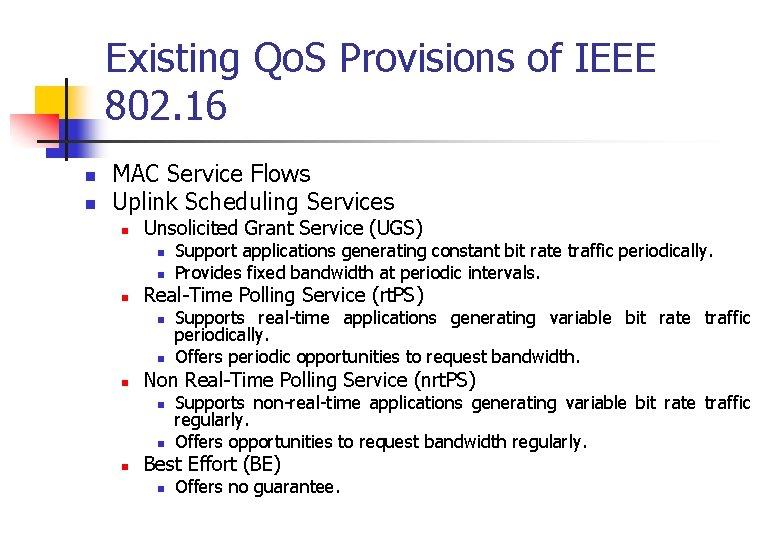
Existing Qo. S Provisions of IEEE 802. 16 n n MAC Service Flows Uplink Scheduling Services n Unsolicited Grant Service (UGS) n n n Real-Time Polling Service (rt. PS) n n n Supports real-time applications generating variable bit rate traffic periodically. Offers periodic opportunities to request bandwidth. Non Real-Time Polling Service (nrt. PS) n n n Support applications generating constant bit rate traffic periodically. Provides fixed bandwidth at periodic intervals. Supports non-real-time applications generating variable bit rate traffic regularly. Offers opportunities to request bandwidth regularly. Best Effort (BE) n Offers no guarantee.
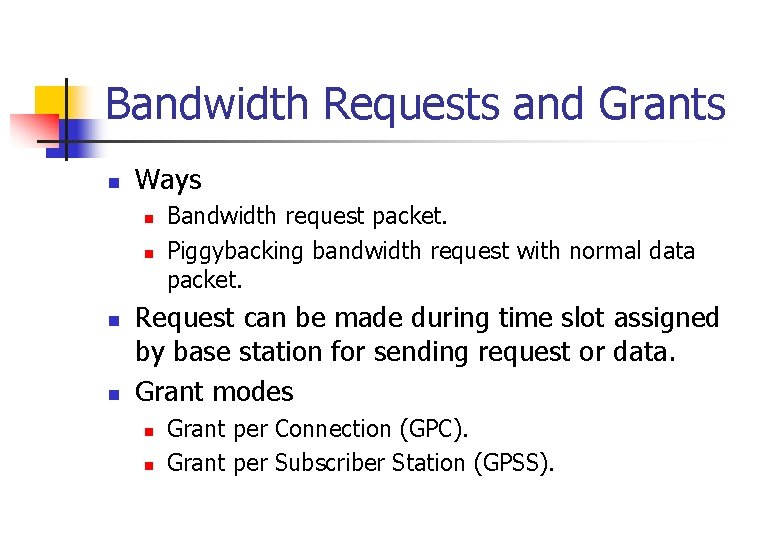
Bandwidth Requests and Grants n Ways n n Bandwidth request packet. Piggybacking bandwidth request with normal data packet. Request can be made during time slot assigned by base station for sending request or data. Grant modes n n Grant per Connection (GPC). Grant per Subscriber Station (GPSS).
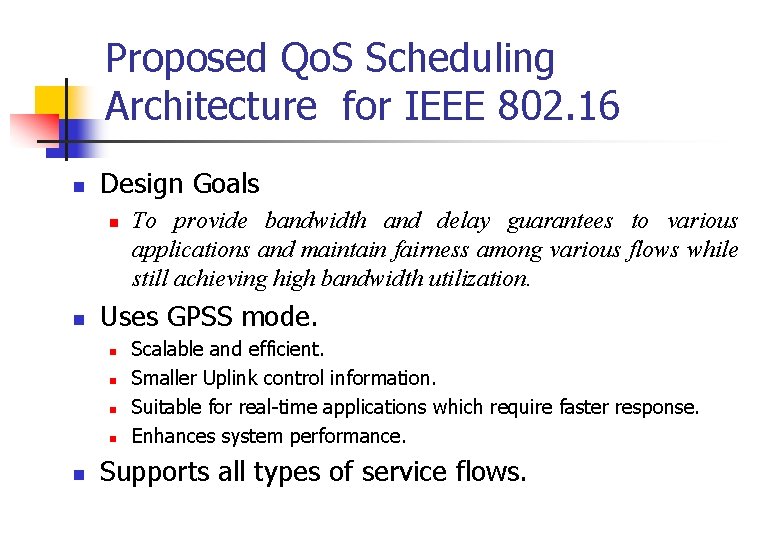
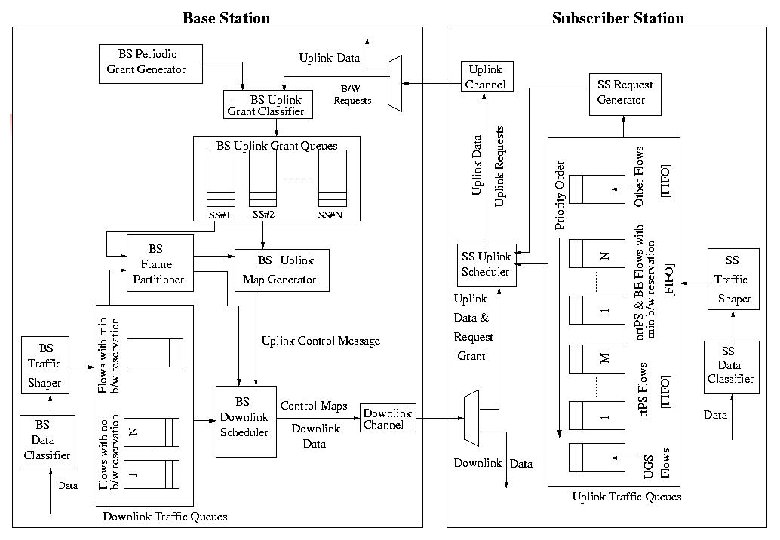
Proposed Qo. S Scheduling Architecture for IEEE 802. 16 n Design Goals n n Uses GPSS mode. n n n To provide bandwidth and delay guarantees to various applications and maintain fairness among various flows while still achieving high bandwidth utilization. Scalable and efficient. Smaller Uplink control information. Suitable for real-time applications which require faster response. Enhances system performance. Supports all types of service flows.
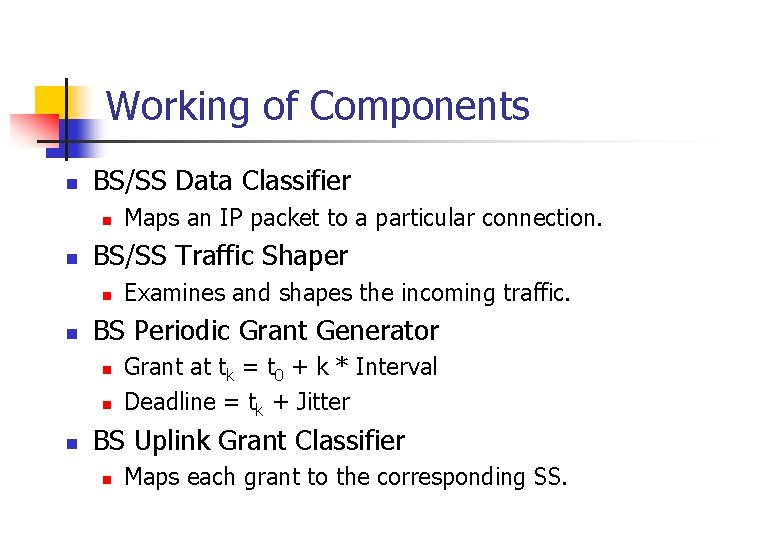
Working of Components n BS/SS Data Classifier n n BS/SS Traffic Shaper n n Examines and shapes the incoming traffic. BS Periodic Grant Generator n n n Maps an IP packet to a particular connection. Grant at tk = t 0 + k * Interval Deadline = tk + Jitter BS Uplink Grant Classifier n Maps each grant to the corresponding SS.
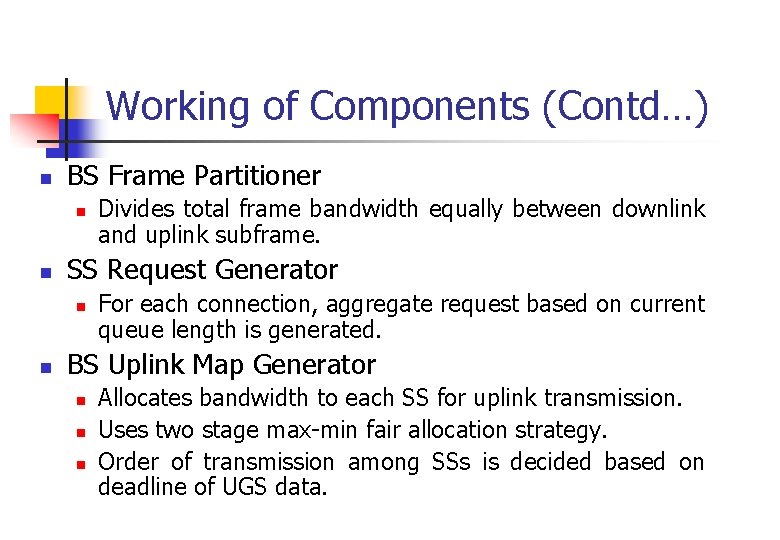
Working of Components (Contd…) n BS Frame Partitioner n n SS Request Generator n n Divides total frame bandwidth equally between downlink and uplink subframe. For each connection, aggregate request based on current queue length is generated. BS Uplink Map Generator n n n Allocates bandwidth to each SS for uplink transmission. Uses two stage max-min fair allocation strategy. Order of transmission among SSs is decided based on deadline of UGS data.
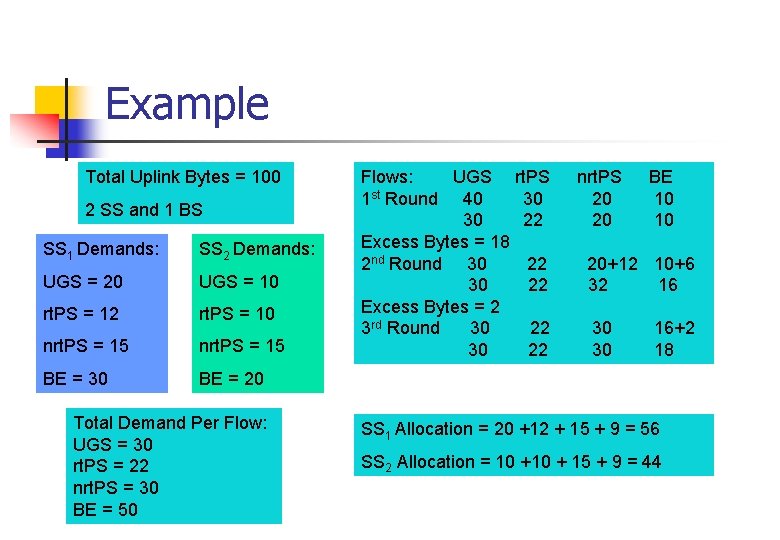
Example Total Uplink Bytes = 100 2 SS and 1 BS SS 1 Demands: SS 2 Demands: UGS = 20 UGS = 10 rt. PS = 12 rt. PS = 10 nrt. PS = 15 BE = 30 BE = 20 Total Demand Per Flow: UGS = 30 rt. PS = 22 nrt. PS = 30 BE = 50 Flows: UGS 1 st Round 40 30 Excess Bytes = 18 2 nd Round 30 30 Excess Bytes = 2 3 rd Round 30 30 rt. PS 30 22 nrt. PS 20 20 BE 10 10 22 22 20+12 10+6 32 16 22 22 30 30 16+2 18 SS 1 Allocation = 20 +12 + 15 + 9 = 56 SS 2 Allocation = 10 + 15 + 9 = 44
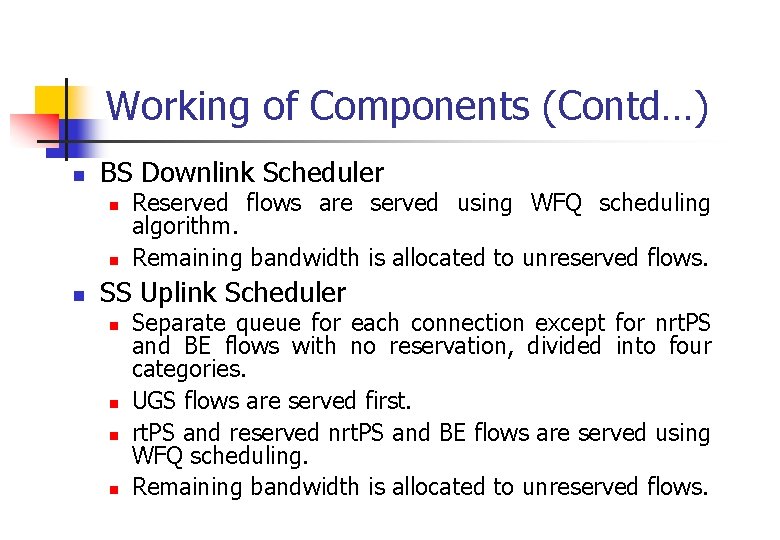
Working of Components (Contd…) n BS Downlink Scheduler n n n Reserved flows are served using WFQ scheduling algorithm. Remaining bandwidth is allocated to unreserved flows. SS Uplink Scheduler n n Separate queue for each connection except for nrt. PS and BE flows with no reservation, divided into four categories. UGS flows are served first. rt. PS and reserved nrt. PS and BE flows are served using WFQ scheduling. Remaining bandwidth is allocated to unreserved flows.
Implementation Details n n Qualnet 3. 6 Network Simulator is used for simulation. IEEE 802. 11 b PHY as physical layer.
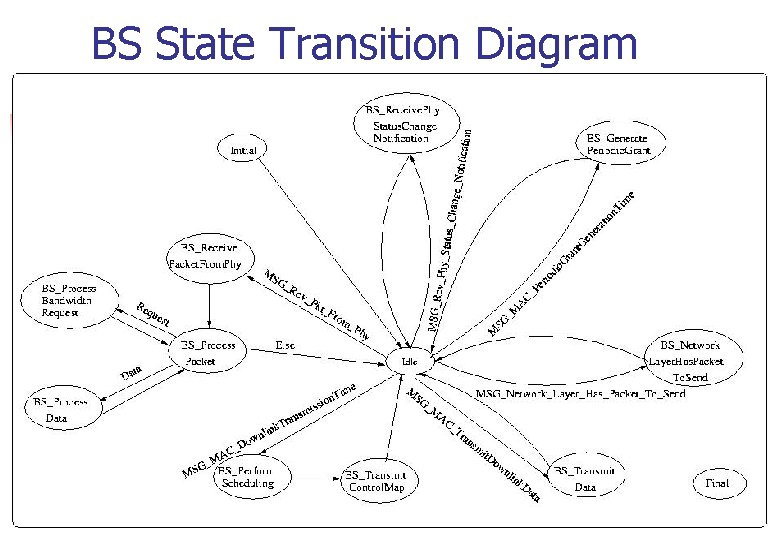
BS State Transition Diagram
SS State Transition Diagram
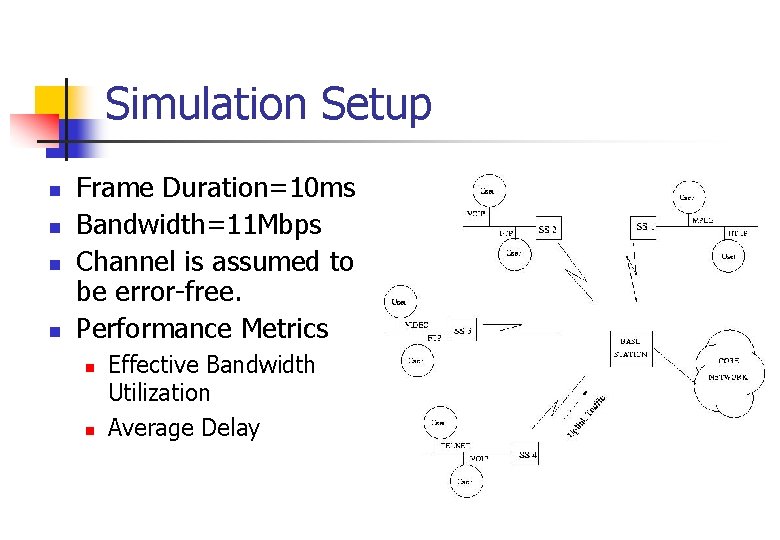
Simulation Setup n n Frame Duration=10 ms Bandwidth=11 Mbps Channel is assumed to be error-free. Performance Metrics n n Effective Bandwidth Utilization Average Delay
Effective Bandwidth Utilization Vs Offered Load [Scenario 1] Offered load by UGS > rt. PS > nrt. PS > BE Maximum Effective Bandwidth Utilization ~ 93%
Effective Bandwidth Utilization Vs Offered Load [Scenario 2] Offered load by UGS < rt. PS < nrt. PS < BE Maximum Effective Bandwidth Utilization ~ 93%
Effective Bandwidth Utilization Vs Number of SS [Scenario 1] Offered load by UGS > rt. PS > nrt. PS > BE Maximum Effective Bandwidth Utilization ~ 88%
Effective Bandwidth Utilization Vs Number of SS [Scenario 2] Offered load by UGS < rt. PS < nrt. PS < BE Maximum Effective Bandwidth Utilization ~ 88%
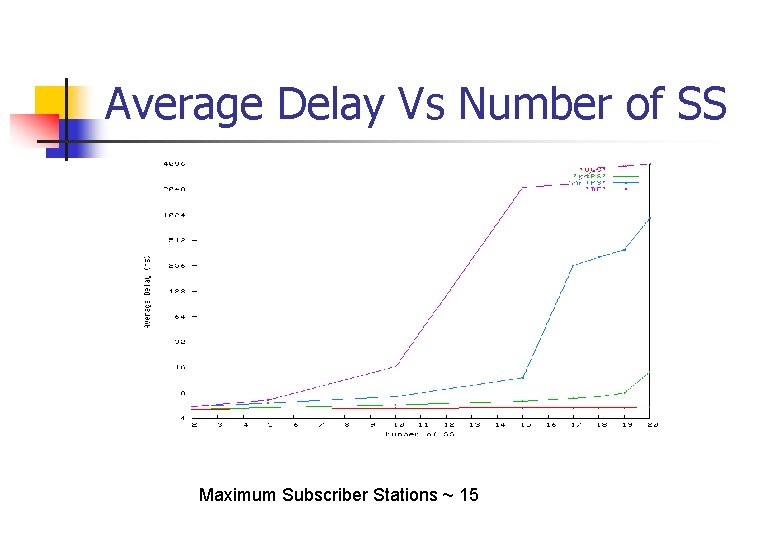
Average Delay Vs Number of SS Maximum Subscriber Stations ~ 15
Average Delay Vs Time [Scenario 1] Offered load by UGS > rt. PS > nrt. PS > BE UGS and rt. PS flows experience low delay.
Average Delay Vs Time [Scenario 2] Offered load by UGS < rt. PS < nrt. PS < BE UGS and rt. PS flows experience low delay.
Average Delay Vs Time [Scenario 3] Three SSs with different type of uplink flows. SS 1 - UGS and rt. PS SS 2 - UGS and nrt. PS SS 3 - UGS and BE Fairness is maintained among flows across SSs
Conclusion n n An efficient Qo. S scheduling architecture for IEEE 802. 16 is necessary to provide required Qo. S guarantees to various applications. Proposed an efficient Qo. S scheduling architecture for IEEE 802. 16 MAC has been implemented in Qualnet 3. 6 along with the proposed architecture. Simulation results are presented to show that our architecture fulfills the stated design goals.
Future Work n Contention slot allocation algorithm can be designed. n Admission control mechanism can be devised. n Performance Study of IEEE 802. 16 MAC over IEEE 802. 11 b PHY.
References n n IEEE 802. 16 -2001. “IEEE Standard for Local and Metropolitan Area Networks Part 16: Air Interface for Fixed Broadband Wireless Access Systems”. Apr. 8, 2002. Guo. Song Chu, Deng Wang, and Shunliang Mei. “A Qo. S architecture for the MAC protocol of IEEE 802. 16 BWA system”. IEEE International Conference on Communications, Circuits and Systems and West Sino Expositions, 1: 435– 439, June 2002. Mohammed Hawa and David W. Petr. “Quality of Service Scheduling in Cable and Broadband Wireless Access Systems”. Tenth IEEE International Workshop on Quality of Service, pages 247– 255, May 2002. Abhay K. Parekh and Robert G. Gallagher. A generalized processor sharing approach to flow control in integrated services networks: the multiple node case. IEEE/ACM Trans. Netw. , 2(2): 137– 150, 1994. 21
References n n n C. Eklund, R. B. Marks, K. L. Stanwood, and S. Wang, “IEEE Standard 802. 16: A Technical Overview of the Wireless. MANTM Air Interface for Broadband Wireless Access”, IEEE Communications Magazine, 40(6): 98107, June 2002. Andrew S. Tanenbaum, Computer Networks, Prentice-Hall India, Fourth edition, 2003. S. Keshav. An Engineering Approach to Computer Networking. Pearson Education, Sixth edition, 2003.